
Judge, 1919-09-20 · page 16 of 36
Judge — September 20, 1919 — page 16: what you’re looking at
What you’re looking at
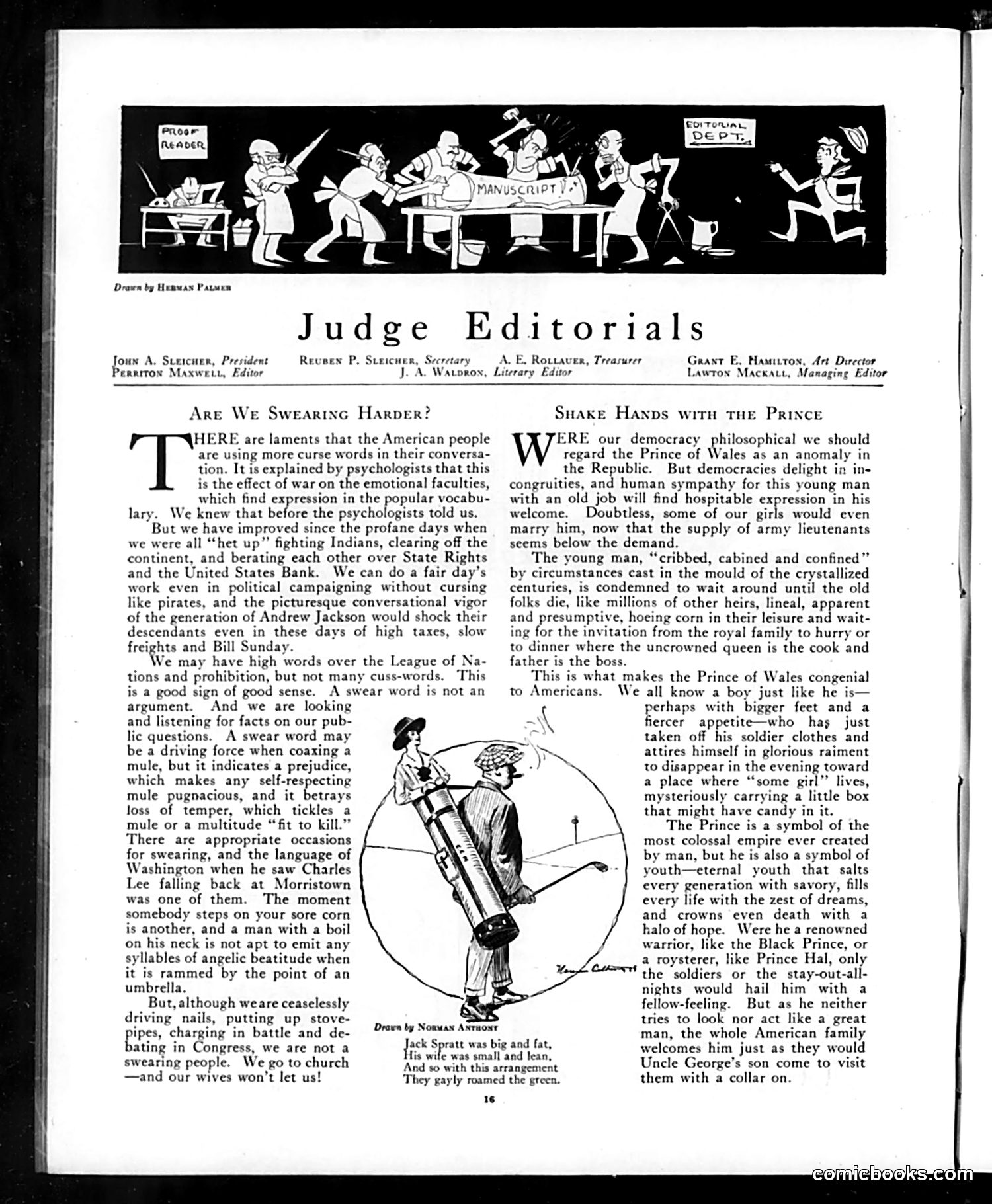
This page contains two satirical editorials with accompanying cartoons: **"Are We Swearing Harder?"** critiques concerns that Americans curse more due to wartime emotional stress. The editorial argues Americans are actually *less* profane than previous generations (citing Andrew Jackson's era), and that swearing indicates prejudice rather than argument. It allows exceptions—Washington's outbursts during the Revolution, or a man with a boil on his neck. The accompanying cartoon (by Norman Anthony) illustrates the nursery rhyme about Jack Sprat and his wife. **"Shake Hands with the Prince"** welcomes the Prince of Wales visiting America. The piece humorously treats royalty as oddly democratic-compatible, comparing the constrained young prince—waiting for elderly relatives to die before inheriting—to relatable American boys sneaking off to impress girlfriends. The prince represents both imperial grandeur and universal youthful restlessness that transcends class. Both editorials use humor to comment on contemporary social attitudes: linguistic decorum and attitudes toward hierarchy/tradition.
📄 Transcribed text from this page (OCR, searchable)
Machine-transcribed from the original scan — historical spelling and the odd misread are preserved.
PRoor Reaver Manuscript V+ 2 — Drawn by Hemwax Patuen Judge Editorials Joun A. Stercuer, President — Revaen P, Steicner, Secretary exriTox Maxwett, Editor Are We Swearinc Harper? HERE are laments that the American people are using more curse words in their conversa- tion. It is explained by psychologists that this is the effect of war on the emotional faculties, which find expression in the popular vocabu- lary. We knew that before the psychologists told us. But we have improved since the profane days when we were all “het up”’ fighting Indians, clearing off the continent, and berating each other over State Rights and the United States Bank. We can do a fair day’s work even in political campaigning without cursing like pirates, and the picturesque conversational vigor of the generation of Andrew Jackson would shock their descendants even in these days of high taxes, slow freights and Bill Sunday. We may have high words over the League of Na- tions and prohibition, but not many cuss-words. This is a good sign of good sense. A swear word is not an argument. And we are looking and listening for facts on our pub- lic questions. A swear word may be a driving force when coaxing a mule, but it indicates a prejudice, which makes any self-respecting mule pugnacious, and it betrays loss of temper, which tickles a mule or a multitude “fit to kill.” There are appropriate occasions for swearing, and the language of Washington when he saw Charles Lee falling back at Morristown was one of them. The moment somebody steps on your sore corn is another, and a man with a boil on his neck is not apt to emit any yllables of angelic beatitude when it is rammed by the point of an umbrella. But, although weare ceaselessly driving nails, putting up stove- pipes, charging in battle and de- ating in Congress, we are not a H swearing people. We go to church —and our wives won’t let us! Drawn by Nonwax ANTHONT jack Spratt was big and fat, Jis wife was small and lean, And so with this arrangement They gayly roamed the green. A. E, Rowtaver, Treasurer A. Watorox, Literary Editor Grant E. Masuttox, Art Director Lawton Mackatt, Managing Editor Snake Hanns witn tHE Prince ERE our democracy philosophical we should regard the Prince of Wales as an anomaly in the Republic. But democracies delight ine congruities, and human sympathy for this young man with an old job will find hospitable expression in his welcome. Doubtless, some of our girls would even marry him, now that the supply of army lieutenants seems below the demand. The young man, “cribbed, cabined and confined” by circumstances cast in the mould of the crystallized centuries, is condemned to wait around until the old folks die, like millions of other heirs, lineal, apparent and presumptive, hoeing corn in their leisure and wait- ing for the invitation from the royal family to hurry or to dinner where the uncrowned queen is the cook and father is the boss. This is what makes the Prince of Wales congenial to Americans. We all know a boy just like he is— perhaps with bigger feet and a fiercer appetite—who has just taken off his soldier clothes and attires himself in glorious raiment to disappear in the evening toward a place where “some girl” lives, mysteriously carrying a little box that might have candy in it. The Prince is a symbol of the most colossal empire ever created by man, but he is also a symbol of youth—eternal youth that salts every generation with savory, fills every life with the zest of dreams, and crowns even death with a halo of hope. Were he a renowned warrior, like the Black Prince, or a roysterer, like Prince Hal, only the soldiers or the stay-out-all- nights would hail him with a fellow-feeling. But as he neither tries to look nor act like a great man, the whole American family welcomes him just as they would Uncle George’s son come to visit them with a collar on.