
Judge, 1919-09-20 · page 6 of 36
Judge — September 20, 1919 — page 6: what you’re looking at
What you’re looking at
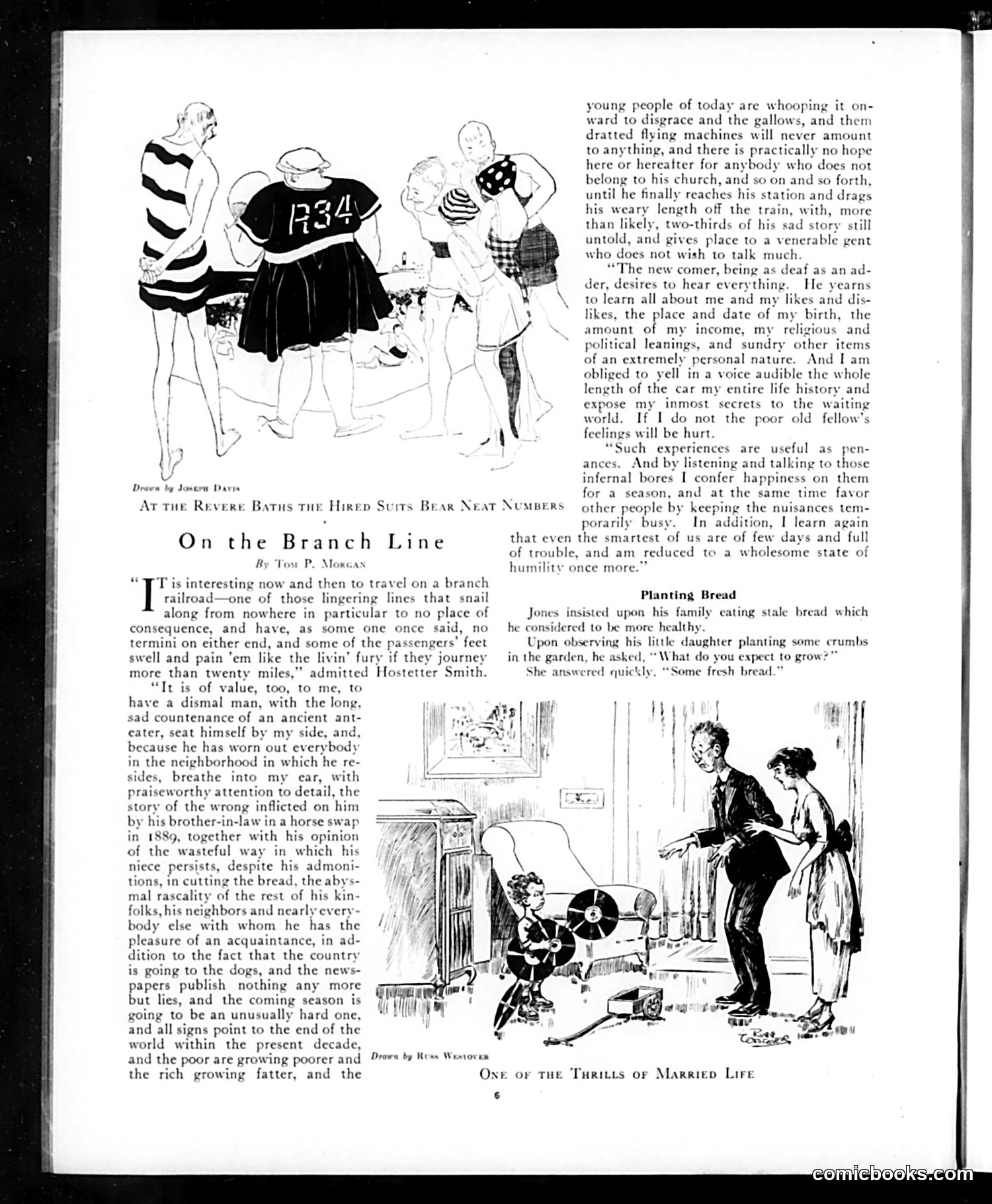
This page contains two distinct pieces: **"On the Branch Line"** by Tom P. Morgan is a humorous short story about traveling on a minor railroad. The accompanying cartoon (drawn by Jameson Davis) shows young women in fashionable 1920s swimwear at "the Revere Baths," with one wearing a sweater labeled "R34"—likely a sorority or school designation. The satire targets the loud, attention-seeking behavior of young travelers on these obscure rail lines. **"Planting Bread"** is a brief anecdote joke about a father asking his daughter what she expects to grow from bread crumbs she's planting. Her answer—"Some fresh bread"—satirizes childish logic. **"One of the Thrills of Married Life"** (drawn by Miss Westover) depicts a domestic scene where a wife discovers her husband in a compromising situation, commenting on the tensions of married life.
📄 Transcribed text from this page (OCR, searchable)
Machine-transcribed from the original scan — historical spelling and the odd misread are preserved.
Drawn by Josern Daves At tue Revere Batus tHE the Branch Line B P. Moxcax is interesting now and then to travel on a branch railroad—one of those lingering lines that snail along from nowhere in particular to no place of consequence, and nave; as some one once said, no termini on either end, and some of the passeng rs’ feet swell and pain ’em like the livin’ fury if they journey more than twenty miles,” admitted Hostetter Smith. “Tt is of value, too, to me, have a dismal man, with the long, sad countenance of an ancient ant- eater, seat himself by my side, and, because he has worn out everybody in the neighborhood in which he re- sides, breathe into my ear, with praiseworthy attention to detail, the story of the wrong inflicted on him by his brother-in-law in a horse swap in 1889, together with his opinion of the wasteful way in which his niece persists, despite his admoni- tions, in cutting the bread, the abys- mal rascality of the rest of his kin- folks, his neighbors and nearly every- body else with whom he has the pleasure of an acquaintance, in ad- dition to the fact that the country is going to the dogs, and the news- papers publish nothing any more but lies, and the coming season is going to be an unusually hard one, and all signs point to the end of the world within the present decade, and the poor are growing poorer and the rich growing fatter, and the On to Drown by Ress Wesroven Hirep Suits Beak Neat NumBers Ont 6 young people of today are whooping it on- ward to disgrace and the gallows, and the dratted flying machines will never amount to anything, and there is practically no hope here or hereatter for anybody who does not belong to his church, and so on and so forth, until he finally reaches his station and drags his weary length off the train, with, more than likely, two-thirds of his sad story still untold, and gives place to a venerable gent who does not wish to talk much “The new comer, being as deaf as an ad- der, desires to hear everything. He yearns to learn all about me and my likes and dis- likes, the place and date of my birth, the amount of my income, my religious and political leanings, and sundry other items of an extremely personal nature. And I am obliged to yell in a voice audible the whole length of the car my entire life history and expose my inmost secrets to the waiting world. If I do not the poor old fellow’s feelings will be hurt. uch experiences are useful pen- ances. And by listening and talking to those infernal bores I confer happiness on them for a season, and at the same time favor other people by keeping the nuisances tem- porarily busy. In addition, I learn again that even the smartest of us are of few days and full of trouble, and am reduced to a wholesome state of humility once more.’ Planting Bread Jones insisted upon his family eating stale bread which Considered to be more healthy. Upon observing his little daughter planting some crumbs in the garden, he asked, “What do you expect to grow?” She answered quickly, “Some fresh bread.” or tHe Turitts or Marriep Lire