
Judge, 1919-09-20 · page 7 of 36
Judge — September 20, 1919 — page 7: what you’re looking at
What you’re looking at
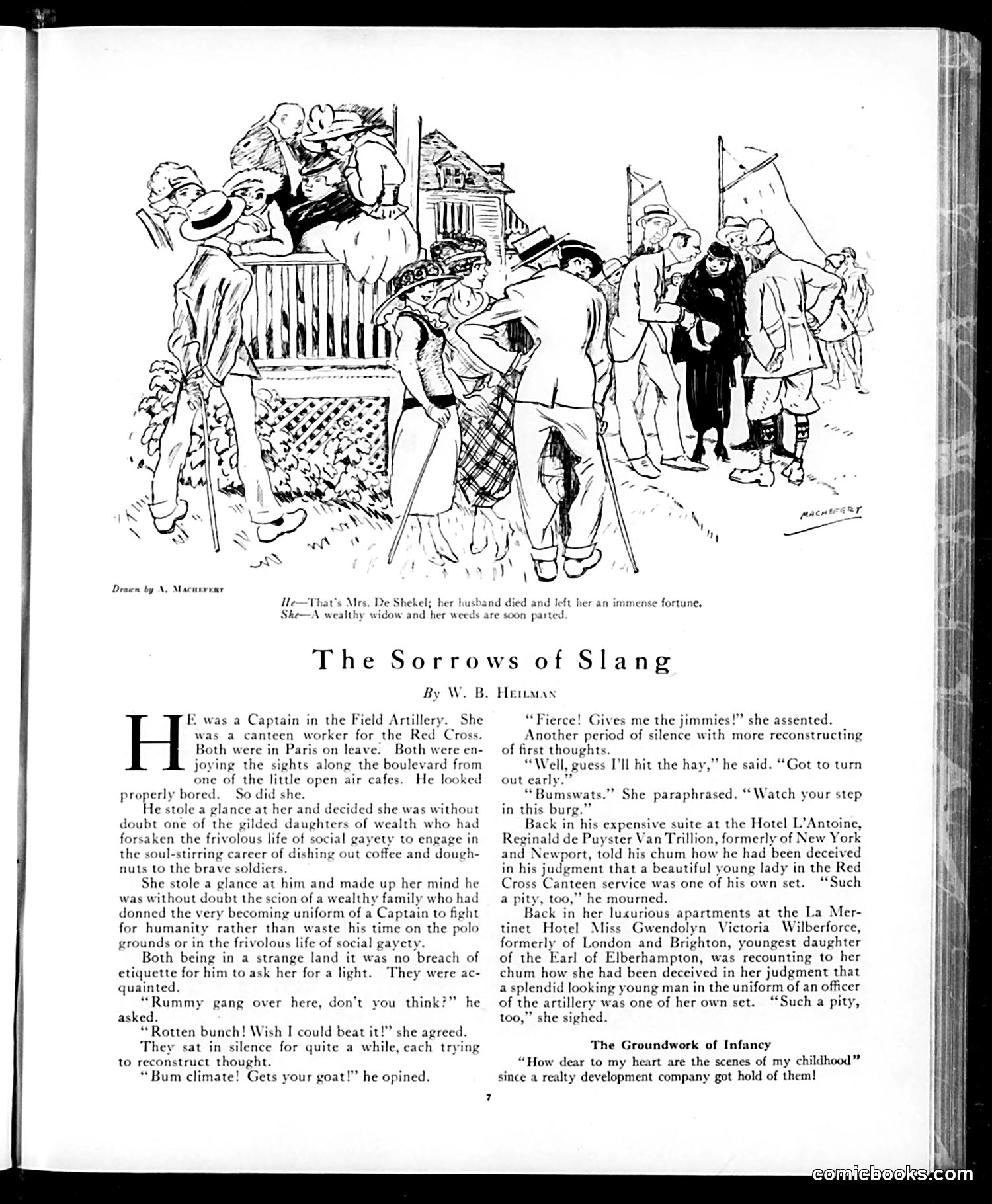
This page contains two satirical pieces from Judge magazine (likely WWI-era, based on references to Paris leave and Red Cross canteen work). **Top cartoon:** A visual joke about a wealthy widow ("Mrs. De Shekel"—the name itself mocking wealth). The caption's punchline relies on slang: "her weeds are soon parted" plays on "widow's weeds" (mourning clothes) while suggesting her money is quickly spent. **"The Sorrows of Slang":** This story satirizes class pretense. Two wealthy aristocrats—Reginald de Puyster Van Trillion and Miss Gwendolyn Victoria Wilberforce—meet in Paris during WWI, each believing the other is a working-class volunteer (soldier and Red Cross worker). Both speak in deliberately crude slang ("gets your goat," "hit the hay," "bumswats") to seem relatable. The irony: they're actually social equals but mutually deceived by surface appearances and slang affectation. The satire targets both aristocratic condescension and the gap between authentic and performative speech. **"The Groundwork of Infancy":** Brief satirical caption mocking developers destroying nostalgic childhood landscapes.
📄 Transcribed text from this page (OCR, searchable)
Machine-transcribed from the original scan — historical spelling and the odd misread are preserved.
Drawn by A. Macuerent He—That's Mrs. De Shekel; her husband died and left her an immense fortune. She—A wealthy widow and her weeds are soon parted The Sorrows of Slang By W. B. Heaan E was a Captain in the Field Artillery. She was a canteen worker for the Red Cross. Both were in Paris on leave. Both were en- joying the sights along the boulevard from one of the little open air cafes. He looked properly bored. So did she. He stole a glance at her and decided she was without doubt one of the gilded daughters of wealth who had forsaken the frivolous life of social gayety to engage in the soul-stirring career of dishing out coffee and dough- nuts to the brave soldiers. She stole a glance at him and made up her mind he was without doubt the scion of a wealthy family who had donned the very becoming uniform of a Captain to fight for humanity rather than waste his time on the polo grounds or in the frivolous life of social gayety. Both being in a strange land it was no breach of etiquette for him to ask her for a light. They were ac- quainted. “Rummy gang over here, don’t you think?” he asked. “Rotten bunch! Wish I could beat it!” she agreed. They sat in silence for quite a while, cach trying to reconstruct thought. “Bum climate! Gets your goat!” he opined. “Fierce! Gives me the jimmies!” she assented. Another period of silence with more reconstructing of first thoughts. “Well, guess I'll hit the hay,” he said. ‘Got to turn out early. “Bumswats.” She paraphrased. ‘Watch your step in this burg.” Back in his expensive suite at the Hotel L’Antoine, Reginald de Puyster Van Trillion, formerly of New York and Newport, told his chum how he had been deceived in his judgment that a beautiful young lady in the Red Cross Canteen service was one of his own set. “Such a pity, too,” he mourned. Back in her lucurious apartments at the La Mer- tinet Hotel Miss Gwendolyn Victoria Wilberforce, formerly of London and Brighton, youngest daughter of the Earl of Elberhampton, was recounting to her chum how she had been deceived in her judgment that a splendid looking young man in the uniform of an officer of the artillery was one of her own set. “Such a pity, too,” she sighed. The Groundwork of Infancy “How dear to my heart are the scenes of my childhood” since a realty development company got hold of them!