
Judge, 1919-09-20 · page 8 of 36
Judge — September 20, 1919 — page 8: what you’re looking at
What you’re looking at
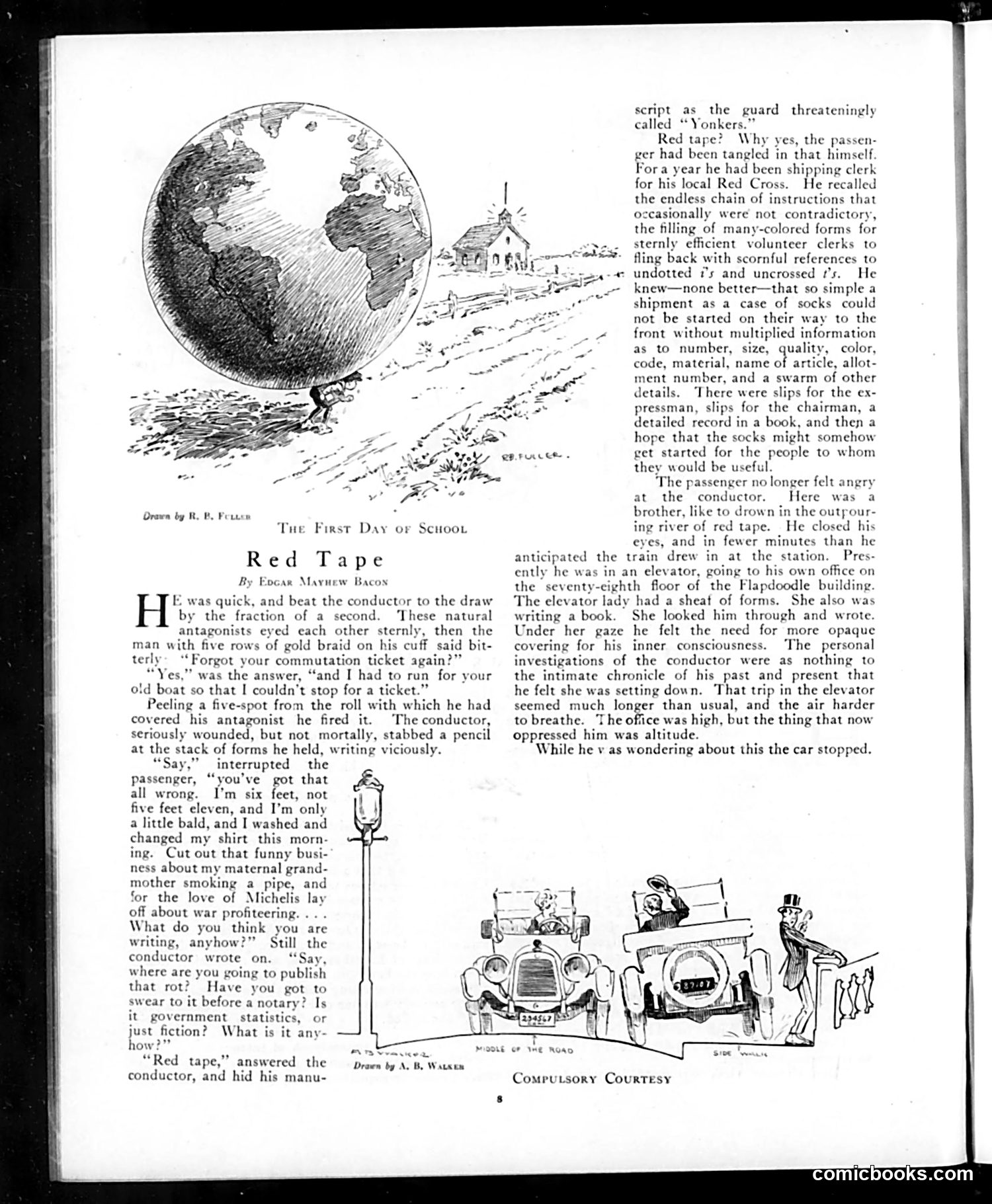
This satirical piece critiques the proliferation of bureaucratic paperwork, particularly during World War I. A train conductor and passenger clash over a forgotten commutation ticket. The conductor responds by filling out excessive forms—"red tape"—with unnecessary details about the passenger's appearance and background. The passenger, recognizing the absurdity, realizes he's experienced worse through his Red Cross shipping clerk work: simple sock shipments required endless colored forms, contradictory instructions, and multiple sign-offs before reaching the front. The satire extends to an elevator operator who interrogates him with yet more forms. The joke cuts across institutional inefficiency—whether railroads, charity organizations, or office buildings—all bury simple transactions under mountains of paperwork. The piece mocks how wartime bureaucracy has metastasized into everyday life, turning minor interactions into nightmarish form-filling exercises. "Compulsory Courtesy" (the second cartoon's title, showing traffic chaos) reinforces themes of modern institutional absurdity.
📄 Transcribed text from this page (OCR, searchable)
Machine-transcribed from the original scan — historical spelling and the odd misread are preserved.
Orawn by RB Feuten Tue First Day or Scuoor Red Tape By Eocar Mayuew Bacon as quick, and beat the conductor to the draw by the fraction of a second. These natural antagonists eyed each other sternly, then the man with five rows of gold braid on his cuff said bit- terly: ‘‘Forgot your commutation ticket again?” “Yes,”” was the answer, “and I had to run for your old boat so that I couldn't stop for a ticket.” Peeling a five-spot from the roll with which he had covered his antagonist he fired it. The conductor, seriously wounded, but not mortally, stabbed a pencil at the stack of forms he held, writing viciously. “Say,” interrupted the passenger, “‘you’ve got that v2 all wrong. I'm six feet, not five feet eleven, and I’m only a little bald, and I washed and changed my shirt this morn- ing. Cut out that funny busi- ness about my maternal grand- mother smoking a pipe, and for the love of Michelis lay off about war profiteering. . . . What do you think you are writing, anyhow?” Still the conductor wrote on. “Say, where are you going to publish that rot? Have you got to swear to it before a notary? Is it government statistics, or just fiction? What is it any- how?” “Red tape,” answered the answe Drawn by A. B. Watsen conductor, and hid his manu- script as the guard threateningly called “ Yonkers.” Red tape? Why yes, the passen- ger had been tangled in that himself. Fora year he had been shipping clerk for his local Red Cross. He recalled the endless chain of instructions that occasionally were not contradictory, the filling of many-colored forms for sternly efficient volunteer clerks to fling back with scornful references to undotted is and uncrossed #’s. He knew—none better—that so simple a shipment as a case of socks could not be started on their way to the front without multiplied information as to number, size, quality, color, code, material, name of article, allot- ment number, and a swarm of other details. There were slips for the ex- pressman, slips for the chairman, a detailed record in a book, and then a hope that the socks might somehow get started for the people to whom they would be useful. The passenger no longer felt angry at the conductor. Here was a brother, like to drown in the outpour- ing river of red tape. He closed his eyes, and in fewer minutes than he anticipated the train drew in at the station. Pres- ently he was in an elevator, going to his own office on the seventy-eighth floor of the Flapdoodle building. The elevator lady had a sheat of forms. She also was She looked him through and wrot Under her gaze he felt the need for more opaque covering for his inner consciousness. The personal investigations of the conductor were as nothing to the intimate chronicle of his past and present that he felt she was setting down. That trip in the elevator seemed much longer than usual, and the air harder to breathe. The office was high, but the thing that now oppressed him was altitude. While he v as wondering about this the car stopped. writing a book Computsory Courtesy comicbooks.com