
Judge, 1919-09-20 · page 11 of 36
Judge — September 20, 1919 — page 11: what you’re looking at
What you’re looking at
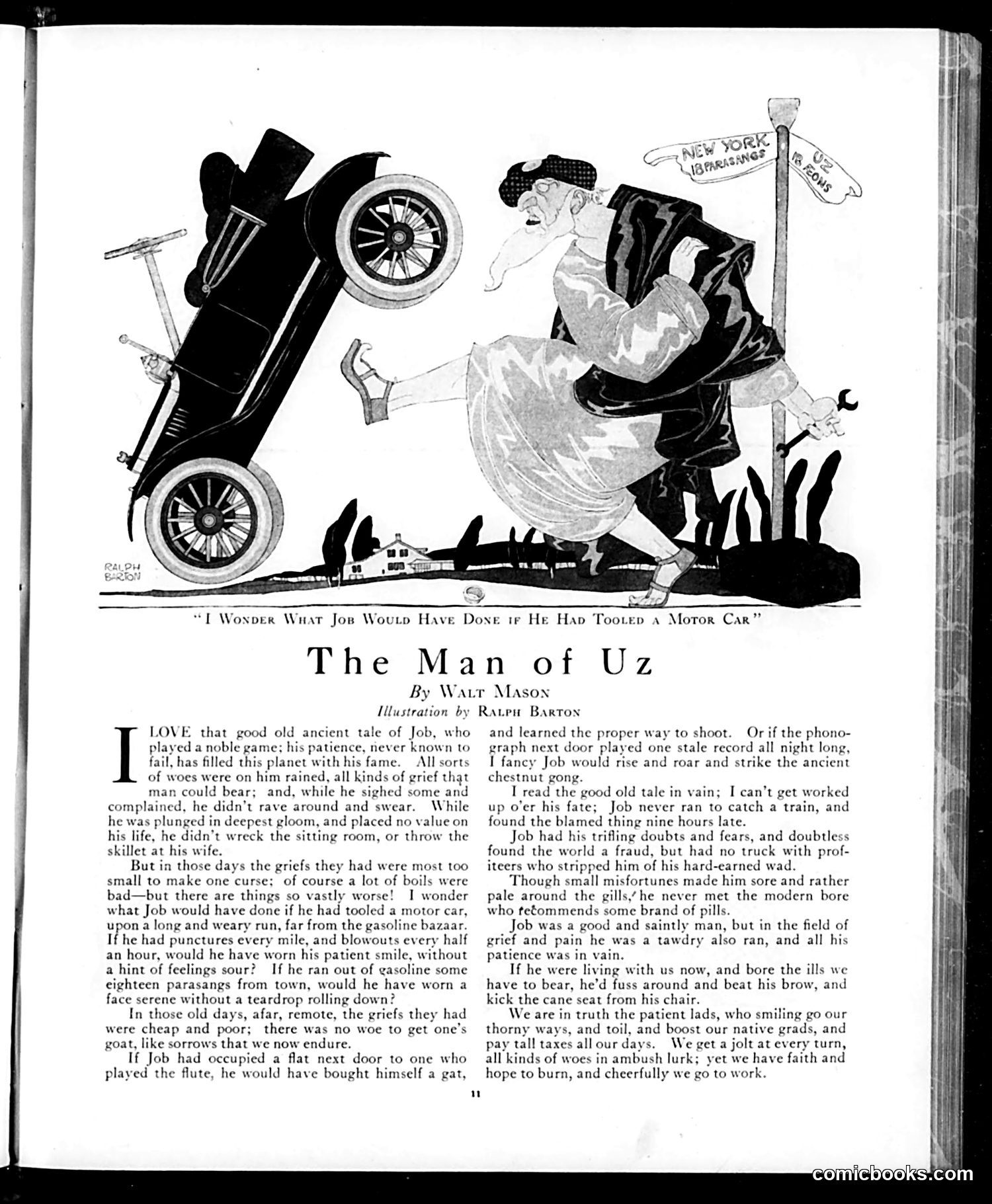
This is a humorous poem by Walt Mason with Ralph Barton's illustration comparing the biblical Job's ancient patience to modern hardships—specifically, early automobile troubles. The cartoon shows a man struggling with a motorcar that's tipped over, contrasting with Job's biblical trials. The joke: Job endured boils and catastrophes with grace, but modern people face *worse* irritations—flat tires, breakdowns far from gas stations, missed trains, neighbors playing phonographs or recommending pills, profiteers, and taxes. The satire argues that contemporary Americans, despite facing "trivial" modern annoyances (mechanical failures, noise, commercialism), still maintain Job-like patience and keep working. It's gently mocking early-20th-century complaints about automobiles and modern life's minor inconveniences while praising resilience. The tone suggests these "new" problems are petty compared to biblical suffering, yet modern people handle them with surprising forbearance.
📄 Transcribed text from this page (OCR, searchable)
Machine-transcribed from the original scan — historical spelling and the odd misread are preserved.
“T Woxver Wurat Jos Woutp Have Done te He Hav Tootep 1 Moror Car” The Man of Uz By Wait Mason Illustration by Raven Barton LOVE that good old ancient tale of Job, who played a noble game; his patience, never known to fail, has filled this planet with his fame. All sorts of woes were on him rained, all kinds of grief that man could bear; and, while he sighed some and complained, he didn’t rave around and swear. While he was plunged in deepest gloom, and placed no value on his life, he didn’t wreck the sitting room, or throw the skillet at his wife. But in those days the griefs they had were most too small to make one cur: of course a lot of boils were bad—but there are things so vastly worse! I wonder what Job would have done if he had tooled a motor car, upon a long and weary run, far from the gasoline bazaar. If he had punctures every mile, and blowouts every half an hour, would he have worn his patient smile, without a hint of feelings sour? If he ran out of gasoline some eighteen parasangs from town, would he have worn a face serene without a teardrop rolling down? In those old days, afar, remote, the griefs they had were cheap and poor; there was no woe to get one’s goat, like sorrows that we now endure. If Job had occupied a flat next door to one who played the flute, he would have bought himself a gat, and learned the proper way to shoot. Or if the phono- graph next door played one stale record all night long, I fancy Job would rise and roar and strike the ancient chestnut gong. I read the good old tale in vain; I can’t get worked up o'er his fate; Job never ran to catch a train, and found the blamed thing nine hours late. Job had his trifling doubts and fears, and doubtless found the world a fraud, but had no truck with prof- iteers who stripped him of his hard-earned wad. Though small misfortunes made him sore and rather pale around the gills,/he never met the modern bore who fetommends some brand of pills. Job was a good and saintly man, but in the field of grief and pain he was a tawdry also ran, and all his patience was in vain. If he were living with us now, and bore the ills we have to bear, he'd fuss around and beat his brow, and kick the cane seat from his chair. We are in truth the patient lads, who smiling go our thorny ways, and toil, and boost our native grads, and pay tall taxes allourdays. We get a jolt at every turn, all kinds of woes in ambush lurk; yet we have faith and hope to burn, and cheerfully we go to work.