
Judge, 1919-09-20 · page 5 of 36
Judge — September 20, 1919 — page 5: what you’re looking at
What you’re looking at
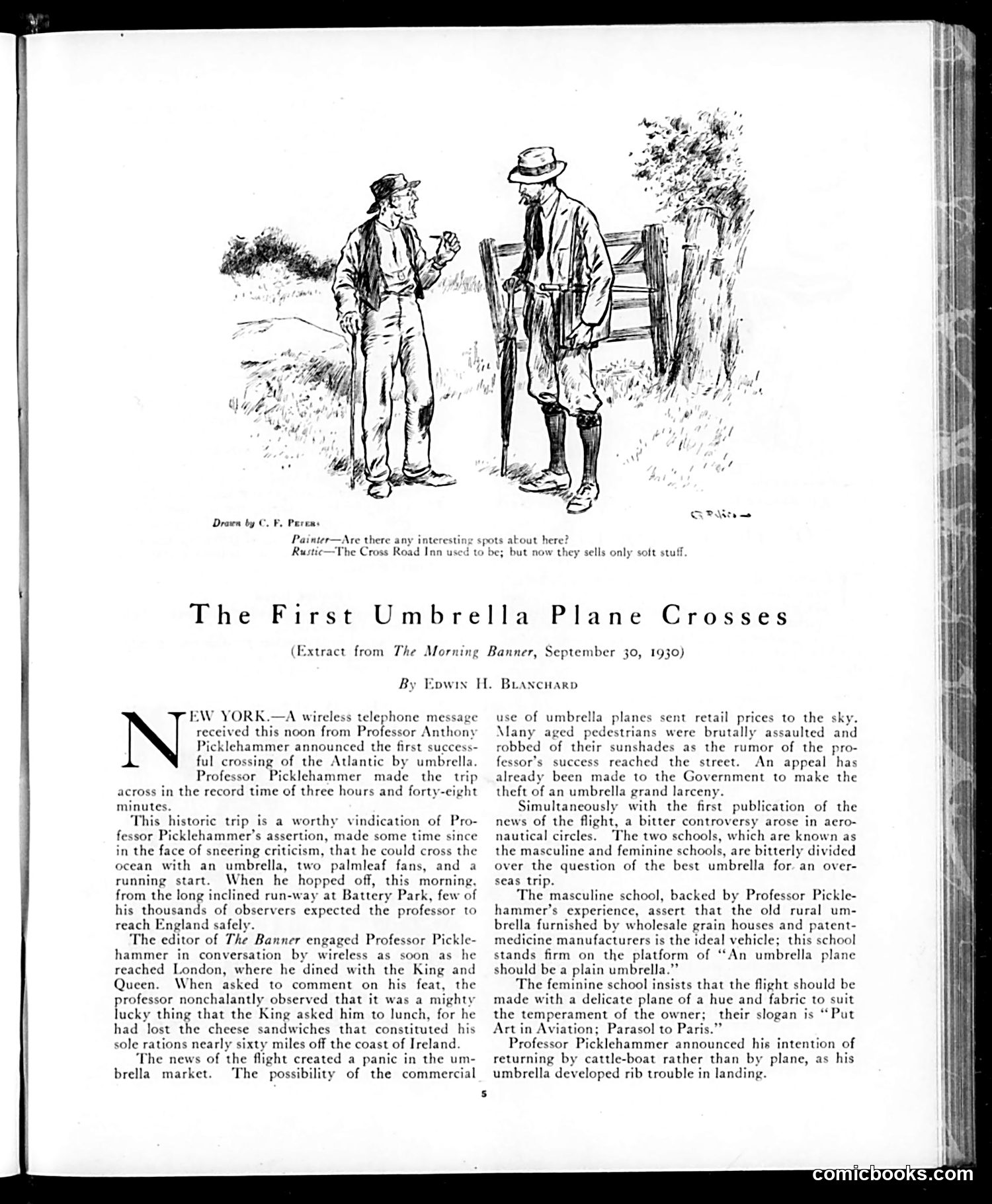
This satirical piece from *The Morning Banner* (September 30, 1930) mocks Professor Pickelhammer's claimed transatlantic flight using an umbrella, two palmleaf fans, and a running start. The cartoon depicts two men discussing the implausible achievement at a rural crossroads. The satire targets both the absurdity of such a claim and the commercial opportunism it sparked—umbrella manufacturers capitalized on the "historic" flight. A secondary joke notes the controversy between "masculine" and "feminine" schools debating whether the umbrella should be plain or delicate for ocean crossings. The piece appears to be satirizing credulous public belief in dubious aviation claims and the entrepreneurial hype surrounding 1930s aviation achievements, when genuine aviation breakthroughs were still novel enough to capture public imagination.
📄 Transcribed text from this page (OCR, searchable)
Machine-transcribed from the original scan — historical spelling and the odd misread are preserved.
Drawn by C.F, Perens Are there any interestin The Cross Road Inn use: Painter- Rustic spots atout here? be; but now they sells only soft stuff. The First Umbrella Plane Crosses (Extract from The Morning Banner, September 30, 1930) By Fowix H. Biancuarp EW YORK.—A wireless telephone message received this noon from Professor Anthony Picklehammer announced the first success- ful crossing of the Atlantic by umbrella. Professor Picklehammer made the trip across in the record time of three hours and forty-eight minutes. This historic trip is a worthy vindication of Pro- fessor Picklehammer’s assertion, made some time since in the face of sneering criticism, that he could cross the ocean with an umbrella, two palmleaf fans, and a running start. When he hopped off, this morning, from the long inclined run-way at Battery Park, few of his thousands of observers expected the professor to reach England safely. The editor of The Banner engaged Professor Pickle- hammer in conversation by wireless as soon as he reached London, where he dined with the King and Queen. When asked to comment on his feat, the professor nonchalantly observed that it was a mighty lucky thing that the King asked him to lunch, for he had lost the cheese sandwiches that constituted his sole rations nearly sixty miles off the coast of Ireland. The news of the flight created a panic in the um- brella market. The possibility of the commercial use of umbrella planes sent retail prices to the sky. Many aged pedestrians were brutally assaulted and robbed of their sunshades as the rumor of the pro- fessor’s success reached the street. An appeal has already been made to the Government to make the theft of an umbrella grand larceny. Simultaneously with the first publication of the news of the flight, a bitter controversy arose in aero- nautical circles. The two schools, which are known as the masculine and feminine schools, are bitterly divided over the question of the best umbrella for. an over- seas trip. The masculine school, backed by Professor Pickle- hammer’s experience, assert that the old rural um- brella furnished by wholesale grain houses and patent- medicine manufacturers is the ideal vehicle; this school stands firm on the platform of “An umbrella plane should be a plain umbrella.” The feminine school insists that the flight should be made with a delicate plane of a hue and fabric to suit the temperament of the owner; their slogan is “Put Artin Aviation; Parasol to Paris.” Professor Picklehammer announced his intention of returning by cattle-boat rather than by plane, as his umbrella developed rib trouble in landing.