
A complete issue · 36 pages · 1918
Judge — February 23, 1918
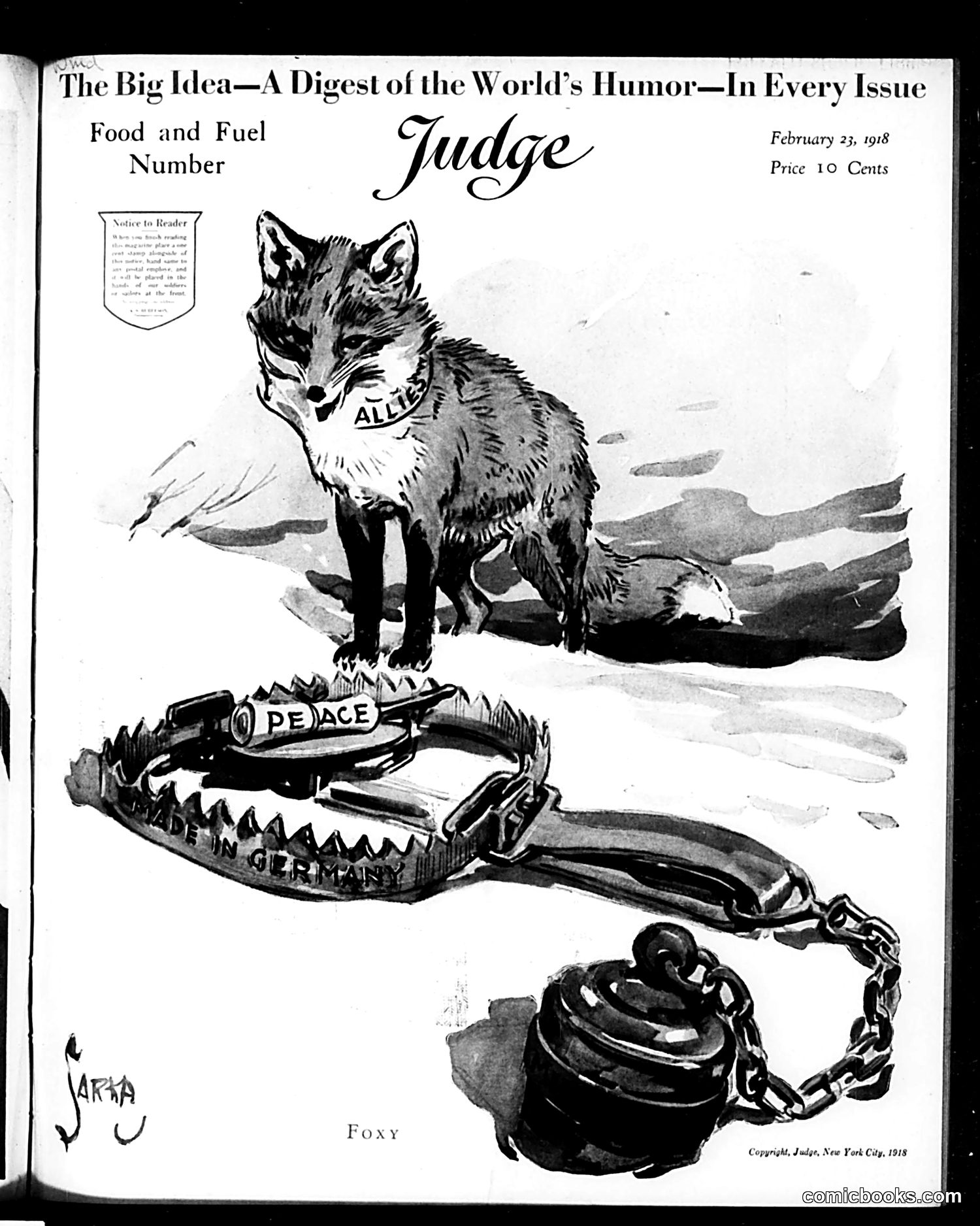
This political cartoon depicts a fox wearing an "Allied" collar, standing over a German military trap (marked "Peace") and a land mine. The satire targets Germany's peace overtures during World War I, portraying them as deceptive traps set by a cunning enemy. The "fox" represents the Allies (particularly America and Britain), shown as clever enough to recognize and avoid Germany's supposed peace negotiations as military deception. The spiked trap and explosive suggest the Allies should distrust German peace proposals as weapons designed to catch them off-guard. Published in early 1918—months before the November armistice—the cartoon reflects American wartime skepticism toward any German diplomatic initiatives, urging continued military vigilance.
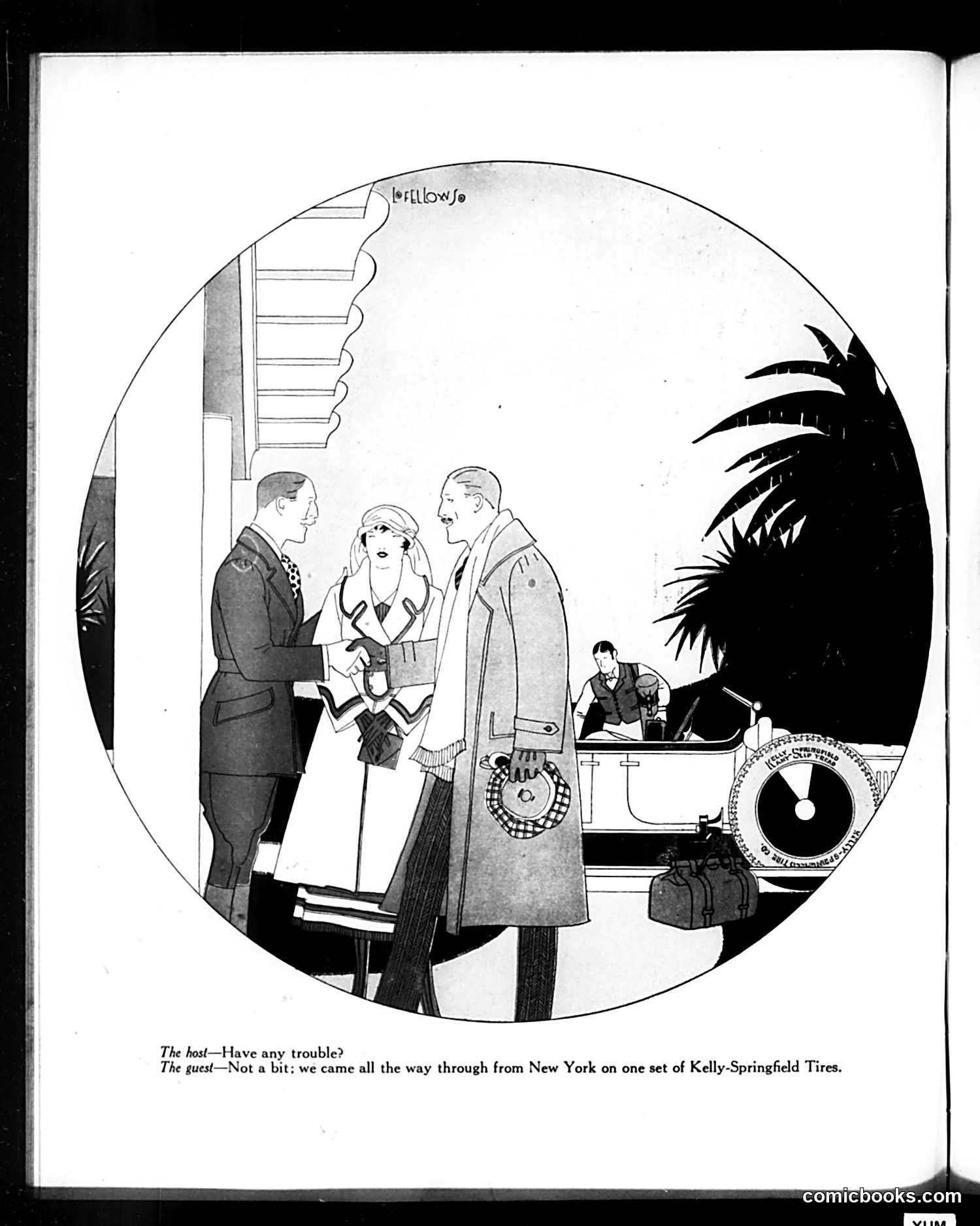
This is an advertisement for Kelly-Springfield Tires disguised as a cartoon joke. Two men greet a woman arriving at what appears to be a tropical hotel or resort (indicated by the palm trees and desk clerk visible in the background). The humor is straightforward product advertising: the host asks if the guest had any travel trouble, and the guest responds that they drove all the way from New York without problems—crediting Kelly-Springfield Tires for the reliable journey. The "joke" is essentially a testimonial claiming the tires' durability and quality. The tropical setting suggests leisure travel, appealing to affluent readers. This represents early automotive advertising that used humor and lifestyle imagery to promote tire brands to a growing car-owning public in the early 20th century.
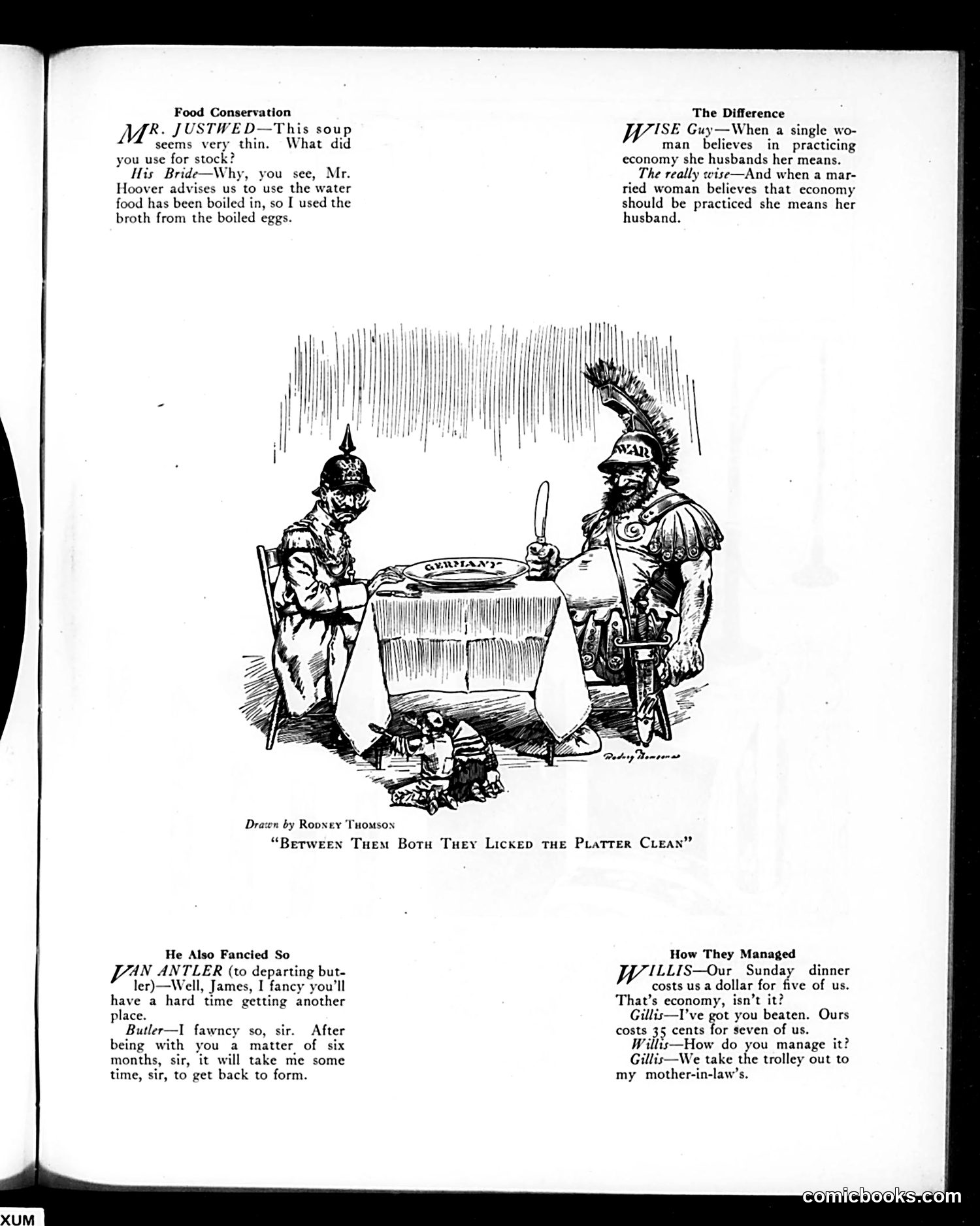
The central cartoon depicts two military officers (appearing to be German, based on the spiked Prussian helmets and uniforms) seated at a table labeled "GERMANY," licking a plate clean. The caption "Between Them Both They Licked the Platter Clean" suggests commentary on German wartime food rationing or scarcity. The surrounding dialogue snippets mock domestic economy during what appears to be WWI—wives bragging about feeding families cheaply, husbands struggling financially. The upper section contrasts a "wise" woman who economizes by husbanding her means. This page satirizes both enemy deprivation and American home-front economic pressures, using the German officers as visual metaphor for national resource depletion during wartime. The humor relies on audiences understanding Germany faced severe food shortages during the war.
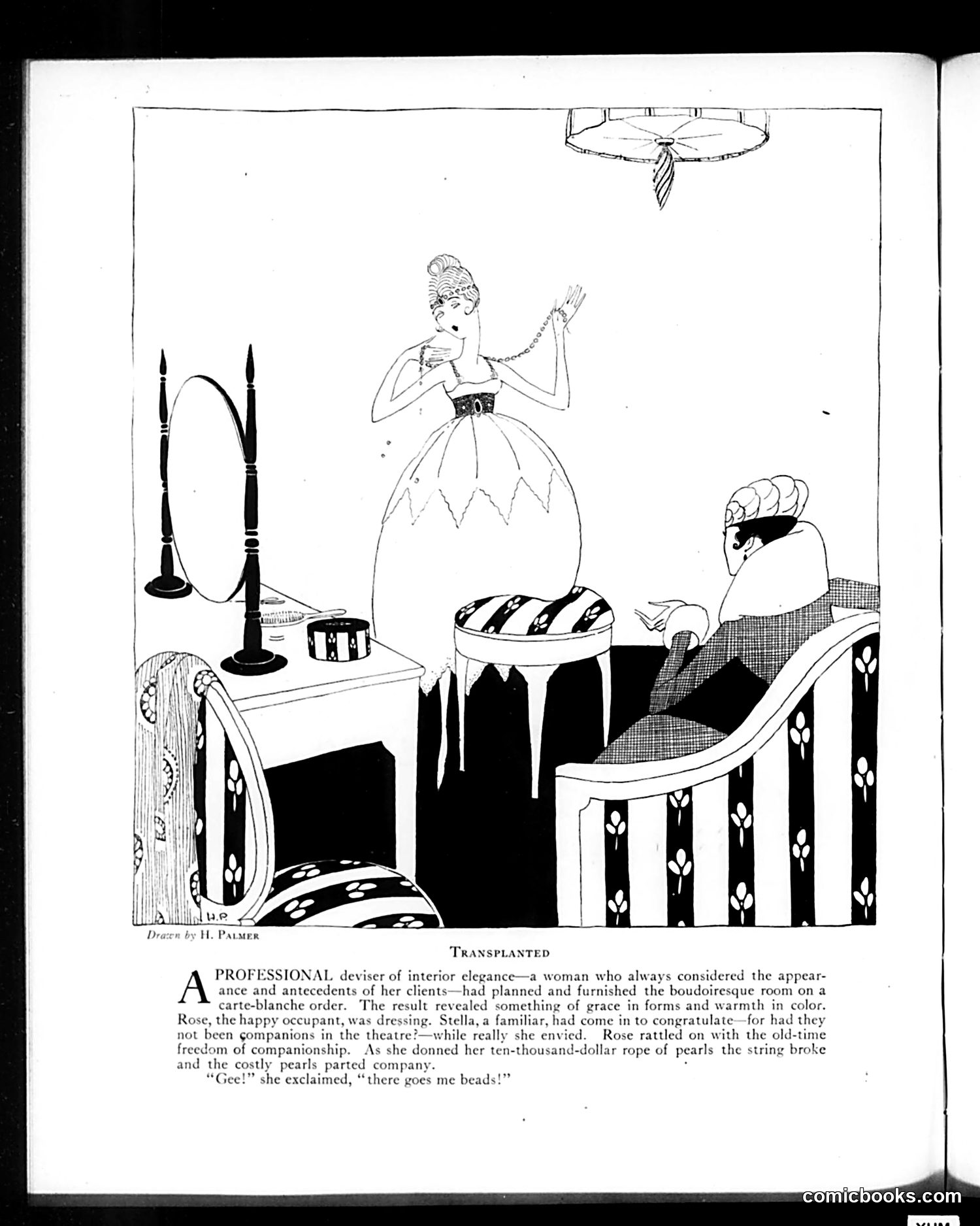
This illustration satirizes interior decorators and their wealthy clients. The caption explains that a professional decorator furnished a bedroom in fashionable "boudoir" style. The joke centers on a client named Rose who broke an expensive ten-thousand-dollar pearl necklace while dressing, exclaiming "there goes me beads!" The satire targets the contrast between refined aesthetic pretensions and crude reality: despite the decorator's careful attention to "grace in forms and warmth in color," the wealthy client's unrefined speech ("there goes me beads") and careless handling of valuable items reveal her lack of genuine sophistication. The ornate bedroom setting emphasizes the gap between outward appearance and actual refinement.
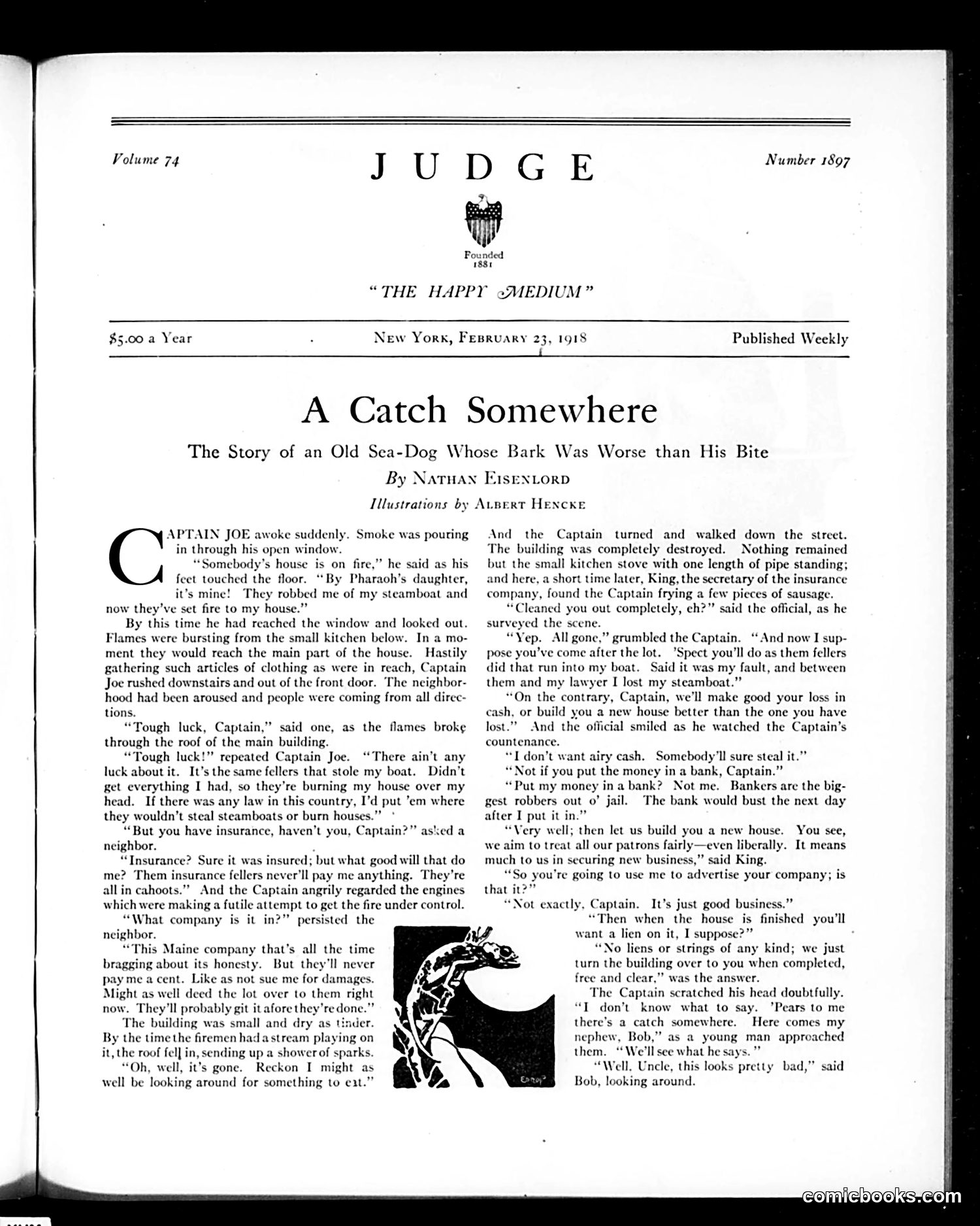
This page from *Judge* magazine (February 23, 1918) contains a short story titled "A Catch Somewhere" by Nathanax Eisenlord, illustrated by Albert Hencke. The narrative follows Captain Joe, an old sea-dog whose house catches fire. As neighbors and officials respond, they discuss insurance claims and property loss. The small illustration shows a dog, likely representing the story's subtitle reference to "an old sea-dog whose bark was worse than his bite"—a pun playing on the nautical term "sea-dog" (sailor) with an actual dog. The story itself appears to be humorous fiction rather than political satire. It's primarily entertainment content for the magazine's readers, with the dog illustration serving as a visual gag related to the captain's character.
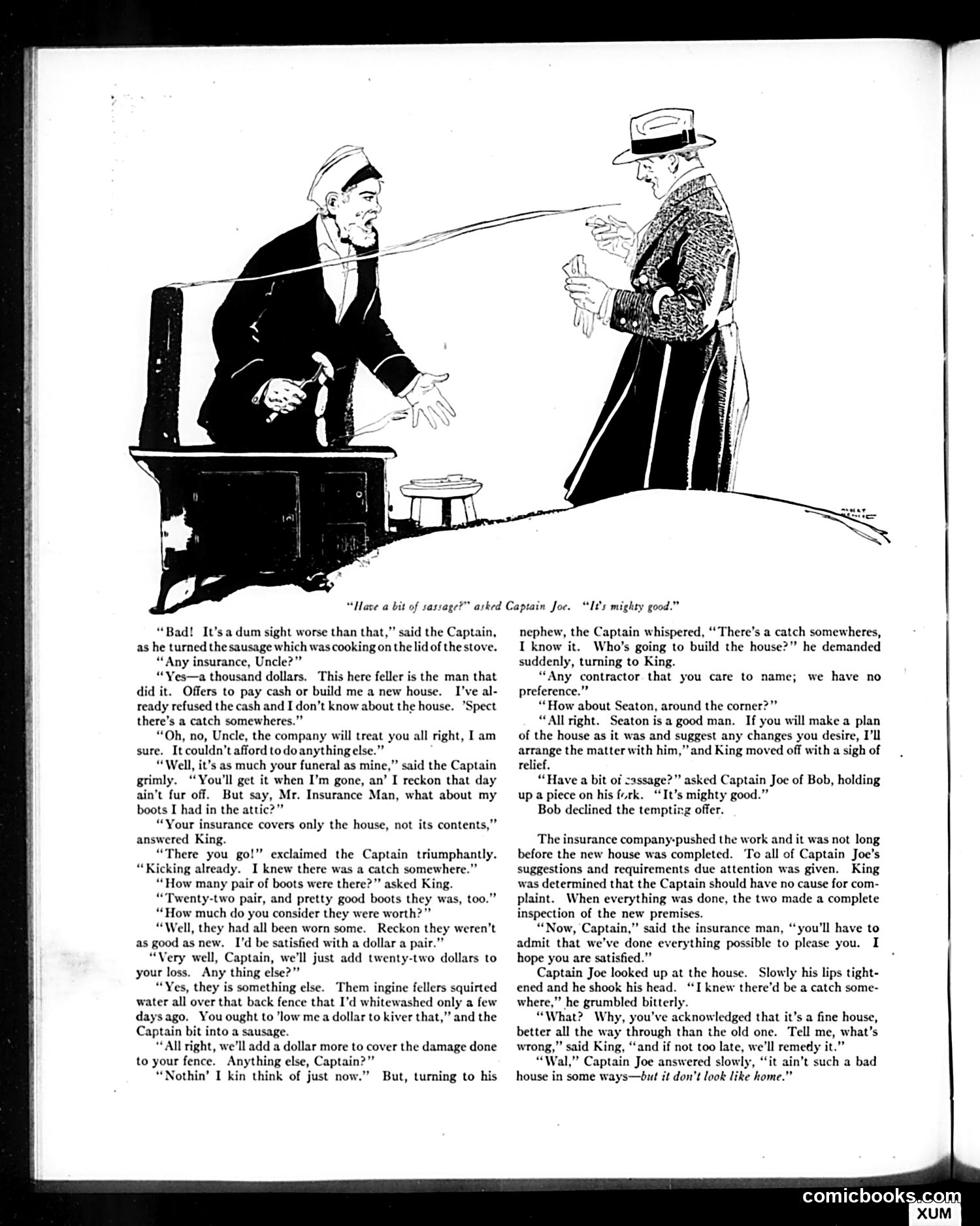
This page contains a humorous story about Captain Joe negotiating with an insurance company representative over property damage. The cartoon illustrates their conversation: Captain Joe sits at a desk while the insurance man (identified as "King") stands with a fork, apparently discussing sausage and other damages to a house. The satire targets insurance company practices of the era—their reluctance to pay claims and tendency to find "catches" or loopholes to deny coverage. Captain Joe repeatedly suspects hidden conditions ("there's a catch somewhere"), while King eventually admits the house is actually fine, suggesting the insurance industry's adversarial relationship with policyholders and their reputation for paying minimal claims when possible.
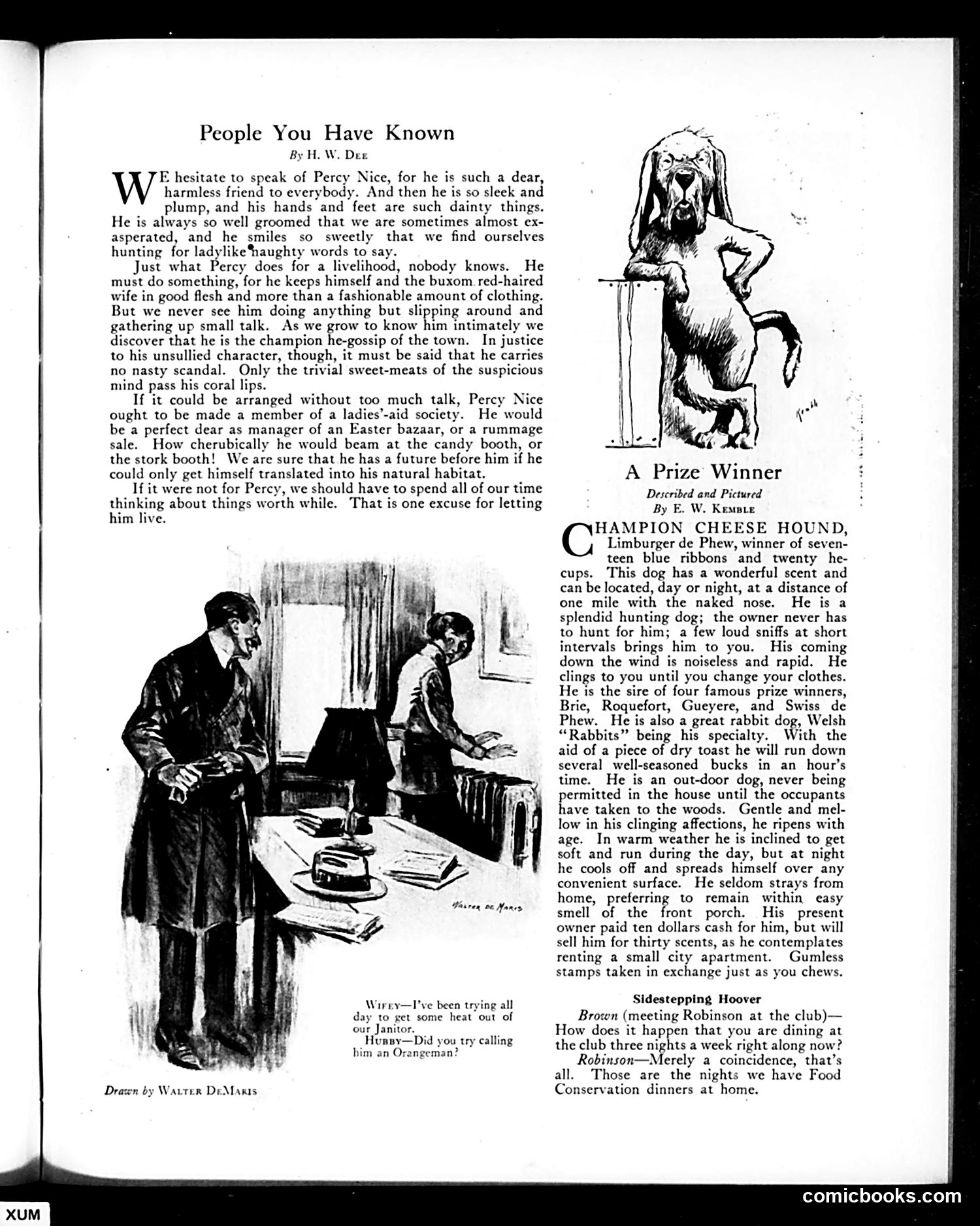
This page contains two satirical pieces typical of Judge's early 20th-century humor: **"People You Have Known: Percy Nice"** mocks a social parasite—a well-dressed, perpetually grooming man of mysterious occupation who survives by gathering and spreading trivial gossip around town. The satire suggests he's useless to society, existing only as idle entertainment. The cartoon by Walter DeMaris shows an office scene where a worker tries unsuccessfully to get heat from an uncooperative janitor, illustrating working-class frustration. **"A Prize Winner"** is absurdist satire describing a hunting dog named "Limburger de Phew" with puns on cheese names (Brie, Roquefort, Swiss). The joke hinges on the dog's overpowering smell—detectable at great distances, "ripening with age," and driving occupants from their home. It's wordplay humor mocking both prize-dog pretension and food preservation. The **"Sidestepping Hoover"** joke references food conservation during WWI rationing, where "Food Conservation dinners" (meager meals) at home justify dining club visits—poking fun at wartime sacrifice claims.
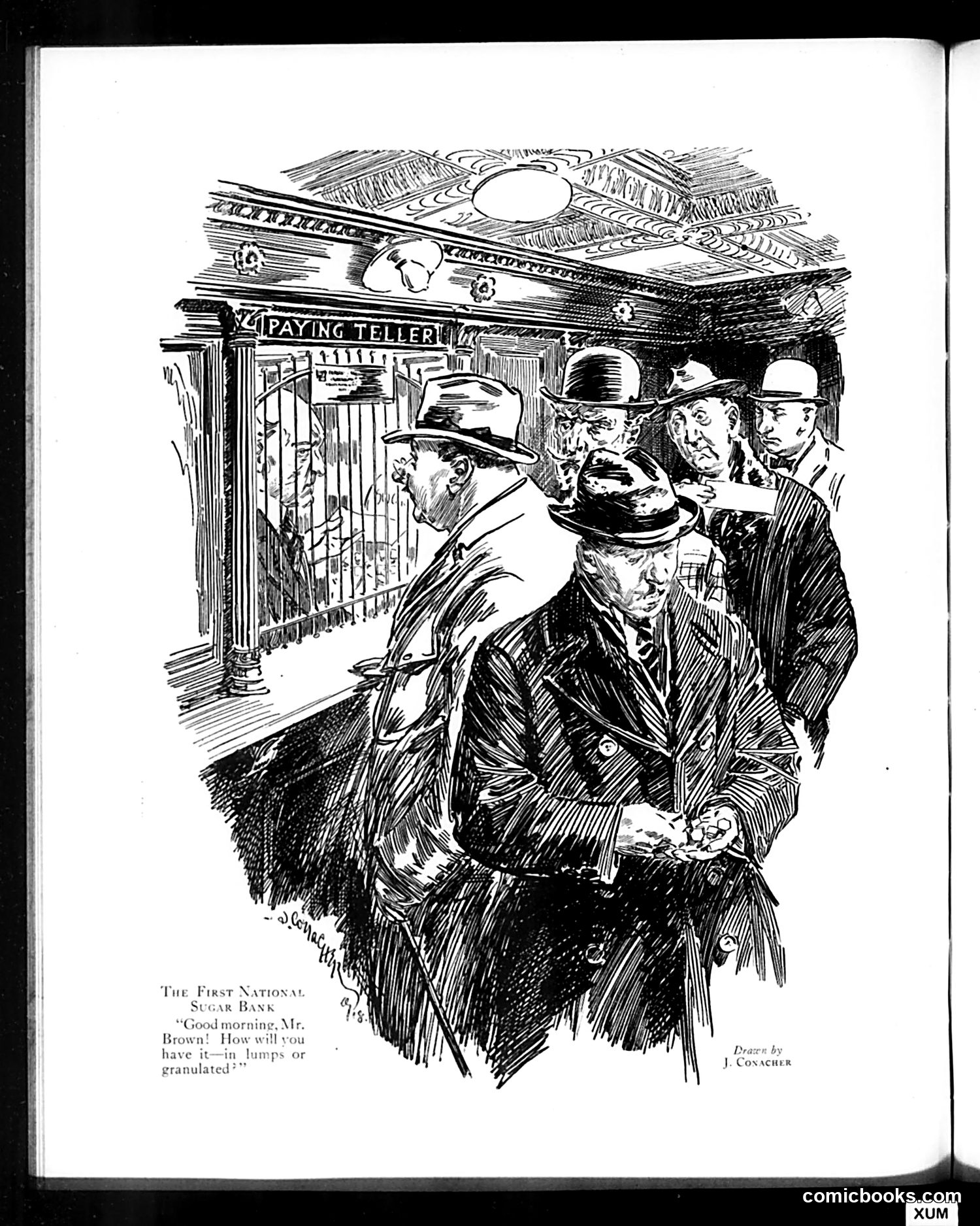
This political cartoon by J. Coxsacher depicts a bank teller window labeled "PAYING TELLER" with a line of working-class men (identifiable by their worn clothes and hats) waiting to conduct business. The caption reads: "Good morning, Mr. Brown! How will you have it—in lumps or granulated?" The satire appears to target **sugar price manipulation or profiteering**. The teller's casual question about the form of sugar delivery mocks the financial system's treatment of ordinary citizens—reducing them to commodities while banks control access to basic goods. The "First National Sugar Bank" likely references real banking institutions' involvement in commodity speculation that affected food prices and working people's ability to afford necessities. The cartoon criticizes economic inequality and corporate control of essential resources.
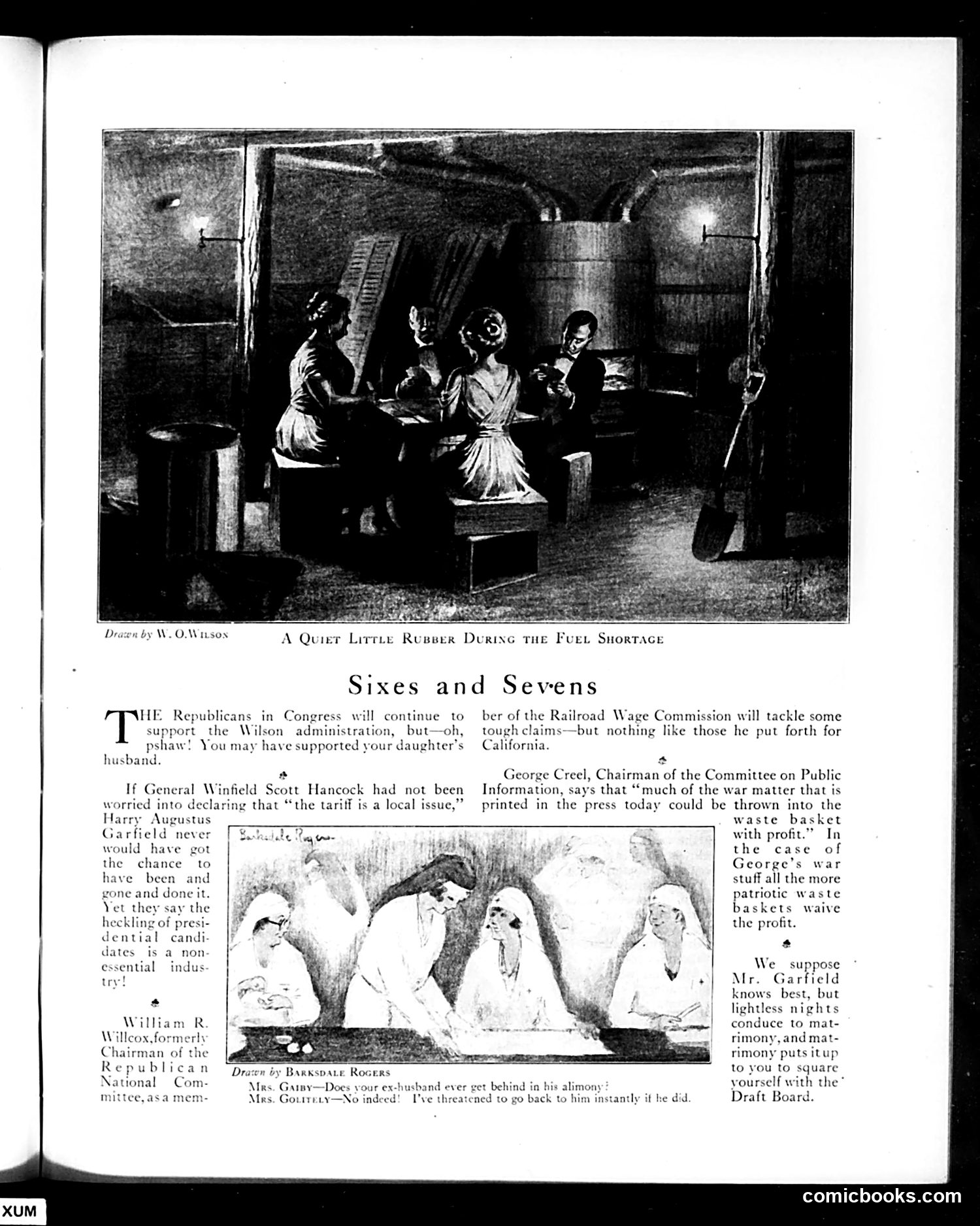
This page from *Judge* magazine satirizes Wilson administration politics during WWI-era America. The top cartoon by W.O. Wilson depicts wartime fuel shortages, showing women in a cellar during rationing. The main article "Sixes and Sevens" mocks Republican Congressional support for Wilson while complaining—a politically inconsistent position. It references General Winfield Scott Hancock (a historical political figure) and Harry Garfield, apparently the Fuel Administrator, sarcastically suggesting he failed to secure fair wage agreements. The article also criticizes George Creel, head of the Committee on Public Information (the official WWI propaganda agency), suggesting government could suppress negative war news. The lower cartoon by Barsdale Rogers shows a woman in an "alimony" predicament, likely satirizing wartime social disruption. The closing jest about the "Draft Board" suggests young men avoiding military service through marriage—a topical WWI concern.
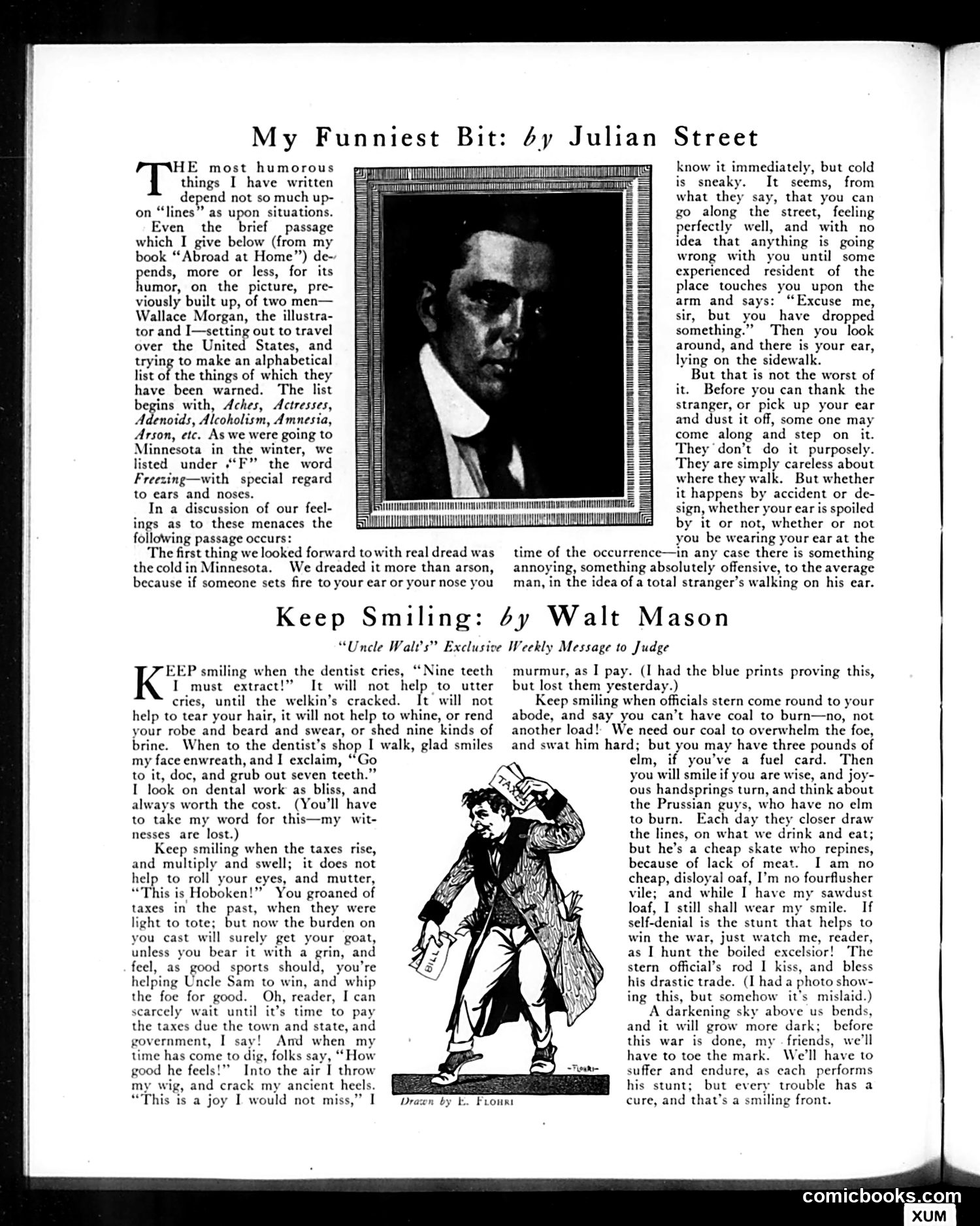
This page contains two humorous essays from early 20th-century Judge magazine. **"My Funniest Bit" by Julian Street** presents an absurdist joke about Minnesota winter dangers. Street and illustrator Wallace Morgan compiled warnings about travel hazards (alphabetically: aches, actresses, alcoholism, etc.). The humor hinges on Minnesota cold being so severe that ears literally freeze and fall off unnoticed—only discovered when a stranger informs you that you've "dropped something." The exaggeration mocks both Midwestern weather folklore and the obliviousness of travelers. **"Keep Smiling" by Walt Mason** is patriotic wartime messaging (references to "Uncle Sam," coal rationing, Prussian enemies suggest WWI era). Mason urges readers to maintain cheerfulness through hardships—dental extractions, rising taxes, fuel shortages—as a civic duty helping America defeat Germany. It's propagandistic encouragement dressed as lighthearted philosophy, typical of wartime morale-building journalism. Both pieces use humor to address contemporary anxieties: travel hazards and wartime sacrifice.
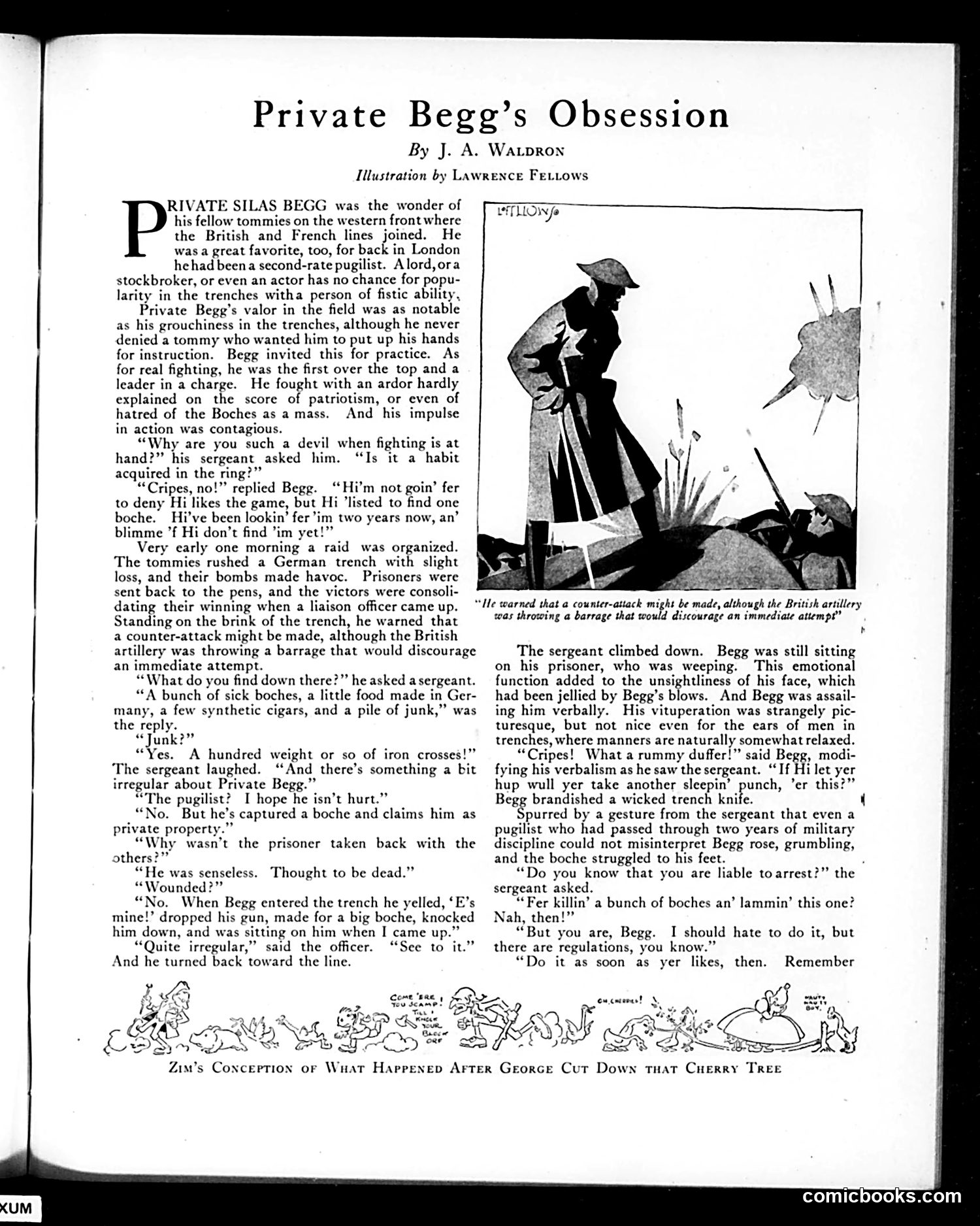
This WWI story depicts Private Silas Begg, a British soldier characterized as a former boxer whose combat ferocity stems from a personal vendetta: he's been hunting one specific German soldier for two years. The narrative illustrates how individual obsession—rather than patriotism or hatred of Germans collectively—drives his exceptional battlefield performance. The satire lies in the contrast: Begg's violent, obsessive behavior, while militarily effective, violates military discipline and regulations. When he captures his target and begins beating him senseless, a sergeant must intervene, warning Begg he could face arrest despite his valor. The story questions whether individual grudges serve military purposes, and gently mocks the contradiction between rewarding soldiers for aggressive fighting while punishing them for excessive brutality. The illustrated cartoon at bottom (Zim's conception) remains unclear from visible context.
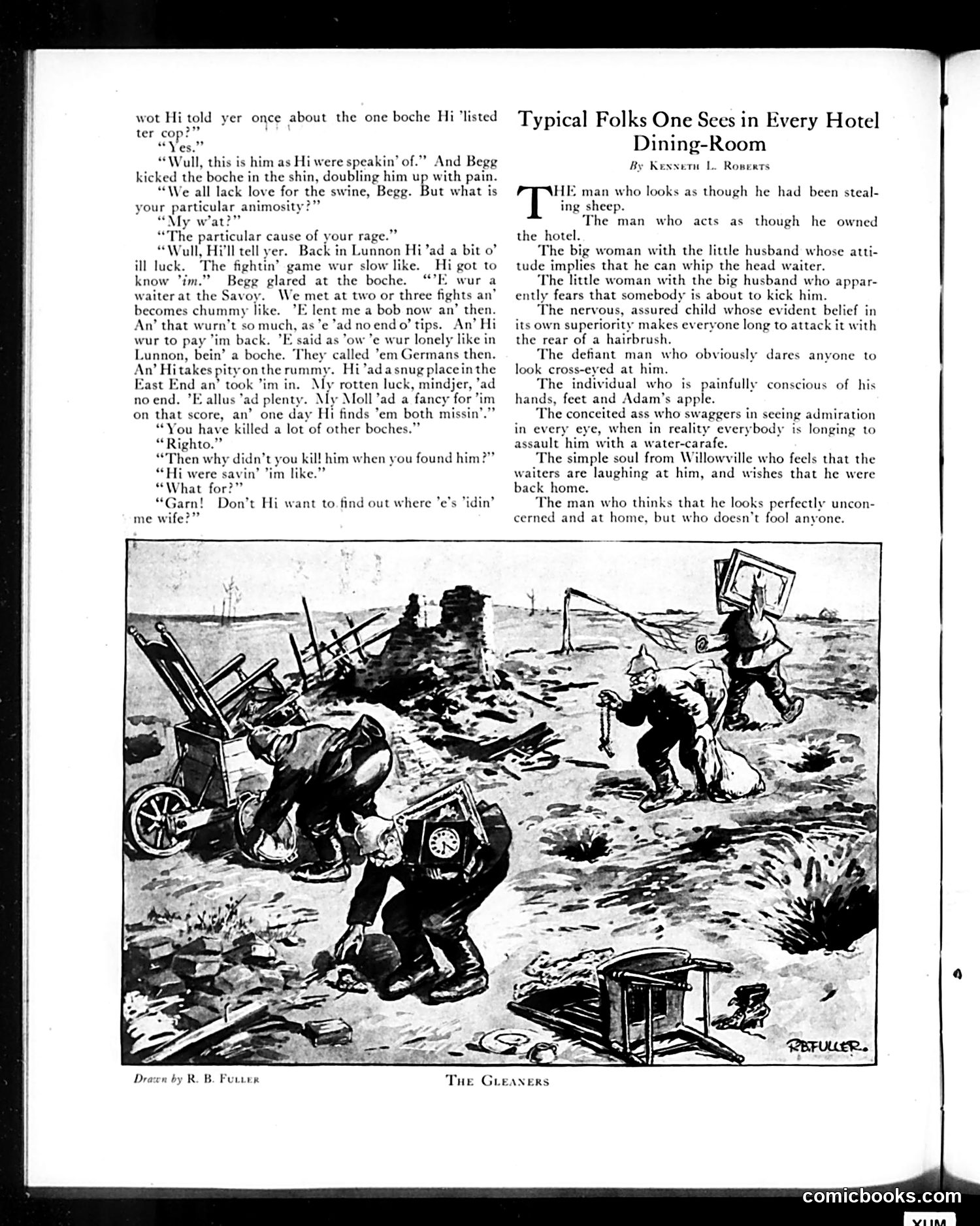
This page contains two distinct pieces: **"The Gleaners" (Bottom Cartoon):** A WWI-era comic strip drawn by R.B. Fuller. Two British soldiers discuss why one is torturing a captured German soldier ("boche"). The twist: the soldier is seeking revenge because the German was a waiter in London who befriended him, borrowed money, seduced his wife ("Moll"), and disappeared with her. The dark humor hinges on the soldier "saving" this particular enemy for personal vengeance rather than military necessity—a commentary on how war intersects with private grievances. **"Typical Folks One Sees in Every Hotel Dining-Room" (Top Essay):** By Kenneth L. Roberts, this is social satire cataloging recognizable hotel dining room "types"—the insecure nouveau riche, anxious spouses, precocious children, the self-conscious man obsessed with his appearance, the phony sophisticate, and the homesick provincial. It's gentle satirical observation of American social behavior and class anxiety, typical of Judge's humor circa 1910s-1920s.
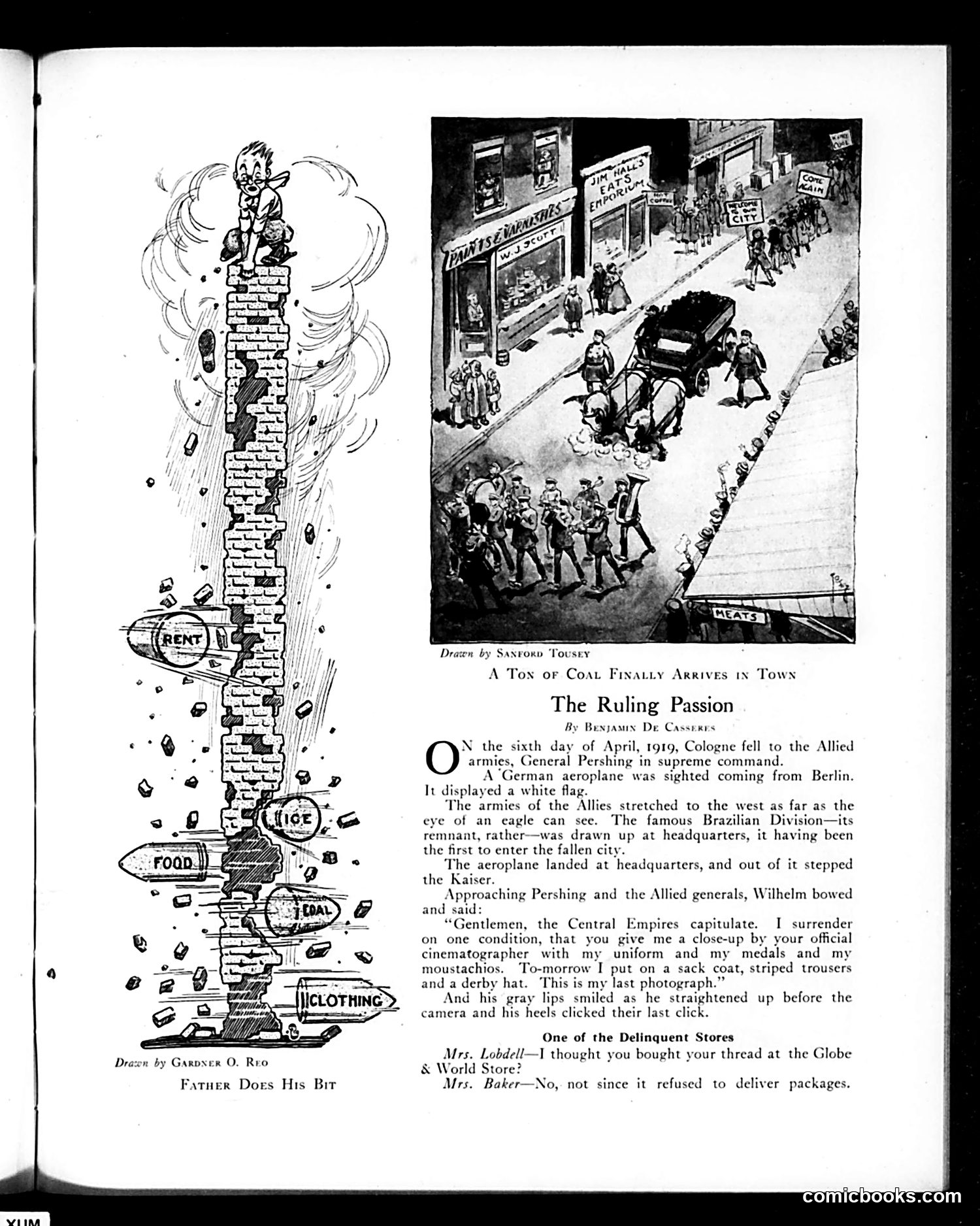
**Left cartoon ("Father Does His Bit")**: A satirical tower of wartime shortages, drawn by Gardner O. Reo. The brick column is labeled with rationing items (rent, food, clothing) with a small figure perched atop, suggesting civilians are stacked upon deprivation during WWI. The "bit" fathers contribute appears to be enduring escalating costs of living. **Right cartoon ("A Ton of Coal Finally Arrives in Town")**: Shows a street scene celebrating the arrival of coal delivery during a fuel shortage. The street crowds suggest coal was scarce enough to warrant public celebration—reflecting WWI-era energy rationing. **Story ("The Ruling Passion")**: Set April 6, 1919 (after WWI's armistice), Kaiser Wilhelm II surrenders to General Pershing but requests one final photograph in uniform with medals before civilian life. The joke: even in defeat, vanity remains his defining trait—his "ruling passion." **Brief dialogue**: Mrs. Baker stopped patronizing the Globe & World Store due to delivery failures, satirizing unreliable wartime commerce.
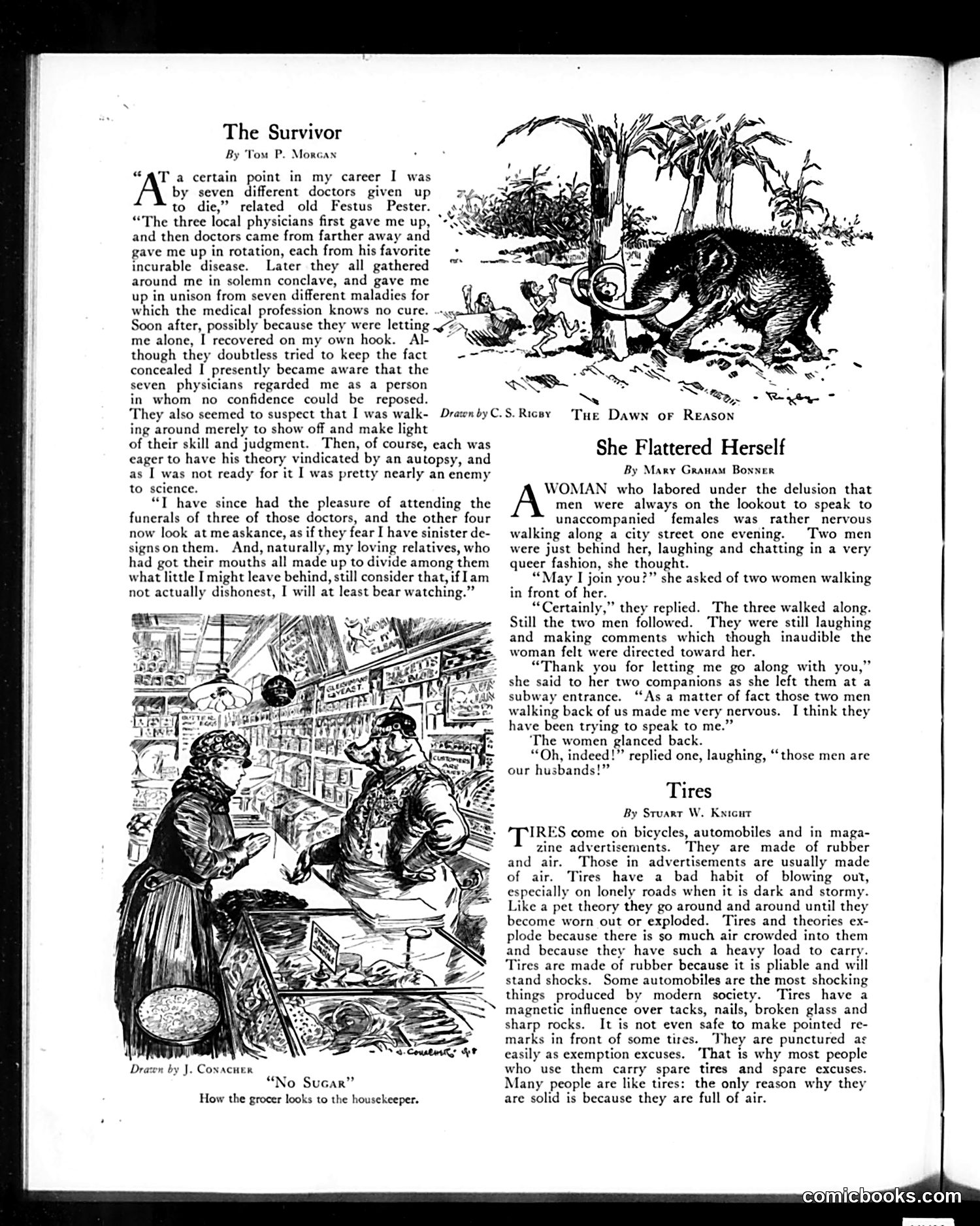
**"The Survivor"** satirizes the medical profession's tendency to give up on patients prematurely. An old man claims seven doctors declared him incurable from various diseases, then abandoned him. He recovered naturally once left alone—but now the doctors resent him, viewing his survival as either showing off or an affront to medical science. The joke: doctors are more invested in their theories and reputations than patient welfare. The cartoon below shows a grocer during sugar rationing (likely WWI-era), illustrating economic hardship. **"She Flattered Herself"** mocks women's vanity. A woman mistakenly believes two men are pursuing her romantically when they're actually following their own wives, who are walking ahead. The humor depends on her misreading social attention as romantic interest. **"Tires"** is light satirical commentary comparing tires and human nature—both are "solid" only because filled with air, both eventually fail under pressure, and both attract trouble magnetically. It's wordplay-driven social observation rather than sharp political satire.
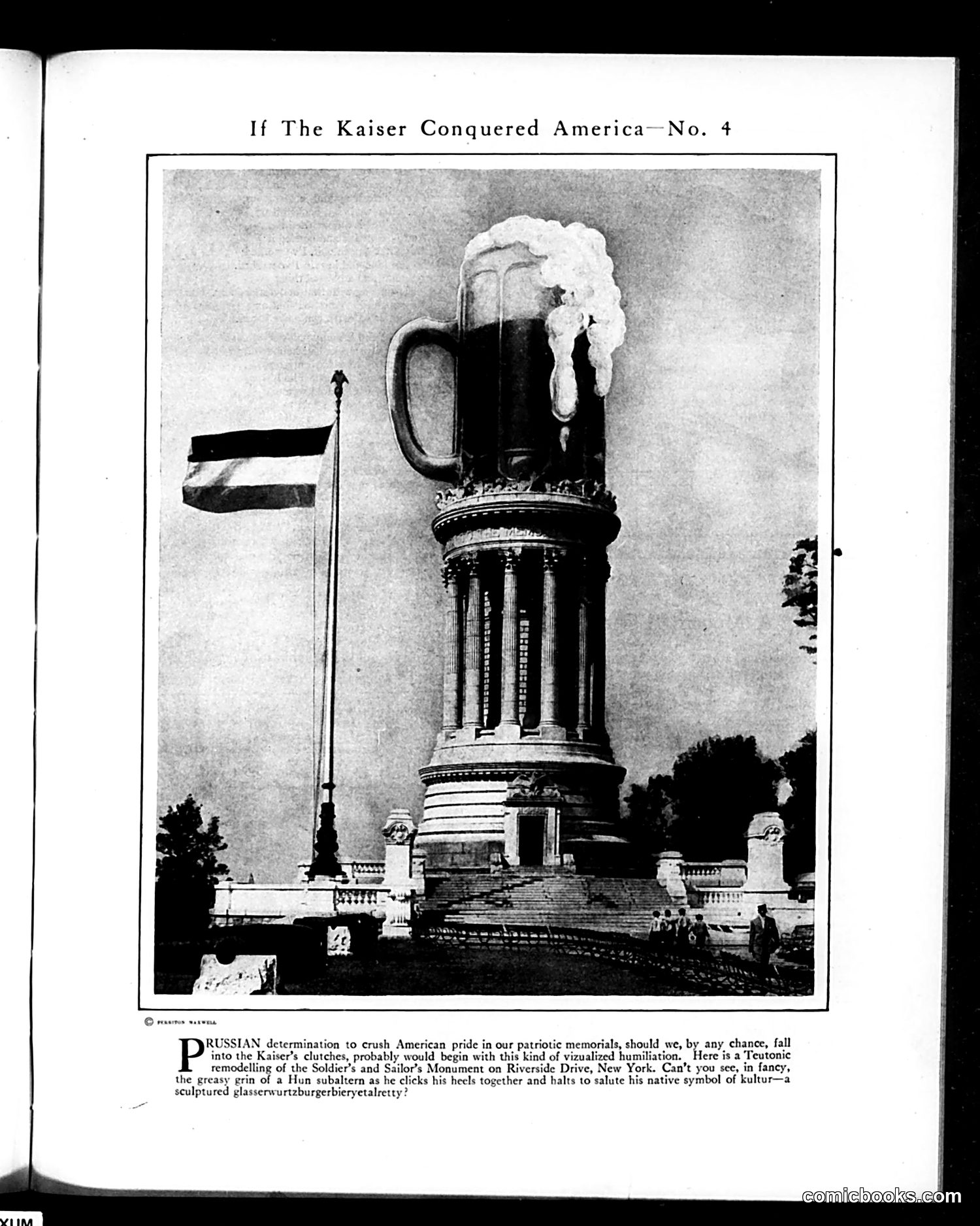
This satirical cartoon imagines what would happen if Germany's Kaiser conquered America. The image depicts the Soldier's and Sailor's Monument on New York's Riverside Drive grotesquely transformed: a giant beer mug replaces the monument's traditional top, with a German flag planted nearby. The text mocks the Kaiser's alleged determination to humiliate American patriotic symbols. The satire suggests that German occupation would desecrate American monuments by replacing them with German cultural icons (here, beer—stereotyping German culture). The cartoon ridicules "Hun" military officers saluting "their native symbol of kultur" through crude, contemptuous language. This is WWI-era propaganda depicting German victory as an existential threat to American identity and values, using grotesque humor to mobilize patriotic sentiment.
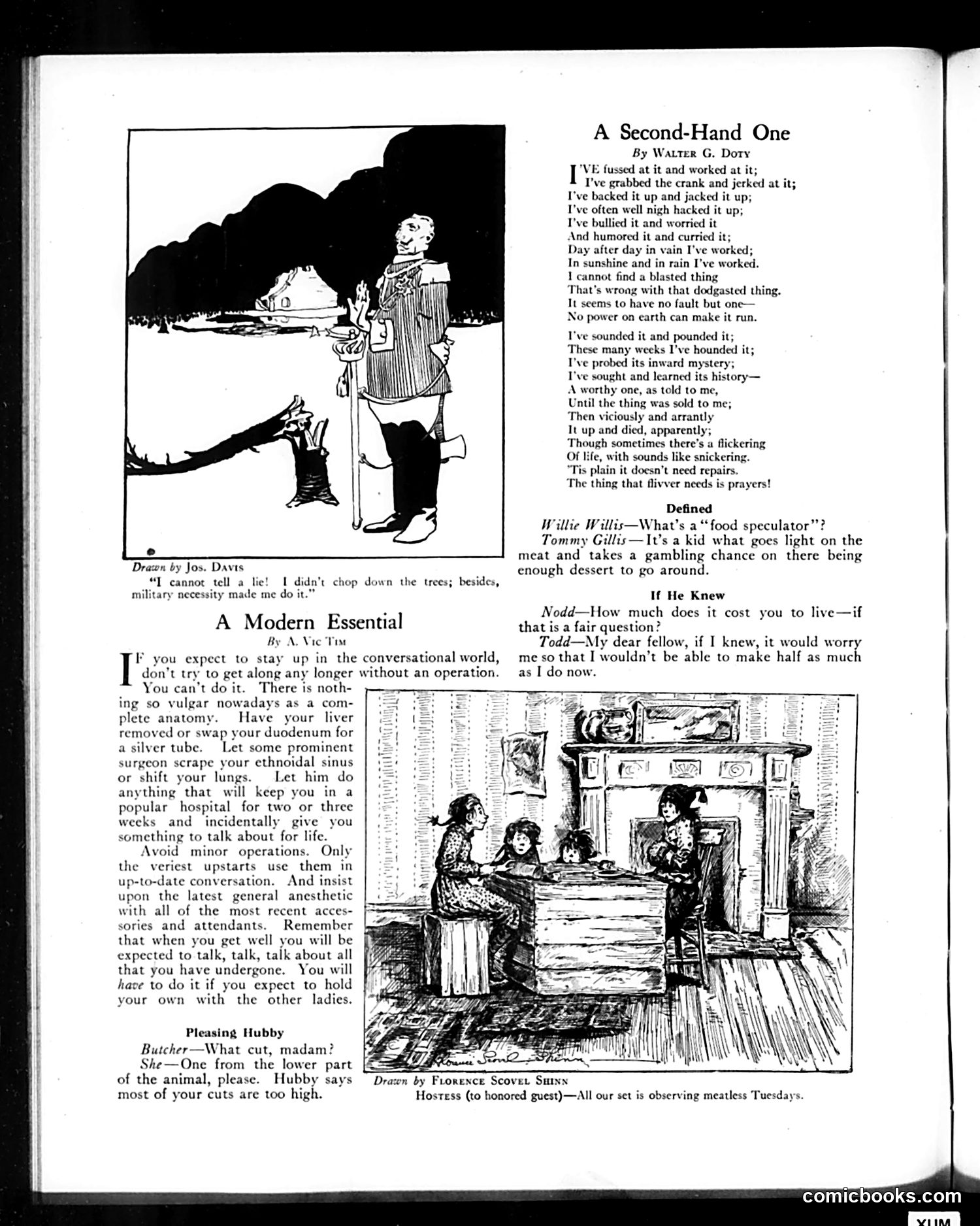
This page contains three separate satirical pieces mocking early 20th-century American life: **"A Second-Hand One"** ridicules the unreliability of early automobiles (likely Model T Fords, called "flivvers"). The poem humorously describes an owner's futile attempts to repair a broken car that defies diagnosis—the joke being that this newfangled technology is so unpredictable it needs "prayers" rather than mechanics. **"A Modern Essential"** satirizes upper-class hypochondria and status-seeking. The piece mocks wealthy people who undergo unnecessary surgeries simply to have interesting medical stories for social conversation—suggesting vanity and one-upmanship have replaced genuine health concerns. **"Pleasing Hubby"** makes a wartime joke about food rationing (likely WWI-era meatless Tuesdays), where a wife requests cheaper cuts of meat, sarcastically attributing it to her husband's complaint that butchers' prices are too high. All three pieces mock contemporary anxieties: unreliable technology, social pretension, and economic hardship.
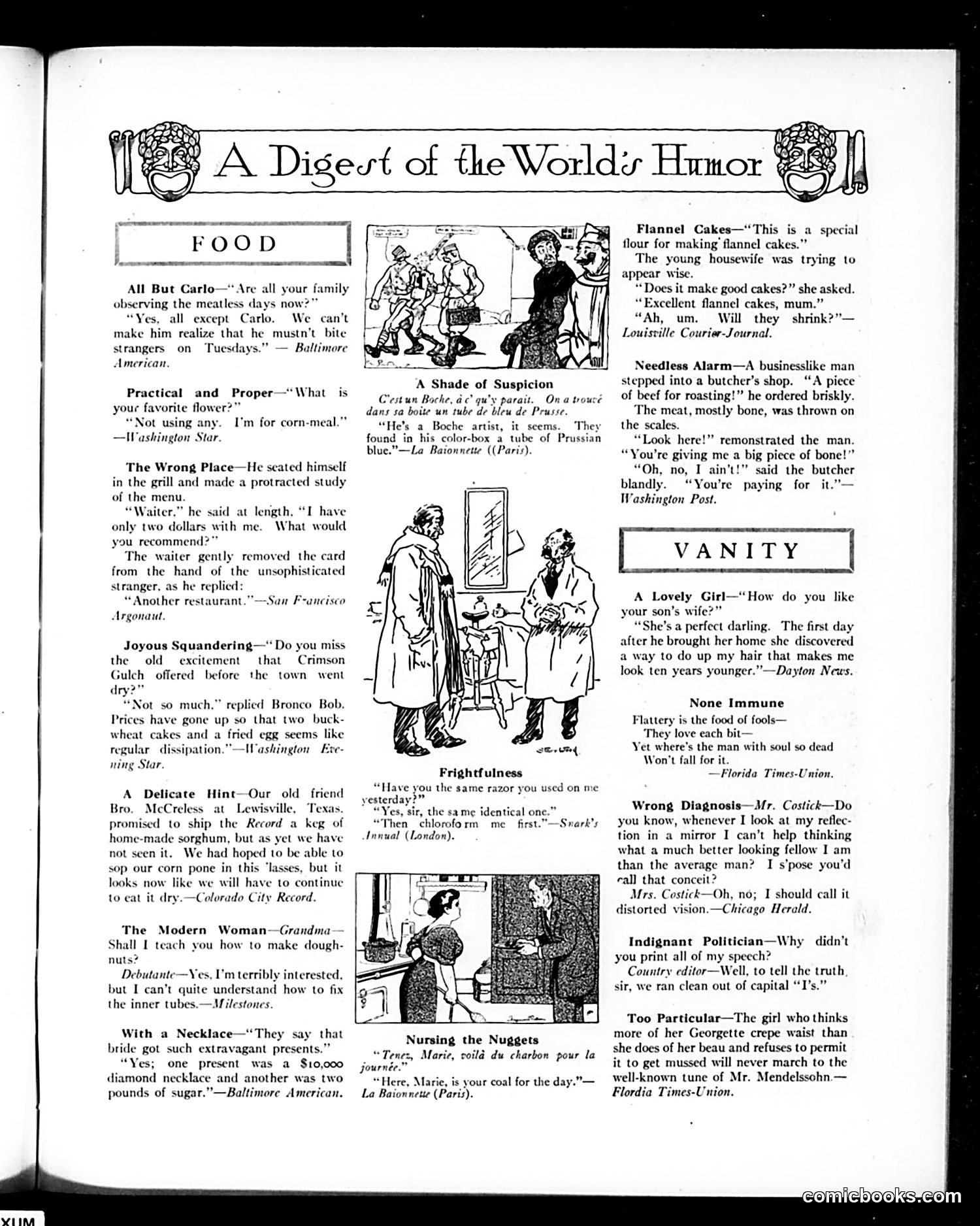
This page collects brief humorous anecdotes organized by topic (Food, Vanity). The jokes reflect early 20th-century domestic and social concerns: **Food section** satirizes rationing during WWI (meatless days), inflation ("two buck wheat cakes"), and class anxiety about restaurant affordability. **International items** reference WWI: "A Shade of Suspicion" jokes about finding Prussian blue paint (suggesting German espionage), while "Frightfulness" references brutal German military tactics, using a razor joke as dark humor about German violence. **Vanity section** mocks gender stereotypes—a newlywed daughter-in-law valued only for beauty treatments, female vanity about clothing over romance, and a man's distorted self-image. The humor relies on period-specific anxieties: wartime suspicion of Germans, economic hardship, gender roles, and class consciousness. Most jokes would require historical context for modern readers to fully appreciate.
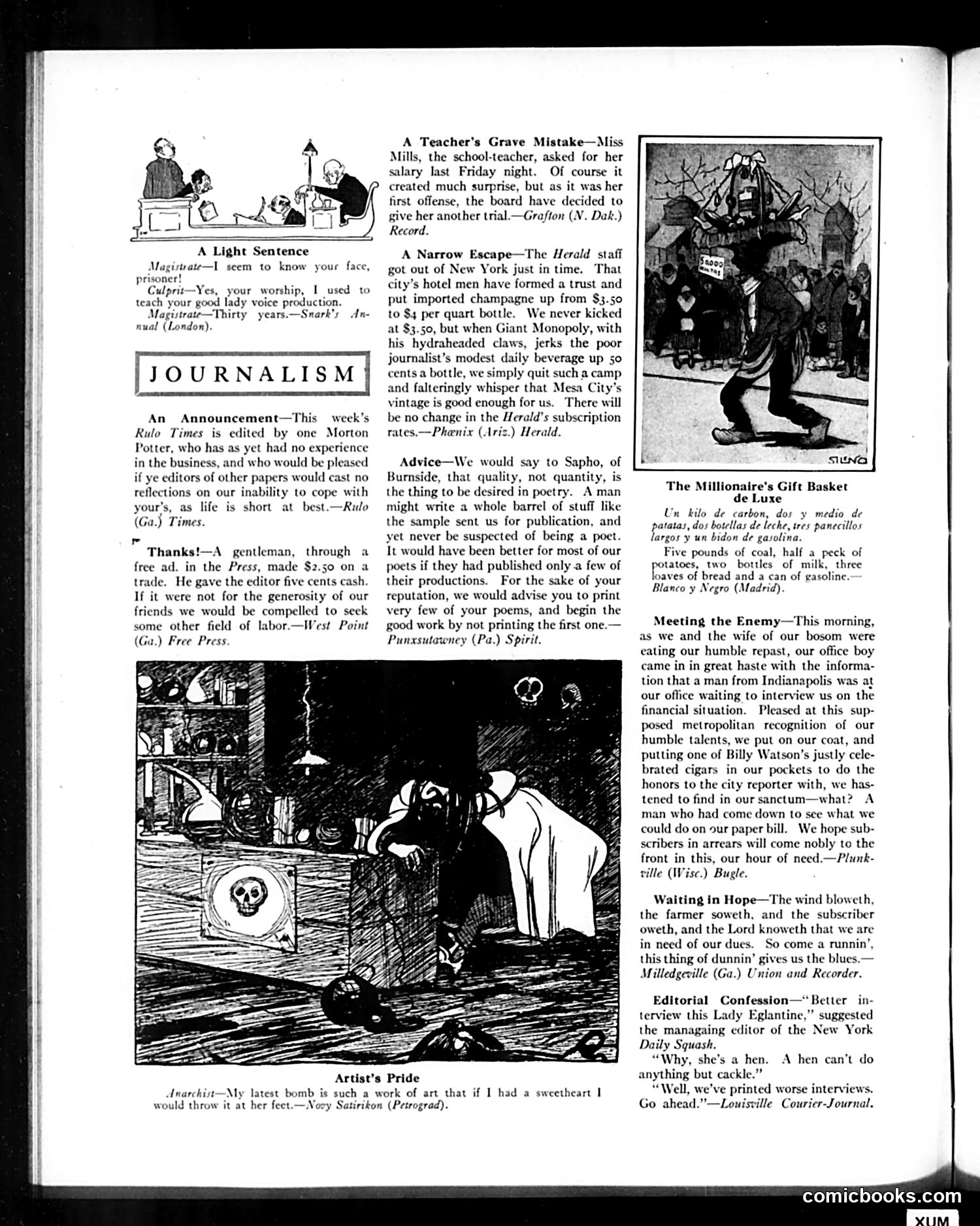
This page collects editorial humor and brief satirical pieces about journalism and small-town life. The main cartoon ("Artist's Pride") depicts an anarchist proudly showing a bomb, claiming it's "such a work of art" he'd throw it at his lover's feet—dark satire on revolutionary extremism viewed as absurd vanity. The "Millionaire's Gift Basket de Luxe" cartoon (with parallel Spanish and English captions) mocks wealthy philanthropists' meager relief efforts during economic hardship—a luxury basket contains only basic necessities: coal, potatoes, milk, bread, and gasoline. The surrounding text pieces parody small-town newspapers' chronic financial struggles and staff incompetence: editors asking competitors not to criticize their inexperience, desperate thanks for tiny advertising revenue, complaints about unpaid subscribers, and a principal giving a harsh sentence to a teacher merely for requesting her salary—all satirizing how rural papers operated on poverty budgets and faced constant money troubles.
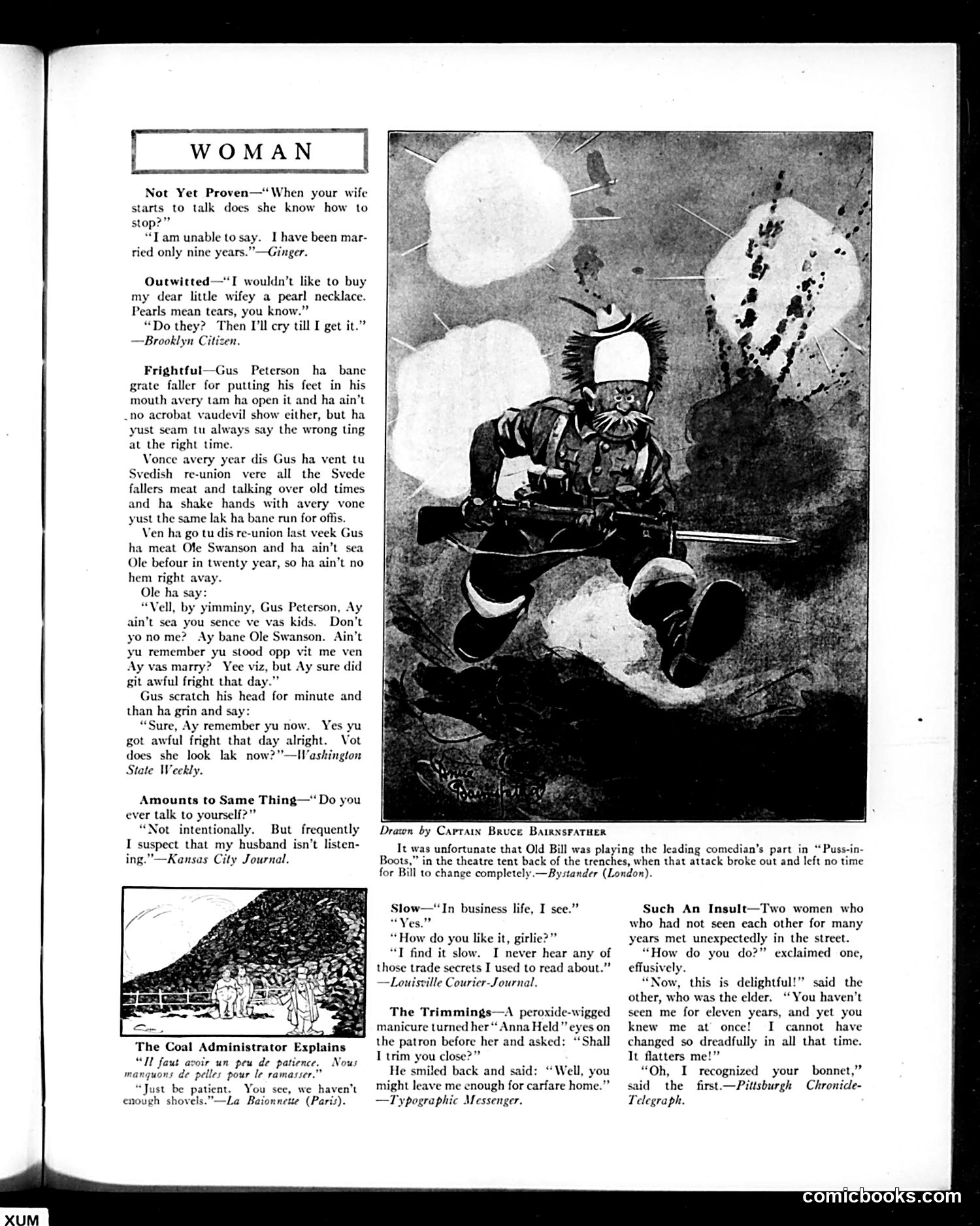
This page from *Judge* magazine collects brief humorous anecdotes about gender relations and social encounters, typical of early-20th-century American satire. The cartoons mock predictable relationship dynamics: wives who won't stop talking, women manipulating husbands for jewelry, and men saying the wrong thing socially. One extended anecdote features Swedish immigrants ("Gus Peterson," "Ole Swanson") with exaggerated dialect humor, depicting a reunion where Gus awkwardly forgets an old acquaintance. The Bruce Bairnsfather cartoon shows a soldier in a theatrical costume ("Puss-in-Boots") caught in a WWI trench attack—satirizing the chaos of war interrupting entertainment. Other jokes target workplace dynamics, flirtation rituals, and women's vanity (a manicurist's response to grooming requests, a woman complimented on her recognizable hat rather than her appearance). The humor reflects period stereotypes about women's materialism, chattiness, and appearance-consciousness, alongside mockery of working-class immigrant speech patterns. The satire assumes a male perspective throughout.
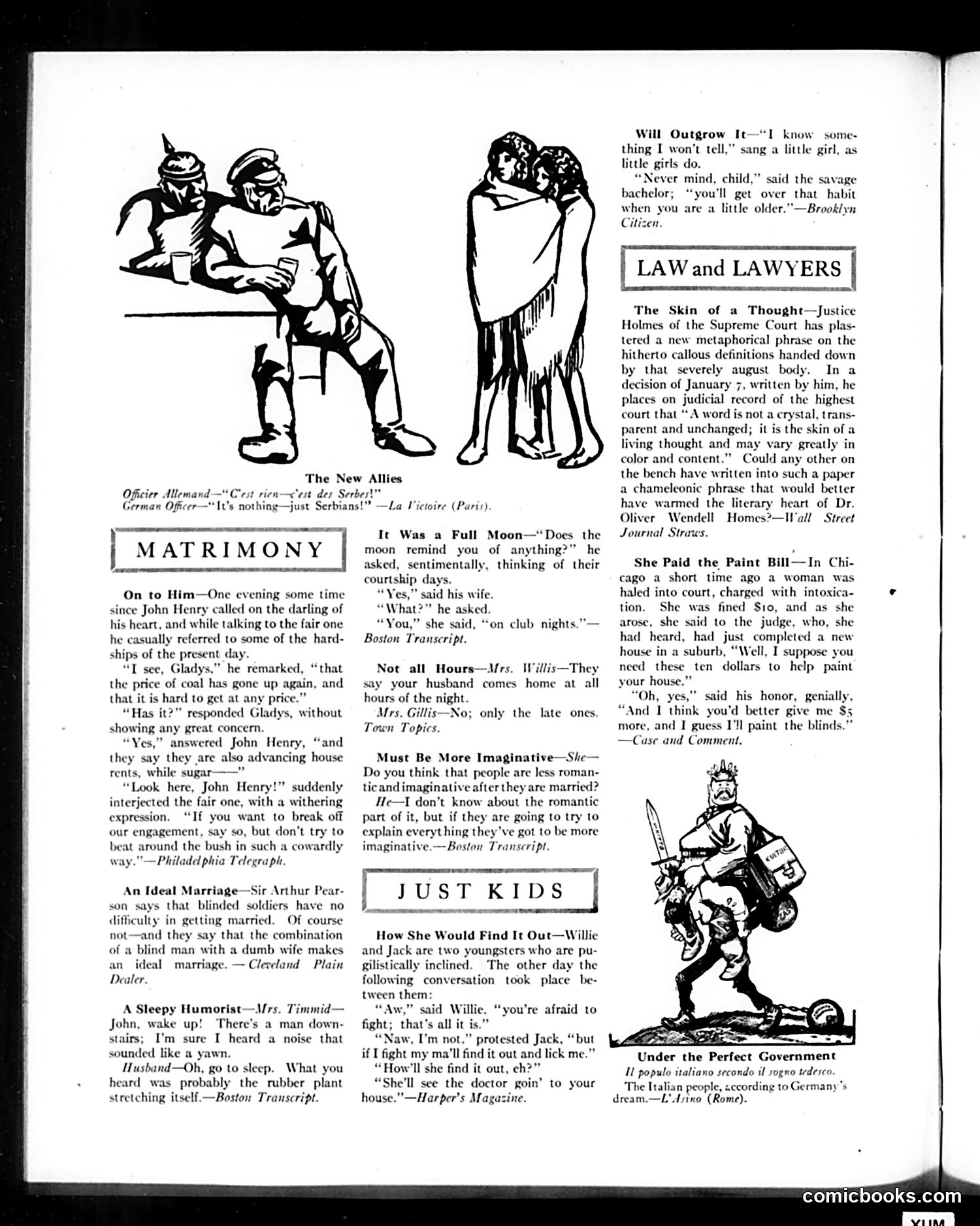
The cartoon depicts a German officer dismissing Serbian soldiers as insignificant ("It's nothing—just Serbians!"), referenced in French as well. This satirizes WWI attitudes: Germany's military confidence and contempt for smaller nations, particularly Serbia, which was a flashpoint of the 1914 conflict. The cartoon mocks German arrogance about the Balkans—treating Serbian resistance as trivial despite Serbia's strategic importance and fierce resistance during the war. The accompanying caption quotes a French newspaper, suggesting international observation of German overconfidence. For modern readers: this reflects pre-war or early-war attitudes about military might versus reality, satirizing how major powers underestimated smaller nations' capacity to resist or complicate larger conflicts.
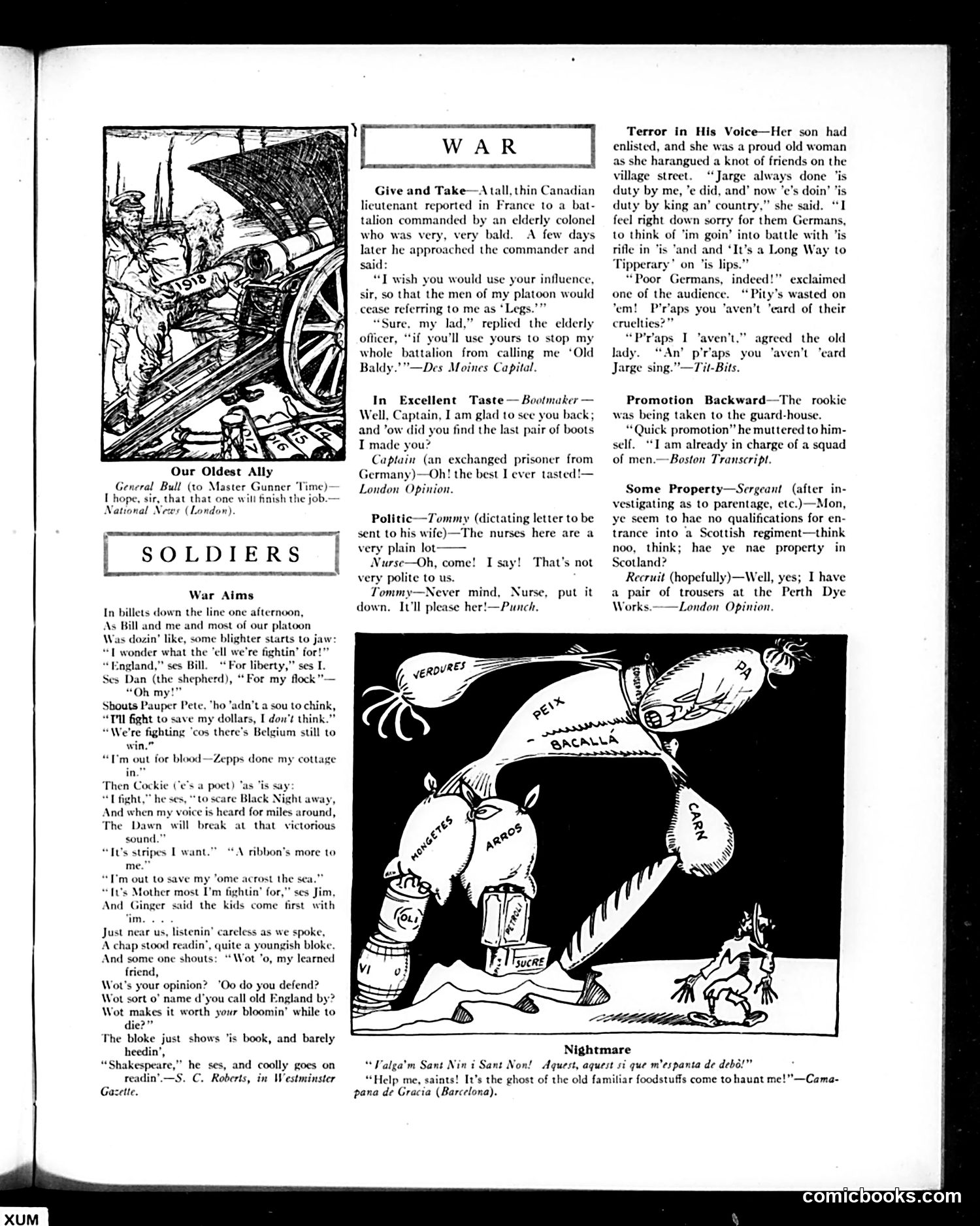
This WWI-era page presents soldiers' perspectives on the war through humor and anecdotes. **"War Aims"** features British soldiers casually debating why they're fighting—some cite Belgium's defense, others mention personal losses (Zeppelin attacks), family protection, or abstract ideals. The satire mocks how ordinary soldiers hold contradictory, sometimes selfish reasons for enlisting, contrasting with official patriotic rhetoric. **"Our Oldest Ally"** (top left) appears to reference France as Britain's traditional ally, suggesting confidence in eventual victory. The remaining brief anecdotes mock military life: a Canadian officer's tall frame versus a bald colonel; a captain's confused taste preferences (likely satirizing German prison conditions); a nurse correcting a soldier's letter-writing; and a mother's fierce pride in her soldier son. **"Nightmare"** (bottom cartoon) depicts a Spanish soldier terrified by apparitions labeled with food items—satirizing wartime food shortages and rationing as genuinely frightening to soldiers. Overall, the page uses working-class British dialect and domestic humor to humanize soldiers while gently critiquing war's absurdities and hardships.
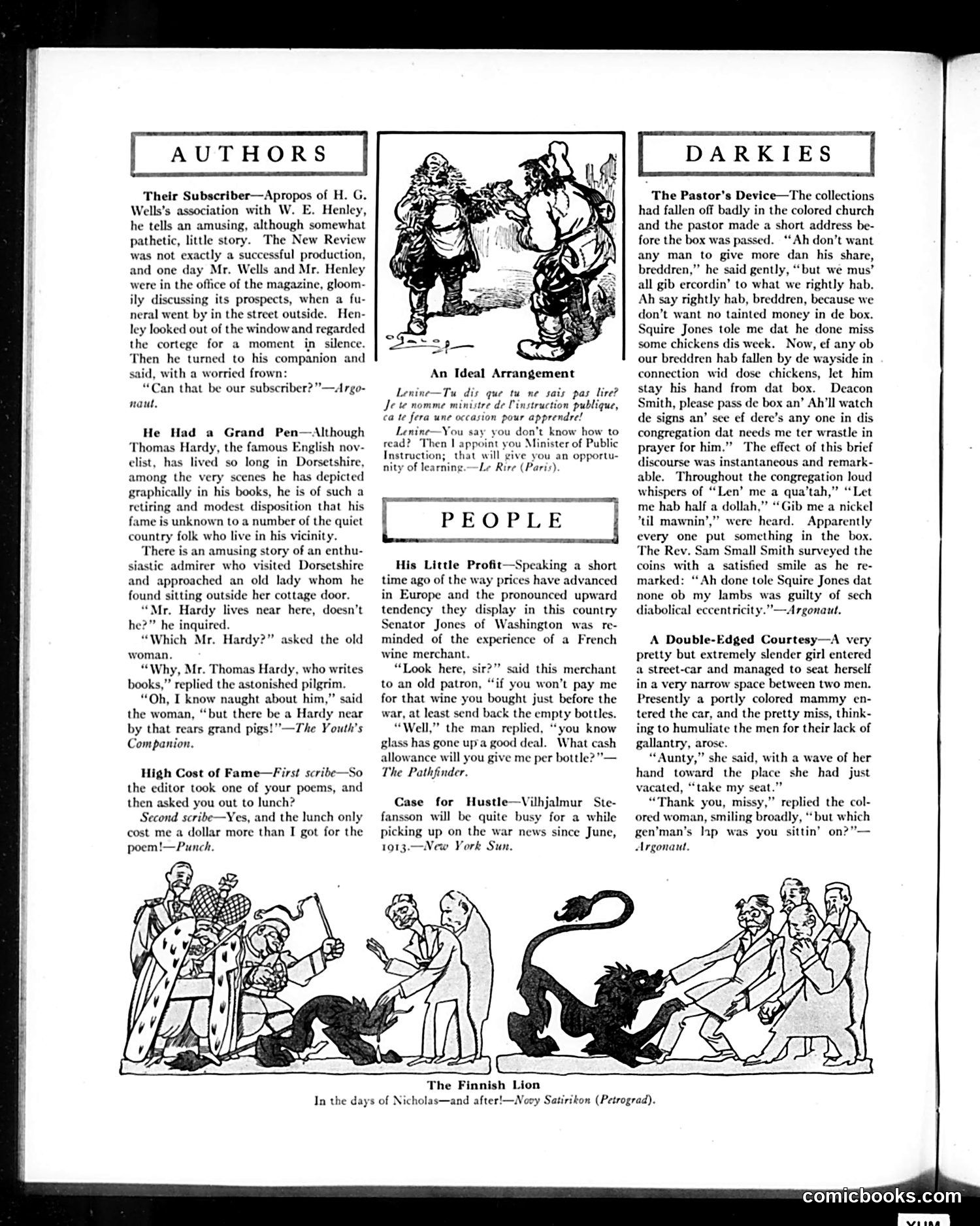
This page contains satirical pieces and cartoons targeting early 20th-century figures and social issues. **The "Ideal Arrangement" cartoon** depicts Lenin (identified in French caption), satirizing Soviet leadership by suggesting Lenin appointed an illiterate as Minister of Public Instruction—the joke being that incompetence was being rewarded rather than punished. This reflects Western anti-Bolshevik sentiment following the 1917 Revolution. **"The Finnish Lion" cartoon** (bottom) appears to reference Finland's struggle for independence from Russia "in the days of Nicholas"—likely Tsar Nicholas II—with the image showing citizens wrestling or fighting a lion, symbolizing Russian imperial power. **"The Pastor's Device"** story mocks African American church culture through dialect humor, depicting a pastor cleverly extracting donations by insinuating that anyone who stole chickens from a white parishioner should donate money to avoid divine punishment. The humor relies on racist stereotypes about Black communities. The page also includes lighter anecdotes about English authors Hardy and Wells, treating literary life humorously.
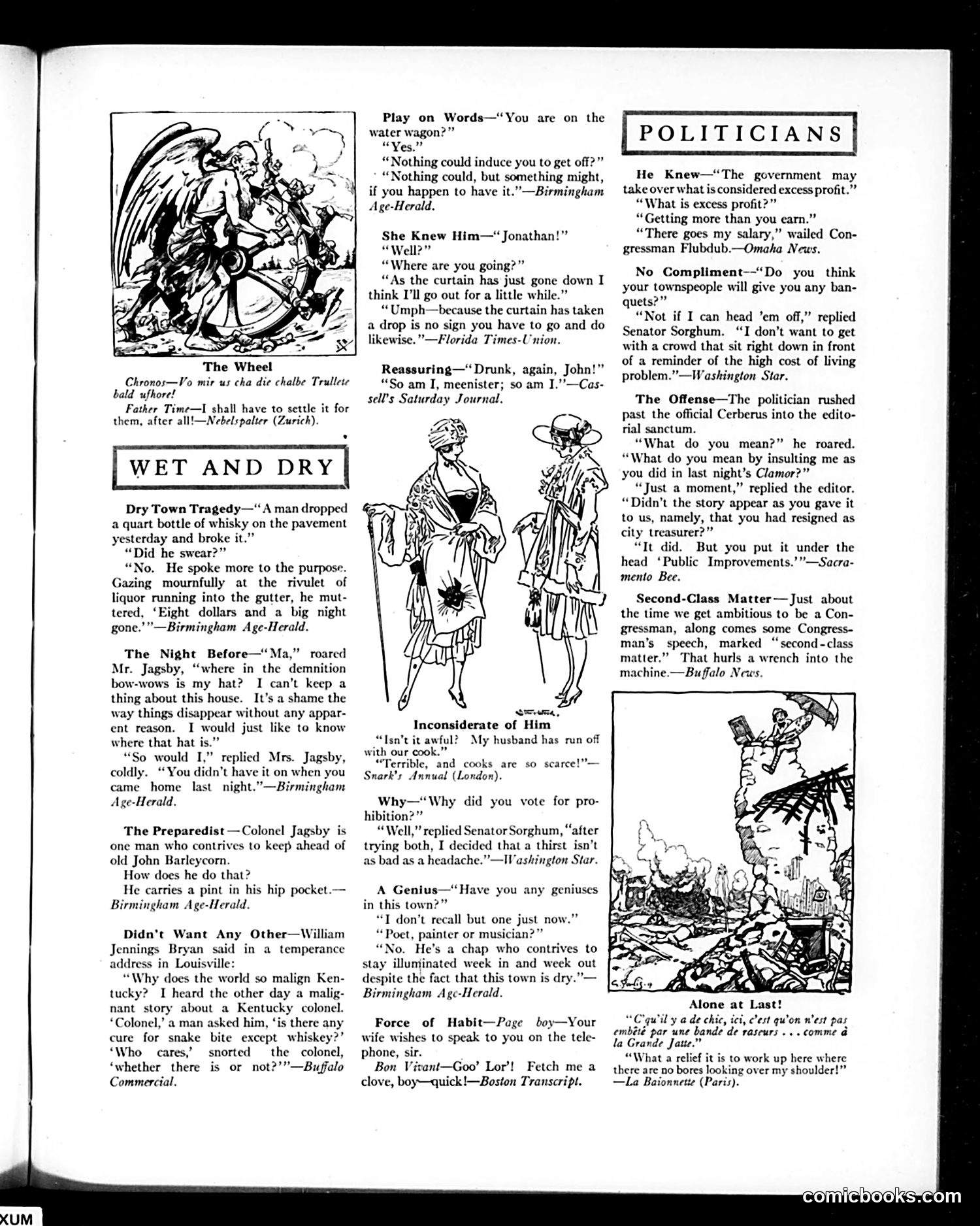
This page satirizes Prohibition and political hypocrisy through short humor pieces. The recurring theme is alcohol—America was debating or enforcing Prohibition during this era. **Key satire points:** - **"Wet and Dry" section**: Jokes about alcohol's scarcity and value during dry towns (areas banning liquor). One quip describes a man mourning spilled whiskey worth "eight dollars and a big night." - **Politicians section**: Mocks politicians' contradictions. Senator Sorghum claims he voted for Prohibition after "trying both" alcohol and sobriety, deciding thirst beats hangovers. A congressman complains about being quoted advocating "Public Improvements" when he actually resigned as treasurer—the editor sardonically used the phrase as cover. - **"Force of Habit"**: A wealthy man ("Bon Vivant") automatically orders a clove cigarette, suggesting habitual excess. The cartoons and quips ridicule both Prohibition's enforcement and politicians' selective morality—they publicly support temperance while privately indulging or benefiting from corruption. The humor exploits era-specific economic and social anxieties about alcohol availability and political dishonesty.
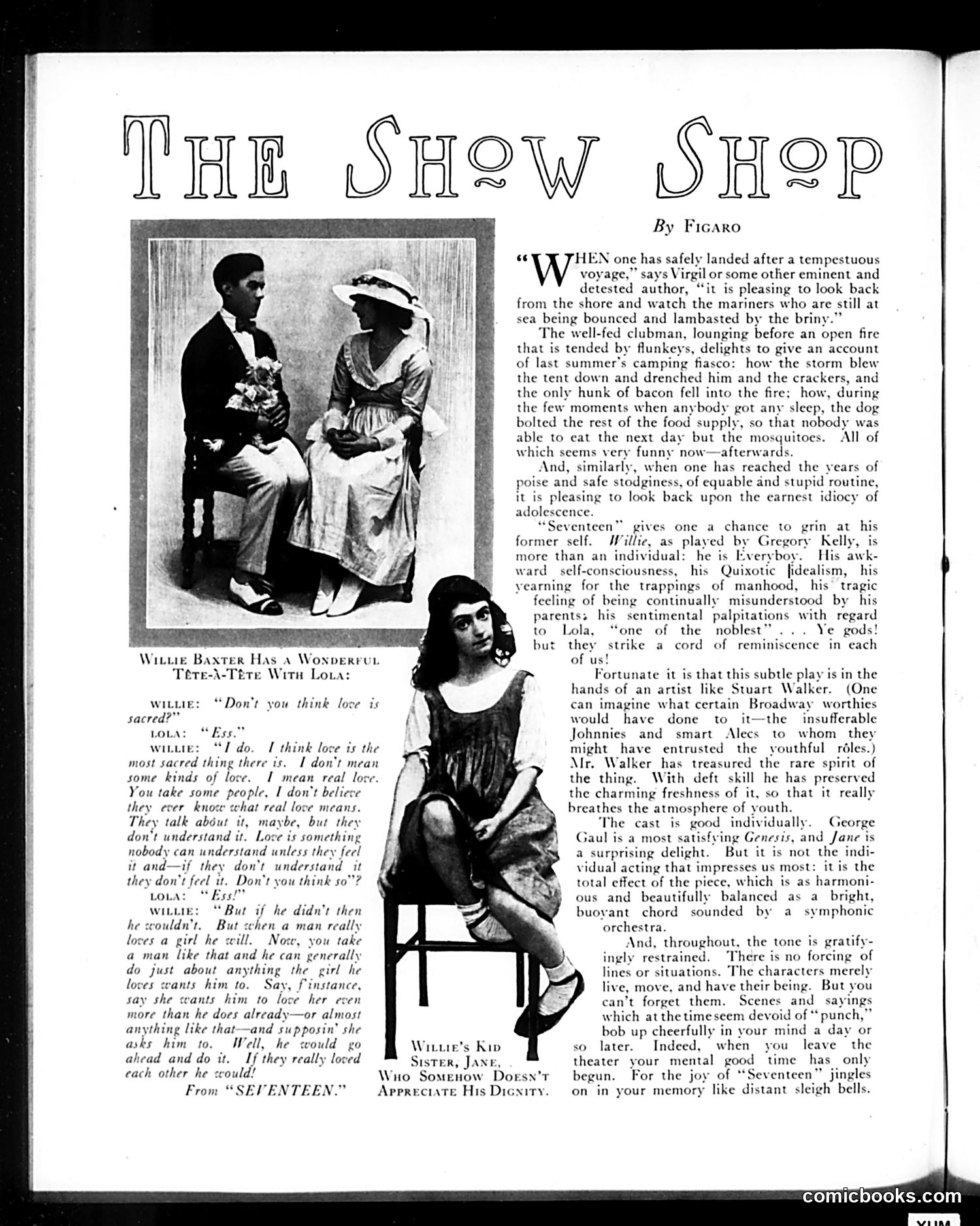
This page reviews the stage play **"Seventeen,"** directed by Stuart Walker and starring Gregory Kelly as Willie Baxter. The review, attributed to Figaro (a Judge pseudonym), praises the production as a nostalgic comedy about adolescence. The satirical premise is that adults enjoy remembering teenage awkwardness from a safe distance—just as travelers enjoy recounting camping disasters once home. Willie, played by Kelly, represents "Everyboy": self-conscious, idealistic, misunderstood by parents, and sentimentally preoccupied with a girl named Lola. The dialogue snippet shows Willie earnestly philosophizing about "real love" to Lola, capturing the play's tone of gentle mockery of adolescent earnestness. The reviewer praises Walker's restraint in preserving the play's "charming freshness" and its balanced ensemble cast, noting the show's quiet charm lingers in memory "like distant sleigh bells" rather than relying on obvious comedic "punch."
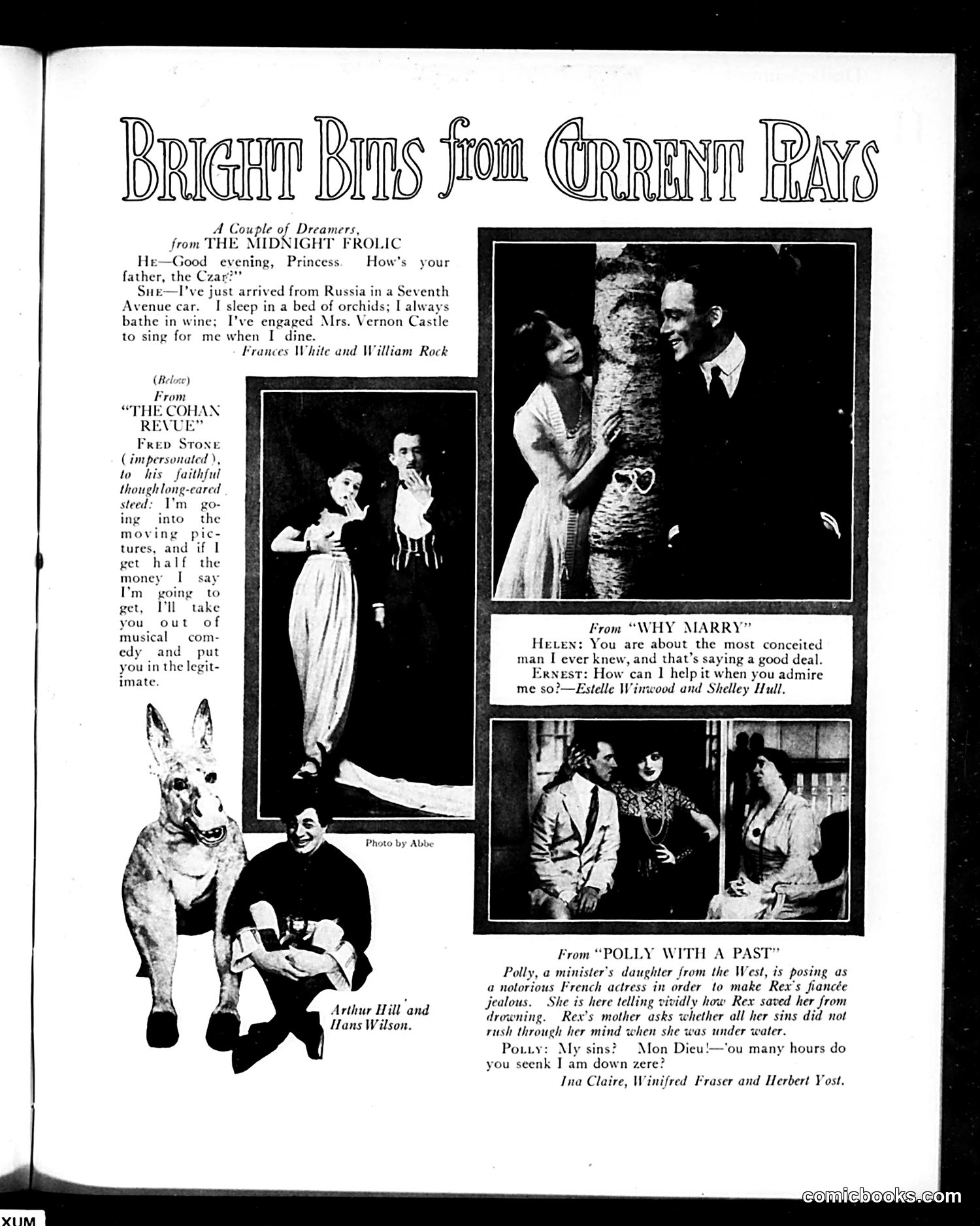
This page collects humorous excerpts from Broadway productions of the era, featuring popular theatrical stars. The humor relies on theatrical absurdity and character pretense: **"The Midnight Frolic"** excerpt mocks nouveau-riche pretension: a woman claims Russian nobility and outrageous luxury (sleeping in orchids, bathing in wine, employing Mrs. Vernon Castle as a personal singer). **"Why Marry"** presents a romantic comedy exchange where a conceited man boasts of being admired. **"Polly with a Past"** satirizes a minister's daughter posing as a French courtesan—the joke being her pragmatic response when asked if sins crossed her mind while drowning. Her dismissive French accent reply ("how many hours do you think I was down there?") suggests moral flexibility. The lower left shows Fred Stone (a popular comedian) threatening to move his donkey co-star from musical comedy to "legitimate" theater if he makes enough money—absurdist humor about theatrical ambition. These are light theatrical gossip items showcasing Broadway's popular entertainments and stars.
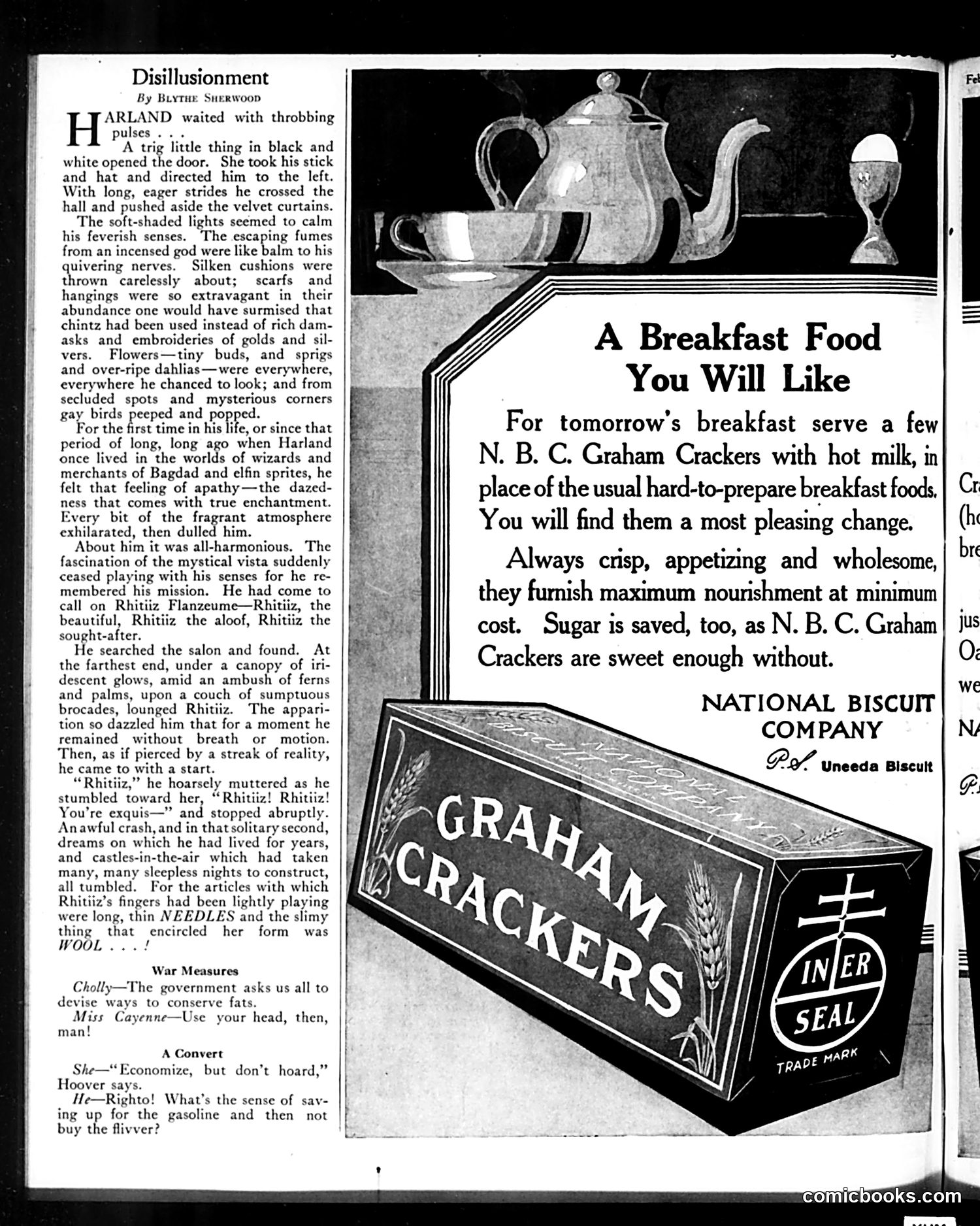
This page contains a short story titled "Disillusionment" by Blythe Sherwood alongside period advertising. **The Story:** A man named Harland visits an elaborately decorated salon to call on a woman named Rhitiiz, whom he romanticizes as exotic and mysterious. Upon finding her, his dreams shatter when he discovers she's knitting—her "fingers had been lightly playing" with "long, thin NEEDLES" and "the slimy thing that encircled her form was WOOL." **The Satire:** The humor targets romantic idealization of women. Harland constructs an elaborate fantasy around Rhitiiz through her mysterious, luxurious presentation, only to find her engaged in mundane domestic work (knitting). The story mocks men who project fantasy onto women rather than seeing them as ordinary people with everyday activities. **The Advertising:** The page also features an N.B.C. Graham Crackers advertisement promoting wartime food economy—fitting for the likely WWI-era publication. The piece reflects early 20th-century gender commentary and class attitudes toward women's domestic roles.
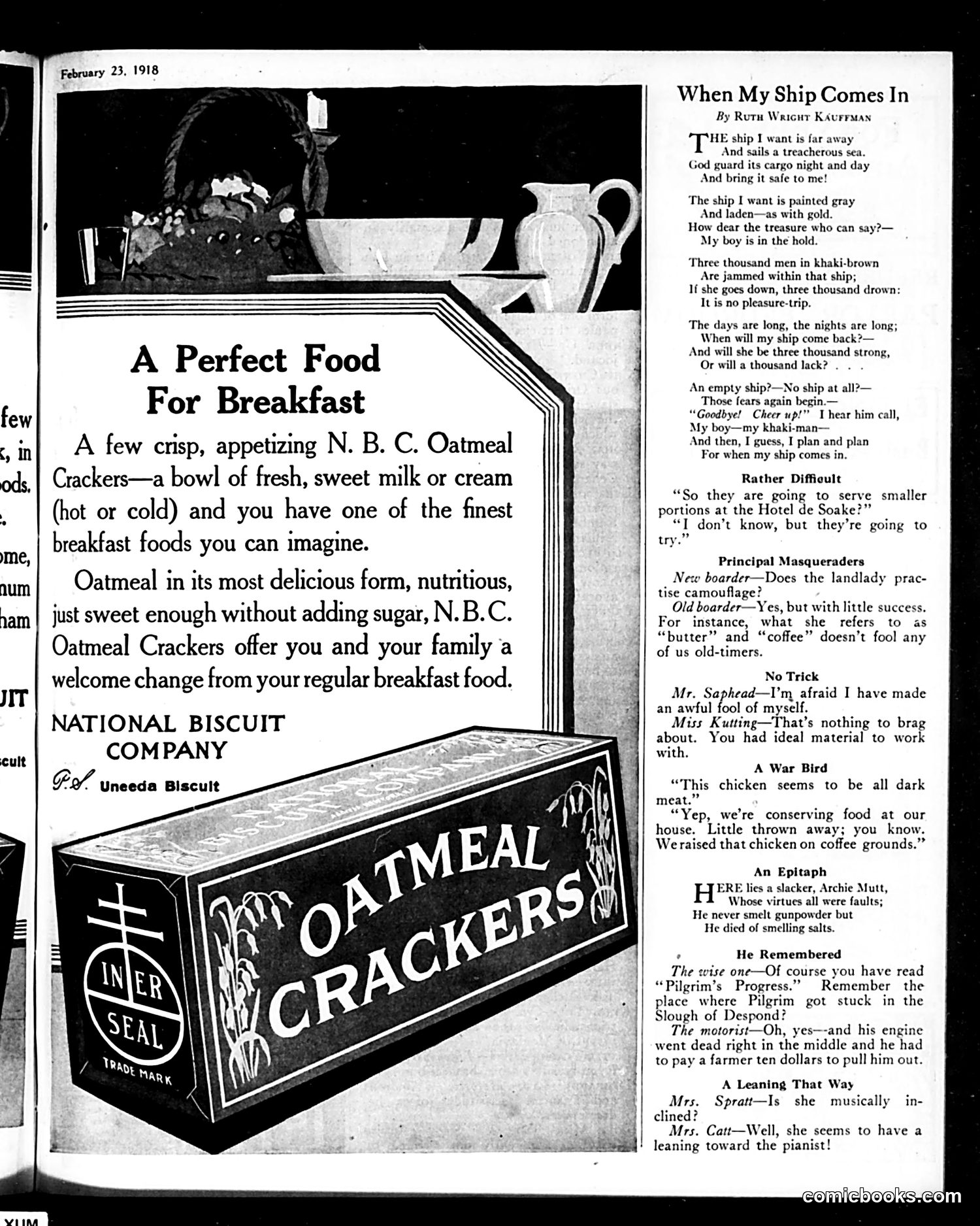
This page mixes advertisement with wartime humor. The **N.B.C. Oatmeal Crackers ad** (left) is straightforward product promotion. The **right side contains satirical short pieces** reflecting WWI anxieties. "When My Ship Comes In" by Ruth Wright Kauffman is the most significant—it's a poignant poem about a mother waiting for her son to return from war ("My boy is in the hold" of a ship carrying 3,000 khaki-clad soldiers). The anxiety about whether the ship will return fully crewed ("Will a thousand lack?") reflects real wartime losses. The other brief jokes address **home-front wartime concerns**: food rationing ("Hotel de Soake"), food conservation (chicken raised on coffee grounds), and **draft-dodging mockery** ("slacker"). The "Principal Masqueraders" joke about landlady's poor-quality food uses the contemporaneous term "camouflage"—military jargon entering civilian speech. Overall, the page juxtaposes commercial normalcy with earnest and satirical reflections on war's impact on American families and society.
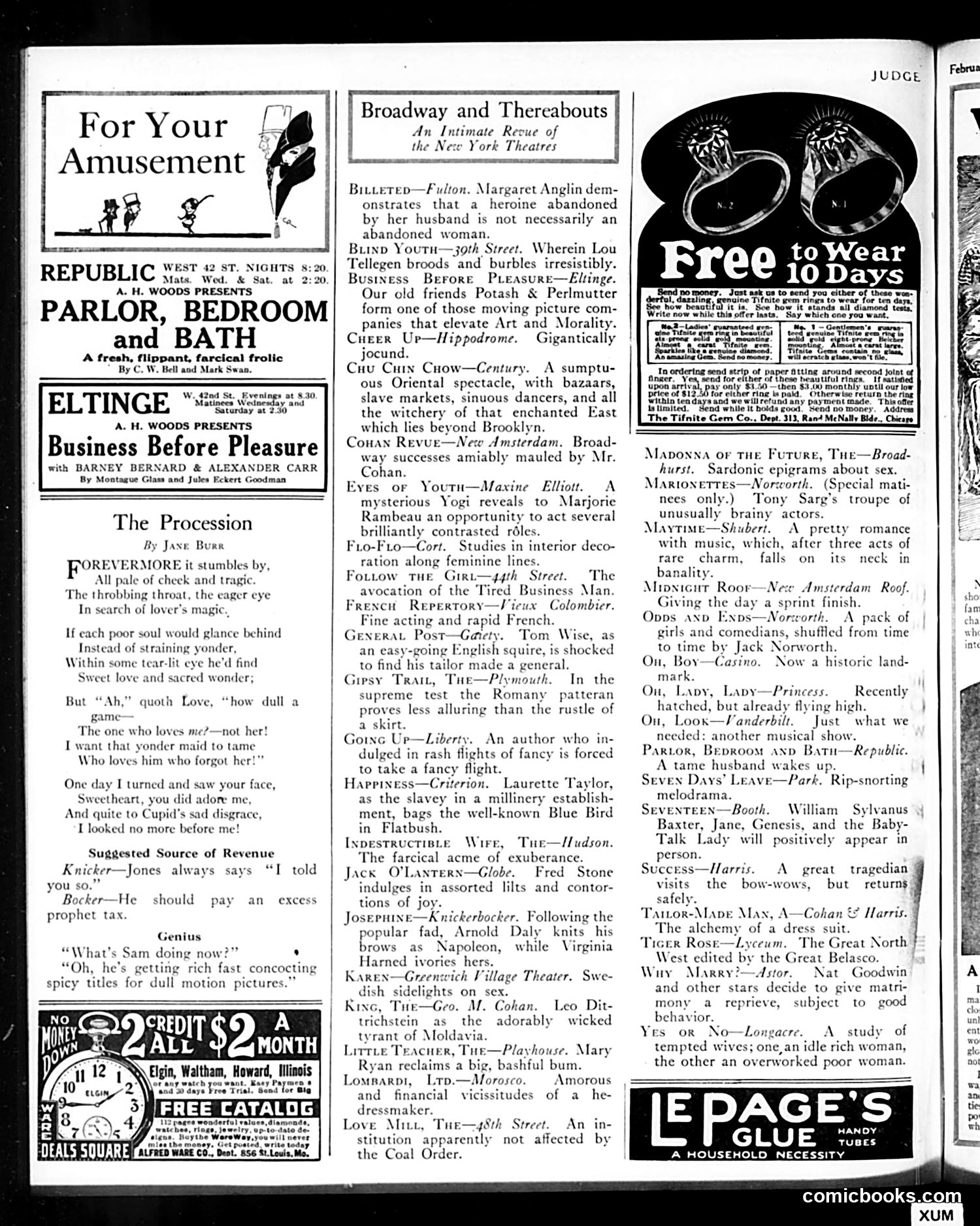
This page is primarily **theatrical advertising and reviews**, not political satire. It features: **"Broadway and Thereabouts"** — a theater column reviewing New York productions of the era. Notable shows include "Chu Chin Chow" (an Oriental spectacle), "Business Before Pleasure" (featuring vaudeville stars Potash & Perlmutter), and various dramatic works. The reviews use playful, punchy language typical of Judge's irreverent style. **Left side content** includes advertisements for theatrical productions and a poem "The Procession" by Jane Burr about romantic longing — standard magazine filler. **The "Free to Wear 10 Days" ring advertisement** (upper right) is a mail-order jewelry promotion, common in period magazines. There is **no discernible political cartoon or social satire** on this page. It's essentially entertainment and consumer advertising dressed in Judge's characteristic witty, theatrical house style — reflective of the magazine's urban, Broadway-focused readership during the early 20th century.
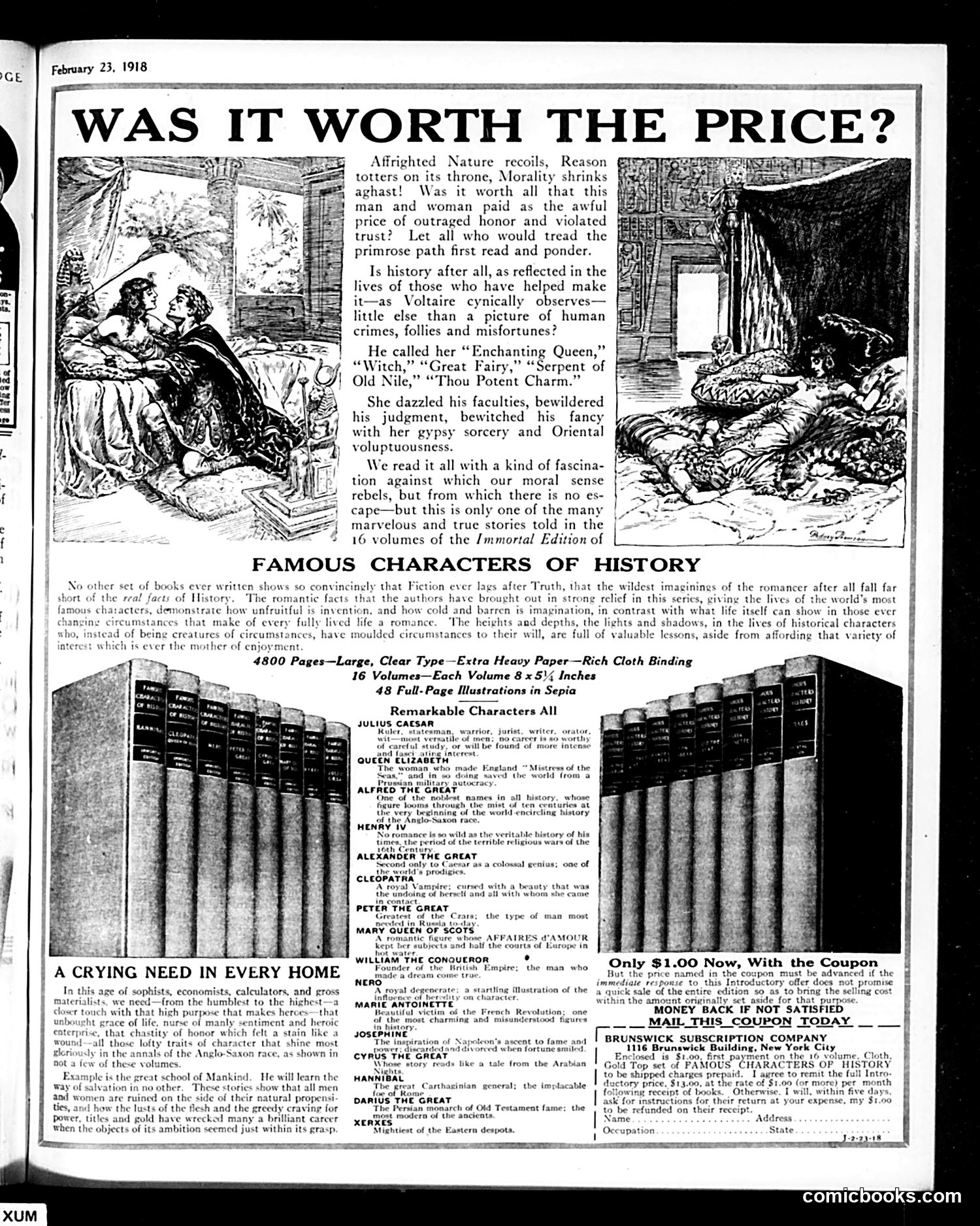
This 1918 *Judge* page combines editorial moralism with a book advertisement. The heading "WAS IT WORTH THE PRICE?" introduces two illustrated vignettes depicting romantic/sexual scandal—likely referencing historical figures like Cleopatra and Caesar (named in the book listing below). The text warns against the "primrose path" of seduction, presenting these figures' romantic entanglements as cautionary tales of "outraged honor and violated trust." The accompanying advertisement promotes a 16-volume "Immortal Edition of Famous Characters of History," selling it as morally instructive despite featuring scandalous stories. The pitch suggests readers will learn virtue *through* tales of vice—a tension the ad exploits: thrilling scandal packaged as self-improvement. This reflects Progressive Era attitudes (WWI-era America): fascination with sensational history tempered by moralizing rhetoric. The coupon-based sales approach was common advertising practice of the period.
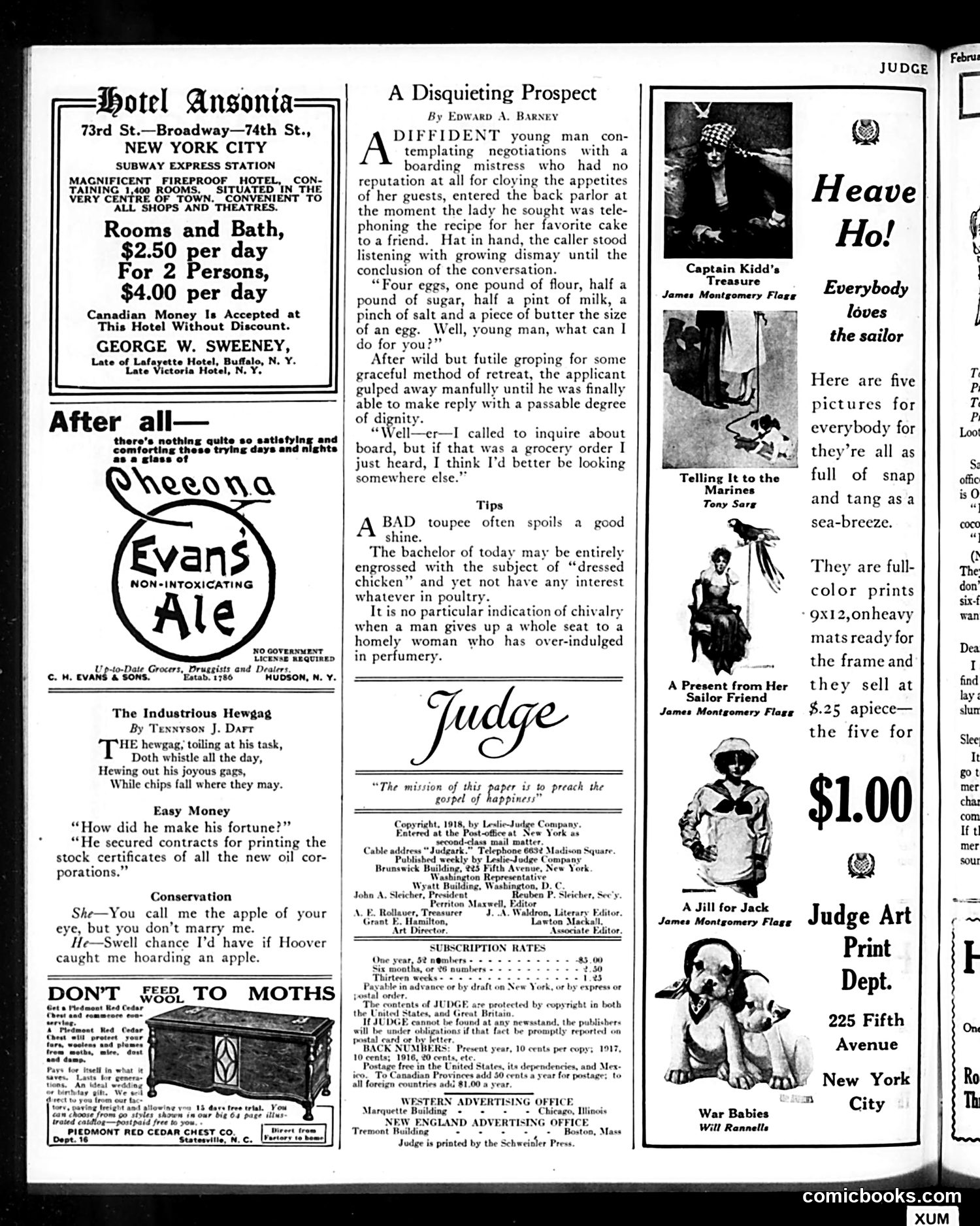
This is primarily a **commercial/advertising page** with some satirical content. The main elements are: **The Humor Pieces:** - "A Disquieting Prospect" satirizes boarding house meals—a young man seeking lodging discovers the landlady is phoning a cake recipe, implying meager food rations. The joke reflects post-WWI concerns about food scarcity/rationing. - "Conservation" references Herbert Hoover's food conservation campaign (he was Food Administrator during WWI), joking that men fear being caught "hoarding" even an apple. **The Illustrations:** Five patriotic maritime scenes by James Montgomery Flagg (a famous WWI-era illustrator) celebrate sailors, likely wartime propaganda. Titles reference naval themes ("Captain Kidd's Treasure," "War Babies"). **Heavy Advertising:** Hotel Ansonia, Evans Ale (non-intoxicating), moth prevention products, and the Judge Art Print Department dominate the page. The overall tone reflects **1918 wartime America**—rationing anxieties, patriotic mobilization, and commercial opportunism coexisting on a single page.
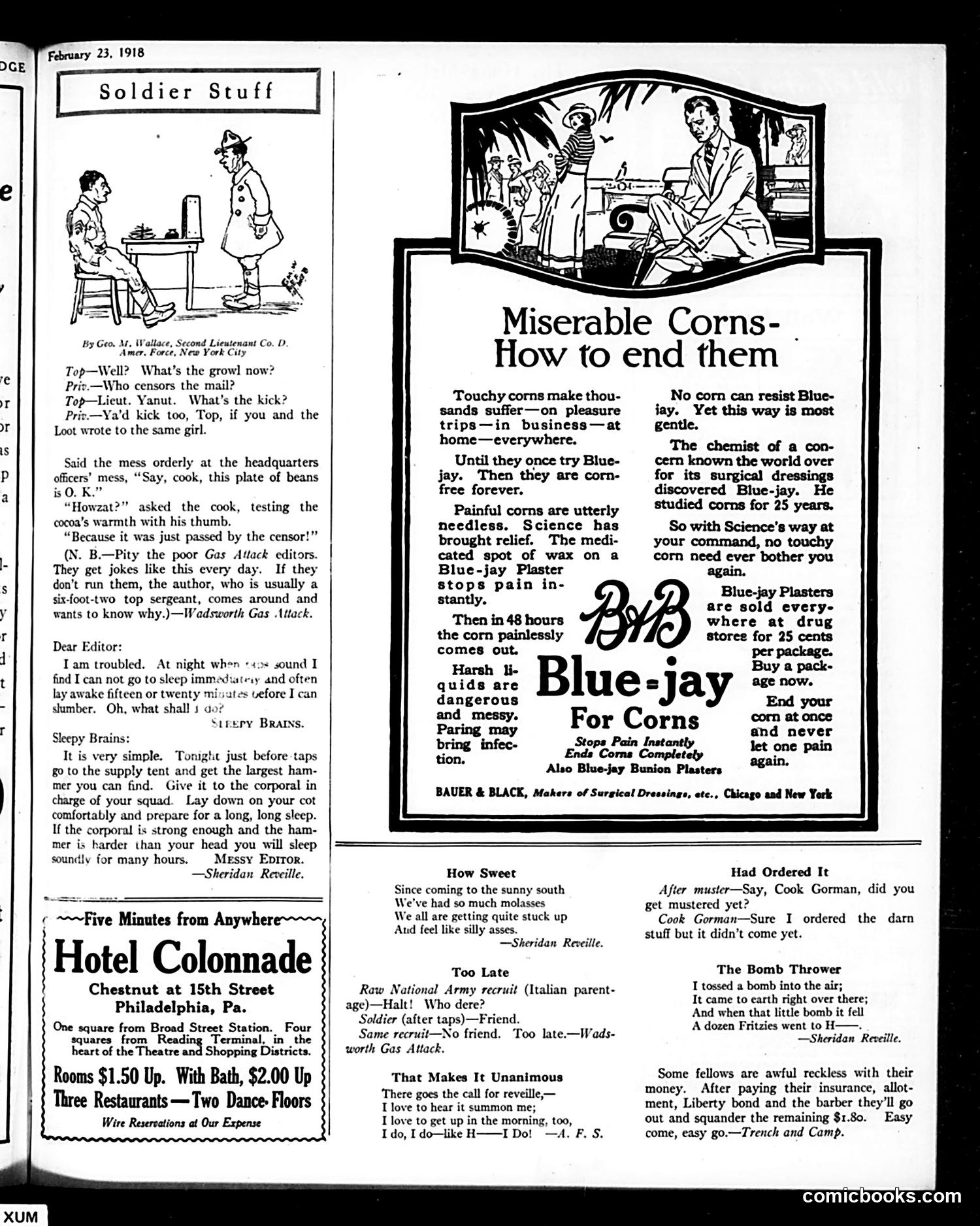
This February 1918 *Judge* page collects military humor from American soldiers during WWI's final year. The cartoons and jokes satirize army life and wartime conditions: **"Soldier Stuff" cartoon**: A soldier complains about mail censorship—two officers censor letters to the same girl, creating romantic rivalry. This mocks both military bureaucracy and the common soldier's frustration with censors reading private correspondence. **Recurring themes**: Multiple pieces joke about army food ("beans...passed by the censor"), insomnia from artillery sounds, and the brutal military hierarchy (a sergeant might assault you if you don't print his joke). **Pro-war content**: "The Bomb Thrower" celebrates killing German soldiers ("Fritzies"), while "That Makes It Unanimous" humorously suggests universal enthusiasm for dawn reveille. The page primarily advertises Blue-jay corn plasters and a Philadelphia hotel. The humor reflects soldiers' dark comedic coping with regimentation, danger, and boredom during active wartime.
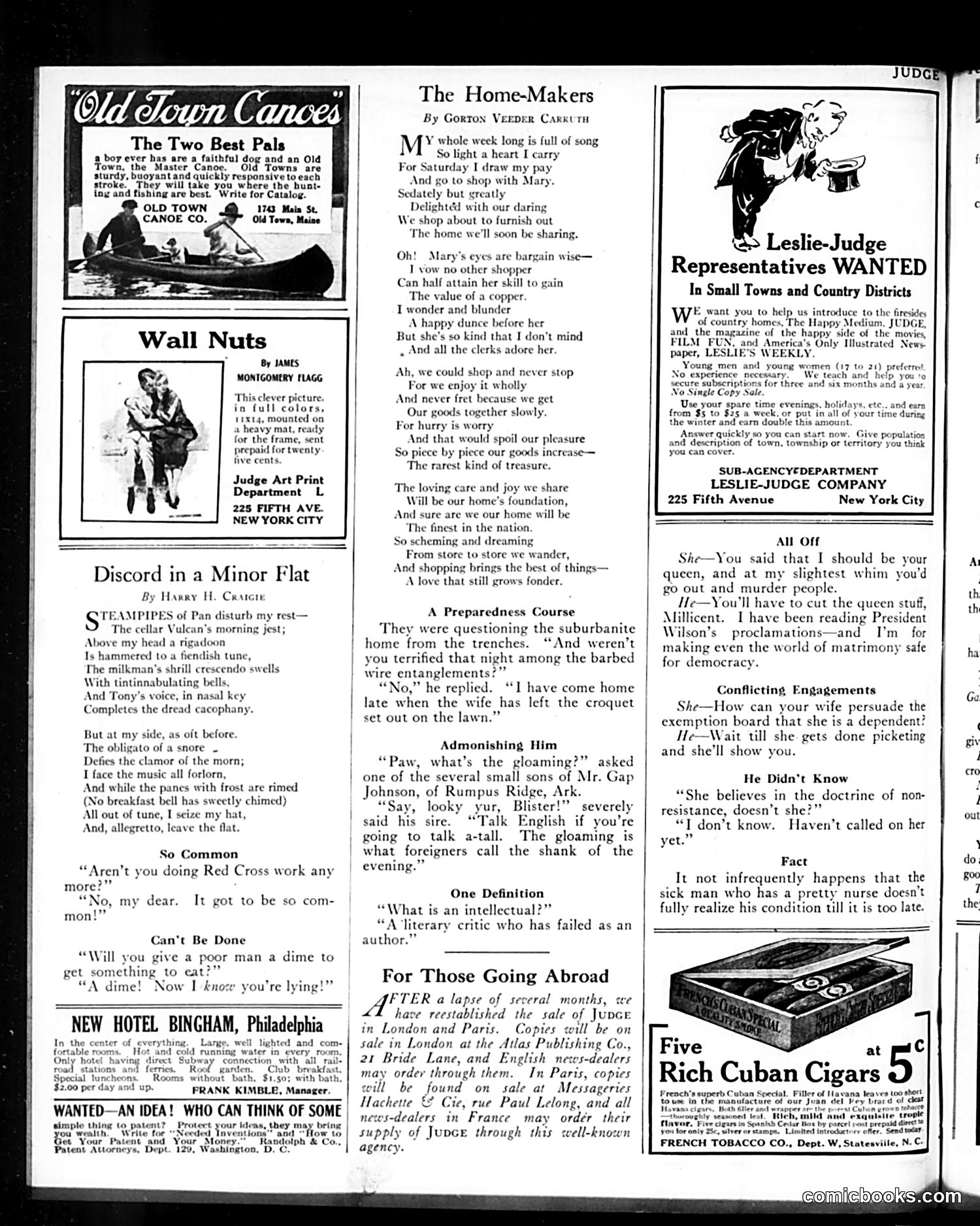
This page is primarily **advertising and light humor**, not political satire. The main content includes: **"The Home-Makers"** — A sentimental poem celebrating a young couple shopping together to furnish their new home before marriage, emphasizing domestic contentment and the wife's shrewd bargaining skills. **Humor pieces** like "Discord in a Minor Flat" (tenement noise complaints), "Preparedness Course" (a joke equating croquet equipment left on a lawn to wartime danger), and "Admonishing Him" (rural dialect humor about a father correcting his son's use of the word "gloaming"). **Advertisements** dominate: Old Town Canoes, Judge Art Prints, a Philadelphia hotel, patent services, and Cuban cigars. The page reflects **pre-WWI American middle-class values**: domesticity, consumer shopping, class-based humor (rural vs. urban speech patterns), and nostalgia. The humor relies on now-dated references to tenement life and sentimental courtship rituals rather than sharp political commentary.
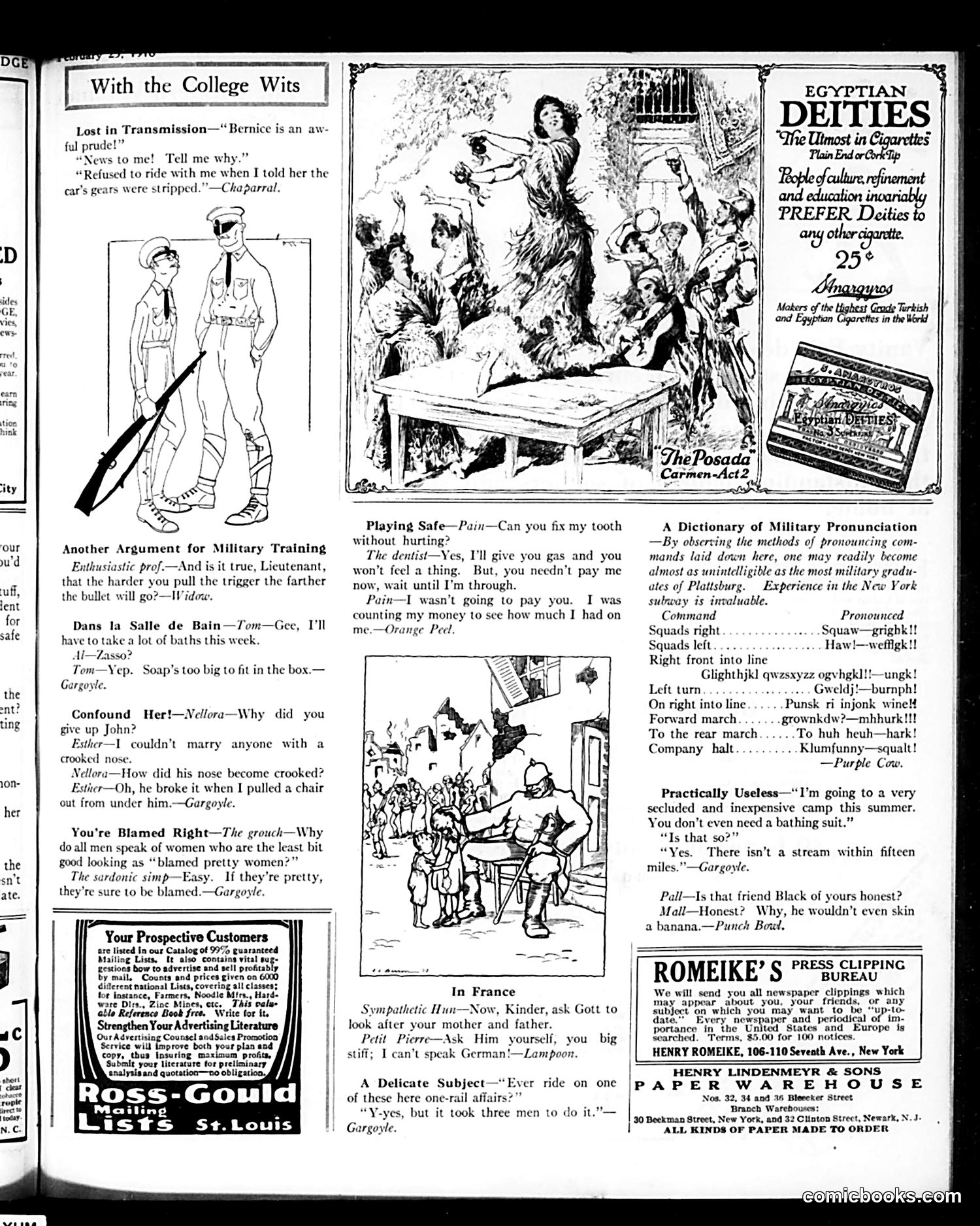
This page from Judge magazine (dated February 27, 1918) contains college humor and wartime satire. The main content includes: **"With the College Wits"** — A series of brief jokes from college humor magazines (Chaparral, Gargoyle, Lampoon, etc.). These mock naive or foolish exchanges among students—a young man misinterpreting a woman's refusal to ride in a car with stripped gears as prudishness; absurdist bathroom humor. **"Another Argument for Military Training"** — A joke where a professor naively asks a military officer if pulling a trigger harder makes bullets go farther, mocking the public's ignorance about firearms during WWI. **"Sympathetic Hun" and "Petit Pierre"** — References to German ("Hun") soldiers; a joke about a French child unable to speak German to pray. **"Dictionary of Military Pronunciation"** — A satirical guide to military speech, mocking how officers bark unintelligible orders. The page predominantly advertises mailing lists, cigarettes, and newspaper clipping services. It's typical WWI-era humor satirizing military training, courtship confusion, and wartime cultural differences.
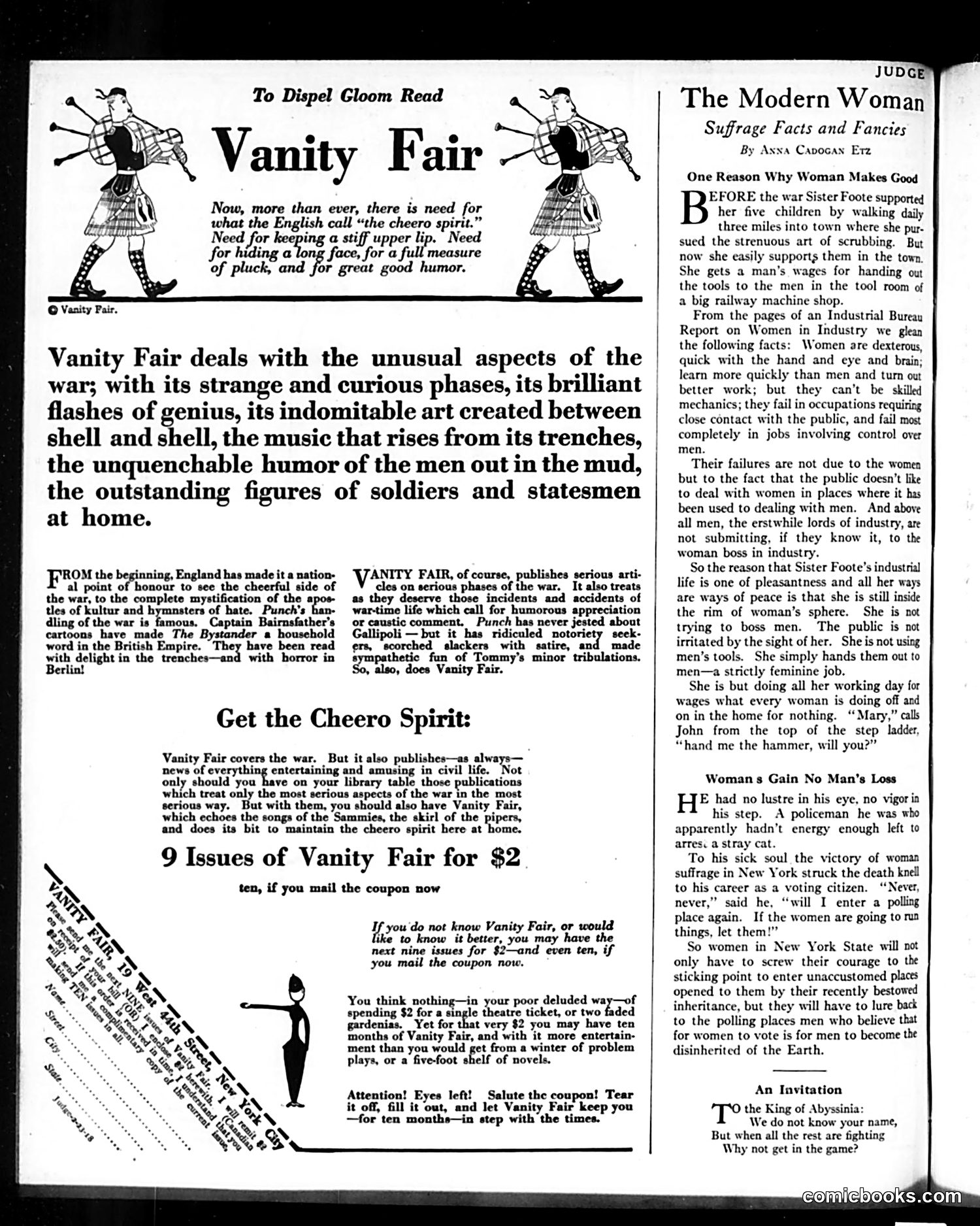
This page from Judge magazine, a rival to Vanity Fair, addresses wartime morale during World War I. The left side advertises Vanity Fair magazine, emphasizing its role in maintaining "cheero spirit"—British stoicism and humor amid war's grimness. It references real wartime cartoonists (Captain Bairnsfather, Punch magazine) and appeals to readers' desire for entertaining war coverage alongside serious journalism. The right column, "The Modern Woman: Suffrage Facts and Fancies" by Anna Cadogan Ertz, discusses women's wartime industrial work. It argues women succeed as factory workers (dexterous, quick learners) but fail in supervisory roles—not due to capability but because male workers and the public resist female authority. The piece sardonically presents an "Industrial Bureau Report" claiming women can't handle skilled mechanics or public-facing jobs, revealing contemporary gender prejudices disguised as fact. This supports the suffrage argument: if women can do men's wartime jobs, they deserve equal political rights.
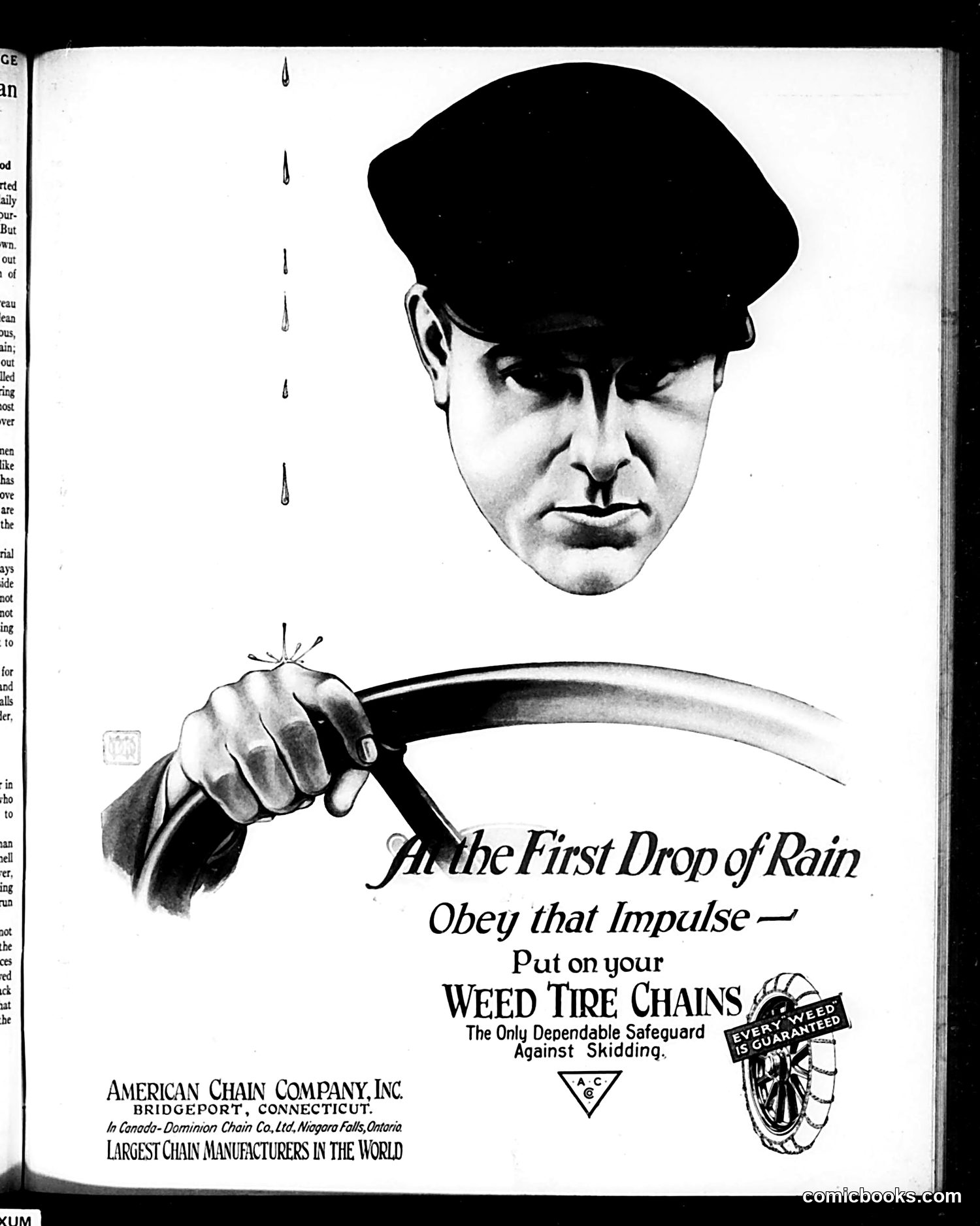
This is an advertisement for Weed Tire Chains, not a political cartoon. It features a man in a cap holding a curved tire chain, with falling raindrops illustrated above. The ad's message urges drivers to immediately put on tire chains at the first sign of rain for safety against skidding—a practical concern when road traction was a genuine hazard in early automotive history. The "impulse" referenced is the instinctive response to approaching wet weather. The American Chain Company, based in Bridgeport, Connecticut, markets their product as "the only dependable safeguard" for vehicle safety. This reflects the era when tire chains were essential winter/wet-weather equipment.
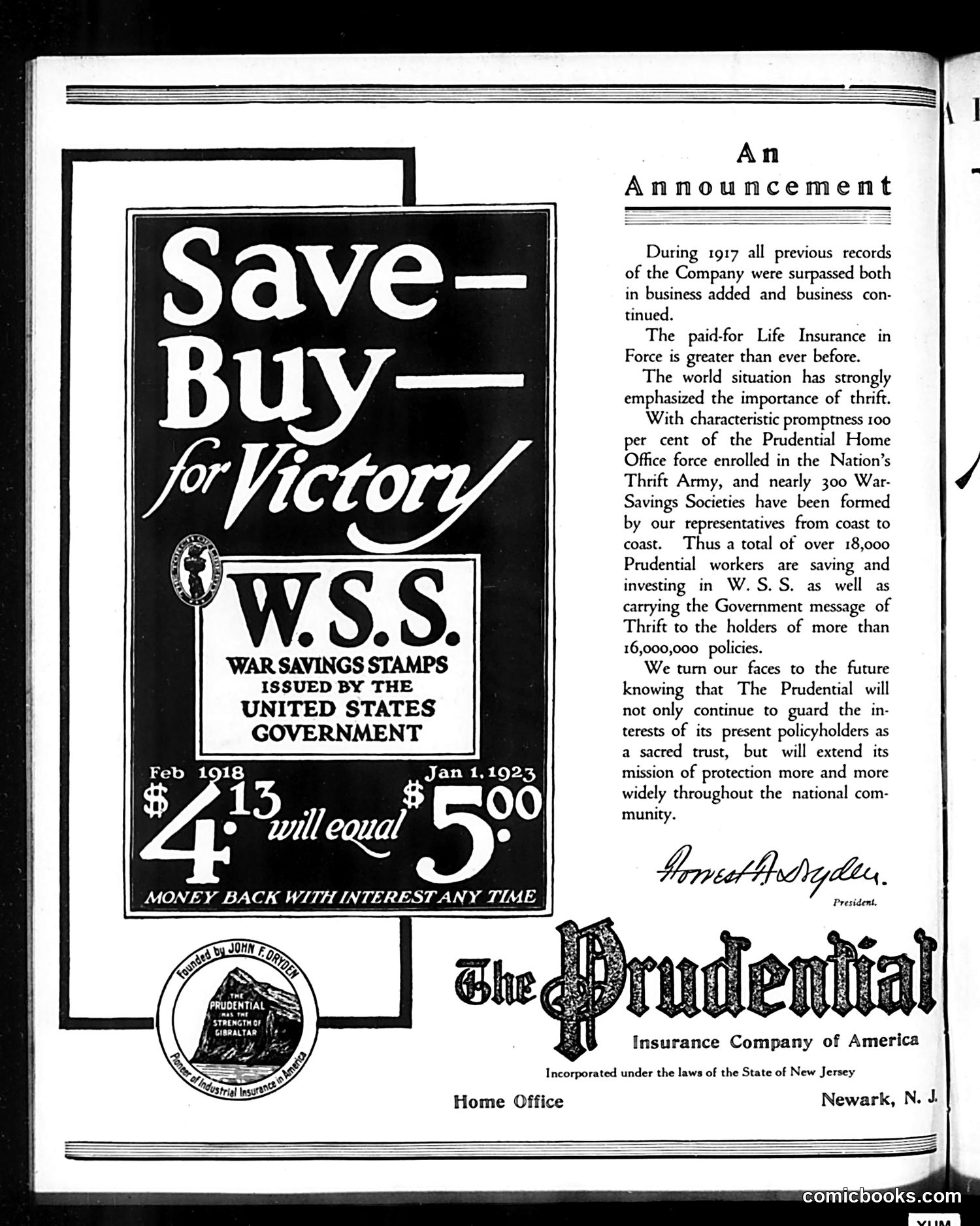
This is primarily a **War Bonds advertisement**, not satire. The Prudential Insurance Company uses patriotic messaging to promote War Savings Stamps (W.S.S.) during World War I. **Key elements:** - The "Save-Buy for Victory" poster advertises U.S. government-issued War Savings Stamps, convertible from 4¢ (Feb 1918) to 5.00 dollars (Jan 1, 1923) - The accompanying announcement celebrates that Prudential's entire home office force enrolled in the "Nation's Thrift Army" - Nearly 300 War-Savings Societies were formed by Prudential representatives - Over 18,000 Prudential workers invested in W.S.S., reaching 16 million policyholders **Context for modern readers:** During WWI, the U.S. government encouraged savings through these stamps as a patriotic and financial duty. Large corporations like Prudential leveraged employee participation to demonstrate corporate patriotism while promoting thrift. This represents corporate-government cooperation during wartime mobilization.