
Judge, 1918-02-23 · page 22 of 36
Judge — February 23, 1918 — page 22: what you’re looking at
What you’re looking at
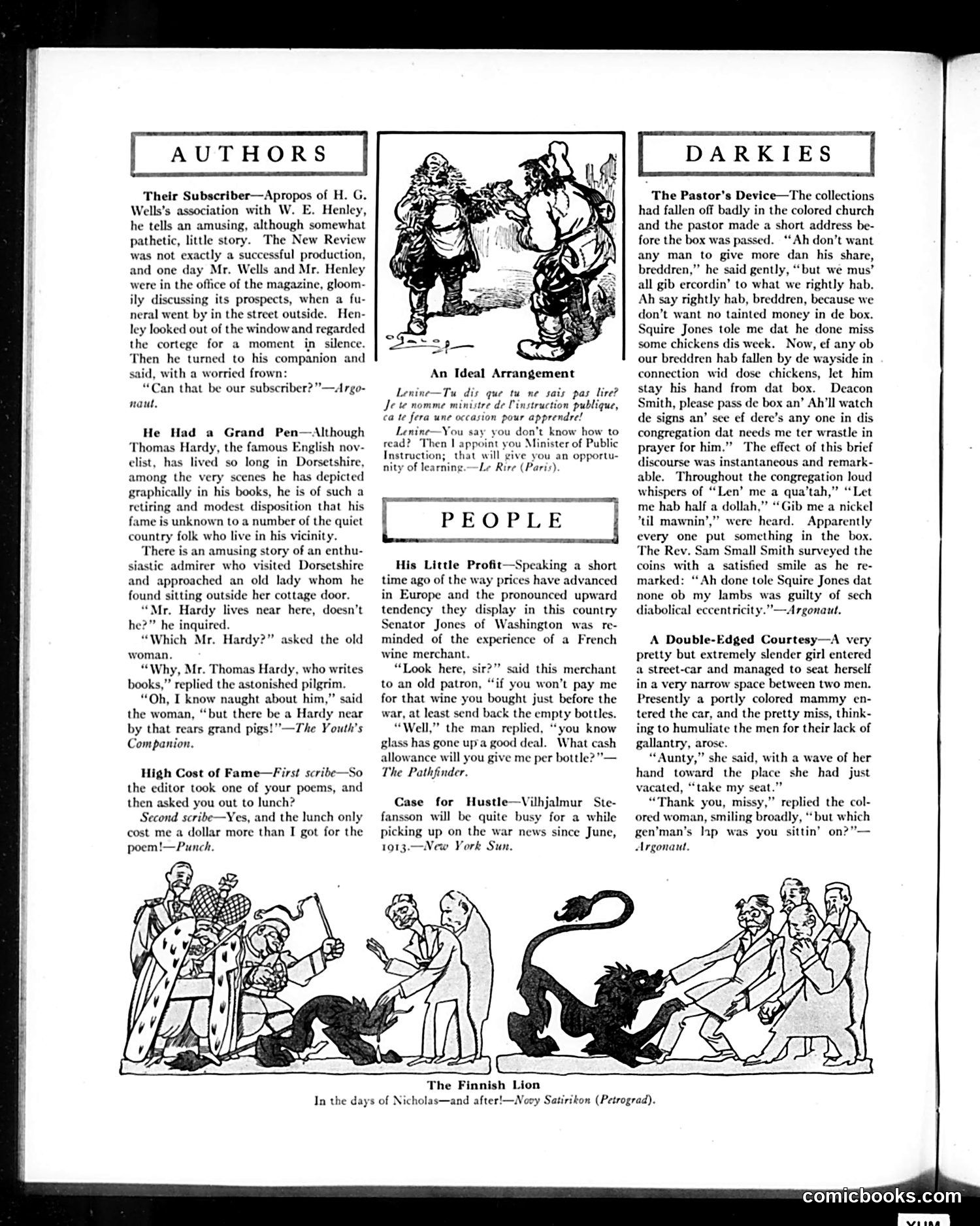
This page contains satirical pieces and cartoons targeting early 20th-century figures and social issues. **The "Ideal Arrangement" cartoon** depicts Lenin (identified in French caption), satirizing Soviet leadership by suggesting Lenin appointed an illiterate as Minister of Public Instruction—the joke being that incompetence was being rewarded rather than punished. This reflects Western anti-Bolshevik sentiment following the 1917 Revolution. **"The Finnish Lion" cartoon** (bottom) appears to reference Finland's struggle for independence from Russia "in the days of Nicholas"—likely Tsar Nicholas II—with the image showing citizens wrestling or fighting a lion, symbolizing Russian imperial power. **"The Pastor's Device"** story mocks African American church culture through dialect humor, depicting a pastor cleverly extracting donations by insinuating that anyone who stole chickens from a white parishioner should donate money to avoid divine punishment. The humor relies on racist stereotypes about Black communities. The page also includes lighter anecdotes about English authors Hardy and Wells, treating literary life humorously.
📄 Transcribed text from this page (OCR, searchable)
Machine-transcribed from the original scan — historical spelling and the odd misread are preserved.
AUTHORS Their Subscriber—Apropos of H. G. Wells’s association with W. E. Henley, he tells an amusing, although somewhat pathetic, little story. The New Review was not exactly a successful production, and one day Mr. Wells and Mr. Henley were in the office of the magazine, gloom- ily discussing its prospects, when a fu- neral went by in the street outside. Hen- ley looked out of the window and regarded the cortege for a moment in silence. Then he turned to his companion and said, with a worried frown: “Can that be our subscriber?” —Argo- naut, He Had a Grand Pen—Although Thomas Hardy, the famous English nov- elist, has lived so long in Dorsetshire, among the y scenes he has depicted graphically in his books, he is of such a retiring and modest disposition that his fame is unknown to a number of the quiet country folk who live in his vicinity. ‘There is an amusing story of an enthu- siastic admirer who visited Dorsetshire and approached an old lady whom he found sitting outside her cottage door. “Mr. Hardy lives near here, doesn’t he?” he inquired. “Which Mr. Hardy?” asked the old woman, “Why, Mr. Thomas Hardy, who writes books,” replied the astonished pilgrim. “Oh, I know naught about him,” said the woman, “but there be a Hardy near by that rears grand pigs!" —The Youth's Companion. High Cost of Fame—First scribe—So the editor took one of your poems, and then asked you out to lunch? Second scribe—Yes, and the lunch only cost me a dollar more than I got for the poem!—Punch. In the days of Nicholas—and after!— An Ideal Arrangement nine—Tu dis que tu ne sais pas lire? Je te nomme ministre de Vinstruction publique, ca te fera une occasion pour apprendre! Lenine—You say. you don’t know how to Then | appoint you Minister of Public Instruction; that will give you an opportu- nity of learning. —Le Rire (Paris) Jaen er eres ere PEOPLE aE a ae a: His Little Profit—Speaking a short time ago of the way prices have advanced in Europe and the pronounced upward tendency they display in this country Senator Jones of Washington was re- minded of the experience of a French wine merchant. “Look here, sir?” said this merchant to an old patron, “if you won’t pay me for that wine you bought just before the war, at least send back the empty bottles. “Well,” the man replied, “‘you know glass has gone up'a good deal. What cash allowance will you give me per bottle?” — The Pathfinder. Case for Hustle—Vilhjalmur Ste- fansson will be quite busy for a while picking up on the war news since June, 1913.—New York Sun. The Finnish Lion RKIES The Pastor's Device—The collections had fallen off badly in the colored church and the pastor made a short address be- fore the box was passed. ‘Ah don’t want any man to give more dan his share, breddren,” he said gently, “but we mus’ all gib ercordin’ to what we rightly hab. Ah say rightly hab, breddren, because we don’t want no tainted money in de box. Squire Jones tole me dat he done miss some chickens dis week. Now, ef any ob our breddren hab fallen by de wayside in connection wid dose chickens, let him stay his hand from dat box. Deacon Smith, please pass de box an’ Ah’ll watch de signs an’ sce ef dere’s any one in dis congregation dat needs me ter wrastle in prayer for him.” The effect of this brief discourse was instantaneous and remark- able. Throughout the congregation loud whispers of “Len’ me a qua’tah,” “Let me hab half a dollah,” “Gib me a nickel ‘til mawnin’,” were heard. Apparently every one put something in the box. The Rev. Sam Small Smith surveyed the coins with a satisfied smile as he re- marked: ‘Ah done tole Squire Jones dat none ob my lambs was guilty of sech diabolical eccentricity.” —Argonaut. A Double-Edged Courtesy—A very pretty but extremely slender girl entered a street-car and managed to seat herself in a very narrow space between two men. Presently a portly colored mammy en- tered the car, and the pretty miss, think- ing to humuliate the men for their lack of gallantry, arose. “Aunty,” she said, with a wave of her hand toward the place she had just vacated, “take my sea’ “Thank you, missy,” replied the col- ored woman, smiling broadly, “but which gen’man’s lap was you sittin’ on?”— Argonaut. 1y Satirikon (Petrograd). comicbooks.com