
Judge, 1918-02-23 · page 34 of 36
Judge — February 23, 1918 — page 34: what you’re looking at
What you’re looking at
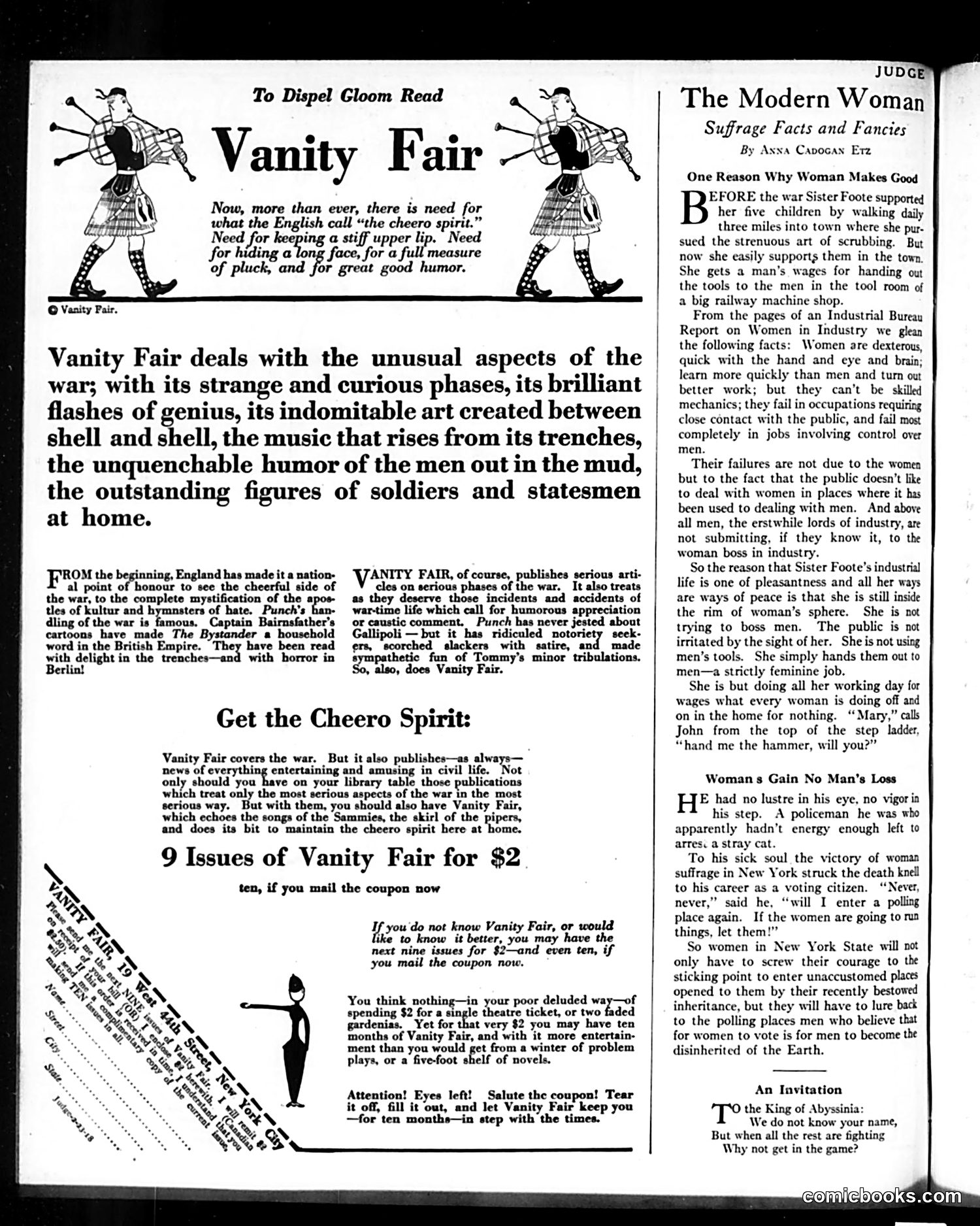
This page from Judge magazine, a rival to Vanity Fair, addresses wartime morale during World War I. The left side advertises Vanity Fair magazine, emphasizing its role in maintaining "cheero spirit"—British stoicism and humor amid war's grimness. It references real wartime cartoonists (Captain Bairnsfather, Punch magazine) and appeals to readers' desire for entertaining war coverage alongside serious journalism. The right column, "The Modern Woman: Suffrage Facts and Fancies" by Anna Cadogan Ertz, discusses women's wartime industrial work. It argues women succeed as factory workers (dexterous, quick learners) but fail in supervisory roles—not due to capability but because male workers and the public resist female authority. The piece sardonically presents an "Industrial Bureau Report" claiming women can't handle skilled mechanics or public-facing jobs, revealing contemporary gender prejudices disguised as fact. This supports the suffrage argument: if women can do men's wartime jobs, they deserve equal political rights.
📄 Transcribed text from this page (OCR, searchable)
Machine-transcribed from the original scan — historical spelling and the odd misread are preserved.
To Dispel Gloom Read Now, more than ever, there is need for what the English call “the cheero spirit.” Need for keeping a stiff upper lip. Need for hiding a face, for a full measure of pluck, and he great good humor. © Vanity Pair. Vanity Fair deals with the unusual aspects of the war; with its str: e and curious phases, its brilliant flashes of genius, its indomitable art created between shell and shell, the music that rises from its trenches, the un enchable humor of the men out in the mud, the outstanding figures of soldiers and statesmen at home. ROM the be; d has madeit a nation- eee inks iat nae ie cieeetal sine ot the war, to the complete mystification of the aj tles of kultur and L; Somme of hate. Punch’s dling of the war is famous. Captain Bairnsfather’s cartoons have made The Bystander a household word in the British Empire. They have been read pith delight in the trenches—and with horror in r VANITY FAIR, of course, publishes serious arti- cles on serious phases of the war. It also treats as they deserve those incidents and accidents of war-time life which call for humorous appreciation or caustic comment. Punch has never jested about Gallipoli — but it has ridiculed notoriety seek- ers, scorched slackers with satire, and made sympathetic fun of Tommy’s minor tribulations. So, also, does Vanity Fair. Get the Cheero Spirit: Vanity Fair covers the war. But it also publishes—as always— news of everythi only Soon entertaining and amusing in civil life. Not ve on your library table those publications which treat only the most serious aspects of the war in the most serious way. jut with them, you should also have Vanity Fair, which echoes the songs of the Sammies, the skirl of the pipers, and does its bit to maintain the cheero spirit here at jsome. 9 Issues of Vanity Fair for $2 ten, if you mail the coupon now Hpyou ‘do not know Vanity Fair, or would like to know it better, you may have the next nine issues for $2—and even ten, if you mail the coupon now. You think nothing—in your poor deluded wa; f spending $2 for a single theatre ticket, or two faded gardenias. Yet for that very $2 you may have ten months of Vanity Fair, and with it more entertain- ment than you would get from a winter of problem plays, or a fivefoot shelf of novels. Attention! Eyes left! Salute the coupon! Tear it off, fill it out, and let Vanity Fair keep you —for ten months—in step with the times. JUDGE The Modern Woman Suffrage Facts and Fancies By Asxa Cavocan Erz One Reason Why Woman Makes Good EFORE the war Sister Foote supported her five children by walking daily three miles into town where she pur- sued the strenuous art of scrubbing. But now she easily supports them in the town. She gets a man’s wages for handing out the tools to the men in the tool room of a big railway machine shop. From the pages of an Industrial Bureau Report on Women in Industry we glean the following facts: Women are dexterous, quick with the hand and eye and brain; learn more quickly than men and turn out better work; but they can’t be skilled mechanics; they fail in occupations requiring close contact with the public, and fail most completely in jobs involving control over men. Their failures are not due to the women but to the fact that the public doesn’t like to deal with women in places where it has been used to dealing with men. And above all men, the erstwhile lords of industry, are not submitting, if they know it, to the woman boss in industry. So the reason that Sister Foote’s industrial life is one of pleasantness and all her ways are ways of peace is that she is still inside the rim of woman’s sphere. She is not trying to boss men. The public is not irritated by the sight of her. She is not using men’s tools. She simply hands them out to men—a strictly feminine job. She is but doing all her working day for wages what every woman is doing off and on in the home for nothing. “Mary,” calls John from the top of the step ladder, “hand me the hammer, will you?” Woman s Gain No Man's Loss HE had no lustre in his eye, no vigor in his step. A policeman he was who apparently hadn’t energy enough left to arres, a stray cat. To his sick soul the victory of woman suffrage in New York struck the death knell to his career as a voting citizen. “Never, never,” said he, “will I enter a polling place again. If the women are going to run things, let them!” So women in New York State will not only have to screw their courage to the sticking point to enter unaccustomed places opened to them by their recently bestowed inheritance, but they will have to lure back to the polling places men who believe that for women to vote is for men to become the disinherited of the Earth. An Iavitation T° the King of Abyssinia: We do not know your name, But when all the rest are fighting Why not get in the game?