
Judge, 1918-02-23 · page 14 of 36
Judge — February 23, 1918 — page 14: what you’re looking at
What you’re looking at
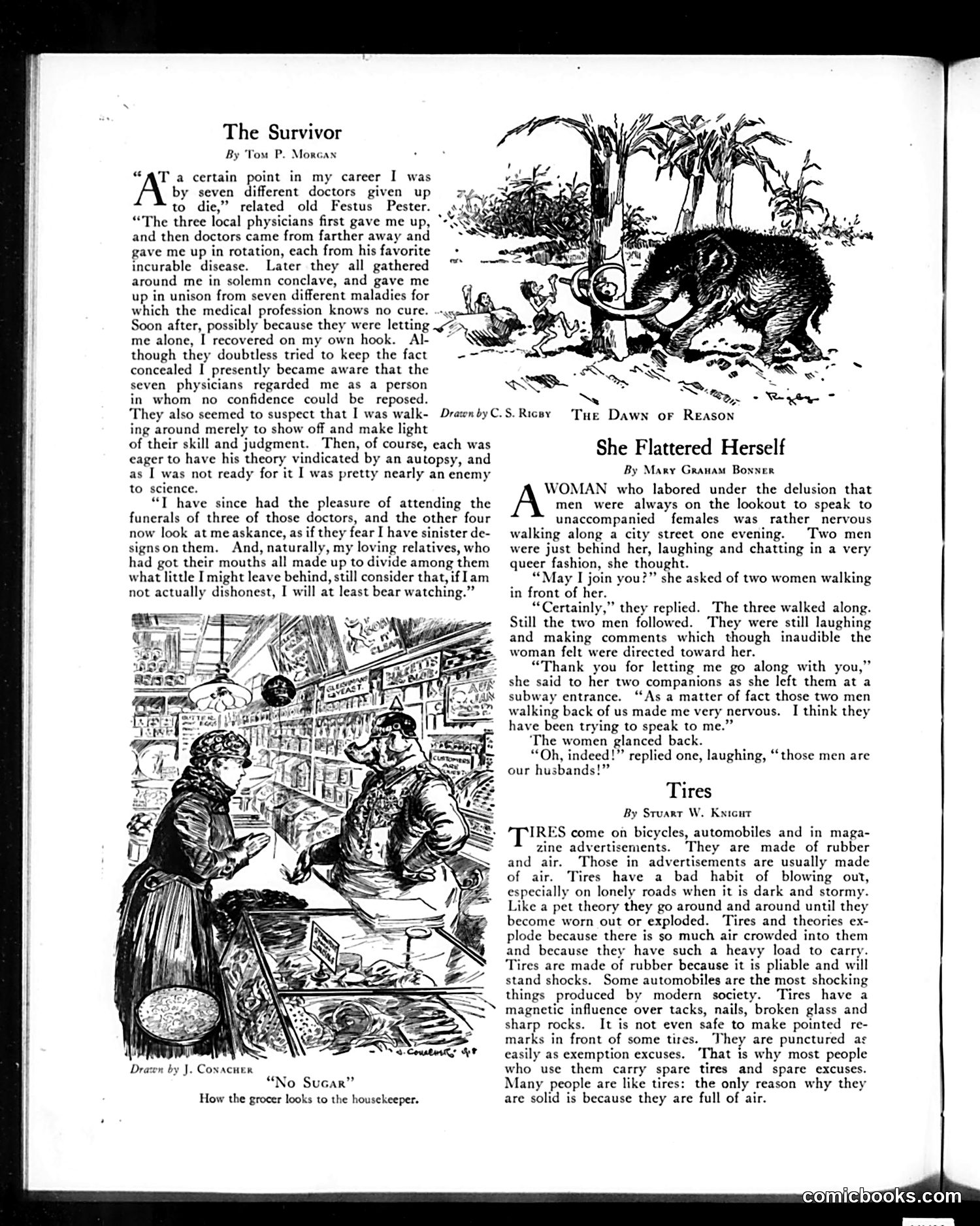
**"The Survivor"** satirizes the medical profession's tendency to give up on patients prematurely. An old man claims seven doctors declared him incurable from various diseases, then abandoned him. He recovered naturally once left alone—but now the doctors resent him, viewing his survival as either showing off or an affront to medical science. The joke: doctors are more invested in their theories and reputations than patient welfare. The cartoon below shows a grocer during sugar rationing (likely WWI-era), illustrating economic hardship. **"She Flattered Herself"** mocks women's vanity. A woman mistakenly believes two men are pursuing her romantically when they're actually following their own wives, who are walking ahead. The humor depends on her misreading social attention as romantic interest. **"Tires"** is light satirical commentary comparing tires and human nature—both are "solid" only because filled with air, both eventually fail under pressure, and both attract trouble magnetically. It's wordplay-driven social observation rather than sharp political satire.
📄 Transcribed text from this page (OCR, searchable)
Machine-transcribed from the original scan — historical spelling and the odd misread are preserved.
The Survivor By ‘Tou P. Moncax “AT a certain point in my career I was by seven different doctors given up to die,” related old Festus Pester. “The three local physicians first gave me up, ** and then doctors came from farther away and gave me up in rotation, each from his favorite incurable disease. Later they all gathered around me in solemn conclave, and gave me up in unison from seven different maladies for which the medical profession knows no cure. <9 Soon after, possibly because they were letting 47 me alone, I recovered on my own hook. Al- though they doubtless tried to keep the fact concealed I presently became aware that the seven physicians regarded me as a person in whom no confidence could be reposed. They also seemed to suspect that I was walk- Drawn byC. S. Ricay ing around merely to show off and make light of their skill and judgment. Then, of course, each was eager to have his theory vindicated by an autopsy, and as I was not ready for it I was pretty nearly an enemy to science. “I have since had the pleasure of attending the funerals of three of those doctors, and the other four now look at me askance, as if they fear I have sinister de- signsonthem. And, naturally, my loving relatives, who had got their mouths all made up to divide among them what little I might leave behind, still consider that, iflam not actually dishonest, I will at least bear watching.” Drazen by J. Coxacuen “No Sucar” How the grocer looks to the housekeeper. Tue Dawn oF Reason She Flattered Herself By Mary Granam Bonner WOMAN who labored under the delusion that men were always on the lookout to speak to unaccompanied females was rather nervous walking along a city street one evening. Two men were just behind her, laughing and chatting in a very queer fashion, she thought. “May I join you?” she asked of two women walking in front of her. “Certainly,” they replied. The three walked along. Still the two men followed. They were still laughing and making comments which though inaudible the woman felt were directed toward her. “Thank you for letting me go along with you,” she said to her two companions as she left them at a subway entrance. “As a matter of fact those two men walking back of us made me very nervous. I think they have been trying to speak to me.” ‘The women glanced back. “Oh, indeed!” replied one, laughing, ‘those men are our husbands!” Tires By Stuart W. Kxitcut ‘TIRES come on bicycles, automobiles and in maga- zine advertisements. They are made of rubber and air. Those in advertisements are usually made of air. Tires have a bad habit of blowing out, especially on lonely roads when it is dark and stormy. Like a pet theory they go around and around until they become worn out or exploded. Tires and theories ex- plode because there is so much air crowded into them and because they have such a heavy load to carry. Tires are made of rubber because it is pliable and will stand shocks. Some automobiles are the most shocking things produced by modern society. Tires have a magnetic influence over tacks, nails, broken glass and sharp rocks. It is not even safe to make pointed re- marks in front of some tires. They are punctured as easily as exemption excuses. ‘That is why most people who use them carry spare tires and spare excuses. Many people are like tires: the only reason why they are solid is because they are full of air. icbooks.com