
Judge, 1918-02-23 · page 24 of 36
Judge — February 23, 1918 — page 24: what you’re looking at
What you’re looking at
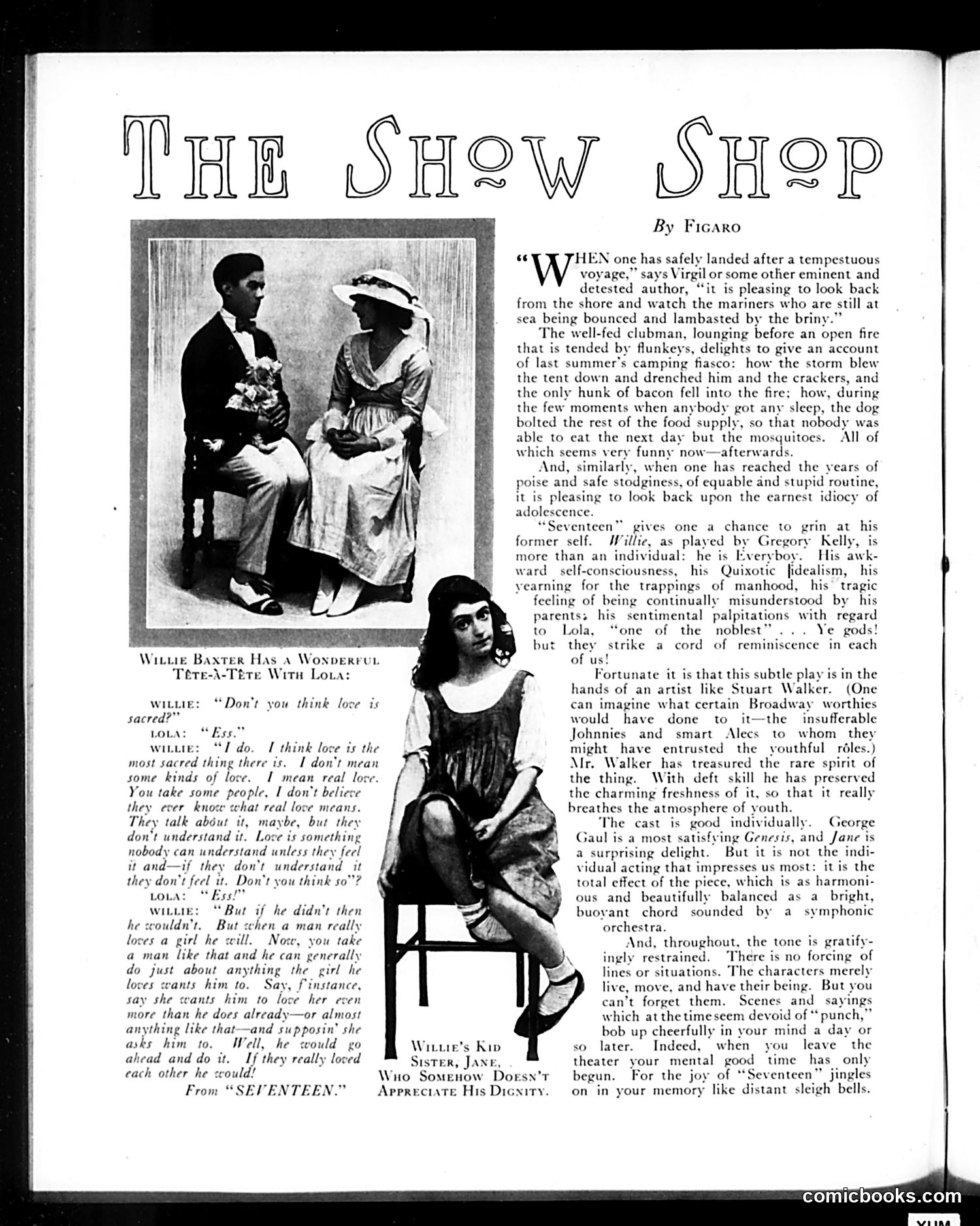
This page reviews the stage play **"Seventeen,"** directed by Stuart Walker and starring Gregory Kelly as Willie Baxter. The review, attributed to Figaro (a Judge pseudonym), praises the production as a nostalgic comedy about adolescence. The satirical premise is that adults enjoy remembering teenage awkwardness from a safe distance—just as travelers enjoy recounting camping disasters once home. Willie, played by Kelly, represents "Everyboy": self-conscious, idealistic, misunderstood by parents, and sentimentally preoccupied with a girl named Lola. The dialogue snippet shows Willie earnestly philosophizing about "real love" to Lola, capturing the play's tone of gentle mockery of adolescent earnestness. The reviewer praises Walker's restraint in preserving the play's "charming freshness" and its balanced ensemble cast, noting the show's quiet charm lingers in memory "like distant sleigh bells" rather than relying on obvious comedic "punch."
📄 Transcribed text from this page (OCR, searchable)
Machine-transcribed from the original scan — historical spelling and the odd misread are preserved.
THE SHeW SHEP Wituie Baxter Has a Wonverrun e-A-Téte With Low. “Don't you think love is ss. ‘I do. I think love ts the most sacred thing there is. 1 don't mean some kinds of love. I mean real lox You take some people, | don’t believe they ever know what real love means. They talk abdut it, maybe, but they don’t understand tt. Love is something nobody can understand unless they feel it and—if they don't understand it they don’t feel ut. Don’t you think so”? ss !”* wittie: “But if he didn’t then couldn't. But sehen a man really cesa girl he will. Now, you take a man like that and he can generally do just about anything the girl he loves wants him to. Say, finstance, say she wants him to love her even more than he does already—or almost anything like that—and supposin’ she asks him to. Well, he could go ahead and do it. If they really loved each other he « ! . , From ‘ Wituie’s Kip Sister, JANE, Wuo Som APPRECIAT 1OW Dic By Ficaro “ HEN onc has safely landed after a tempestuous voyage,” says Virgil or some other eminent and detested author, “it is pleasing to look back from the shore and watch the mariners who are still at sea being bounced and lambasted by the briny.” The well-fed clubman, lounging before an open fire that is tended by flunkeys, delights to give an account of last summer's camping fiasco: how the storm blew the tent down and drenched him and the crackers, and the only hunk of bacon fell into the fire: how, during the few moments when anybody got any sleep, the dog bolted the rest of the food supply, so that nobody was able to eat the next day but the mosquitoes. All of which seems very funny now—afterwards. And, similarly, when one has reached the years of poise and safe stodginess, of equable and stupid routine, it is pleasing to look back upon the earnest idiocy of adolescence. “Seventeen” gives one a chance to grin at his former self. Willie, as played by Gregory Kelly, is more than an individual: he is Everyboy. His awk- ward self-consciousness, his Quixotic |idealism, his yearning for the trappings of manhood, his tragic feeling of being continually misunderstood by his parents: his sentimental palpitations with regard “one of the noblest” Ye gods! strike a cord of reminiscence in each Lola, they of us! Fortunate it is that this subtle play is in the hands of an artist like Stuart Walker. (One can imagine what certain Broadway worthies would have done to it—the insufferable Johnnies and smart Alecs to whom they might have entrusted the youthful réles.) Mr. Walker has treasured the rare spirit of the thing. With deft skill he has preserved the charming freshness of it, so that it really breathes the atmosphere of youth. The cast is good individually. George Gaul is a most satisfying Genesis, and Jane is a surprising delight. But it is not the indi- vidual acting that impresses us most: it is the total effect of the piece, which is as harmoni- ous and beautifully balanced as a_ bright, buovant chord sounded by a symphonic orchestra. And, throughout, the tone is gratify- ingly restrained. There is no forcing of lines or situations. The characters merely live, move, and have their being. But you can’t forget them. Scenes and sayings which at the timescem devoid of * punch,” bob up cheerfully in your mind a day or later. Indeed, when you leave the theater your mental good time has_ only begun. For the joy of “Seventeen” jingles on in your memory like distant sleigh bells. to but so Dor comicbooks.com