
A complete issue · 28 pages · 1917
Judge — January 27, 1917
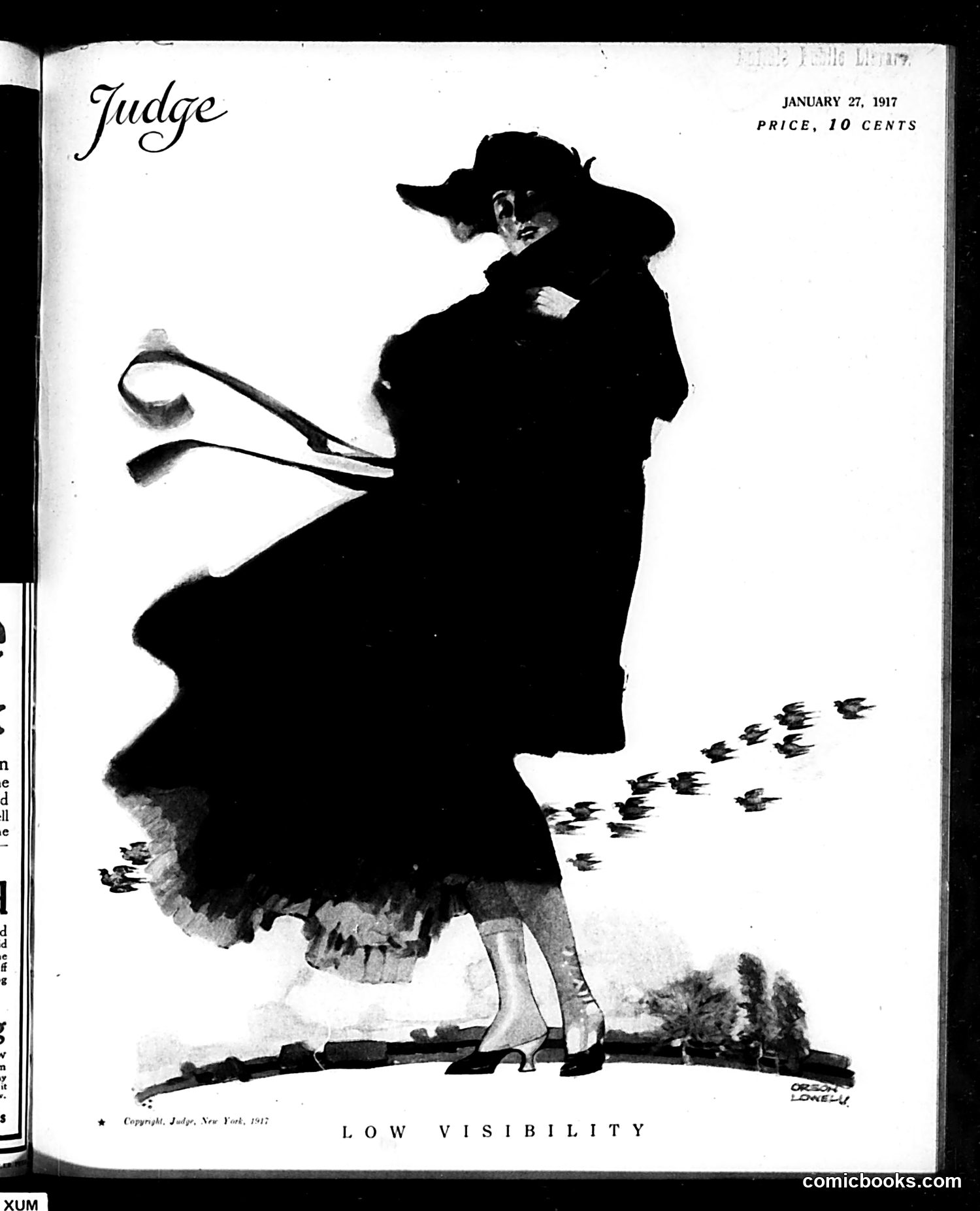
This political cartoon satirizes American isolationism during World War I. The silhouetted female figure represents America, depicted as deliberately blinded—her vision obscured by a large hood or covering. She holds binoculars (useless while blinded) and walks forward heedlessly while birds (likely representing warnings or international events) fly past her. The title "Low Visibility" is ironic: America claims poor sight as excuse to ignore the escalating European conflict, despite mounting pressure to enter the war. The cartoon critiques American policymakers and the public for willfully ignoring clear dangers and moral obligations to intervene. This appears shortly before the U.S. entered WWI in April 1917.
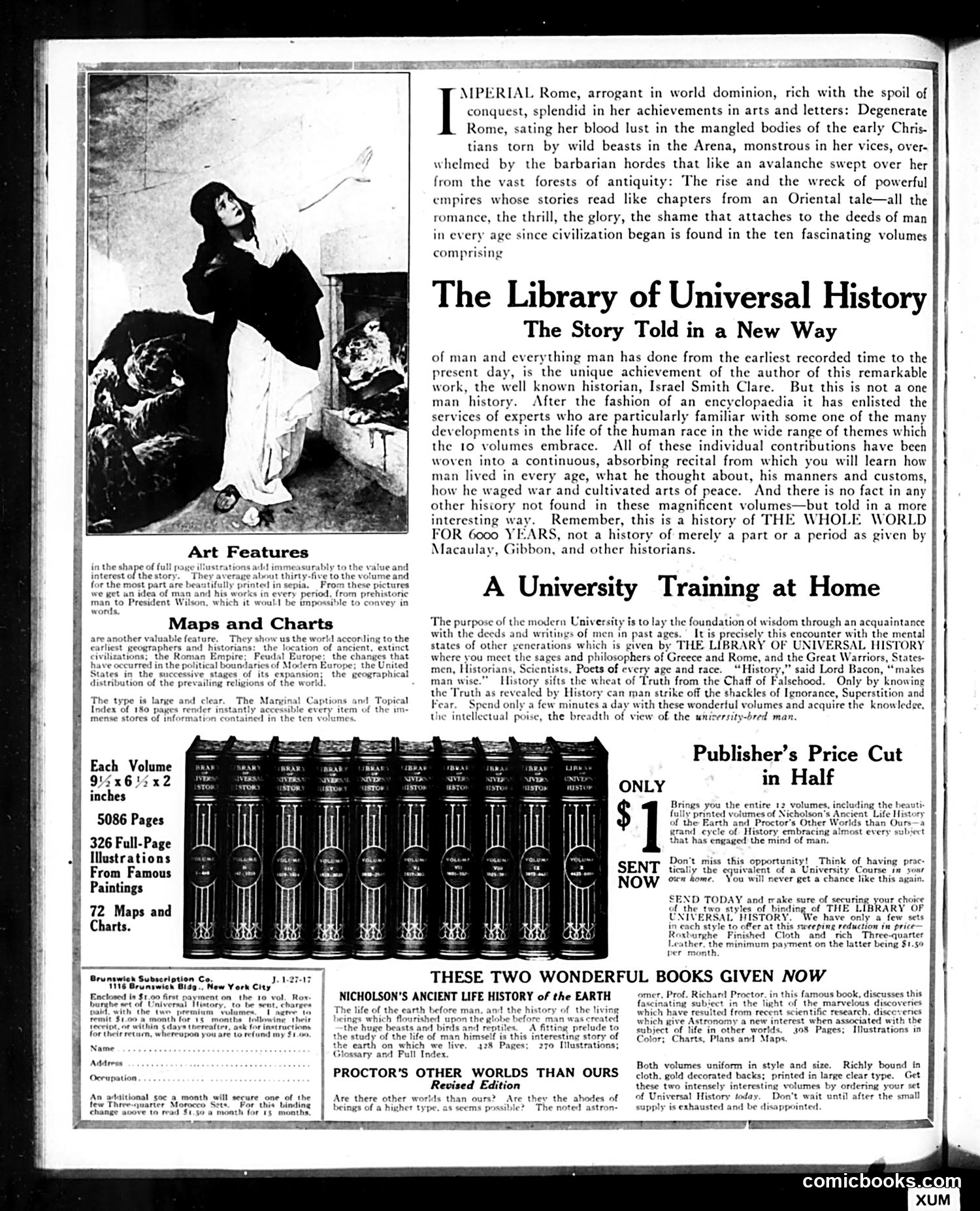
This page is primarily **advertising**, not satire or political commentary. The top features "The Library of Universal History," a 10-volume encyclopedia set by historian Israel Smith Clare, marketed as comprehensive world history "not a one man history." The left sidebar advertises the books' specifications (5086 pages, 326 illustrations, 72 maps), while the main text emphasizes this as an affordable "University Training at Home"—educational self-improvement for middle-class readers. The bottom promotes two companion volumes: "Nicholson's Ancient History of the Earth" and "Proctor's Other Worlds Than Ours" (Revised Edition). There are **no political cartoons or satire visible**—this is a straightforward mail-order book advertisement typical of Judge magazine's revenue model, appealing to self-educated readers seeking knowledge and cultural advancement.
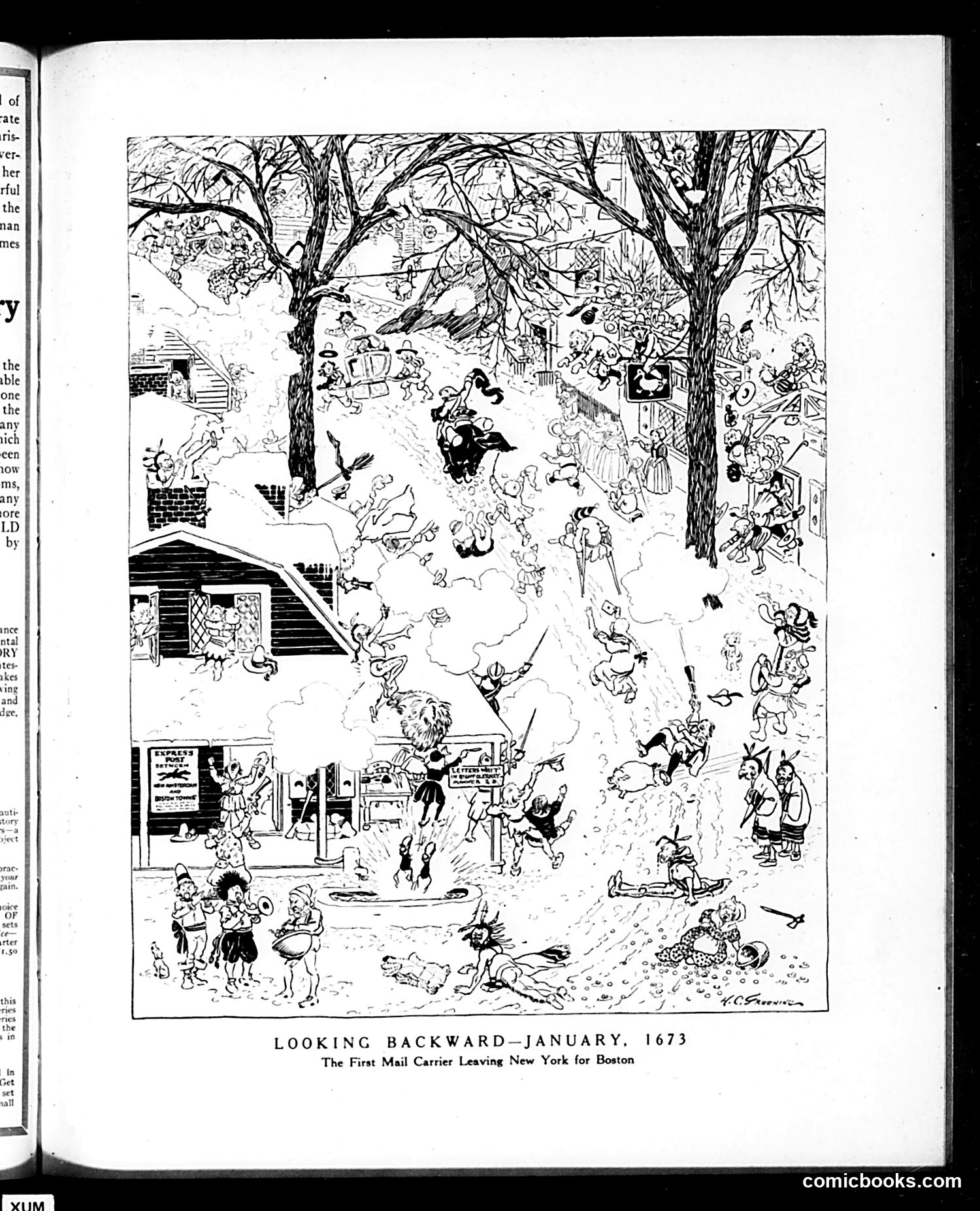
This satirical cartoon depicts a chaotic colonial-era scene imagining the first mail delivery between New York and Boston in 1673. The humor likely stems from contrasting modern (1920s-era Judge magazine) concepts of efficient mail service with absurdly primitive colonial conditions—figures scattered throughout an undeveloped landscape, crude buildings, and general pandemonium surrounding the mail carrier's departure. The satire probably comments on postal service inefficiency or the romanticization of colonial history. The "looking backward" title suggests ironic nostalgia. The crowded, disorganized scene parodies both actual colonial chaos and contemporary complaints about mail delivery, using historical distance as a vehicle for contemporary social commentary on American progress (or lack thereof) in logistical systems.
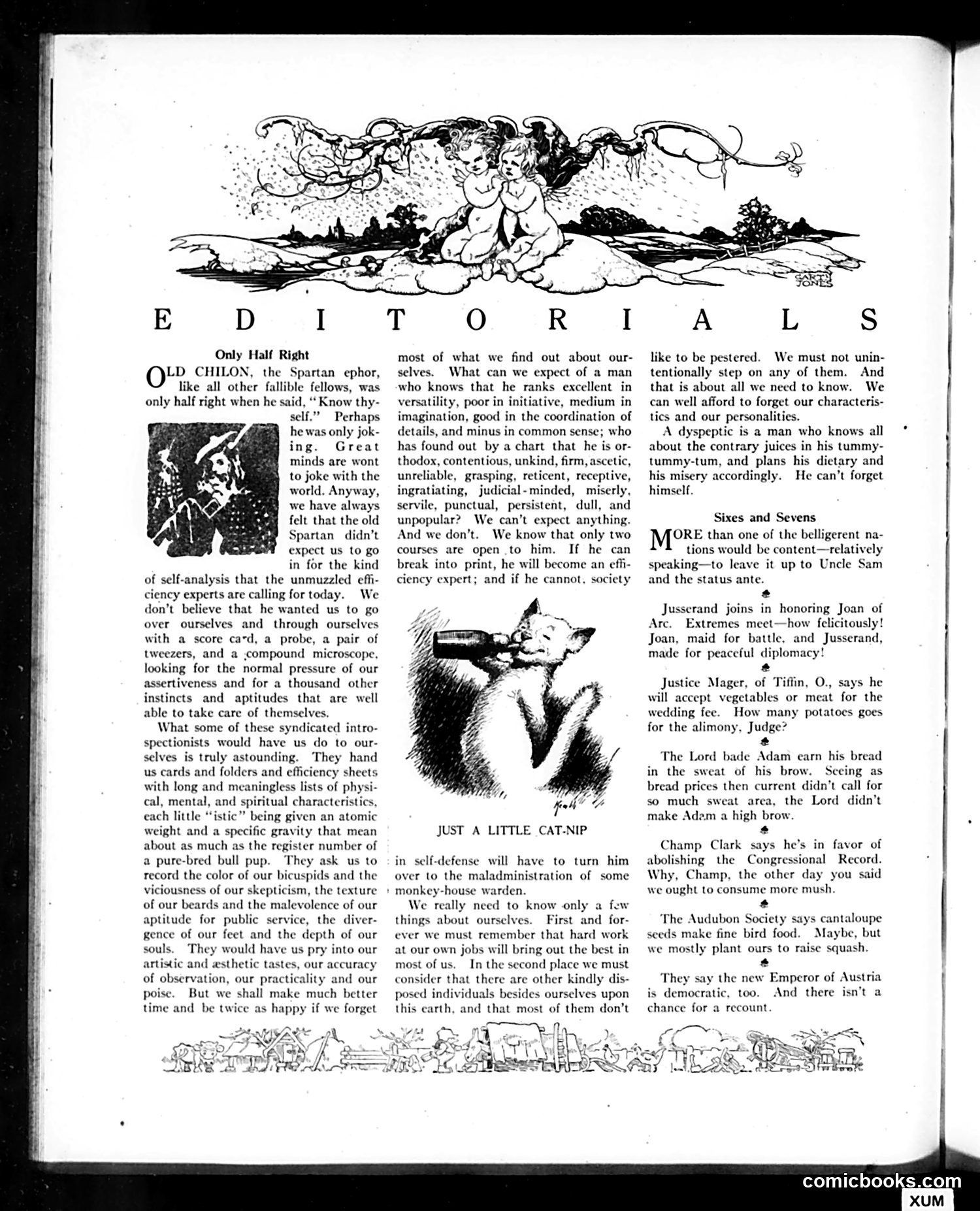
This page presents satirical commentary on personality types and contemporary issues. The main editorial criticizes "Old Chilon," a Spartan philosopher figure, arguing that even excellent people have flaws—they can't be experts in everything. The piece advocates for humility and self-awareness rather than the self-analysis fad among "syndicated introspectionists." The "Sixes and Sevens" section contains brief satirical notes about various topics: Joan of Arc, Congressional Record abolition, wedding fees, bread prices, the Austrian Emperor, and cantaloup seeds as bird food. These are typical Judge-style commentary on political figures and everyday absurdities. The illustration "Just a Little Cat-Nip" shows a cat, likely a visual pun accompanying the text about animal behavior or human folly.
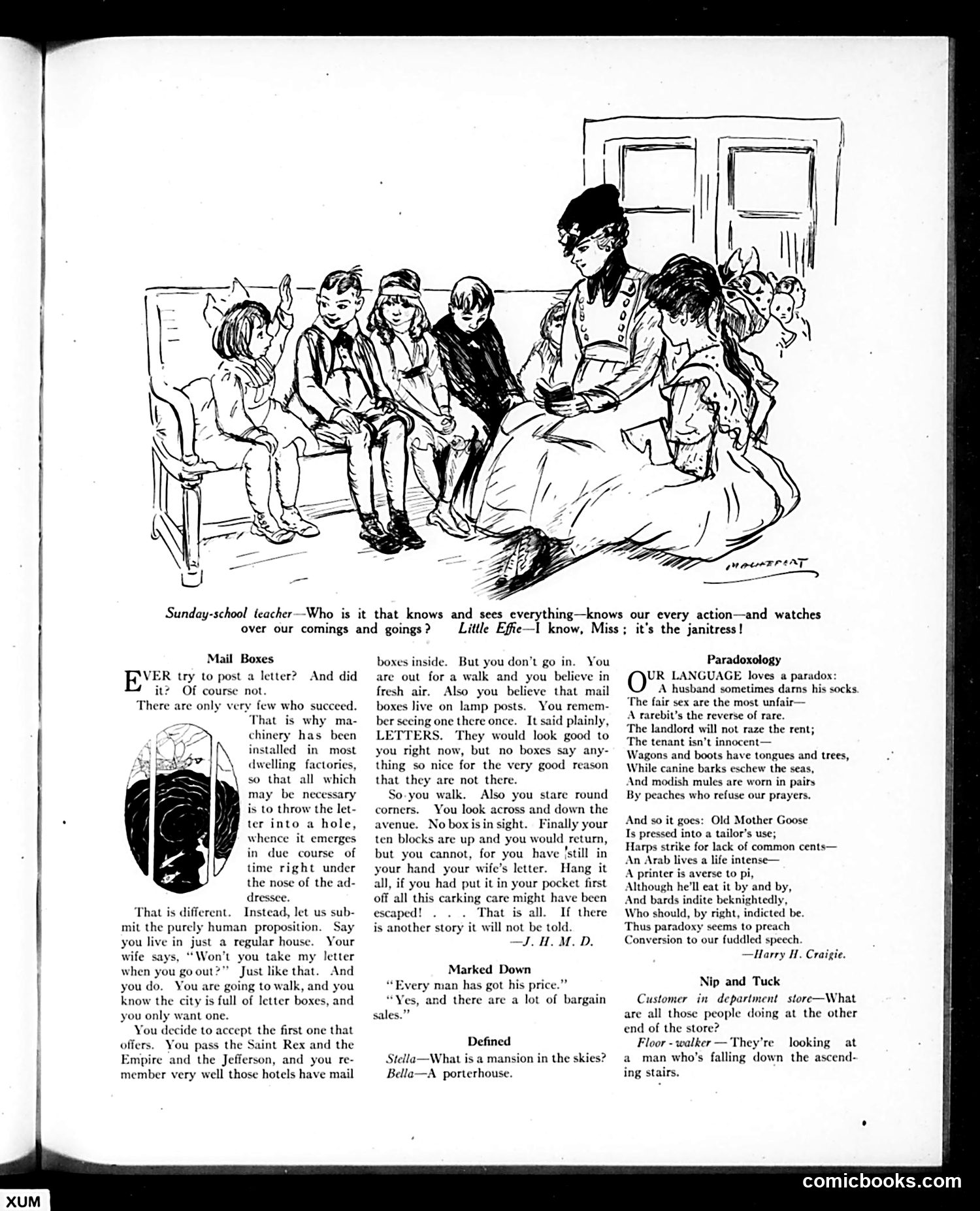
The top illustration depicts a Sunday school teacher surrounded by children, with the caption suggesting she "knows and sees everything—knows our every action—and watches over our comings and goings." This appears to be gentle satire about adult authority figures and childhood surveillance, humorously positioning teachers as omniscient observers. The remaining text sections contain various short humor pieces and definitions (Mail Boxes, Paradoxology, Marked Down, Nip and Tuck, etc.). These are light satirical observations about everyday life—mail delivery absurdities, linguistic paradoxes, bargaining, and department store behavior. The humor is gentle and domestic in focus, typical of early-to-mid 20th century Judge magazine's style. There's no clear political commentary; rather, the satire targets universal human behaviors and social conventions with mild, family-friendly wit.
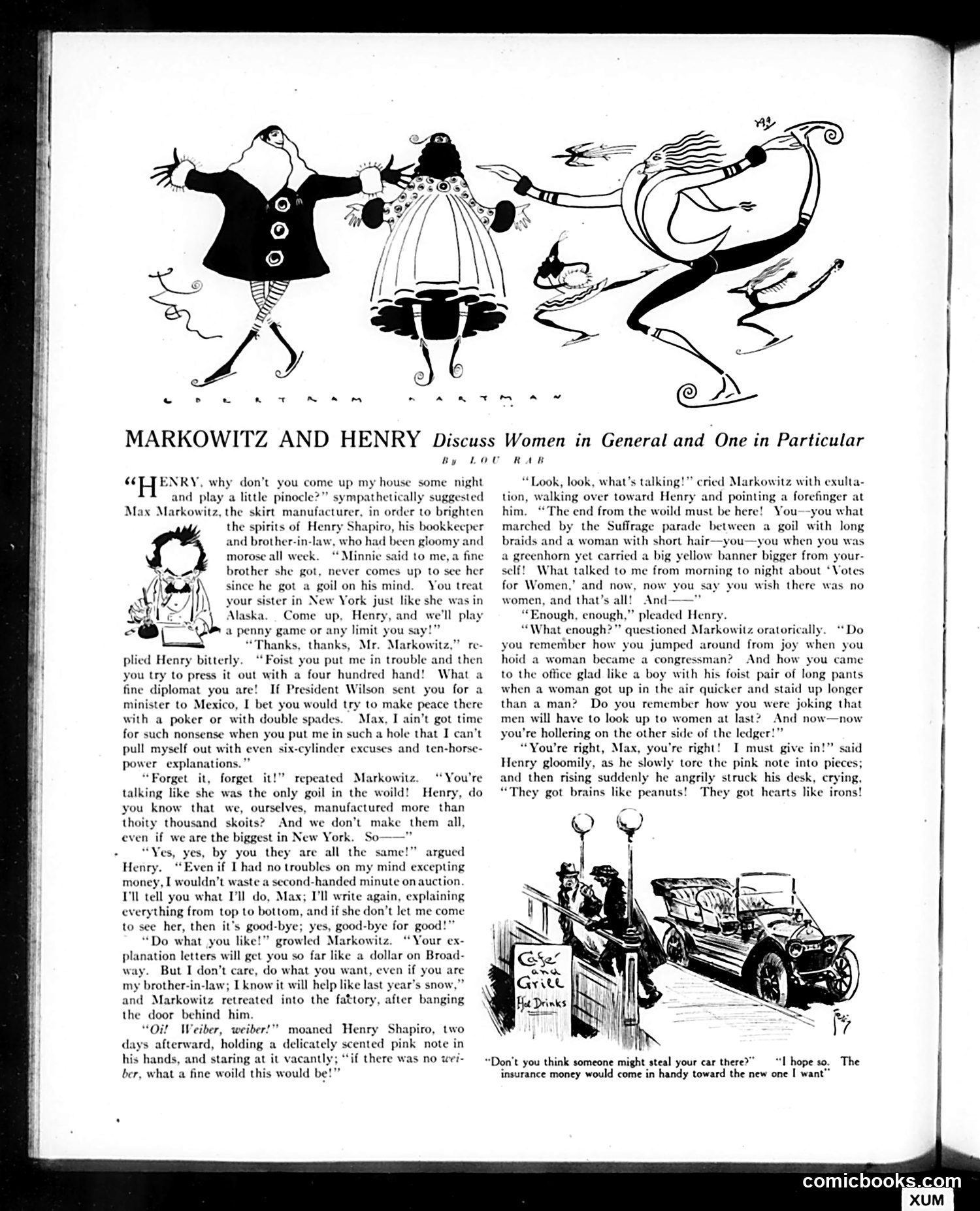
This satirical piece depicts a conversation between **Max Markowitz** (a skirt manufacturer) and **Henry Shapiro** (his bookkeeper and brother-in-law), both identifiable as Jewish-American characters by their dialect and names. **The satire's core**: Henry is lovesick over a woman and wishes women didn't exist. Markowitz confronts him with hypocrisy—Henry had enthusiastically supported women's suffrage and celebrated women's professional achievements (becoming congressmen, performing aviation stunts). Now that romance troubles him personally, Henry denounces women entirely. **The point**: The cartoon mocks men who champion women's rights abstractly but resent women when it affects them individually. It critiques selective feminism and exposes the gap between stated progressive values and actual attitudes toward women. **Historical context**: This appears from the suffrage era (women's voting rights were a live issue), when Judge magazine regularly satirized both suffragettes and anti-suffrage positions. The Yiddish-inflected dialogue reflects Judge's common use of immigrant characters for humor.
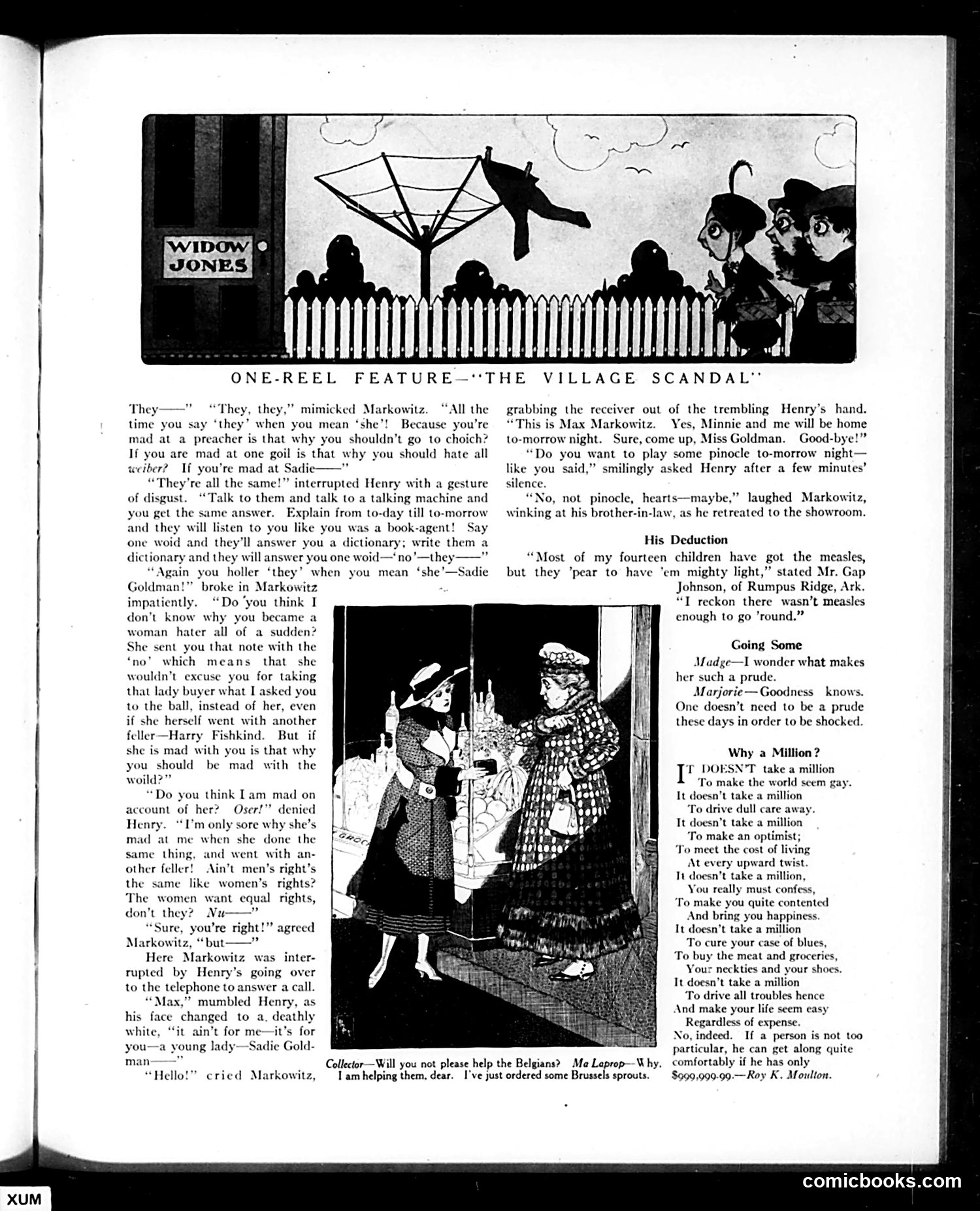
This page features a one-reel film synopsis about working-class characters (Markowitz, Henry, Sadie Goldman) navigating romantic jealousy and gender politics. The satire centers on Henry's hypocritical complaint: he's angry his girlfriend attended a ball with another man, yet he saw nothing wrong attending with a different woman himself. When Markowitz points out the double standard—"The women want equal rights, don't they?"—Henry protests that men deserve the same freedoms. The joke critiques male inconsistency regarding women's equality: men demand traditional privileges while resisting reciprocal treatment. The Yiddish-inflected dialogue marks these as immigrant characters, typical of Judge's ethnic humor of the era. Below appear unrelated fillers: a rural anecdote, a poem about contentment without wealth, and a joke about charitable giving. These were common space-fillers in period magazines.
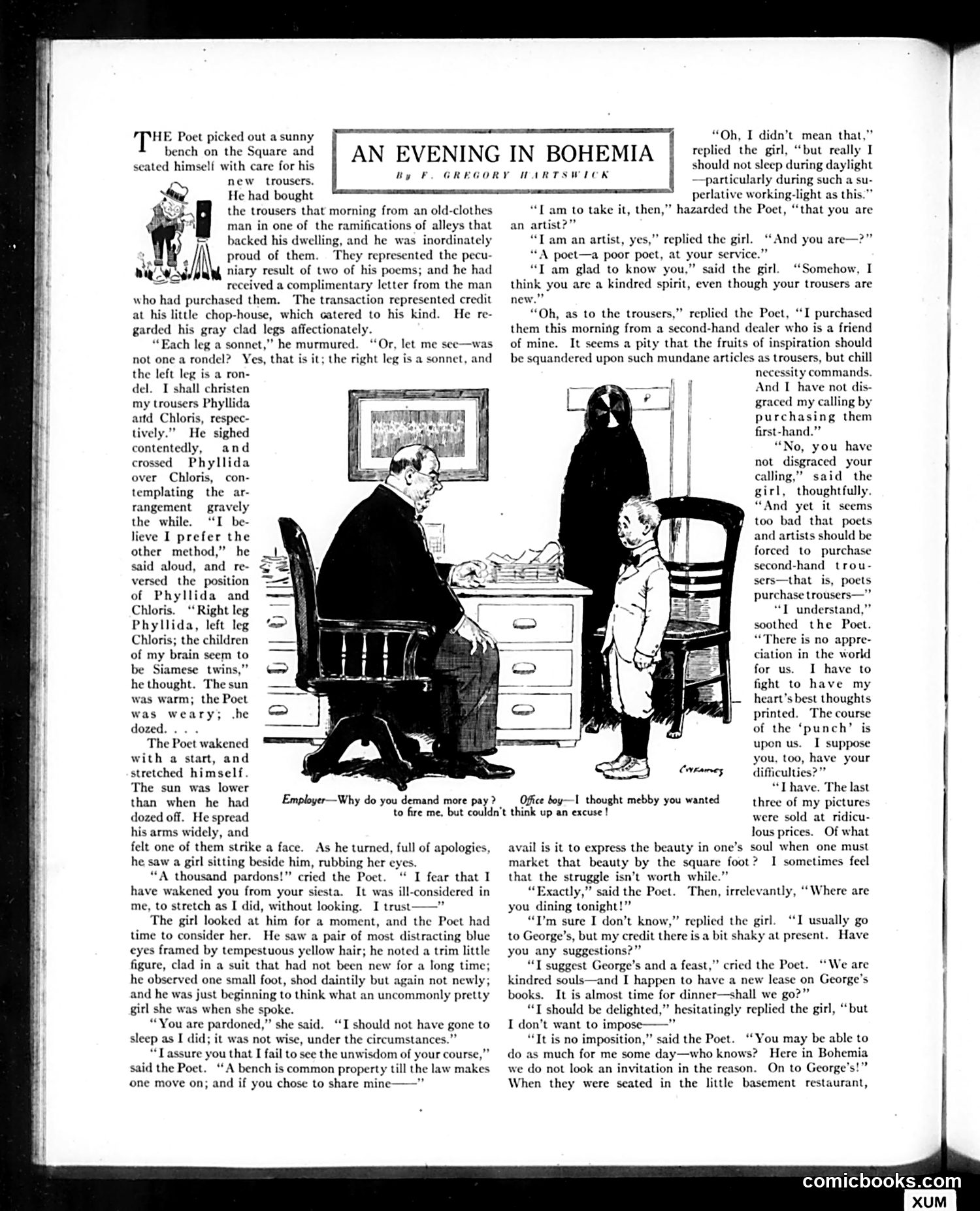
This story satirizes the romantic pretensions of impoverished artists in early 20th-century urban bohemia. A poor poet, proud of secondhand trousers purchased with payment for his poems, meets an equally struggling female artist on a public bench. The satire targets their shared delusion: both romanticize their poverty as noble artistic calling while actually living in genuine want. The poet whimsically names his trouser legs after classical literary heroines; the girl apologizes for napping during daylight to avoid wasting expensive artificial light—revealing the real hardship beneath their aesthetic posturing. The inset cartoon mocks employer-employee relations: a boss claims he wanted to fire an employee but "couldn't think up an excuse"—suggesting employment instability even when dismissal lacks justification. The piece ridicules how struggling artists in Bohemian quarters simultaneously embrace poverty as spiritually superior while actually suffering material deprivation, unable to afford new clothing or proper working conditions.
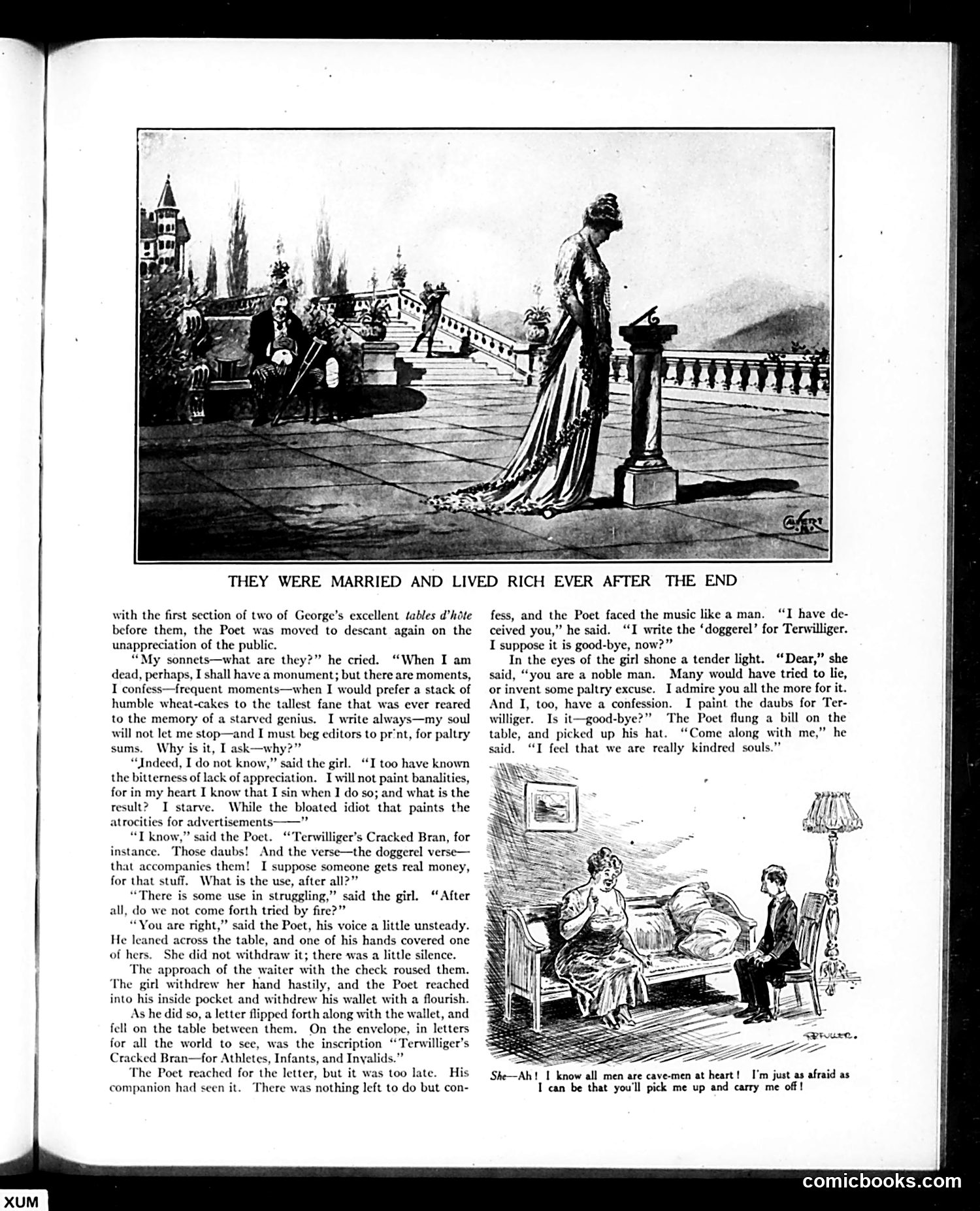
This is a satirical tale mocking artistic pretension and hypocrisy. Two struggling artists—a Poet and a Girl—meet and commiserate about their lack of appreciation, lamenting that they refuse to compromise their principles by creating "commercial trash." The Poet specifically sneers at advertising copy for "Terwilliger's Cracked Bran," calling it doggerel and the accompanying illustrations worthless "daubs." The punchline: a letter falls from the Poet's wallet revealing he *himself* writes those despised advertisements for Terwilliger. Rather than rejecting him, the Girl confesses she paints those same "daubs." Instead of tragic separation, they reconcile and leave together. The satire targets the self-righteous artistic elite who publicly disdain commercial work while secretly depending on it financially. The joke is that their shared hypocrisy makes them "kindred souls"—they're revealed as frauds who talk nobly but compromise for money like everyone else.
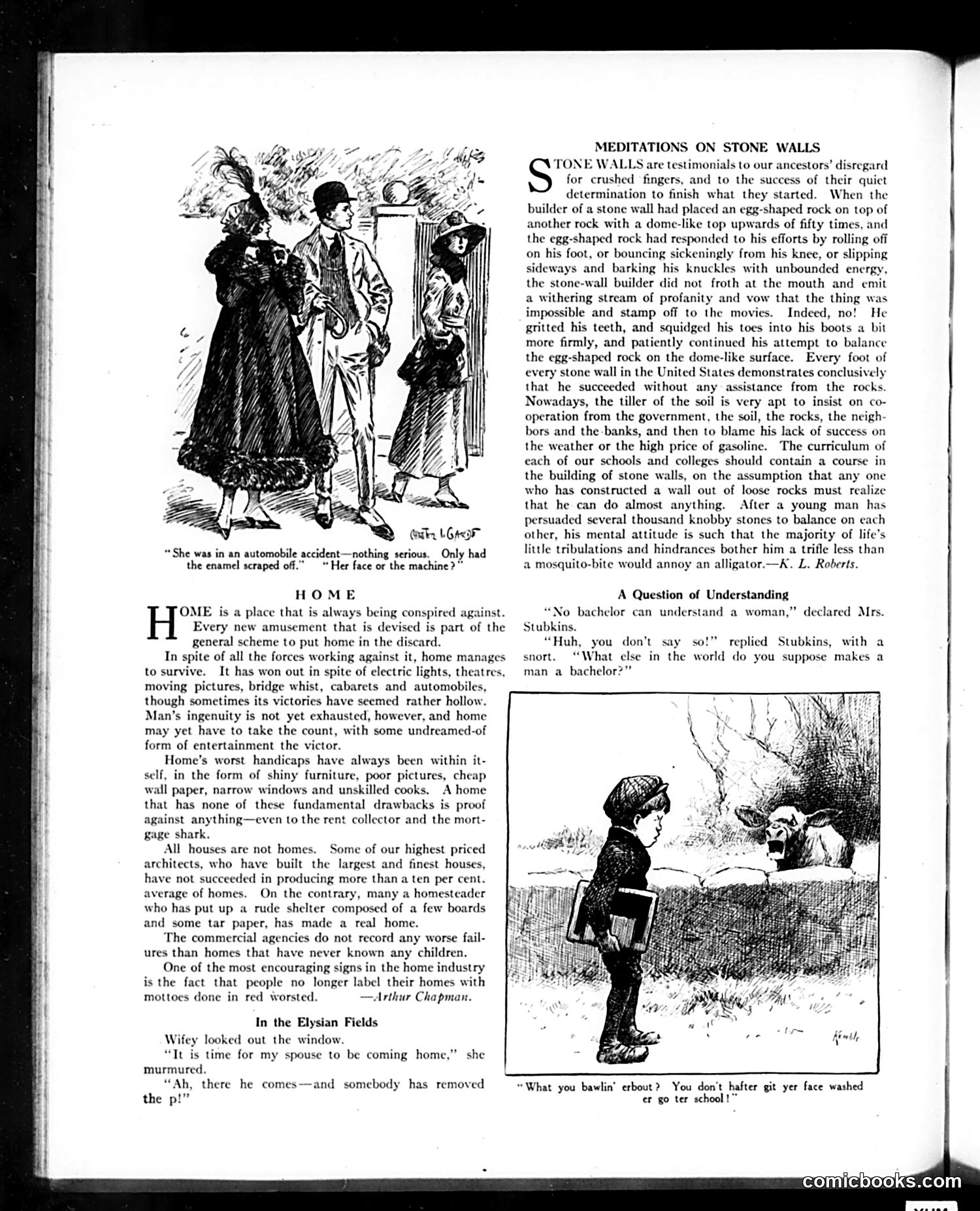
**Top Cartoon**: A joke about an automobile accident. A man tells another that a woman had a minor crash where "only had the enamel scraped off," prompting the response "Her face or the machine?"—a sexist jab at women's vanity and appearance, typical of early 20th-century humor that mocked women's supposed obsession with looks. **"Home" Essay**: A satirical meditation on domestic life under assault from modern entertainments (automobiles, movies, cabarets, bridge whist). The piece argues that true "homes" aren't built by fancy architects but by character—and humorously suggests stone-wall building as a character-building curriculum, since it teaches persistence. **"In the Elysian Fields" Vignette**: A pun-based joke where a wife awaits her husband's return, then notices someone has removed the "P" from a sign—likely reading "Home Sweet Home" or similar, now becoming "Home Sweet Home" without the "P"—a play on words about spousal absence. The page exemplifies Judge's genteel satirical style: mildly critical of modernity while defending traditional values, with light humor rather than sharp political critique.
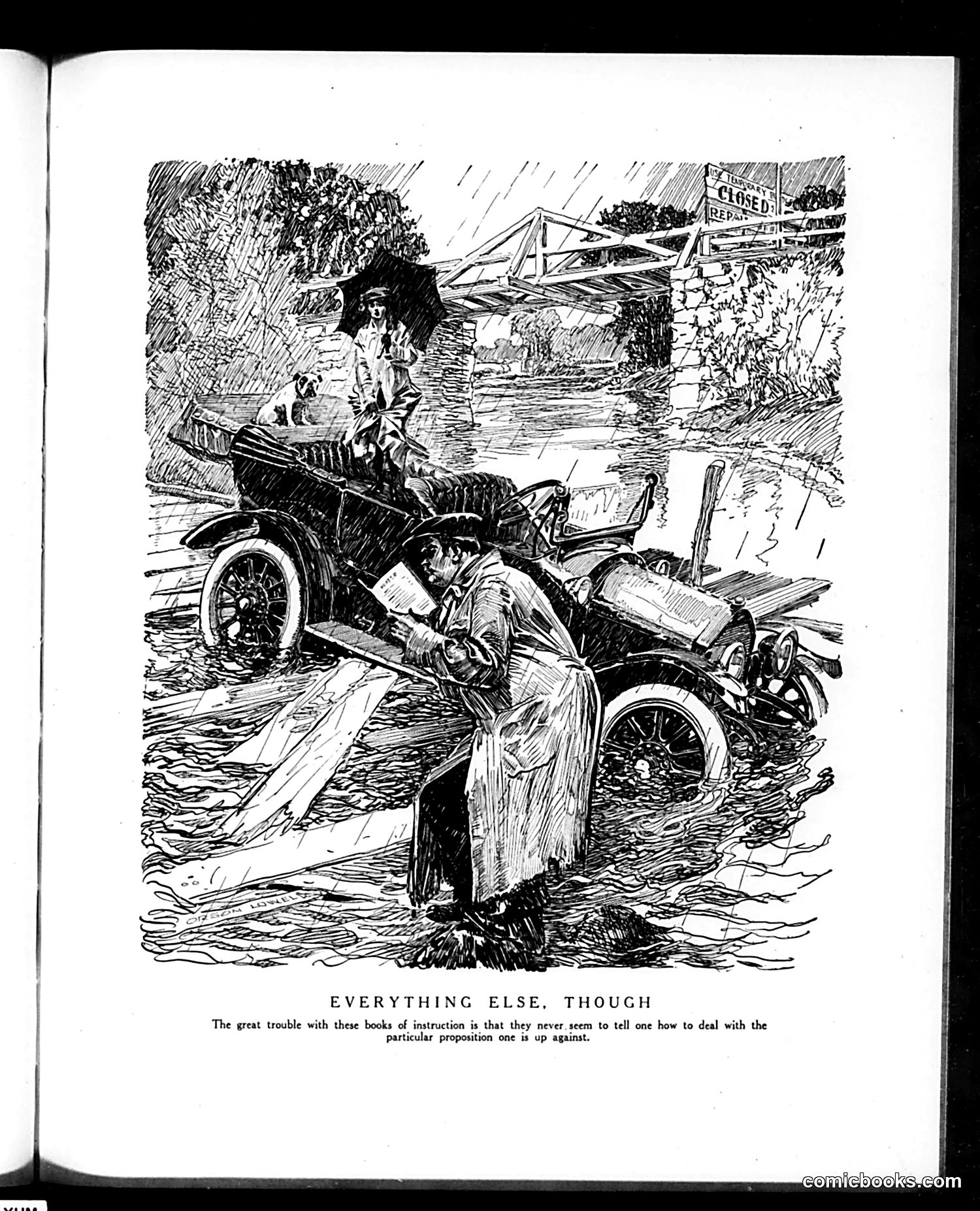
This illustration satirizes instruction manuals and automotive guides. The title "EVERYTHING ELSE, THOUGH" introduces the caption: "The great trouble with these books of instruction is that they never seem to tell one how to deal with the particular proposition one is up against." The image shows a woman stranded in muddy water with two stalled automobiles—one behind her, one ahead. While instruction books presumably cover standard operation, they fail to address real-world predicaments like this flooded crossing. The satire mocks the gap between theoretical instruction and practical problem-solving. This reflects early 20th-century anxieties about automobile ownership and the inadequacy of available guidance for everyday driving challenges. The woman's predicament illustrates the uselessness of textbook knowledge when facing unexpected obstacles.
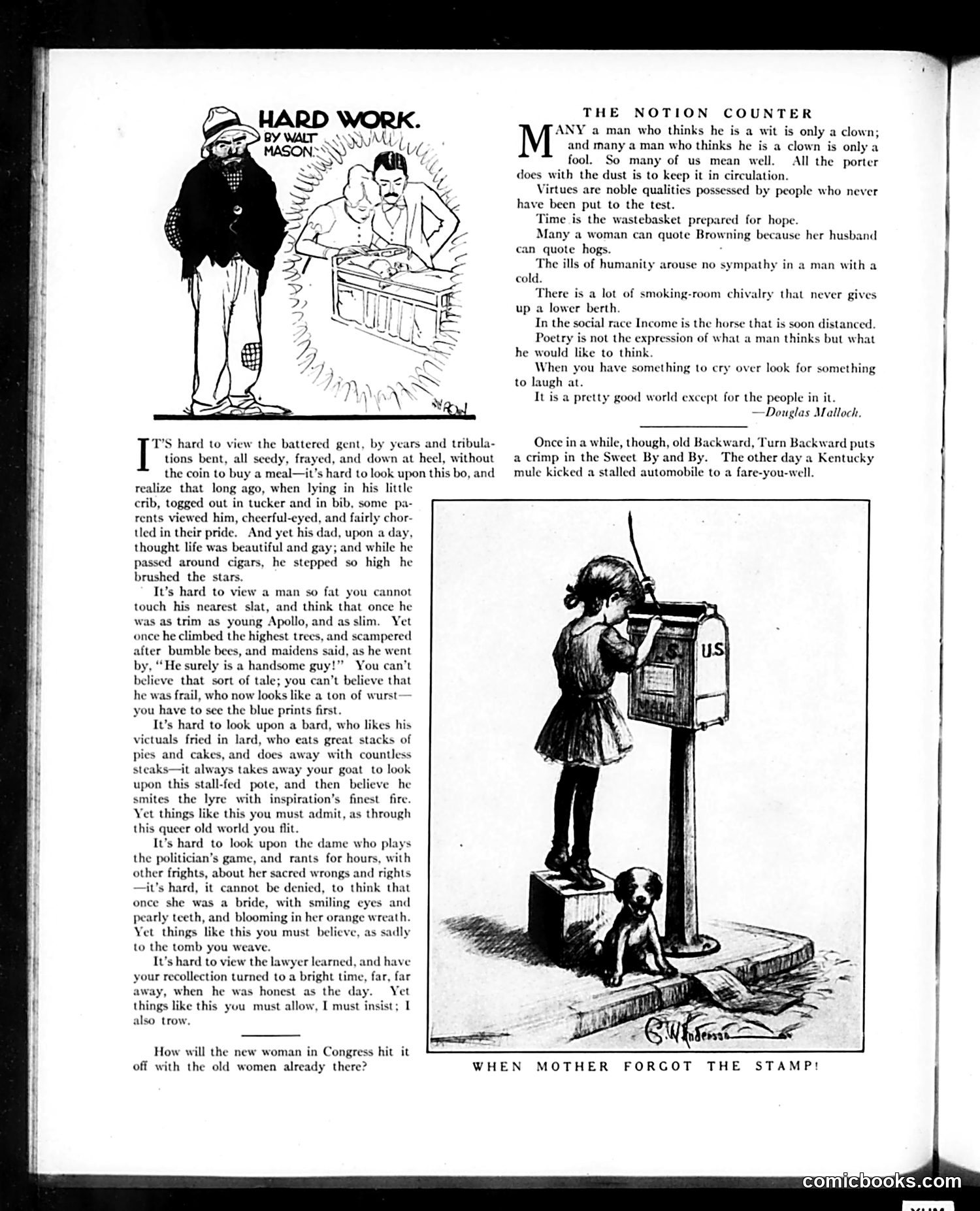
This page contains two distinct elements: **"The Notion Counter"** (left) is a humorous column of aphorisms attributed to Douglas Malloch. These are satirical observations on human nature—witty one-liners mocking hypocrisy, pretension, and self-deception. Examples: "Income is the horse that is soon distanced" (wealth doesn't last); "Poetry is not...what a man thinks but what he would like to think" (aspiration vs. reality). **"When Mother Forgot the Stamp!"** (right cartoon) depicts a young girl at a U.S. mailbox with a dog. The joke references mail delivery rules: without proper postage, letters were returned. The humor lies in depicting a child's innocent mistake causing her correspondence to fail—a common domestic mishap of the era when hand-posting mail was routine. Both pieces use gentle satire typical of *Judge* magazine's social commentary, targeting everyday human foibles rather than specific political figures or events.
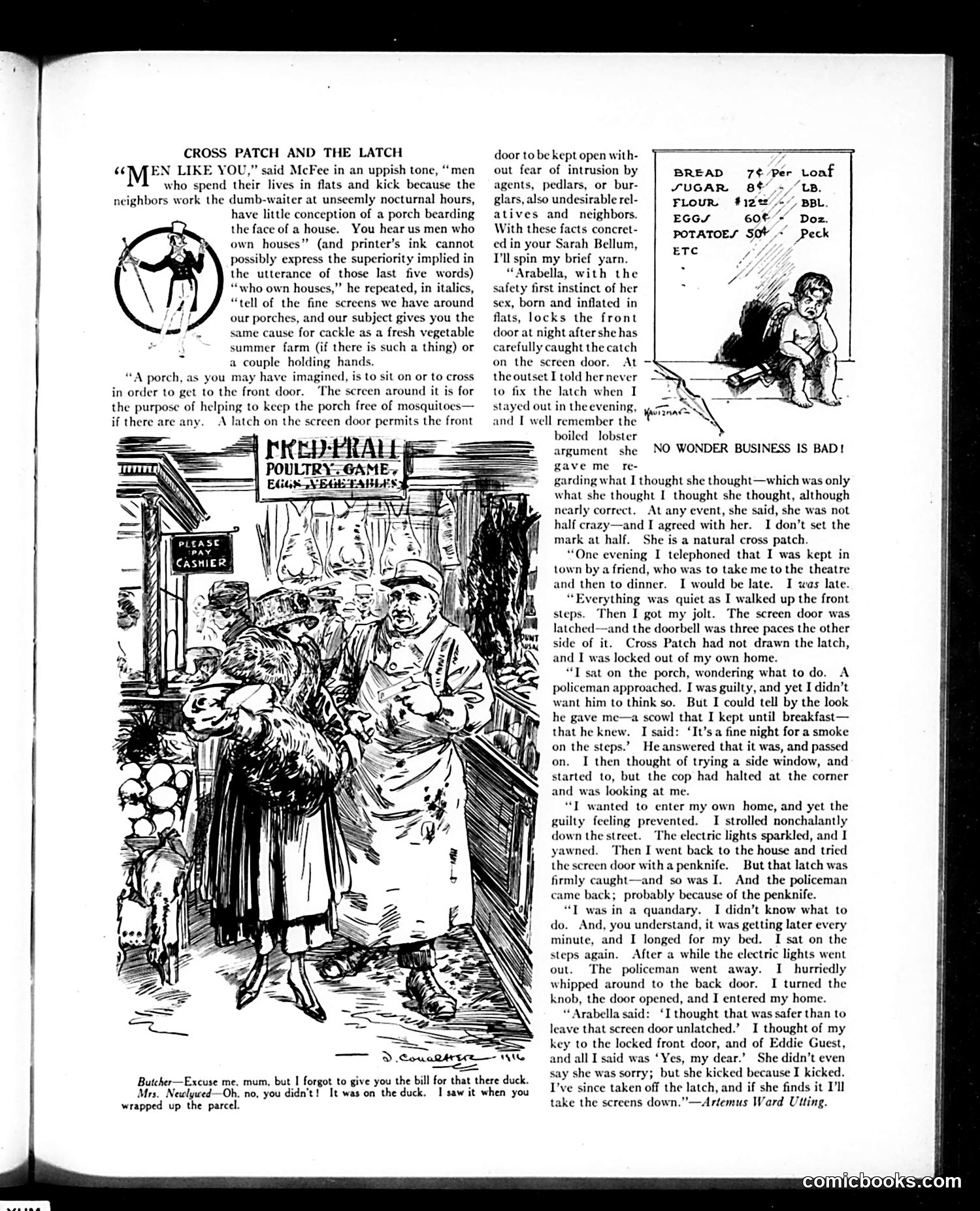
This is a humorous domestic story satirizing the anxieties of middle-class homeownership and wives' "safety-first" attitudes. The narrator (McFee) mocks apartment dwellers who complain about porches, then describes being locked out of his own home by his wife Arabella, who obsessively latches the screen door despite his instructions not to. The joke targets the contradiction: Arabella locks him out to prevent intrusions, creating the ironic situation where he—the legitimate owner—becomes the suspicious outsider. A policeman watching him try to break in with a penknife heightens the comedy. The cartoon illustration shows a butcher and grocer, connecting to the price list sidebar ("No Wonder Business is Bad!")—likely referencing post-WWI inflation concerns. The satire critiques both nagging wives and excessive security paranoia among the newly prosperous urban middle class.
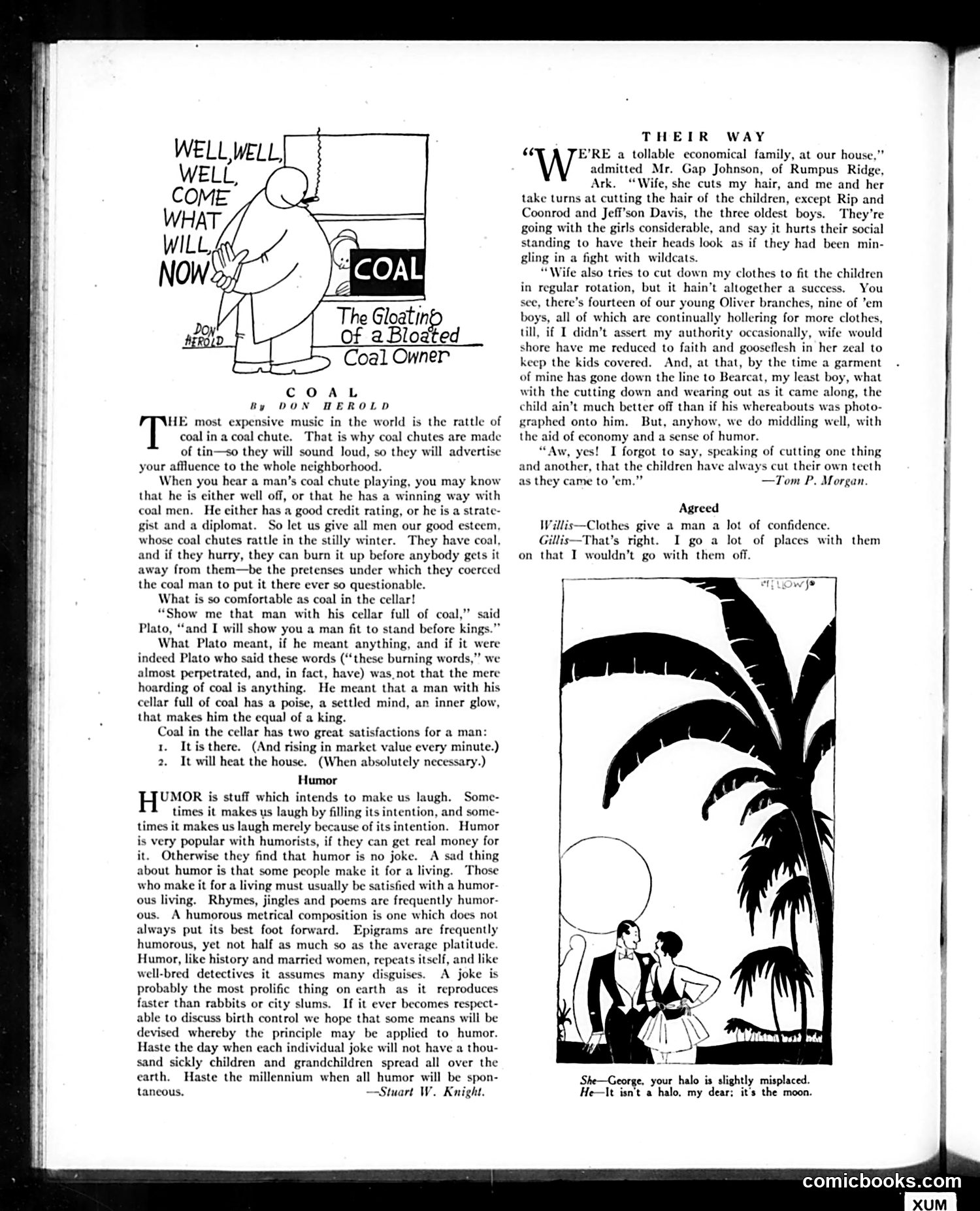
**The Coal Owner Cartoon** (top left): Don Herold satirizes wealthy coal owners' pretentious displays of affluence. The "bloated coal owner" gloats over his full coal cellar—a status symbol in winter. The satire mocks how coal-hoarding represents wealth and security; Herold humorously claims Plato said a man with a full coal cellar is "fit to stand before kings." The joke targets conspicuous consumption: the loud tin coal chute announces prosperity to neighbors, and owning coal becomes a bizarre measure of social standing. **"Their Way" Story**: This humorous domestic sketch portrays Mr. Gap Johnson of rural Arkansas, a self-described "tollable economical family" man who cuts hair and clothes for his large family to save money. The humor derives from poor rural families' resourcefulness—wife cuts everyone's hair, clothes get passed down through fourteen children. The irony: his three oldest boys refuse homemade haircuts because it damages their social standing with girls, forcing them to maintain appearances despite poverty. Both pieces satirize American status anxiety and economic pretension.
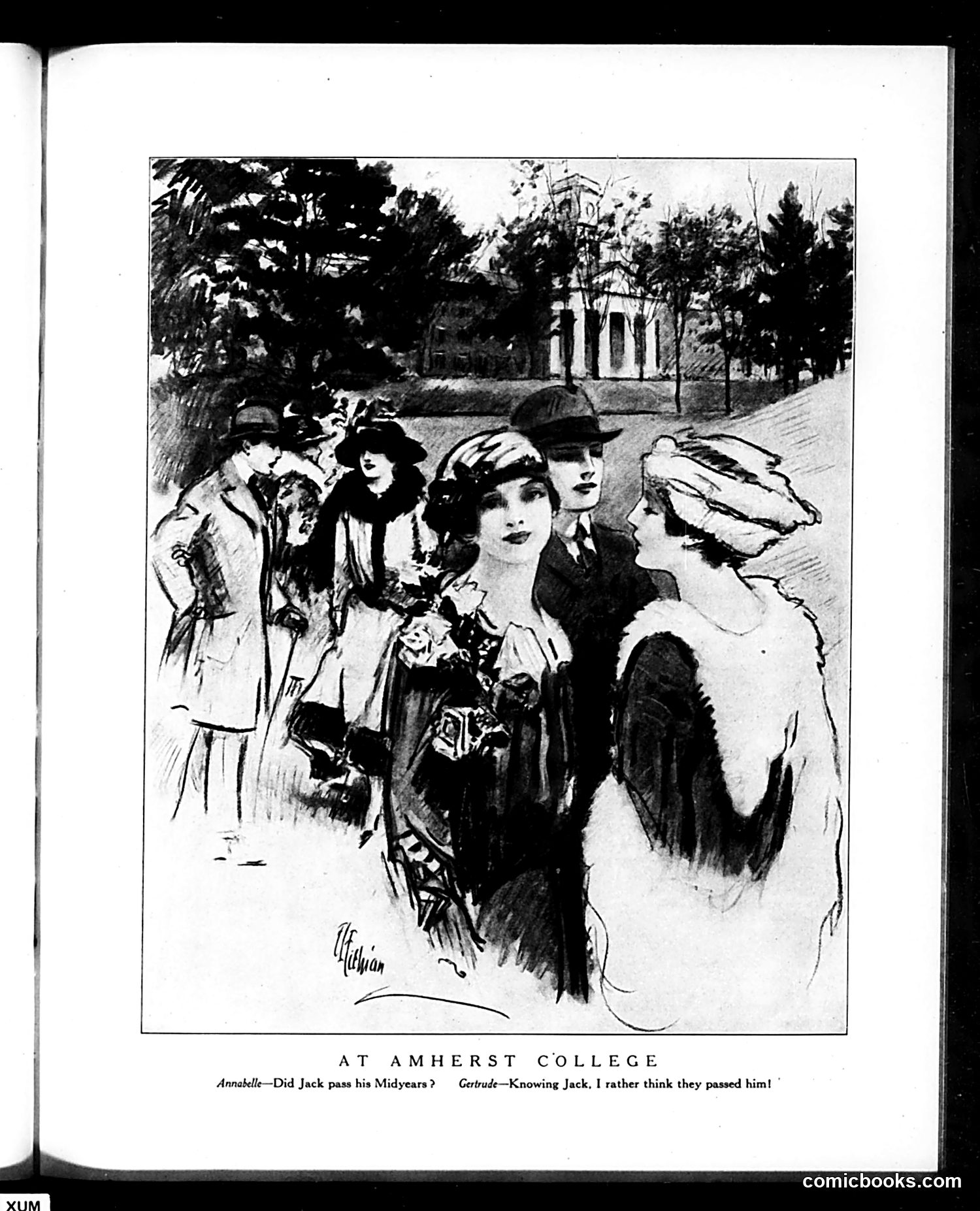
This cartoon satirizes academic standards at Amherst College. The joke turns on a pun: when Annabelle asks if "Jack passed his Midyears" (midyear exams), Gertrude replies that she thinks "they passed him"—reversing who did the passing. The implication is that Jack is such a poor student that the exams were lowered to his level rather than him meeting the standard. It's social satire about grade inflation or institutional leniency toward certain students, likely wealthy or well-connected ones. The fashionably dressed women in the campus setting suggest this is commentary on social hierarchies at elite colleges, where academic rigor might be compromised by other considerations. The cartoon gently mocks both the student's incompetence and the college's accommodating standards.
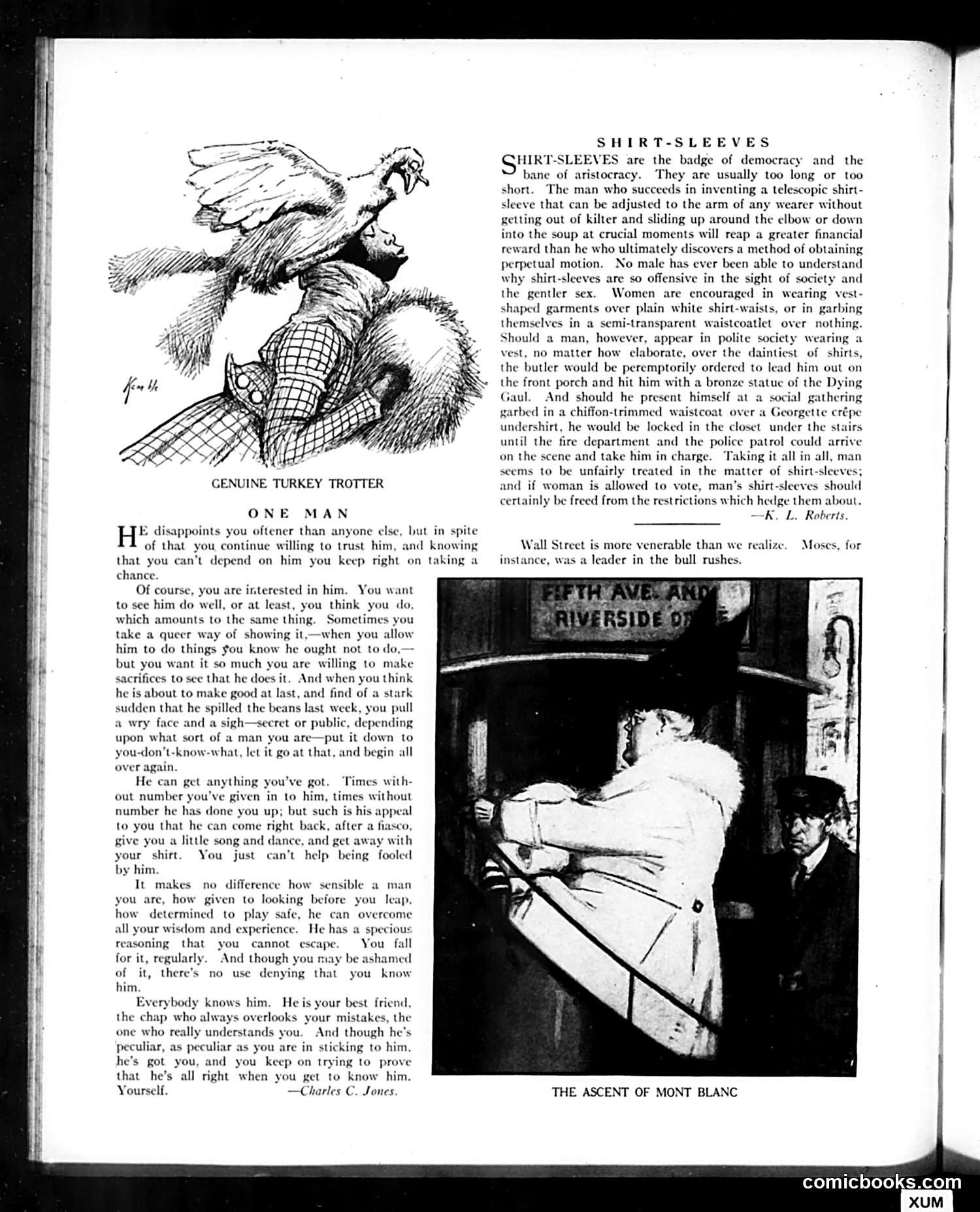
This page contains two satirical pieces from *Judge* magazine: **"One Man"** (by Charles C. Jones): A sardonic essay about how people—despite knowing better—repeatedly trust and forgive someone who consistently disappoints them. The piece describes this person as charming, persuasive, and somehow able to manipulate others into giving him "your shirt" despite repeated failures. It's a commentary on human weakness and the universal experience of being fooled by someone charismatic. **"Shirt-Sleeves"** (by K. L. Roberts): Social satire mocking class pretension. The author argues that men are unfairly restricted from showing rolled-up sleeves in polite society (considered working-class/undignified), while women wear equally revealing or casual garments without censure. The Moses/Wall Street joke is unclear but appears to mock financial culture's historical hypocrisy. The "Genuine Turkey Trotter" illustration is a humorous drawing unrelated to the text.
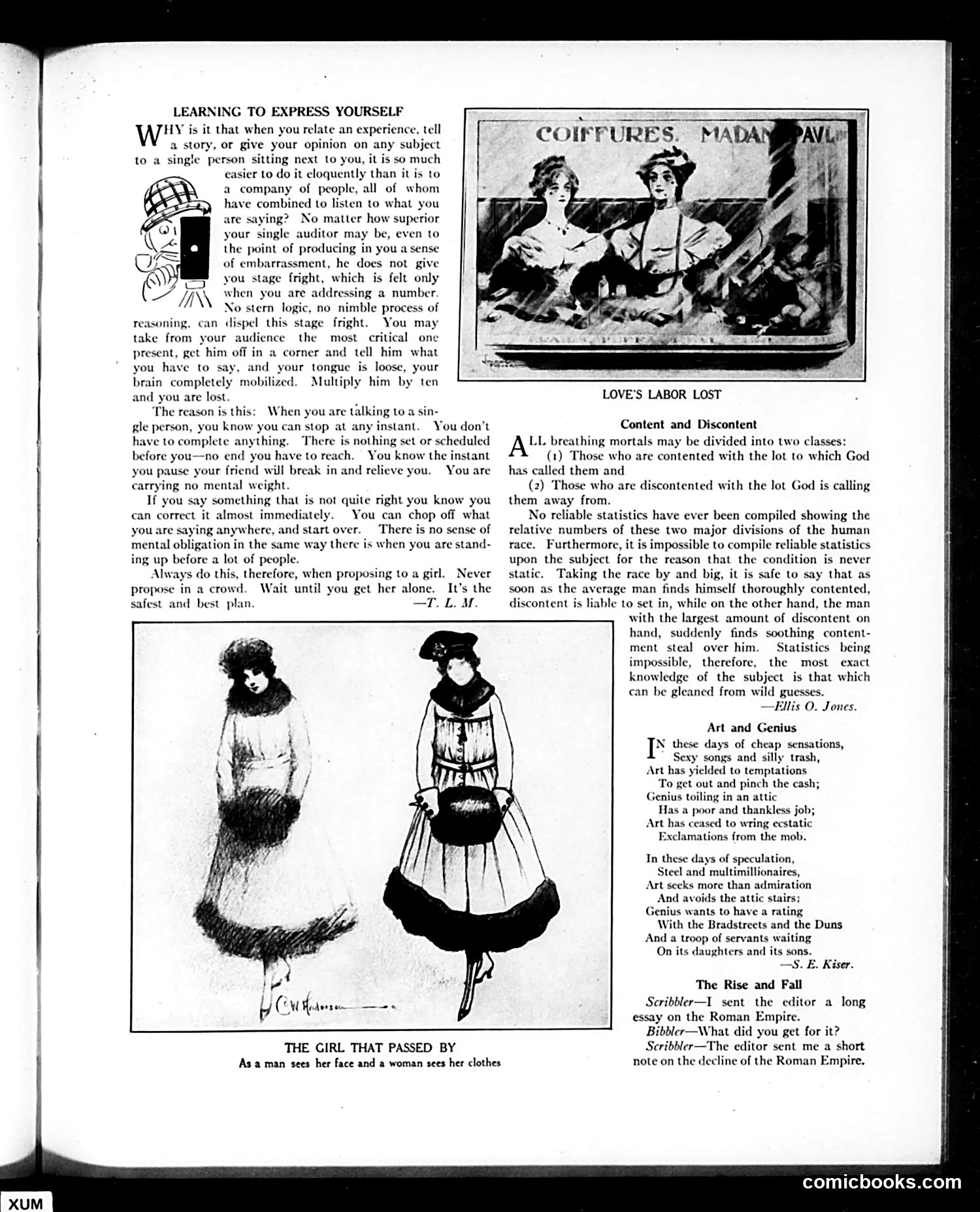
This page from *Judge* magazine contains satirical commentary rather than political cartoons. The main pieces address social observations: **"Learning to Express Yourself"** advises men proposing to women to do so privately, not in crowds—suggesting anxiety about public performance and romance. **"The Girl That Passed By"** illustrates gender difference in perception: men notice women's faces, women notice clothes—a commentary on male versus female priorities in appearance. **"Love's Labor Lost"** discusses human contentment philosophically, suggesting people are paradoxically discontent even when achieving their goals. **"Art and Genius"** and **"The Rise and Fall"** are poems critiquing commercialism in art and a joke about editorial rejection. The fashion illustration "Coiffures, Madame Davil" appears to be advertisement or style content, unrelated to satire. Overall, the page reflects early-20th-century American attitudes about gender, ambition, and artistic integrity.
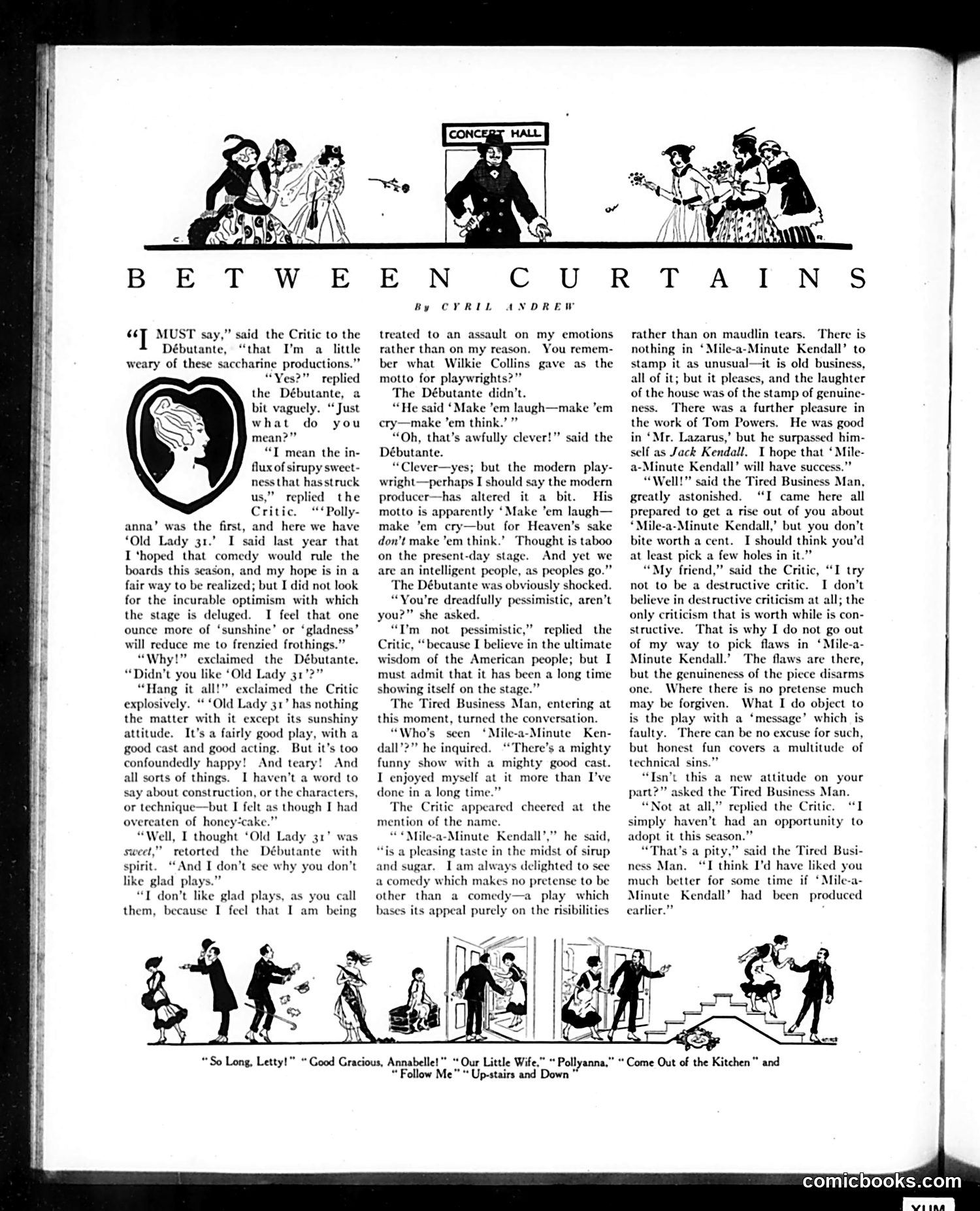
This theatrical criticism piece satirizes early 1910s Broadway's embrace of saccharine sentimentality. A Critic complains to a Debutante that recent plays—particularly "Pollyanna" and "Old Lady 31"—assault audiences' emotions rather than intellect. He laments that modern producers have corrupted Wilkie Collins's playwriting motto ("Make 'em laugh—make 'em cry—make 'em think") into "don't make 'em think," pandering to audiences by avoiding substance. When a Tired Business Man praises the lighter "Mile-a-Minute Kendall," the Critic unexpectedly agrees, praising its unpretentious entertainment value and genuine laughter. The satire suggests Broadway's split between critics demanding intellectual rigor and audiences simply seeking fun—and mocks the Critic's eventual hypocrisy in accepting entertainment without depth.
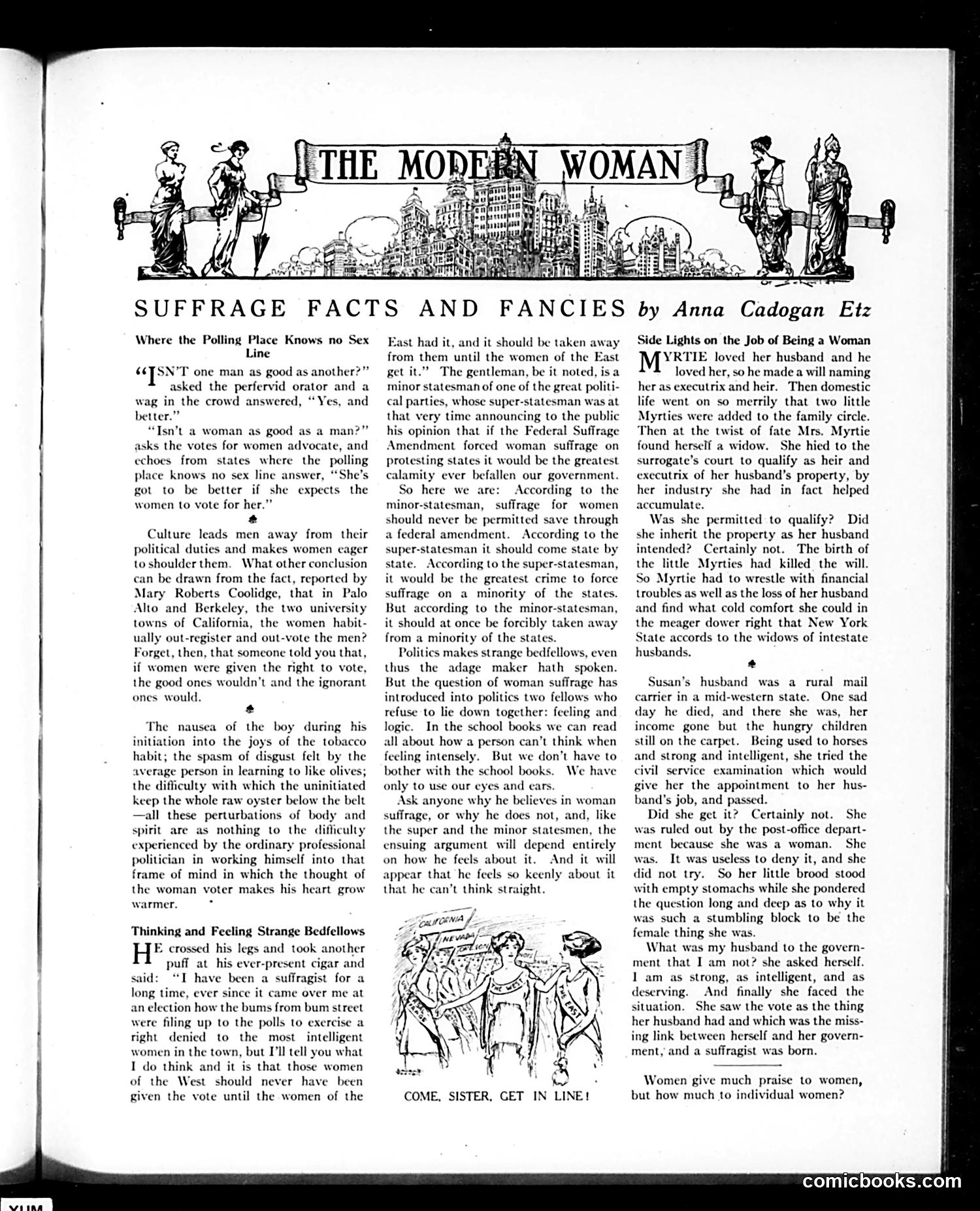
This page satirizes opposition to women's suffrage through multiple arguments. The main cartoon (bottom left, captioned "COME, SISTER, GET IN LINE!") depicts women being herded like cattle, mocking the patronizing rhetoric used against suffrage. The text ridicules male politicians' contradictory stances: one "minor statesman" argues suffrage should come federally while simultaneously opposing federal imposition on states—an illogical position exposed through satire. Another section mocks professional politicians' emotional resistance to women voters, comparing their discomfort to learning to smoke or eat oysters. The piece also challenges the claim that "good women" won't vote if given the chance, citing evidence from California university towns where women actually *out-voted* men. The sidebar story about "Myrtie" illustrates practical injustices: a widow loses control of her own property despite being named executrix—demonstrating why women needed legal/political rights. Overall, Etz uses humor and logic to expose the hypocrisy and irrationality of anti-suffrage arguments.
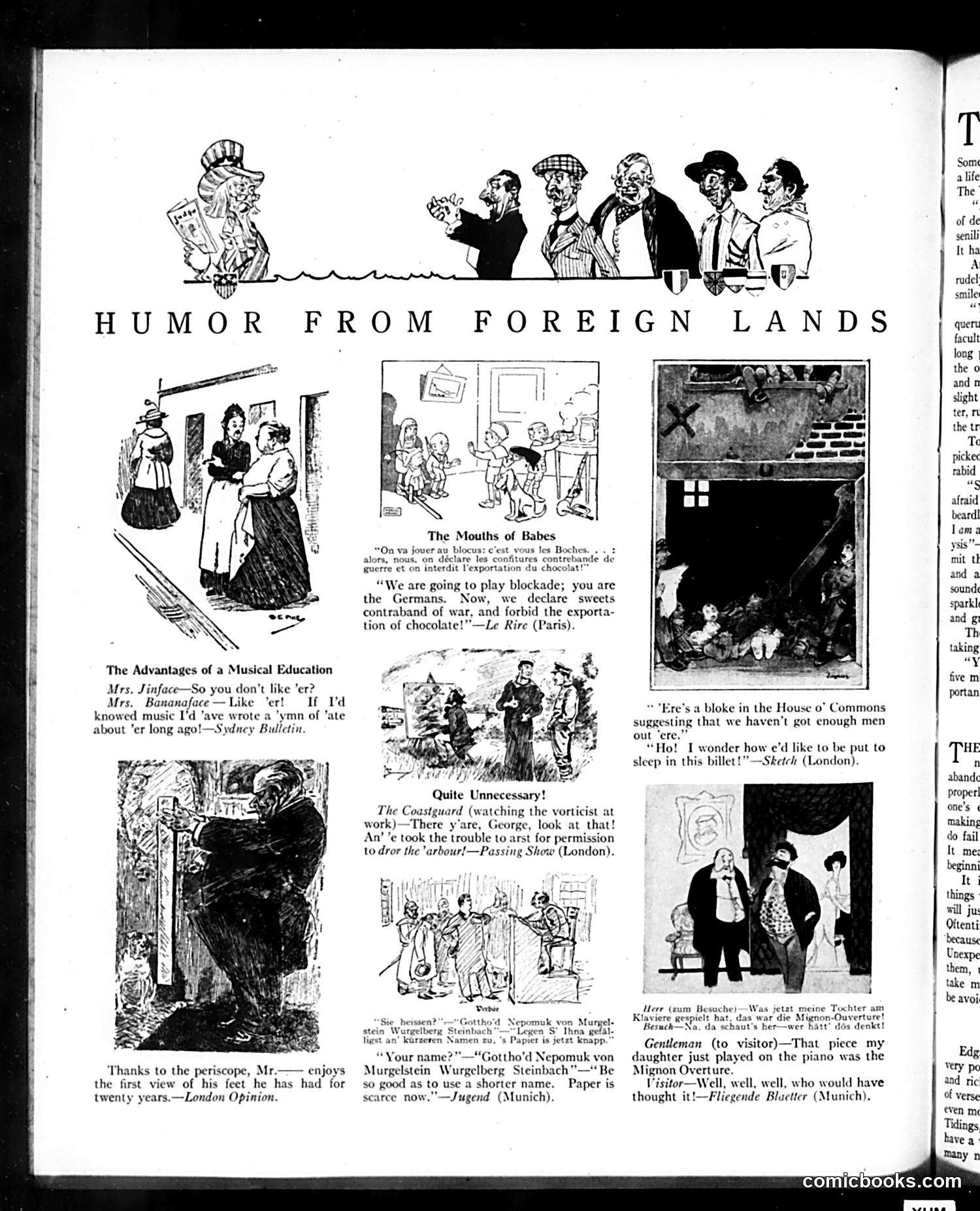
This page collects international satirical cartoons and jokes, likely from WWI-era publications. The humor addresses contemporary concerns: **"The Mouths of Babes"** (French source) satirizes children playing a blockade game, declaring chocolate "contraband"—referencing actual German wartime blockades and food rationing that affected civilians. **"Quite Unnecessary"** mocks a coastguard objecting to an artist ("vorticist") drawing the harbor, requiring permission—poking fun at wartime bureaucratic overreach and security paranoia. **The German name joke** ridicules the absurdly long Germanic names (Nepomuk von Murgelstein Wurgelberg Steinbach), suggesting paper shortage makes brevity necessary—satirizing both German naming conventions and wartime material scarcity. **The musical performance anecdote** jokes about a visitor praising a daughter's piano playing of the "Mignon Overture"—likely gentle mockery of pretentious musical culture. The page's framing as "foreign" humor allows Judge to present international wartime observations and cultural stereotypes to American readers.
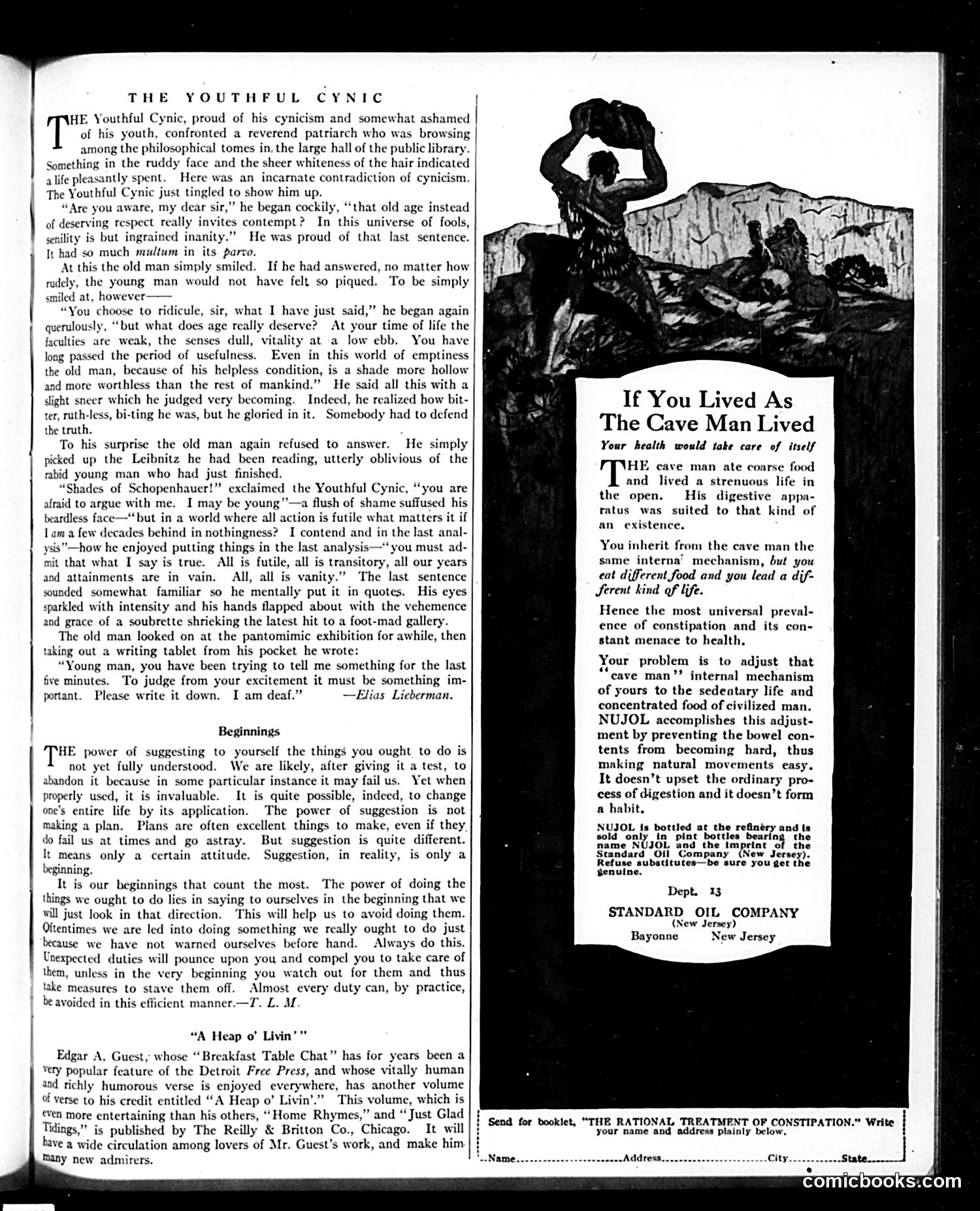
This satirical story mocks young intellectuals who adopt cynicism as a pose of sophistication. A pompous young man confronts an elderly scholar in a library, arrogantly lecturing him that age deserves contempt, not respect, and that all life is futile and transitory—spouting pseudo-philosophical rhetoric with theatrical gestures. The elderly man's response is devastating in its simplicity: he silently ignores the young cynic, then writes a note revealing he is deaf and asks the youth to write down his "important" message. The implication is cutting—the young man's entire elaborate cynical philosophy amounts to nothing worth communicating. The satire targets the pretentious adoption of pessimistic philosophy (referencing Schopenhauer) by youth seeking to appear intellectually superior. By refusing to engage and exposing the emptiness behind the performance, the old man demonstrates that genuine wisdom lies in quiet dignity, not bombastic rhetoric. The accompanying article on "Beginnings" reinforces this theme: real change comes from inner resolve, not clever words.
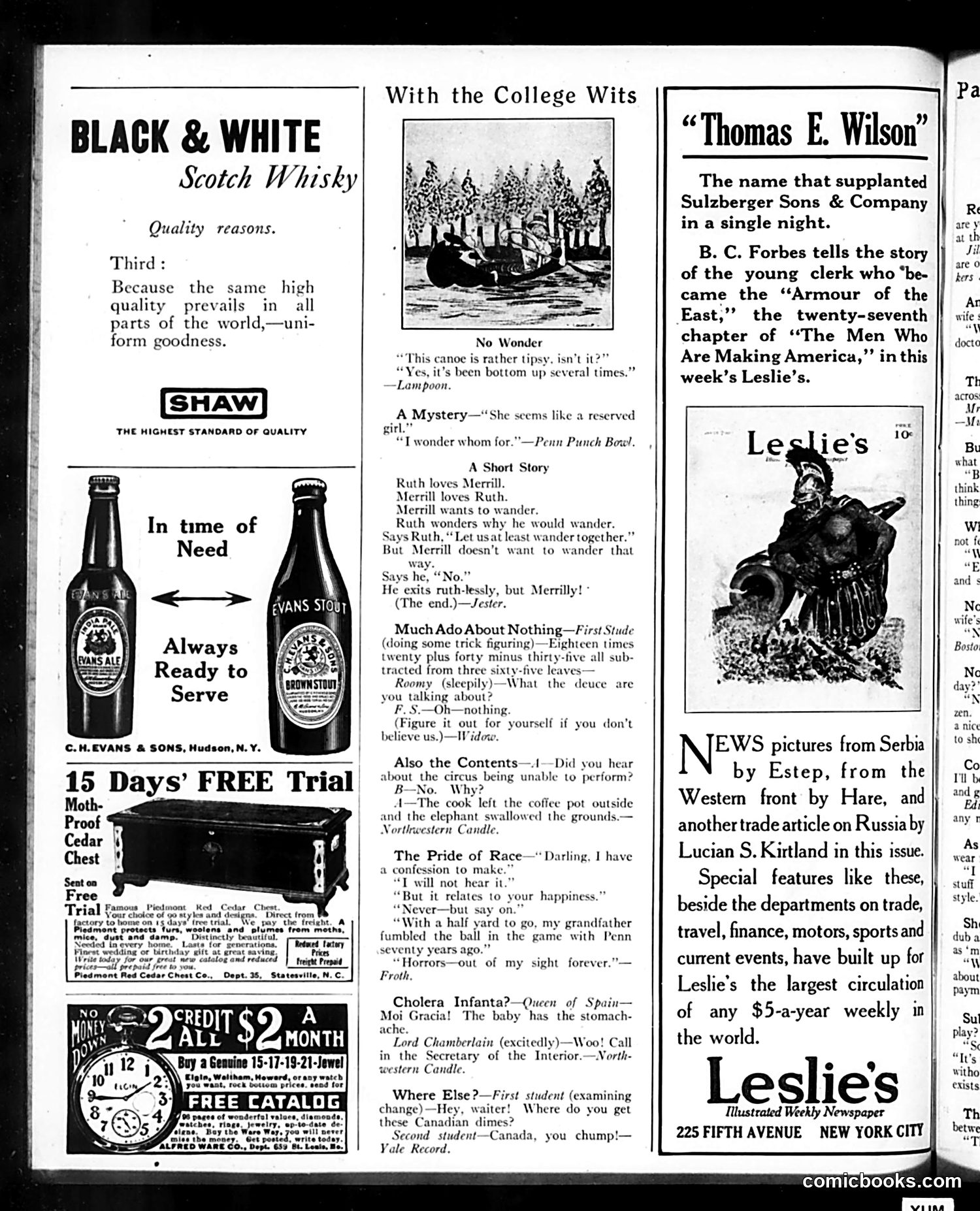
This page consists primarily of **advertisements and college humor**, not political satire. The main content features: **"With the College Wits"** — A humor section collecting jokes from college publications (Lampoon, Penn Punch Bowl, Jester, etc.). These are light, pun-based jokes typical of 1910s-era college wit: a drunk canoe, wordplay about "ruth-lessly," a math joke, and campus anecdotes. **Advertisements** dominate the page: - Black & White Scotch Whisky ("quality reasons") - Evans Stout beer ("always ready to serve") - Cedar chest furniture - Jewelry/watch credit offer **Leslie's Weekly** advertisement — promoting their illustrated weekly newspaper, highlighting an article on Thomas E. Wilson (appears to be a business figure) and coverage of WWI-related content (Serbia, Western front, Russia). There is **no political cartooning visible**. This is a standard magazine page mixing light collegiate humor with period advertising, likely from around 1915-1920 based on the WWI references.
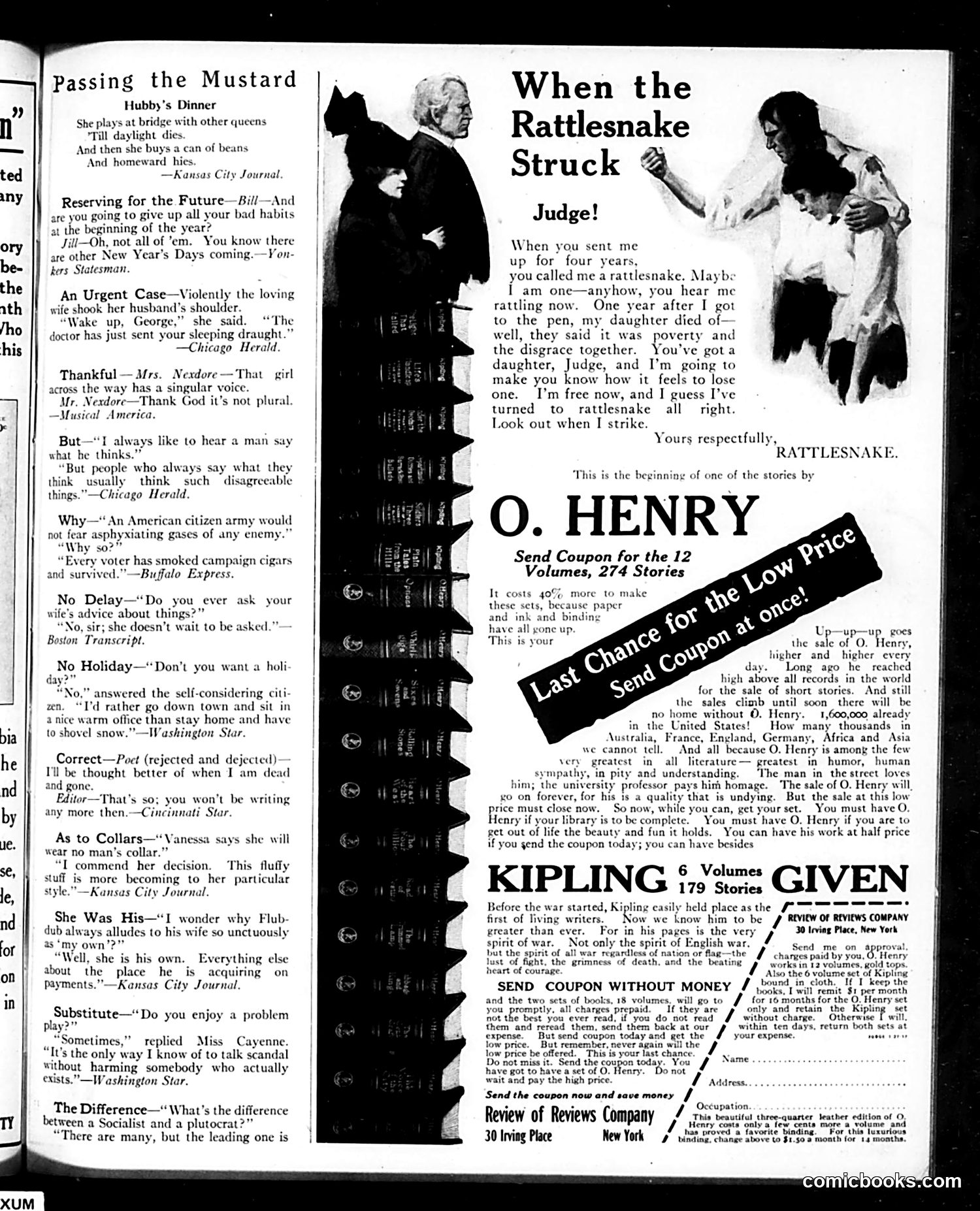
This page contains two distinct elements: **Left side:** A collection of brief humorous anecdotes mocking domestic life and social conventions—wives neglecting husbands for bridge, men avoiding home chores, etc. These are typical early 20th-century jokes about gender roles and marriage. **Right side:** An advertisement disguised as editorial content for O. Henry's collected stories, framed around "When the Rattlesnake Struck." The featured text appears to be from an O. Henry story about a convict (sent to prison by a judge, told him he was a "rattlesnake") whose daughter died of poverty and shame during his four-year sentence. Now freed, he seeks revenge against the judge. The advertisement exploits this dramatic narrative to sell O. Henry's complete works, claiming his stories are universally beloved and outselling all competitors. The "coupon" offer emphasizes affordability and broad American readership. The satire here is subtle—Judge magazine is using a revenge tragedy to market sentimental fiction, blending entertainment and commerce in a way that mixes editorial credibility with commercial promotion.
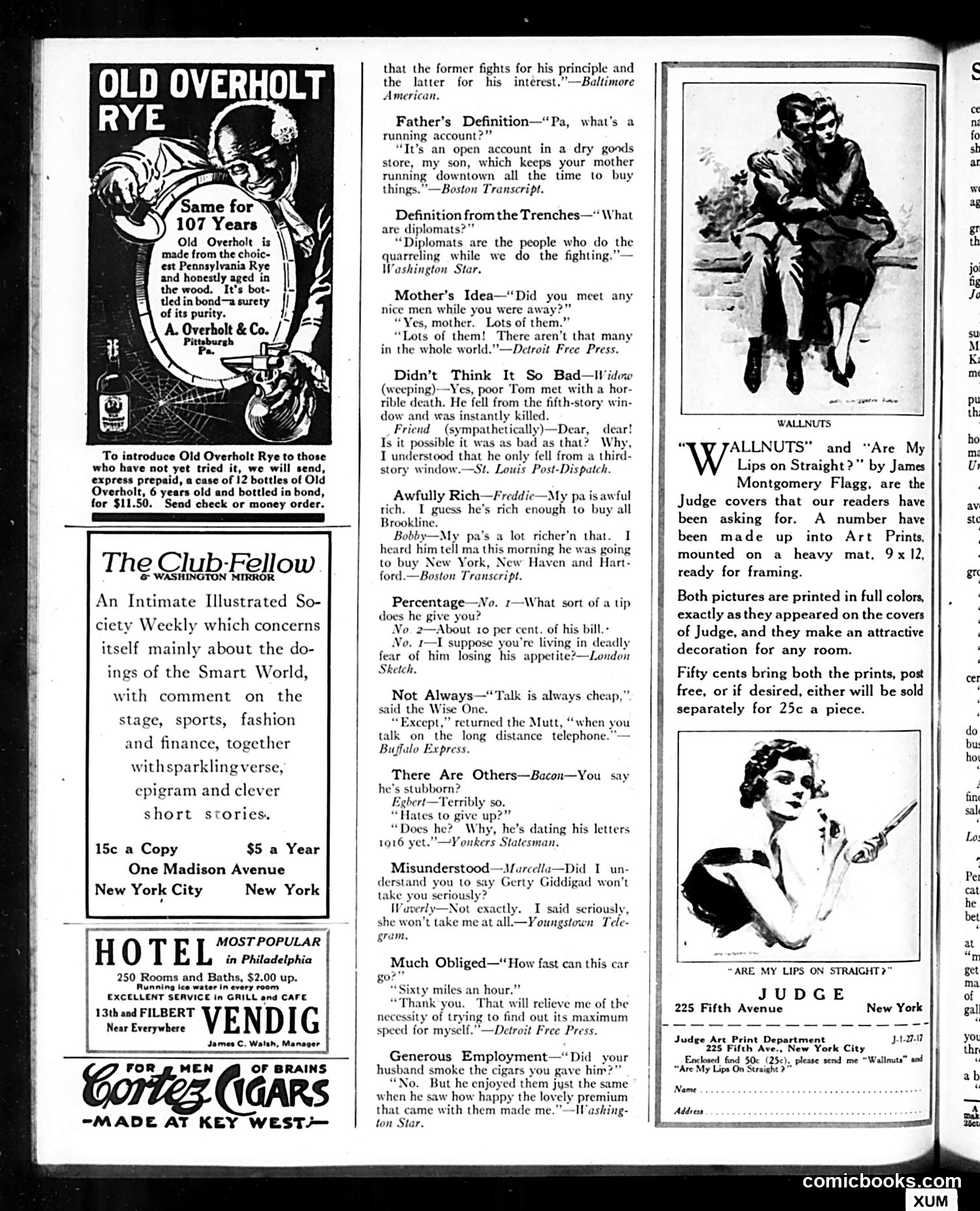
This page is primarily **advertising and humor content** rather than political cartoons. The main elements are: **Advertisements:** Old Overholt Rye whiskey, The Club-Fellow magazine, Hotel Vendig, and Correz cigars dominate the layout. **Humor Section:** The bulk of the text consists of brief jokes and witticisms organized by theme—"Father's Definition," "Definition from the Trenches," "Mother's Idea," etc. These are typical Judge magazine fare: punchy one-liners about domestic life, gender relations, and everyday situations. **One Reference to Current Events:** "Definition from the Trenches" alludes to World War I (soldiers vs. diplomats), suggesting this issue was published during or shortly after WWI. The joke contrasts battlefield soldiers with diplomats who "quarrel" rather than fight. **Art Prints Advertisement:** Judge promoted James Montgomery Flagg cover illustrations ("Wallnuts" and "Are My Lips on Straight?") as framed art prints for home decoration. The page reflects Judge's function as a **society and humor magazine** rather than primarily a political satire publication during this era.
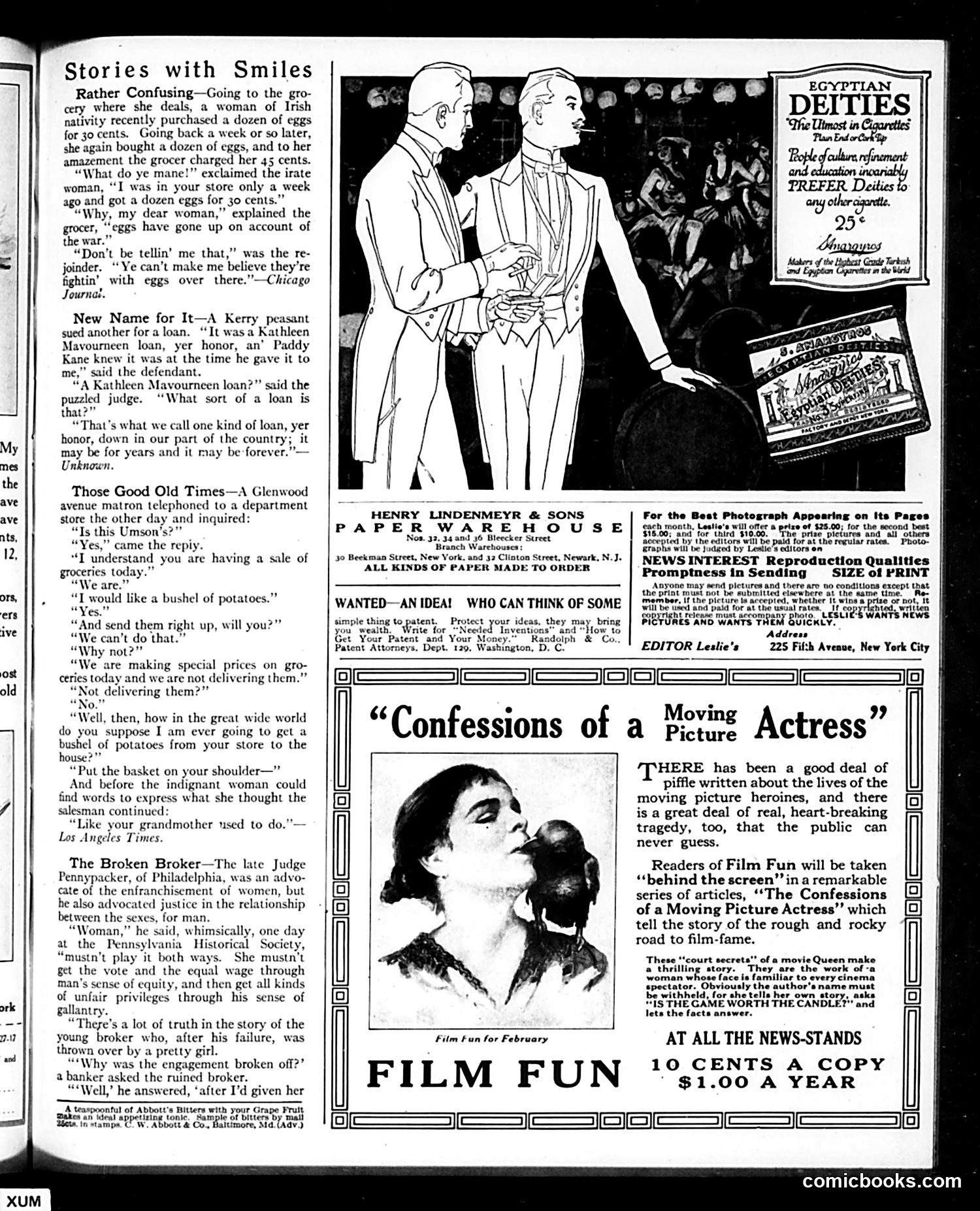
This page from *Judge* magazine contains three humorous short stories satirizing Irish immigrants, economic inflation, and gender relations in early 20th-century America: **"Rather Confusing"** mocks an Irish immigrant woman's misunderstanding of wartime inflation. She thinks egg prices rose due to war fighting overseas, not supply shortages—the joke hinging on her literal interpretation and Irish dialect. **"New Name for It"** plays on the song "Kathleen Mavourneen" (about indefinite separation) to describe a loan with no repayment deadline—humor derived from the linguistic/cultural reference. **"Those Good Old Times"** satirizes nostalgia for the past by showing a modern woman frustrated that a department store won't deliver groceries, forcing her to carry them home "like your grandmother" did—mocking both customer entitlement and romanticization of "the good old days." The remaining content is advertisements and promotion for *Film Fun* magazine, unrelated to satire.
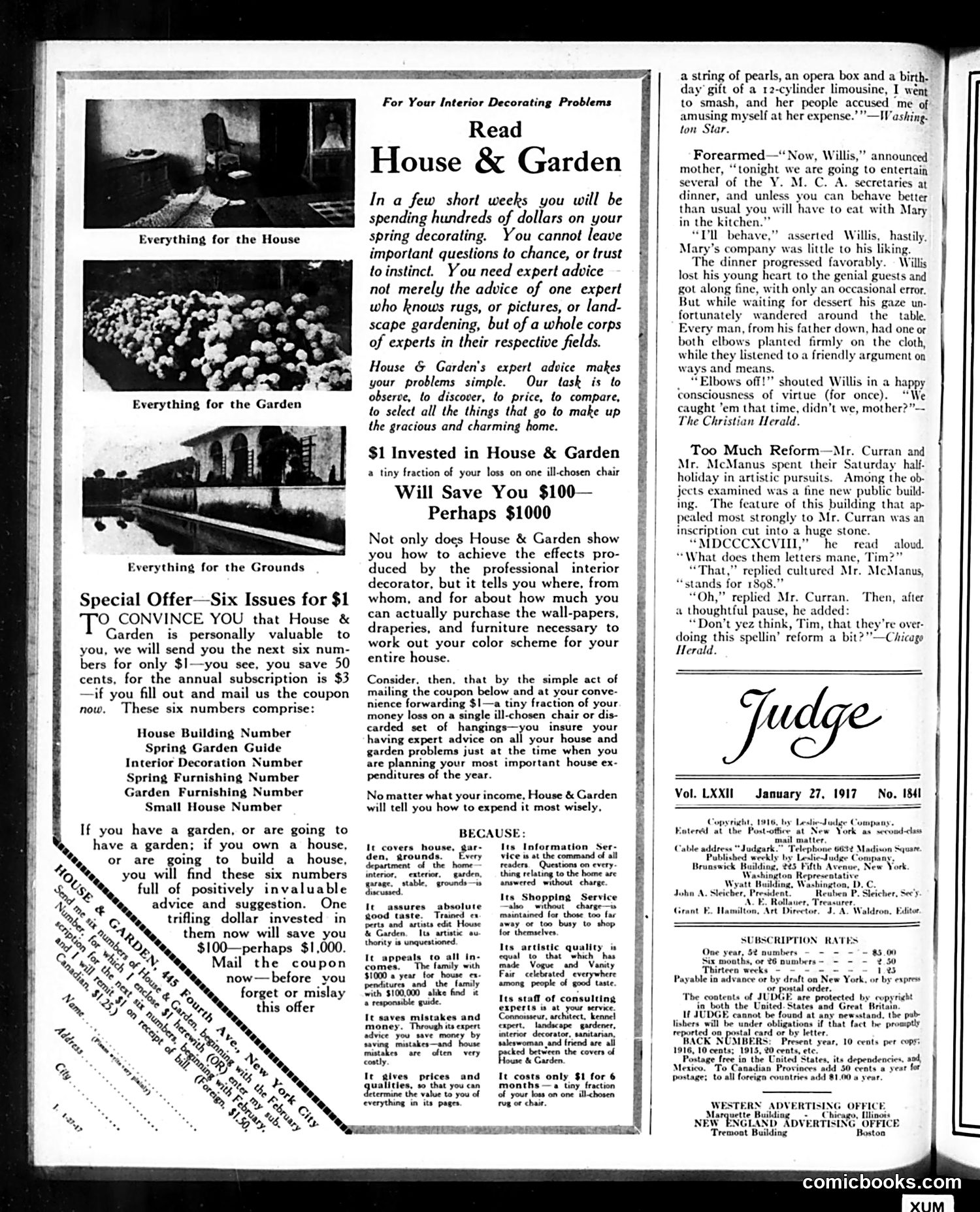
This page is primarily **advertising for House & Garden magazine**, not political satire. It contains no cartoons or political commentary. The advertisement targets homeowners planning spring renovations, promising expert advice on interior decoration, furnishings, and landscaping. The marketing pitch emphasizes that a $1 subscription investment will "save you $100—perhaps $1,000" by preventing costly decorating mistakes. The page includes three photographs labeled "Everything for the House," "Everything for the Garden," and "Everything for the Grounds," illustrating the magazine's scope. Three small stories in the right column—titled "Forewarmed," "Too Much Reform," and appearing to reference social etiquette—appear to be sample editorial content from the publication. This reflects the historical context: January 1917 was a period of American prosperity and home-improvement culture before U.S. entry into World War I, making such lifestyle advertising economically viable in a satirical weekly.
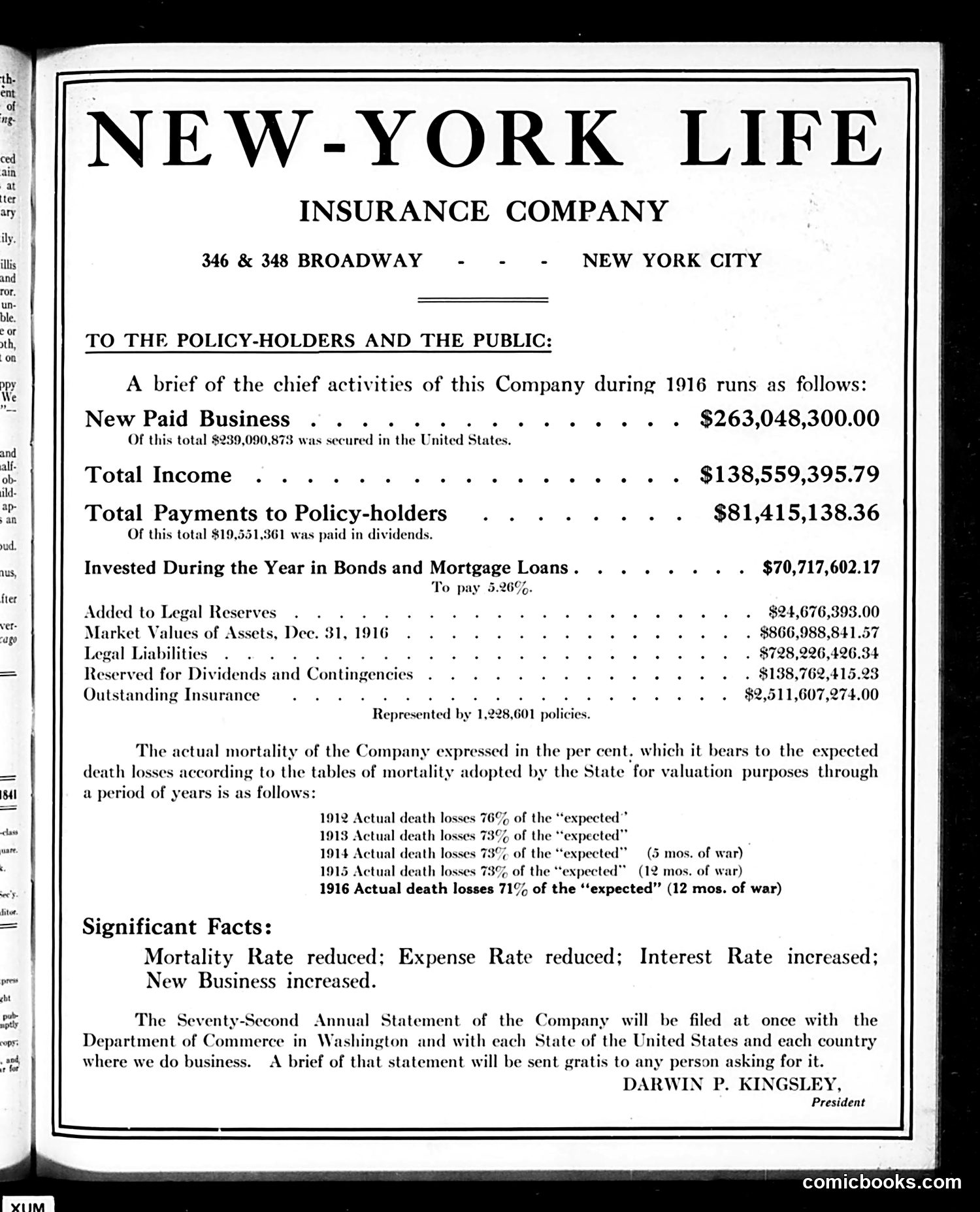
This page is **not a cartoon or satirical content**—it's a straightforward **insurance company advertisement** masquerading as editorial material in Judge magazine. New-York Life Insurance Company presents their 1916 annual financial summary to policyholders and the public. The "significant facts" highlight improved performance: reduced mortality rates, reduced expenses, and increased interest earnings, alongside $263 million in new business. The mortality statistics notably reference World War I (noting "12 mos. of war"), showing the company's actual death claims ran 71% of expected levels—a selling point suggesting their policyholders were healthier or longer-lived than actuarial tables predicted. This is essentially a financial report dressed in magazine format to reach readers. The document signed by President Darwin P. Kingsley served dual purposes: regulatory disclosure and advertising. There is no satire or political commentary present—it's purely corporate promotion of financial stability.
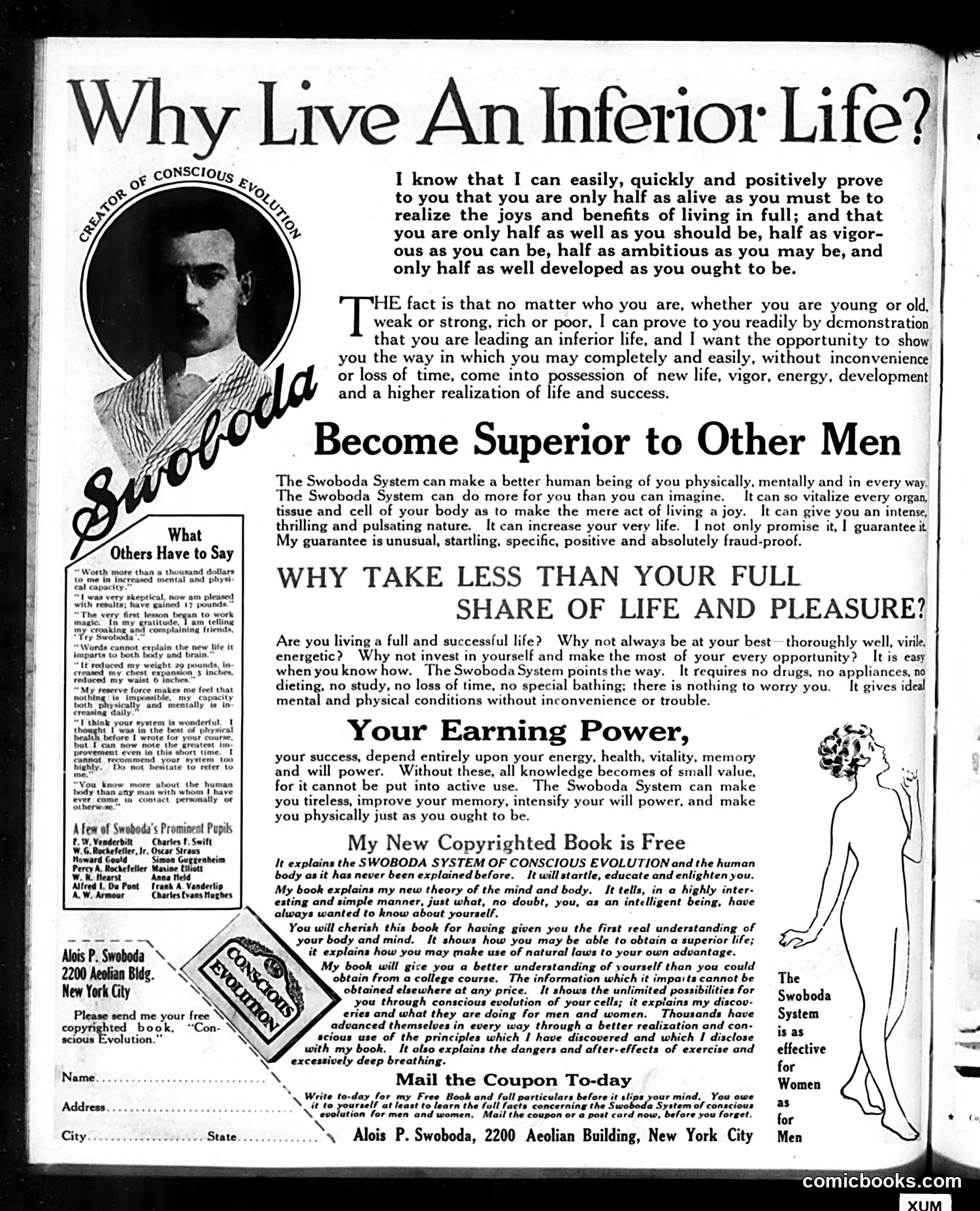
This is primarily a **full-page advertisement**, not satire. It promotes the "Swoboda System," a self-improvement method by Alois P. Swoboda, claiming to enhance physical vigor, mental capacity, and earning power. The page features: - **Portrait of Swoboda** labeled "Creator of Conscious Evolution" - **Testimonials** from prominent wealthy men (Vanderbilt, Rockefeller, Gould, etc.), claiming weight gain, chest expansion, and increased vitality - **Grandiose claims**: the system requires "no drugs, no appliances, no dieting" yet promises superhuman results - **Appeal to male ambition**: "Become Superior to Other Men," maximize "earning power" For modern readers, this reflects **early 20th-century pseudoscience marketing**—promising transformative self-improvement through vague methods. The emphasis on "conscious evolution" and celebrity endorsements (real names used) represents pre-FDA regulation-era hucksterism. The underlying message: you're inadequate unless you purchase this system.