
Judge, 1917-01-27 · page 13 of 28
Judge — January 27, 1917 — page 13: what you’re looking at
What you’re looking at
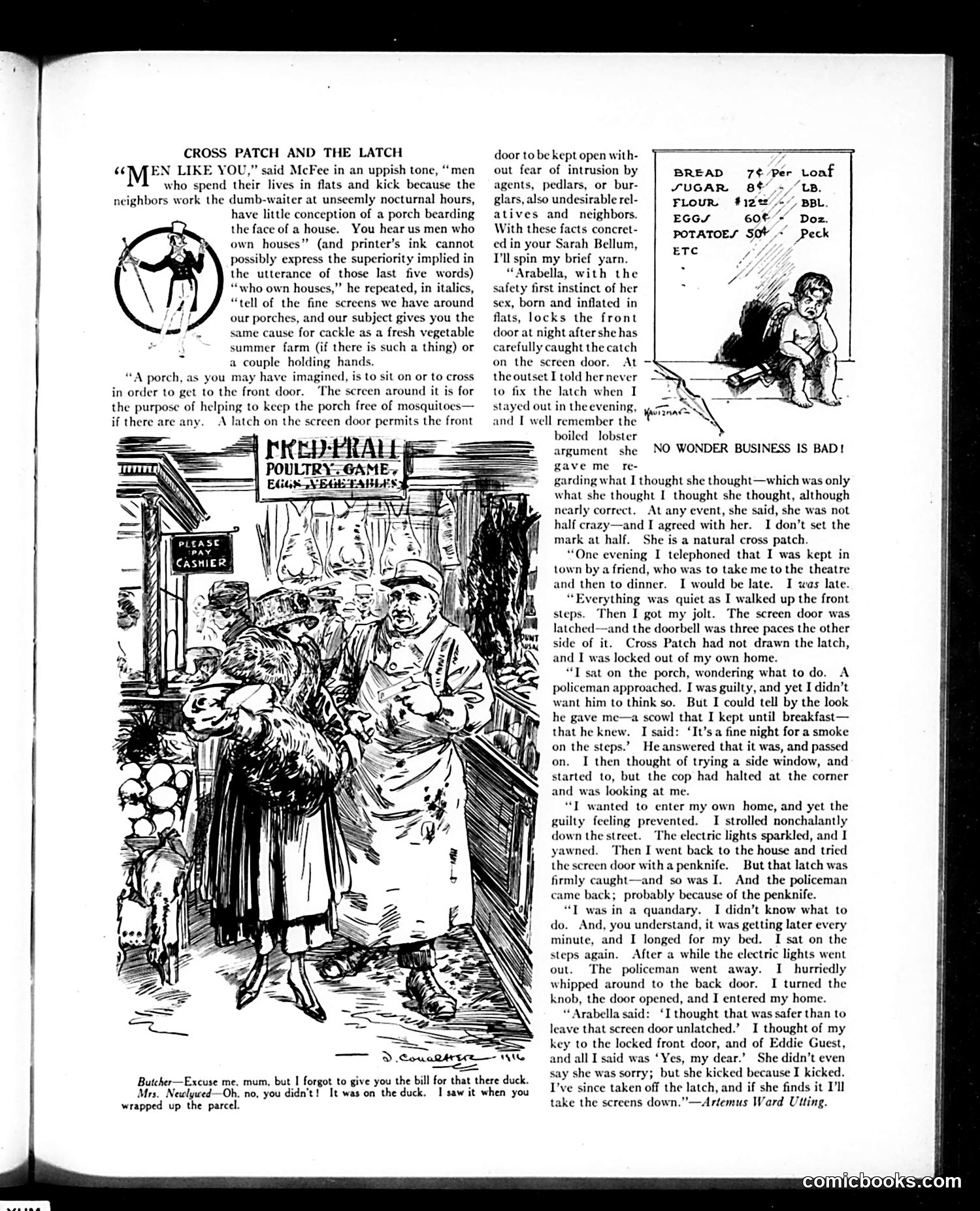
This is a humorous domestic story satirizing the anxieties of middle-class homeownership and wives' "safety-first" attitudes. The narrator (McFee) mocks apartment dwellers who complain about porches, then describes being locked out of his own home by his wife Arabella, who obsessively latches the screen door despite his instructions not to. The joke targets the contradiction: Arabella locks him out to prevent intrusions, creating the ironic situation where he—the legitimate owner—becomes the suspicious outsider. A policeman watching him try to break in with a penknife heightens the comedy. The cartoon illustration shows a butcher and grocer, connecting to the price list sidebar ("No Wonder Business is Bad!")—likely referencing post-WWI inflation concerns. The satire critiques both nagging wives and excessive security paranoia among the newly prosperous urban middle class.
📄 Transcribed text from this page (OCR, searchable)
Machine-transcribed from the original scan — historical spelling and the odd misread are preserved.
who spend their | in order to get to the front door. the purpose of helping to keep the porch free of mosquitoes— if there are any. A latch on the screen door permits the front CROSS PATCH AND THE LATCH 6¢)\TEN LIKE YOU,” said McFee in an uppish tone, “men s in flats and kick because the neighbors work the dumb-waiter at unseemly nocturnal hours, have little conception of a porch bearding the face of a house. You hear us men who own houses” (and printer’s ink cannot possibly express the superiority implied in the utterance of those last five words) “who own houses,” he repeated, in italics, “tell of the fine screens we ha our porches, and our subject gives you the same cause for cackle as a fresh vegetable summer farm (if there is such a thing) or a couple holding hands. you may have imagined, is to sit on or to cross The screen around it is for door to be kept open with- out fear of intrusion by agents, pedlars, or bur- glars, also undesirable rel- atives and_ neighbors. With these facts concret- ed in your Sarah Bellum, I'll spin my brief yarn. “Arabella, with the safety first instinct of her born and inflated in flats, locks the front door at night after she has carefully caught the catch on the screen door, At the outset I told hernever to fix the latch when I stayed out in the evening, and I well remember the BREAD 7¢ Per Loaf SUGAR. Bt >” FLouR #122 4 ) BBL. POTATOES SO*~ Peck NA SSS ))) ‘ase! SS i PL SSS Butcher—Excuse me, mum, but | forgot to give you the bill for that there duck. Mrs. Newlywed—Oh, no, you didn’t! It was on the duck. | saw it when you wrapped up the parcel. 9 Con arerrre— 1G sexand- bon boiled lobster argument she NO WONDER BUSINESS IS BAD! gave me re- garding what I thought she thought—which was only what she thought I thought she thought, although nearly correct. At any event, she said, she was not half crazy—and I agreed with her. I don’t set the mark at half. She is a natural cross patch. “One evening I telephoned that I was kept in town by a friend, who was to take me to the theatre and then to dinner. I would be late. I was late. “Everything was quiet as I walked up the front steps. Then I got my jolt. The screen door was latched—and the doorbell was three paces the other side of it. Cross Patch had not drawn the latch, and I was locked out of my own home. “T sat on the porch, wondering what to do. A policeman approached. I was guilty, and yet I didn’t want him to think so. But I could tell by the look e gave me—a scowl that I kept until breakfast— that he knew. I said: ‘It’s a fine night for a smoke on the steps.’ He answered that it was, and passed on. I then thought of trying a side window, and started to, but the cop had halted at the corner and was looking at me. “TI wanted to enter my own home, and yet the guilty feeling prevented. I strolled nonchalantly down the street. The electric lights sparkled, and I yawned. Then I went back to the house and tried the screen door with a penknife. But that latch was firmly caught—and so was I. And the policeman came back; probably because of the penknife. “T was in a quandary. I didn’t know what to do. And, you understand, it was getting later every minute, and I longed for my bed. I sat on the steps again. After a while the electric lights went out. The policeman went away. I hurriedly whipped around to the back door. I turned the knob, the door opened, and I entered my home. “ Arabella said: ‘I thought that was safer than to leave that screen door unlatched.’ I thought of my key to the locked front door, and of Eddie Guest, and all I said was ‘Yes, my dear.’ She didn’t even say she was sorry; but she kicked because I kicked. I’ve since taken off the latch, and if she finds it I’ll take the screens down.”—Artemus Ward Utting.