
Judge, 1917-01-27 · page 18 of 28
Judge — January 27, 1917 — page 18: what you’re looking at
What you’re looking at
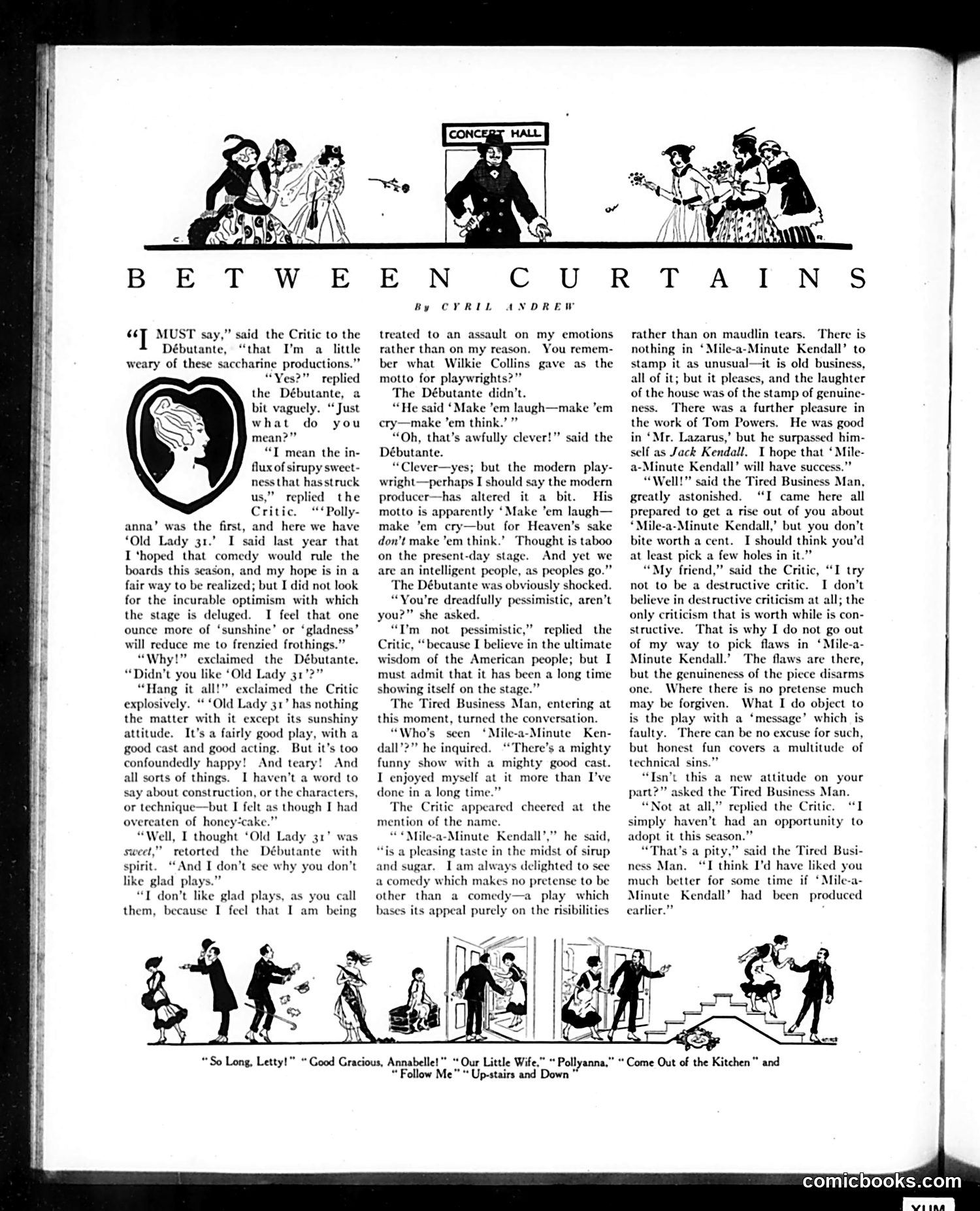
This theatrical criticism piece satirizes early 1910s Broadway's embrace of saccharine sentimentality. A Critic complains to a Debutante that recent plays—particularly "Pollyanna" and "Old Lady 31"—assault audiences' emotions rather than intellect. He laments that modern producers have corrupted Wilkie Collins's playwriting motto ("Make 'em laugh—make 'em cry—make 'em think") into "don't make 'em think," pandering to audiences by avoiding substance. When a Tired Business Man praises the lighter "Mile-a-Minute Kendall," the Critic unexpectedly agrees, praising its unpretentious entertainment value and genuine laughter. The satire suggests Broadway's split between critics demanding intellectual rigor and audiences simply seeking fun—and mocks the Critic's eventual hypocrisy in accepting entertainment without depth.
📄 Transcribed text from this page (OCR, searchable)
Machine-transcribed from the original scan — historical spelling and the odd misread are preserved.
BE T W E sh | MUST say,” said the Critic to the Débutante, “that I’m a little weary of these saccharine productions.” “Yes?” replied the Débutante, a bit vaguely. “Just what do you mean?” “T mean the in- flux of sirupy sweet- ness that hasstruck us,” replied the Critic. “‘Polly- anna’ was the first, and here we have ‘Old Lady 31.’ I said last year that I ‘hoped that comedy would rule the 5 on, and my hope is in a 0 y be realized; but I did not look for the incurable optimism with which the stage is deluged. I feel that one ounce more of ‘sunshine’ or ‘gladness’ will reduce me to frenzied frothings.” exclaimed the Débutante. 3 has aig with it except its sunshiny attitude. It’s a fairly good play, with a good cast and good acting. But it’s too confoundedly happy! And teary! And all sorts of things. I haven’t a word to say about construction, or the characters, or technique—but I felt as though I had ke.” I thought ‘Old Lady 31’ was retorted the Débutante with spirit. “And I don’t see why you don’t like glad plays.” “[ don't like glad plays, as you call them, because I feel that I am being E N By CYRIL ANDREW ‘ated to an assault on my emotions rather than on my reason. You remem- ber what Wilkie Collins gave as the motto for playwrights?” The Débutante didn’t. “He said ‘Make ’em laugh—make ’em cry—make ’em think.’ ” “Oh, that’s awfully clever!” Débutante. “Clever—yes; but the modern play- wright—perhaps I should say the modern producer—has altered it a bit. His motto is apparently ‘Make ‘em laugh— make ‘em cry—but for Heaven's sake don't make ’em think.’ Thought is taboo on the present-day stage. And yet we are an intelligent people, as peoples go.”” The Débutante was obviously shocked. “You're dreadfully pessimistic, aren’t she asked. 'm not pessimistic,” replied the tic, “ because I believe in the ultimate wisdom of the American people; but I must admit that it has been a long time showing itself on the stage.” The Tired Business Man, entering at this moment, turned the conversation. “Who's seen ‘Mile-a-Minute Ken- dall’?” he inquired. here’s a mighty funny show with a mighty good cast. I enjoyed myself at it more than I’ve done in a long time.” The Critic appeared cheered at the mention of the name. “*Mile-a-Minute Kendall’,” he said, “is a pleasing taste in the midst of sirup and sugar. Iam always delighted to see a comedy which makes no pretense to be other than a comedy—a play which bases its appeal purely on the risibilities said the C U RTA rather than on maudlin te: There is nothing in ‘Mile-a-Minute Kendall’ to stamp it as unusual—it is old business, all of it; but it pleases, and the laughter of the house was of the stamp of genuine- ness. There was a further pleasure in the work of Tom Powe He was good in ‘Mr. Lazarus,’ but he surpassed him- self as Jack Kendall. I hope that ‘ Mile- a-Minute Kendall’ will have success.” “Well!” said the Tired Business Man, greatly astonished. “I came here all prepared to get a rise out of you about ‘Mile-a-Minute Kendall,’ but you don’t bite worth a cent. I should think you'd at least pick a few holes in it.” “My friend,” said the Critic, “I try not to be a destructive critic. I don’t believe in destructive criticism at all; the only criticism that is worth while is con- structive. That is why I do not go out of my way to pick flaws in ‘Mile-a- Minute Kendall.’ The flaws are there, but the genuineness of the piece disarms one. Where there is no pretense much may be forgiven. What I do object to is the play with a ‘message’ which is faulty. There can be no excuse for such, but honest fun covers a multitude of technical sins.”” isn’t this a new attitude on your part?” asked the Tired Business Man. Not at all,” replied the Critic. “I simply haven’t had an opportunity to adopt it this season.” “That's a pity,” said the Tired Busi- ness Man. “I think I’d have liked you much better for some time if ‘Mile Minute Kendall’ had been produced earlier.” “So Long, Letty!” “Good Gracious, Annabelle!” “* Our Little Wife.” “ Pollyanna, “Follow Me” * Up-stairs and Down “Come Out of the Kitchen” and comicbooks.com