
Judge, 1917-01-27 · page 9 of 28
Judge — January 27, 1917 — page 9: what you’re looking at
What you’re looking at
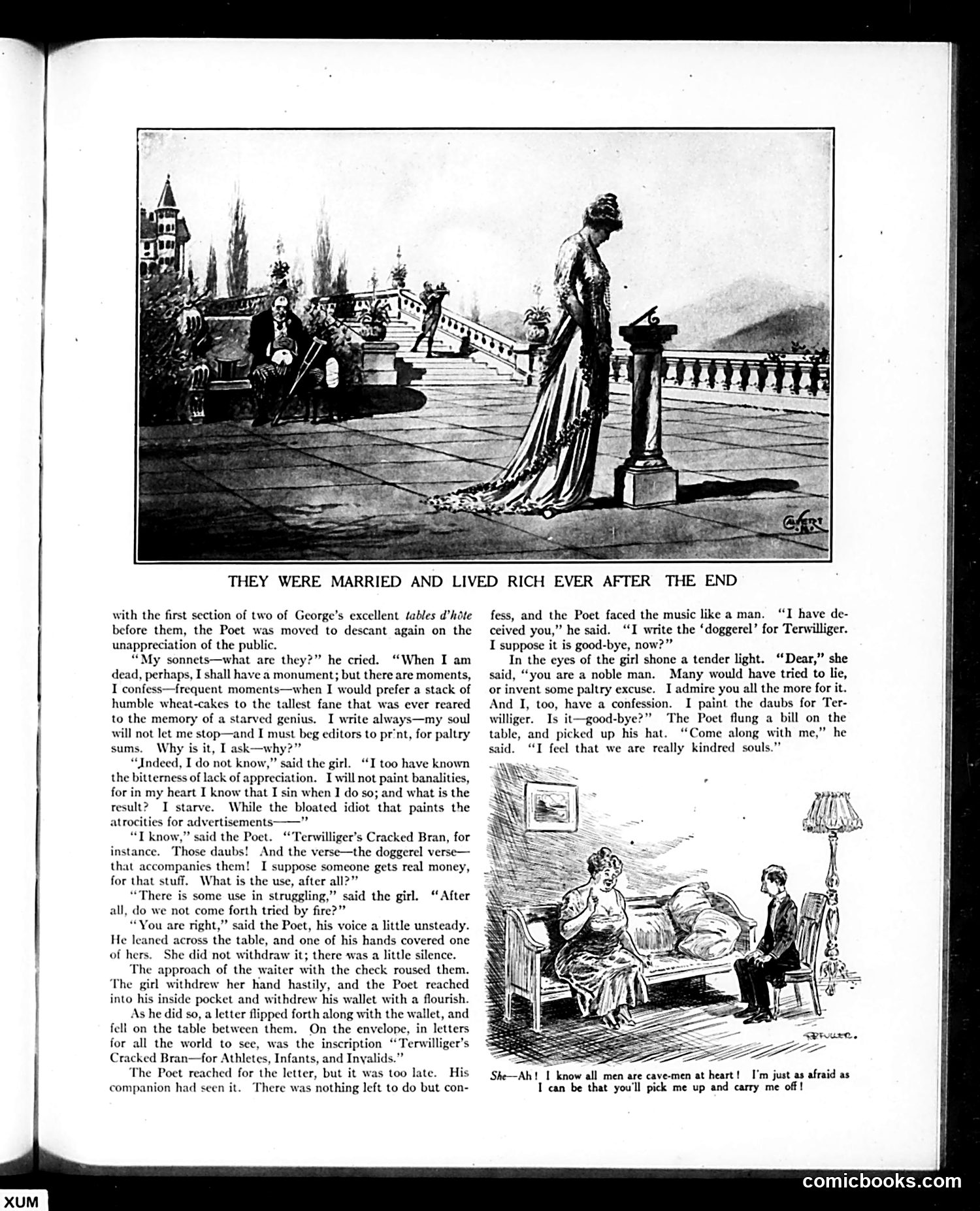
This is a satirical tale mocking artistic pretension and hypocrisy. Two struggling artists—a Poet and a Girl—meet and commiserate about their lack of appreciation, lamenting that they refuse to compromise their principles by creating "commercial trash." The Poet specifically sneers at advertising copy for "Terwilliger's Cracked Bran," calling it doggerel and the accompanying illustrations worthless "daubs." The punchline: a letter falls from the Poet's wallet revealing he *himself* writes those despised advertisements for Terwilliger. Rather than rejecting him, the Girl confesses she paints those same "daubs." Instead of tragic separation, they reconcile and leave together. The satire targets the self-righteous artistic elite who publicly disdain commercial work while secretly depending on it financially. The joke is that their shared hypocrisy makes them "kindred souls"—they're revealed as frauds who talk nobly but compromise for money like everyone else.
📄 Transcribed text from this page (OCR, searchable)
Machine-transcribed from the original scan — historical spelling and the odd misread are preserved.
XUM THEY WERE MARRIED AND LIVED RICH EVER AFTER THE END with the first section of two of George's excellent fables d’hdte before them, the Poet was moved to descant again on the unappreciation of the public. “My sonnets—what are they?” he cried. “When I am dead, perhaps, I shall have a monument; but there are moments, I confess—frequent moments—when I would prefer a stack of humble wheat-cakes to the tallest fane that was ever reared to the memory of a starved genius. I write alvays—my soul will not let me stop—and I must beg editors to print, for paltry sums. Why is it, I ask—why?” “Indeed, I do not know,” said the girl. “I too have known the bitterness of lack of appreciation. I will not paint banalities, for in my heart I know that I sin when I do so; and what is the result? I starve. While the bloated idiot that paints the atrocities for advertisements ——” said the Poet. “Terwilliger’s Cracked Bran, for instance. Those daubs! And the verse—the doggerel verse— that accompanies them! I suppose someone gets real money, for that stuff. What is the use, after all?” “There is some use in struggling,” said the girl. “After all, do we not come forth tried by fire?” “You are right,” said the Poet, his voice a little unsteady. He leaned across the table, and one of his hands covered one of hers. She did not withdraw it; there was a little silence. he approach of the waiter with the check roused them. The girl withdrew her hand hastily, and the Poet reached into his inside pocket and withdrew his wallet with a flourish. As he did so, a letter flipped forth along with the wallet, and fell on the table between them. On the envelope, in letters for all the world to see, was the inscription “Terwilliger’s Cracked Bran—for Athletes, Infants, and Inyalids.” The Poet reached for the letter, but it was too late. His companion had seen it. There was nothing left to do but con- fess, and the Poet faced the music like a man. “I have de- ceived you,” he said. “I write the ‘doggerel’ for Terwilliger. I suppose it is good-bye, now?” In the eyes of the girl shone a tender light. “Dear,” she said, “you are a noble man. Many would have tried to lie, or invent some paltry excuse. I admire you all the more for it. And I, too, have a confession. I paint the daubs for Ter- williger. Is it—good-bye?” The Poet flung a bill on the table, and picked up his hat. ‘Come along with me,” he said. “TI feel that we are really kindred souls.” Seppny ERAS She—Ah!_ 1 know all men are cave-men at heart! I'm just as afraid as I can be that you'll pick me up and carry me off ! comicbooks.com