
Judge, 1917-01-27 · page 5 of 28
Judge — January 27, 1917 — page 5: what you’re looking at
What you’re looking at
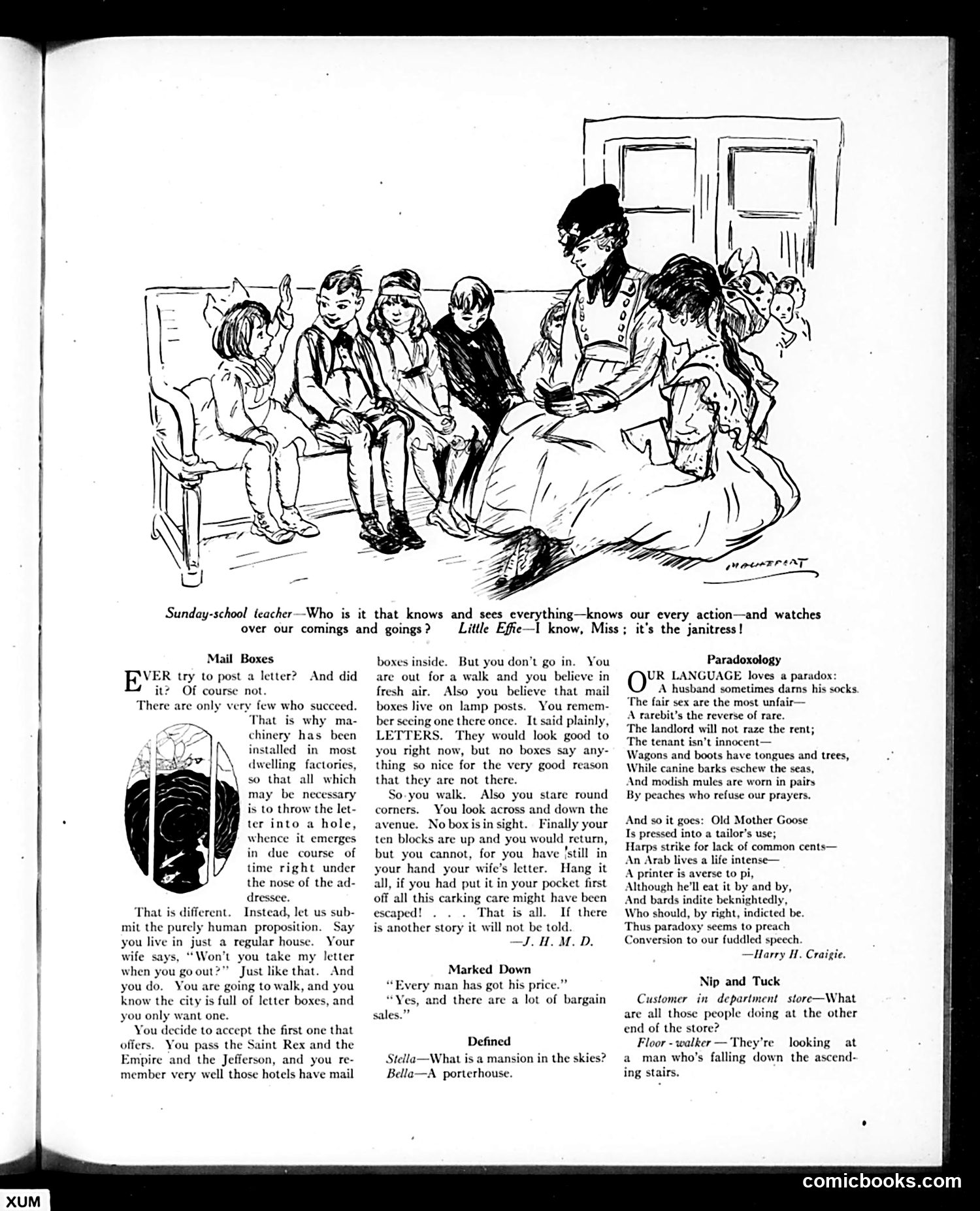
The top illustration depicts a Sunday school teacher surrounded by children, with the caption suggesting she "knows and sees everything—knows our every action—and watches over our comings and goings." This appears to be gentle satire about adult authority figures and childhood surveillance, humorously positioning teachers as omniscient observers. The remaining text sections contain various short humor pieces and definitions (Mail Boxes, Paradoxology, Marked Down, Nip and Tuck, etc.). These are light satirical observations about everyday life—mail delivery absurdities, linguistic paradoxes, bargaining, and department store behavior. The humor is gentle and domestic in focus, typical of early-to-mid 20th century Judge magazine's style. There's no clear political commentary; rather, the satire targets universal human behaviors and social conventions with mild, family-friendly wit.
📄 Transcribed text from this page (OCR, searchable)
Machine-transcribed from the original scan — historical spelling and the odd misread are preserved.
XUM Sunday-school teacher—Who is it that knows and sees everything—knows our every action—and watches over our comings and goings? _— Little Effie—I know, Miss; it’s the janitress! Mail Boxes EVE try to post a letter? And did it? Of course not. There are only very few who succeed. is why ma- has been installed in most dwelling factories, so that all which may be necessary is to throw the let- ter into a hole, whence it emerges in due course of time right under the nose of the ad- dressee. That is different. Instead, let us sub- chine! mit the purely human proposition. y you live in Your wife says, “ letter when you goout?” Just like that. And you do. You are going to walk, and you know the city is full of letter boxes, and you only want one. You decide to accept the first one that offers. You pass the Saint Rex and the Empire and the Jefferson, and you re- member very well those hotels have mail boxes inside. But you don’t go in. You are out for a walk and you believe in fresh air. Also you believe that mail boxes ive on lamp posts. You remem- ber secing one there once. It said plainly, LETTERS. They would look good to you right now, but no boxes say any- thing so nice for the very good reason that they are not there. So-you walk. Also you stare round corners. You look across and down the avenue. No boxisin sight. Finally your ten blocks are up and you would return, but you cannot, for you have {still in your hand your wife’s letter. Hang it all, if you had put it in your pocket first off all this carking care might have been ved! . . . That is all. If there is another story it will not be told. —J.H. M.D. Marked Down ery man has got his price.” es, and there are a lot of bargain sales.” SE Defined Stella—What is a mansion in the skies? Bella—A porterhouse. ee J = Paradoxology UR LANGUAGE loves a paradox: A husband sometimes darns his socks. ‘The fair sex are the most unfair— A rarebit’s the reverse of rare. The landlord will not raze the rent; The tenant isn’t innocent— Wagons and boots have tongues and trees, While canine barks eschew the seas, And modish mules are worn in pairs By peaches who refuse our prayers. And so it goes: Old Mother Goose Is pressed into a tailor’s use; Harps strike for lack of common cents— An Arab lives a life intense— A printer is averse to pi, Although he'll eat it by and by, And bards indite beknightedly, Who should, by right, indicted be. Thus paradoxy seems to preach Conversion to our fuddled speech. —Harry H. Craigie. Nip and Tuck Customer in department store—What are all those people doing at the other end of the store? Floor - walker — They're looking at a man who's falling down the ascend- ing stairs. comicbooks.com