
Judge, 1917-01-27 · page 16 of 28
Judge — January 27, 1917 — page 16: what you’re looking at
What you’re looking at
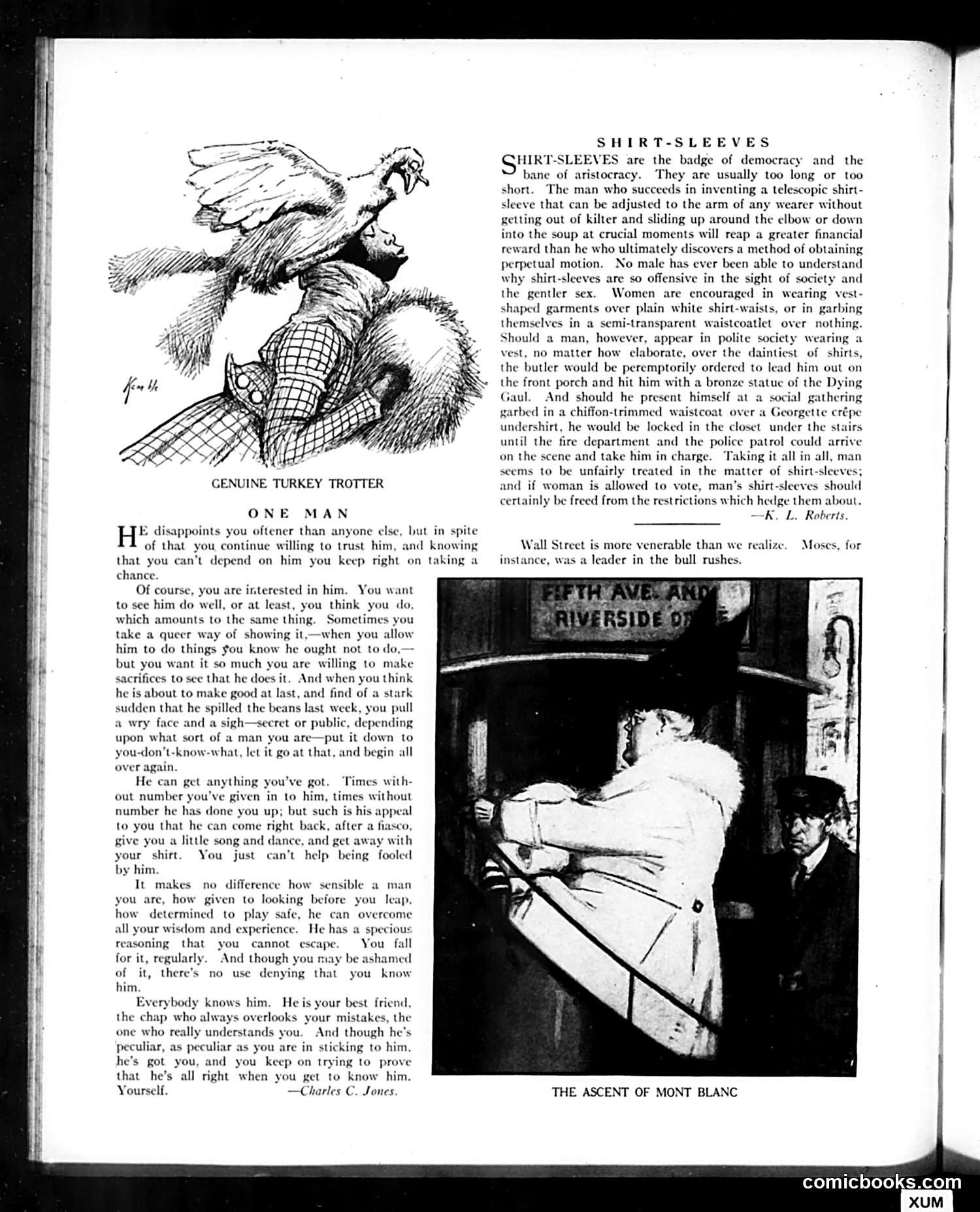
This page contains two satirical pieces from *Judge* magazine: **"One Man"** (by Charles C. Jones): A sardonic essay about how people—despite knowing better—repeatedly trust and forgive someone who consistently disappoints them. The piece describes this person as charming, persuasive, and somehow able to manipulate others into giving him "your shirt" despite repeated failures. It's a commentary on human weakness and the universal experience of being fooled by someone charismatic. **"Shirt-Sleeves"** (by K. L. Roberts): Social satire mocking class pretension. The author argues that men are unfairly restricted from showing rolled-up sleeves in polite society (considered working-class/undignified), while women wear equally revealing or casual garments without censure. The Moses/Wall Street joke is unclear but appears to mock financial culture's historical hypocrisy. The "Genuine Turkey Trotter" illustration is a humorous drawing unrelated to the text.
📄 Transcribed text from this page (OCR, searchable)
Machine-transcribed from the original scan — historical spelling and the odd misread are preserved.
GENUINE TURKEY TROTTER ONE MAN disappoints you oftener than anyone else, but in spite of that you continue willing to trust him, and knowing that you can’t depend on him you keep right on taking a chance. Of course, you are interested in him. You want to see him do well, or you think you do. which amounts to the same thing. Sometimes you take a queer way of showing it,—when you allow him to do things you know he ought not to do, but you want it so much you are willing to make sacrifices to see that he does it. And when you think he is about to make good at last, and find of a stark sudden that he spilled the beans last week, you pull a wry face and a sigh—secret or public, depending upon what sort of a man you are—put it down to you-don't-know-what, let it go at that, and begin all over again. He can get anything you've got. ‘Times with- out number you've given in to him, times without number he you up; but such is his appeal to you t he can come right back, after a fiasco, give you a little song and dance, and get away with your shirt. You just can’t help being fooled by him. It makes no difference how sensible a man you are, how given to looking before you leap. how determined to play safe, he can overcome all your wisdom and experience. He has a specious reasoning that you cannot escape. You fall for it, regularly. And though you may be ashamed of it, there’s no use denying that you know him Everybody knows him. He is your best friend, the chap who always overlooks your mistakes, the one who really understands you. And though he’s peculiar, as peculiar as you are in sticking to him, he’s got you, and you keep on trying to prove that he’s all right when you get to know him. Yourself. —Charles C. Jones SHIRT-SLEEVES HIRT-SLEEVES are the badge of democracy and the bane of aristocracy. They are usually too long or too short. The man who succeeds in inventing a telescopic shirt- sleeve that can be adjusted to the arm of any wearer without getting out of kilter and sliding up around the elbow or down into the soup at crucial moments will reap a greater financial reward than he who ultimately discovers a method of obtaining perpetual motion. No male has ever been able to understand why shirt-sleeves are so offensive in the sight of society and the gentler sex. Women are encouraged in wearing vest- shaped garments over plain white shirt-waists, or in garbing themselves in a semi-transparent waistcoatlet over nothing. Should a man, however, appear in polite society wearing a vest, no matter how claborate, over the daintiest of shirts, the butler would be peremptorily ordered to lead him out on the front porch and hit him with a bronze statue of the Dying Gaul. And should he present himself at a social gathering garbed in a chiffon-trimmed wa over a Georgette crépe undershirt, he would be locked in the closet under the stairs until the fire department and the police patrol could arrive on the scene and take him in charge. Taking it all in all, man seems to be unfairly treated in the matter of shirt-sleeves; and if woman lowed to vote, man’s shirt-sleeves should certainly be freed from the restrictions which hedge them about, —K. L. Roberts Wall Street is more venerable than we realize. Moses, for was a leader in the bull rushe instance, THE ASCENT OF MONT BLANC comicbooks.com