
Judge, 1917-01-27 · page 21 of 28
Judge — January 27, 1917 — page 21: what you’re looking at
What you’re looking at
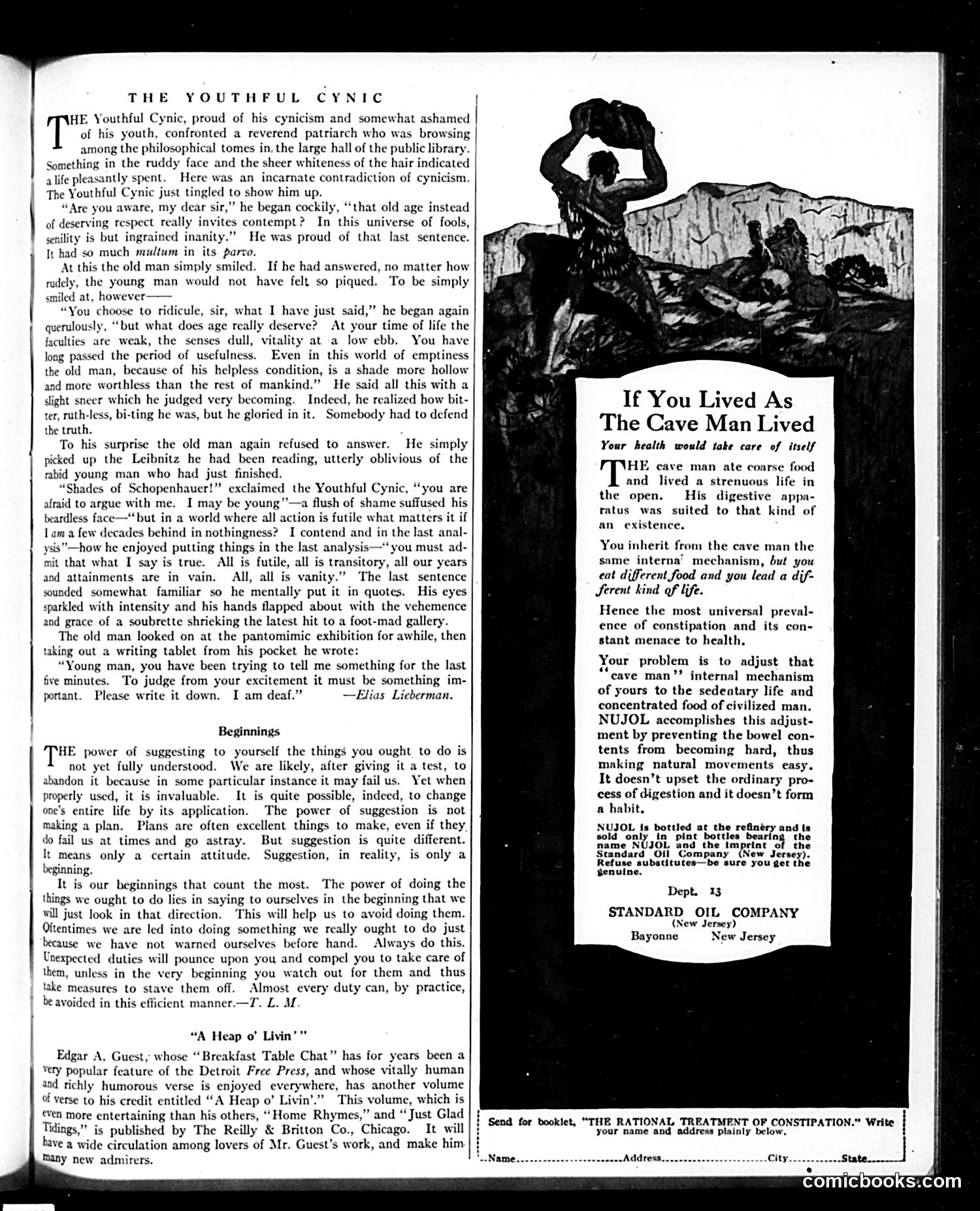
This satirical story mocks young intellectuals who adopt cynicism as a pose of sophistication. A pompous young man confronts an elderly scholar in a library, arrogantly lecturing him that age deserves contempt, not respect, and that all life is futile and transitory—spouting pseudo-philosophical rhetoric with theatrical gestures. The elderly man's response is devastating in its simplicity: he silently ignores the young cynic, then writes a note revealing he is deaf and asks the youth to write down his "important" message. The implication is cutting—the young man's entire elaborate cynical philosophy amounts to nothing worth communicating. The satire targets the pretentious adoption of pessimistic philosophy (referencing Schopenhauer) by youth seeking to appear intellectually superior. By refusing to engage and exposing the emptiness behind the performance, the old man demonstrates that genuine wisdom lies in quiet dignity, not bombastic rhetoric. The accompanying article on "Beginnings" reinforces this theme: real change comes from inner resolve, not clever words.
📄 Transcribed text from this page (OCR, searchable)
Machine-transcribed from the original scan — historical spelling and the odd misread are preserved.
THE YOUTHFUL CYNIC ] HE Youthful Cynic, proud of his cynicism and somewhat ashamed T of his youth, confronted a reverend patriarch who was browsing among the philosophical tomes in, the large hall of the public library. Something in the ruddy f. nd the sheer whiteness of the hair indicated alife pleasantly Here was an incarnate contradiction of cynicism. | The Youthful Cynic just tingled to show him up. “Are you aware, my dear sir,” he began cockily, “that old age instead ing respect really invites contempt? In this universe of fools, ity is but ingrained inanity.” He was proud of that last sentence. It had so much multum in its parvo. is the old man simply smiled. If he had answered, no matter how the young man would not have felt so piqued. To be simply smiled at, however-—— | “You choose to ridicule, sir, what 1 have just said,” he began again querulously, “‘but what does age really deserve? At your time of life the faculties are weak, the senses dull, vitality at a low ebb. You have long passed the period of usefulness. Even in this world of emptiness the old man, because of his helpless condition, is a shade more hollow and more worthless than the rest of mankind.” He said all this with a Indeed, he realized how bit- Somebody had to defend slight sneer which he judged very becoming. ter, ruth-less, bi-ting he was, but he gloried in it. the truth. To his surprise the old man again refused to answer. He simply picked up the Leibnitz he had been reading, utterly oblivious of the rabid young man who had just finished. “Shades of Schopenhauer!” exclaimed the Youthful Cynic, “you are afraid to argue with me. I may be young’’—a flush of shame suffused his beardless face—“ but in a world where all action is futile what matters it if lam a few decades behind in nothingness? I contend and in the last anal- ysis”—how he enjoyed putting things in the last anal ‘ou must ad- mit that what I say is true. All is futile, all is transitory, all our years and attainments are in vain. All, all is vanity.” The last sentence sounded somewhat familiar so he mentally put it in quotes. His eyes sparkled with intensity and his hands flapped about with the vehemence and grace of a soubrette shrieking the latest hit to a foot-mad gallery. The old man looked on at the pantomimic exhibition for awhile, then taking out a writing tablet from his pocket he wrote: “Young man, you have been trying to tell me something for the last To judge from your excitement it must be something im- —Elias Lieberman. five minutes. portant. I am deaf.” Please write it down. Beginnings TH power of suggesting to yourself the things you ought to do is not yet fully understood. We are likely, after giving it a test, to | abandon it because in some particular instance it may fail us. Yet when properly used, it is invaluable. It is quite possible, indeed, to change | one’s entire life by its application. The power of suggestion is not making a plan. Plans are often excellent things to make, even if they, do fail us at times and go astray. But suggestion is quite different. It means only a certain attitude. Suggestion, in reality, is only a beginning. It is our beginnings that count the most. The power of doing the things we ought to do lies in saying to ourselves in the beginning that we will just look in that direction. This will help us to avoid doing them. Oftentimes we are led into doing something we really ought to do just because we have not warned ourselves before hand. Always do this. Unexpected duties will pounce upon you and compel you to take care of them, unless in the very beginning you watch out for them and thus take measures to stave them off. Almost every duty can, by practice, be avoided in this efficient manner.—T. L. M “A Heap o’ Livin’” Edgar A. Guest, whose “Breakfast Table Chat” has for y« very popular feature of the Detroit Free Press, and whose vitally human and richly humorous verse is enjoyed everywhere another volume of verse to his credit entitled “A Heap o’ Livin’. This volume, which is even more entertaining than his others, ‘Home Rhymes,” and “Just Glad Tidings,” is published by The Reilly & Britton Co., Chicago. It will tave a wide circulation among lovers of Mr. Guest’s work, and make him many new admirers. If You Lived As The Cave Man Lived Your health would take care of itself HE cave man ate coarse food and lived a strenuous life in open. His digestive appa was suited to that kind existence. the ratus an You inherit from the cave man the same interna’ mechanism, but you eat different food and you lead a dif- Serent kind of life. Hence the most universal preval- ence of constipation and its con- stant menace to health. Your problem is to adjust that “‘cave man’? internal mechanism of yours to the sedentary life and concentrated food of civilized man. NUJOL accomplishes this adjust- ment by preventing the bowel con- tents from becoming hard, thus making natural movements easy. It doesn’t upset the ordinary pro- cess of digestion and it doesn’t form a habit. NUJOL fs bottled at the refinery and ts sold only in pint bottles bearin; name NUJOL and the imprint o} Standard Oil Company (New Jersey). Refuse substitutes—be sure you get the genuine. Dept. 13 STANDARD OIL COMPANY (New Jersey) Bayonne New Jersey i Send for booklet, “THE RATIONAL TREATMENT OF CONSTIPATION.” Write your name and address plainly below. Address... City.