
Judge, 1917-01-27 · page 19 of 28
Judge — January 27, 1917 — page 19: what you’re looking at
What you’re looking at
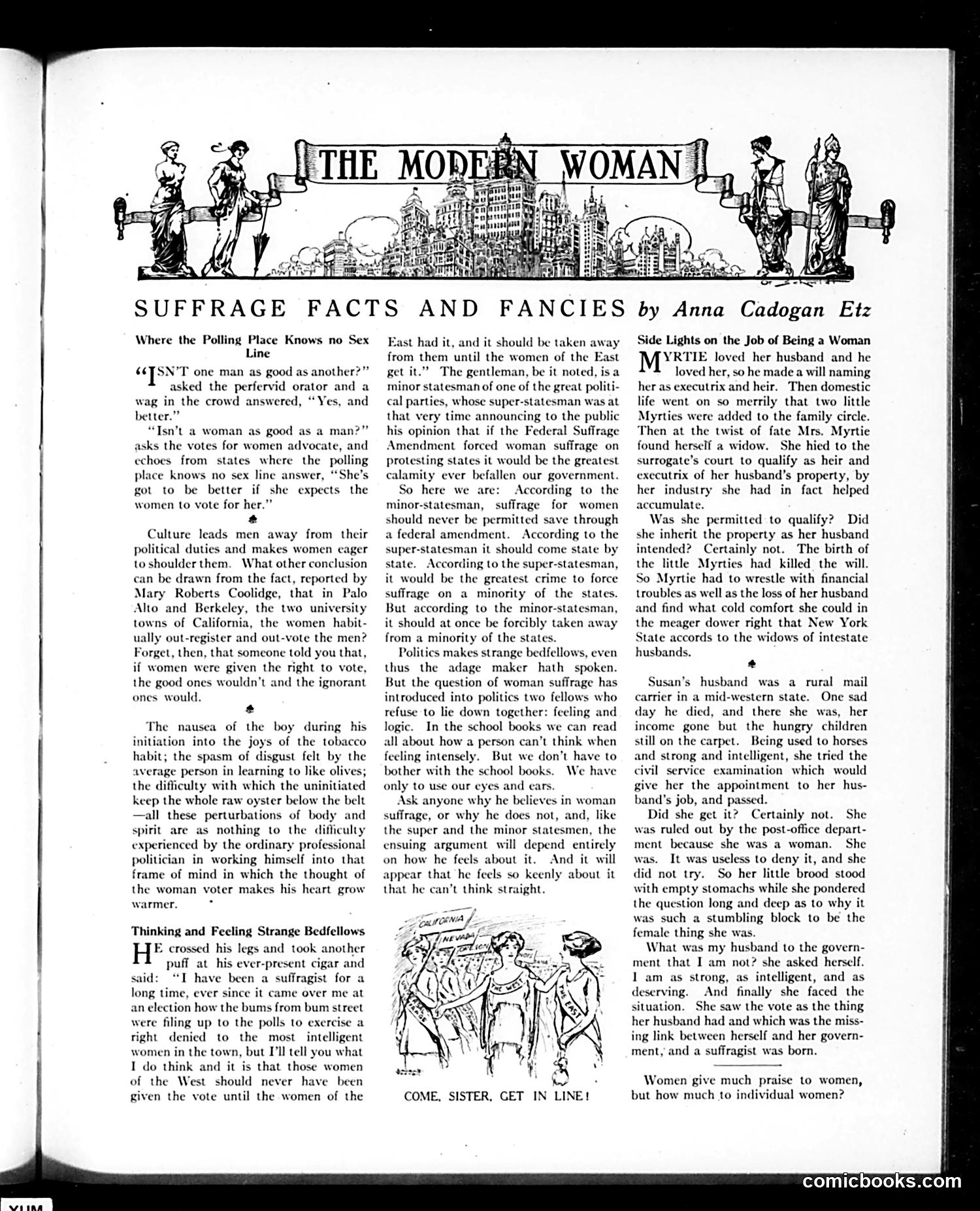
This page satirizes opposition to women's suffrage through multiple arguments. The main cartoon (bottom left, captioned "COME, SISTER, GET IN LINE!") depicts women being herded like cattle, mocking the patronizing rhetoric used against suffrage. The text ridicules male politicians' contradictory stances: one "minor statesman" argues suffrage should come federally while simultaneously opposing federal imposition on states—an illogical position exposed through satire. Another section mocks professional politicians' emotional resistance to women voters, comparing their discomfort to learning to smoke or eat oysters. The piece also challenges the claim that "good women" won't vote if given the chance, citing evidence from California university towns where women actually *out-voted* men. The sidebar story about "Myrtie" illustrates practical injustices: a widow loses control of her own property despite being named executrix—demonstrating why women needed legal/political rights. Overall, Etz uses humor and logic to expose the hypocrisy and irrationality of anti-suffrage arguments.
📄 Transcribed text from this page (OCR, searchable)
Machine-transcribed from the original scan — historical spelling and the odd misread are preserved.
a SUFFRAGE FACTS AND FANCIES Where the Polling Place Knows no Sex Line “J SN’T one man as good as another?” asked the perfervid orator and a wag in the crowd answered, “Yes, and better.” “Isn’t_a woman as good as a man?” asks the votes for women advocate, and echoes from states where the polling place knows no sex line answer, “She's got to be better if she expects the women to vote for her.” & Culture leads men away from their political duties and makes women cager to shoulder them. What other conclusion can be drawn from the fact, reported by Mary Roberts Coolidge, that in Palo Alto and Berkeley, the two university towns of California, the women habit ually out-register and out-vote the men? Forget, then, that someone told you that, if women were given the right to vote, the good ones wouldn't and the ignorant ones would. 2 The nausea of the boy during his initiation into the joys of the tobacco habit; the spasm of disgust felt by the average person in learning to like oliv the difficulty with which the uninitiated keep the whole raw oyster below the belt all these perturbations of body and spirit are as nothing to the difficulty experienced by the ordinary professional politician in working himself into that frame of mind in which the thought of the woman voter makes his heart grow warmer. . Thinking and Feeling Strange Bedfellows H® crossed his legs and took another puff at his ever-present cigar and said: “I have been a suffragist for a long time, ever since it came over me at an election how the bums from bum street were filing up to the polls to exercise a right denied to the most intelligent women in the town, but I'll tell you what I do think and it is that those women of the West should never have been given the vote until the women of the East had it, and it should be taken from them until the women of the East get it.” The gentleman, be it noted, minor statesman of one of the great pol cal parties, whose super-statesman was at that very time announcing to the public his opinion that if the Federal Suffrage Amendment forced woman suffrage on protesting states it would be the greatest calamity ever befallen our government. So here we are: According to the minor-statesman, suffrage for women should never be permitted save through a federal amendment. According to the super-statesman it should come state by state. According to the super-statesman, it would be the greatest crime to force suffrage on a minority of the states. But according to the minor-statesman, it should at once be forcibly taken aw from a minority of the states. Politics makes strange bedfellows, even thus the adage maker hath spoken. But the question of woman suffrage has introduced into politics two fellows who refuse to lie down together: feeling and logic. In the school books we can read all about how a person can’t think when feeling intensely. But we don’t have to bother with the school books. We ha only to use our eyes and Ask anyone why he believes in woman suffrage, or why he does not, and, like the super and the minor statesmen, the ensuing argument will depend entirely on how he feels about it. And it will appear that he feels so keenly about it that he can’t think straight. by Anna Cadogan Etz Side Lights on the Job of Being a Woman RTIE loved her husband and he loved her, so he made a will naming her as executrix and heir. Then domestic life went on so merrily that two little Myrties were added to the family circle. Then at the twist of fate Mrs. My: found herself a widow. She hied to the surrogate’s court to qualify as heir and executrix of her husband’s property, by her industry she had in fact helped accumulate. Was she permitted to qualify? Did she inherit the property as her husband intended? Certainly not. The birth of the little Myrties had killed the will. So Myrtie had to wrestle with financial troubles as well as the loss of her husband and find what cold comfort she could in the meager dower right that New York State accords to the widows of intestate husbands. * Susan’s husband was a rural mail carrier in a mid-western state. One sad day he died, and there she was, her income gone but the hungry children still on the carpet. Being used to horses d strong and intelligent, she tried the civil service examination which would give her the appointment to her hus- band’s job, and passed. Did she get Certainly not. She was ruled out by the post-office depart- ment because she was a woman. She was. It was useless to deny it, and she 1 not try. So her little brood stood with empty stomachs while she pondered the question long and deep as to why it was such a stumbling block to be the female thing she was. What was my husband to the govern- ment that I am not? she asked herself. 1 am as strong, as intelligent, and as deserving. And finally she faced the situation. She saw the vote as the thing her husband had and which was the miss- ing link between herself and her govern- ment, and a suffragist was born. Women giv to women, but how much to individual women? comicbooks.com