
Judge, 1917-01-27 · page 14 of 28
Judge — January 27, 1917 — page 14: what you’re looking at
What you’re looking at
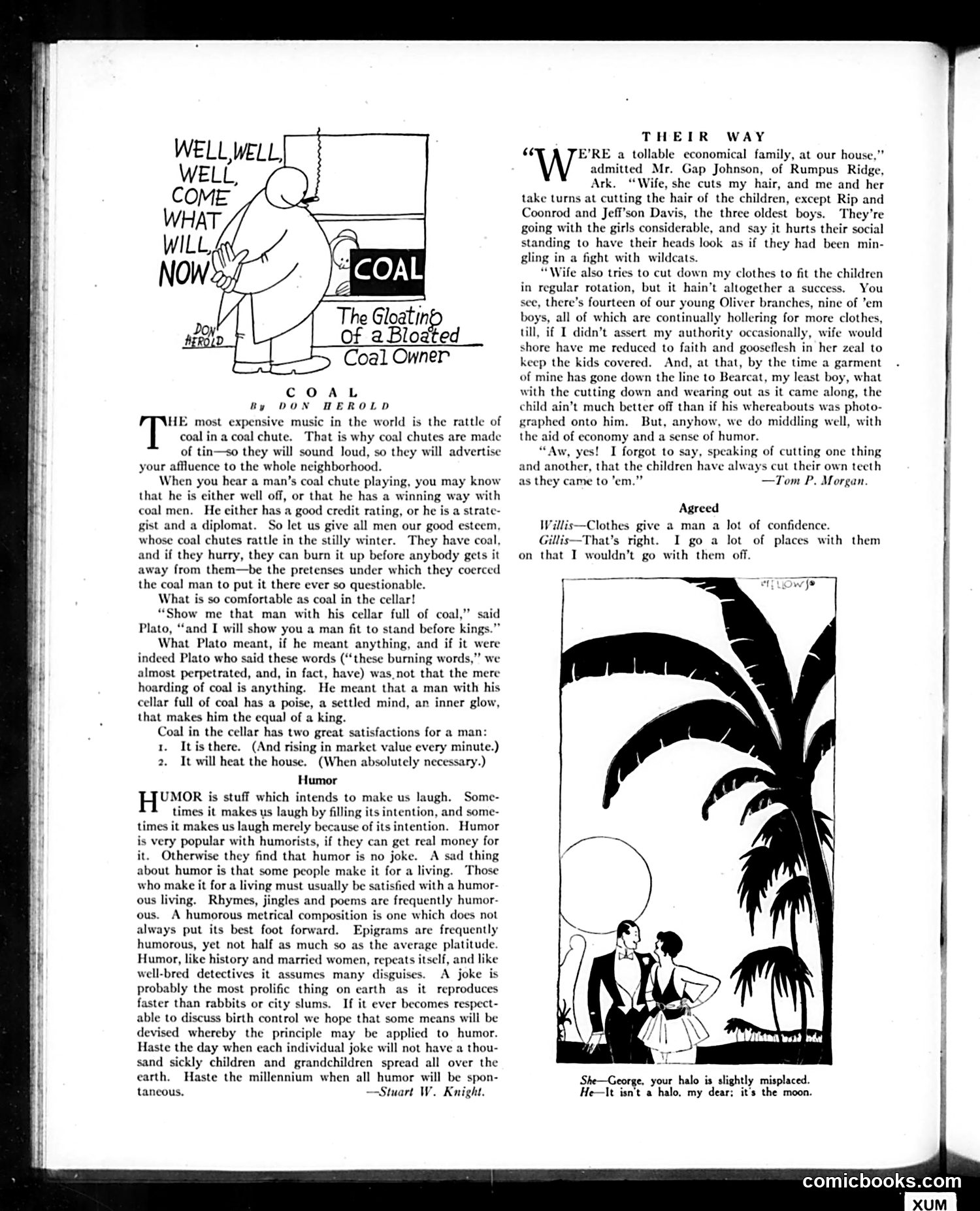
**The Coal Owner Cartoon** (top left): Don Herold satirizes wealthy coal owners' pretentious displays of affluence. The "bloated coal owner" gloats over his full coal cellar—a status symbol in winter. The satire mocks how coal-hoarding represents wealth and security; Herold humorously claims Plato said a man with a full coal cellar is "fit to stand before kings." The joke targets conspicuous consumption: the loud tin coal chute announces prosperity to neighbors, and owning coal becomes a bizarre measure of social standing. **"Their Way" Story**: This humorous domestic sketch portrays Mr. Gap Johnson of rural Arkansas, a self-described "tollable economical family" man who cuts hair and clothes for his large family to save money. The humor derives from poor rural families' resourcefulness—wife cuts everyone's hair, clothes get passed down through fourteen children. The irony: his three oldest boys refuse homemade haircuts because it damages their social standing with girls, forcing them to maintain appearances despite poverty. Both pieces satirize American status anxiety and economic pretension.
📄 Transcribed text from this page (OCR, searchable)
Machine-transcribed from the original scan — historical spelling and the odd misread are preserved.
The Gloatin Of 2Bloated Coal Owner COAL Ry DON HEROLD T's most expensive music in the world is the rattle of coal ina coal chute. That is why coal chutes are made of tin—so they will sound loud, so they will advertise your affluence to the whole neighborhood. When you hear a man’s coal chute playing, you may know that he is either well off, or that he has a winning way with coal men. He cither has a good credit rating, or he is a strate- gist and a diplomat. So let us give all men our good esteem, whose coal chutes rattle in the stilly winter. They have coal, and if they hurry, they can burn it up before anybody gets it away from them—be the pretenses under which they coerced the coal man to put it there ever so questionable. What is so comfortable as coal in the cellar! “Show me that man with his cellar full of coal,” said Plato, “and I will show you a man fit to stand before kings.” What Plato meant, if he meant anything, and if it were indeed Plato who said these words (“these burning words,” we almost perpetrated, and, in fact, have) was_not that the mere hoarding of coal is anything. He meant that a man with his cellar full of coal has a poise, a settled mind, an inner glow, that makes him the equal of a king. Coal in the cellar has two great satisfactions for a man: 1. Itisthere. (And rising in market value every minute.) 2. It will heat the house. (When absolutely necessary.) Humor JMOR is stuff which intends to make us laugh. Some- times it makes us laugh by filling its intention, and some- times it makes us laugh merely because of its intention. Humor is very popular with humorists, if they can get real money for it. Otherwise they find that humor is no joke. about humor is that some people make it fo: who make it for a living must usually be satisfied with a humor- ous living. Rhymes, jingles and poems are frequently humor- ous. A humorous metrical composition is one which does not always put its best foot forward. Epigrams are frequently humorous, yet not half as much so as the average platitude. Humor, like history and married women, repeats itself, and like well-bred detectives it assumes many disguises. A joke is probably the most prolific thing on earth it reproduces faster than rabbits or city slums. If it ever becomes respect- able to discuss birth control we hope that some means will be devised whereby the principle may be applied to humor. Haste the day when each individual joke will not have a thou- sand sickly children and grandchildren spread all over the earth. Haste the millennium when all humor will be spon- taneous. —Stuart W. Knight. THEIR WAY “ce E’RE a tollable economical family, at our house,” W admitted Mr. Gap Johnson, of Rumpus Ridge, Ark. “Wife, she cuts my hair, and me and her take turns at cutting the hair of the children, except Rip and Coonrod and Jeff'son Davis, the three oldest boys. They’re going with the girls considerable, and say it hurts their social standing to have their heads look as if they had been min- gling in a fight with wildcats. “Wife also tries to cut down my clothes to fit the children in regular rotation, but it hain’t altogether a succ You see, there’s fourteen of our young Oliver branches, nine of ’em boys, all of which are continually hollering for more clothes, ll, if I didn’t assert my authority occasionally, wife would shore have me reduced to faith and gooseflesh in her zeal to keep the kids covered. And, at that, by the time a garment of mine has gone down the line to Bearcat, my least boy, what with the cutting down and wearing out as it came along, the child ain’t much better off than if his whereabouts was photo- graphed onto him. But, anyhow, we do middling well, with the aid of economy and a sense of humor. “Aw, yes! I forgot to say, speaking of cutting one thing and another, that the children have always cut their own tecth as they came to 'em.”” —Tom P. Morgan. Agreed Willis—Clothes give a man a lot of confidence. Gillis—That’s right. I go a lot of places with them on that I wouldn’t go with them off. pecs She—George, your halo is slightly misplaced. He—It isn't a halo, my dear; it's the moon. | comicbooks.com