
Judge, 1917-01-27 · page 8 of 28
Judge — January 27, 1917 — page 8: what you’re looking at
What you’re looking at
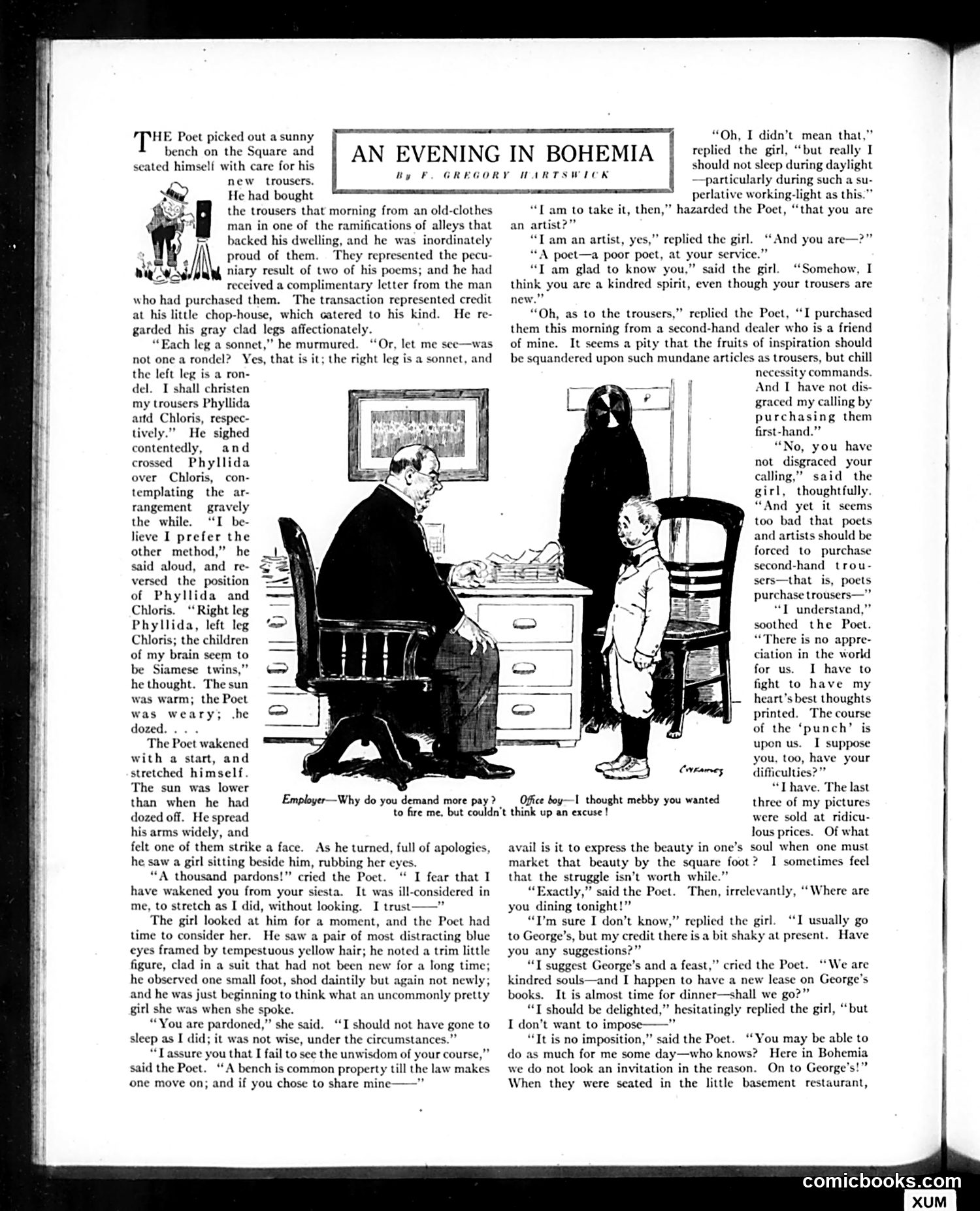
This story satirizes the romantic pretensions of impoverished artists in early 20th-century urban bohemia. A poor poet, proud of secondhand trousers purchased with payment for his poems, meets an equally struggling female artist on a public bench. The satire targets their shared delusion: both romanticize their poverty as noble artistic calling while actually living in genuine want. The poet whimsically names his trouser legs after classical literary heroines; the girl apologizes for napping during daylight to avoid wasting expensive artificial light—revealing the real hardship beneath their aesthetic posturing. The inset cartoon mocks employer-employee relations: a boss claims he wanted to fire an employee but "couldn't think up an excuse"—suggesting employment instability even when dismissal lacks justification. The piece ridicules how struggling artists in Bohemian quarters simultaneously embrace poverty as spiritually superior while actually suffering material deprivation, unable to afford new clothing or proper working conditions.
📄 Transcribed text from this page (OCR, searchable)
Machine-transcribed from the original scan — historical spelling and the odd misread are preserved.
THE Poet picked out a sunny bench on the Square and seated himself with care for his new trousers. He had bought the trousers that morning from an old-clothes man in one of the ramifications of alleys th = backed his dwelling, and he was inordinate! : proud of them. They represented the p ay niary result of two of his poems; and he had § oe received a complimentary letter from the man who had purchased them. The transaction represented credit at his little chop-house, which catered to his kind. He re- garded his gray clad legs affectionately. “Each leg a sonnet,” he murmured. ‘‘Or, let me see—was not one a rondel? Yes, that is it; the right leg is a sonnet, and the left leg is a ron- del. I shall christen my trousers Phyllida artd Chloris, respec- tively.” He sighed contentedly, and crossed Phyllida over Chloris, con- templating the ar- rangement gravely the while. “I be- lieve I prefer the other method,” he said aloud, and re- versed the position of Phyllida and Chloris. ‘Right leg Phyllida, left leg Chloris; the children of my brain seem to be Siamese twins,” he thought. The sun was warm; the Poet was weary; .he dozed. . . . The Poet wakened with a start, and stretched himself. The sun was lower than when he had dozed off. He spread his arms widely, and felt one of them strike a face. As he turned, full of apologies, he saw a girl sitting beside him, rubbing her ey “A thousand pardons!” cried the Poet. I fear that I have wakened you from your siesta. It was ill-considered in me, to stretch as I did, without looking. I trust ‘a The girl looked at him for a moment, and the Poet had time to consider her. He saw a pair of most distracting blue eyes framed by tempestuous yellow hair; he noted a trim little figure, clad in a suit that had not been new for a long time; he observed one small foot, shod daintily but again not newly; and he was just beginning to think what an uncommonly pretty girl she when she spok “You are pardoned,” she said. ‘I should not have gone to sleep as I di under the circumstances.” “Tassure you that I fail to see the unwisdom of your course,” said the Poet. “A bench is common property till the law makes one move on; and if you chose to share mine——” u- a AN EVENING IN BOHEMIA | replied the girl, “but really I : SaRty ‘ | should not sleep during daylight By PF GREGORY WARTSWICK Employer—Why do you demand more pay > to fire me, but couldn't think up an excuse ! “Oh, I didn’t mean that,” particularly during such a su- perlative working-light as this. “Tam to take it, then,” hazarded the Poet, “that you are an artist?” “Tam an artist, yes,” replied the girl. “And you are—?’ “A poet—a poor poet, at your service.” “Tam glad to know you,” said the girl. ‘Somehow, I think you are a kindred spirit, even though your trousers are new.” “Oh, as to the trouse replied the Poet, “I purchased them this morning from a second-hand dealer who is a friend of mine. It seems a pity that the fruits of inspiration should be squandered upon such mundane articles as trousers, but chill necessity commands. | And I have not dis- graced my calling by purchasing them first-hand.” “No, you have not disgraced your calling,” said the girl, thoughtfully. “And yet it seems too bad that poets and artists should be forced to purchase second-hand trou- se that is, poets purchase trousers— “IT understand,” soothed the Poet. “There is no appre- ciation in the world for us. I have to fight to have my heart’s best thoughts printed. The course of the ‘punch’ is upon us. I suppose you, too, have your difficulties?” “Tha he last three of my pictures were sold at ridicu- lous prices. Of what avail is it to express the beauty in one’s soul when one must market that beauty by the square foot? I sometimes feel that the struggle isn’t worth while.” “Exactly,” said the Poet. Then, irrelevantly, ‘‘ Where are you dining tonight!” “I’m sure I don’t know,” replied the girl. ‘I usually go to George’s, but my credit there is a bit shaky at present. Have you any suggestions?” “T suggest George’s and a feast,” cried the Poet. “We are kindred souls—and I happen to have a new lease on George's books. It is almost time for dinner—shall we go?” “T should be delighted,” hesitatingly replied the girl, “but I don’t want to impose——” “It is no imposition,” said the Poet. “You may be able to do as much for me some day—who knows? Here in Bohemia we do not look an invitati i? Office boy—I thought mebby you wanted n in the reason. On to George's! When they were seated in the little basement restaurant, ee - - comicbooks.com