
Judge, 1917-01-27 · page 17 of 28
Judge — January 27, 1917 — page 17: what you’re looking at
What you’re looking at
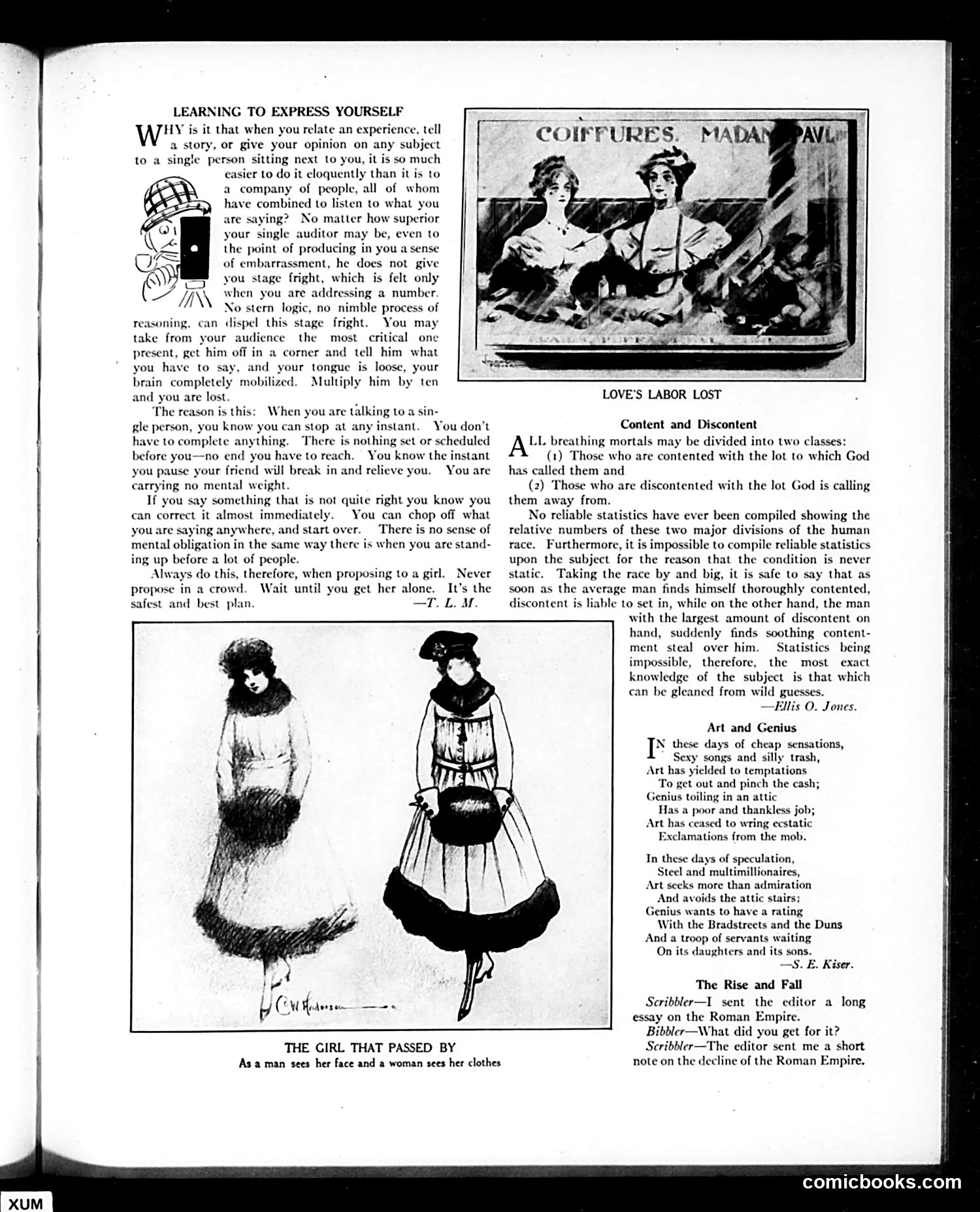
This page from *Judge* magazine contains satirical commentary rather than political cartoons. The main pieces address social observations: **"Learning to Express Yourself"** advises men proposing to women to do so privately, not in crowds—suggesting anxiety about public performance and romance. **"The Girl That Passed By"** illustrates gender difference in perception: men notice women's faces, women notice clothes—a commentary on male versus female priorities in appearance. **"Love's Labor Lost"** discusses human contentment philosophically, suggesting people are paradoxically discontent even when achieving their goals. **"Art and Genius"** and **"The Rise and Fall"** are poems critiquing commercialism in art and a joke about editorial rejection. The fashion illustration "Coiffures, Madame Davil" appears to be advertisement or style content, unrelated to satire. Overall, the page reflects early-20th-century American attitudes about gender, ambition, and artistic integrity.
📄 Transcribed text from this page (OCR, searchable)
Machine-transcribed from the original scan — historical spelling and the odd misread are preserved.
—— a rt at XUM LEARNING TO EXPRESS YOURSELF HY is it that when you relate an experience, tell a story, or give your opinion on any subject to a single person sitting next to you, it is so much easier to do it eloquently than it is to a company of people, all of whom have combined to listen to what you are saying? o matter how superior OI your single auditor may be, even to Vz the point of producing in youa UY of embarrassment, he does not give © ME ou stage fright, which is felt only 7, /JX\, shen you are addressing a number: » stern logic, no nimble process of reasoning, can dispel this stage fright. You may take from your audience the most critical one present, get him off in a corner and tell him what you have to say, and your tongue is loose, your brain completely mobilized. Multiply him by ten and you are lost The reason is this: When you are talking to a sin- gle person, you know you can stop at any instant. You don’t have to complete anything. There is nothing set or scheduled before you—no end you have to reach. You know the instant you pause your friend will break in and relieve you. You are carrying no mental weight. If you say something that is not quite right you know you can correct it almost immediately. You can chop off what you are saying anywhere, and start over. There is no sense of mental obligation in the same way there is when you are stand- ing up before a lot of people. Always do this, therefore, when proposing to a girl. Never propose in a crowd. Wait until you get her alone. It’s the safest and best: plan. —T. L. M. THE GIRL THAT PASSED BY As a man sees her face and a woman sees her clothes LOVE'S LABOR LOST LL breathing mortals may be divided into two classes: (1) Those who are contented with the lot to which God has called them and (2) Those who are discontented with the lot God is calling them away from. No reliable statistics have ever been compiled showing the relative numbers of these two major divi: Furthermore, it is impossible to compile reliable statistics upon the subject for the reason that the condition is never Taking the race by and big, it is safe to say that as soon as the average man finds himself thoroughly contented, discontent is liable to set in, while on the other hand, the man Content and Discontent ions of the human with the largest amount of discontent on hand, suddenly finds soothing content- ment steal over him. Statistics being impossible, therefore, the most exact knowledge of the subject is that which can be gleaned from wild guesses. Ellis O. Jones. Art and Genius N these days of cheap sensations, Sexy songs and silly trash, Art has yielded to temptations To get out and pinch the cash; Genius toiling in an attic Has a poor and thankless job; Art has ceased to wring ecstatic jamations from the mob. In these days of speculation, Steel and multimillionaires, Art secks more than admiration And avoids the attic stairs; Genius wants to have a rating With the Bradstrects and the Duns And a troop of servants waiting On its daughters and its sons. —S. E. Kiser. The Rise and Fall Scribbler—I sent the editor a long essay on the Roman Empire. Bibbler—What did you get for it? Scribbler—The editor sent me a short note on the decline of the Roman Empire. comicbooks.com