
A complete issue · 32 pages · 1916
Judge — October 7, 1916
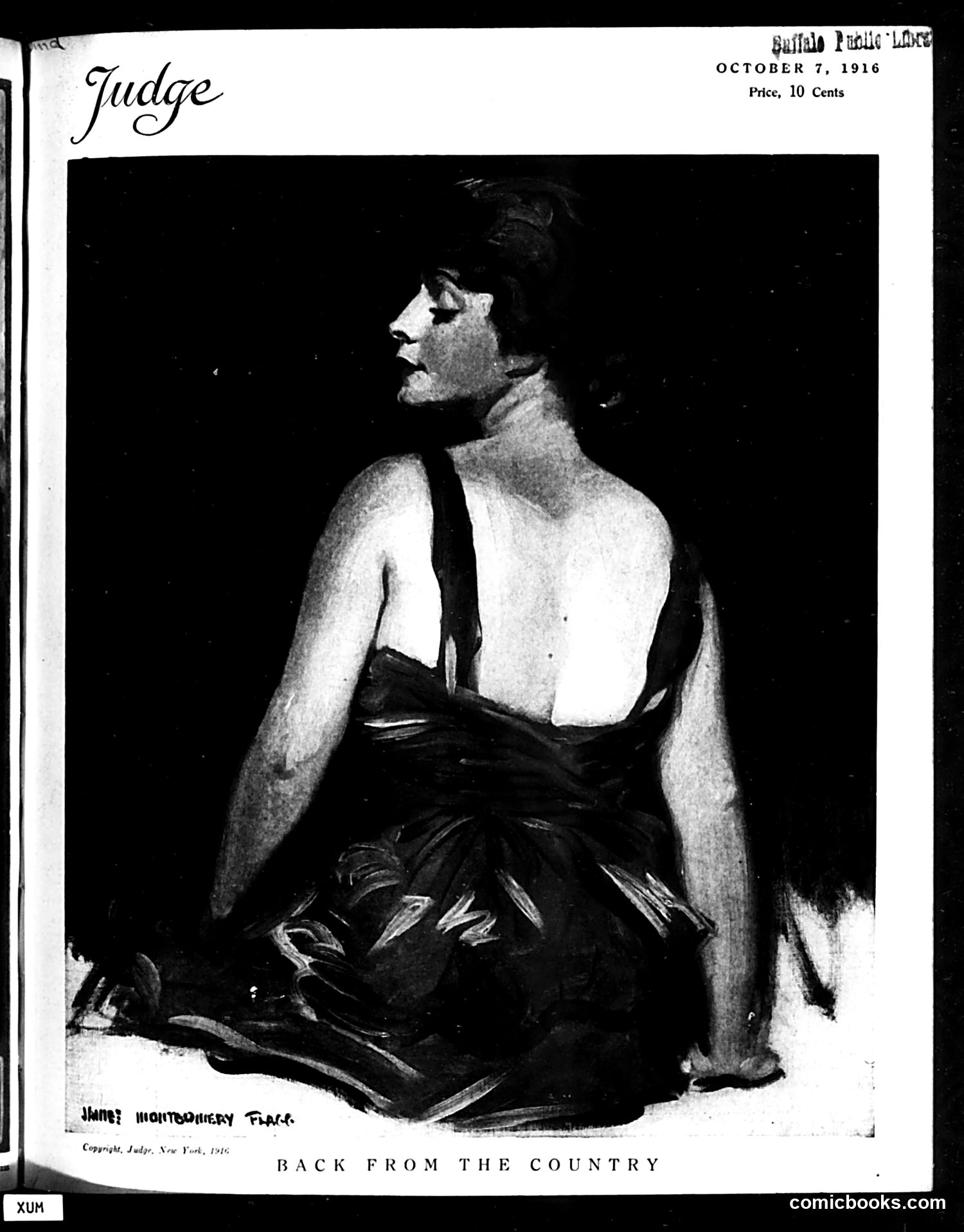
This Judge magazine cover from October 1916 depicts a woman in profile, bare-shouldered and wearing a dark skirt, gazing downward. The title "Back from the Country" suggests a satirical commentary on women returning from rural areas to urban society. The image likely mocks the physical appearance or comportment of country women, reflecting early 20th-century urban attitudes that stereotyped rural women as less refined or sophisticated. The dramatic lighting and somewhat unflattering portrayal emphasize this satirical intent. Without additional identifying text on the visible portion, the specific subject remains unclear, though the work exemplifies Judge's use of physical caricature to comment on social class distinctions and regional differences in 1916 America.
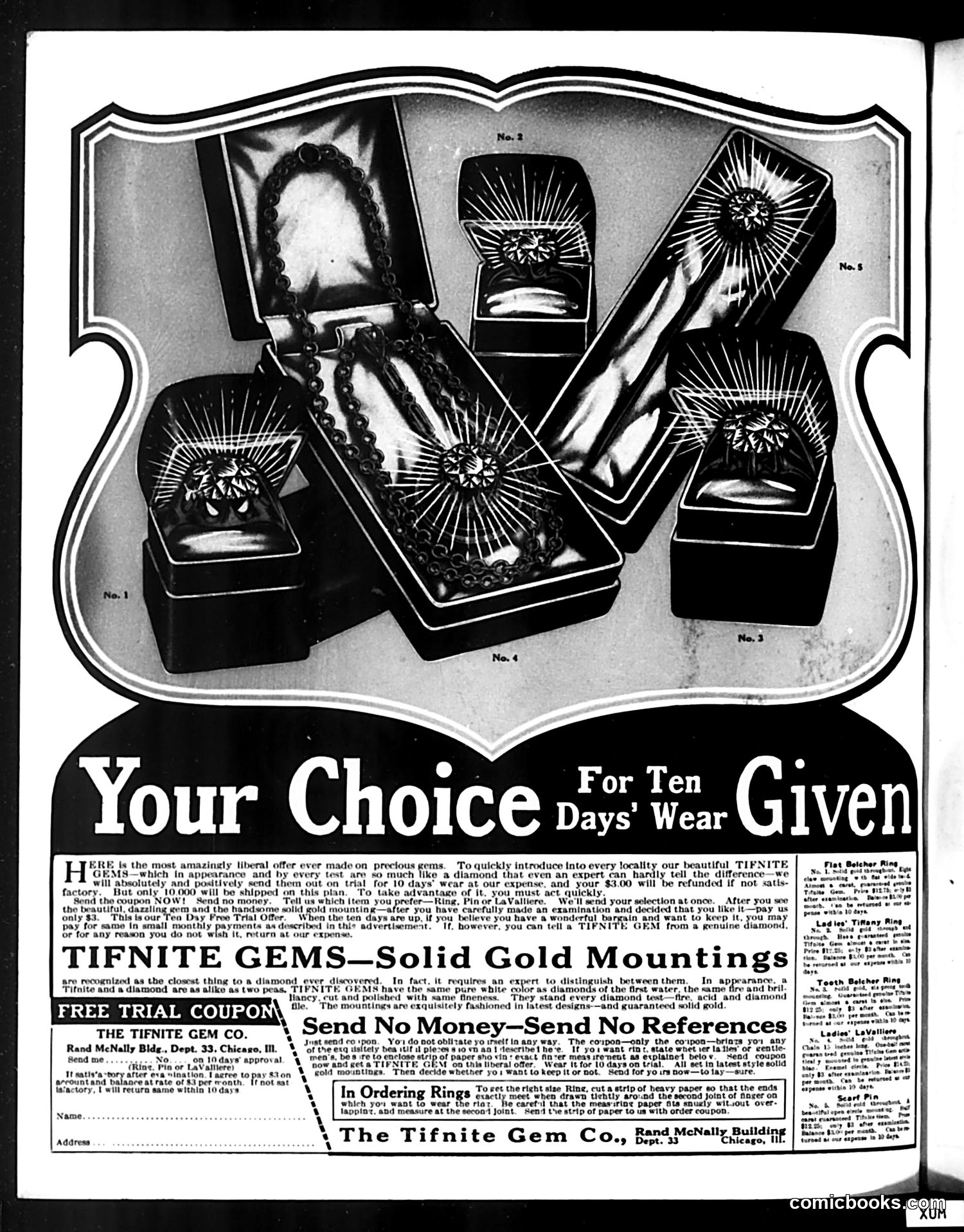
This page is primarily **advertising, not satire**. It showcases "Tifnite Gems"—costume jewelry marketed as diamond imitations sold in gold mountings by The Tifnite Gem Company of Chicago. The ad uses a common early 20th-century sales pitch: five numbered jewelry pieces (rings, pins, brooches) displayed in boxes with the headline "Your Choice For Ten Days' Wear Given." The copy emphasizes that Tifnite Gems closely resemble genuine diamonds and offers a free trial coupon. This represents the period's expansion of affordable luxury goods and direct-mail marketing. The "send no money" promotion was typical of catalog-era consumer culture. There is no political satire or cartoon content—Judge magazine here functions as a standard advertising vehicle rather than presenting editorial commentary.
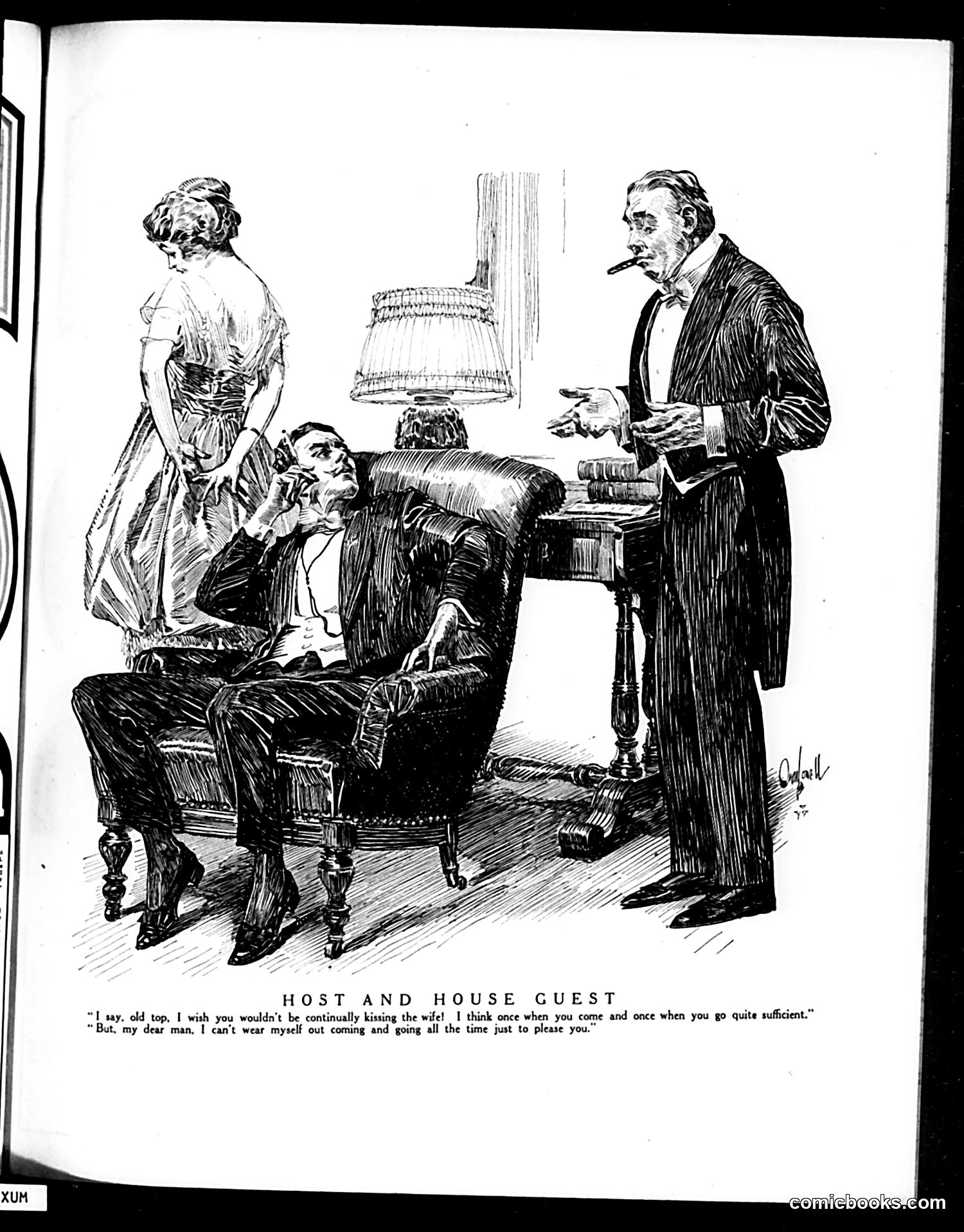
This cartoon satirizes excessive displays of marital affection in social situations. The host (standing right, smoking) complains to his guest (seated) about continuous kissing between husband and wife. The host suggests restraint—kissing only upon arrival and departure—rather than constant public displays "just to please you." The satire targets early 20th-century social conventions around public displays of affection. The "house guest" appears to be someone whose presence encourages or enables excessive romantic behavior, disrupting normal household decorum. The cartoon mocks both the couple's behavior and the guest's apparent influence, treating marital affection as something that should be rationed and controlled within polite society. The humor relies on readers finding such constant kissing socially inappropriate or exhausting.
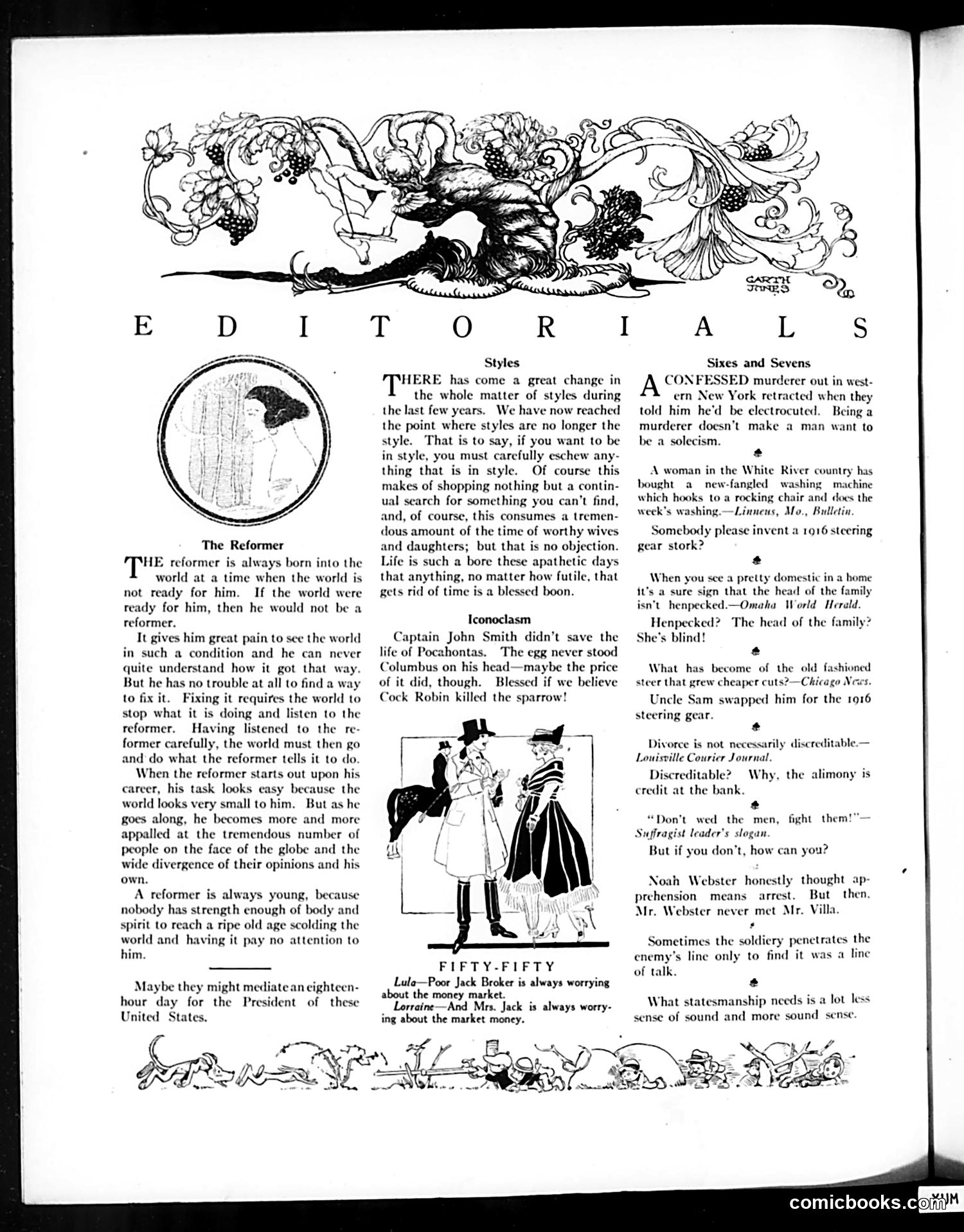
This appears to be a Judge magazine editorial/humor page mixing commentary on social issues with satirical observations. The main content includes: **"The Reformer"** - A lengthy essay criticizing reformers as naive idealists who don't understand practical realities, suggesting reform movements require more than good intentions. **"Fifty-Fifty"** - A cartoon showing a couple where the husband (Jack Broker) worries about money markets while the wife (Lorraine) also worries about market finances, suggesting shared financial anxiety in marriages. The scattered one-liners mock various social absurdities: electrocution as punishment, washing machines, 1916 steering gears, domestic hierarchies, and divorce stigma. The overall tone reflects early 20th-century skepticism toward progressive reform movements while commenting on contemporary domestic and economic concerns.
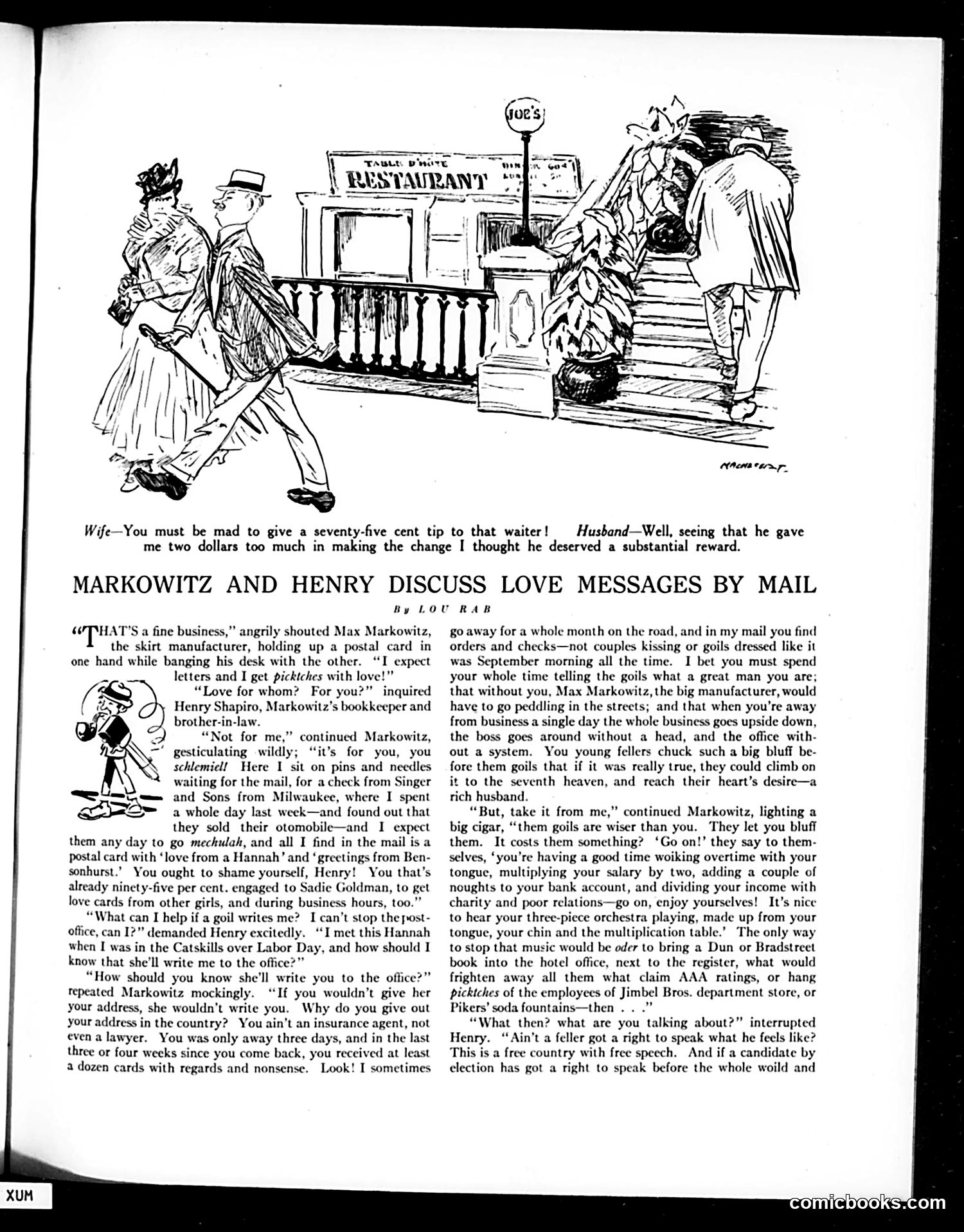
This satirical piece mocks the contrast between romantic ideals and practical business reality. Max Markowitz, a skirt manufacturer, complains to his bookkeeper Henry Shapiro about receiving lovesick postal cards and letters from employees while traveling. The satire targets turn-of-the-century workplace sentimentality—Markowitz expects business correspondence, not romantic musings. Henry defends the practice, arguing workers deserve emotional expression and that love messages actually boost morale and productivity through happiness. The cartoon above illustrates the couple's restaurant encounter, where a husband resents tipping the waiter who gave excessive change—implying the wife's emotional generosity costs money. The joke ultimately mocks both excessive workplace sentimentality and the commodification of human emotion in industrial settings.
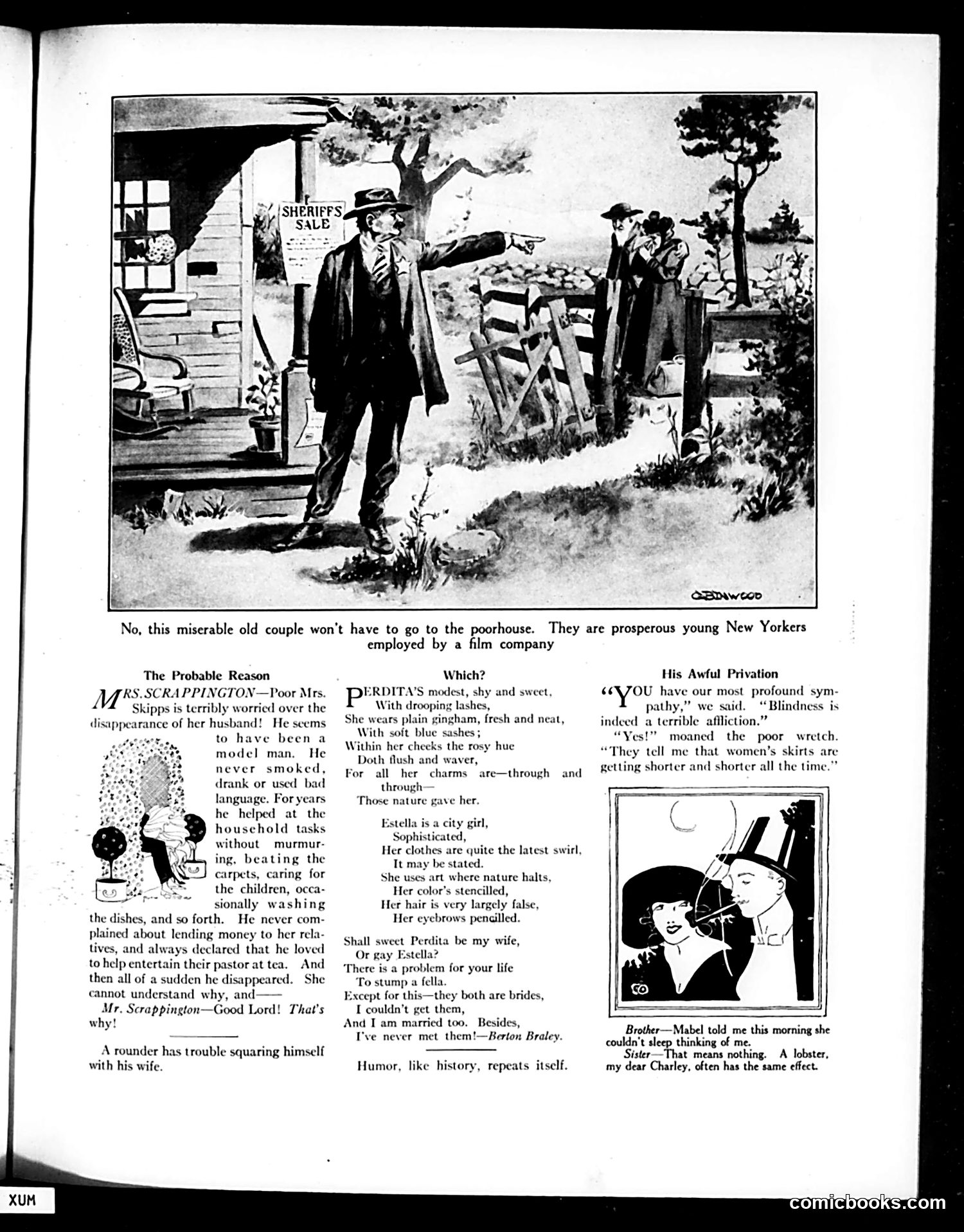
**Main Cartoon (Top):** A sheriff's sale is occurring, but the caption reveals satire—these aren't poor people facing eviction, but "prosperous young New Yorkers employed by a film company." This mocks the movie industry's practice of using real locations and staging elaborate scenes. The "sheriff's sale" sign is a film prop, not an actual foreclosure. **"The Probable Reason":** Mr. Scrappington's wife is baffled by her husband's disappearance, despite his being a model spouse—never smoking, drinking, or complaining, always helping with chores and entertaining her pastor. Mr. Scrappington's response ("That's why!") is the joke: the satirist suggests that such excessive domestic perfection and self-sacrifice would drive any man to flee. The satire targets both nagging wives and overly docile husbands. **Remaining Content:** "Which?" is a light poem contrasting two female types (rural/natural versus urban/artificial); "His Awful Privation" jokes about a blind man's real complaint—women's skirts getting shorter, not blindness itself—mocking misplaced priorities.
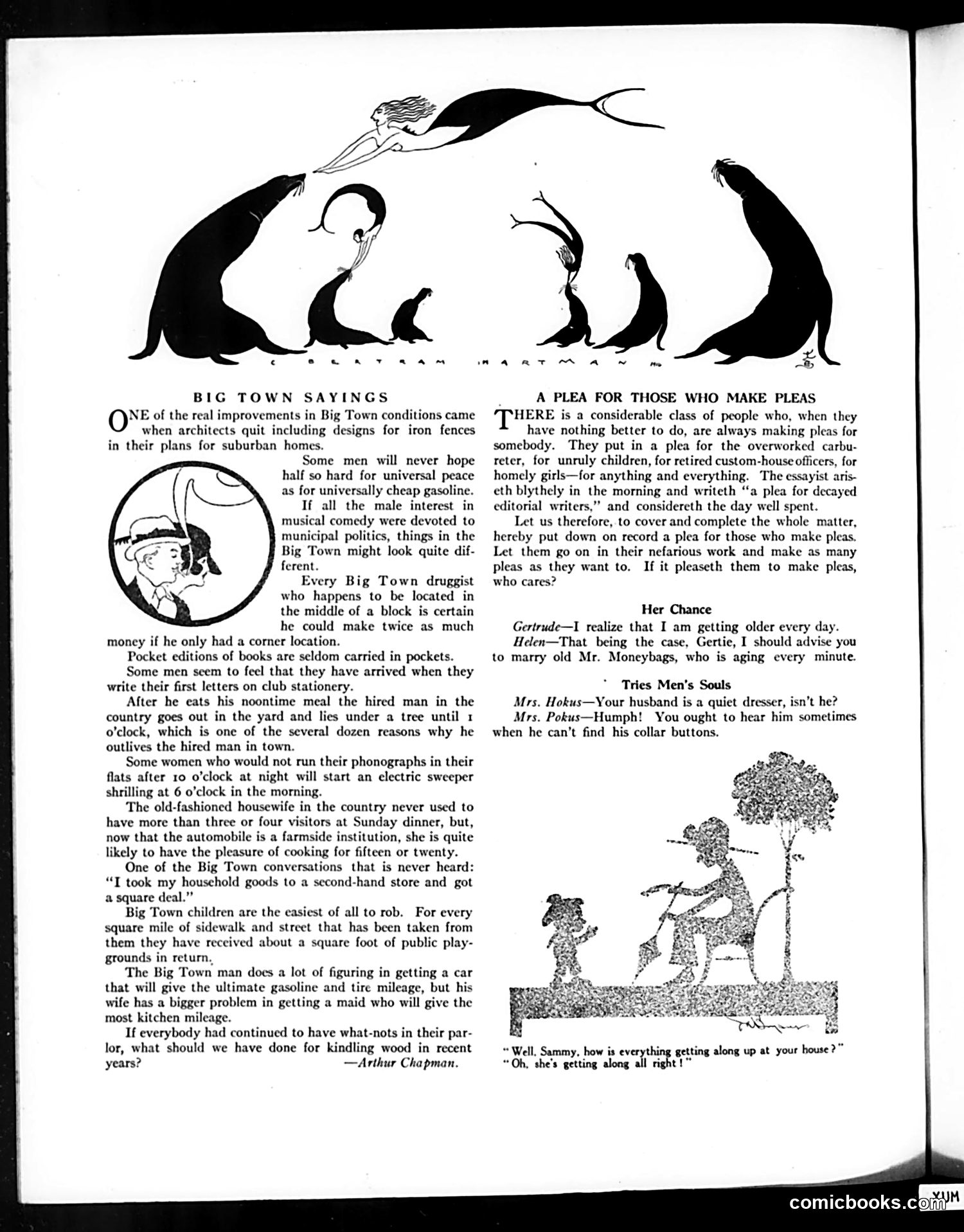
This page contains humorous social commentary typical of early 20th-century American satire, organized into several sections: **"Big Town Sayings"** presents witty observations about urban and suburban life—mocking pretension (men writing on club stationery to seem important), hypocrisy (women complaining about neighbors' phonographs while using loud vacuum cleaners at dawn), and economic absurdities (druggists obsessing over corner locations, wives prioritizing maid efficiency over gasoline mileage). The commentary critiques both modernization's disruptions (automobiles bringing unexpected dinner guests to farms) and nostalgia (lamenting the loss of parlor what-nots as kindling fuel). **"A Plea for Those Who Make Pleas"** satirizes reform-minded essayists who constantly advocate for various causes—suggesting they're self-congratulatory and prolific rather than substantive. **Brief humor sections** ("Her Chance," "Tries Men's Souls") offer domestic comedy: a woman advises her aging friend to marry a wealthy elderly man, and a wife jokes that her quiet-dressing husband becomes loud when frustrated. The cartoon at top shows seals making pleas, visually reinforcing the theme.
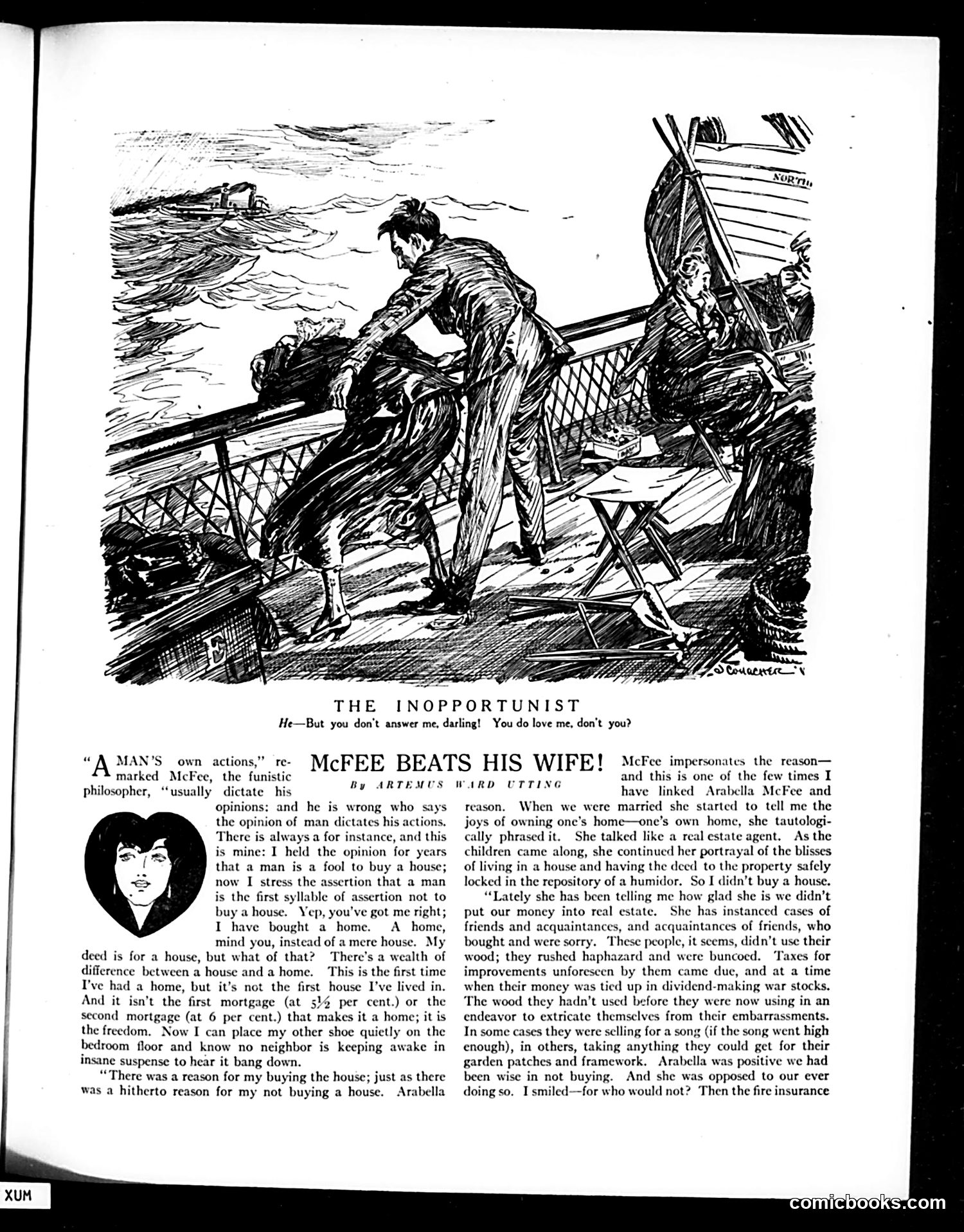
This page satirizes married life and the housing market through philosopher "McFee," a fictional character who embodies contradictory reasoning. The top cartoon shows a man proposing to a woman on a boat—she ignores his romantic declaration, illustrating the cartoon's title: poor timing. The text below presents McFee's rambling philosophical argument about home-buying. He reversed his position from thinking home-ownership foolish to buying one anyway. His wife Arabella similarly flip-flopped, initially promoting homeownership, then opposing it after witnessing neighbors' financial disasters from real estate investments and wartime stock losses. The satire targets both marital dynamics (wives influencing husbands' major decisions) and post-WWI economic anxieties—specifically how families lost money in real estate and found their dividend-earning war stocks inadequate when unexpected property taxes arose. The humor derives from characters' inability to maintain consistent positions, mirroring broader social confusion about financial security during this period.
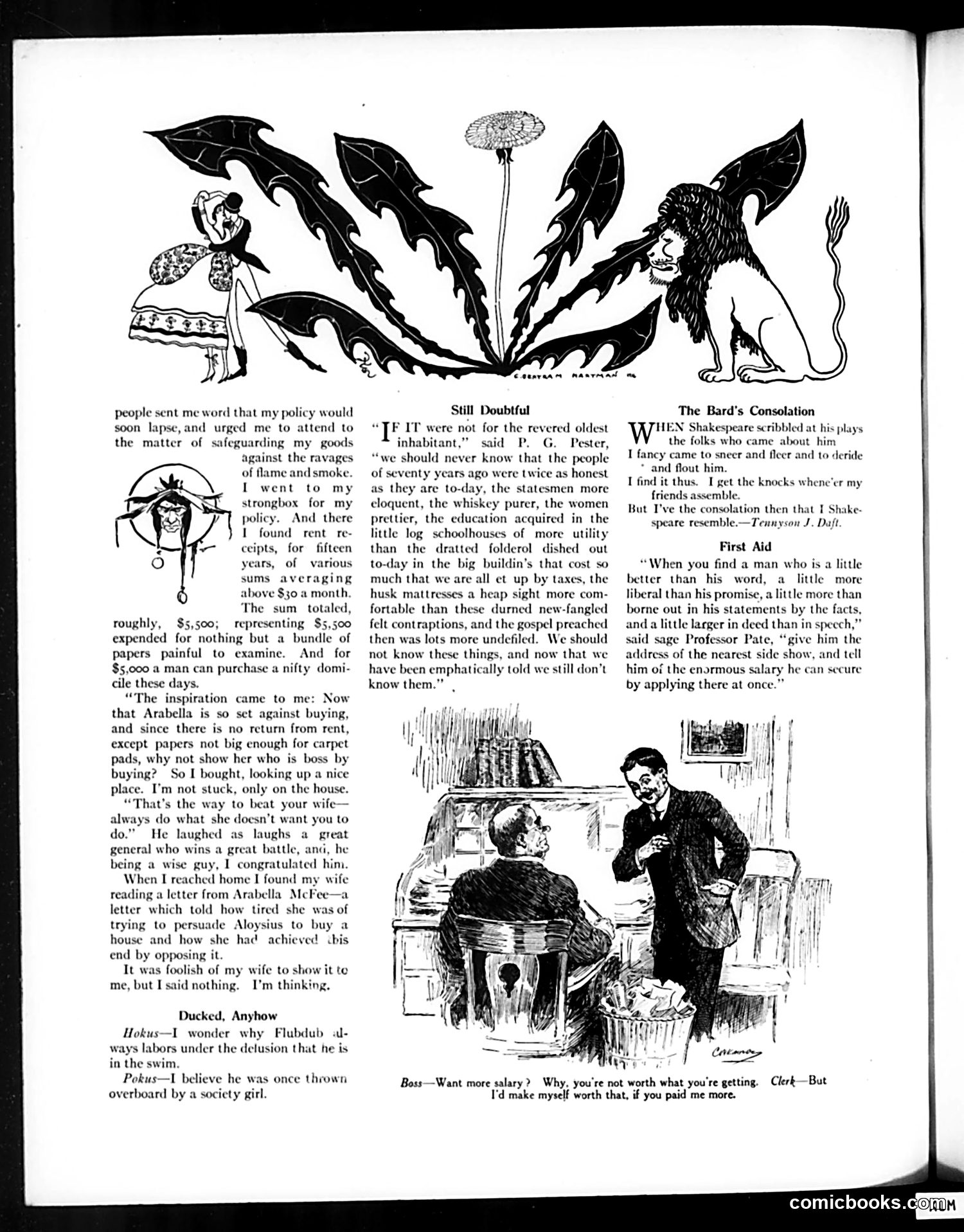
This page contains several satirical pieces mocking American social attitudes and business practices circa early 1900s. **"Ducked, Anyhow"** jokes about a man named Flubdub who, despite being thrown overboard by a "society girl," maintains delusions of social sophistication. **"Still Doubtful"** satirizes nostalgia-mongering, featuring P.G. Pester mocking the "oldest inhabitant" trope—an archetypal figure who constantly claims everything was better in the past (more honest people, better whiskey, superior education). The satire suggests people don't actually believe these claims, yet keep repeating them. **"The Bard's Consolation"** offers dark comfort: if Shakespeare endured mockery from friends while creating masterworks, modern creative people should accept criticism similarly. **"First Aid"** and the cartoon below it mock workplace dynamics: a clerk argues that better pay would make him more productive, while his boss dismisses the proposal. The satire targets employers' penny-pinching logic that undervalues labor. The decorative header illustration is ornamental, not referencing specific content.
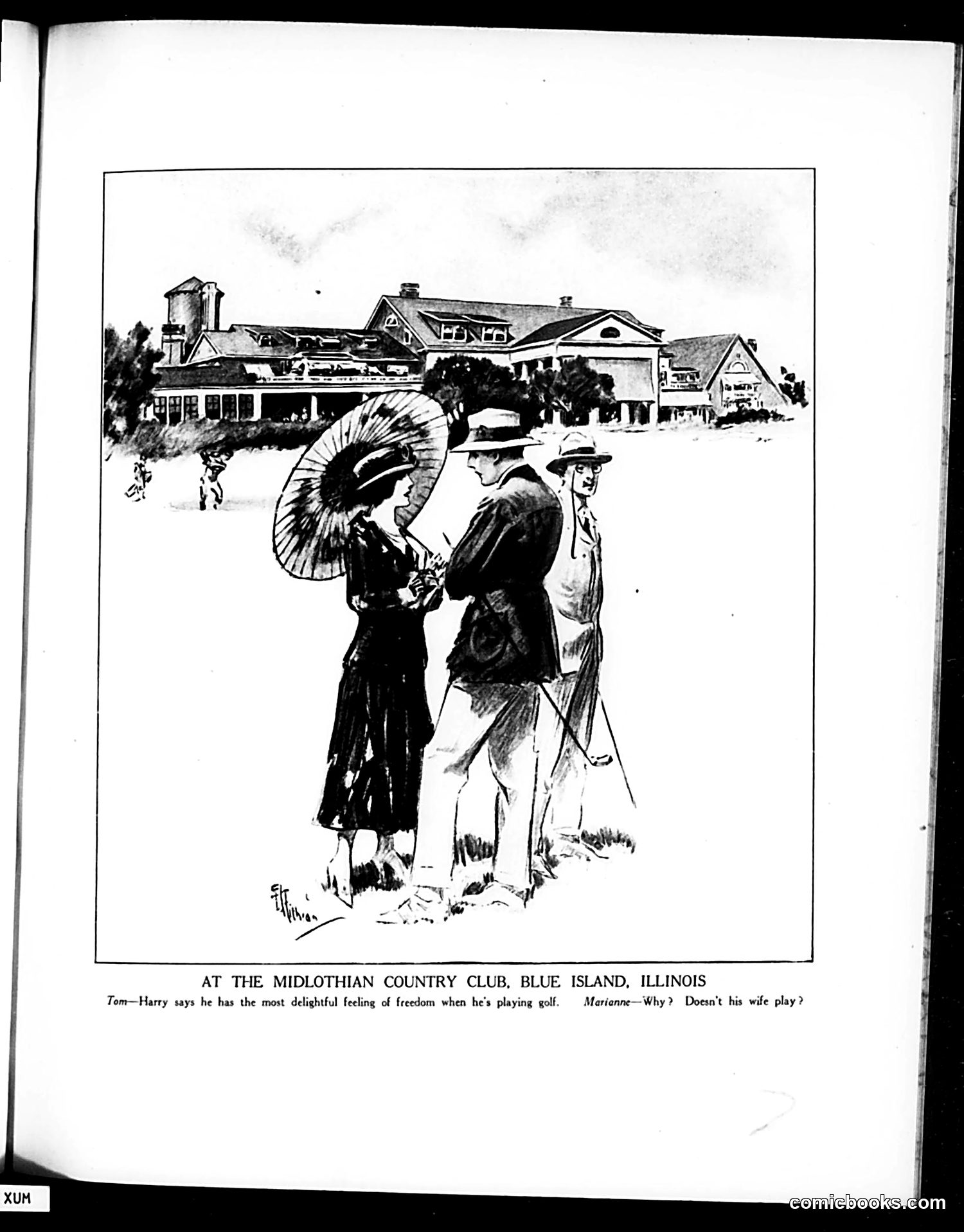
This is a social satire cartoon depicting a conversation at an actual country club (Midlothian Country Club, Blue Island, Illinois). Two people—Tom and a woman named Marianne—observe a man playing golf while his wife watches from the sidelines. The joke centers on marital freedom: Tom explains that "Harry" feels delightfully free while golfing, implying golf provides escape from his wife's presence or oversight. Marianne's question—"Doesn't his wife play?"—sarcastically highlights the absurdity: even at leisure, the wife's absence is what makes the experience enjoyable for him. The satire targets early 20th-century attitudes about marriage and domesticity, suggesting wives were perceived as constraining rather than companionable. The cartoon mocks both Harry's need for spousal escape and the social acceptance of such attitudes among country club society.
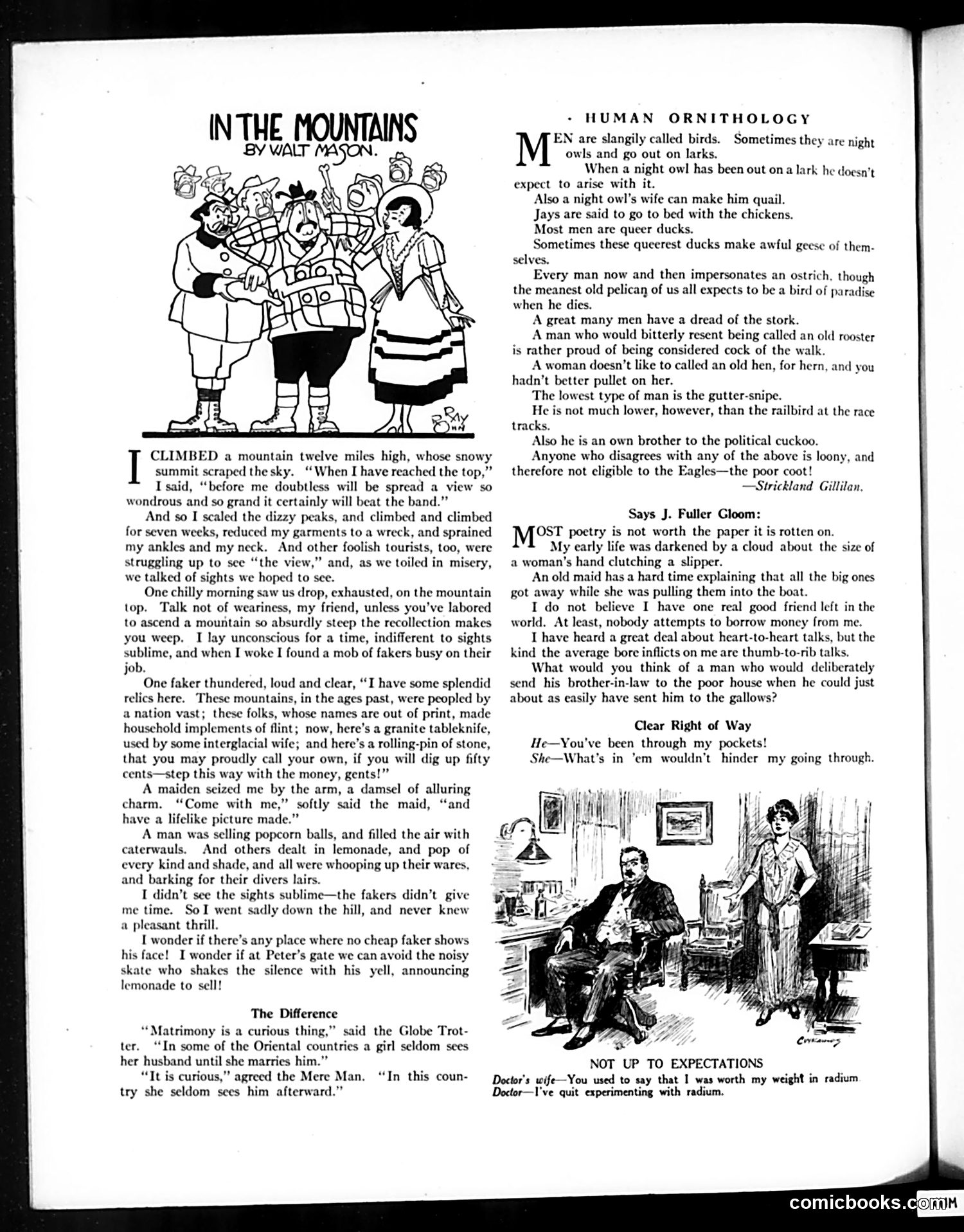
**"In the Mountains" (left):** A satirical narrative poem by Walt Mason mocking tourist culture. The narrator climbs a difficult mountain expecting sublime views but finds the summit overrun with commercial hucksters—con artists selling fake "ancient relics" (flint tools, stone rolling pins), photographs, and refreshments. The joke: tourist destinations are corrupted by exploitation and commercialism that prevents experiencing actual beauty. The fakers are caricatured as aggressive salesmen. **"Human Ornithology" (right):** A crude, extended pun comparing human character types to birds and bird behavior. Men are "queer ducks," become "geese," aspire to be "birds of paradise," fear "storks" (babies), dislike being called "roosters" or "old hens." It's lighthearted wordplay mocking male behavior and gender relations—women "quail" men, shouldn't be "pulled on." **"Clear Right of Way":** A domestic cartoon showing a woman demanding to search her husband's pockets, reducing him to a mere object. Social commentary on marital power dynamics. **Context:** Early 20th-century satirical humor targeting commercialism, tourist culture, and gender relations in an era of rapid urbanization and changing social norms.
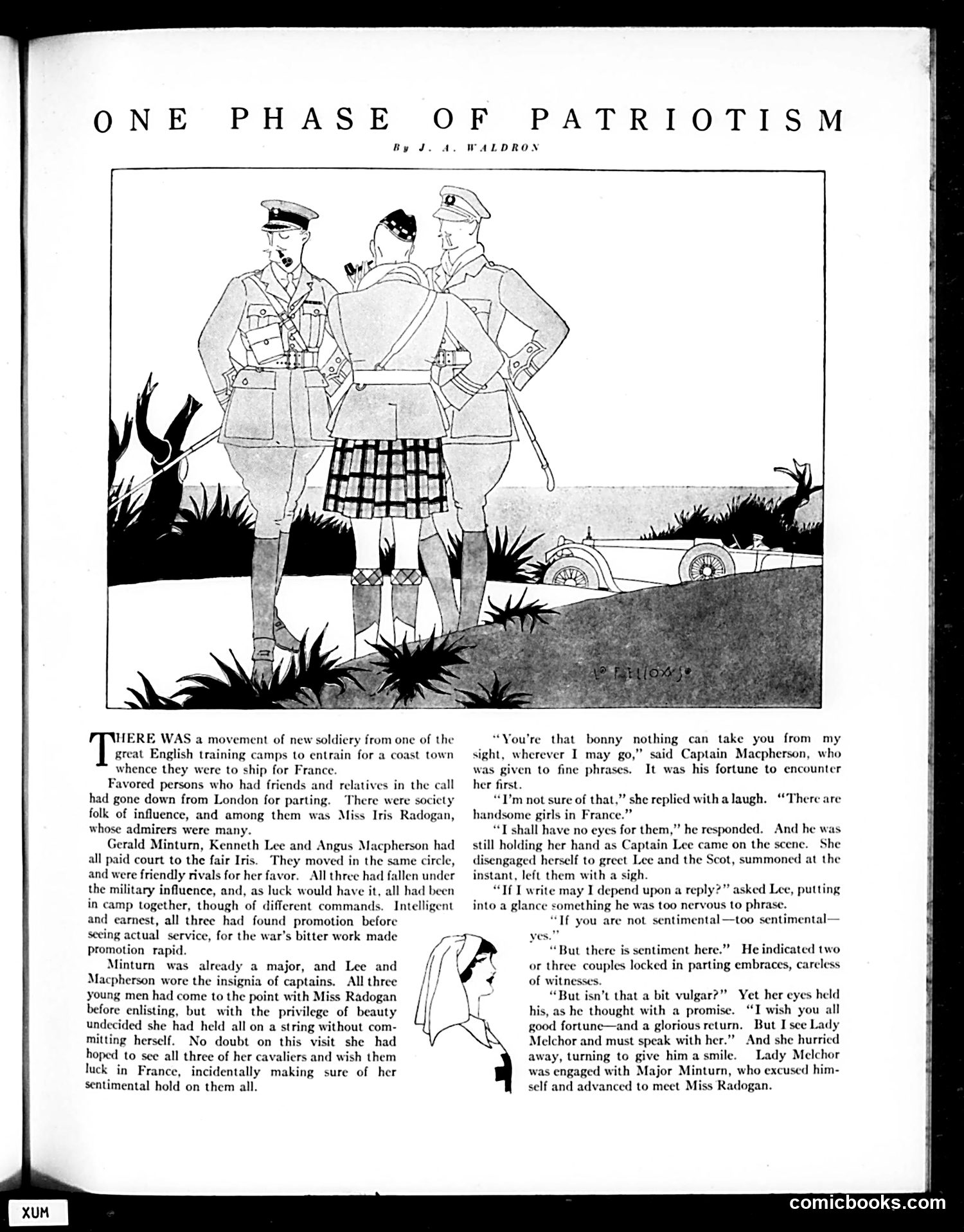
This is a satirical fictional story (not a political cartoon) by J.A. Waldron about romantic rivalry during World War I. Three British officers—Major Minturn and Captains Lee and Macpherson—are shipping out to France and have all courted the same woman, Miss Iris Radogan, a society beauty who has kept all three as romantic options. The satire targets the sentimentality and emotional manipulation surrounding wartime departures. Miss Radogan uses patriotic occasion to maintain her "sentimental hold" on all three men simultaneously, making romantic declarations to each while avoiding commitment. The story mocks both the officers' eagerness to receive her affections before deployment and her calculated exploitation of wartime emotions for romantic advantage. The title suggests this represents one shallow aspect of patriotism: using national duty as romantic theater rather than genuine sacrifice.
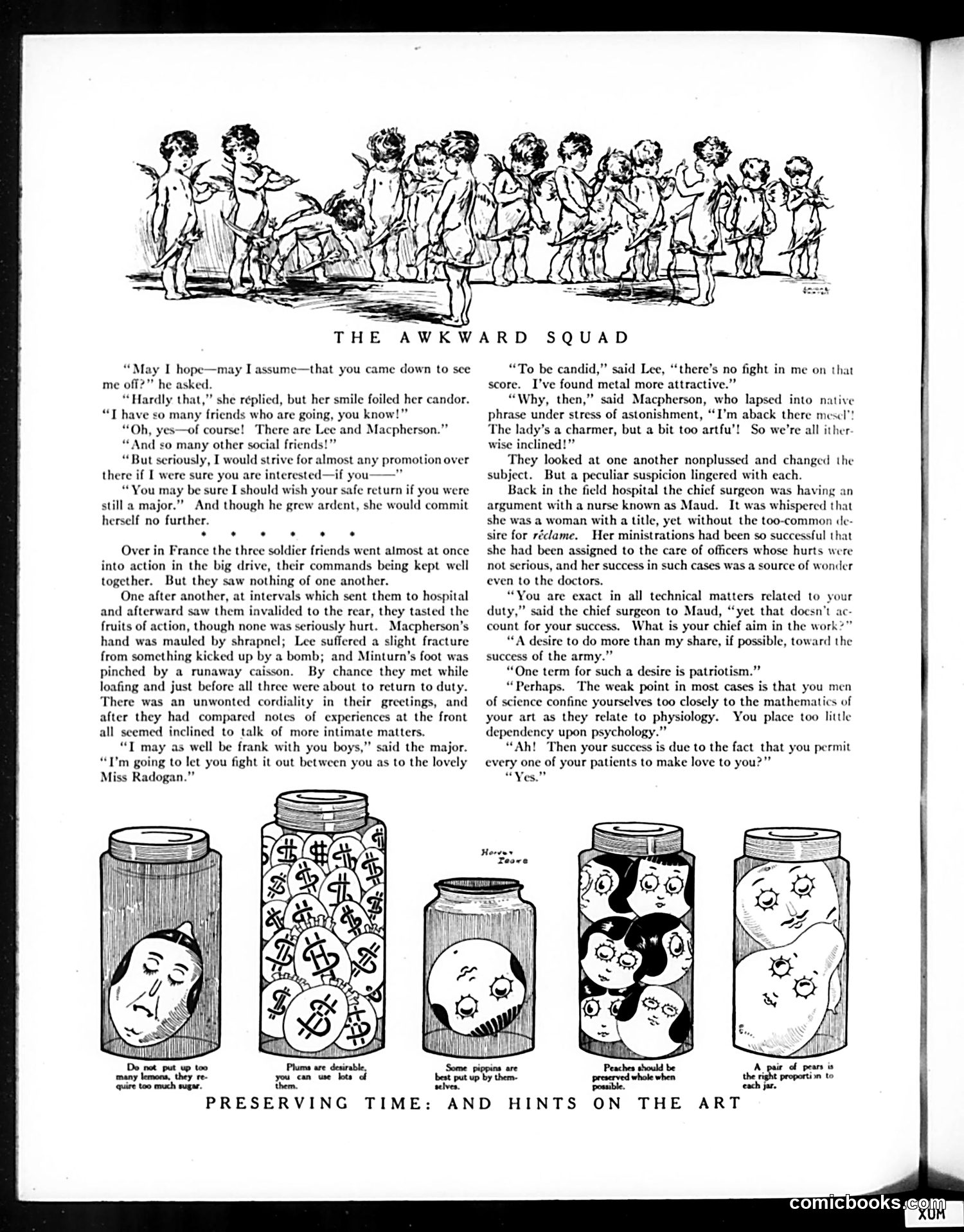
This WWI-era story satirizes romantic entanglement among soldiers. Three male friends—a major, Lee, and Macpherson—all pursue the same woman, Miss Radogan, before shipping to France. Each is wounded in combat and believes he alone has lost interest in her. When they reunite at the front, each expects to "fight it out" romantically, but all three confess they've found "metal more attractive"—revealing none actually care about her anymore. Their relief is mutual and awkward. The satire mocks romantic posturing and masculine ego: the soldiers' sudden indifference exposes their prior interest as superficial posturing rather than genuine feeling. The subplot with nurse Maud suggests that actual devotion to duty (implied flirtation with patients) proves more effective than romantic pursuit. The "Preserving Time" illustrations below appear to be unrelated domestic humor about food storage.
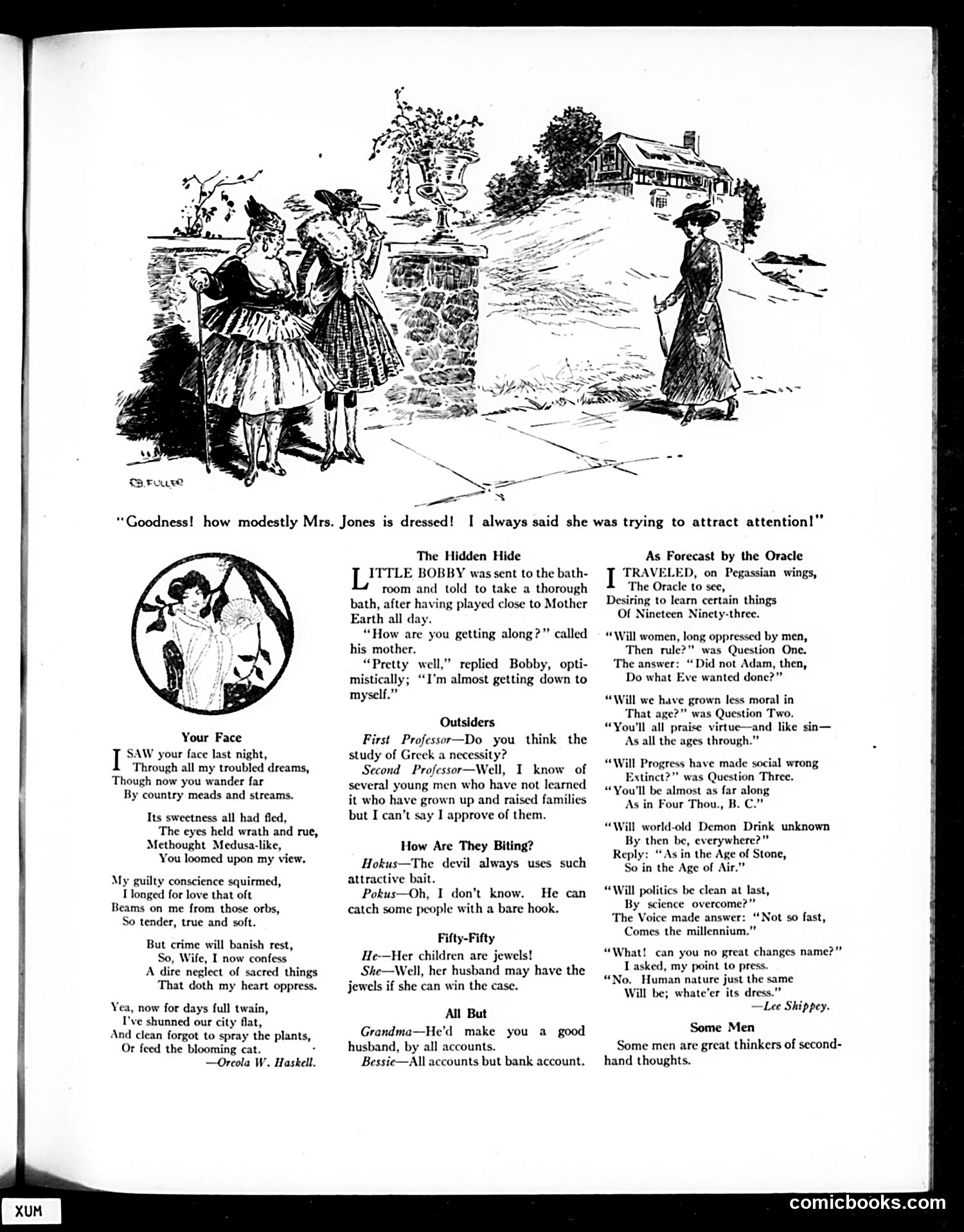
This page contains several short humorous pieces typical of early 20th-century American satirical magazines: **Top Cartoon:** A social satire on female modesty and fashion. Two women gossip cattily about Mrs. Jones's "modest" dress, with one remarking she's "trying to attract attention"—the humor lies in the irony that deliberately modest clothing was itself seen as an attention-seeking strategy. **Short Pieces:** The remaining content includes light domestic humor: a husband confessing he forgot to feed the cat and water plants; a child's wordplay about bathing until he gets "down to myself"; and cynical quips about courtship and morality. **"As Forecast by the Oracle":** A longer satirical poem predicting 1993. It mocks progressive optimism by suggesting that despite claims of social progress, human nature—particularly regarding morality, politics, and alcohol consumption—remains fundamentally unchanged. The tone suggests skepticism about claims of inevitable human improvement. Overall, the page reflects turn-of-the-century American middle-class anxieties about gender roles, morality, and whether modern society was genuinely improving.
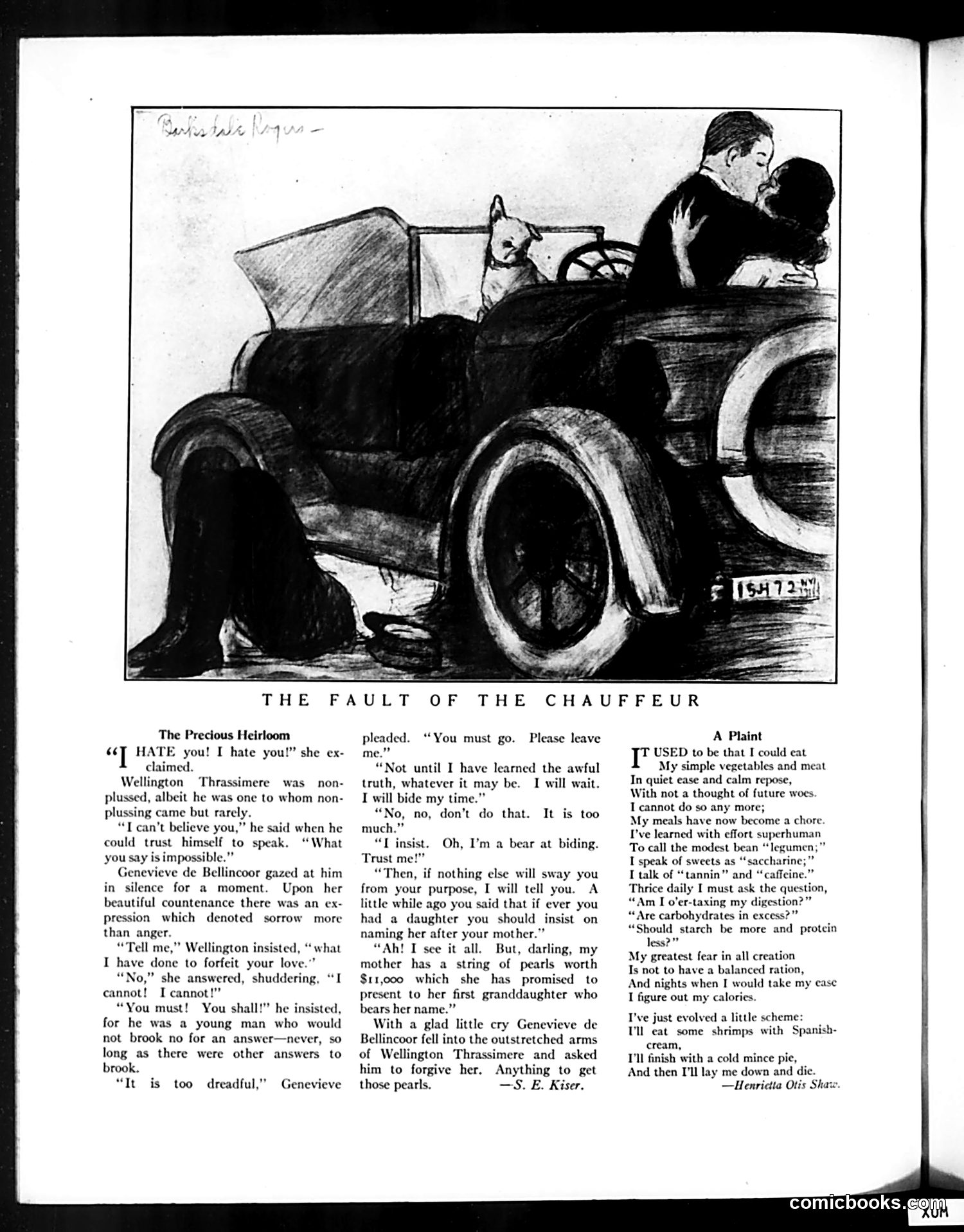
This page contains two separate pieces of satirical fiction, not a political cartoon. **"The Precious Heirloom"** is a humorous short story mocking melodramatic romance novels and fortune-hunting. A wealthy couple (Wellington Thrassimere and Genevieve de Bellincoor) engage in overwrought emotional drama—she dramatically refuses him, he insists on knowing why—only to reveal the entire conflict was about inheriting his mother's $11,000 pearl necklace. The satire ridicules both romantic clichés and the materialism underlying upper-class courtship. **"A Plaint"** is a poem mocking the emerging health-food movement and calorie-consciousness. The speaker laments that meals were once simple pleasures but have become anxious ordeals of nutritional obsession—worrying about "legumes," "carbohydrates," and "calories." The dark humor culminates in eating shrimp and pie before dying, suggesting such neurotic dietary concern is literally life-shortening. Both pieces satirize contemporary American society: romantic pretense and health faddism among the affluent.
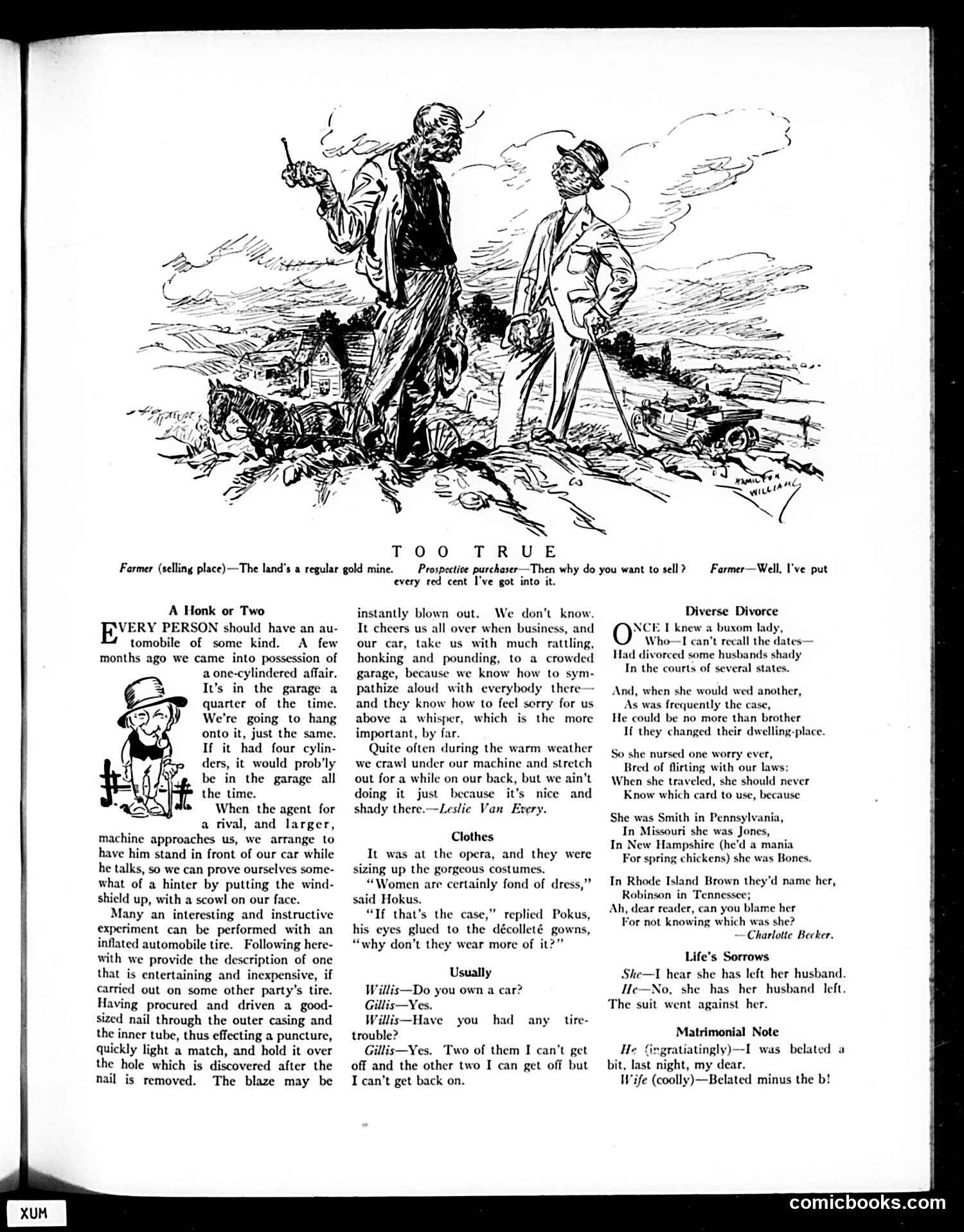
This page contains several satirical pieces typical of early 20th-century American humor: **"Too True" (top cartoon)**: A farmer and land speculator discuss selling property. The joke's premise appears to be that the farmer, having invested heavily ("every red cent"), claims his land is valuable like "a regular gold mine"—yet wants to sell it anyway, revealing the contradiction in his pitch. **"A Honk or Two"**: Satirizes automobile culture and owners' pretenses. The humor targets how car owners brag about their vehicles while they frequently break down, and how people perform fake sympathy about mechanical troubles. The tire-puncturing prank suggests petty rivalry between automobile owners. **"Diverse Divorce"**: A humorous poem about a woman who divorced multiple husbands across different states, accumulating different married names (Smith, Jones, Bones, Brown, Robinson). The satire mocks both her marital instability and confusing interstate marriage laws. The remaining brief comic exchanges mock typical domestic situations—car troubles, marital arguments about punctuality—through wordplay and exaggeration typical of period humor magazines.
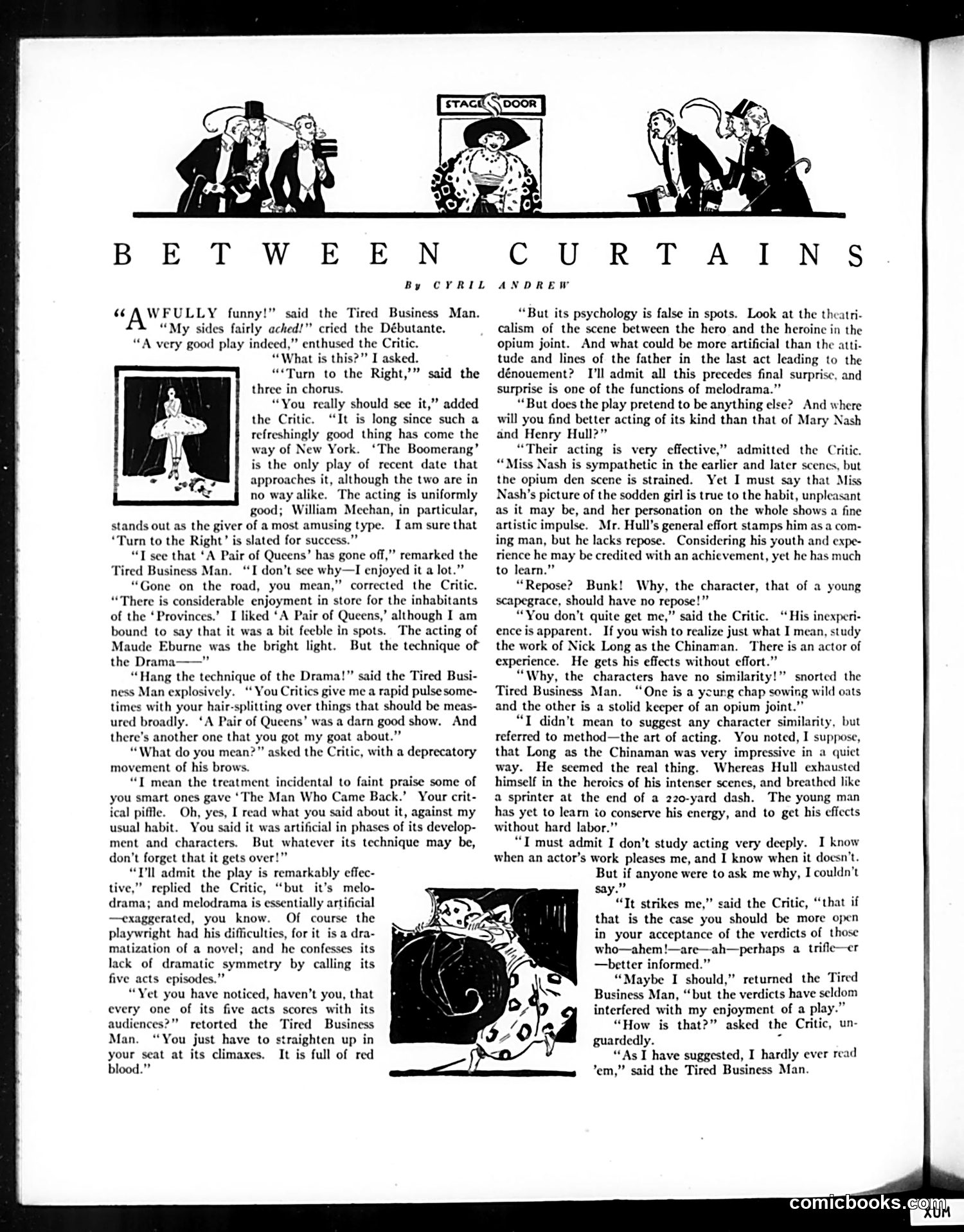
This is theater criticism disguised as dialogue comedy. A "Tired Business Man" (everyman audience member) and a pretentious "Critic" debate the merits of contemporary Broadway plays, including "Turn to the Right," "A Pair of Queens," and "The Man Who Came Back." The satire targets two things: first, the Critic's obsession with technical theatrical language ("technique," "melodrama," "psychology," "dénouement") applied to what are fundamentally effective, entertaining plays; second, his habit of faint praise and nit-picking (questioning actors' "repose" while acknowledging their effectiveness). The Tired Business Man represents the average theatergoer who values emotional impact and entertainment over critical sophistication. The joke is that the Critic's learned objections miss what actually *works* on stage. The illustration shows a cat, reinforcing the metaphorical "cat got your tongue" about the Critic's inability to simply enjoy theater.
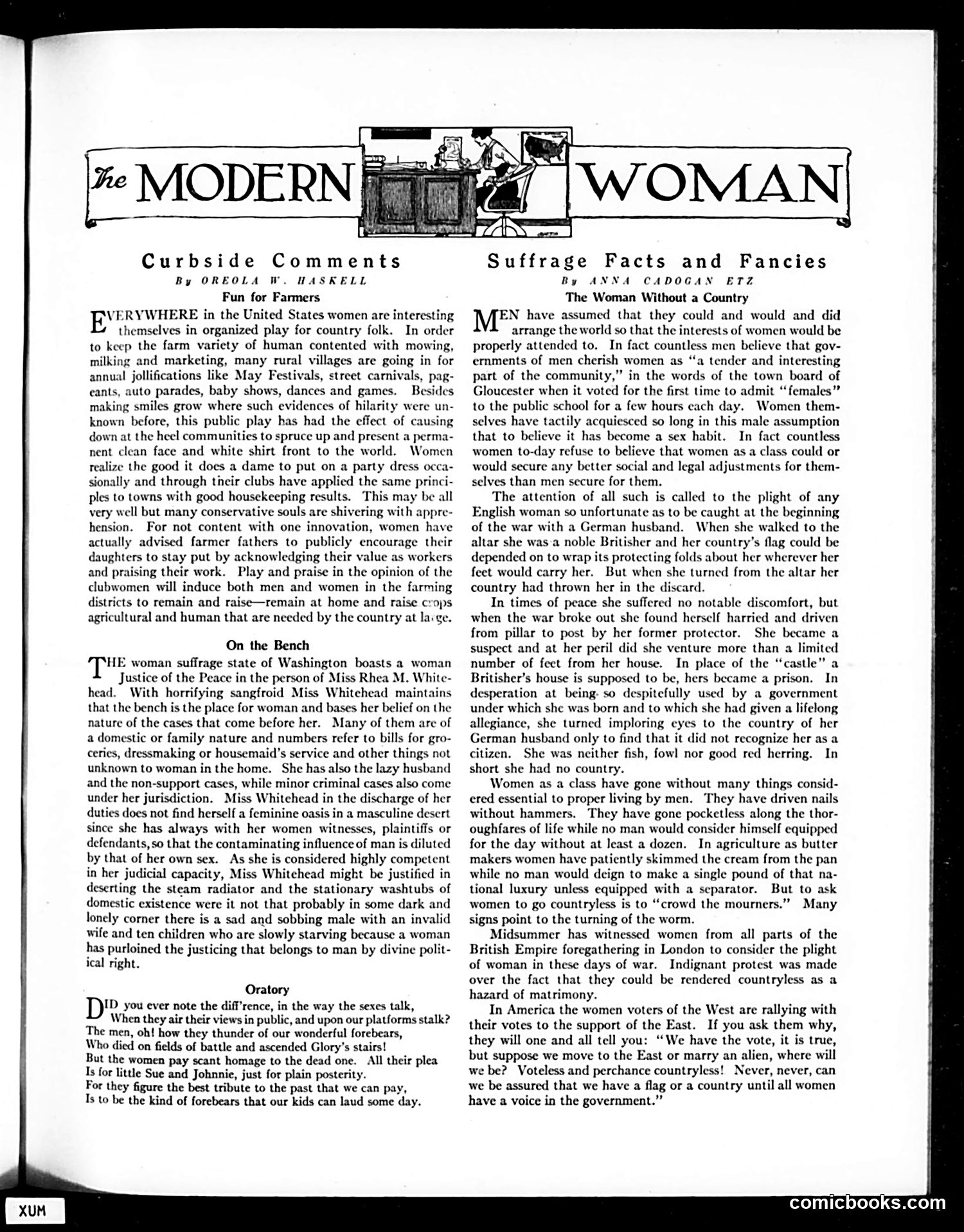
This page contains three satirical essays critiquing women's expanding roles in early 20th-century America, particularly around suffrage and public participation. **"Curbside Comments"** mocks rural women's organizing of community events and farm work encouragement—conservative voices fear women's activism will disrupt traditional domestic life. **"On the Bench"** addresses Miss Rhea M. Whitehead, Washington's female Justice of the Peace. The satire is backhanded: while acknowledging her competence, it argues she belongs in domesticity because cases involve "family nature" (groceries, housemaids, lazy husbands)—implying women judges are only "naturally" suited to domestic matters. The final jab suggests her judicial role leaves some invalid wife and starving children without proper care. **"Oratory"** contrasts male and female public speakers: men glorify historical war heroes; women focus on children's welfare and future generations. The satire suggests women reduce lofty rhetoric to mere "posterity"—questioning whether female public speech is as substantive or noble. Overall, the page uses conditional approval to undermine women's public participation, suggesting expanded roles violate divine and natural order.
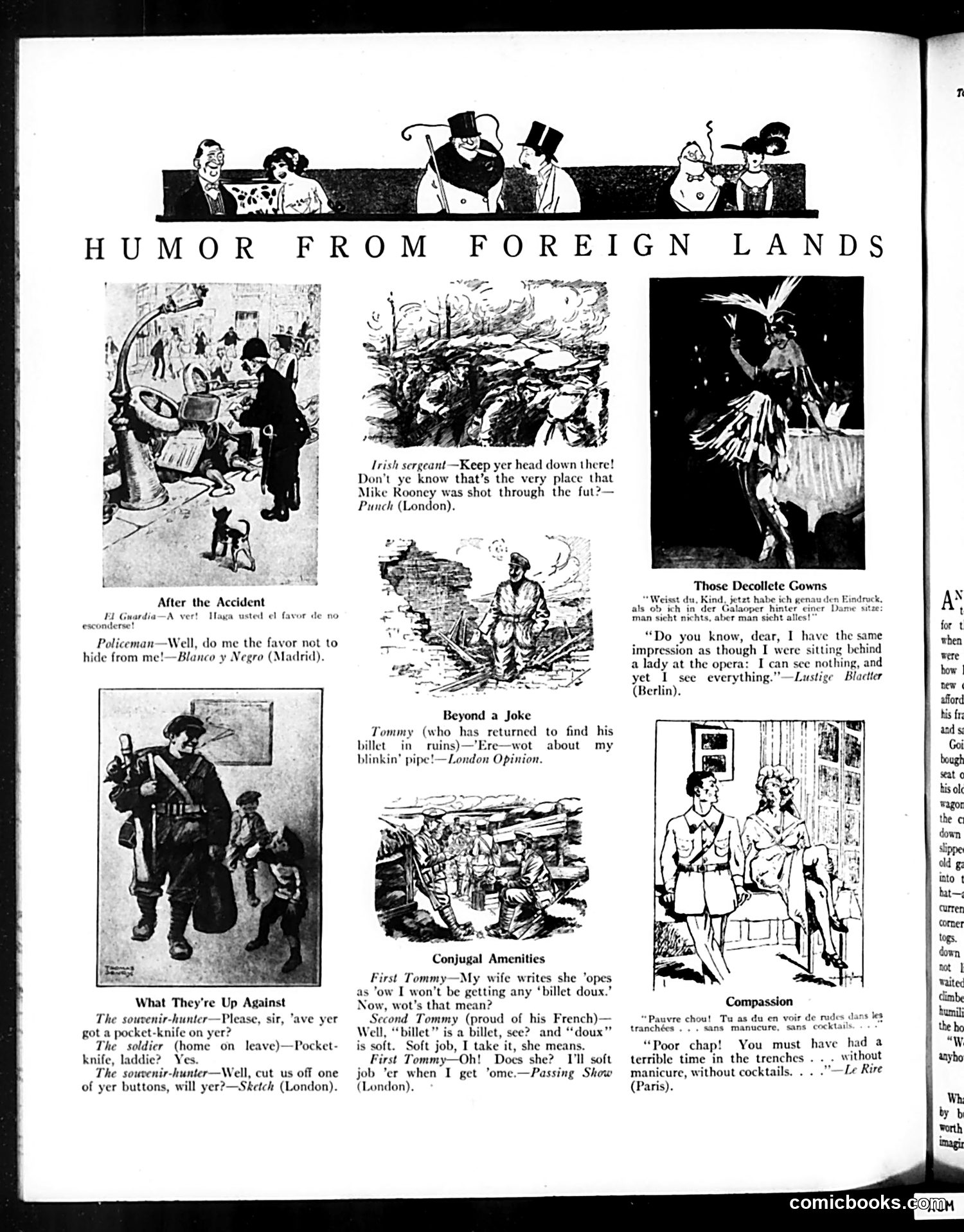
This page collects satirical cartoons and jokes from European publications, translated for American readers. The humor centers on **World War I soldier life and domestic wartime absurdities**. Key jokes include: - **"After the Accident"**: A policeman (likely referencing a Spanish authority figure) chasing someone - **"What They're Up Against"**: A soldier on leave is pestered by a souvenir-hunter demanding his uniform buttons - **"Beyond a Joke"**: A soldier finds his military billet destroyed, missing his pipe - **"Conjugal Amenities"**: Two Tommies misunderstand "billet doux" (French love letters) as a soft military assignment; the first threatens violence toward his wife - **German and French sections**: Officers complain about trench conditions and lack of civilian comforts (manicures, cocktails) The satire mocks soldiers' frustrations with wartime deprivations, home-front ignorance, and the gap between military reality and domestic life. The international collection suggests shared wartime humor across Allied nations.
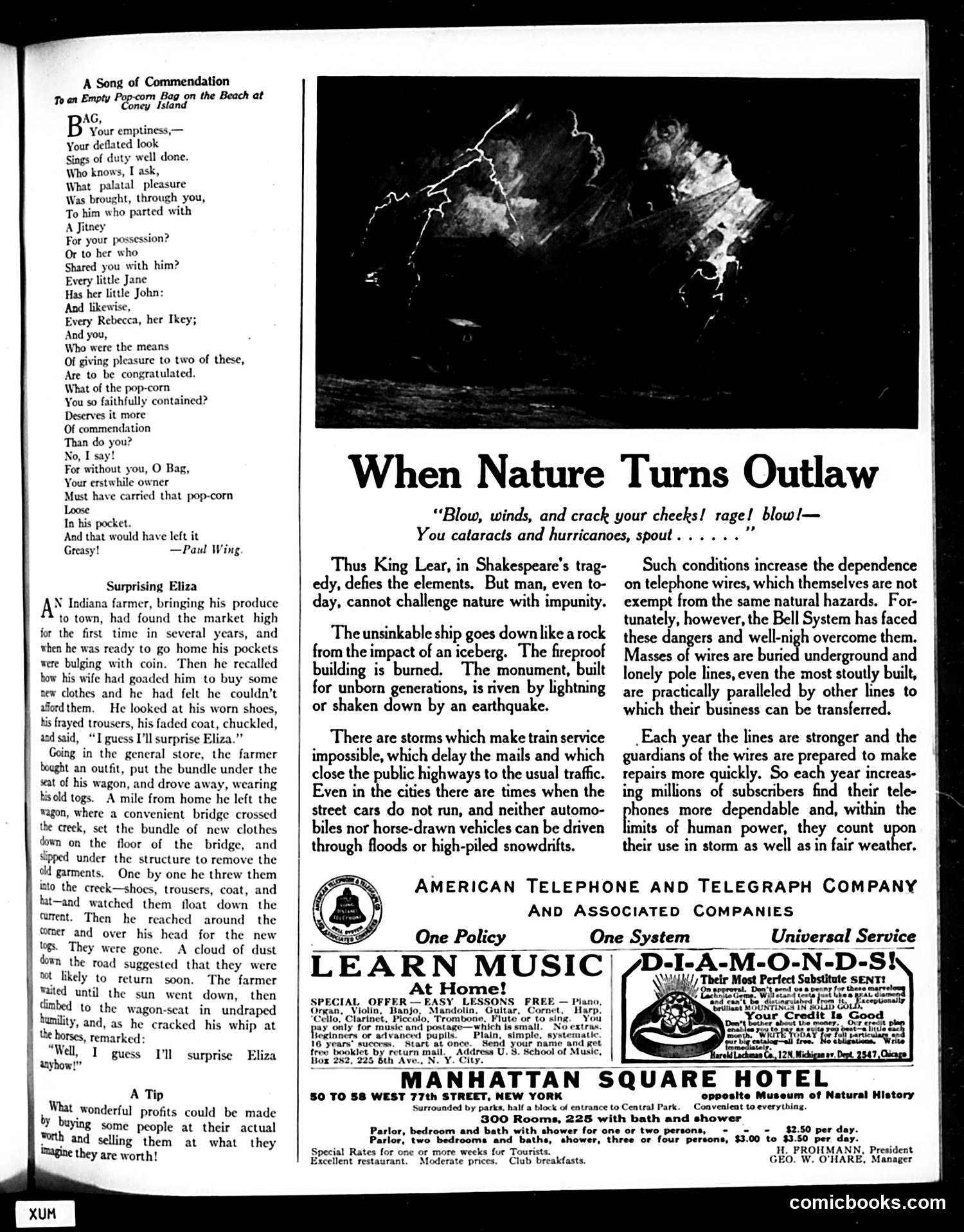
This page combines satirical humor with advertising from an early 20th-century American perspective. **The Cartoons/Stories:** - "A Song of Commendation" satirizes sentimentality by praising a paper bag for containing pop-corn at a beach outing—mocking overwrought, affected praise for ordinary objects. - "Surprising Eliza" is a humorous anecdote: a farmer, excited to buy new clothes after a profitable harvest, hides them under a bridge while removing old ones in the creek. Thieves steal the new bundle while he strips, leaving him to drive home naked. The joke targets rural naïveté and the irony of his attempt to impress his wife. **"When Nature Turns Outlaw":** This is a Bell Telephone advertisement disguised as editorial content, referencing Shakespeare's *King Lear* to discuss natural disasters (storms, floods, earthquakes) that disrupt modern infrastructure. The pitch: despite nature's chaos, Bell's telephone system is so well-engineered with buried wires and backup lines that service remains reliable. It's promotional messaging framed as serious commentary on humanity versus nature. The page primarily serves advertisers while entertaining readers with light satire and folksy humor.
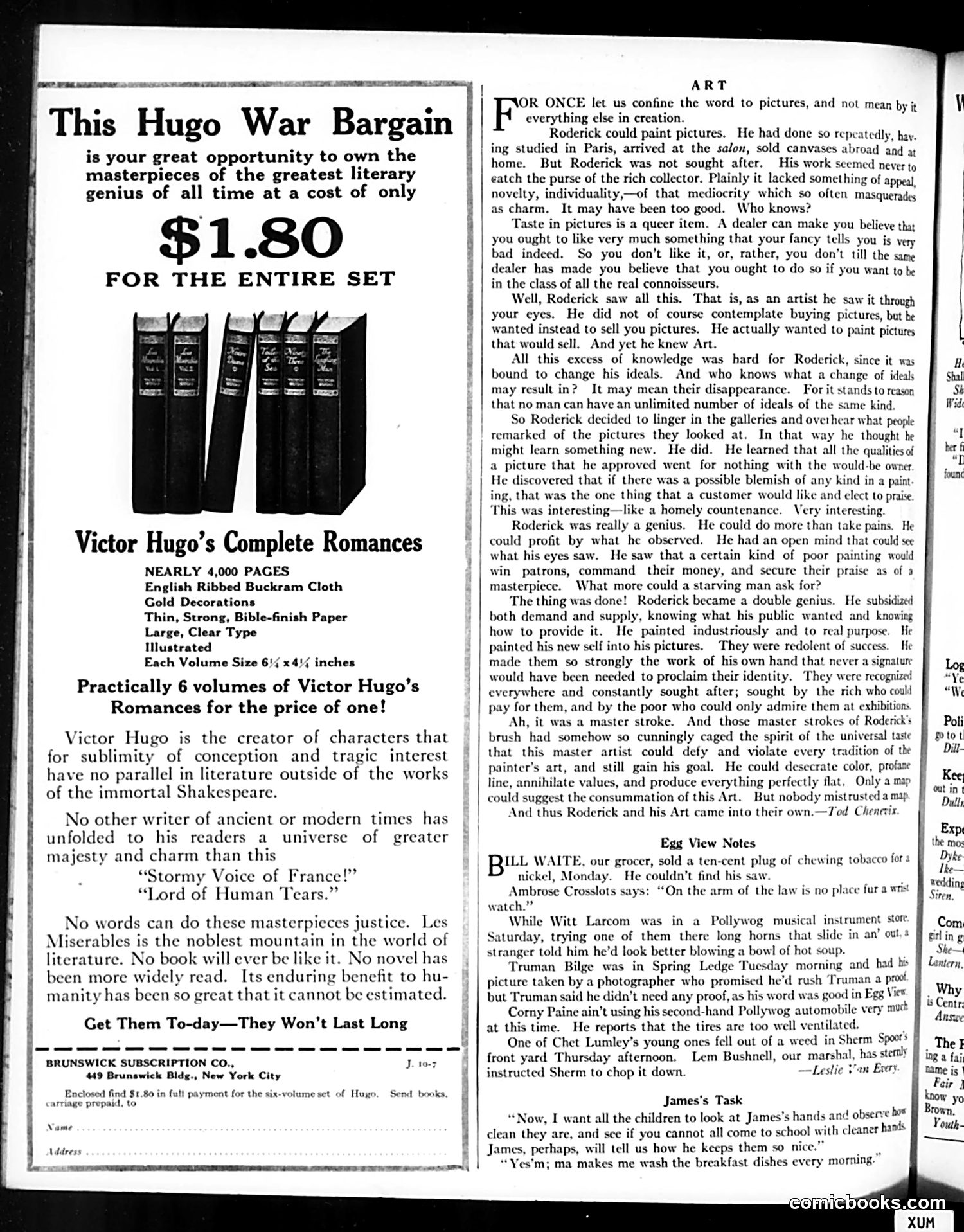
This page is primarily **advertising**, not political satire. The left side features a book advertisement for Victor Hugo's complete romances (6 volumes) at $1.80—presented as an exceptional bargain. The copy emphasizes Hugo's literary genius, comparing him to Shakespeare, and highlights *Les Misérables* as a masterpiece. The right side contains "ART," an apparent short story or serialized fiction about a character named Roderick, a painter struggling to sell his work. The narrative describes how Roderick learns that commercial success requires compromising artistic ideals—customers praise flaws rather than merit. The story satirizes **art market cynicism**: that wealthy patrons' taste is manufactured by dealers, not genuine appreciation. Below is "Egg View Notes," a humor section with brief anecdotes about everyday life—Bill Waite's grocery store, a military band, and a child named James. This is a typical Judge magazine page mixing consumer advertising with light fiction and humor pieces.
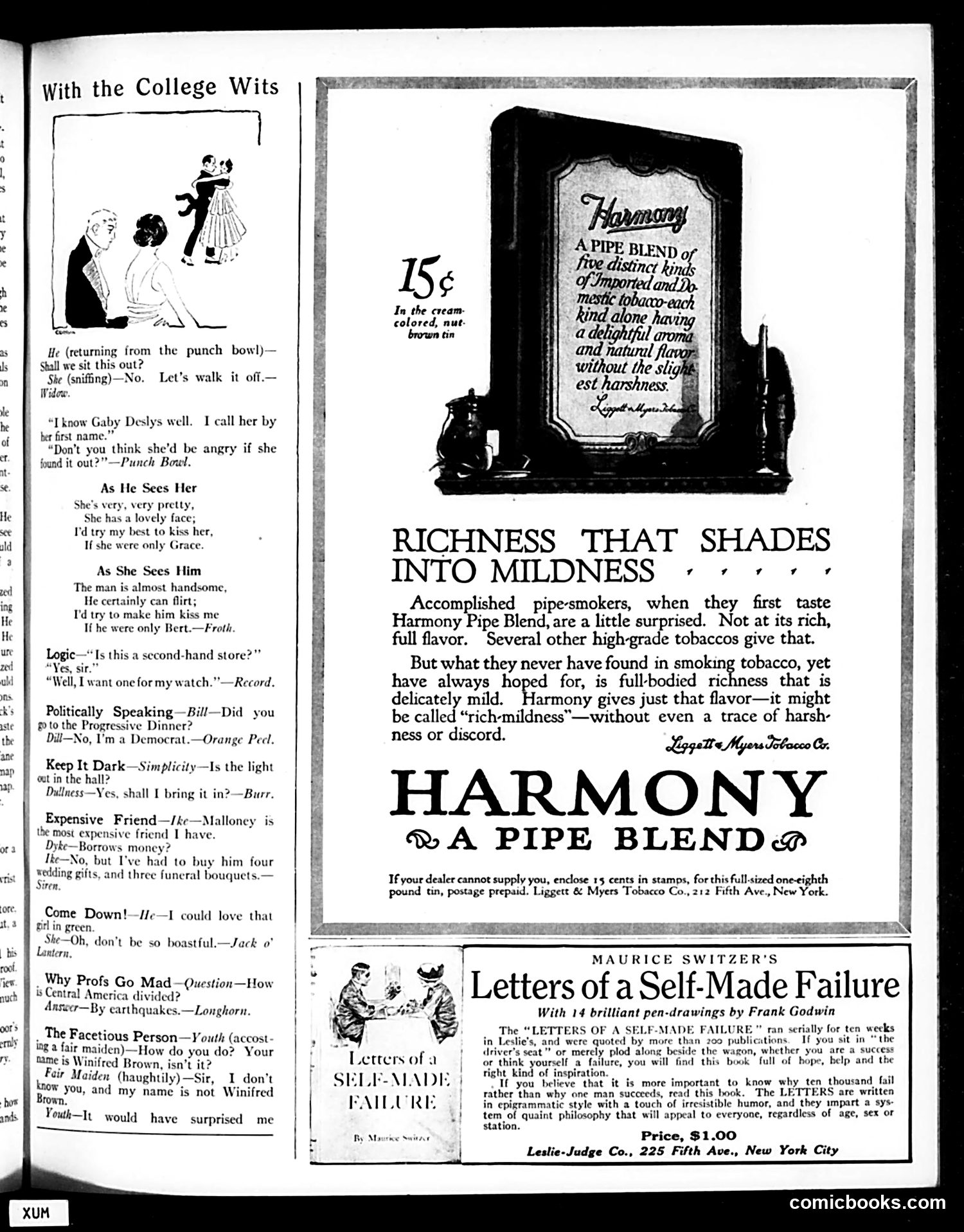
This page contains humor sketches typical of Judge magazine's social satire. The "College Wits" section presents brief comic scenarios about courtship and social etiquette among the educated classes. The main jokes mock romantic posturing: a man returning from the punch bowl proposes walking with a woman, who declines; sketches show how men and women perceive each other differently during flirtation (he sees her beauty, she sizes up his handsomeness). Other quips satirize upper-class pretension—a man casually name-dropping "Gaby Deslys" (likely a celebrity of the era), someone asking about a "second-hand store" as a joke, debates about progressive politics. The humor targets affectation and shallow social performance among college-educated Americans. The satire is gentle, poking fun at courtship rituals, snobbery, and the gap between self-presentation and reality. The page also advertises Harmony Pipe Blend tobacco and Maurice Switzer's book *Letters of a Self-Made Failure*, indicating this is primarily a commercial/editorial mix typical of Judge's format.
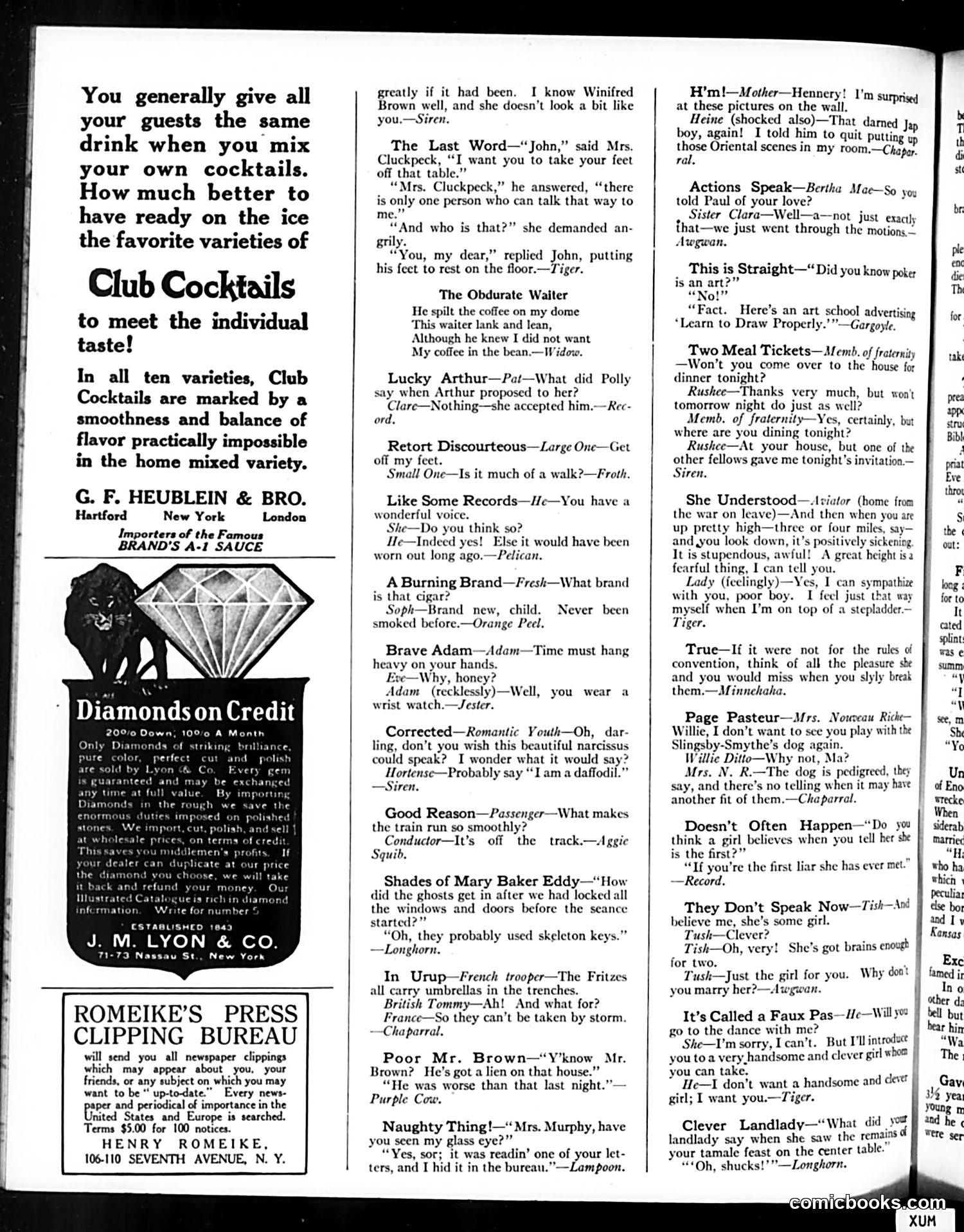
This page is primarily **advertising and humor fillers**, not political satire. The advertisements dominate (Club Cocktails, diamonds on credit, press clipping service), while the content consists of brief joke columns with attributions to various fictional sources ("Tiger," "Siren," "Pelican," etc.). The jokes themselves are lightweight domestic and social humor typical of early 20th-century magazines—marital squabbles ("Mrs. Cluckpeck" nagging her husband), romantic mishaps, and puns. One joke references World War I ("French trooper—The Fritzes all carry umbrellas"), but this is incidental. The only potentially satirical element is "Shades of Mary Baker Eddy," mocking Christian Science founder Mary Baker Eddy through a spiritualism joke. Otherwise, there is **no meaningful political or social commentary**—just period advertising and filler comedy aimed at entertaining readers between more substantial articles.
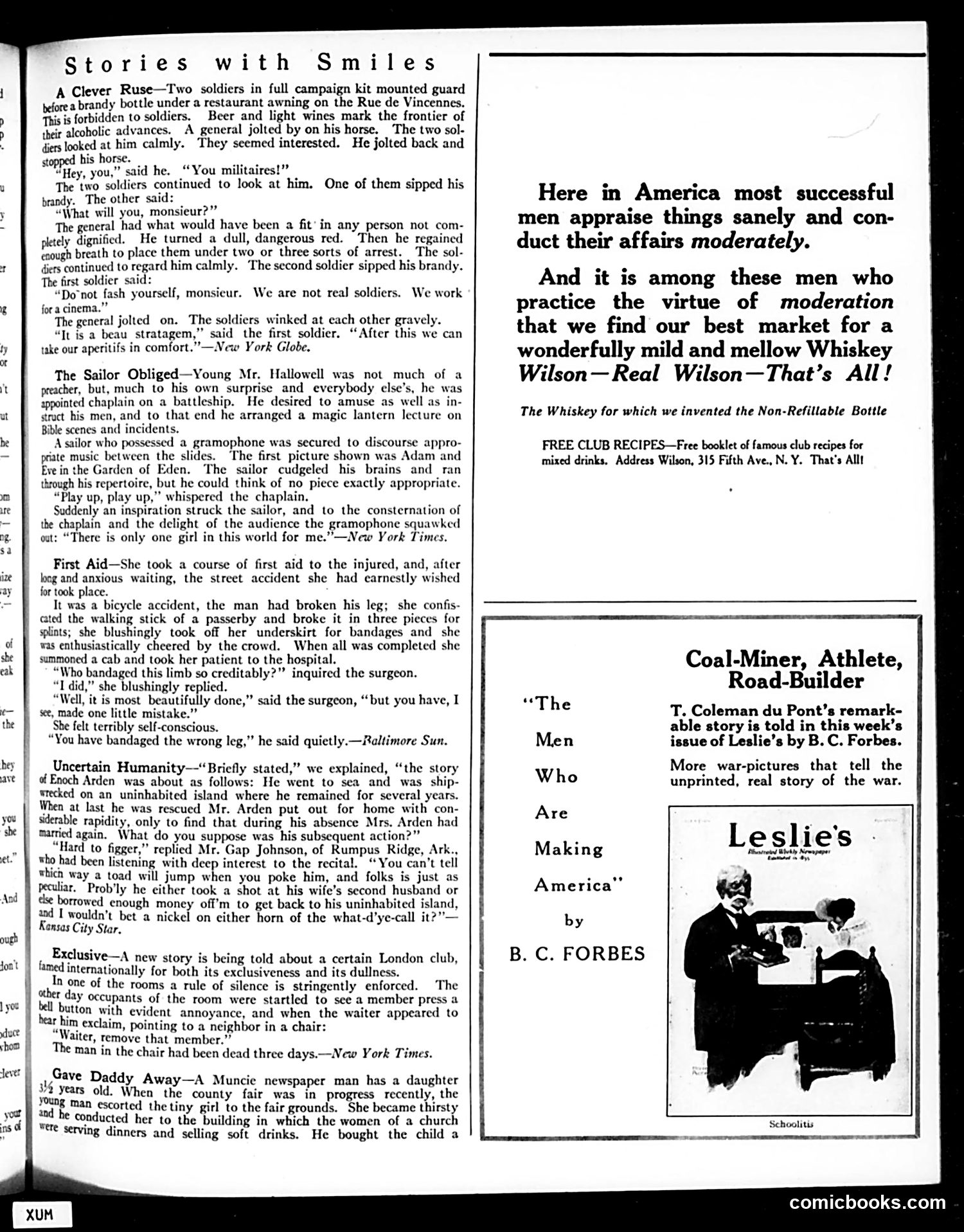
This page from Judge contains several brief humorous anecdotes rather than political cartoons. The stories satirize human nature and military/social absurdities circa World War I era: **"A Clever Ruse"** mocks French soldiers who brazenly drink brandy (forbidden to soldiers) under a general's nose, then escape consequences by claiming to be cinema actors. **"The Sailor Obliged"** jokes about a naval chaplain's magic lantern Bible lecture undermined when a sailor's gramophone plays "There is only one girl in this world for me" during an Adam and Eve scene—absurdly inappropriate. **"First Aid"** satirizes an overeager first-aid student who, after waiting desperately for an accident victim to practice on, successfully bandages the *wrong leg*. The page also includes a Wilson's Real Whiskey advertisement and promotion for Leslie's magazine featuring B.C. Forbes' war stories. These anecdotes use irony and unexpected twists to lampoon incompetence, pretension, and human contradiction—typical Judge magazine humor.
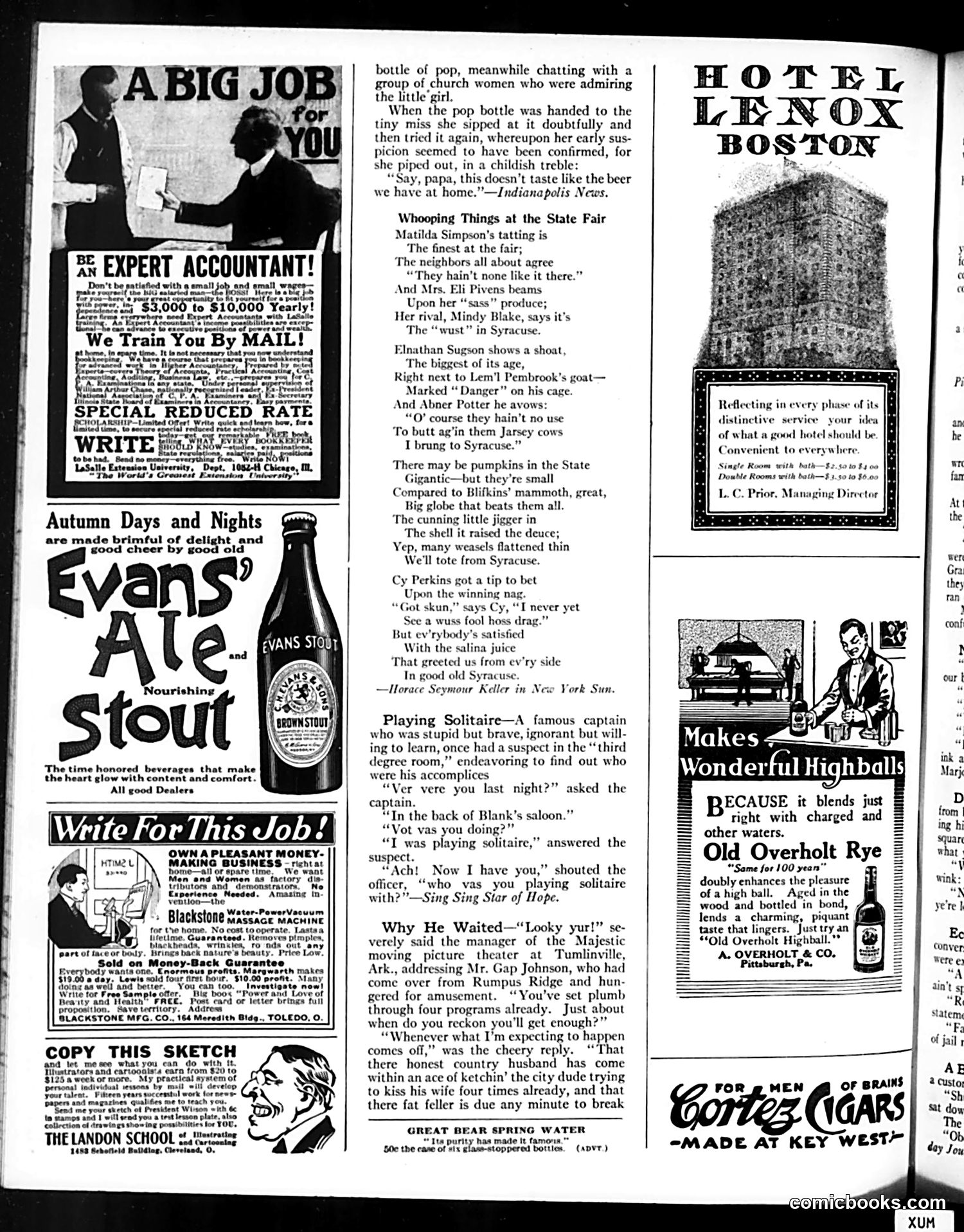
This page is primarily **advertisements and humor pieces**, not political cartoons. The **main content** consists of: 1. **Job training ads** (accountant, cartooning school) — typical of early 20th-century magazine marketing 2. **Humorous anecdotes** mocking rural/small-town life: - A child commenting her home beer tastes better than store-bought pop (satirizing Prohibition-era attitudes) - Exaggerated State Fair boasting by rural competitors - A "third degree" police interrogation joke where an officer comically misunderstands "solitaire" as a two-person game - A theater patron waiting to witness a domestic drama unfold 3. **Product advertisements** (Evans ale, Overholt Rye, Cortez cigars, massage machines) The humor targets **rural/rustic speech patterns and behavior** as amusing to urban readers, and contains a mild jab at **Prohibition** (the child's remark). This reflects Judge's audience: educated, urban, middle-class Americans who found country dialect entertaining.
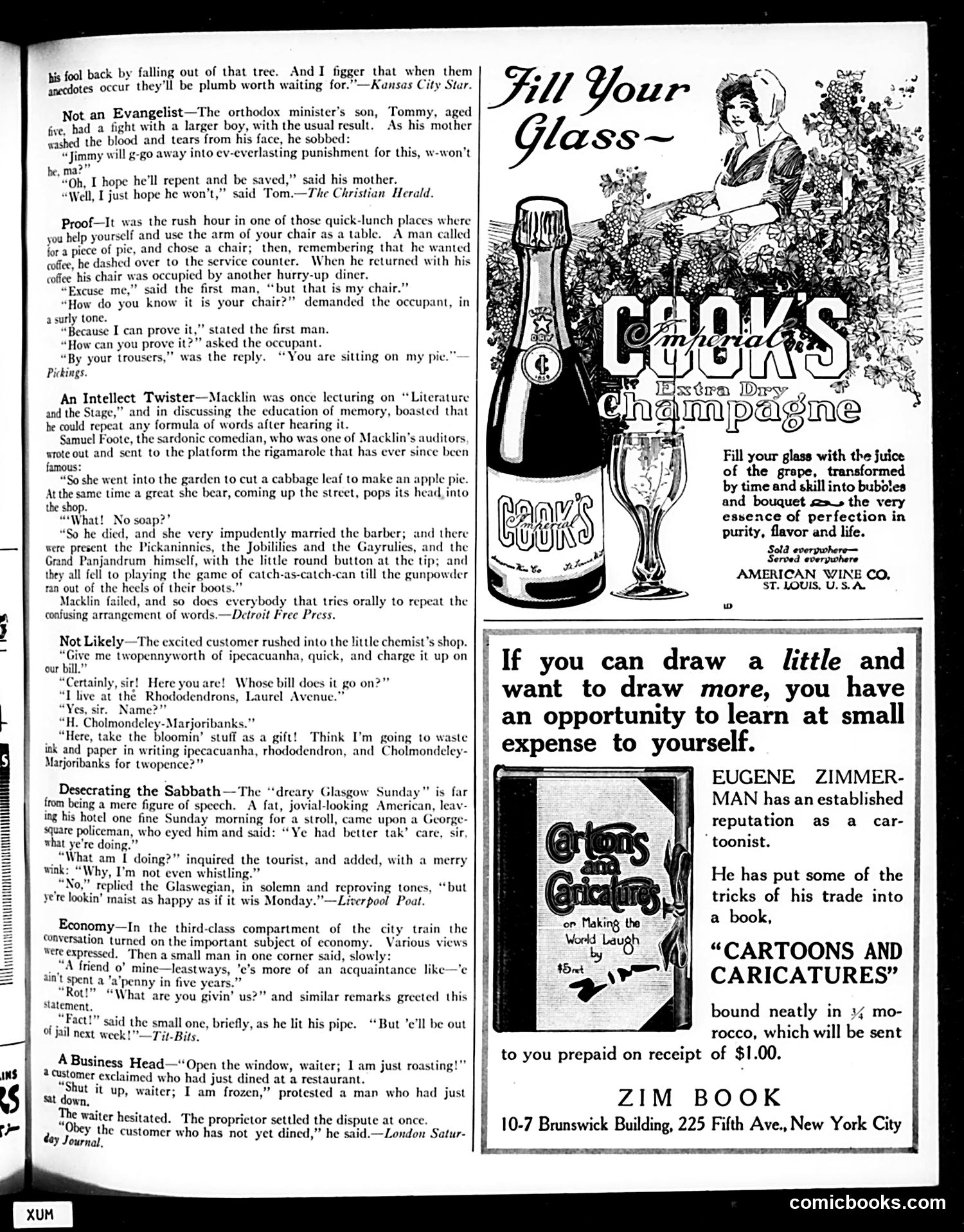
This page contains several short humorous anecdotes satirizing human behavior and social conventions of the early 20th century: **"Not an Evangelist"** mocks religious hypocrisy: a minister's son, after being beaten in a fight, hopes his attacker *won't* repent—contradicting Christian teachings about redemption. **"Proof"** jokes about absent-mindedness at a quick-lunch counter, where a man proves his chair ownership by sitting on his own pie. **"An Intellect Twister"** recounts a famous theatrical anecdote where Samuel Foote challenged actor Macklin's claimed memory abilities with a deliberately nonsensical tongue-twister about "the Grand Panjandrum"—still used today to test memorization. **"Desecrating the Sabbath"** satirizes strict Scottish Sabbath observance: a Glasgow policeman rebukes an American tourist for merely *looking* too happy on Sunday. **"Economy"** darkly jokes that an extremely frugal man hasn't spent money in five years—because he's been imprisoned. The advertisements on the right promote Cook's champagne and a cartooning instruction book by Eugene Zimmerman.
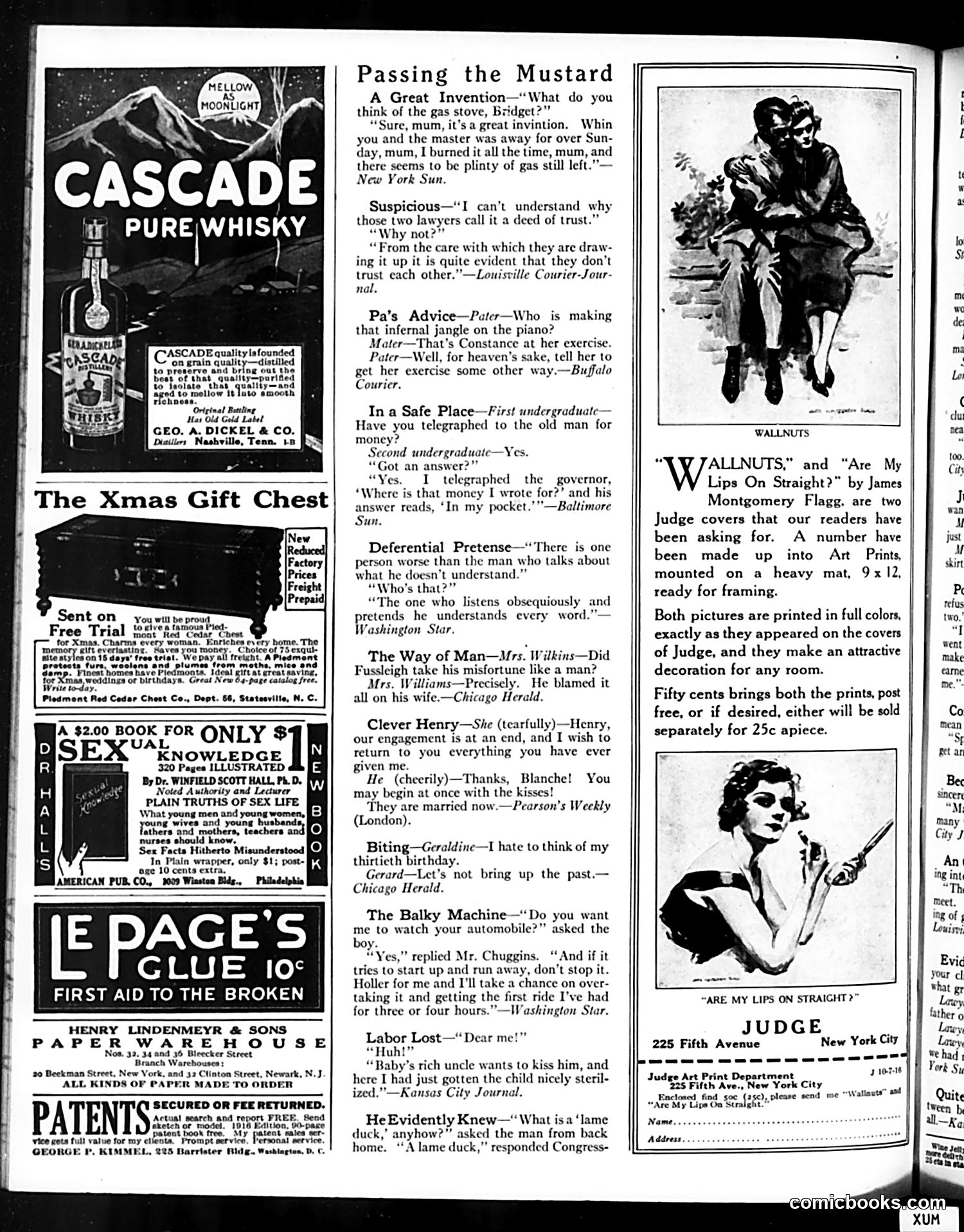
This page is primarily **advertisements and humorous anecdotes** rather than political cartoons. The content reflects early 20th-century American life and concerns. The jokes mock contemporary social behaviors: servants misunderstanding modern conveniences (the gas stove); lawyers' untrustworthiness; domestic marital dynamics; college students' financial dependence on parents; and automobile unreliability. One recurring theme is **gender relations**—a young woman returning gifts after an engagement ends, a man cleverly avoiding commitment by accepting her "kisses" back. The advertisements target period anxieties: sex education ("Plain Truths of Sex Life"), household goods (cedar chests, glue), and whiskey. The two featured Judge cover illustrations—"Wallnuts" and "Are My Lips On Straight?"—appear to be romantic/beauty-themed artwork available for framing at 50 cents. The satire is genteel and domestic rather than political, reflecting Judge's role as a humor magazine for middle-class readers.
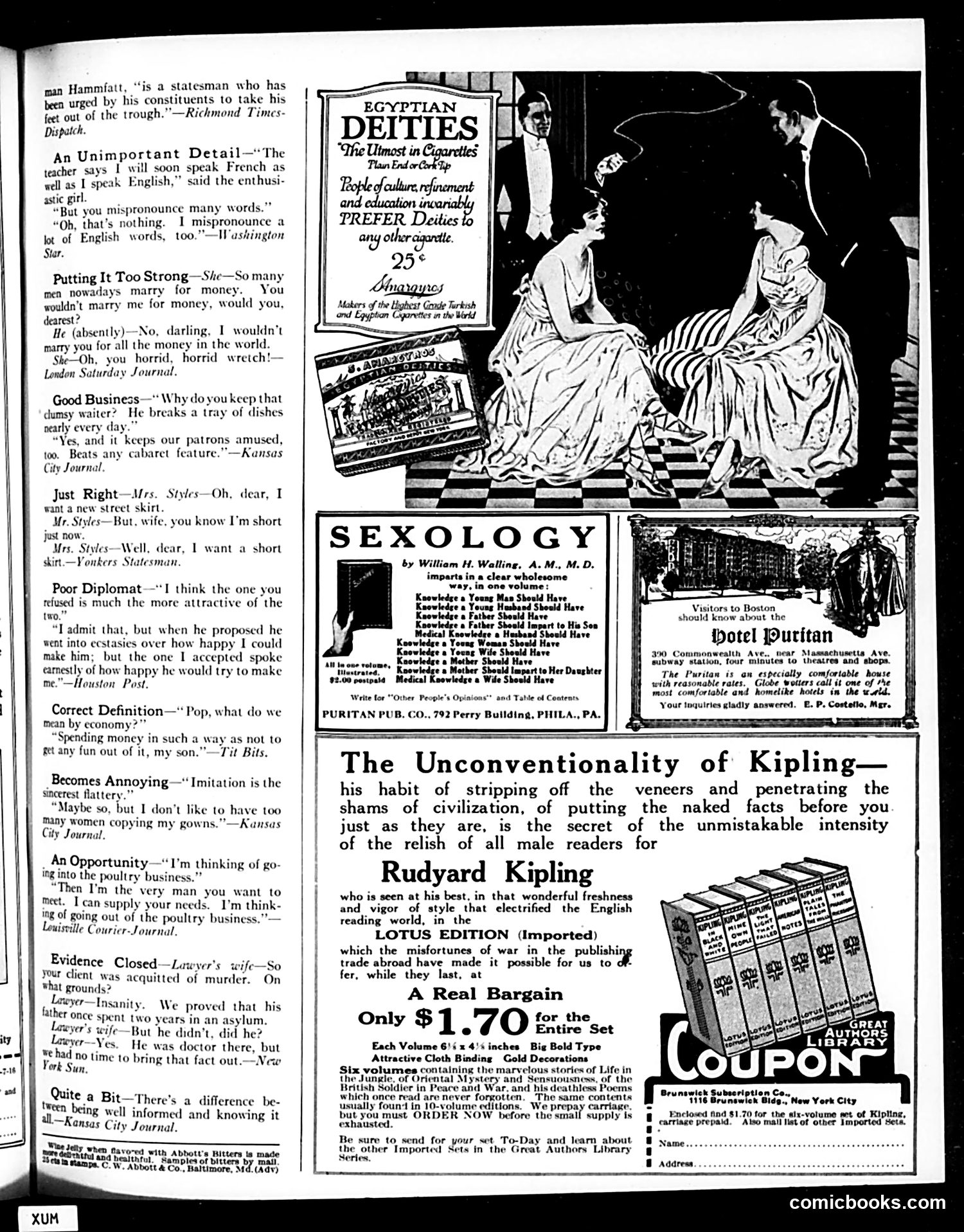
This page is primarily **advertisements and humor columns**, typical of Judge's format. The political/social satire is minimal: **Main Content:** - **Left column**: Brief humorous anecdotes mocking marital discord, linguistic pretension, and economic folly—standard period domestic comedy with no specific political targets. - **Center**: An ad for "Egyptian Deities" cigars (25¢), using exotic orientalism to market tobacco. - **Right**: Hotel advertisement and a substantial **book promotion for Rudyard Kipling's "Lotus Edition."** The ad describes Kipling's work as stripping away civilization's "veneers" to reveal "naked facts"—celebrating his unflinching realism as particularly appealing to male readers. **Context for Modern Readers:** This reflects early 20th-century advertising aesthetics and Kipling's celebrated status as a major literary figure. The framing of his work as appealingly "unconventional" and masculine was typical marketing of the era. The page shows Judge functioning as much as a platform for upscale consumer goods as for satire. No specific political figures or events are referenced here.
This page is primarily **advertisements and short humor pieces**—typical of Judge's format. The main content includes: **"Shear Steal" (center)**: A domestic comedy sketch where a husband endures his wife's nightly security checklist—locking icebox, windows, hiding silver, checking for gas leaks. The humor satirizes **middle-class anxiety about property theft and home security**, likely reflecting post-burglary paranoia or insurance concerns of the era. The wife's relentless questioning drives the exhausted husband to irritation. **Short jokes** scattered throughout mock social pretense ("Subtle Impoliteness"), romantic disappointment, and thrifty housewives—typical period humor targeting gender relations and class anxieties. **Advertisements** dominate the left side: diamonds and watches "on credit" (targeting working-class consumers), the Hotel Powhatan in Washington D.C., and photography contests—reflecting 1916 commercial culture. The page contains **no political cartoons or caricatures**—it's primarily commercial and light domestic satire typical of Judge's entertainment-focused content.
This is primarily a **product advertisement page**, not a satirical cartoon. It promotes "The 3C's Reference Library"—a bundled set of Webster's Revised Unabridged Dictionary and The National Encyclopedia intended for home and business use. The page's implicit satire is **social/commercial rather than political**: it targets aspirational middle-class readers by suggesting that owning comprehensive reference books signals respectability and self-improvement. The text emphasizes that self-education through "authoritative works of reference" is essential for business success and social standing—a common early-20th-century marketing pitch appealing to anxiety about appearing ignorant. The repeated phrase "Every Self Respecting Home and Business Office Needs It" subtly equates book ownership with respectability itself, making non-purchase seem like social failure. There are **no identifiable political figures, caricatures, or specific historical events referenced** on this page. It's a straightforward period advertisement using aspirational messaging typical of Judge magazine's commercial content.
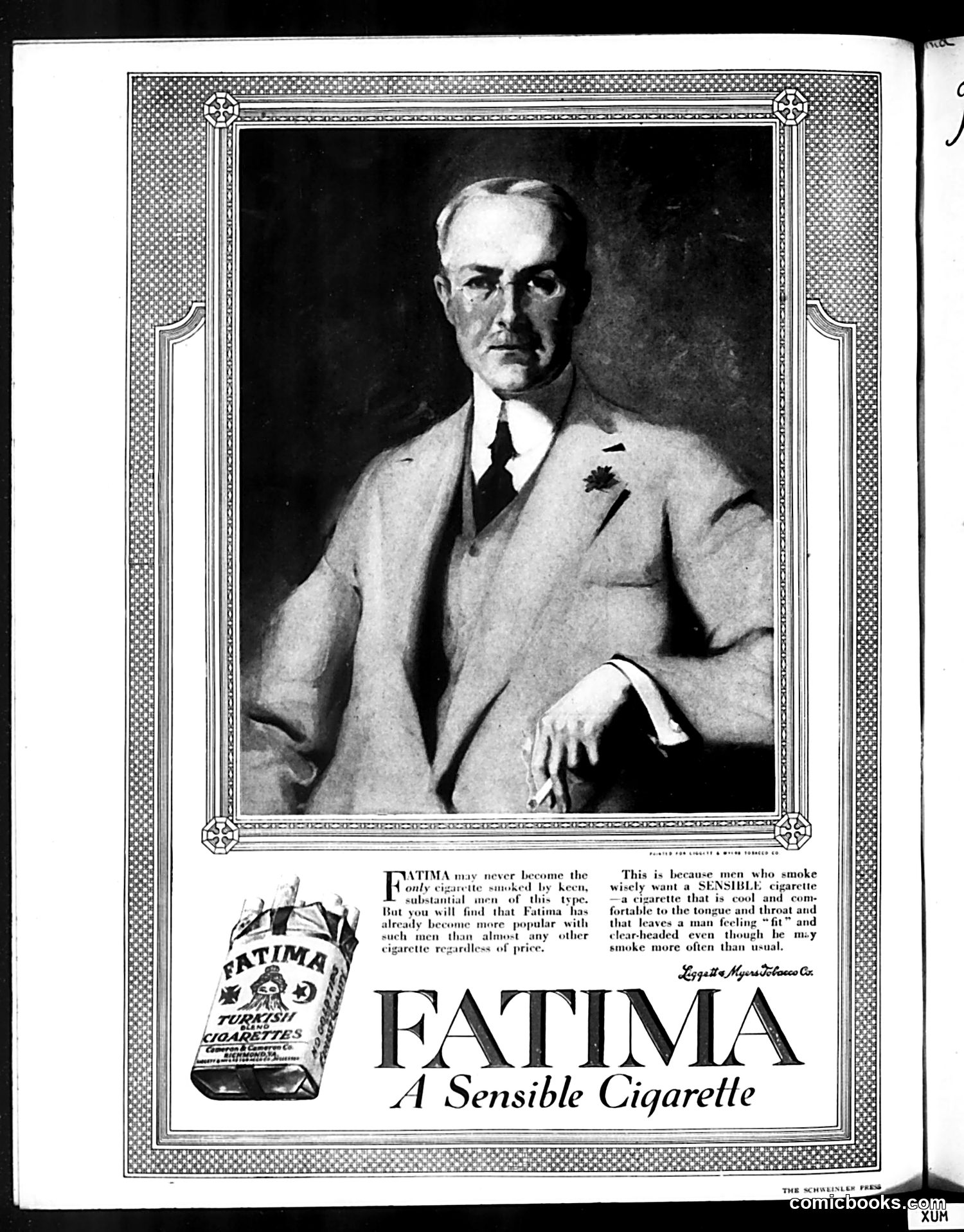
This page is primarily a **cigarette advertisement** for Fatima brand, marketed as "A Sensible Cigarette" by Liggett Myers Tobacco Co. The ad features a formal portrait of a well-dressed man and argues that Fatima cigarettes appeal to "substantial men of this type" despite being inexpensive. The ad claims smokers remain "clear-headed" even when smoking frequently, positioning the product as rational and moderate compared to other cigarettes. This reflects early-20th-century advertising strategy: associating a consumer product with respectability, masculinity, and sensibility. The phrase "sensible cigarette" is ironic to modern readers, given what we now know about smoking's health effects. The ad represents a time when cigarettes were openly marketed without health warnings, and advertisers could claim cognitive benefits from smoking.