
Judge, 1916-10-07 · page 9 of 32
Judge — October 7, 1916 — page 9: what you’re looking at
What you’re looking at
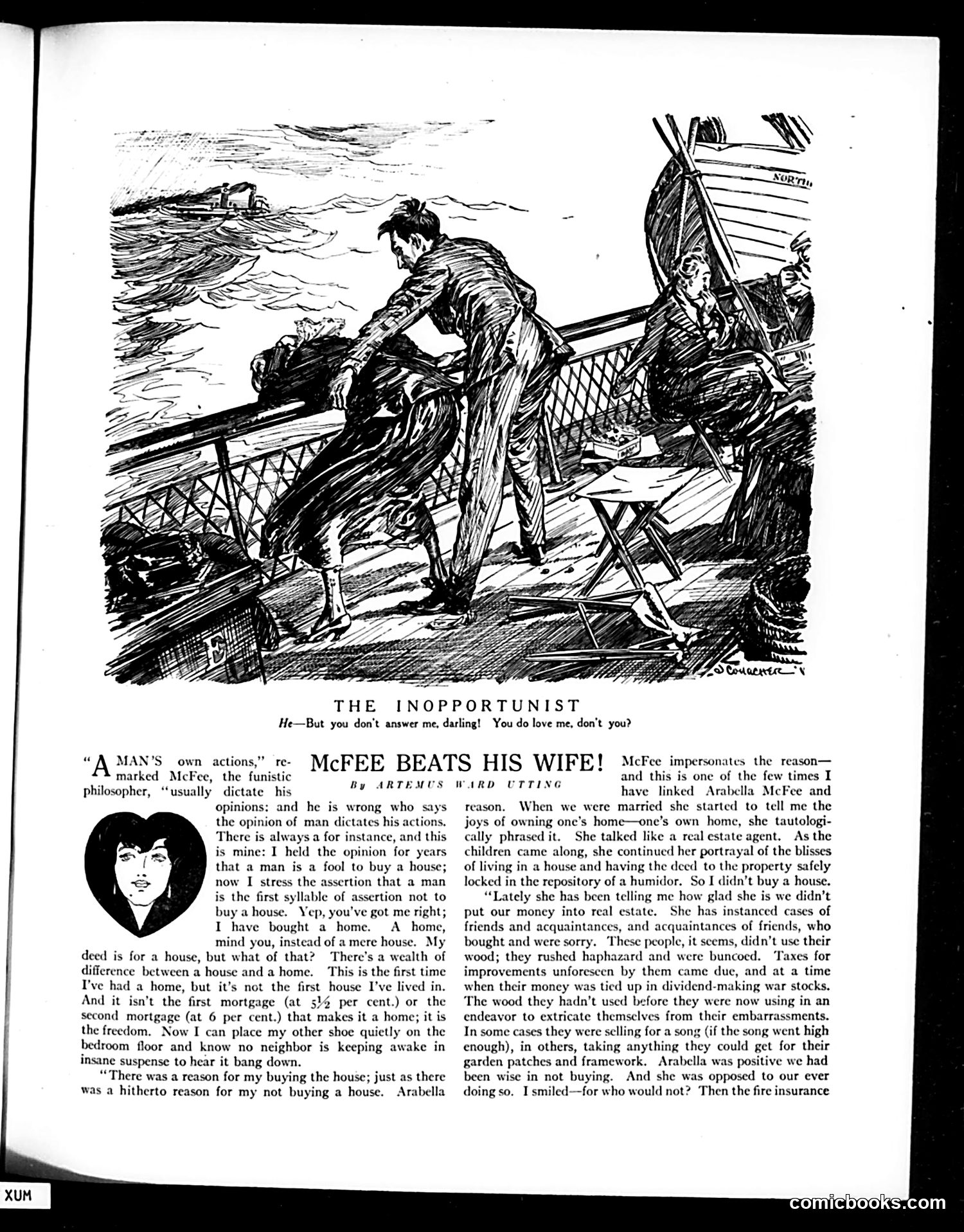
This page satirizes married life and the housing market through philosopher "McFee," a fictional character who embodies contradictory reasoning. The top cartoon shows a man proposing to a woman on a boat—she ignores his romantic declaration, illustrating the cartoon's title: poor timing. The text below presents McFee's rambling philosophical argument about home-buying. He reversed his position from thinking home-ownership foolish to buying one anyway. His wife Arabella similarly flip-flopped, initially promoting homeownership, then opposing it after witnessing neighbors' financial disasters from real estate investments and wartime stock losses. The satire targets both marital dynamics (wives influencing husbands' major decisions) and post-WWI economic anxieties—specifically how families lost money in real estate and found their dividend-earning war stocks inadequate when unexpected property taxes arose. The humor derives from characters' inability to maintain consistent positions, mirroring broader social confusion about financial security during this period.
📄 Transcribed text from this page (OCR, searchable)
Machine-transcribed from the original scan — historical spelling and the odd misread are preserved.
XUM THE INOPPORTUNIST He—But you don’t answer me, darling! You do love me, don’t you? cs MAN’S own actions,” re- marked McFee, the funistic Philosopher, “usually dictate his opinions; and he is wrong who says the opinion of man dictates his actions. There is always a for instance, and this is mine: I held the opinion for years that a man is a fool to buy a house; now I stress the assertion that a man is the first syllable of assertion not to buy a house. Yep, you've got me right; I have bought a home. A_ home, mind you, instead of a mere house. My deed is for a house, but what of that? There’s a wealth of difference between a house and a home. This is the first time I've had a home, but it’s not the first house I've lived in. And it isn’t the first mortgage (at 514 per cent.) or the second mortgage (at 6 per cent.) that makes it a home; it is the freedom. Now I can place my other shoe quietly on the bedroom floor and know no neighbor is keeping awake in insane suspense to hear it bang down, “There was a reason for my buying the house; just as there was a hitherto reason for my not buying a house. Arabella By ARTEMUS McFEE BEATS HIS WIFE! McFee impersonates the reason— and this is one of the few times I have linked Arabella McFee and reason. When we were married she started to tell me the joys of owning one’s home—one’s own home, she tautologi- cally phrased it. She talked like a real estate agent. As the children came along, she continued her portrayal of the blisses of living in a house and having the deed to the property safely locked in the repository of a humidor. So I didn’t buy a house. “Lately she has been telling me how glad she is we didn’t put our money into real estate. She has instanced vs of friends and acquaintances, and acquaintances of friends, who bought and were sorry. These people, it scems, didn’t use their wood; they rushed haphazard and were buncoed. ‘Taxes for improvements unforeseen by them came due, and at a time when their money was tied up in dividend-making war stocks. The wood they hadn't used before they were now using in an endeavor to extricate themselves from their embarrassments. In some cases they were selling for a song (if the song went high enough), in others, taking anything they could get for their garden patches and framework. Arabella was positive we had been wise in not buying. And she was opposed to our ever doing so. I smiled—for who would not? Then the fire insurance WARD UTTING