
Judge, 1916-10-07 · page 8 of 32
Judge — October 7, 1916 — page 8: what you’re looking at
What you’re looking at
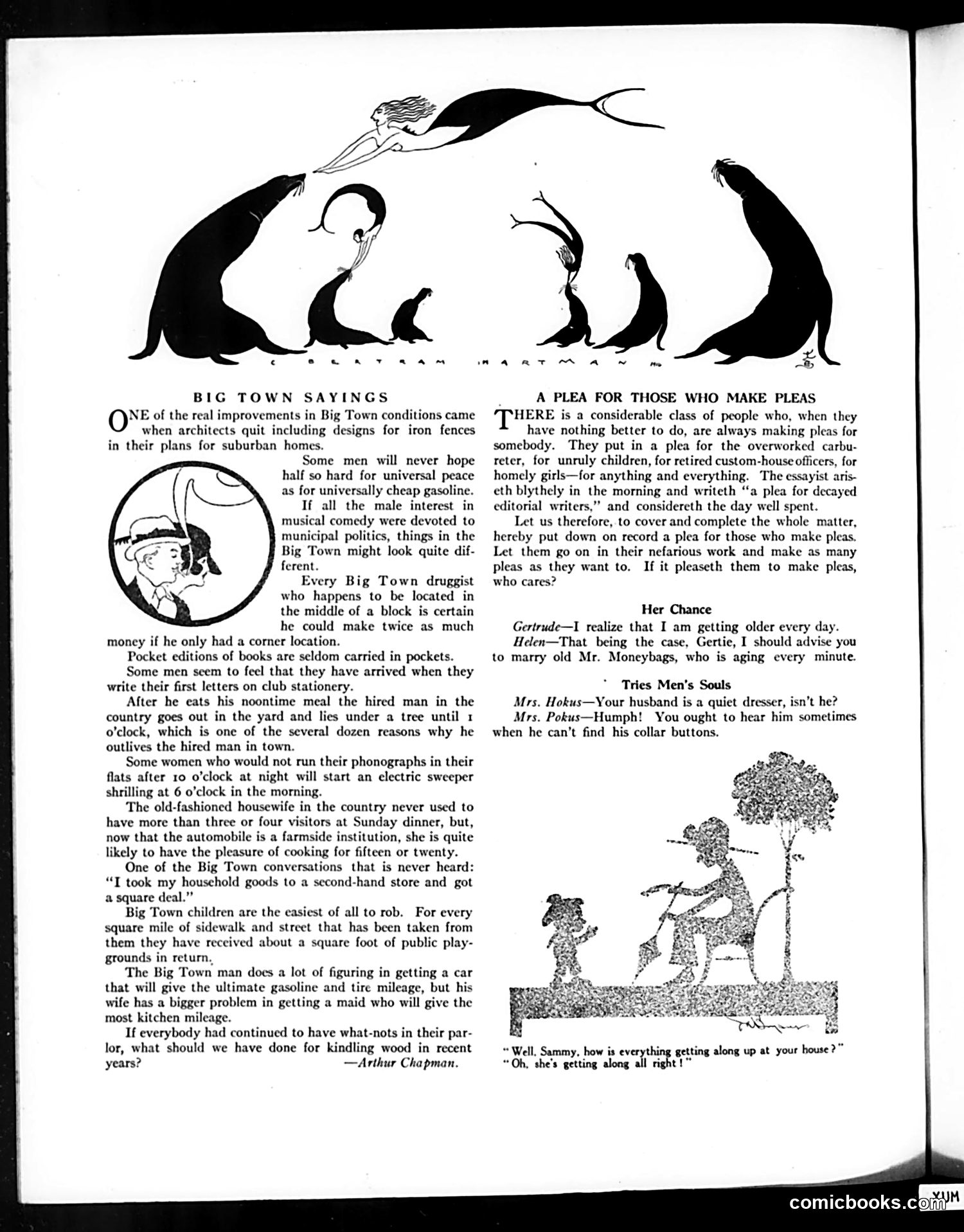
This page contains humorous social commentary typical of early 20th-century American satire, organized into several sections: **"Big Town Sayings"** presents witty observations about urban and suburban life—mocking pretension (men writing on club stationery to seem important), hypocrisy (women complaining about neighbors' phonographs while using loud vacuum cleaners at dawn), and economic absurdities (druggists obsessing over corner locations, wives prioritizing maid efficiency over gasoline mileage). The commentary critiques both modernization's disruptions (automobiles bringing unexpected dinner guests to farms) and nostalgia (lamenting the loss of parlor what-nots as kindling fuel). **"A Plea for Those Who Make Pleas"** satirizes reform-minded essayists who constantly advocate for various causes—suggesting they're self-congratulatory and prolific rather than substantive. **Brief humor sections** ("Her Chance," "Tries Men's Souls") offer domestic comedy: a woman advises her aging friend to marry a wealthy elderly man, and a wife jokes that her quiet-dressing husband becomes loud when frustrated. The cartoon at top shows seals making pleas, visually reinforcing the theme.
📄 Transcribed text from this page (OCR, searchable)
Machine-transcribed from the original scan — historical spelling and the odd misread are preserved.
1 & Wy BIG TOWN SAYINGS O E of the real improvements in Big Town conditions came when architects quit including designs for iron fences in their plans for suburban homes. Some men will never hope half so hard for universal peace as for universally cheap gasoline. If all the male interest in musical comedy were devoted to municipal politics, things in the Big Town might look quite dif- ferent. Every Big Town druggist who happens to be located in the middle of a block is certain he could make twice as much moncy if he only had a corner location. Pocket editions of books are seldom carried in pockets. Some men seem to feel that they have arrived when they write their first letters on club stationery. After he eats his noontime meal the hired man in the country goes out in the yard and lies under a tree until 1 o'clock, which is one of the several dozen reasons why he outlives the hired man in town. Some women who would not run their phonographs in their flats after 10 o’clock at night will start an electric sweeper shrilling at 6 o’clock in the morning. The old-fashioned housewife in the country never used to have more than three or four visitors at Sunday dinner, but, now that the automobile is a farmside institution, she is quite likely to have the pleasure of cooking for fifteen or twenty. One of the Big Town conversations that is never heard: “TI took my houschold goods to a second-hand store and got a square deal.”” Big Town children are the easiest of all to rob. For every square mile of sidewalk and street that has been taken from them they have received about a square foot of public play- grounds in return, The Big Town man does a lot of figuring in getting a car that will give the ultimate gasoline and tire mileage, but his wife has a bigger problem in getting a maid who will give the most kitchen mileage. If everybody had continued to have what-nots in their par- lor, what should we have done for kindling wood in recent years? —Arthur Chapman. A PLEA FOR THOSE WHO MAKE PLEAS "THERE is a considerable class of people who, when they have nothing better to do, are always making pleas for somebody. They put in a plea for the overworked carbu- reter, for unruly children, for retired custom-house officers, for homely girls—for anything and everything. The essayist aris- eth blythely in the morning and writeth “a plea for decayed editorial writers,” and considereth the day well spent. Let us therefore, to cover and complete the whole matter, hereby put down on record a plea for those who make pleas. Let them go on in their nefarious work and make as many pleas as they want to. If it pleaseth them to make pleas, who cares? Her Chance Gertrude—I realize that I am getting older every day. Helen—That being the case, Gertie, I should advise you to marry old Mr. Moneybags, who is aging every minute. Tries Men's Souls Mrs. Hokus—Your husband is a quiet dresser, isn’t he? Mrs. Pokus—Humph! You ought to hear him sometimes when he can't find his collar buttons. “ Well. Sammy, how is ever; hing getting along up at your house?” “Oh, she's getting along a ight |" comicbooks.comal