
Judge, 1916-10-07 · page 10 of 32
Judge — October 7, 1916 — page 10: what you’re looking at
What you’re looking at
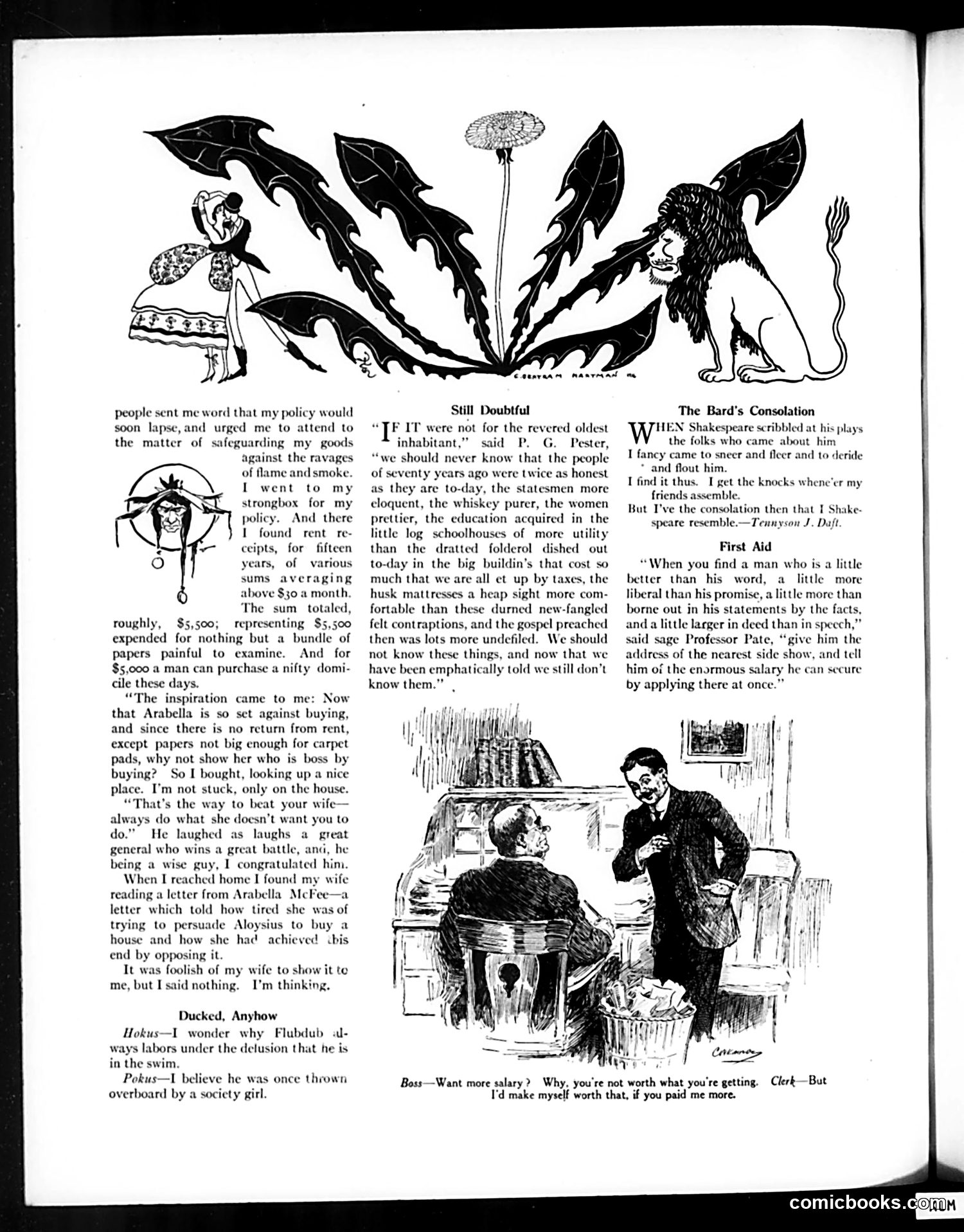
This page contains several satirical pieces mocking American social attitudes and business practices circa early 1900s. **"Ducked, Anyhow"** jokes about a man named Flubdub who, despite being thrown overboard by a "society girl," maintains delusions of social sophistication. **"Still Doubtful"** satirizes nostalgia-mongering, featuring P.G. Pester mocking the "oldest inhabitant" trope—an archetypal figure who constantly claims everything was better in the past (more honest people, better whiskey, superior education). The satire suggests people don't actually believe these claims, yet keep repeating them. **"The Bard's Consolation"** offers dark comfort: if Shakespeare endured mockery from friends while creating masterworks, modern creative people should accept criticism similarly. **"First Aid"** and the cartoon below it mock workplace dynamics: a clerk argues that better pay would make him more productive, while his boss dismisses the proposal. The satire targets employers' penny-pinching logic that undervalues labor. The decorative header illustration is ornamental, not referencing specific content.
📄 Transcribed text from this page (OCR, searchable)
Machine-transcribed from the original scan — historical spelling and the odd misread are preserved.
soon lapse,and urged me to attend to the matter of safeguarding my goods against the ravages of flame and smoke. I went to my strongbox for my policy. And there 1 found rent re- ceipts, for fifteen years, of various sums averaging above $30 a month, The sum totaled, roughly, $5,500; representing $5,500 expended for nothing but a bundle of papers painful to examine. And for $5,000 a man can purchase a nifty domi- cile these days. “The inspiration came to me: Now that Arabella so set against buying, and since there is no return from rent, except papers not big enough for carpet pads, why not show her who is boss by buying? So I bought, looking up a nice place. I’m not stuck, only on the house. hat’s the way to beat your wife— always do what she doesn’t want you to do.” He laughed as laughs a great gencral who wins a great battle, and, he being a wise guy, I congratulated him. When I reached home I found my wife reading a letter from Arabella McFee—a letter which told how tired she was of trying to persuade Aloysius to buy a house and how she had achieved cbis end by opposing it. It was foolish of my wife to show it te me, but I said nothing. I’m thinking. Ducked, Anyhow Hokus—I wonder why Flubdub al- ways labors under the delusion that he is in the swim. Pokus—I believe he was once thrown overboard by a society girl. eaenraan RARTNAd me Still Doubtful “TF IT were not for the revered oldest inhabitant,” said P. G. Pester, “we should never know that the people Zo were twice as honest s they are to-day, the statesmen more eloquent, the whiskey purer, the women prettier, the education acquired in the little log schoolhouses of more utility than the dratted folderol dished out to-day in the big buildin’s that cost so much that we are all et up by taxes, the husk mattresses a heap sight more com- fortable than these durned new-fangled felt contraptions, and the gospel preached then was lots more undefiled. We should not know these things, and now that we have been emphatically told we still don’t know them.” | of sevent i The Bard's Consolation HEN Shakespeare scribbled at his plays the folks who came about him I fancy came to snecr and fleer and to deride * and flout him. I find it thus. I get the knocks whene'er my friends assemble. But I've the consolation then that I Shake- speare resemble.—Tennyson J. Daft First Aid “When you find a man who is a little better than his word, a little more liberal than his promise, a little more than borne out in his statements by the facts, and a little larger in deed than in specch,” said sage Professor Pate, “give him the address of the nearest side show, and tell him of the enormous salary he can secure by applying there at once.” Boss—Want more salary? Why, you're not worth what you're getting. Clerk —But I'd make myself worth that, if you paid me more. comicbooks.