
Judge, 1916-10-07 · page 16 of 32
Judge — October 7, 1916 — page 16: what you’re looking at
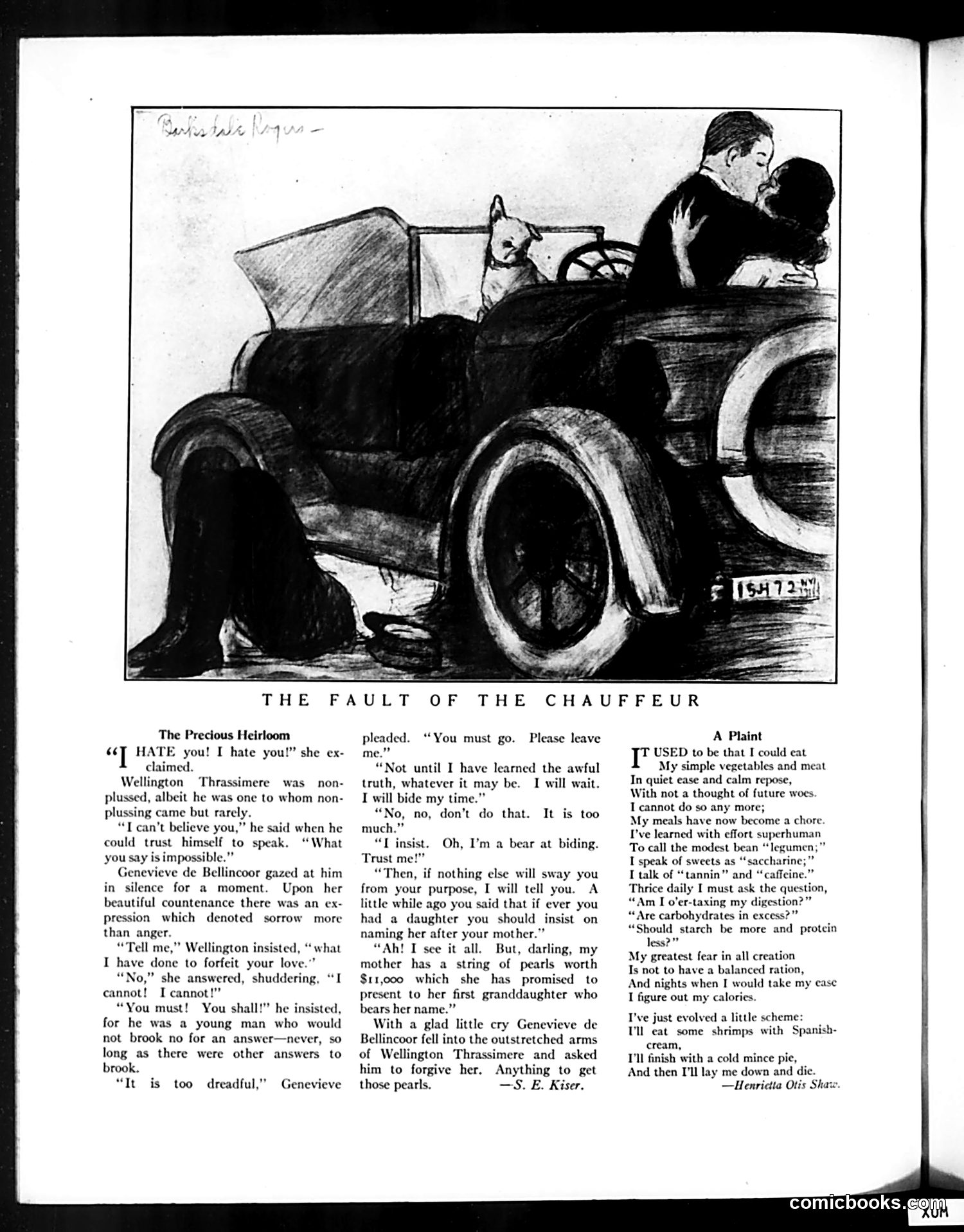
What you’re looking at
This page contains two separate pieces of satirical fiction, not a political cartoon. **"The Precious Heirloom"** is a humorous short story mocking melodramatic romance novels and fortune-hunting. A wealthy couple (Wellington Thrassimere and Genevieve de Bellincoor) engage in overwrought emotional drama—she dramatically refuses him, he insists on knowing why—only to reveal the entire conflict was about inheriting his mother's $11,000 pearl necklace. The satire ridicules both romantic clichés and the materialism underlying upper-class courtship. **"A Plaint"** is a poem mocking the emerging health-food movement and calorie-consciousness. The speaker laments that meals were once simple pleasures but have become anxious ordeals of nutritional obsession—worrying about "legumes," "carbohydrates," and "calories." The dark humor culminates in eating shrimp and pie before dying, suggesting such neurotic dietary concern is literally life-shortening. Both pieces satirize contemporary American society: romantic pretense and health faddism among the affluent.
📄 Transcribed text from this page (OCR, searchable)
Machine-transcribed from the original scan — historical spelling and the odd misread are preserved.
THE FAULT OF THE CHAUFFEUR The Precious Heirloom 667] HATE you! I hate you!” she ex- claimed. Wellington Thrassimere was non- plussed, albeit he was one to whom non- plussing came but rarely. “T "t believe you,” he said when he could trust himself to speak. “What you say is impossible.” Genevieve de Bellincoor gazed at him in silence for a moment. Upon her beautiful countenance there was an ex- pression which denoted sorrow more than anger. “Tell me,” Wellington insisted, “what I have done to forfeit your love.” “No,” she answered, shuddering, cannot! I cannot! You must! You shall!” he insisted, for he was a young man who would not brook no for an answer—never, so long as there were other answers to brook. “Tt is too dreadful,” Genevieve pleaded. “You must go. Please leave me.” “Not until I have learned the awful truth, whatever it may be. I will wait. I will bide my time.” “No, no, don’t do that. It is too Oh, I’m a bear at biding. Trust me! “Then, if nothing else will sway you from your purpose, I will tell you. A little while ago you said that if ever you had a daughter you should insist on naming her after your mother.” “Ah! I see it all. But, darling, my mother has a string of pearls worth $11,000 which she has promised to present to her first granddaughter who bears her name.” With a glad little cry Genevieve de Bellincoor fell into the outstretched arms of Wellington Thrassimere and asked him to forgive her. Anything to get those pearls. —S. E. Kiser. A Plaint USED to be that I could eat My simple vegetables and meat In quiet ease and calm repose, With not a thought of future woes. I cannot do so any more; My meals have now become a chore I’ve learned with effort superhuman To call the modest bean ‘“legumen;” I speak of sweets as “saccharine;” T talk of “tannin” and “caffeine.” Thrice daily I must ask the question, “Am I o’er-taxing my digestion?” ¢ carbohydrates in excess?” “Should starch be more and protein less?” My greatest fear in all creation Is not to have a balanced ration, And nights when I would take my ease I figure out my calories. I've just evolved a little sche: Tl eat some shrimps with cream, T'll finish with a cold mince pie, And then I'll lay me down and die. —Henrictta Otis S comicbooks.