
Judge, 1916-10-07 · page 19 of 32
Judge — October 7, 1916 — page 19: what you’re looking at
What you’re looking at
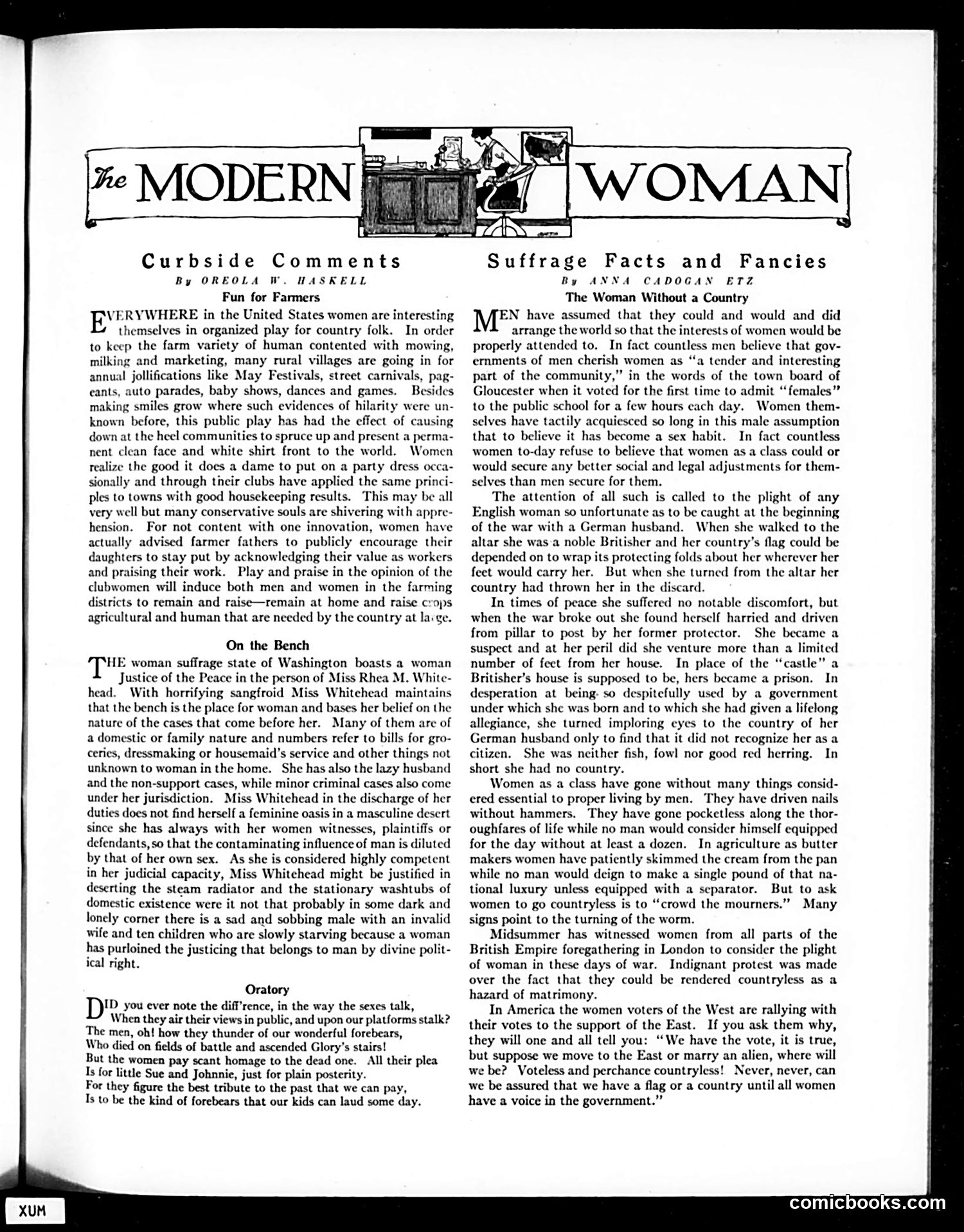
This page contains three satirical essays critiquing women's expanding roles in early 20th-century America, particularly around suffrage and public participation. **"Curbside Comments"** mocks rural women's organizing of community events and farm work encouragement—conservative voices fear women's activism will disrupt traditional domestic life. **"On the Bench"** addresses Miss Rhea M. Whitehead, Washington's female Justice of the Peace. The satire is backhanded: while acknowledging her competence, it argues she belongs in domesticity because cases involve "family nature" (groceries, housemaids, lazy husbands)—implying women judges are only "naturally" suited to domestic matters. The final jab suggests her judicial role leaves some invalid wife and starving children without proper care. **"Oratory"** contrasts male and female public speakers: men glorify historical war heroes; women focus on children's welfare and future generations. The satire suggests women reduce lofty rhetoric to mere "posterity"—questioning whether female public speech is as substantive or noble. Overall, the page uses conditional approval to undermine women's public participation, suggesting expanded roles violate divine and natural order.
📄 Transcribed text from this page (OCR, searchable)
Machine-transcribed from the original scan — historical spelling and the odd misread are preserved.
tb paren NS | # MODERN Curbside Comments By OREOLA W. HASKELL Fun for Farmers VERYWHERE in the United States women are interesting themselves in organized play for country folk. In order to keep the farm variety of human contented with mowing, milking and marketing, many rural villages are going in for annual jollifications like May Festivals, street carnival. eants, auto parades, baby shows, dances and games. Be making smiles grow where such evidences of hilarity were un- known before, this public play has had the effect of causing down at the heel communities to spruce up and present a perma- nent clean face and white shirt front to the world. Women realize the good it does a dame to put on a party dress occa- sionally and through their clubs have applied the same princi- ples to towns with good housekeeping results. This may be all very well but many conserva: souls are shivering with appre- hension. For not content with one innovation, women have actually advised farmer fathers to publicly encourage their daughters to stay put by acknowledging their value as workers and praising their work. Play and praise in the opinion of the clubwomen will induce both men and women in the farming districts to remain and raise—remain at home and raise crops agricultural and human that are needed by the country at la:ge. On the Bench HE woman suffrage state of Washington boasts a woman Justice of the Peace in the person of Miss Rhea M. White- head. With horrifying sangfroid Miss Whitehead maintains that the bench is the place for woman and bases her belief on the nature of the cases that come before her. Many of them are of a domestic or family nature and numbers refer to bills for gro- dressmaking or housemaid’s service and other things not unknown to woman in the home. She has also the lazy husband and the non-support cases, while minor criminal cases also come under her jurisdiction. Miss Whitehead in the discharge of her duties does not find herself a feminine oasis in a masculine desert since she has always with her women witnesses, plaintiffs or defendants, so that the contaminating influence of man is diluted by that of her own sex. As she is considered highly competent in her judicial capacity, Miss Whitchead might be justified in deserting the steam radiator and the stationary washtubs of domestic existence were it not that probably in some dark and lonely corner there is a sad and sobbing male with an invalid wife and ten children who are slowly starving because a woman has purloined the justicing that belongs to man by divine polit- ical right. Oratory D» you ever note the diff’rence, in the way the sexes talk, When they air their views in public, and upon our platforms stalk? The men, oh! how they thunder of our wonderful forebears, Who died on fields of battle and ascended Glory’s stairs! But the women pay scant homage to the dead one. All their plea Is for little Sue and Johnnie, just for plain posterity. For they figure the best tribute to the past that we can pay, Is to be the kind of forebears that our kids can laud some day. Suffrage Facts and Fancies By ANNA CADOGAN ETZ The Woman Without a Country ME. have assumed that they could and would and did arrange the world so that the interests of women would be properly attended to. In fact countless men believe that gov- ernments of men cherish women as “a tender and interesting part of the community,” in the words of the town board of Gloucester when it voted for the first time to admit “females” to the public school for a few hours cach day. Women them- selves have tactily acquiesced so long in this male assumption that to believe it has become a sex habit. In fact countless women to-day refuse to believe that women as a class could or would secure any better social and legal adjustments for them- selves than men secure for them. The attention of all such is called to the plight of any English woman so unfortunate as to be caught at the beginning of the war with a German husband. When she walked to the altar she was.a noble Britisher and her country’s flag could be depended on to wrap its protecting folds about her wherever her feet would carry her. But when she turned from the altar her country had thrown her in the discard. In times of peace she suffered no notable discomfort, but when the war broke out she found herself harried and driven from pillar to post by her former protector. She became a suspect and at her peril did she venture more than a limited number of fect from her house. In place of the “castle” a Britisher’s house is supposed to be, hers became a prison. In desperation at being: so despitefully used by a government under which she was born and to which she had given a lifelong allegiance, she turned imploring eyes to the country of her German husband only to find that it did not recognize her as a citizen. She was neither fish, fowl nor good red herring. In short she had no country. Women as a class have gone without many things consid- cred essential to proper living by men. They have driven nails without hammers. They have gone pockctless along the thor- oughfares of life while no man would consider himself equipped for the day without at least a dozen. In agriculture as butter makers women have patiently skimmed the cream from the pan while no man would deign to make a single pound of that na- tional luxury unless equipped with a separator. But to ask women to go countryless is to ‘crowd the mourners.”” Many signs point to the turning of the worm. Midsummer has witnessed women from all parts of the British Empire foregathering in London to consider the plight of woman in these days of war. Indignant protest was made over the fact that they could be rendered countryless as a hazard of matrimony. In America the women voters of the West are rallying with their votes to the support of the East. If you ask them why, they will one and all tell you: “We have the vote, it is true, but suppose we move to the East or marry an alien, where will we be? Voteless and perchance countryless! Never, never, can we be assured that we have a flag or a country until all women have a voice in the government.” comicbooks.com