
Judge, 1916-10-07 · page 18 of 32
Judge — October 7, 1916 — page 18: what you’re looking at
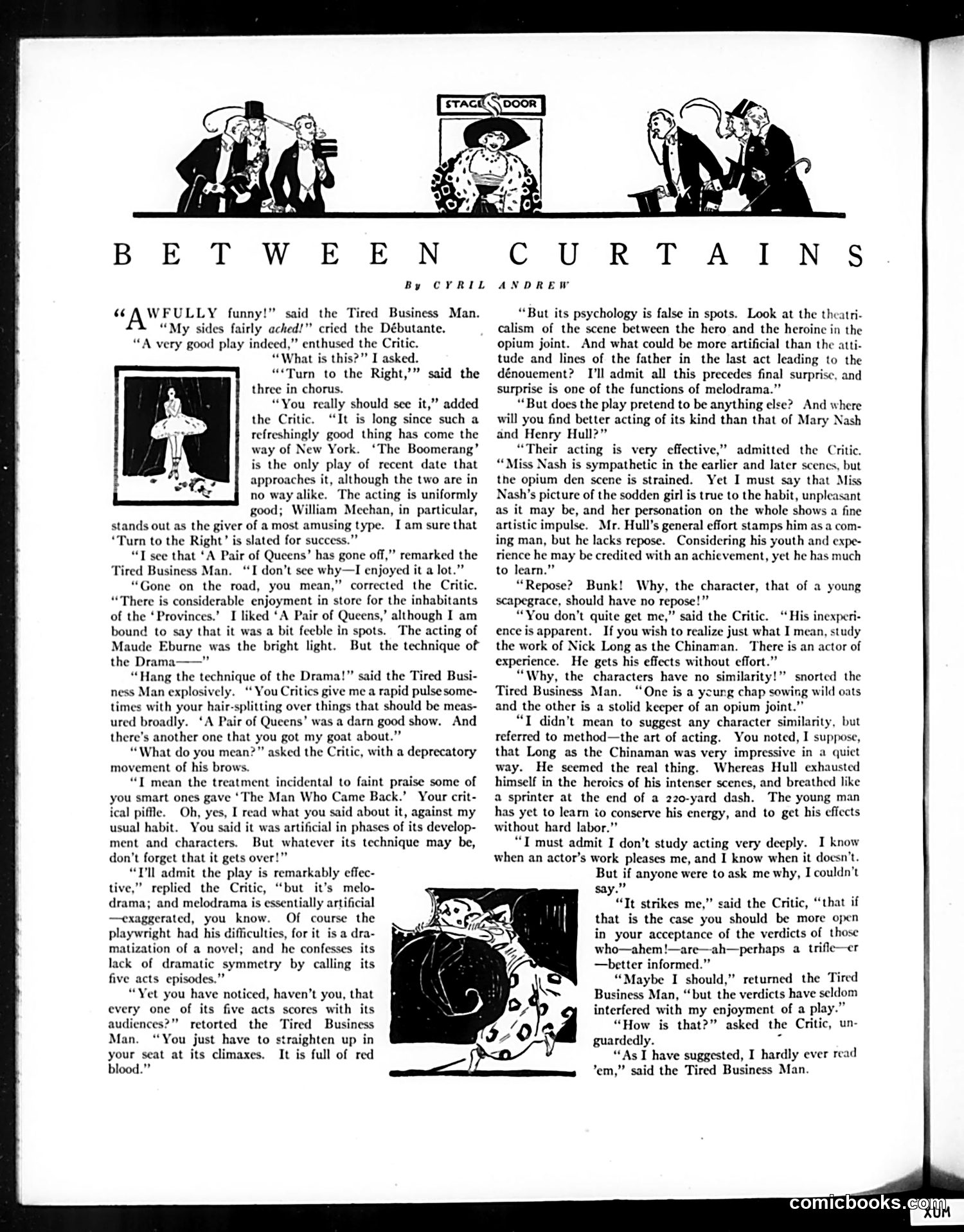
What you’re looking at
This is theater criticism disguised as dialogue comedy. A "Tired Business Man" (everyman audience member) and a pretentious "Critic" debate the merits of contemporary Broadway plays, including "Turn to the Right," "A Pair of Queens," and "The Man Who Came Back." The satire targets two things: first, the Critic's obsession with technical theatrical language ("technique," "melodrama," "psychology," "dénouement") applied to what are fundamentally effective, entertaining plays; second, his habit of faint praise and nit-picking (questioning actors' "repose" while acknowledging their effectiveness). The Tired Business Man represents the average theatergoer who values emotional impact and entertainment over critical sophistication. The joke is that the Critic's learned objections miss what actually *works* on stage. The illustration shows a cat, reinforcing the metaphorical "cat got your tongue" about the Critic's inability to simply enjoy theater.
📄 Transcribed text from this page (OCR, searchable)
Machine-transcribed from the original scan — historical spelling and the odd misread are preserved.
BETWEEN CURTAIN S By CYRIL ANDREW “AN FULLY funny!” said the Tired Business Man. “My sides fairly ached!” cried the Débutante. “A very good play indeed,” enthused the Critic. “What is this?” I asked. “*Turn to the Right,’” said the three in chorus. You really should see it,” added the Critic. “It is long since such a refreshingly good thing has come the way of New York. ‘The Boomerang’ is the only play of recent date that approaches it, although the two are in no way alike. The acting is uniformly good; William Mechan, in particular, stands out as the giver of a most amusing type. I am sure that ‘Turn to the Right’ is slated for success.” “T see that ‘A Pair of Queens’ has gone off,” remarked the Tired Business Man. “I don’t see why—I enjoyed it a lot.” “Gone on the road, you mean,” corrected the Critic. “There is considerable enjoyment in store for the inhabitants 8, of the ‘Provinces.’ I liked ‘A Pair of Queens,’ although I am bound to say that it was a bit feeble in spots. The acting of Maude Eburne was the bright light. But the technique of the Drama——" “Hang the technique of the Drama!” said the Tired Busi- ness Man explosi You Critics give me a rapid pulse some- times with your plitting over things that should be meas- ured broadly. ‘A Pair of Queens’ was a darn good show. And there’s another one that you got my goat about.” What do you mean?” asked the Critic, with a deprecatory movement of his brows. “T mean the t ent incidental to faint praise some of you smart ones ga’ © Man Who Came Back.’ Your crit- ical piffle. Oh, yes, I read what you said about it, against my usual habit. You said it was artificial in phases of its develop- ment and characters. But whatever its technique may be, don’t forget that it gets over!” “Tl admit the play is remarkably effec- tive,” replied the Critic, “but it’s melo- drama; and melodrama is essentially artificial —cxaggerated, you know. Of course the playwright had his difficulties, for it is a dra- matization of a novel; and he confesses its lack of dramatic symmetry by calling its five acts episodes.” Yet you have noticed, haven’t you, that y one of its five acts scores with its audiences?” retorted the Tired Business Man. “You just have to straighten up in your seat at its climaxes. It is full of red blood.” “But its psychology is false in spots. Look at the theatri- calism of the scene between the hero and the heroine in the opium joint. And what could be more artificial than the atti- tude and lines of the father in the last act leading to the dénouement? I'll admit all this precedes final surprise, and surprise is one of the functions of melodrama.” “But does the play pretend to be anything else? And where will you find better acting of its kind than that of Mary Nash and Henry Hull?” “Their acting is very effective,” admitted the Critic. Nash is sympathetic i in the earlier and later scenes, but the opium den scene is strained. Yet I must say that Miss Nash’s picture of the sodden girl is true to the habit, unpleasant as it may be, and her personation on the whole shows a fine artistic impulse. Mr. Hull’s general effort stamps him as a com- ing man, but he lacks repose. Considering his youth and expe- rience he may be credited with an achievement, yet he has much to learn.” “Repose? Bunk! Why, the character, that of a young scapegrace, should have no repose!” “You don’t quite get me,” said the Critic. “His inexperi- ence is apparent. If you wish to realize just what I mean, study the work of Nick Long as the Chinaman. There is an actor of experience. He gets his effects without effort.” “Why, the characters have no similarity!” snorted the Tired Business Man, ‘One is a young chap sowing wild oats and the other is a stolid keeper of an opium joint.” “I didn’t mean to suggest any character similarity, but referred to method—the art of acting. You noted, I suppose, that Long as the Chinaman was very impressive in a quict way. He seemed the real thing. Whereas Hull exhausted himself in the heroics of his intenser scenes, and breathed like a sprinter at the end of a 220-yard dash. The young man has yet to learn to conserve his energy, and to get his effects without hard labor.”’ “TI must admit I don’t study acting very deeply. I know when an actor’s work pleases me, and I know when it docsn’t. But if anyone were to ask me why, I couldn’t say.” “It strikes me,” said the Critic, “that if that is the case you should be more open in your acceptance of the verdicts of those who—ahem!—are—ah—perhaps a trifle—cr —better informed.” “Maybe I should,” returned the Tired Business Man, “but the verdicts have seldom interfered with my enjoyment of a play “How is that?” asked the Critic, un- guardedly. “As I have suggested, I hardly ever read ’em,” said the Tired Business Man. comicbooks.«&