
Judge, 1916-10-07 · page 5 of 32
Judge — October 7, 1916 — page 5: what you’re looking at
What you’re looking at
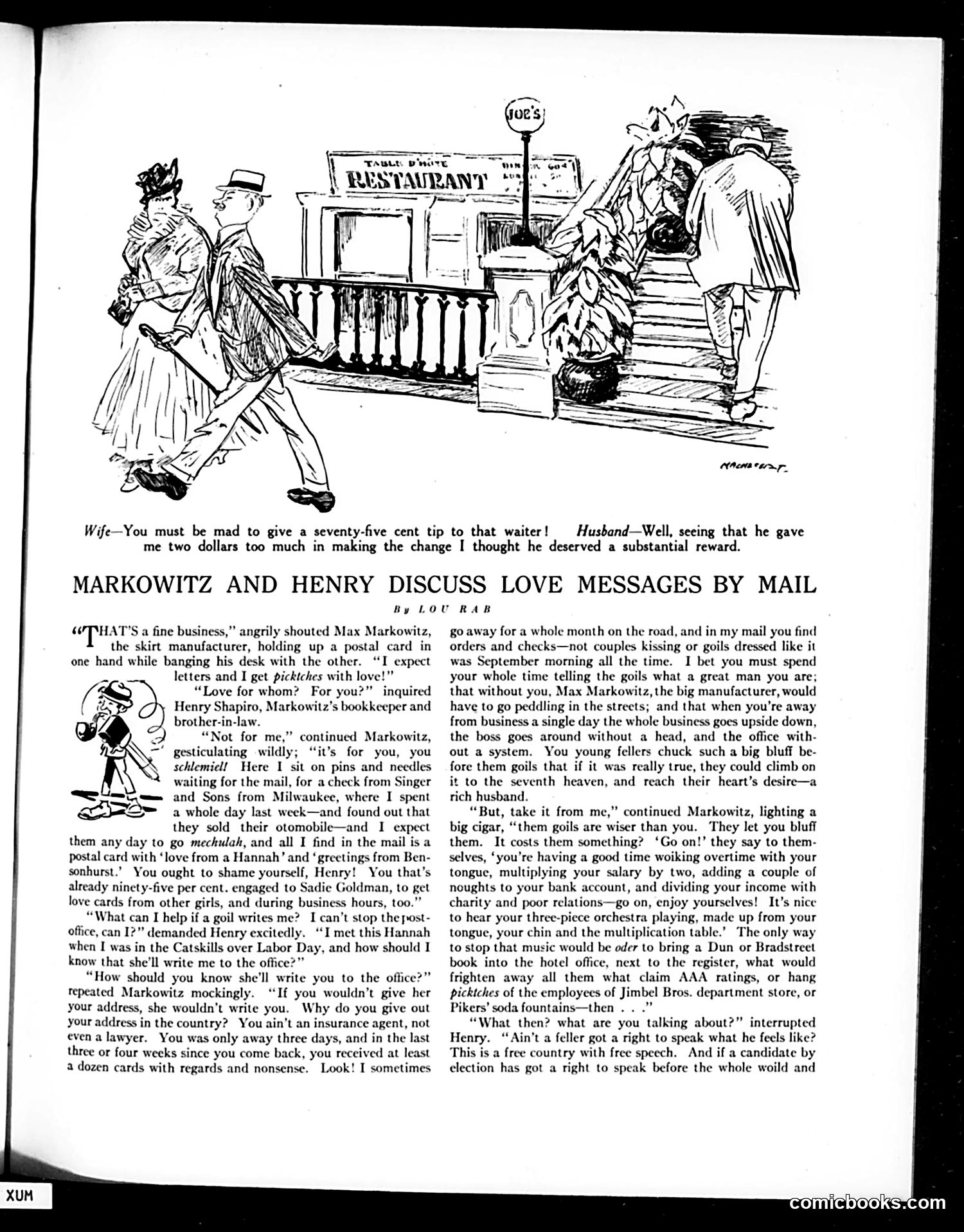
This satirical piece mocks the contrast between romantic ideals and practical business reality. Max Markowitz, a skirt manufacturer, complains to his bookkeeper Henry Shapiro about receiving lovesick postal cards and letters from employees while traveling. The satire targets turn-of-the-century workplace sentimentality—Markowitz expects business correspondence, not romantic musings. Henry defends the practice, arguing workers deserve emotional expression and that love messages actually boost morale and productivity through happiness. The cartoon above illustrates the couple's restaurant encounter, where a husband resents tipping the waiter who gave excessive change—implying the wife's emotional generosity costs money. The joke ultimately mocks both excessive workplace sentimentality and the commodification of human emotion in industrial settings.
📄 Transcribed text from this page (OCR, searchable)
Machine-transcribed from the original scan — historical spelling and the odd misread are preserved.
TABLE, DHOTE ai XUM Wife—You must be mad to give a seventy-five cent tip to that waiter! iN \ RESTAURANT “of OP | Husband—Well, seeing that he gave me two dollars too much in making the change I thought he deserved a substantial reward. MARKOWITZ AND HENRY DISCUSS LOVE MESSAGES BY MAIL By Lov s¢ THAT'S a fine business,” angrily shouted Max Markowitz, the skirt manufacturer, holding up a postal card in one hand while banging his desk with the other. “I expect letters and I get picktches with love!” “Love for whom? For you?” inquired Henry Shapiro, Markowitz’s bookkeeper and brother-in-law. eo) “Not for me,” continued Markowitz, —' gesticulating wildly; “it’s for you, you \ schlemiel! Here I sit on pins and needles waiting for the mail, for a check from Singer ~= == and Sons from Milwaukee, where I spent ae a whole day last week—and found out that they sold their otomobile—and I expect them any day to go mechulah, and all I find in the mail is a postal card with ‘love from a Hannah’ and ‘greetings from Ben- sonhurst.’ You ought to shame yourself, Henry! You that’s already ninety-five per cent. engaged to Sadie Goldman, to get love cards from other girls, and during business hours, too.”” “What can I help if a goil writes me? I can’t stop the post- office, can I?” demanded Henry excitedly. ‘I met this Hannah when I was in the Catskills over Labor Day, and how should I know that she'll write me to the office?” “How should you know she'll write you to the office’ repeated Markowitz mockingly. “If you wouldn’t give her your address, she wouldn’t write you. Why do you give out your address in the country? You ain't an insurance agent, not even a lawyer. You was only away three days, and in the last three or four weeks since you come back, you received at least a dozen cards with regards and nonsense. Look! I sometimes RAB go away for a whole month on the road, and in my mail you find orders and checks—not couples kissing or goils dressed like it was September morning all the time. I bet you must spend your whole time telling the goils what a great man you are; that without you, Max Markowitz, the big manufacturer, would have to go peddling in the streets; and that when you're away from business a single day the whole business goes upside down, the boss goes around without a head, and the office with- out a system. You young fellers chuck such a big bluff be- fore them goils that if it was really true, they could climb on it to the seventh heaven, and reach their heart’s desire—a rich husband. “But, take it from me,” continued Markowitz, lighting a big cigar, “them goils are wiser than you. They let you bluff them. It costs them something? ‘Go on!’ they say to them- selves, ‘you're having a good time woiking overtime with your tongue, multiplying your salary by two, adding a couple of noughts to your bank account, and dividing your income with charity and poor relations—go on, enjoy yourselves! It’s nice to hear your three-piece orchestra playing, made up from your tongue, your chin and the multiplication table.’ The only way to stop that music would be oder to bring a Dun or Bradstreet book into the hotel office, next to the register, what would frighten away all them what claim AAA ratings, or hang picktches of the employees of Jimbel Bros. department store, or Pikers’ soda fountains—then . . .” “What then? what are you talking about?” interrupted Hens “Ain't a feller got a right to speak what he feels like? This is a free country with free speech. And if a candidate by election has got a right to speak before the whole woild and