
A complete issue · 28 pages · 1915
Judge — December 11, 1915
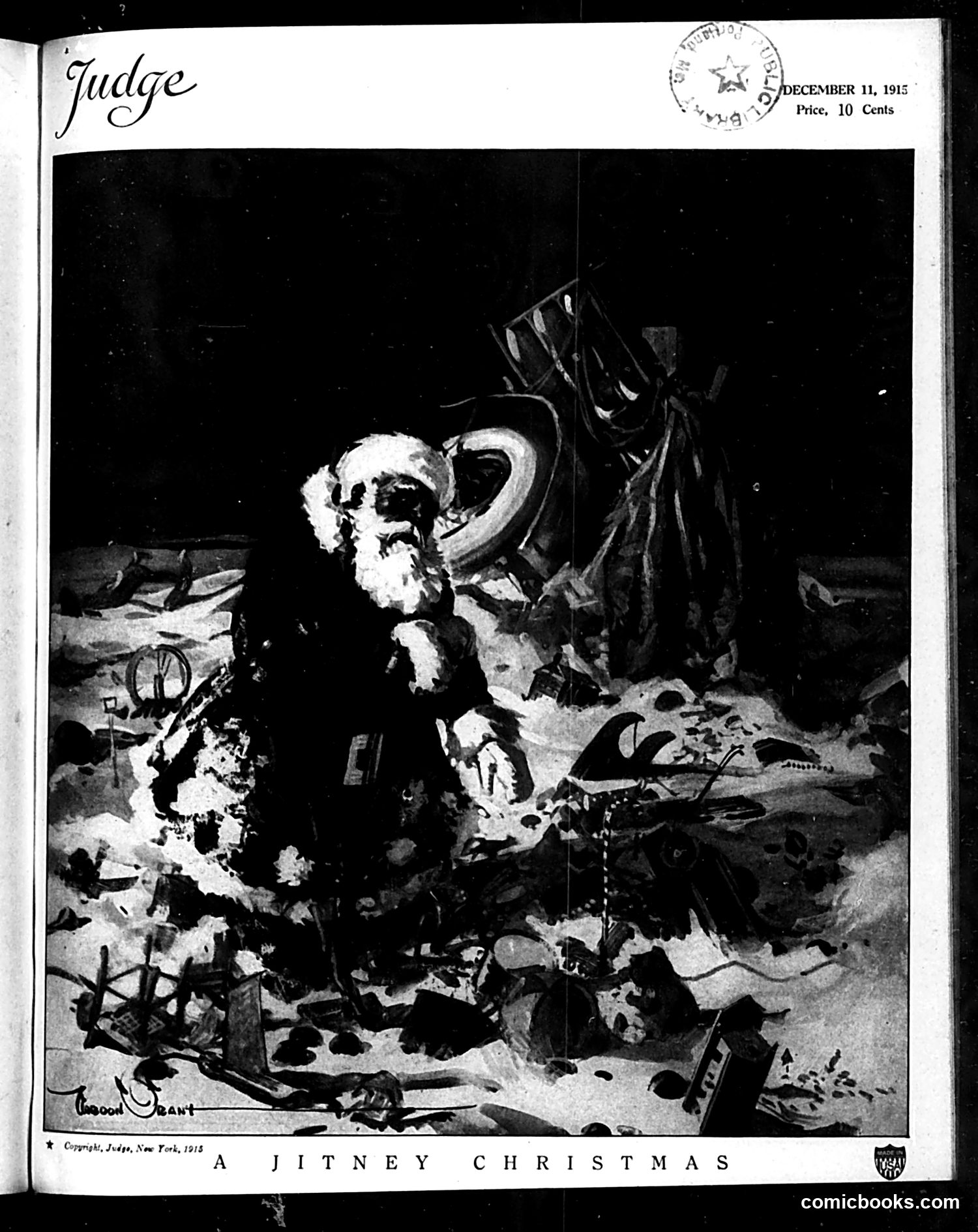
This Judge magazine cover from December 11, 1915 appears to satirize the "jitney" phenomenon—small, inexpensive buses that competed with established streetcar and taxi services in the 1910s. The cartoon depicts a disheveled Santa Claus surrounded by scattered debris and wreckage, suggesting that jitneys have disrupted the holiday season and traditional transportation systems. The "jitney" was a major social concern of this era, as these cheap five-cent rides undercut established transit monopolies and created traffic chaos in cities. By associating jitneys with Christmas disruption, Judge ridicules their dangerous, chaotic impact on urban life and commerce, portraying them as destructive to the holiday economy and public order.
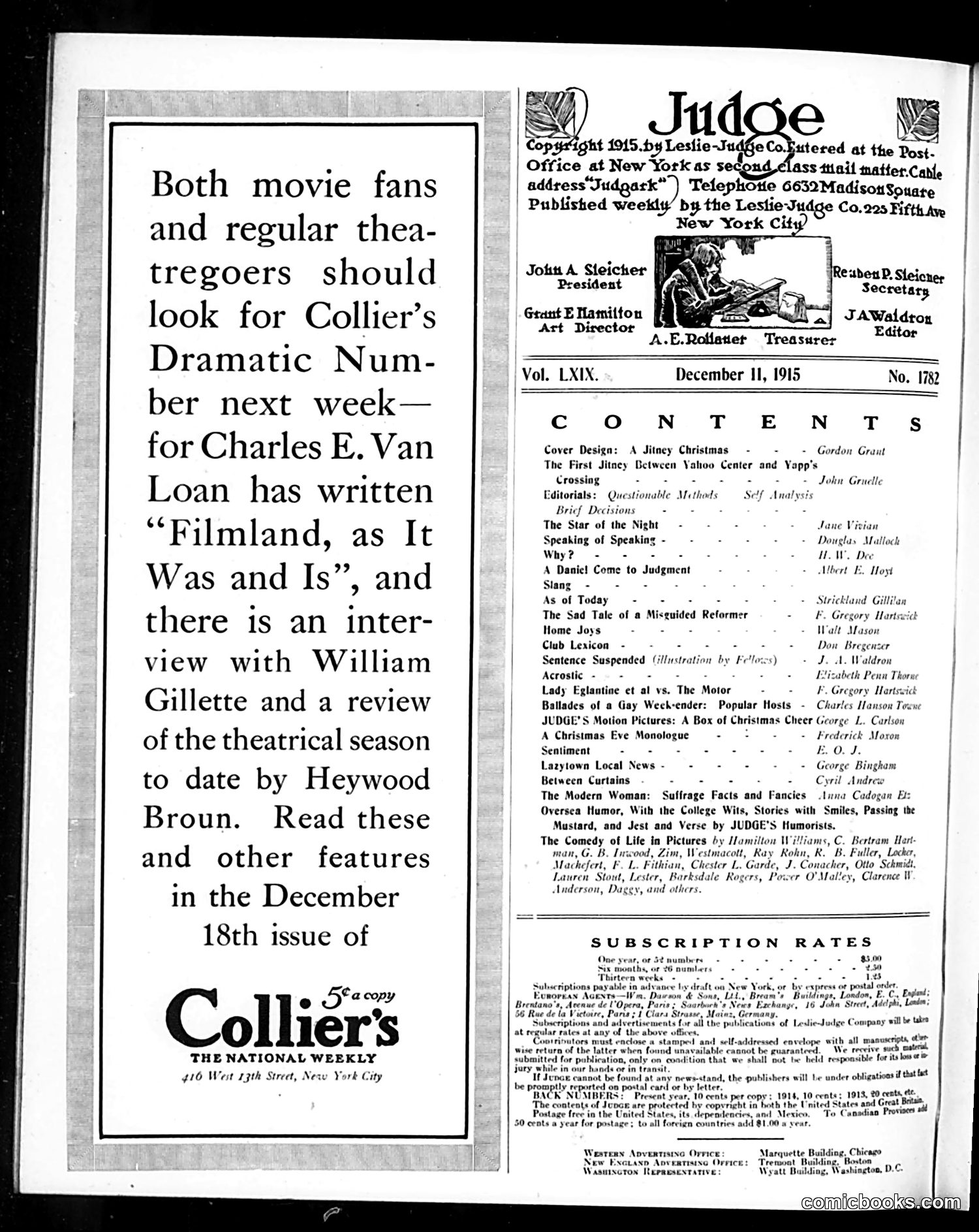
This page is primarily **advertising** for Collier's magazine, promoting their December 18th issue. The ad targets "both movie fans and regular theatregoers" with upcoming content: Charles E. Van Loan's article "Filmland, as It Was and Is," an interview with actor William Gillette, and theatrical criticism by Heywood Broun. The right side shows Judge's own table of contents, featuring articles on contemporary topics like women's suffrage, reformed criminals, and modern humor. The page reflects **1915 entertainment culture**: cinema was still novel enough to warrant special magazine coverage, and theatrical criticism was considered serious journalism. No specific political satire or caricature appears prominent on this particular page—it's primarily editorial and promotional content.
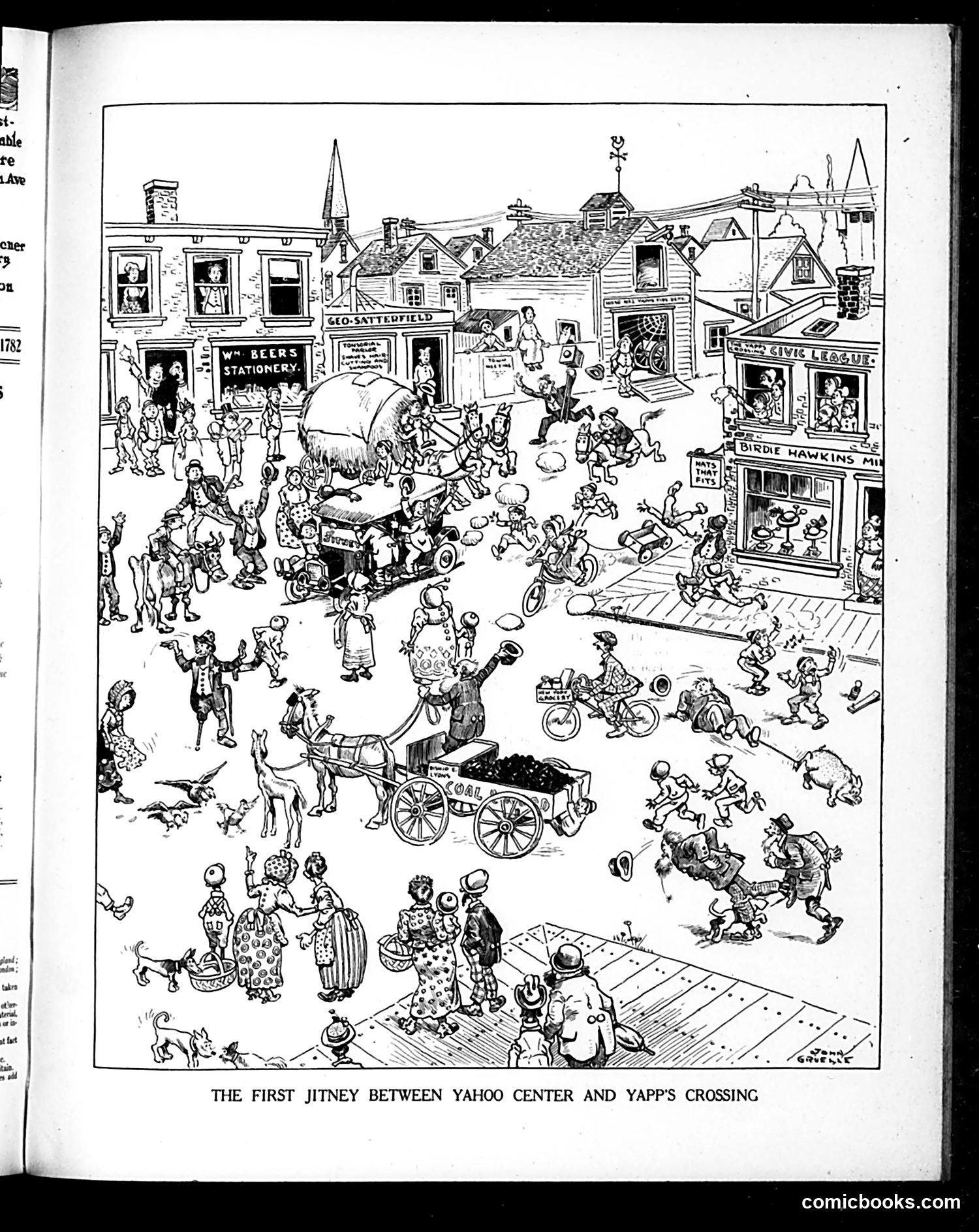
This is a satirical street scene depicting "The First Jitney Between Yahoo Center and Yapp's Crossing"—a humorous reference to the jitney craze of the early 1910s, when small buses competed with established transportation systems. The cartoon mocks the chaos and mayhem jitney services introduced to American towns. The crowded street shows children playing, pedestrians, hand-drawn carts, bicycles, and the large jitney bus all competing for space in dangerous, disorderly conditions. Store signs (including "Wm. Beers Stationery" and "Civic League") suggest a typical small American town. The satire targets both the jitney fad's rapid proliferation and the social disruption it caused—the breakdown of orderly street life. The "Yahoo Center" reference appears deliberately absurd, emphasizing the provincial quality of places adopting this new transit.
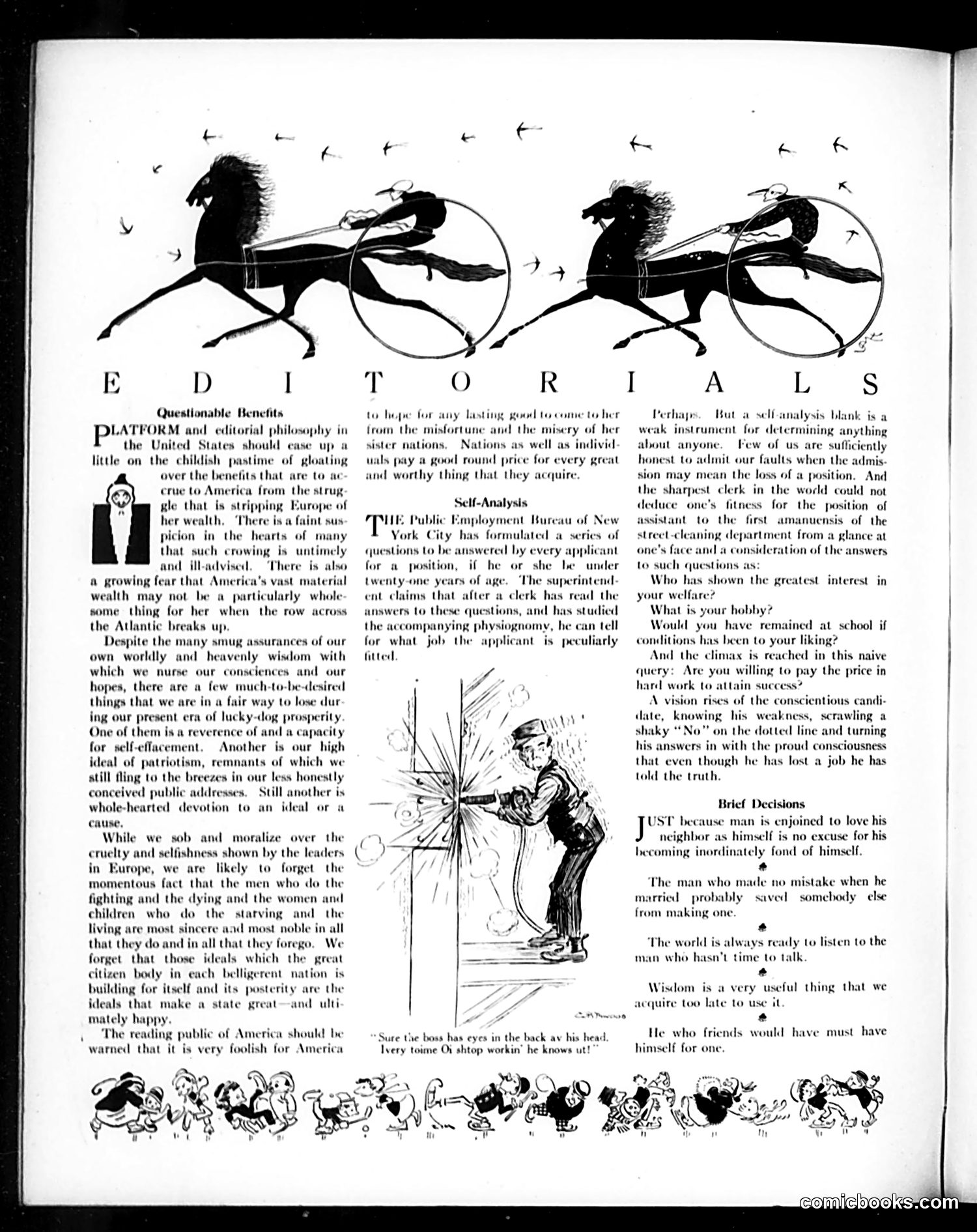
The top illustration titled "EDITORIALS" depicts two identical silhouettes of women in classical pose, holding whips and driving chariot wheels. This appears to be satirizing female authority or empowerment—likely commentary on women's suffrage or changing gender roles in early 20th-century America. The accompanying text discusses patriotism, national ideals, and self-reflection. A middle illustration shows a man at work with explosives or machinery, captioned "Sure the boss has eyes in the back av his head. Every time I'm shop workin' he knows it!"—satirizing worker surveillance and workplace distrust. The "Brief Decisions" section offers cynical aphorisms about marriage, human nature, and wisdom, typical of Judge's sardonic editorial voice. The exact historical moment remains unclear without a date.
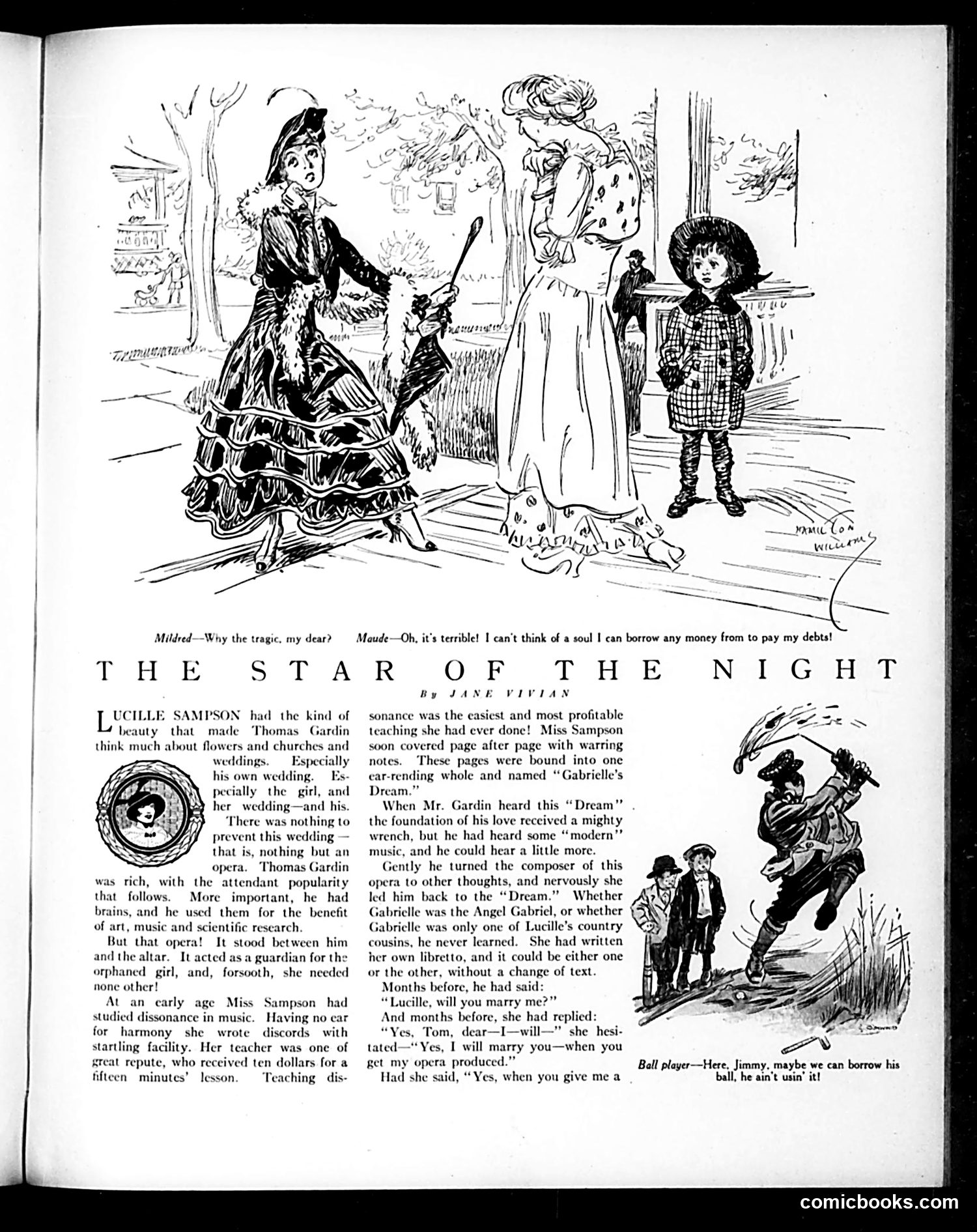
This page from *Judge* presents a short story by Jane Vivian rather than political satire. The top cartoon depicts a domestic scene where a woman (Mildred) tells a man (presumably her husband) that she cannot borrow money to pay debts, establishing the story's financial conflict. The narrative below concerns Lucille Sampson, a talented musician whose wealthy suitor (Thomas Gardin) proposes marriage conditional on her producing an opera. The story explores themes of artistic aspiration versus romantic compromise—common fodder for early 20th-century women's fiction. The accompanying illustrations show the romantic drama unfolding. This is primarily entertainment content rather than political commentary.
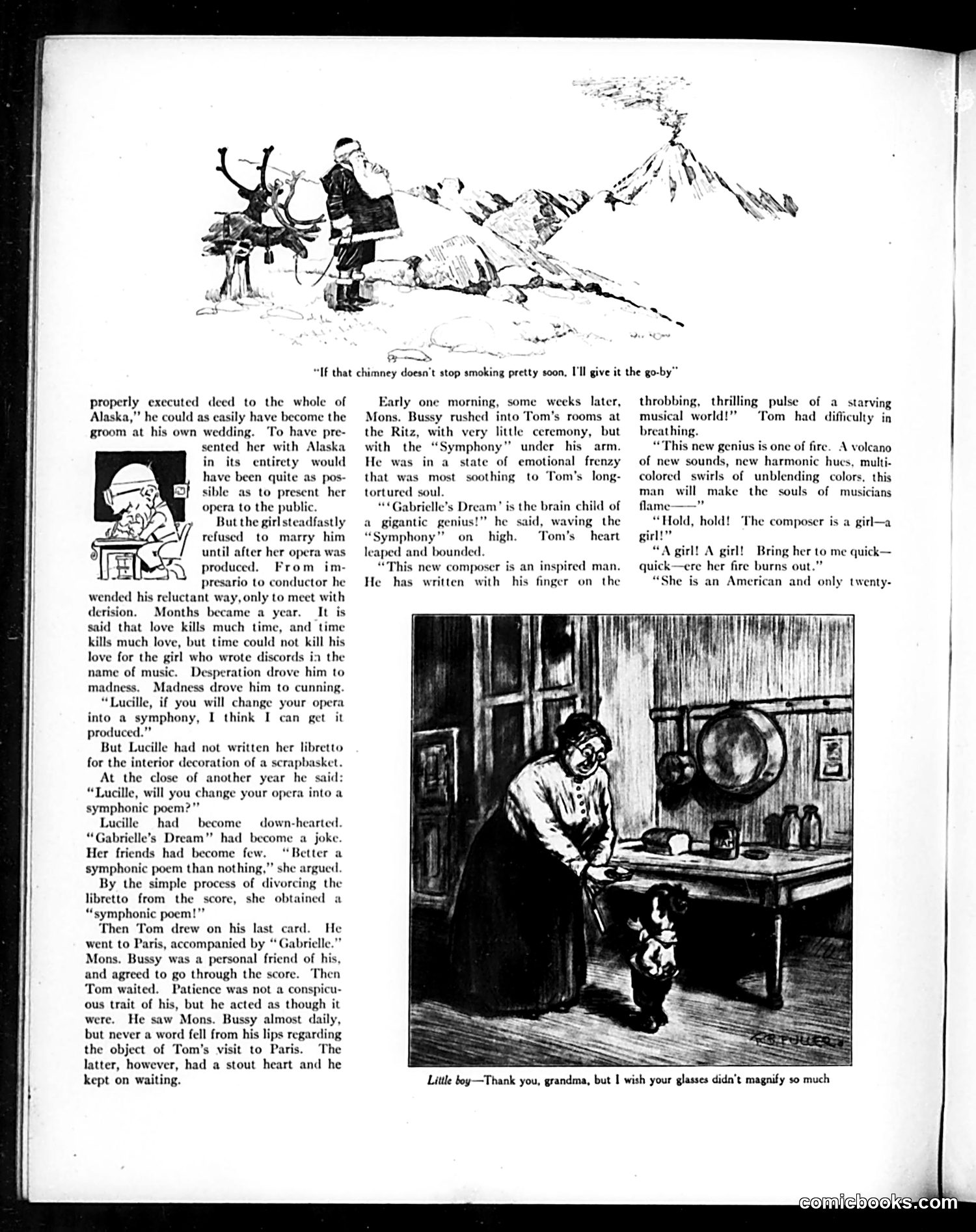
**The Story**: This page serializes a romantic tale about Tom, an impresario who falls in love with Lucille, a female composer. She refuses to marry him until her opera "Gabrielle's Dream" is produced. Unable to get it staged, Tom gradually convinces her to transform it into a symphony, then a symphonic poem—progressively compromising her artistic vision. He finally takes the score to Paris, where a famous conductor (Mons. Bussy) enthusiastically endorses it as genius work by "an inspired man"—only to learn the composer is a young American woman. **The Satire**: The piece mocks both the music world's gender bias and how artistic integrity gets sacrificed for commercial success. It suggests that a woman composer's work gains recognition only when attributed to a man, and that love/desperation drive artists to water down their original vision. The smaller cartoon about the chimney is unrelated domestic humor. The page criticizes early 20th-century barriers women faced in the arts industry.
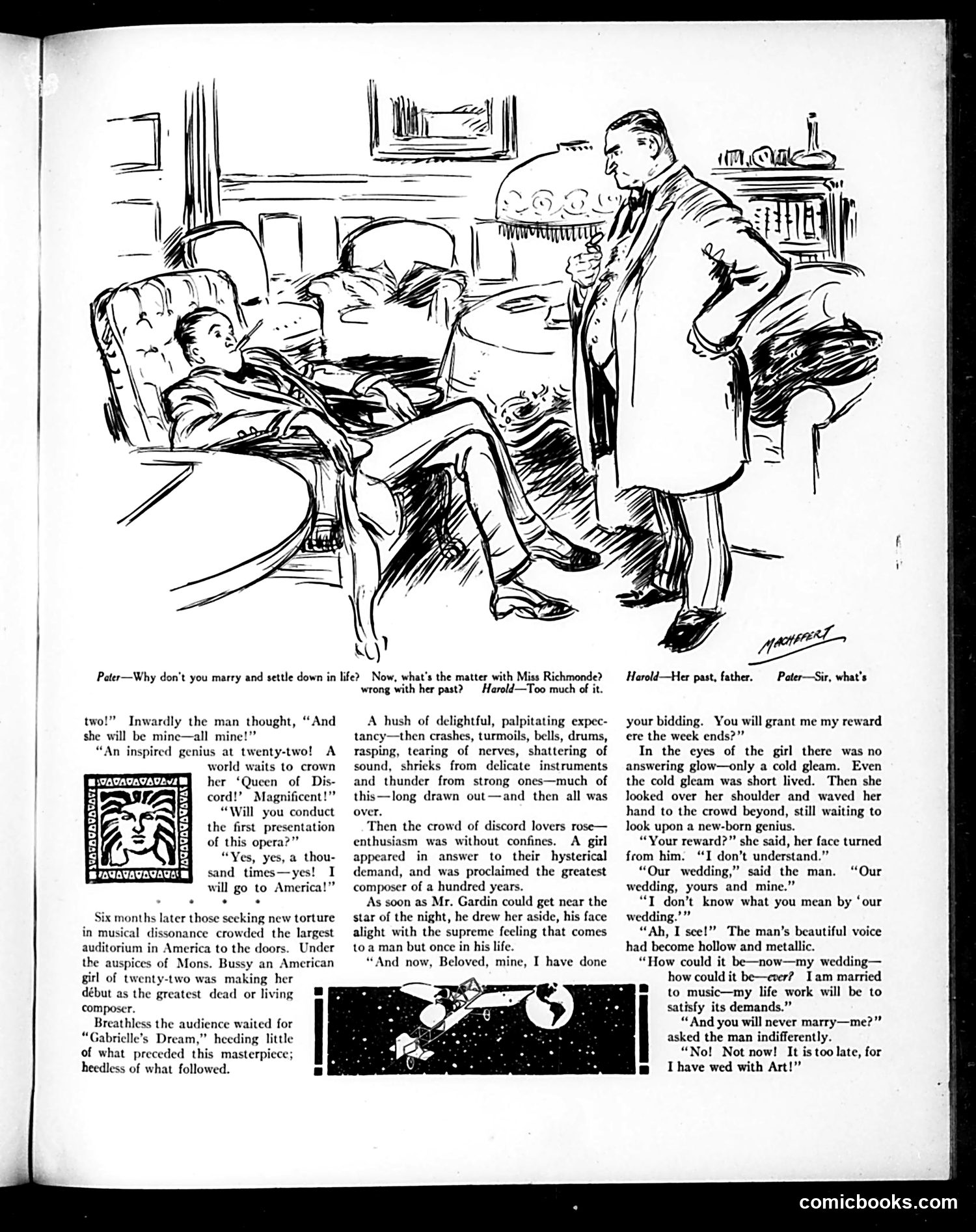
This story satirizes the conflict between romantic love and artistic ambition, likely reflecting early 20th-century anxieties about women pursuing careers. The narrative follows a man who encourages a talented young woman (Miss Richmonde) to compose an opera, imagining marriage afterward. Her avant-garde composition "Gabrielle's Dream"—described as discordant noise with crashes and thunder—becomes a sensational success, making her famous. The satire targets both figures: the man's assumption that professional success naturally leads to marriage, and the woman's complete devotion to "Art," abandoning personal relationships entirely. Her final declaration—"I have wed with Art!"—is the punchline, mocking the romantic notion that artistic genius demands total self-sacrifice and celibacy. The joke likely resonates with Judge's audience as commentary on the "New Woman" and artistic pretension, suggesting both excessive romanticism about art and skepticism toward women prioritizing careers over marriage.
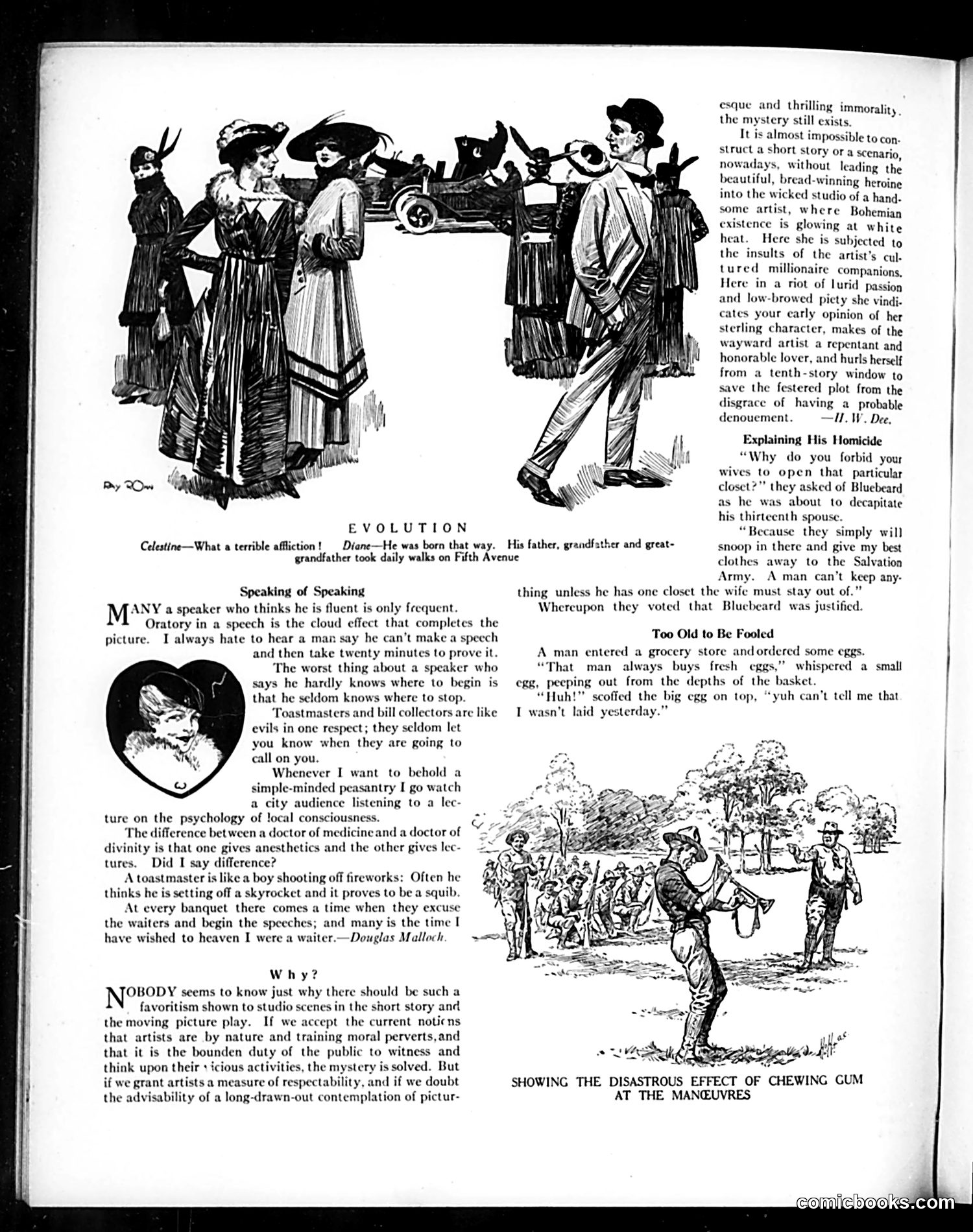
This page from Judge (an early 20th-century satirical magazine) contains multiple unrelated humor pieces targeting contemporary social behaviors: **"Evolution"**: A brief joke about inherited character flaws, using two fashionable women as observers. **"Speaking of Speaking"**: A sustained critique of public speakers—particularly toastmasters and after-dinner orators—who claim modesty about their abilities while delivering lengthy, tedious remarks. The humor targets the gap between speakers' self-awareness and their actual impact. References to "bill collectors" suggest unwelcome intrusions into one's time. **"Why?"**: Social commentary questioning why short stories and films consistently depict artists' studios as dens of immorality and seduction. The author ironically suggests this cliché persists only if we accept that artists are "moral perverts" worthy of public surveillance. **"Explaining His Homicide"** and **"Too Old to Be Fooled"**: Brief joke pieces using exaggeration for humor. **Bottom illustration**: Titled "Showing the Disastrous Effect of Chewing Gum at the Maneuvers," depicting military exercises disrupted by someone chewing gum—likely satirizing a contemporary social habit.
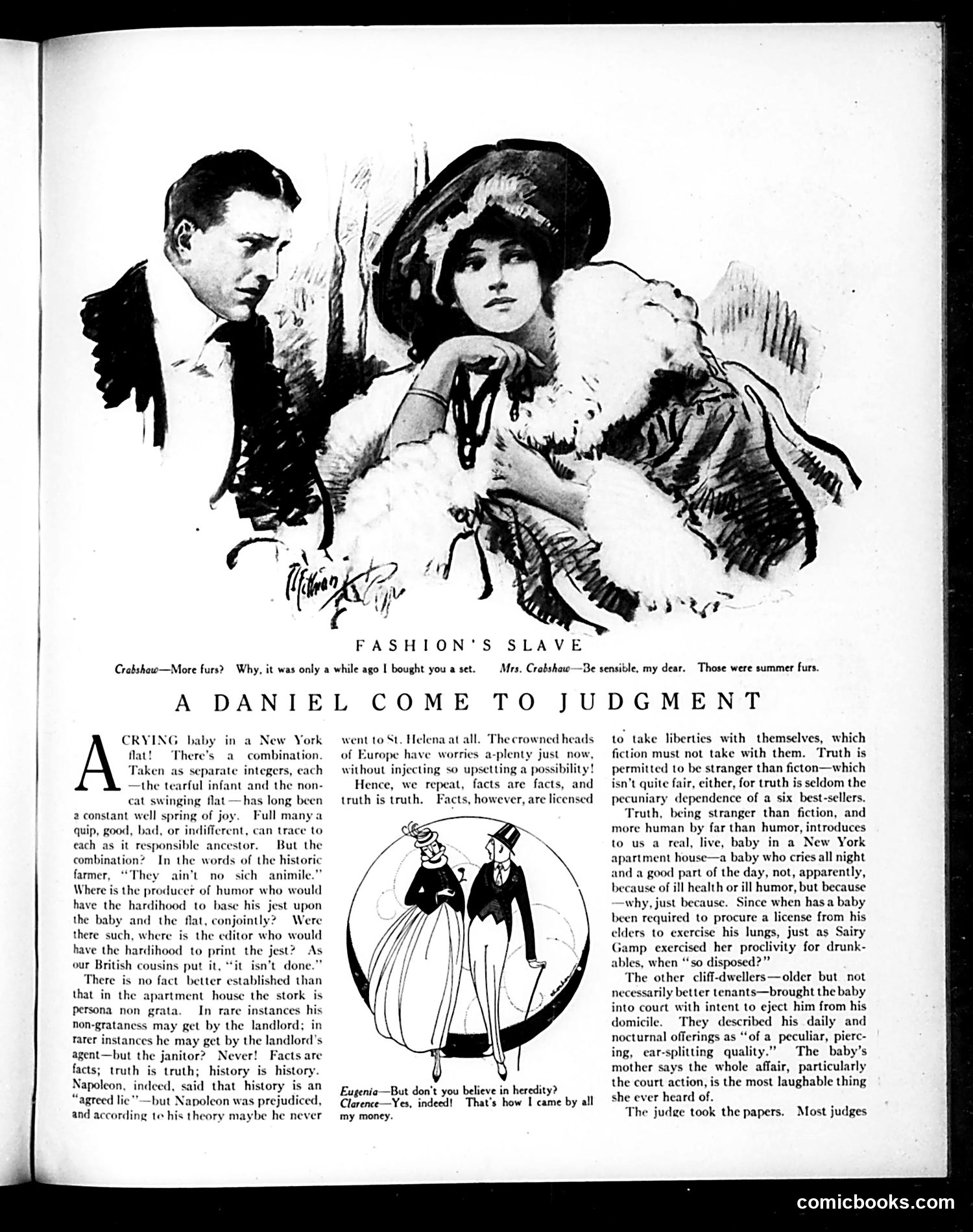
This page contains two satirical pieces about social hypocrisy and absurdity: **"Fashion's Slave"** (top cartoon): A husband protests his wife's constant demand for new fur coats, noting he just bought her a set. Her response—that those were "summer furs"—mocks the arbitrary fashion industry's ability to convince wealthy women that they need entirely separate wardrobes for different seasons, treating fashion as an endless consumption treadmill. **"A Daniel Come to Judgment"** (main article): The piece ridicules apartment-house culture in New York City. Landlords and tenants sue to evict a baby from a flat because its crying disturbs neighbors. The author argues this absurdly prioritizes property comfort over basic human needs—a baby cannot be licensed to cry any more than a person can be licensed to breathe. The satire exposes the dehumanizing pettiness of urban apartment living and class-conscious neighbor disputes. Both pieces target wealthy or pretentious urban society with gentle, humorous criticism.
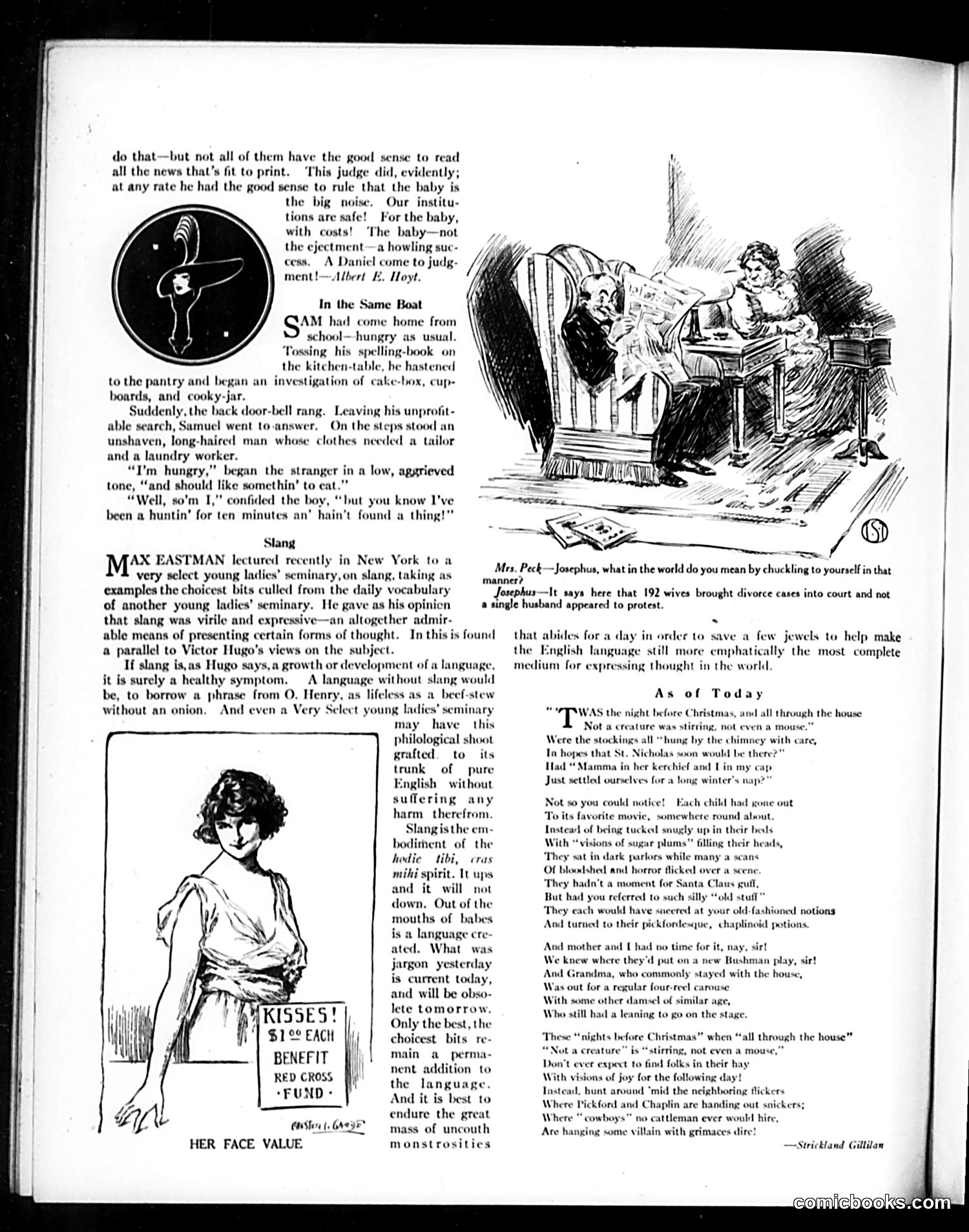
This page contains several satirical pieces typical of Judge's social commentary: **"In the Same Boat"** depicts a hungry schoolboy (Samuel) and a vagrant both searching for food, drawing an ironic parallel between a child's typical hunger and an adult's desperation. The humor lies in their unexpected camaraderie over shared want. **"Slang" section** discusses Max Eastman's lecture defending slang as a healthy linguistic development, referencing Victor Hugo. The satire suggests that even elite young ladies' seminaries inevitably adopt colorful language—implying that refinement cannot suppress natural speech evolution. **"As of Today"** mocks modern Christmas, contrasting Clement Clarke Moore's idealized "Night Before Christmas" poem with contemporary reality: children abandoning tradition for movies featuring Mary Pickford and Charlie Chaplin instead of sugar plums and Santa Claus. Grandma joins them at "four-reel" cinema rather than staying home. The satire targets how commercial entertainment and modernity are displacing Victorian domestic sentimentality. A Red Cross fundraiser advertisement ("Her Face Value") appears alongside these pieces.
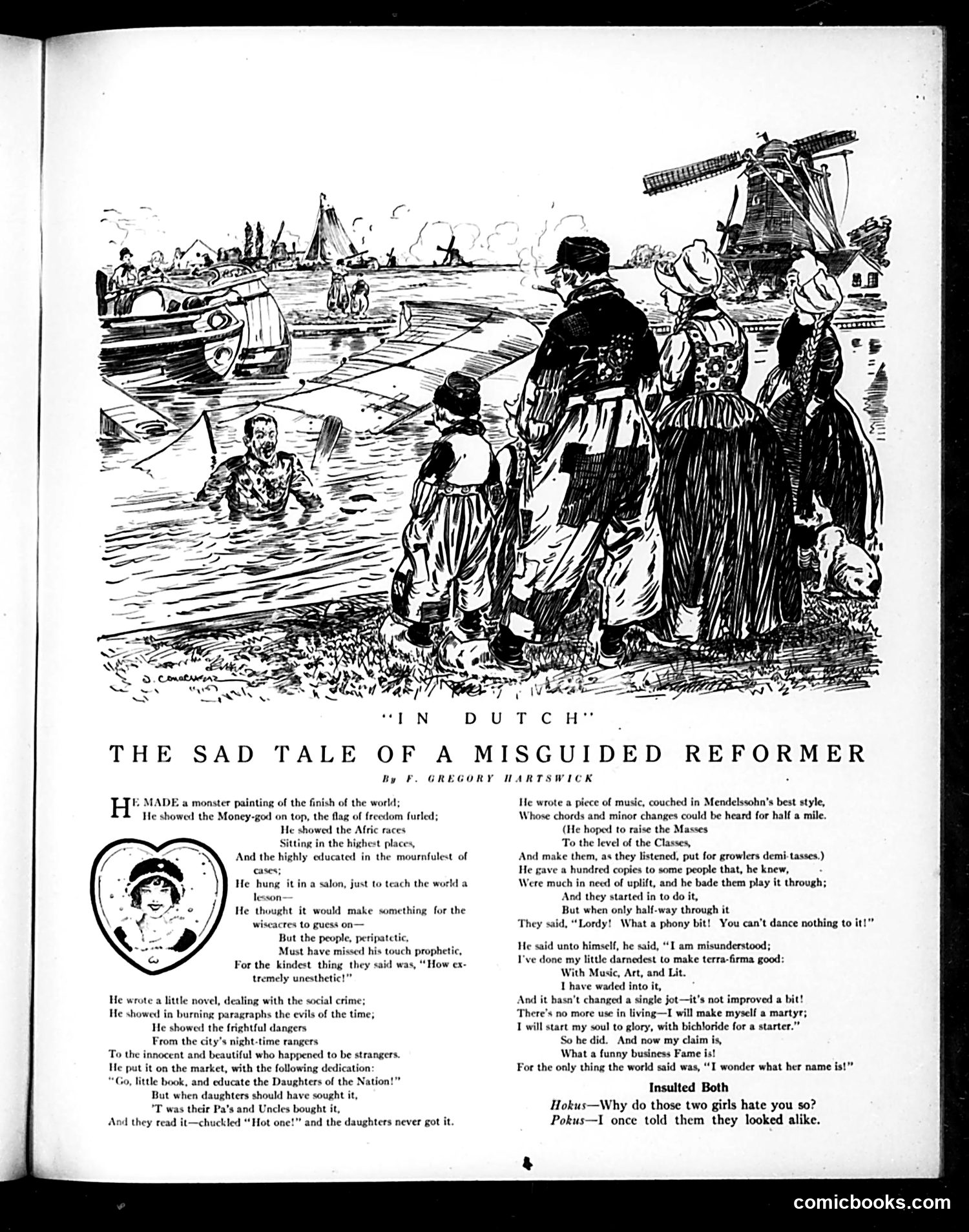
This satirical poem by Gregory Hartswick mocks well-intentioned but ineffectual social reformers of the period (likely early 1900s). The protagonist is a self-righteous artist-activist who attempts to improve society through high-minded works: apocalyptic paintings depicting racial equality, novels exposing urban crime, and classical music meant to elevate the masses. The satire's point: his efforts consistently fail because ordinary people either ignore them or find them pretentious and unrelatable. His painting is called "unesthetic," his novel reaches only men who read it as titillation, and his music is un-danceable. The bitter ending—he commits suicide expecting martyrdom, only for the world to forget him entirely—mocks both his self-importance and society's indifference to reform movements. The concluding "Hokus-Pokus" joke about girls looking alike provides comic relief from the dark ending. The Dutch village setting in the illustration appears decorative rather than thematically significant.
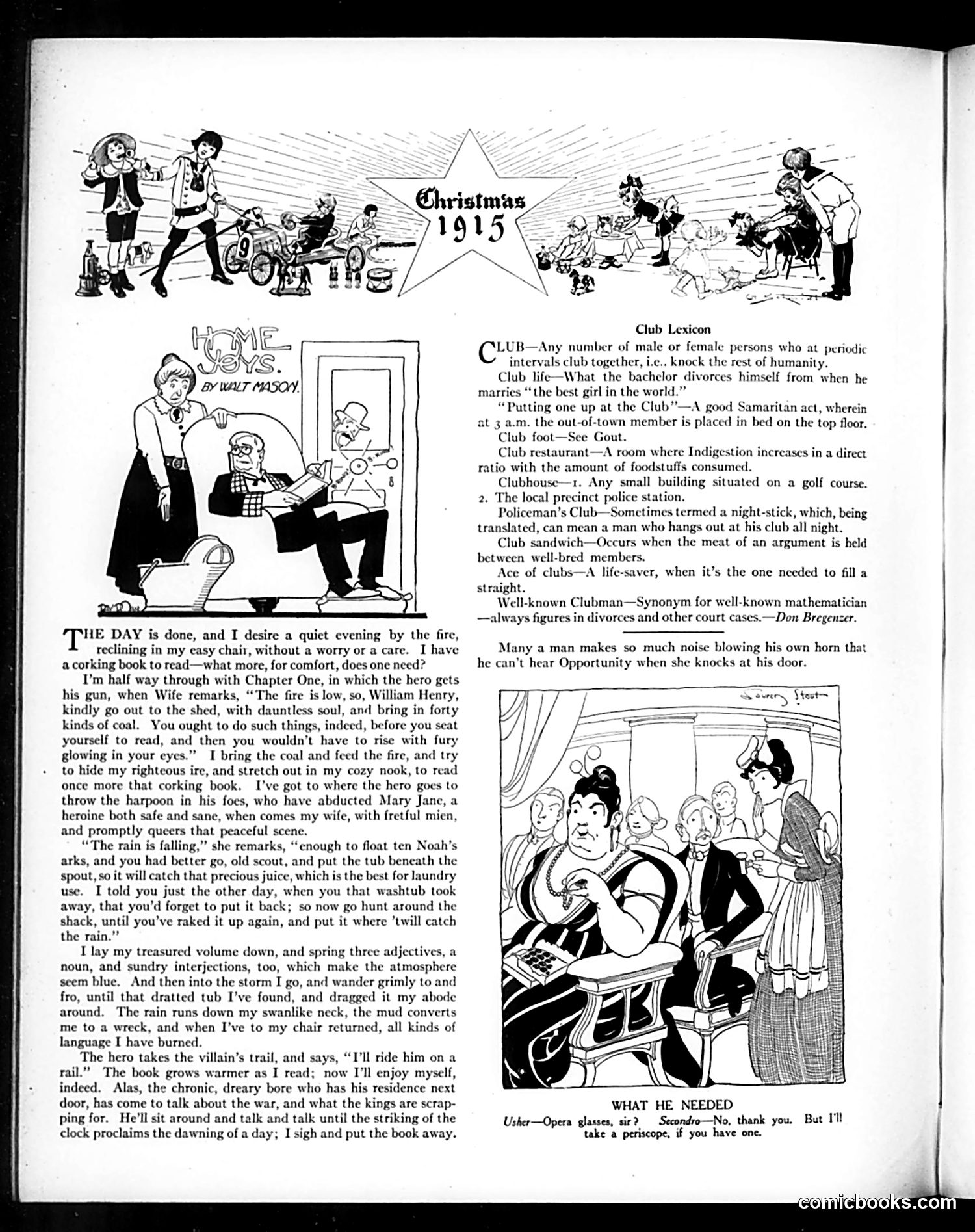
This page satirizes domestic married life. The main story humorously depicts a husband's repeatedly interrupted evening—he tries to read an adventure novel but is constantly sent on errands by his wife (fetching coal, retrieving a rain barrel). Just as he finally settles in to read, a neighbor arrives to discuss the war, ruining his evening completely. The accompanying "Club Lexicon" offers satirical definitions of club-related terms, mocking both bachelor clubs and married life. It jokes that clubs are where men escape marriage, that club restaurants cause indigestion, and contains a quip about "well-known clubmen" resembling mathematicians because they're "always figures in divorces." The small cartoon at bottom shows theater patrons; a second patron requests a periscope rather than opera glasses—likely referencing WWI trench warfare, which was dominating news in 1915. The overall message: marriage means lost leisure and constant domestic demands, while clubs represent masculine escape.
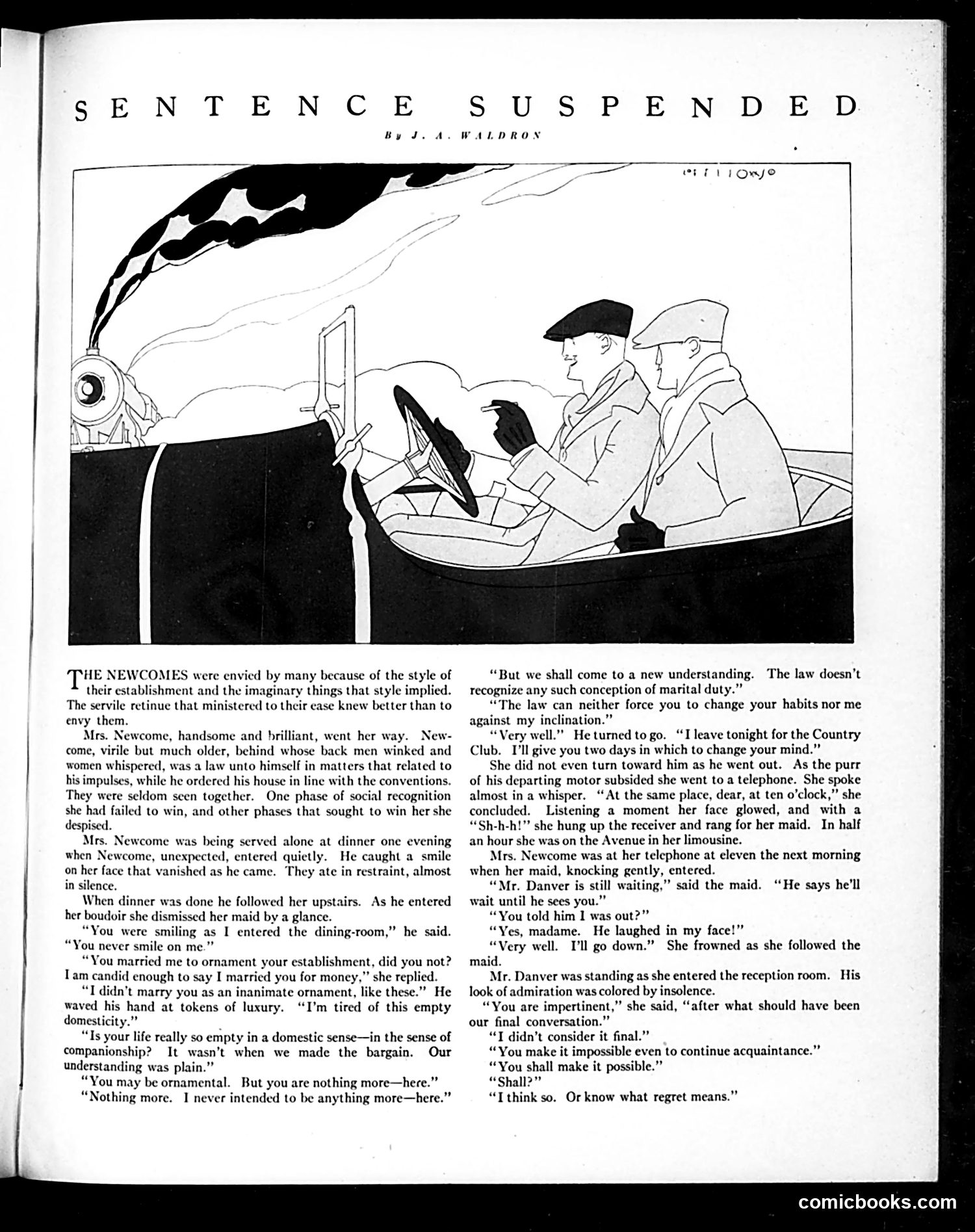
This page from *Judge* presents a serialized narrative satirizing upper-class marriage and marital infidelity. The story depicts Mr. and Mrs. Newcome in a loveless arrangement: she married him for money; he married her as a decorative accessory. When Mr. Newcome demands marital "duty," she refuses, and he leaves for his Country Club. The cartoon illustration (top) shows the couple in a car or carriage—visually representing their emotional distance. The narrative then reveals Mrs. Newcome's affair: she arranges a clandestine rendezvous at "ten o'clock" with someone unnamed. The next day, Mr. Danver—apparently her lover—visits, and she attempts to end their "acquaintance." His final line ("I think so. Or know what regret means") contains a veiled threat, suggesting coercion or blackmail. The satire critiques the hollowness of wealthy marriages based on financial transaction rather than affection, while exposing the hypocrisy and scandal lurking beneath polite society's conventions.
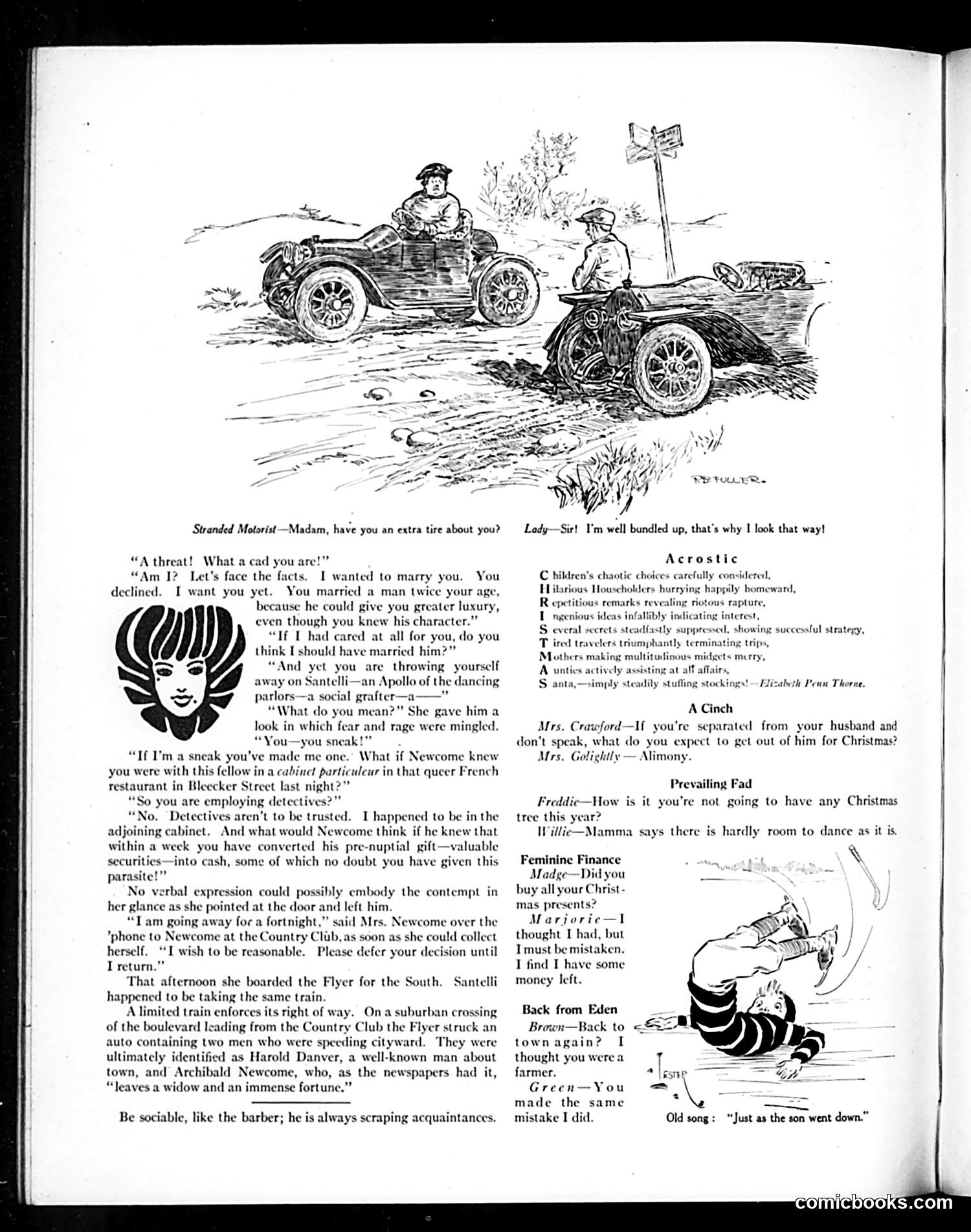
The main illustrated story depicts a blackmail scenario typical of early 1900s melodrama. A rejected suitor confronts a woman who married a wealthy older man (Newcome) for money rather than love. The man threatens to expose her affair with a dancer named Santelli unless she complies with his wishes. She rejects him indignantly. The plot resolves when both Newcome and the blackmailer die in a train accident, leaving the woman a wealthy widow. **The satire targets:** Upper-class hypocrisy—specifically women who marry for wealth while conducting affairs, and men who exploit such situations through blackmail and surveillance. The accompanying humor sections mock minor domestic absurdities (Christmas trees preventing dancing, wives extracting alimony through silence, farmers making repeated mistakes), while the acrostic poem provides moral commentary on "Christmas" virtues. The cartoon reflects *Judge* magazine's preoccupation with exposing society's moral corruption behind genteel appearances.
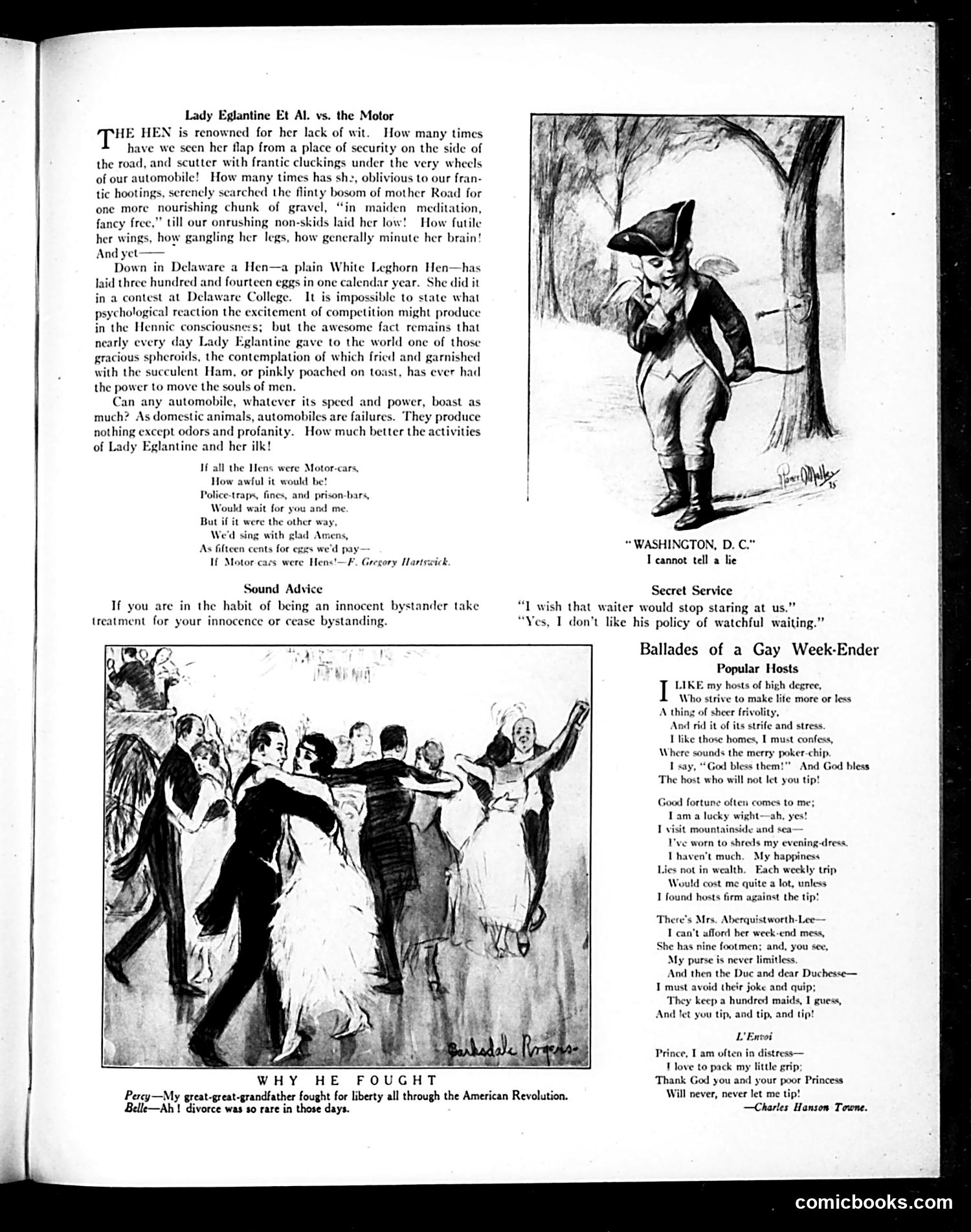
**Main Satirical Article: "Lady Eglantine Et Al. vs. the Motor"** This piece humorously contrasts the humble hen with the automobile—a technology rapidly transforming 1920s America. A Delaware hen named Lady Eglantine laid 314 eggs in one year, a documented achievement. The satire's point: despite their speed and power, automobiles are utterly useless compared to hens. Cars produce only "odors and profanity" while hens provide nourishment that "move[s] the souls of men." The included poem imagines a dystopian world where hens became cars—resulting in police traps and prisons. The satire mocks automotive culture's dominance and expense while celebrating practical, humble farmyard productivity. It's an anti-modernist jab, defending traditional rural values against industrial progress. **Minor Items:** "Secret Service" jokes about restaurant surveillance; "Ballades of a Gay Week-Ender" satirizes wealthy hosts who allow tipping; "Why He Fought" contains a divorce joke about Revolutionary era social constraints.
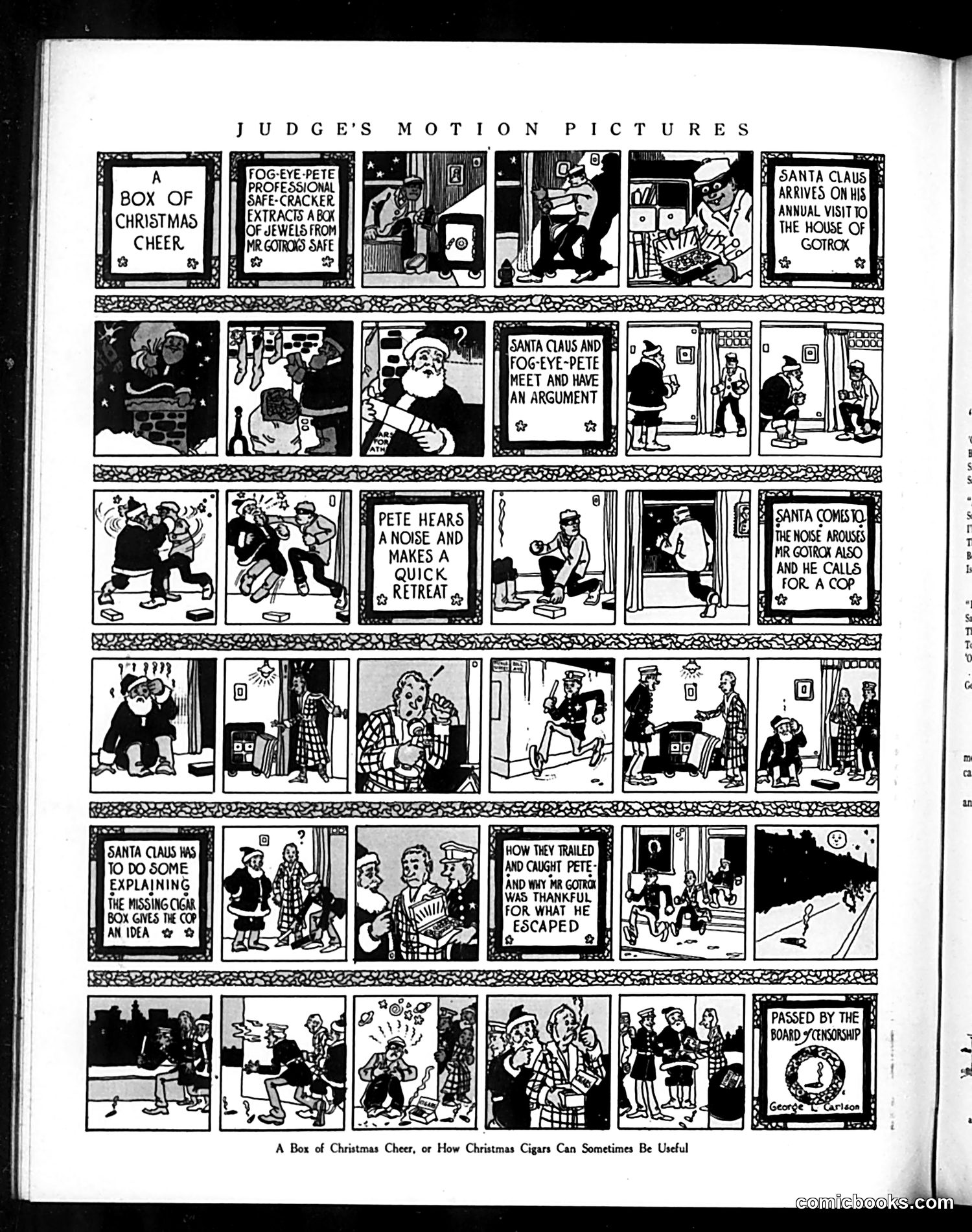
This multi-panel Judge cartoon satirizes the uses of Christmas cigars beyond smoking. The narrative follows "Fog-Eye-Pete," a criminal character, and Santa Claus. The story depicts Pete stealing a jewelry box from a safe, then encountering Santa Claus, who confronts him. Pete escapes but is later caught. The cigar box becomes central to the plot—Santa uses it (unclear exactly how from the images) to track or apprehend Pete, making the "Christmas cheer" unexpectedly useful for law enforcement. The satire appears to mock both petty criminals and the commercialization of Christmas gifts, while celebrating holiday-themed problem-solving. The final panel shows the story "passed by the board of censorship," indicating Judge's editorial oversight. The cartoon entertains through slapstick crime-caper narrative rather than sharp political commentary.
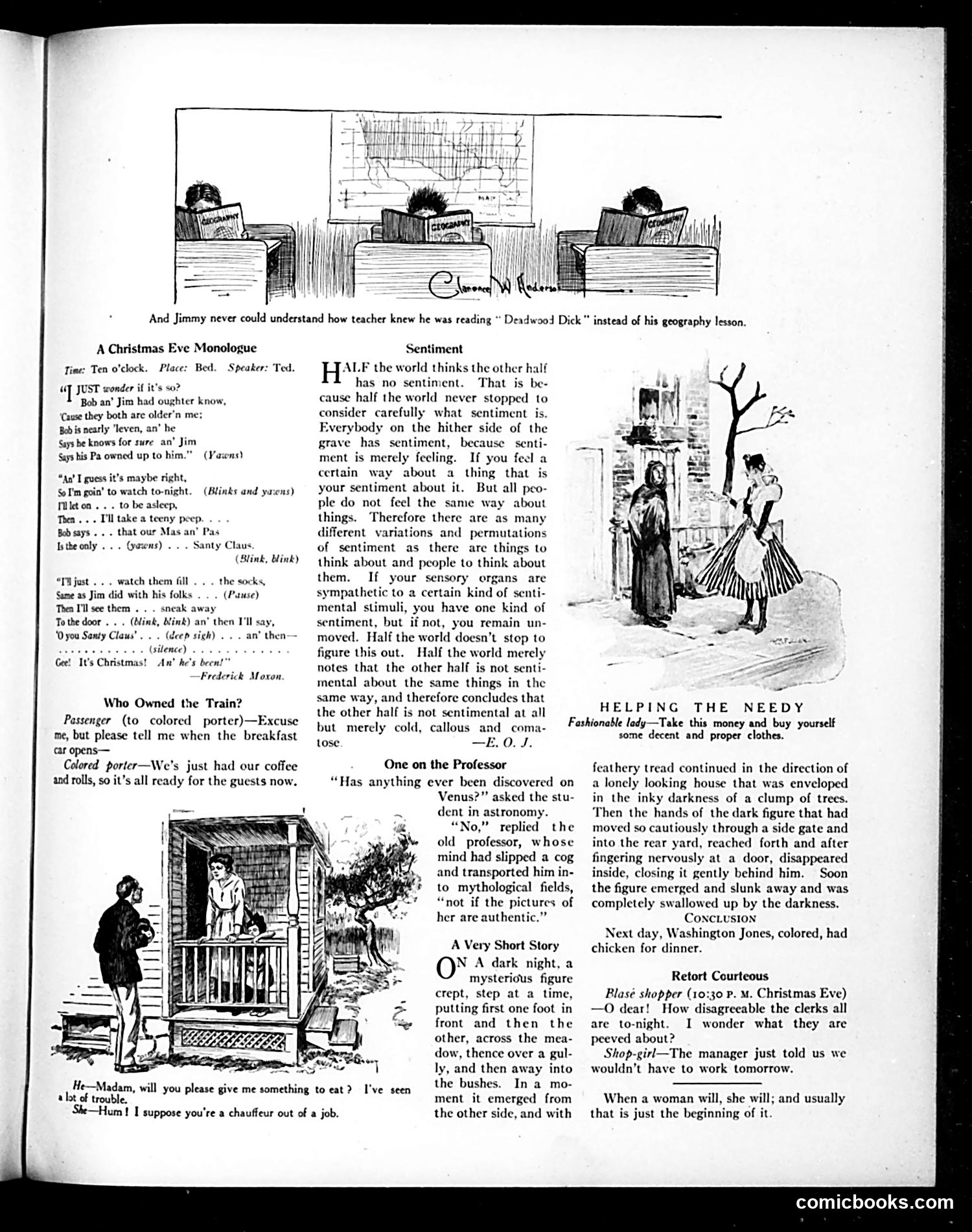
This page contains several satirical pieces typical of early 20th-century American humor: **"Jimmy and Deadwood Dick"** (top cartoon): Mocks student inattention—Jimmy reads the popular dime novel "Deadwood Dick" instead of geography, yet the teacher somehow knows. The joke targets both children's distraction and teachers' omniscience. **"A Christmas Eve Monologue"**: A sentimental piece where a child named Ted plans to stay awake on Christmas Eve to catch Santa Claus, echoing children's folklore about verifying parental claims. **"Who Owned the Train?"**: A brief joke playing on the porter's possession—the passenger asks about breakfast service, and the porter's ambiguous reply suggests he runs the operation. **"Sentiment"** (essay): Defends sentiment as legitimate feeling, critiquing those who dismiss others as "cold" for differing emotional responses. **"One on the Professor"**: A professor, mentally confused, mistakes Venus (the Roman goddess) for the planet, absurdly claiming authentic pictures exist of her. **Other sketches** include a mysterious nighttime visit (revealed as charitable gift-giving) and holiday shopping complaints. The humor reflects period attitudes about class, race, and sentimentality.
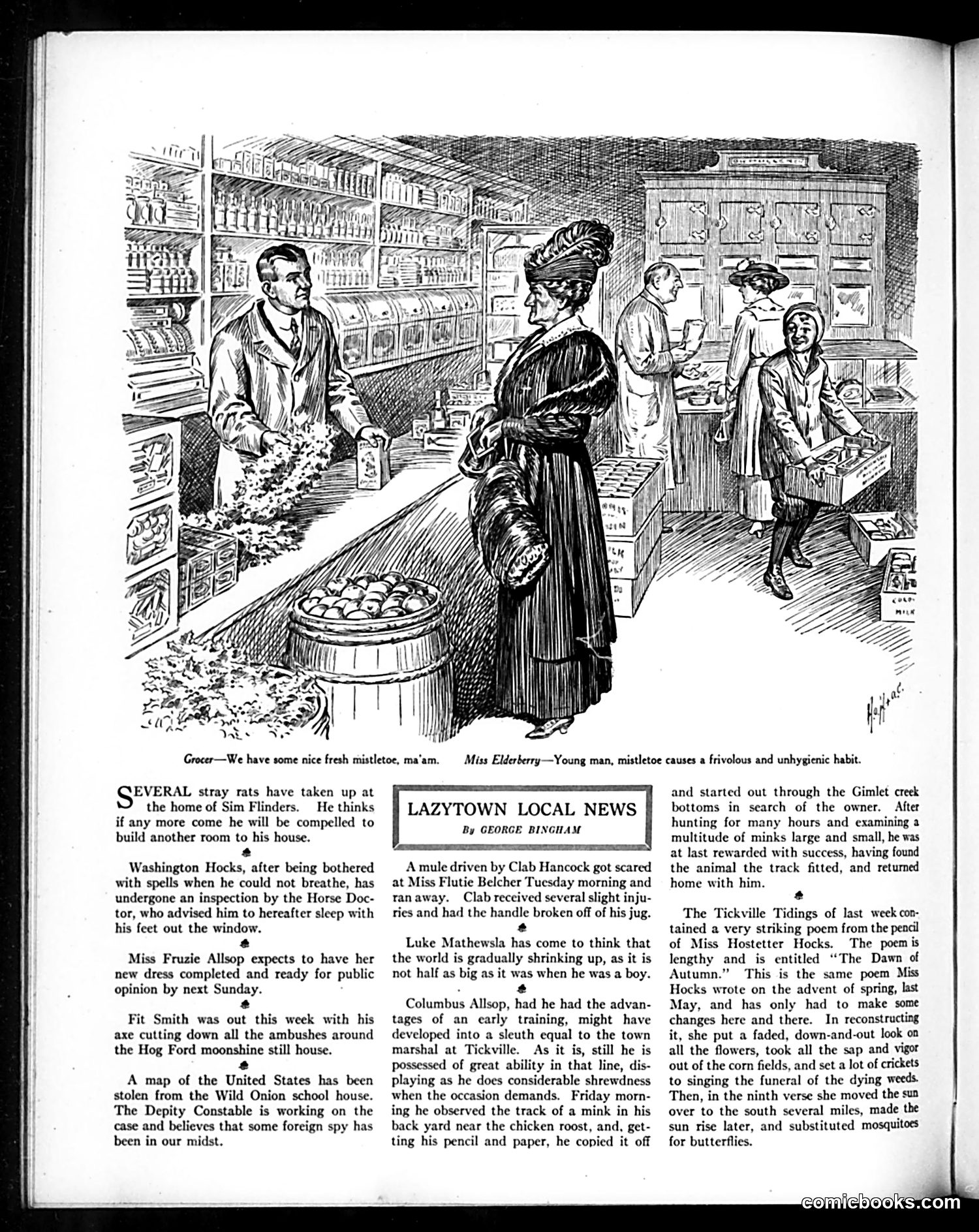
This page contains two elements: a satirical cartoon at the top and humorous local news items below. **The Cartoon:** A grocer offers "fresh mistletoe" to a female customer. She responds that mistletoe causes "frivolous and unhygienic" habits—a reference to the Christmas tradition of kissing under mistletoe. The satire mocks Victorian-era prudishness about even innocent romantic gestures. **"Lazytown Local News":** This is mock-rural gossip from a fictional backwater town. The humor targets small-town absurdity: a man's rat infestation, bizarre medical advice (sleeping with feet out the window), stolen maps blamed on "foreign spies," and particularly Columbus Allsop's comically futile effort to track a mink by copying its pawprint and then exhaustively examining every mink in the area. The final item ridicules a poet for simply recycling last spring's poem with seasonal word-swaps ("dawn of autumn" instead of spring). The satire mocks rural ignorance, small-town paranoia, and literary pretension.
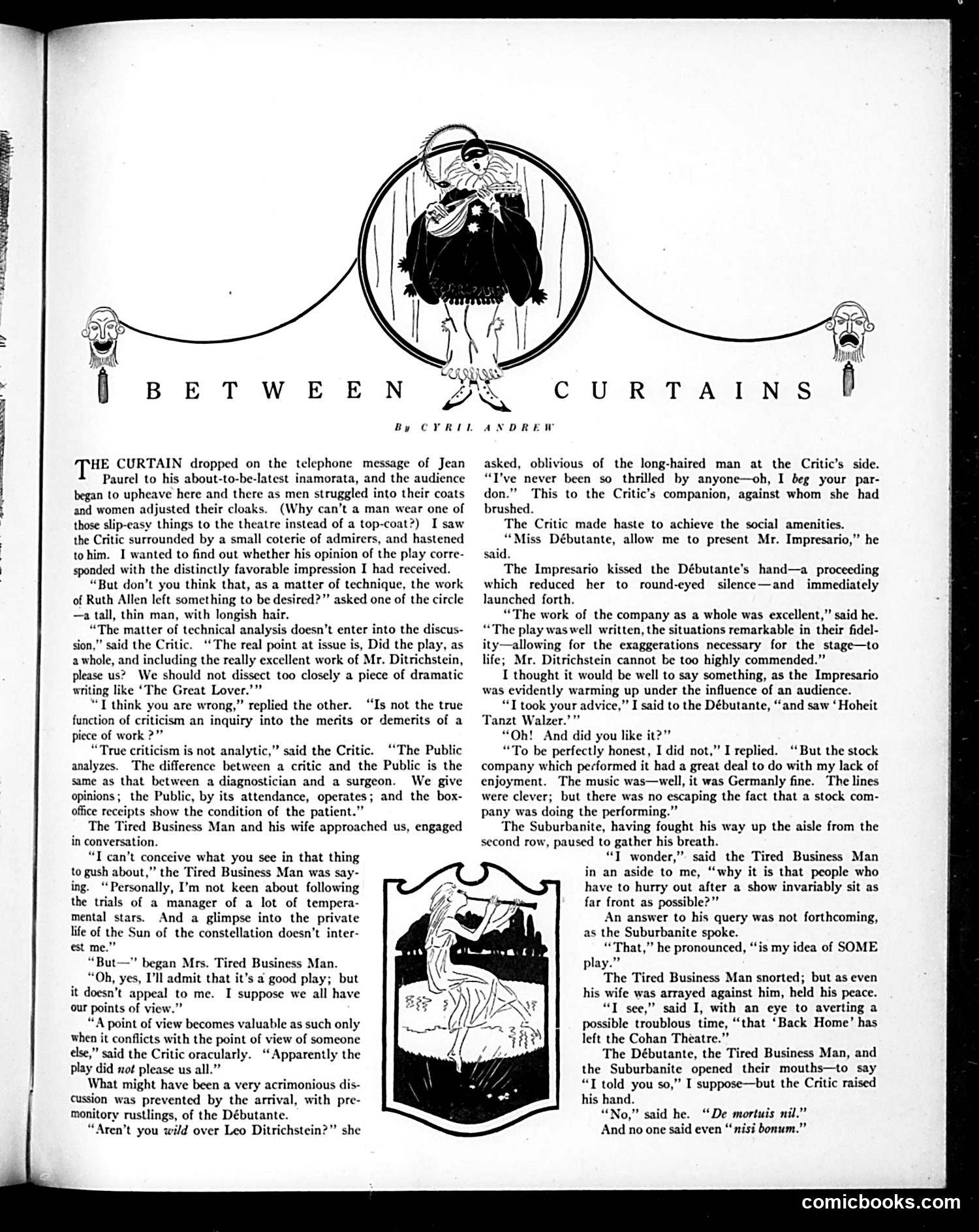
This theatrical satire depicts post-show conversation among New York society types after a play (likely featuring actor Leo Ditrichstein). The cartoon mocks several social archetypes: **The Critic**: A pompous intellectual who dismisses technical analysis, claiming critics are "diagnosticians" while the public merely "operates" through attendance. His pronouncements are presented as absurdly pretentious. **The Tired Business Man**: Represents the average theatergoer who finds the play's plot (about temperamental actors) tedious and unrelatable. **The Débutante**: An enthusiastic, socially ambitious young woman thrilled by famous performers. **The Impresario**: A theatrical producer offering effusive praise. The humor lies in contrasting the Critic's grandiose aesthetic philosophy with ordinary people's simple reactions to entertainment. The satire suggests that professional critics obscure rather than illuminate theatrical merit through affected language and false authority—a timeless complaint about cultural gatekeeping.
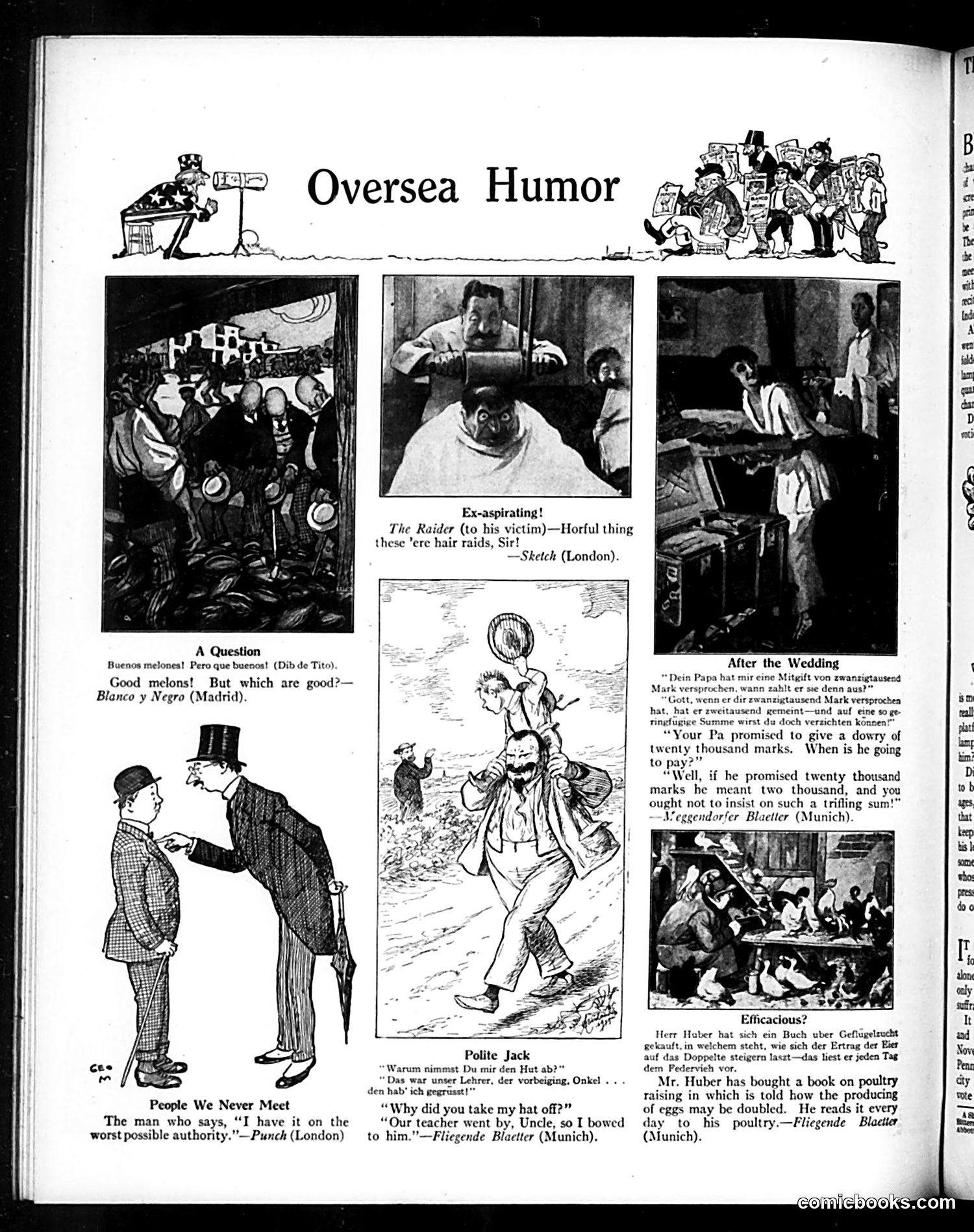
This page collects humorous cartoons and anecdotes from European publications (Madrid, London, Munich), showcasing how different cultures approached comedy. The jokes target universal human foibles: **"A Question"** mocks produce vendors—a visual gag about selecting good melons, suggesting quality is subjective or hard to judge. **"People We Never Meet"** satirizes a common type: the person who cites dubious authority to support dubious claims. **"Ex-aspirating"** plays on a hair-raiding (likely a WWI reference to stealing supplies) victim's complaints, rendered in thick dialect for comedic effect. **"Polite Jack"** shows a boy removing his hat to a passing teacher—absurd politeness taken to illogical extremes. **"After the Wedding"** presents a marital dispute: a groom promised a large dowry but now claims he meant a fraction of it, arguing the bride shouldn't "insist on such a trifling sum"—satirizing both male dishonesty and financial sharp-dealing in marriage. **"Efficacious?"** jokes that merely *reading* poultry-raising advice to chickens won't actually increase egg production—mocking magical thinking.
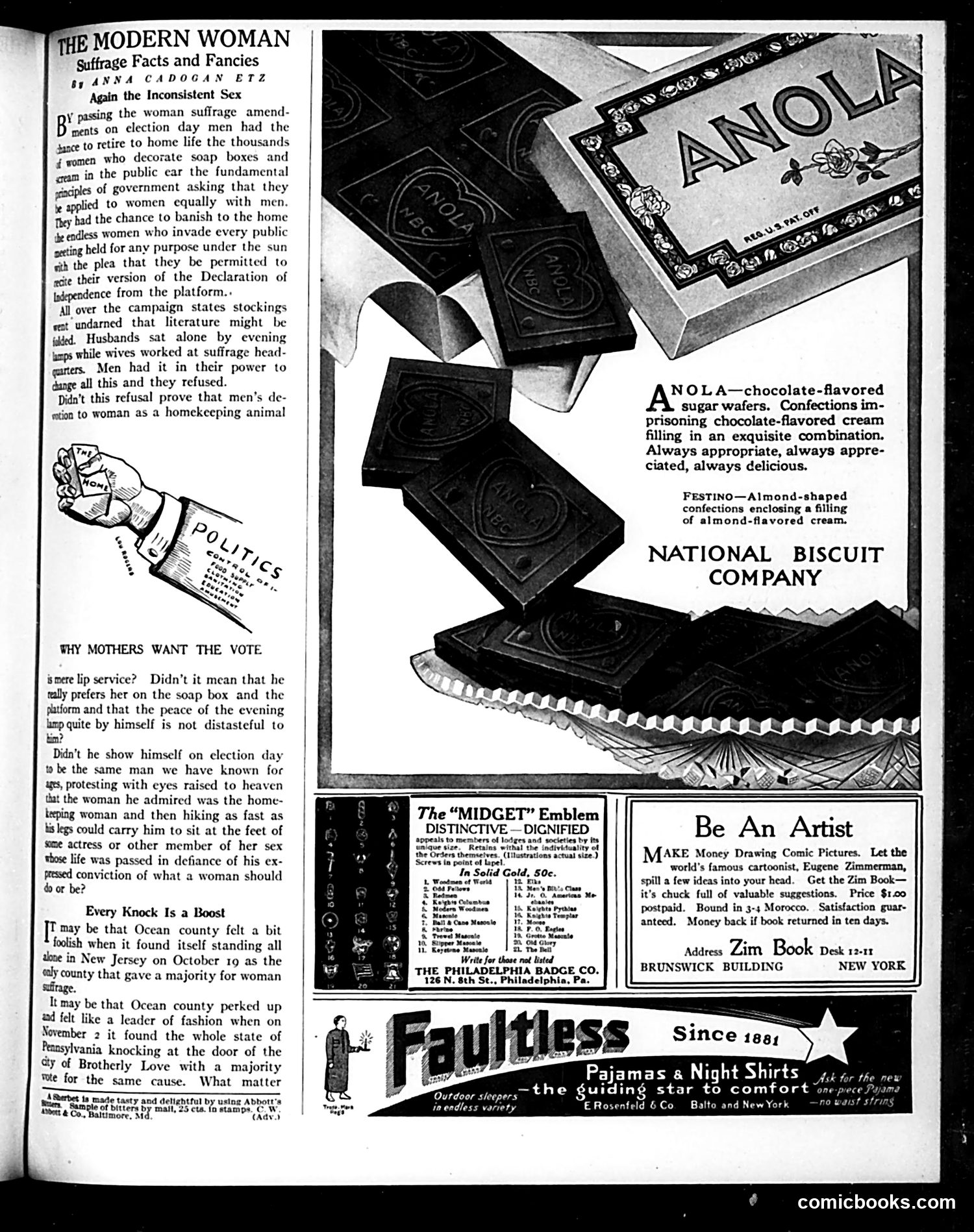
This satirical piece mocks women suffragists by portraying them as hypocritical and domestically negligent. The main cartoon argues that if men truly opposed women voting, they could have simply stayed home and forced wives back into domestic life—yet men refused, suggesting male indifference to the suffrage cause. The article's central irony: it claims men actually *prefer* women in public activism (decorating "soap boxes," attending rallies) over domestic duties, then criticizes women for abandoning housework for suffrage campaigning. The text sarcastically questions whether men's passive resistance proves they view women merely as "homekceping animals." The final section celebrates Ocean County, New Jersey, and Pennsylvania granting women suffrage majorities, though framed as oddities rather than endorsements. The cartoons and ads interspersed throughout are unrelated product advertisements typical of magazine layouts. The satire overall presents suffragists as self-contradictory while mocking male hypocrisy about women's "proper" roles.
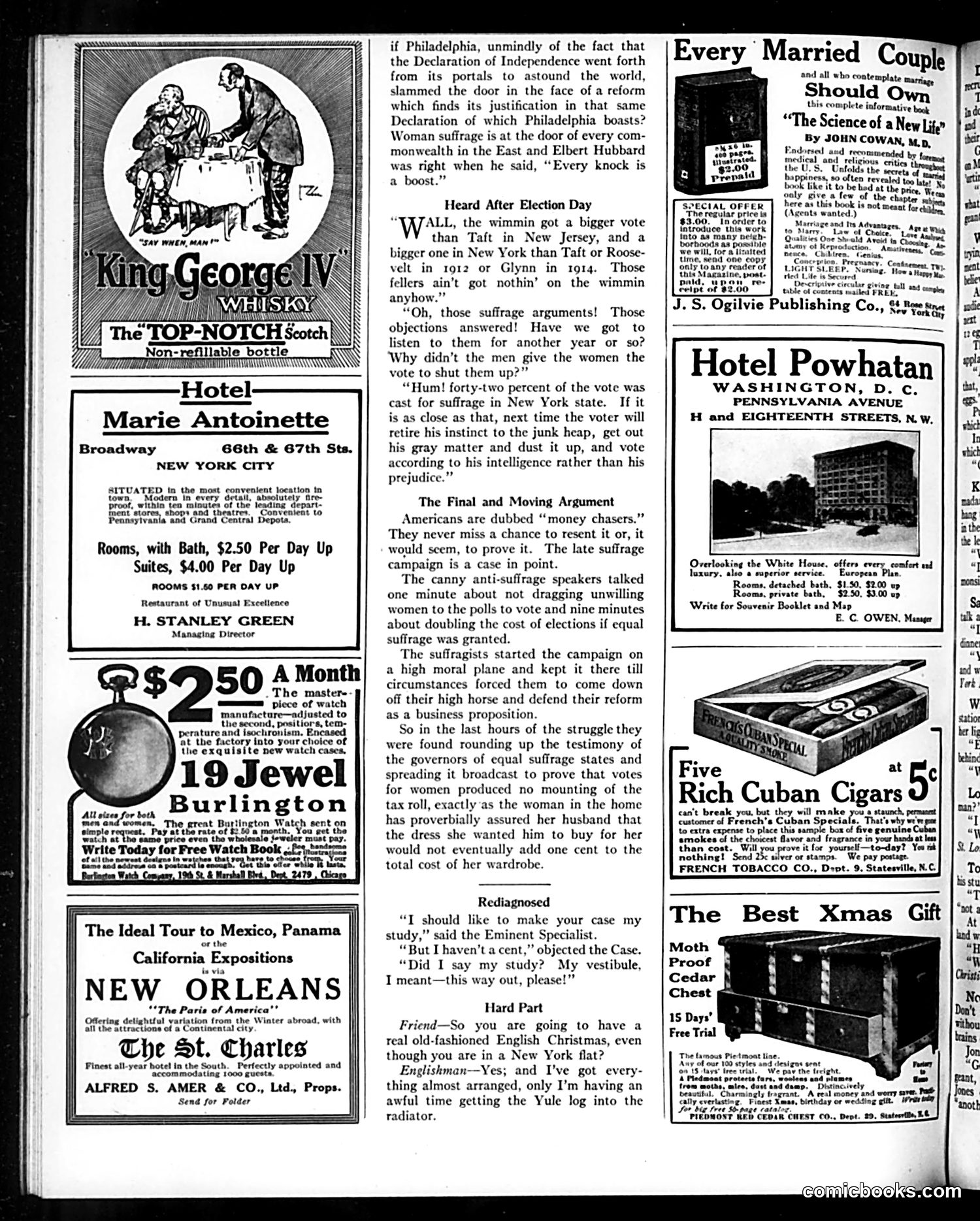
This page from *Judge* magazine contains primarily **advertisements** interspersed with satirical commentary on **women's suffrage**. The main political content criticizes Philadelphia for opposing women's voting rights despite being the birthplace of the Declaration of Independence. The article mocks anti-suffrage arguments, particularly the claim that granting women votes would double election costs. A dialogue labeled "Heard After Election Day" portrays working-class men acknowledging women received significant vote totals in recent elections (likely referencing 1912-1914 campaigns), suggesting suffrage momentum was building. The satire emphasizes that suffragists ultimately had to defend their cause on **economic grounds**—proving equal suffrage states didn't see tax increases—rather than moral arguments, suggesting pragmatism defeated idealism in the political debate. The page also includes unrelated comic snippets ("Rediagnosed," "Hard Part") typical of *Judge*'s format, plus hotel and product advertisements.
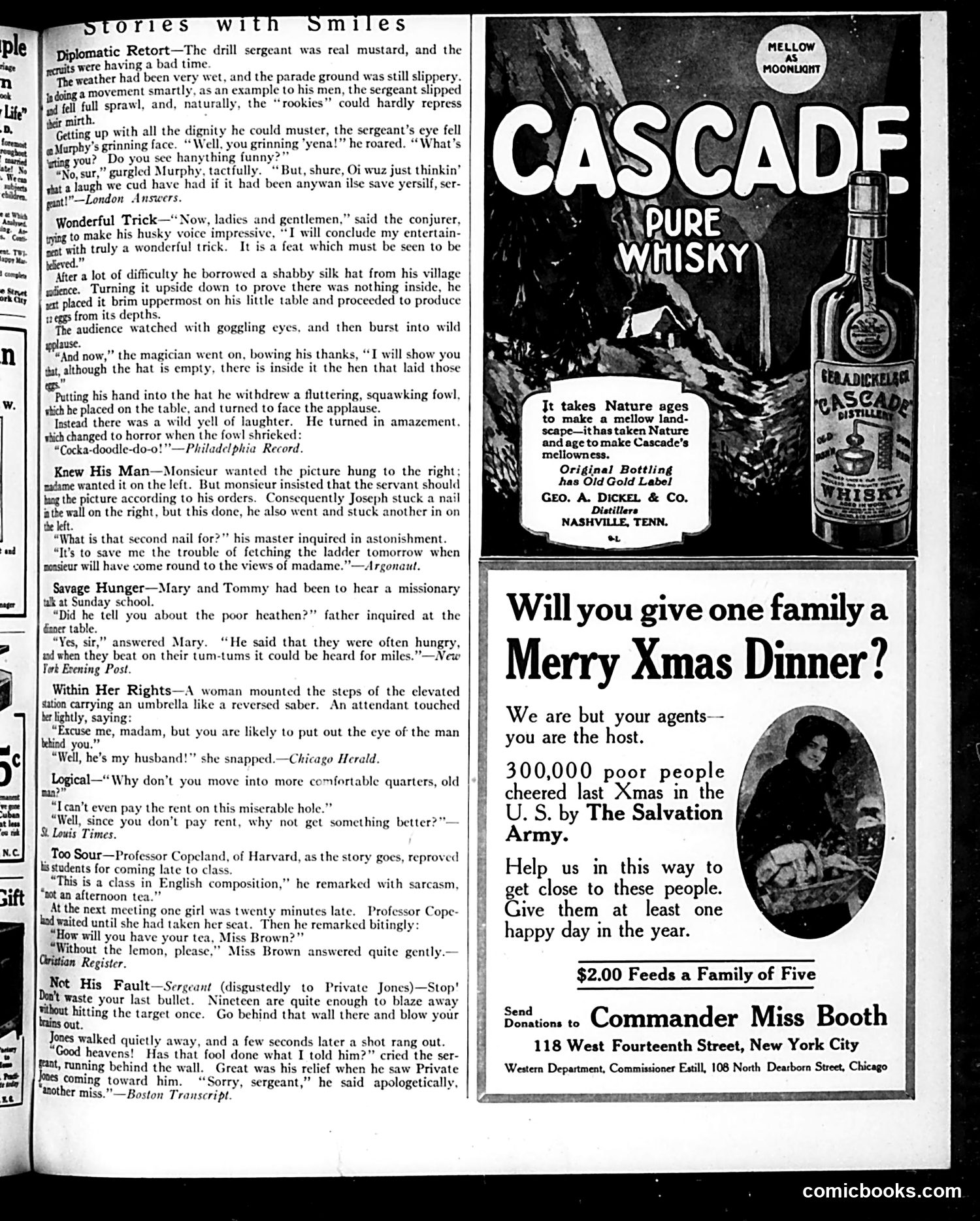
This page contains a collection of brief humorous anecdotes, typical of Judge's "Stories with Smiles" format. The cartoons and jokes mock various social situations: **The main sketches satirize:** 1. **Military discipline**: A drill sergeant slips in mud, then angrily confronts his laughing recruits—the joke being his loss of dignity after demonstrating "proper" form. 2. **Magician's mishap**: A conjurer produces a hen from a hat, but it crows "Cocka-doodle-do"—revealing it's a rooster, not a hen, undermining his "wonderful trick." 3. **Servant's practical wisdom**: A servant anticipates his master changing his mind about picture placement, pre-emptively hammering a second nail. 4. **Various domestic comedies**: Including a woman wielding an umbrella like a weapon at her husband, and a professor sarcastically remarking on a student's tardiness. The humor relies on irony, unexpected reversals, and character types (pompous authority figures, clever servants, oblivious civilians). This represents typical early-20th-century American magazine humor—gentle, domestically focused satire without political edge.
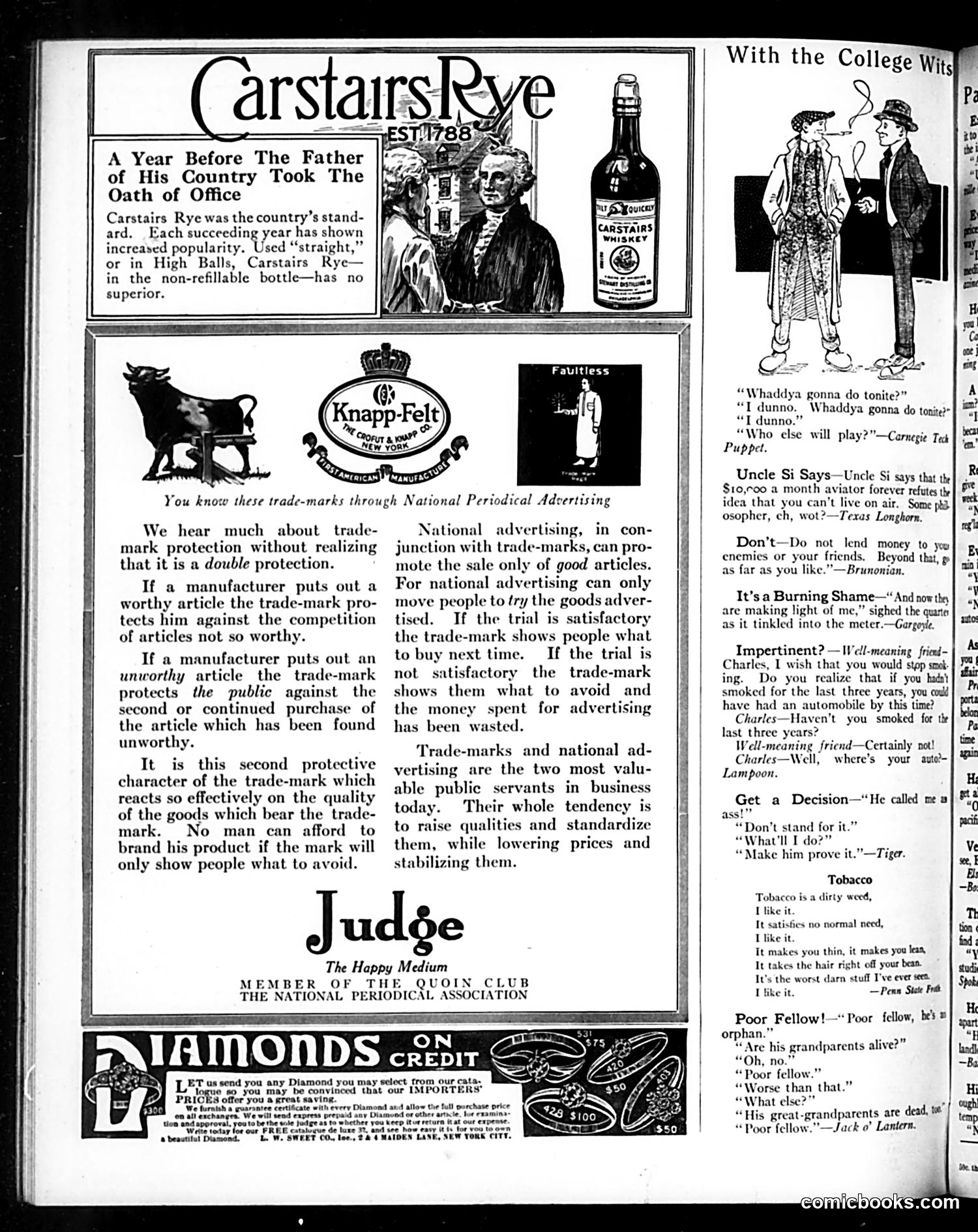
This page from *Judge* magazine features mostly **advertisements and humor columns** rather than political cartoons. The main content includes: **Advertisements**: Carstairs Rye whiskey (featuring George Washington's era imagery), Judge magazine itself ("The Happy Medium"), and Diamonds on Credit. **Humor Columns**: Brief jokes and witticisms from "College Wits," "Uncle Si Says," and other contributors—typical magazine filler content mocking contemporary social situations (aviators, lending money, smoking habits, automobile ownership). **Editorial Content**: A substantial piece on trade-marks and national advertising, arguing that brand protection serves the public by ensuring product quality and standardization while lowering prices. The page reflects early 20th-century magazine culture: advertisements presented as entertainment, brief satirical commentary on modern life (airplanes, automobiles), and editorial defense of advertising's role in consumer protection. There are no identifiable political figures or campaign references—this is social humor aimed at the educated magazine-reading public.
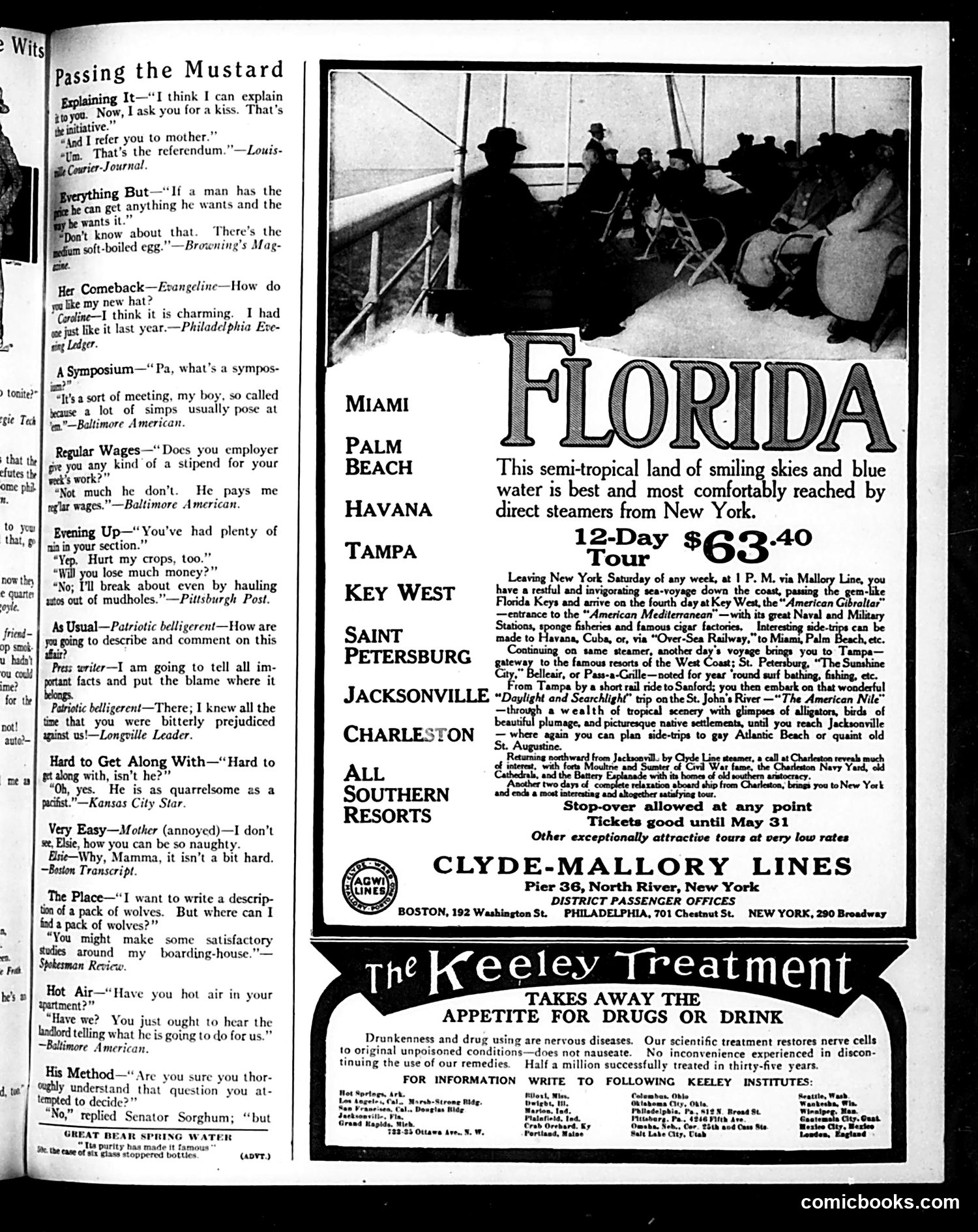
This page is primarily **advertising**, not satirical content. The right half features a Clyde-Mallory Lines steamship advertisement promoting Florida tourism (Miami, Tampa, Key West, Charleston, etc.) as an accessible destination via direct service from New York. The left side contains brief humorous **one-liners and jokes** typical of Judge's filler content—wordplay and domestic humor rather than political satire. Examples include a man deflecting a kiss request by referring someone to his mother ("that's the referendum"), and jokes about employers' wage practices. At the bottom, **The Keeley Treatment advertisement** promotes a "cure" for alcoholism and drug addiction, claiming to restore nerve cells—reflecting period attitudes toward addiction as a medical rather than moral issue. The page reflects early 20th-century American popular humor: light domestic comedy, leisure travel promotion, and contemporary medical claims presented without critical examination.
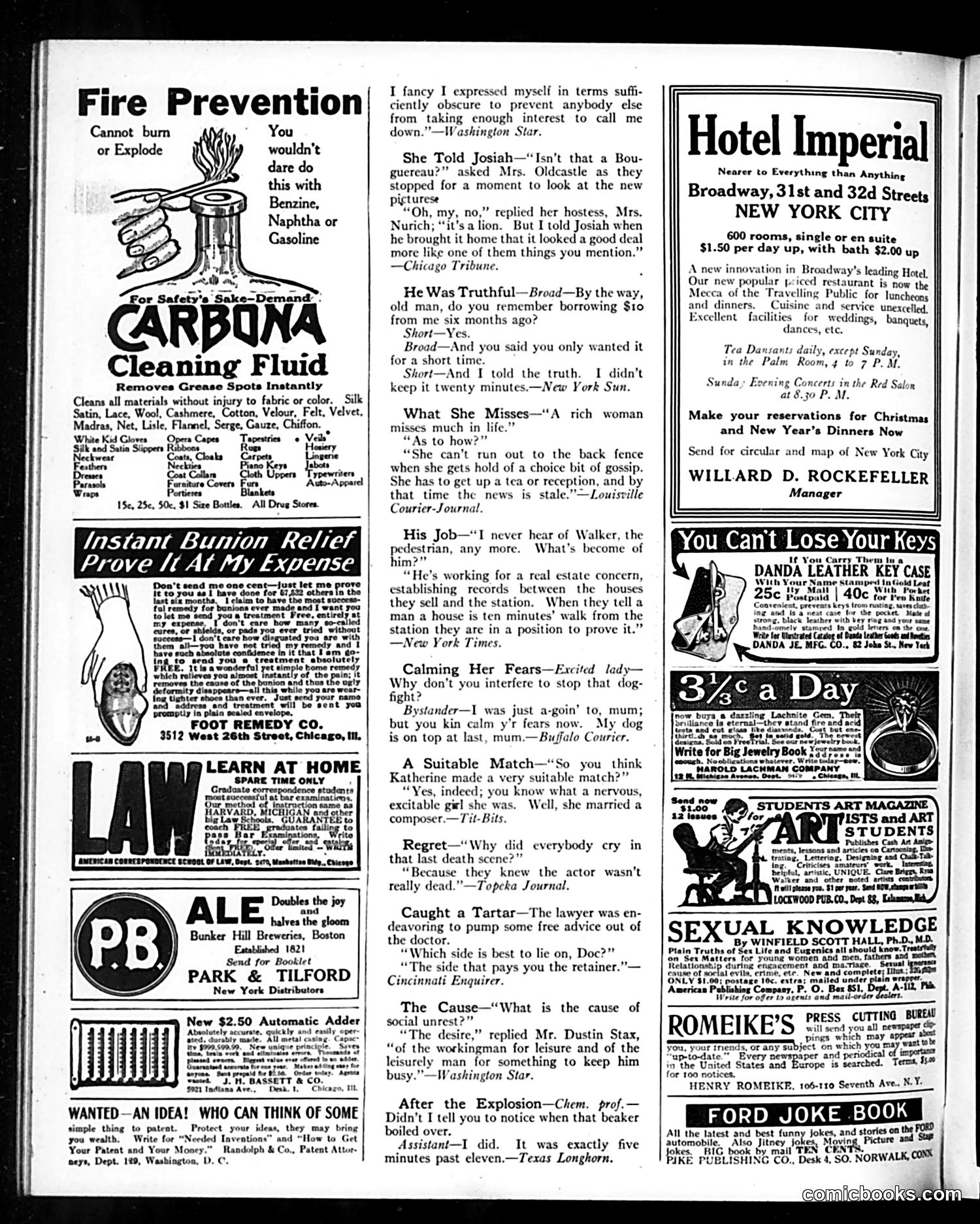
This page is primarily **advertisements and humor columns**, not political satire. The content consists of: **Advertisements**: Carbona Cleaning Fluid, bunion relief, correspondence law school, PB ale, and other consumer products typical of early 20th-century magazines. **Humor Columns**: Brief anecdotes with punchlines about everyday situations—a woman mistaking a lion painting for something else, a man who borrowed money and repaid it immediately, a pedestrian becoming a real estate worker, a nervous girl marrying a composer. These are gentle, domestic jokes rather than political commentary. **Notable context**: References to "Josiah," "Mrs. Oldcastle," and other middle-class characters suggest this reflects concerns of affluent readers about propriety, gossip, marriage, and social status. The page contains **no discernible political cartoons or caricatures**—it's primarily a commercial/entertainment page typical of Judge magazine's mix of advertising and light comedy.
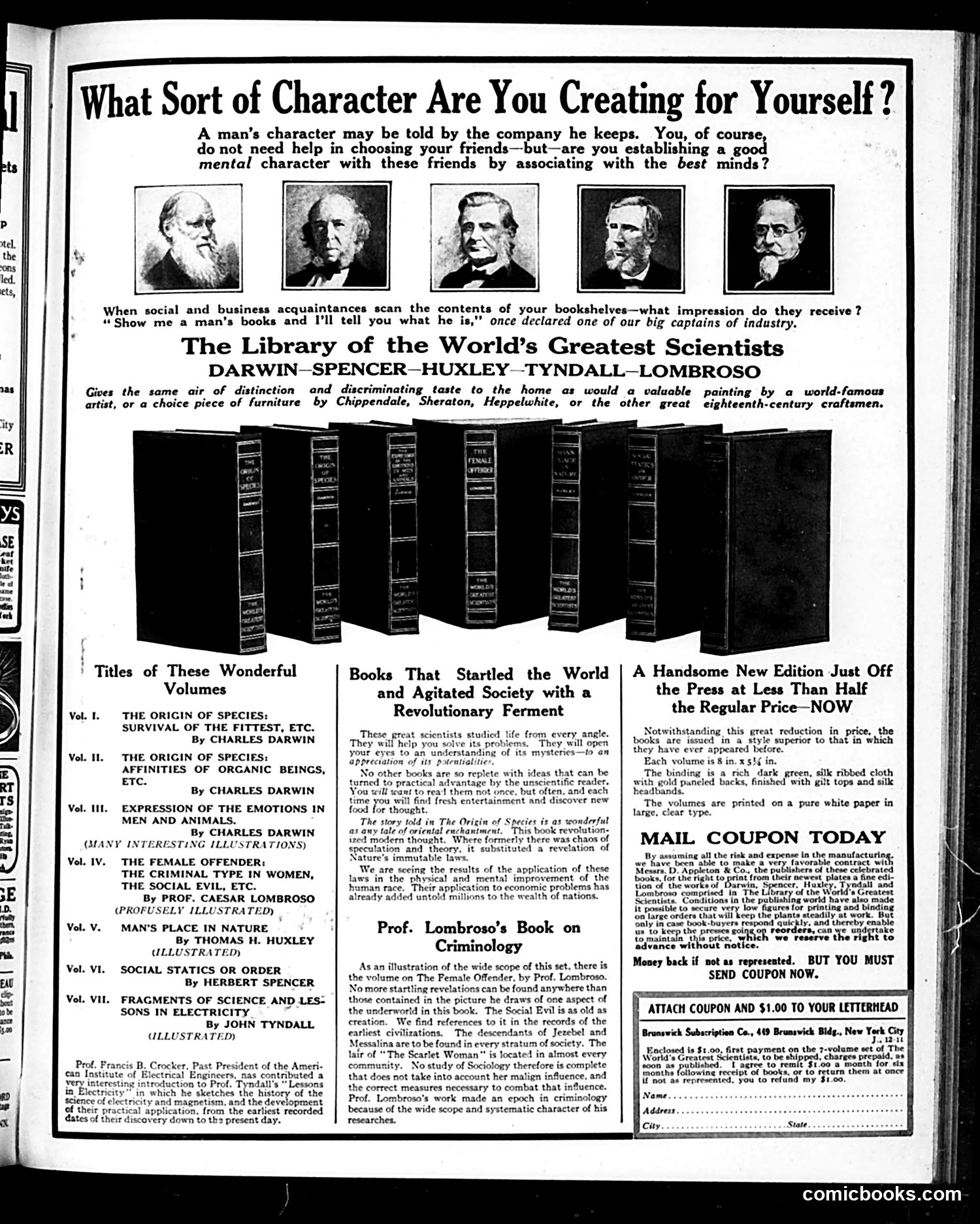
This is a book advertisement disguised as social commentary. The headline poses a question about character-building through reading, then promotes a seven-volume set featuring Darwin, Spencer, Huxley, Tyndall, and Lombroso—leading scientific figures of the late 19th century. The satire is subtle: the ad suggests that owning these books will signal intellectual distinction to visitors, comparing them to fine furniture. It emphasizes how these "revolutionary" scientific works—particularly Darwin's *Origin of Species* and Lombroso's criminology studies—demonstrate mental sophistication and good taste. The underlying message appeals to self-improvement and social aspiration: by displaying these works, you establish yourself as someone who associates with "the best minds" and contributes to human progress through understanding science. The reduced price makes this cultural capital accessible. This reflects the period's faith in scientific authority and the commercial appeal of self-improvement through literature—positioning book ownership as both intellectual and social investment.
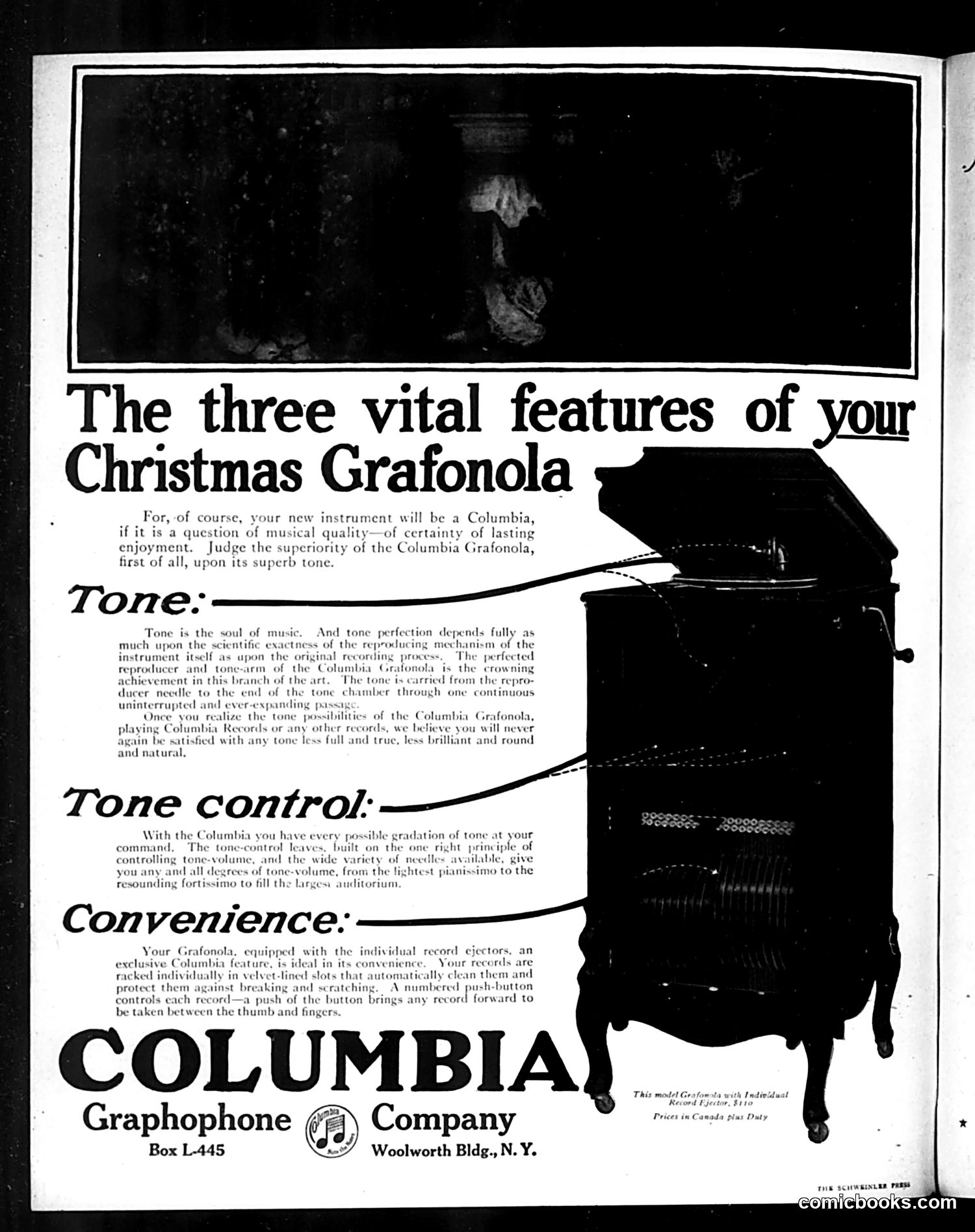
This is **not a cartoon or satire**—it's a straightforward advertisement for Columbia Grafonolas (early phonographs/record players), likely from the 1910s-1920s based on the design and technology described. The page appears in *Judge* magazine simply as paid advertising. It promotes three features of Columbia's gramophone model as ideal Christmas gifts: superior **tone** quality (emphasizing the scientific precision of the reproducer mechanism), **tone control** (allowing volume adjustment from soft to loud), and **convenience** (individual record storage in velvet slots with push-button selection). The silhouetted product image shows the ornate wooden cabinet typical of period phonographs. The ad uses aspirational language about "musical quality" and "artistic achievement" to position the expensive device as a luxury purchase. There is no political commentary, caricature, or satirical content on this page—it's a commercial message placed within an entertainment publication.