
Judge, 1915-12-11 · page 15 of 28
Judge — December 11, 1915 — page 15: what you’re looking at
What you’re looking at
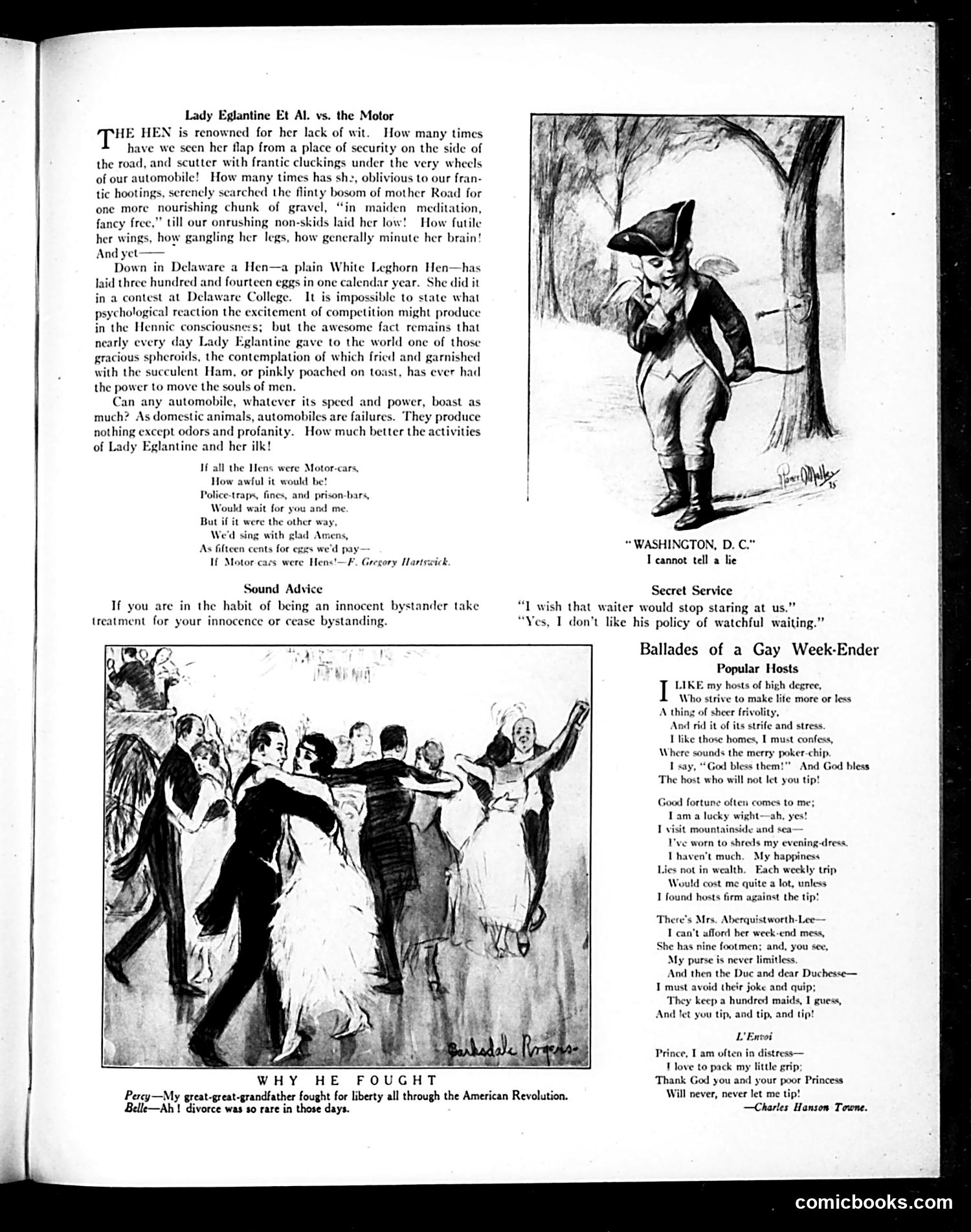
**Main Satirical Article: "Lady Eglantine Et Al. vs. the Motor"** This piece humorously contrasts the humble hen with the automobile—a technology rapidly transforming 1920s America. A Delaware hen named Lady Eglantine laid 314 eggs in one year, a documented achievement. The satire's point: despite their speed and power, automobiles are utterly useless compared to hens. Cars produce only "odors and profanity" while hens provide nourishment that "move[s] the souls of men." The included poem imagines a dystopian world where hens became cars—resulting in police traps and prisons. The satire mocks automotive culture's dominance and expense while celebrating practical, humble farmyard productivity. It's an anti-modernist jab, defending traditional rural values against industrial progress. **Minor Items:** "Secret Service" jokes about restaurant surveillance; "Ballades of a Gay Week-Ender" satirizes wealthy hosts who allow tipping; "Why He Fought" contains a divorce joke about Revolutionary era social constraints.
📄 Transcribed text from this page (OCR, searchable)
Machine-transcribed from the original scan — historical spelling and the odd misread are preserved.
Lady Eglantine Et Al. vs. the Motor HE HEN is renowned for her lack of wit. How many times have we scen her flap from a place of security on the side of the road, and scutter with frantic cluckings under the very wheels of our automobile! How many times has she, oblivious to our fran- tic hootings, serencly scarched the flinty bosom of mother Road for one more nourishing chunk of gravel, “in maiden meditation, fancy free,” till our onrushing non-skids laid her low! How futile her wings, how gangling her legs, how generally minute her brain! And yet Down in Delaware a Hen—a plain White Leghorn Hen—has laid three hundred and fourteen e ‘ar. She did it in a contest at Delaware College. ) state what psychologic clion the excitement of competition might produce in the Hennic consciousness; but the awesome fact remains that nearly every day Lady Eglantine gave to the world one of those gracious spheroids, the contemplation of which fried and garnished ; with the succulent Ham, or pinkly poached on toast, has ever had the power to move the souls of men. Can any automobile, whatever its speed and power, boast as much? As domestic animals, automobiles are failures. They produce nothing except odors and profanity. How much better the activiti of Lady Eglantine and her ilk! If all the Hens were Motor-cars, How awful it would be! Police-traps, fines, and_prison-bars, Would wait for you and me But if it were the other way, We'd sing with glad Amens, As fifteen cents for “ WASHINGTON, D. C.” Grecory Martswick. I cannot tell a lie Sound Advice Secret Service Tf you are in the habit of being an innocent bystander take “I wish that waiter would stop staring at us. treatment for your innocence or cease bystanding. “Yes, I don’t like his policy of watchful waiting.” Ballades of a Gay Week-Ender Popular Hosts J LIKE my hosts of high degree, Who strive to make lite more or less A thing of sheer frivolity, And rid it of its strife and stress. 1 like those homes, I must confess, Where sounds the merry poker-chip. I say, “God bless them!" And God bless The host who will not let you tip! Good fortune oft Tam a lucky wight—ah, yes! I visit mountainside and sea— I've worn to shreds my eve Thaven’t much. My happiness Lies not in wealth. Each weekly trip Would cost me quite a lot, unless I found hosts firm against the tip! comes to me; ing-dress, There's Mrs. Aberquistworth-Lee— T can't afford her week-end mess, She has nine footmen; and, you see, My purse is never limitless And then the Duc and dear Duchesse— I must avoid their joke and quip; They keep a hundred maids, T guess, And let you tip, and tip, and tip! L'Envoi Prince, I am often in distress— : Hove to pack my little grip: WHY HE FOUGHT Thank God you and your poor Princess Percy—My great-great-grandfather fought for liberty all through the American Revolution. Will never, never let me tip! le—Ah ! divorce was so rare in those days. —Charles Hanson Towne. comicbooks.com