
Judge, 1915-12-11 · page 6 of 28
Judge — December 11, 1915 — page 6: what you’re looking at
What you’re looking at
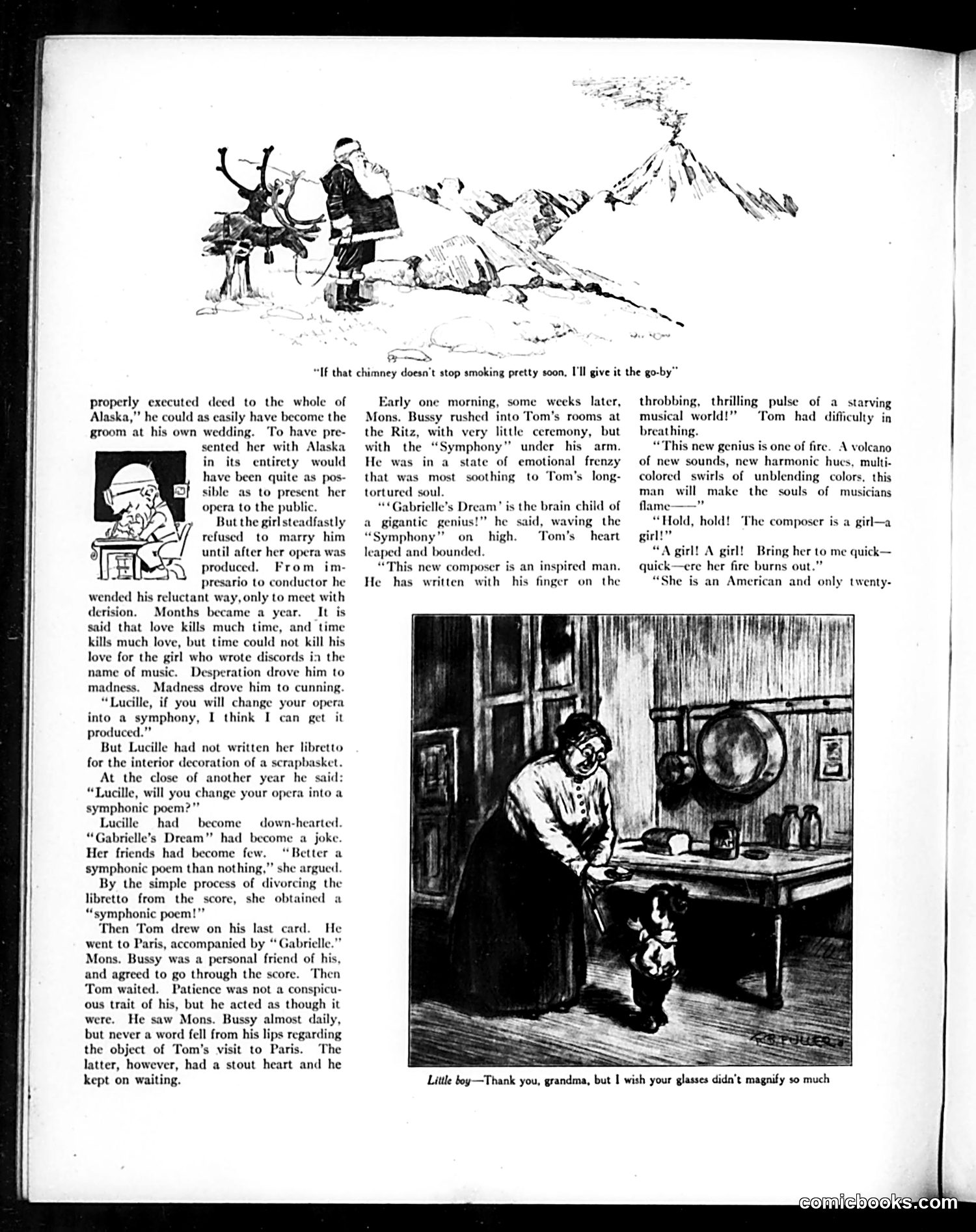
**The Story**: This page serializes a romantic tale about Tom, an impresario who falls in love with Lucille, a female composer. She refuses to marry him until her opera "Gabrielle's Dream" is produced. Unable to get it staged, Tom gradually convinces her to transform it into a symphony, then a symphonic poem—progressively compromising her artistic vision. He finally takes the score to Paris, where a famous conductor (Mons. Bussy) enthusiastically endorses it as genius work by "an inspired man"—only to learn the composer is a young American woman. **The Satire**: The piece mocks both the music world's gender bias and how artistic integrity gets sacrificed for commercial success. It suggests that a woman composer's work gains recognition only when attributed to a man, and that love/desperation drive artists to water down their original vision. The smaller cartoon about the chimney is unrelated domestic humor. The page criticizes early 20th-century barriers women faced in the arts industry.
📄 Transcribed text from this page (OCR, searchable)
Machine-transcribed from the original scan — historical spelling and the odd misread are preserved.
properly executed deed to the whole of Alaska,” he could as easily have become the groom at his own wedding. To have pre- sented her with Alaska in its entirety would have been quite as pos- sible as to present her opera to the public. But the girl steadfastly refused to marry him until after her opera was produced. From im- presario to conductor he wended his reluctant way, only to meet with derision. Months became a year. It is said that love kills much time, and time kills much love, but time could not kill his love for the girl who wrote discords in the name of music. Desperation drove him to madness. Madness drove him to cunning. Lucille, if you will change your ope into a symphony, I think I can get it produced.” But Lucille had not written her libretto for the interior decoration of a scrapbasket. At the close of another year he said: “Lucille, will you change your opera into a symphonic poem?” Lucille had = become —down-hearted. “Gabrielle’s Dream” had become a joke. Her friends had become few. “Better a symphonic poem than nothing,” she argued. By the simple process of divorcing the libretto from the score, she obtained a “symphonic poem Then Tom drew on his last card. He went to Paris, accompanied by “¢ Mons. Bussy was a personal friend of his, and agreed to go through the score. Then Tom waited. Patience was not a conspicu- ous trait of his, but he acted as though it were. He saw Mons. Bussy almost daily, but never a word fell from his lips regarding the object of Tom's visit to Paris. The latter, however, had a stout heart and he kept on waiting. r—S “If that chimney doesn’t stop smoking pretty soon, I'll give it the go-by” Early one morning, some weeks later, throbbing, thrilling pulse of a starving Mons. Bussy rushed into Tom's rooms at musical world!” = Tom had difficulty in the Ritz, with very little ceremony, but with the “Symphony” under his arm. “This new genius is one of fire. A volcano He was in a state of emotional frenzy of new sounds, new harmonic hucs, multi- that was most soothing to Tom's long- colored swirls of unblending colors, this tortured soul. man will make the souls of musicians ‘Gabrielle’s Dream’ is the brain child of | flame——” a gigantic genius!” he said, waving the “Hold, hold! ‘The composer is a gira “Symphony” on high. Tom’s heart — girl!” leaped and bounded. “A girl! A girl! Bring her to me quick— “This new composer is an inspired man. — quick—ere her fire burns out.” He has written with his finger on the “She is an American and only twenty- Little boy—Thank you, grandma, but I wish your glasses didn’t magnify so much