
Judge, 1915-12-11 · page 24 of 28
Judge — December 11, 1915 — page 24: what you’re looking at
What you’re looking at
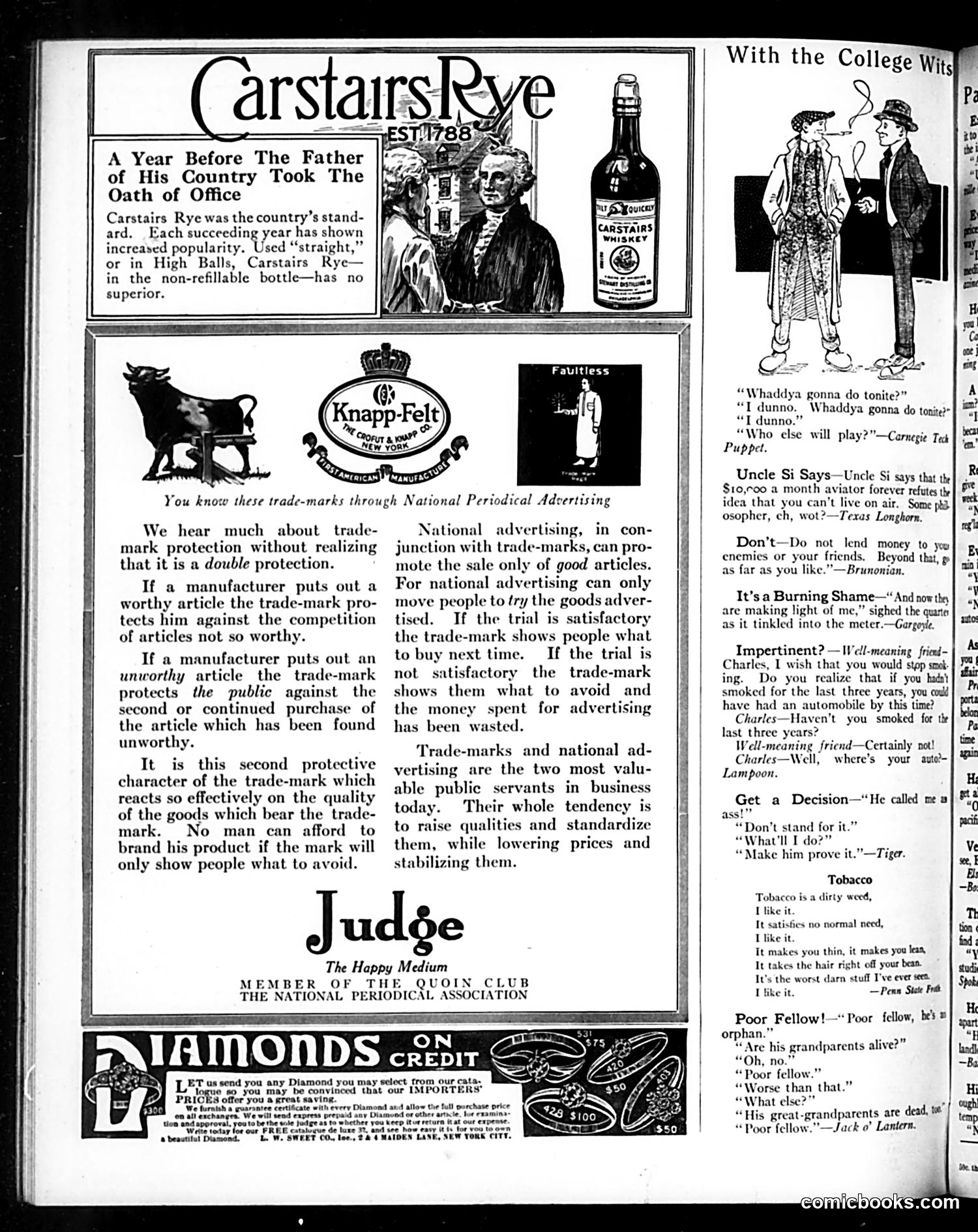
This page from *Judge* magazine features mostly **advertisements and humor columns** rather than political cartoons. The main content includes: **Advertisements**: Carstairs Rye whiskey (featuring George Washington's era imagery), Judge magazine itself ("The Happy Medium"), and Diamonds on Credit. **Humor Columns**: Brief jokes and witticisms from "College Wits," "Uncle Si Says," and other contributors—typical magazine filler content mocking contemporary social situations (aviators, lending money, smoking habits, automobile ownership). **Editorial Content**: A substantial piece on trade-marks and national advertising, arguing that brand protection serves the public by ensuring product quality and standardization while lowering prices. The page reflects early 20th-century magazine culture: advertisements presented as entertainment, brief satirical commentary on modern life (airplanes, automobiles), and editorial defense of advertising's role in consumer protection. There are no identifiable political figures or campaign references—this is social humor aimed at the educated magazine-reading public.
📄 Transcribed text from this page (OCR, searchable)
Machine-transcribed from the original scan — historical spelling and the odd misread are preserved.
With the College Wits A Year Before The Father of His Country Took The Oath of Office Carstairs Rye was the country’s stand- ard. Each succeeding year has shown increased popularity. Used “straight,” or in High Balls, Carstairs Rye— in the non-refillable bottle—has no superior. “Whaddya gonna do tonite?” “T dunno. Whaddya gonna do tonite: “T dunno.” ; “Who else will play?”—Ca Pome wrnegic Teck Uncle Si Says Uncle Si says that the $10,coo a month aviator forever refutes the idea that you can’t live on air. Some ph3- osopher, ch, wot?—Texas Longhorn, You know these trade-marks through National Periodical Advertising We hear much about trade- National advertising, in con- Don't—Do not lend money to you mark protection without realizing that it is a double protection. If a manufacturer puts out a worthy article the trade-mark pro- tects him against the competition of articles not so worthy. If a manufacturer puts out an unworthy article the trade-mark protects the public against the second or continued purchase of the article which has been found unworthy. It is this second protective character of the trade-mark which reacts so effectively on the quality of the goods which bear the trade- mark. No man can afford to brand his product if the mark will only show people what to avoid. junction with trade-marks, can pro- mote the sale only of good articles. For national advertising can only move people to try the goods adver- tised. If the trial is satisfactory the trade-mark shows people what to buy next time. If the trial is not satisfactory the trade-mark shows them what to avoid and the money spent for advertising has been wasted. Trade-marks and national ad- vertising are the two most valu- able public servants in business today. Their whole tendency is to raise qualities and standardize them, while lowering prices and stabilizing them. J 7 The Happy Medium MEMBER _ OF THE THE NATIONAL PERIODICAL QUOIN CLUB ASSOCIATION ET us send you any Diamond you may select from our cat: ue so you may be convinced that our IMPORTERS’ | enemies or your friends. as far as you like.”"—Brunonian, It’s a Burning Shame— “And now they are making light of me, as it tinkled into the meter.—Gargoyle. Impertinent? —Well-meaning friexd- Charles, I wish that you would stop smet- ing. Do you realize that if you hads} smoked for the last three years, have had an automobile by this time? Charles—Haven't you smoked {or the last three ye Well-meaning friend—Certainly not! Charles—Well, Lampoon. Get a Decision—‘He called mo ass!” where’s your auto’ Don’t stand for ii “What'll I do “Make him prove it.”—Tiger. Tobacco It satisfies no normal need, 1 like it It makes you thin, it makes you lean, It takes the hair right off your bean. It's the worst darn stuff I've ever seen Poor Fellow!—‘ Poor fellow, bes ® orphan.” “Oh, no.” “Poor fellow.’ —Penn State Fr re his grandparents alive?” “Worse than, that.” “What “His great-grandparents are dead, te” “Poor fellow.” "—Jack o’ Lantern. Beyond that, g ”” sighed the quate, cond Be GT WFR be. ra a ay bof EL