
Judge, 1915-12-11 · page 14 of 28
Judge — December 11, 1915 — page 14: what you’re looking at
What you’re looking at
The main illustrated story depicts a blackmail scenario typical of early 1900s melodrama. A rejected suitor confronts a woman who married a wealthy older man (Newcome) for money rather than love. The man threatens to expose her affair with a dancer named Santelli unless she complies with his wishes. She rejects him indignantly. The plot resolves when both Newcome and the blackmailer die in a train accident, leaving the woman a wealthy widow. **The satire targets:** Upper-class hypocrisy—specifically women who marry for wealth while conducting affairs, and men who exploit such situations through blackmail and surveillance. The accompanying humor sections mock minor domestic absurdities (Christmas trees preventing dancing, wives extracting alimony through silence, farmers making repeated mistakes), while the acrostic poem provides moral commentary on "Christmas" virtues. The cartoon reflects *Judge* magazine's preoccupation with exposing society's moral corruption behind genteel appearances.
📄 Transcribed text from this page (OCR, searchable)
Machine-transcribed from the original scan — historical spelling and the odd misread are preserved.
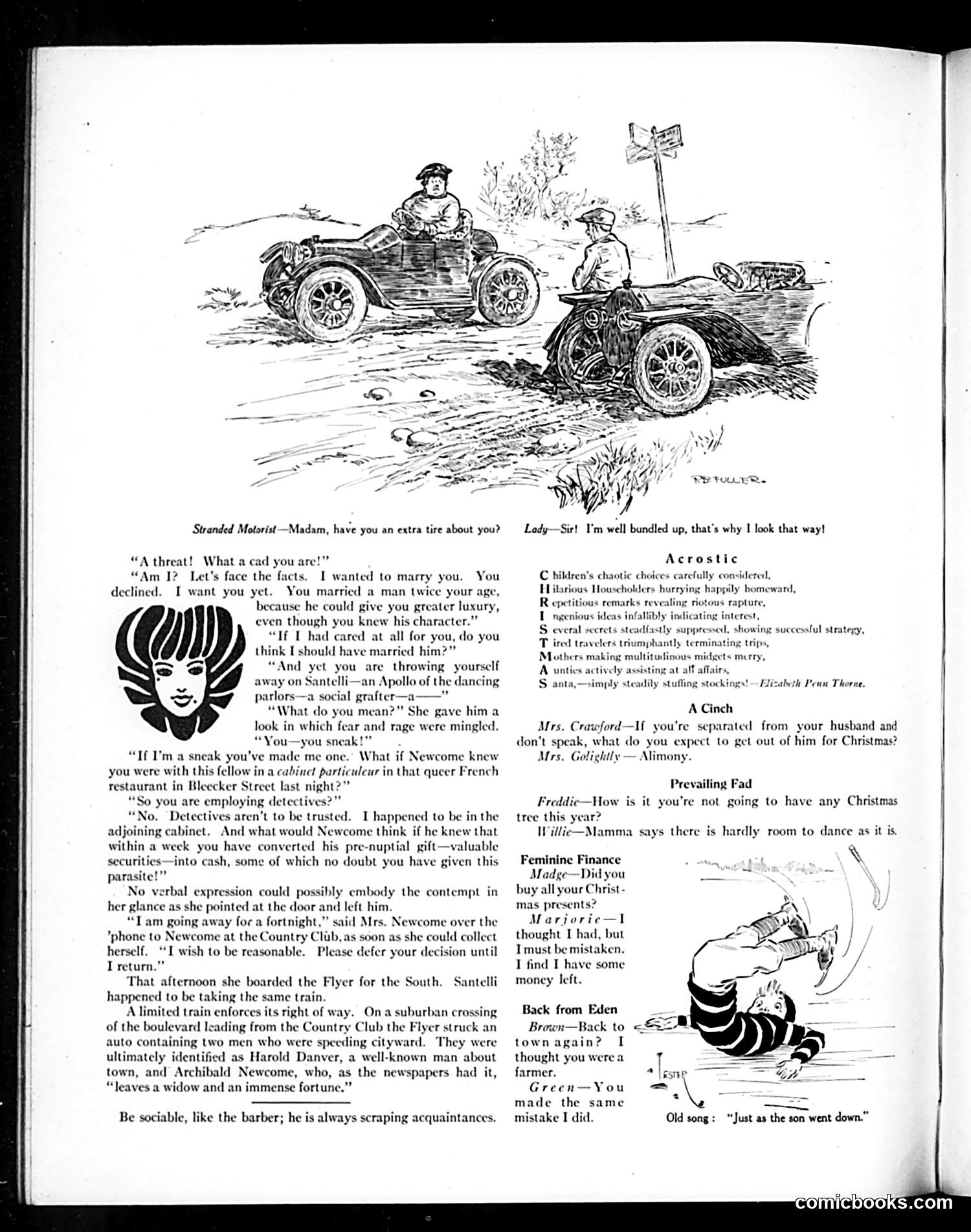
Stranded Motorist Madam, have you an extra tire about you? A threat! What a cad you are!” You Be, “Am I? Let’s face the facts. I wanted to marry you. declined. I want you yet. You married a man twice your because he could give you greater luxury, even though you knew his character.” “If [ had cared at all for you, do you think [should have married him?” se “And yet you are throwing yourself away on Santelli—an Apollo of the dancing parlors—a social grafter—a——” “What do you mean?” She gave him a look in which fear and rage were mingled. “You—you sneak!” “If I'm a sneak you've made me one. What if Newcome knew you were with this fellow in a cabinet particuleur in that queer French restaurant in Bleecker Street last night?” » you are employing detectives?” “No. Detecti ren’t to be trusted. I happened to be in the adjoining cabinet. And what would Newcome think if he knew that within a week you have converted his pre-nuptial gift—valuable securities—into cash, some of which no doubt you have gi i parasite No verbal expression could possibly embody the contempt in her glance as she pointed at the door and left him. “Tam going away for a fortnight,” said Mrs. Newcome over the ‘phone to Newcome at the Country Clib, as soon as she could collect herself. “I wish to be reasonable. Please defer your decision until I return. That afternoon she boarded the Flyer for the South, happened to be taking the same train. A limited train enforces its right of way. Ona suburban crossing of the boulevard leading from the Country Club the Flyer struck an auto containing two men who were speeding cityward. They were ultimately identified as Harold Danver, a well-known man about town, and Archibald Newcome, who, as the newspapers had it, “leaves a widow and an immense fortune.” Santelli Be sociable, like the barber; he is al scraping acquaintances. Lody—Sir! I'm well bundled up, that’s why I look that way! Acrostic choices carefully considered, hap ous rapture, C hildren’s cha Hilarious Householders hurryi y homeward, ficating interest, al, showing successful strategy, i trips, allibly S everal secrets steadfastly suppre T ired travelers triumphantly term NM A unties actively S anta,—simply st hers making multitudinous midgets merry, Elizabeth Penn Thorne, ly stuffing stocki A Cinch Mrs. Crawford—If you're separated from your husband and don’t speak, what do you expect to get out of him for Christmas? Mrs. Golightly — Mimony. Prevailing Fad Freddice—How is it you're not going to have any Christmas tree this year? Willie—Mamma s hardly room to dance as it is. s there Feminine Finance om \ Madge—Did you buy all your Christ- mas presents? Marjorie—I thought I had, but I must be mistaken. I find I have some money left. Back from Eden Brown—Back to «: town again? I thought you were a farmer. Green—You made the same — “a Old song: “Just as the son went down. mistake I did.