
Judge, 1915-12-11 · page 11 of 28
Judge — December 11, 1915 — page 11: what you’re looking at
What you’re looking at
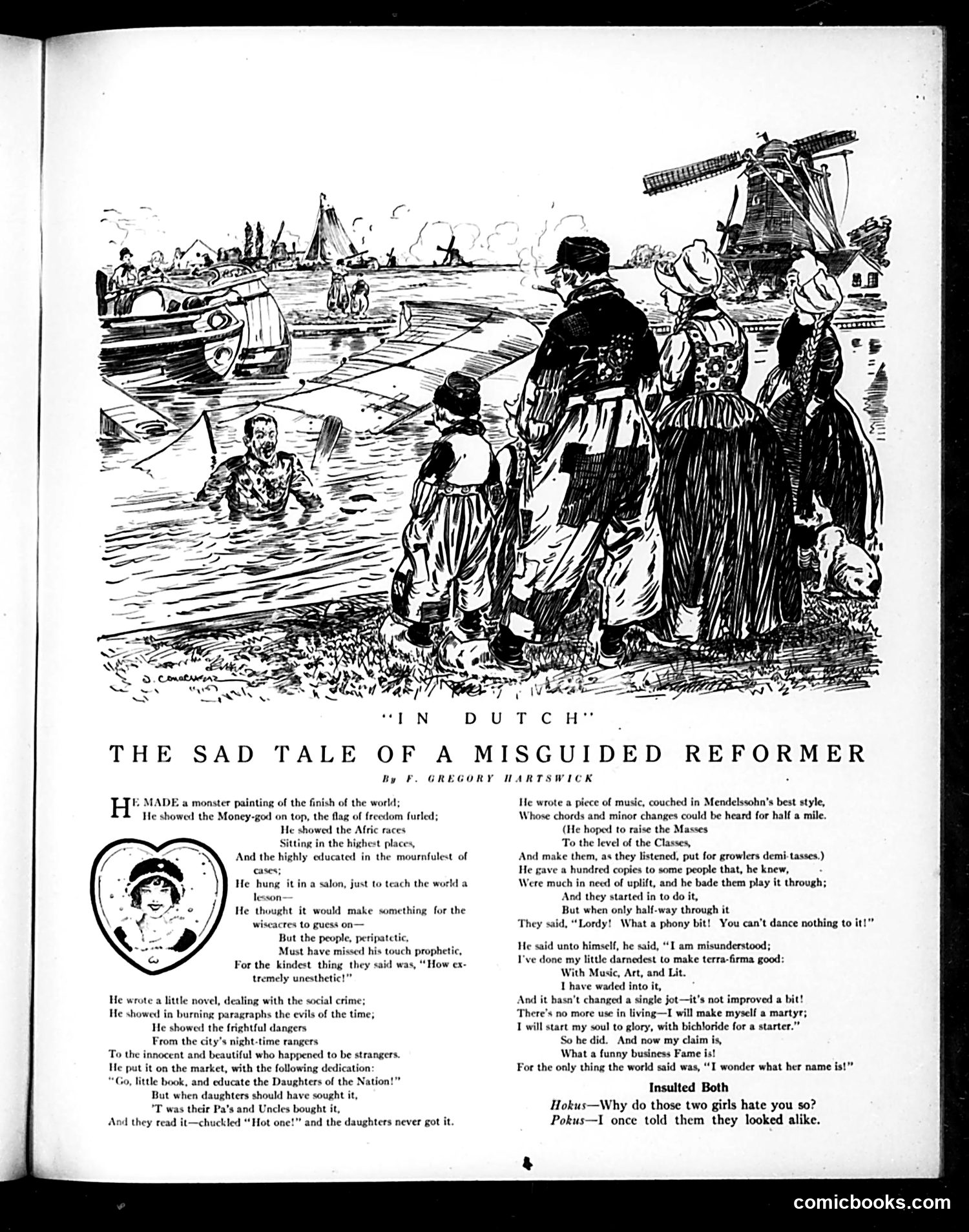
This satirical poem by Gregory Hartswick mocks well-intentioned but ineffectual social reformers of the period (likely early 1900s). The protagonist is a self-righteous artist-activist who attempts to improve society through high-minded works: apocalyptic paintings depicting racial equality, novels exposing urban crime, and classical music meant to elevate the masses. The satire's point: his efforts consistently fail because ordinary people either ignore them or find them pretentious and unrelatable. His painting is called "unesthetic," his novel reaches only men who read it as titillation, and his music is un-danceable. The bitter ending—he commits suicide expecting martyrdom, only for the world to forget him entirely—mocks both his self-importance and society's indifference to reform movements. The concluding "Hokus-Pokus" joke about girls looking alike provides comic relief from the dark ending. The Dutch village setting in the illustration appears decorative rather than thematically significant.
📄 Transcribed text from this page (OCR, searchable)
Machine-transcribed from the original scan — historical spelling and the odd misread are preserved.
BAS atc SLA ae '7/ “TON ; THE SAD TALE OF A MISGUIDED REFORMER HARTSWICK : By Fo. GREGORY E. MADE a monster painting of the finish of the world; He showed the Money-god on top, the flag of freedom furled; He showed the Afric races Sitting in the highest places, And the highly educated in the mournfulest of cases; He hung it ina salon, just to teach the world a lesson- He thought it would make something for the wiseaces to guess on— But the people, peripatetic, Must have missed his touch prophetic, For the kindest thing they said was, “How ex- tremely unesthetic!”” He wrote a little novel, dealing with the social crime; He showed in burning paragraphs the evils of the time; He showed the frightful dangers From the city’s night-time rangers To the innocent and beautiful who happened to be strangers. He put it on the market, with the following dedication: “Go, little book, and educate the Daughters of the Nation!” But when daughters should have sought it, ‘T was their Pa’s and Uncles bought it, And they read it—chuckled “Hot one!” and the daughters never got it. H He wrote a piece of music, couched in Mendelssohn's best style, Whose chords and minor changes could be heard for half a mile. (He hoped to raise the Masses To the level of the Classes, And make them, as they listened, put for growlers demi-tasses.) He gave a hundred copies to some people that, he knew, Were much in need of uplift, and he bade them play it through; And they started in to do it, But when only half-way through it They said, “Lordy! What a phony bit! You can’t dance nothing to it!” He said unto himself, he said, “I am misunderstood; I've done my little darnedest to make terra-firma good: With Music, Art, and Lit. I have waded into it, And it basn’t changed a single jot—it's not improved a bit! ‘There's no more use in living—I will make myself a martyr; I will start my soul to glory, with bichloride for a starter.” So he did. And now my claim is, What a funny business Fame is! For the only thing the world said was, “I wonder what her name is!” Insulted Both Hokus—Why do those two girls hate you so? Pokus—I once told them they looked alike. comicbooks.com