
Judge, 1915-12-11 · page 9 of 28
Judge — December 11, 1915 — page 9: what you’re looking at
What you’re looking at
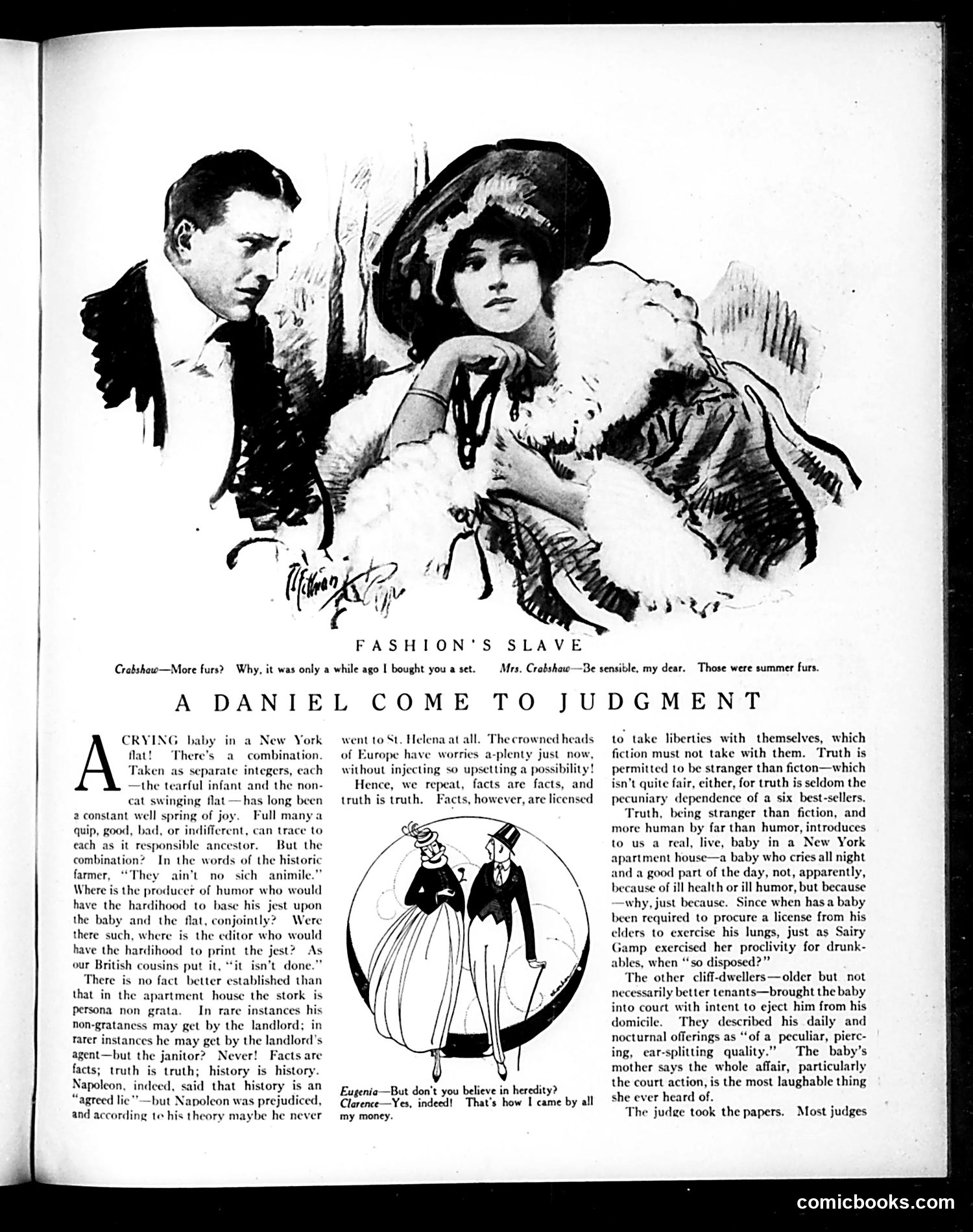
This page contains two satirical pieces about social hypocrisy and absurdity: **"Fashion's Slave"** (top cartoon): A husband protests his wife's constant demand for new fur coats, noting he just bought her a set. Her response—that those were "summer furs"—mocks the arbitrary fashion industry's ability to convince wealthy women that they need entirely separate wardrobes for different seasons, treating fashion as an endless consumption treadmill. **"A Daniel Come to Judgment"** (main article): The piece ridicules apartment-house culture in New York City. Landlords and tenants sue to evict a baby from a flat because its crying disturbs neighbors. The author argues this absurdly prioritizes property comfort over basic human needs—a baby cannot be licensed to cry any more than a person can be licensed to breathe. The satire exposes the dehumanizing pettiness of urban apartment living and class-conscious neighbor disputes. Both pieces target wealthy or pretentious urban society with gentle, humorous criticism.
📄 Transcribed text from this page (OCR, searchable)
Machine-transcribed from the original scan — historical spelling and the odd misread are preserved.
Crabshaw—More furs? Cc. Ese FT ft Ms Why, it was only a while ago I bought you a set. FASHION'S SLAVE Mrs. Crabshaw—Be sensible, my dear. Those were summer furs. A DANIEL COME TO JUDGMENT CRYI baby in a New York flat! There’s a combination. Taken as separate integers, each —the tearful infant and the non- cat swinging flat —has long been 2 constant well spring of joy. Full many a quip, good, bad, or indifferent, can trace to each it responsible ancestor. But the combination? In the words of the historic farmer, “They ain't no sich animile.” Where is the producet of humor who would have the hardihood to base his jest upon the baby and the flat, conjointly? Were there such, where is the editor who would have the hardihood to print the jest? As our British cousins put it, “it isn’t done.” There is no fact better established than that in the apartment house the stork is Persona non grata. In rare ances his Non-grataness may get by the landlord; in Tarer instances he may get by the landlord's agent—but the janitor? Never! Facts are facts; truth is truth; history history. Napoleon, indeed, said that history is an “agreed lie’ —but Napoleon was prejudiced, and according te his theory maybe he never went to St. Helena at all. The crowned heads of Europe have worries a-plenty just now, without injecting so upsetting a possibility! Hence, we repeat, facts are facts, truth is truth. nd Facts, however, are licensed Eugenia—But don't you believe in heredity? Clarence—Yes, indeed! That's how I came by all my money. to take liberties with themselves, which fiction must not take with them. Truth is permitted to be stranger than ficton—which isn’t quite fair, either, for truth is seldom the pecuniary dependence of a six best-sellers. Truth, being stranger than fiction, and more human by far than humor, introduces to us a real, live, baby in a New York apartment house—a baby who cries all night nd a good part of the day, not, apparently, because of ill health or ill humor, but because -why, just because. Since when has a baby been required to procure a license from his elders to exercise his lungs, just as Sairy Gamp exercised her proclivity for drunk- ables, when “so disposed?” the other cliff-dwellers—older but not necessarily better tenants—brought the baby into court with intent to eject him from his domicile. They described his daily and nocturnal offerings as “of a peculiar, pierc- ing, ear-splitting quality.” The baby’s mother says the whole affair, particularly the court action, is the most laughable thing she ever heard of. judge took the papers. Most judges comicbooks.com