
Judge, 1915-12-11 · page 7 of 28
Judge — December 11, 1915 — page 7: what you’re looking at
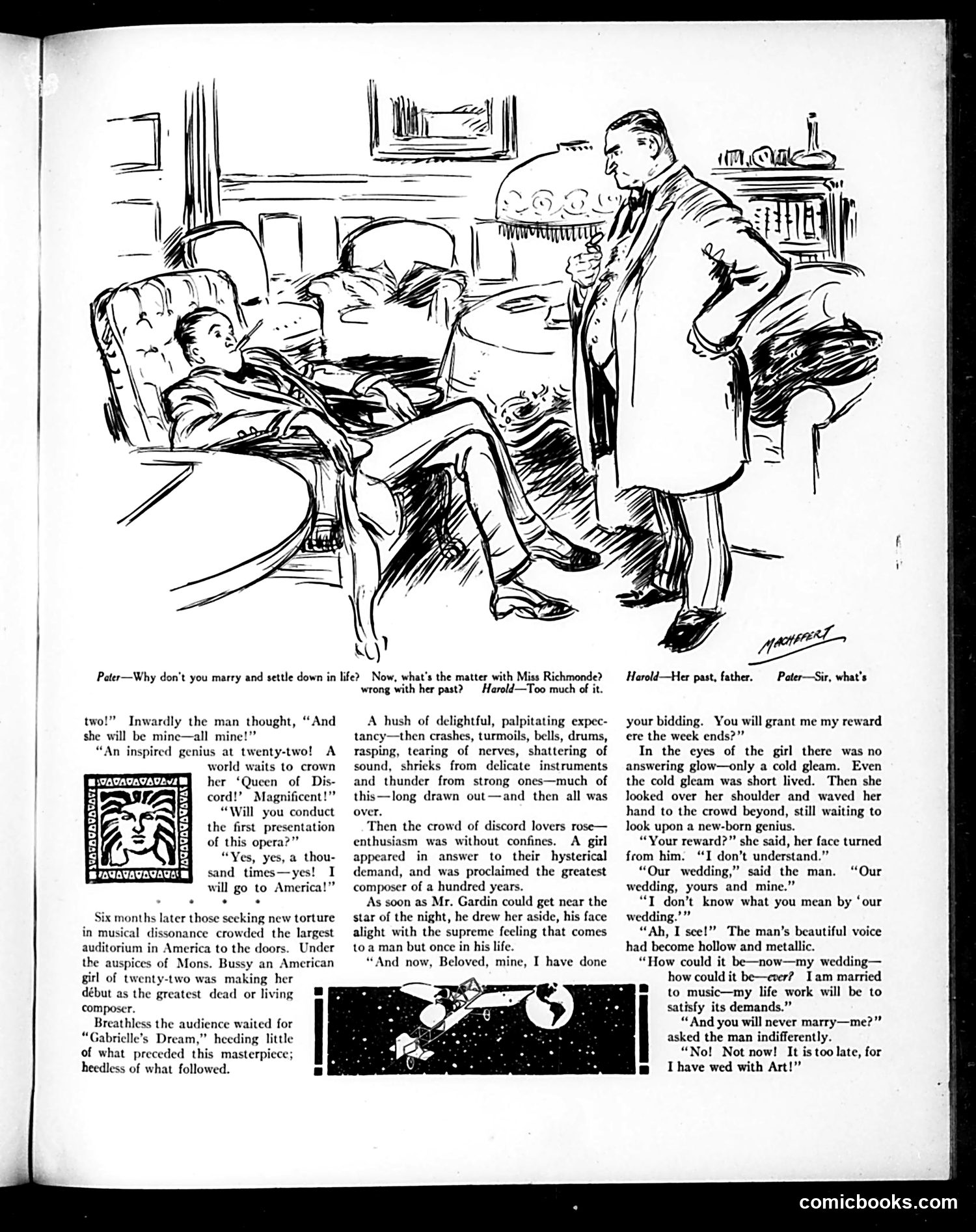
What you’re looking at
This story satirizes the conflict between romantic love and artistic ambition, likely reflecting early 20th-century anxieties about women pursuing careers. The narrative follows a man who encourages a talented young woman (Miss Richmonde) to compose an opera, imagining marriage afterward. Her avant-garde composition "Gabrielle's Dream"—described as discordant noise with crashes and thunder—becomes a sensational success, making her famous. The satire targets both figures: the man's assumption that professional success naturally leads to marriage, and the woman's complete devotion to "Art," abandoning personal relationships entirely. Her final declaration—"I have wed with Art!"—is the punchline, mocking the romantic notion that artistic genius demands total self-sacrifice and celibacy. The joke likely resonates with Judge's audience as commentary on the "New Woman" and artistic pretension, suggesting both excessive romanticism about art and skepticism toward women prioritizing careers over marriage.
📄 Transcribed text from this page (OCR, searchable)
Machine-transcribed from the original scan — historical spelling and the odd misread are preserved.
Pater—Why don’t you marry and settle down in life? Now, what's the matter with Miss Richmonde? two!” Inwardly the man thought, “And she will be mine—all mine!” “An inspired genius at twenty-two! A world waits to crown her ‘Queen of Dis- cord!’ Magnificent!” “Will you conduct the first presentation of this opera?” “Yes, yes, a thou- sand times—yes! I will go to America!” Six months later those seeking new torture in musical dissonance crowded the largest auditorium in America to the doors. Under the auspices of Mons. Bussy an American girl of twenty-two was making her début as the greatest dead or living composer. Breathless the audience waited for “Gabrielle’s Dream,” heeding little of what preceded this masterpiece; heedless of what followed. wrong with her past? Harold—Too much of it. A hush of delightful, palpitating expec- tancy—then crashes, turmoils, bells, drums, rasping, tearing of nerves, shattering of sound, shrieks from delicate instruments and thunder from strong ones—much of this—long drawn out—and then all was over. Then the crowd of discord lovers rose— enthusiasm was without confines. A girl appeared in answer to their hysterical demand, and was proclaimed the greatest composer of a hundred years. As soon as Mr. Gardin could get near the star of the night, he drew her aside, his face alight with the supreme feeling that comes toa man but once in his life. “And now, Beloved, mine, I have done Harold—Her past, father. Pater—Sir, what's your bidding. You will grant me my reward ere the week ends?” In the eyes of the girl there was no answering glow—only a cold gleam. Even the cold gleam was short lived. Then she looked over her shoulder and waved her hand to the crowd beyond, still waiting to look upon a new-born genius. “Your reward?” she said, her face turned from him. “I don’t understand.” “Our wedding,” said the man. wedding, yours and mine.” “T don’t know what you mean by ‘our wedding.’” “Ah, I sce!” The man’s beautiful voice had become hollow and metallic. “How could it be—now—my wedding— how could it be—ever?_ Iam married ® to music—my life work will be to satisfy its demands.” “And you will never marry—me?”’ asked the man indifferently. “No! Not now! It is too late, for Ihave wed with Art!” “Our comicbooks.com