
Judge, 1915-12-11 · page 4 of 28
Judge — December 11, 1915 — page 4: what you’re looking at
What you’re looking at
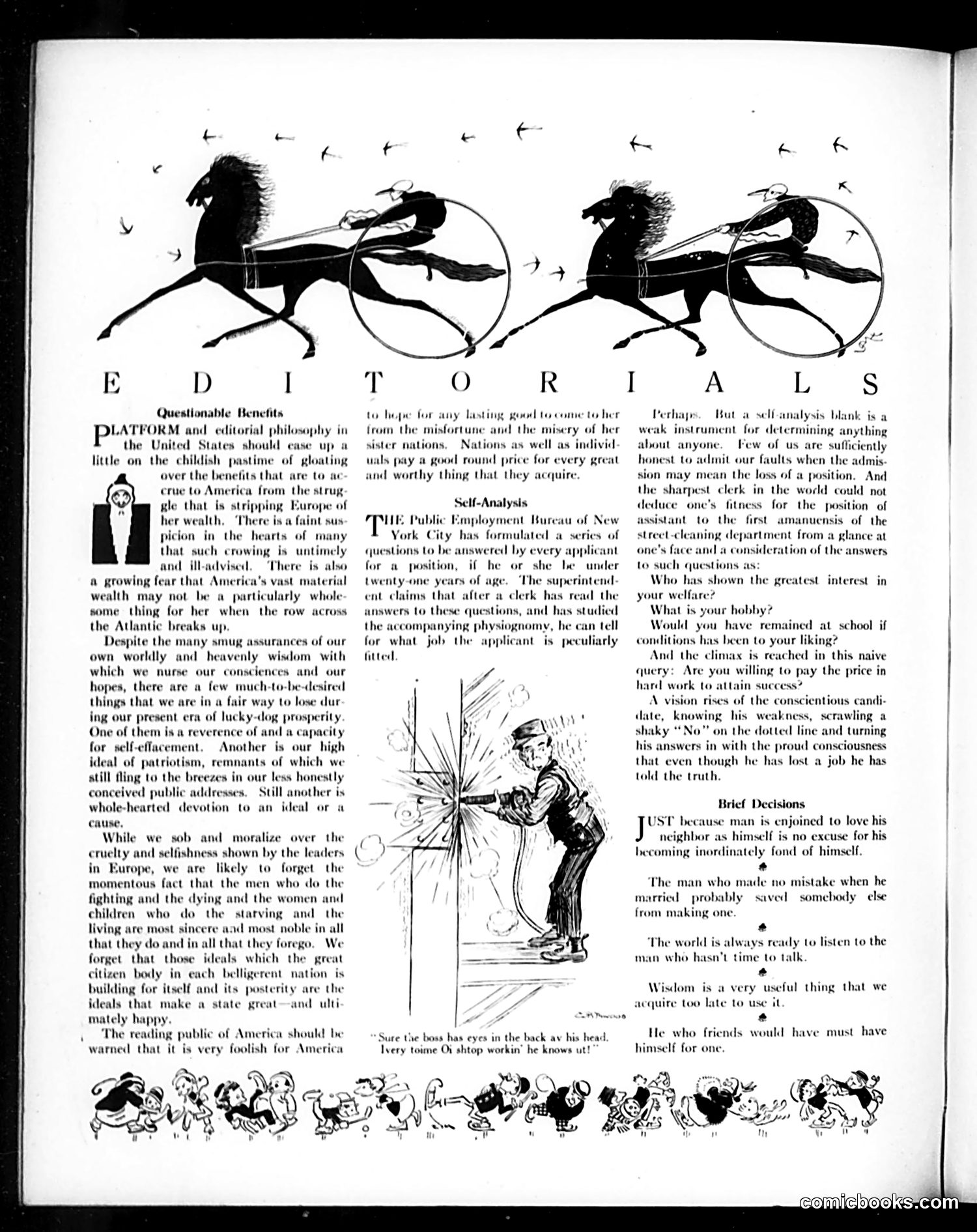
The top illustration titled "EDITORIALS" depicts two identical silhouettes of women in classical pose, holding whips and driving chariot wheels. This appears to be satirizing female authority or empowerment—likely commentary on women's suffrage or changing gender roles in early 20th-century America. The accompanying text discusses patriotism, national ideals, and self-reflection. A middle illustration shows a man at work with explosives or machinery, captioned "Sure the boss has eyes in the back av his head. Every time I'm shop workin' he knows it!"—satirizing worker surveillance and workplace distrust. The "Brief Decisions" section offers cynical aphorisms about marriage, human nature, and wisdom, typical of Judge's sardonic editorial voice. The exact historical moment remains unclear without a date.
📄 Transcribed text from this page (OCR, searchable)
Machine-transcribed from the original scan — historical spelling and the odd misread are preserved.
D 1D) 4 Questionable Benefits LATFORM and editorial philosophy in the United States should ease up a little on the childish pastime of gloating over the benefits that are to ac erue to America from the strug gle t is stripping Europe of her wealth, ‘There is a faint sus picion in the hearts of that such crowing is untimely and illadvised. ‘There is also a growing fear that America's vast material wealth may not be a particularly whole some thing for her when the row across the Atlantic breaks up. Despite the many smug assurances of our own worldly and heavenly wisdom with which we nurse our consciences and our hopes, there are a few much-to-be-desired things that we are in a fair way to lose dur ing our present era of lucky-dog prosperity. One of them is a reverence of and a capacity for self-eflacement. Another is our high ideal of patriotism, remnants of which we still fling to the breezes in our less honestly conceived public addresses. other is whole-hearted devotion to an ideal or a cause, While moralize over the cruelty and selfishness shown by the leaders in Europe, we are likely to forget the ntous fact that the men who do the fighting and the dying and the women and Q we sob and children who do the starving and the living are most sincere and most noble in all that they do and in all that th We forget that those ideals whi great citizen body in each belli nation is building for itself and its posterity are the ideals that make a state great--and ulti mately happy. The reading public of America should be warned that it is very foolish for America O ty Lanting good to come to her sh to hope for from the misfortune and the misery of hei Nations as well as indi uister nations. uals pay a good round price for every. gre and worthy thing that they acquire. Self-Analysis HE, Public Employment Bur York City has formulated questions to be answered by ev of New series of y applicant he under for a position, if he twenty-one years of age. ¢ questions, and has studied vy, he can tell answers to the the accompanying physiogno for what job the applicant fitted Sure the boss has eyes in the back av his head. Ivery toime Oi shtop workin” he knows ut! Perhaps. But a sellanalysis blank is a weak instrument for determining about anyone. Few of us are sufliciently honest to admit our faults when the admis: sion may mean the loss of a position. And the sharpest clerk in the world could not deduce one's fitness for the position of to the first’ amanuensis of the y department from a glance at consi¢ anything ant cleani one’s face and jon of the answers to such questions as: Who has shown the greatest interest in re? What is your hobby? Would you have remained at school if conditions has been to your liking? And the climax is reached in this naive query: Are you willing to pay the price in hard work to attain success? A vision rises of the conscientious candi- date, knowing his weakness, scrawling a shaky “No” on the dotted line and turning his answers in with the proud consciousness that even though he has lost a job he has told the truth. Brief Decisions yest because man is enjoined to love his neighbor as himself is no excuse for his hecoming inordinately fond of himself. * The man who made no mistake when he married probably somebody else from making one saved * ‘The world is always ready to listen to the man who hasn't time to talk * Wisdom is a very useful thing that we acquire too late to use it & He who friends would have must have himself for one.