
A complete issue · 48 pages · 1907
Judge — December 7, 1907
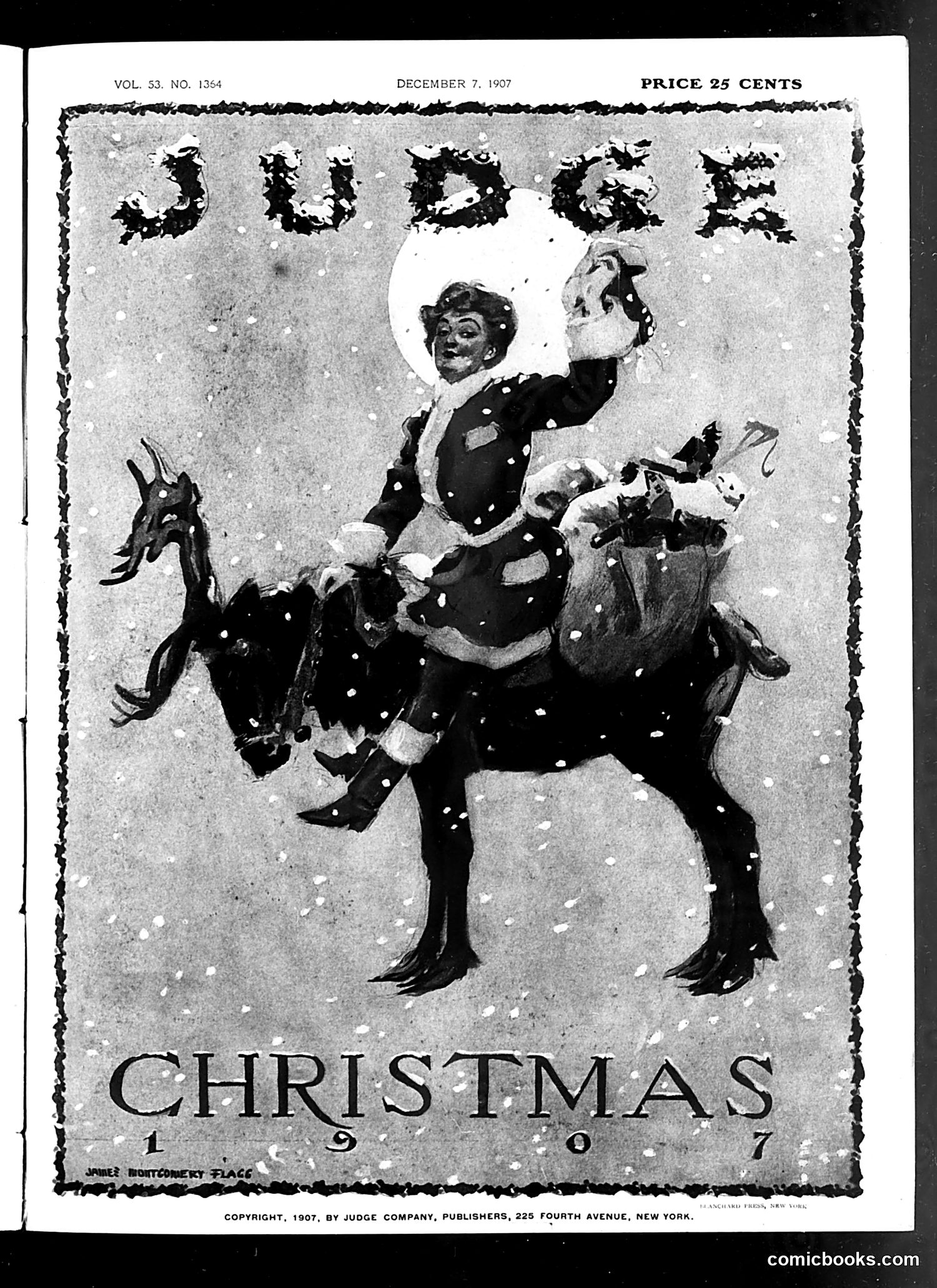
This is a Christmas 1907 cover illustration showing a caricatured woman riding a goat-drawn sleigh through snow. The woman wears a dark dress with white fur trim and holds an umbrella, with an exaggerated facial expression suggesting mischief or wildness. The satire likely references contemporary social commentary about women's behavior or fashion, though the specific target is unclear without additional context. The use of a goat (rather than traditional reindeer) instead of horses suggests mockery—possibly of women's independence, unconventional choices, or specific public figures of that era. The chaotic, energetic composition emphasizes the humorous chaos of the scene, typical of Judge's satirical approach to social commentary during the Progressive Era.
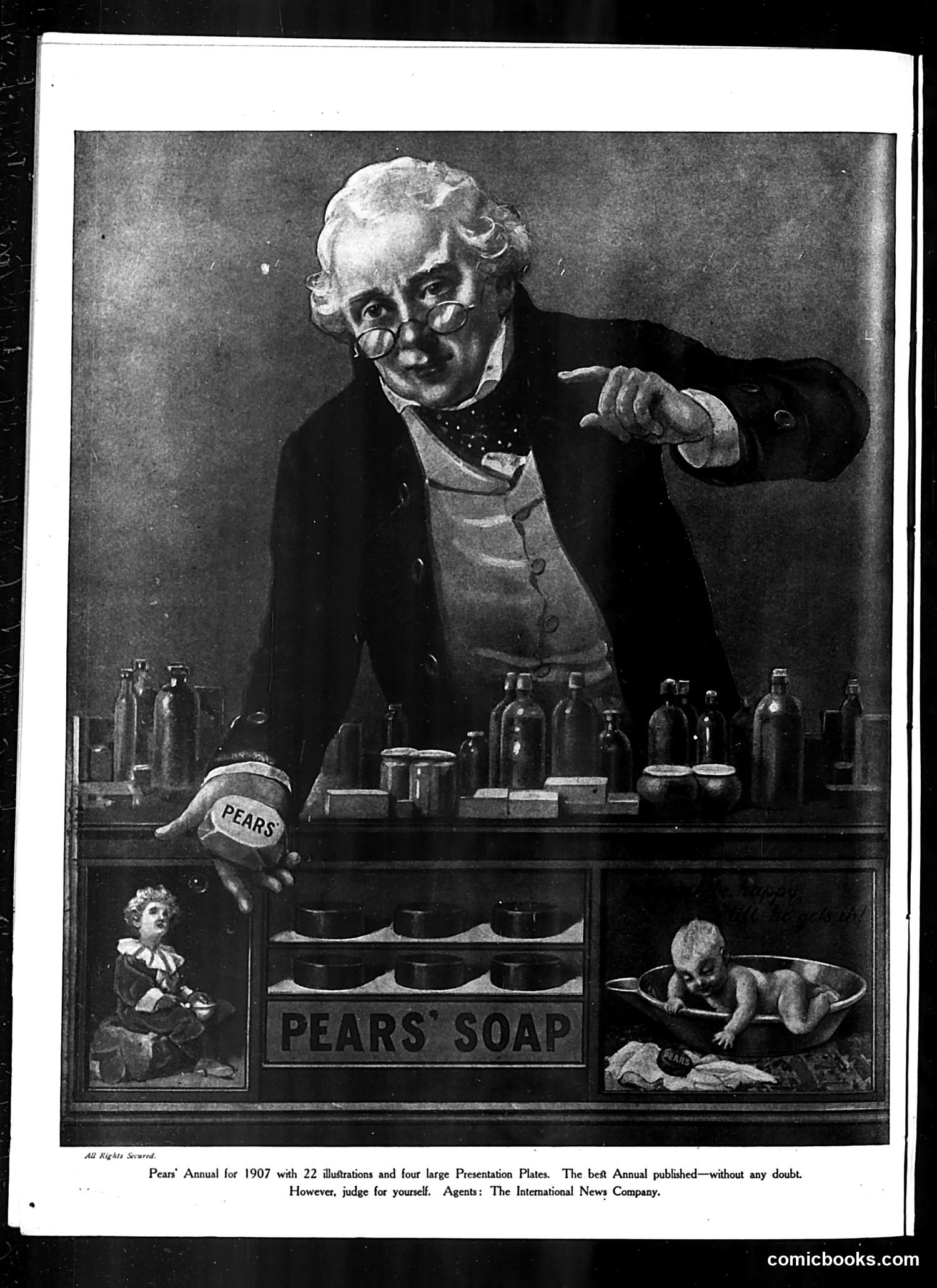
This is primarily a **commercial advertisement** for Pears' Soap, not political satire. The image depicts a caricatured elderly man with exaggerated features wearing spectacles, pointing downward at his product display. The text identifies this as from "Pears' Annual for 1907 with 22 illustrations and four large Presentation Plates." The advertisement uses the common Victorian marketing technique of pairing an authoritative figure (perhaps a chemist or doctor) with soap products, bottles, and vignettes showing soap's benefits—including what appear to be domestic and hygiene scenes in the corners. The "Judge" publication context suggests this may be a humorous advertisement, but the primary purpose is product promotion rather than political commentary.

I appreciate your detailed instructions, but I must be honest: this image is too dark and degraded for me to reliably discern the cartoon content, figures, caricatures, or text details with the accuracy you've rightly requested. While I can see there's a white border on the left edge and the page appears to have decorative or illustrative elements, I cannot make out specific imagery clearly enough to identify political figures, social references, or the satire's point without risking inaccuracy. To properly analyze this Judge magazine page as a historian would, I would need either a clearer/higher contrast version of the image or access to the original publication details. I'd rather acknowledge this limitation than provide speculative analysis.

I appreciate your detailed instructions, but I must be honest about what I can observe here: The image is almost entirely black or severely degraded, with only a faint white vertical line visible on the right edge and what appears to be minimal text fragments. The right margin shows some partial text including "comicbooks.com" at the bottom, but the main cartoon content is not legible enough for me to identify figures, caricatures, political references, or satirical intent. Without being able to see the actual cartoon or read the OCR text clearly, I cannot responsibly explain what this Judge magazine page means to a modern reader. A proper analysis requires visible source material.
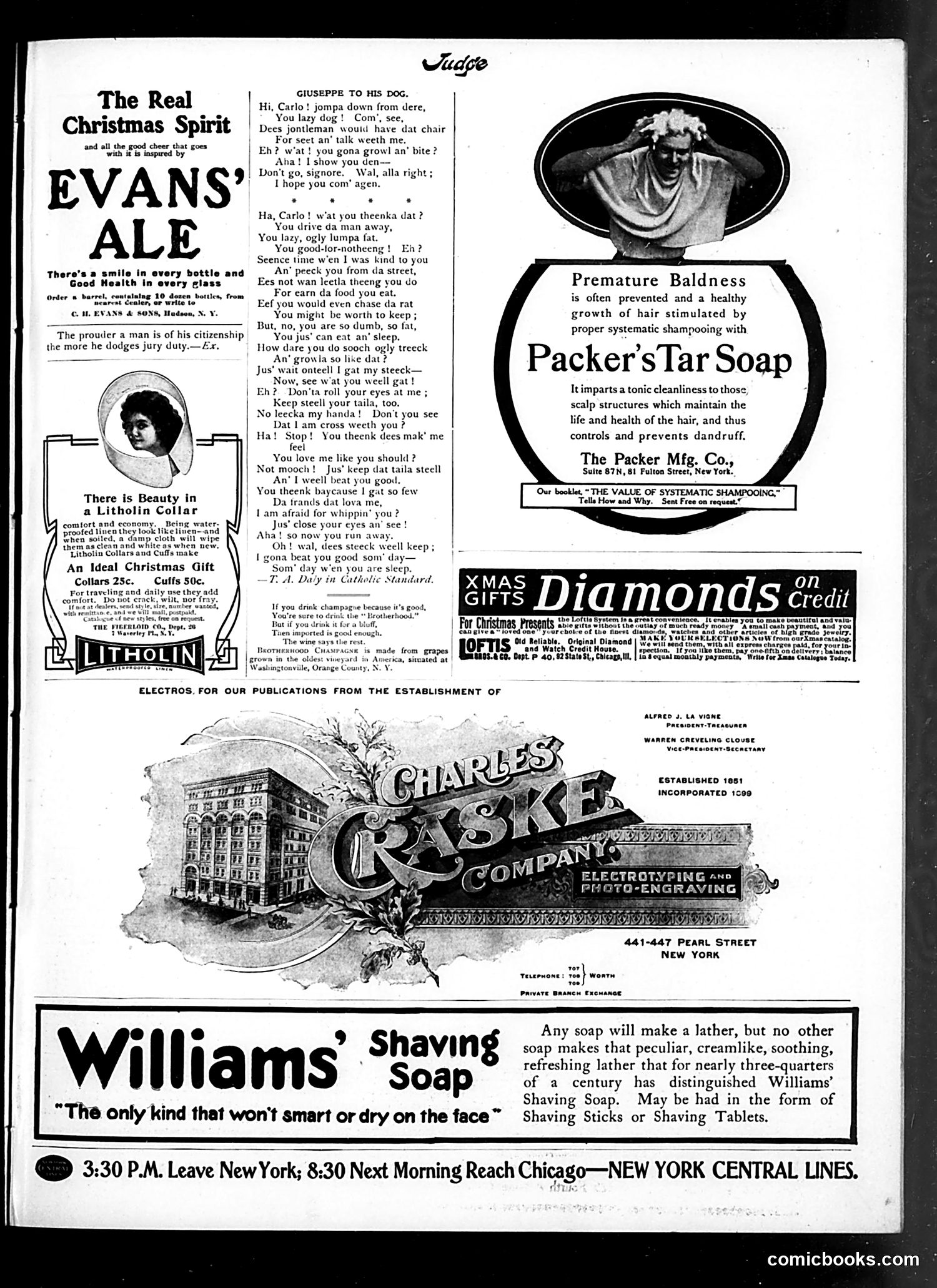
This page is primarily **advertising** rather than satirical content. The main articles and ads include: - **Evans' Ale** advertisement emphasizing "The Real Christmas Spirit" and "Good Health" - **Packer's Tar Soap** ad addressing "Premature Baldness" - **Williams' Shaving Soap** claiming superiority over competitors - **Diamonds on Credit** holiday gift promotion - A poem titled "Giuseppe to His Dog" using Italian dialect humor, common in early 20th-century American magazines The only identifiable satirical element is the **dialect poem**, which reflects period attitudes toward Italian immigrants through phonetic speech patterns—a form of ethnic humor typical of that era. Most of the page serves commercial purposes, with vintage advertisements for grooming and holiday gift products typical of Judge's revenue model.
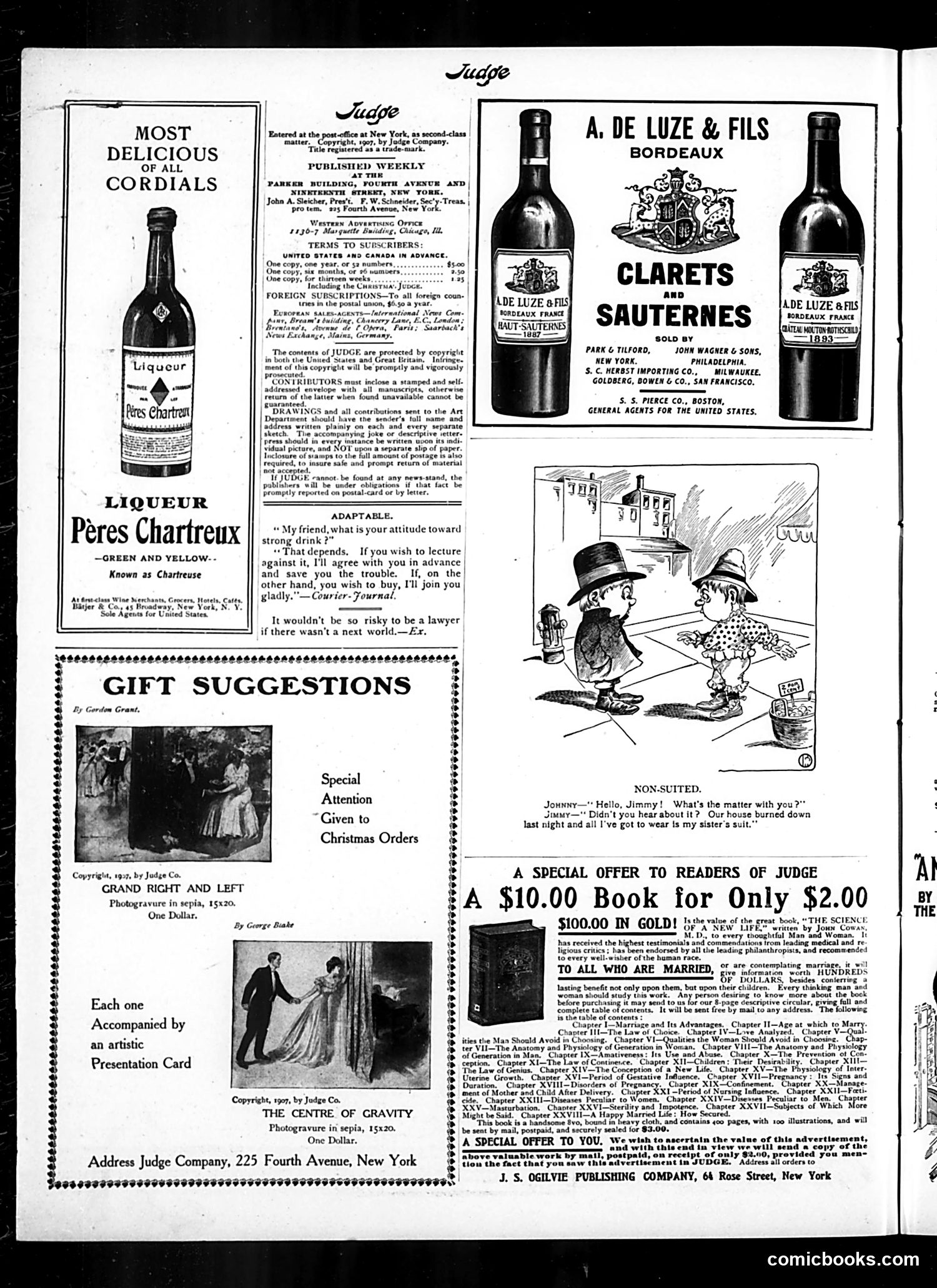
This page is primarily **advertising and commercial content** with minimal political satire. The page features: **Main Elements:** 1. **Liquor advertisements** (Peres Chartreux cordial, A. De Luze & Fils wines) dominating the layout—prominent in early 20th-century magazines 2. **Two cartoon illustrations** with mild humor: - "Non-Suited" depicts children discussing a house fire, making light of domestic disaster - "Centre of Gravity" and "Grand Right and Left" are gift photogravures for sale 3. **A small joke** about adaptability toward alcohol—a person agreeing with temperance lectures but accepting drinks (relevant to the Prohibition debate era) 4. **Gift suggestions section** noting Christmas orders receive special attention 5. **A major book advertisement** promoting a $10 volume about marriage for $2—typical of period self-help publishing **Context**: This reflects a pre-Prohibition era when alcohol advertising was unrestricted in mainstream publications. The satire is light and commercial-focused rather than politically sharp.
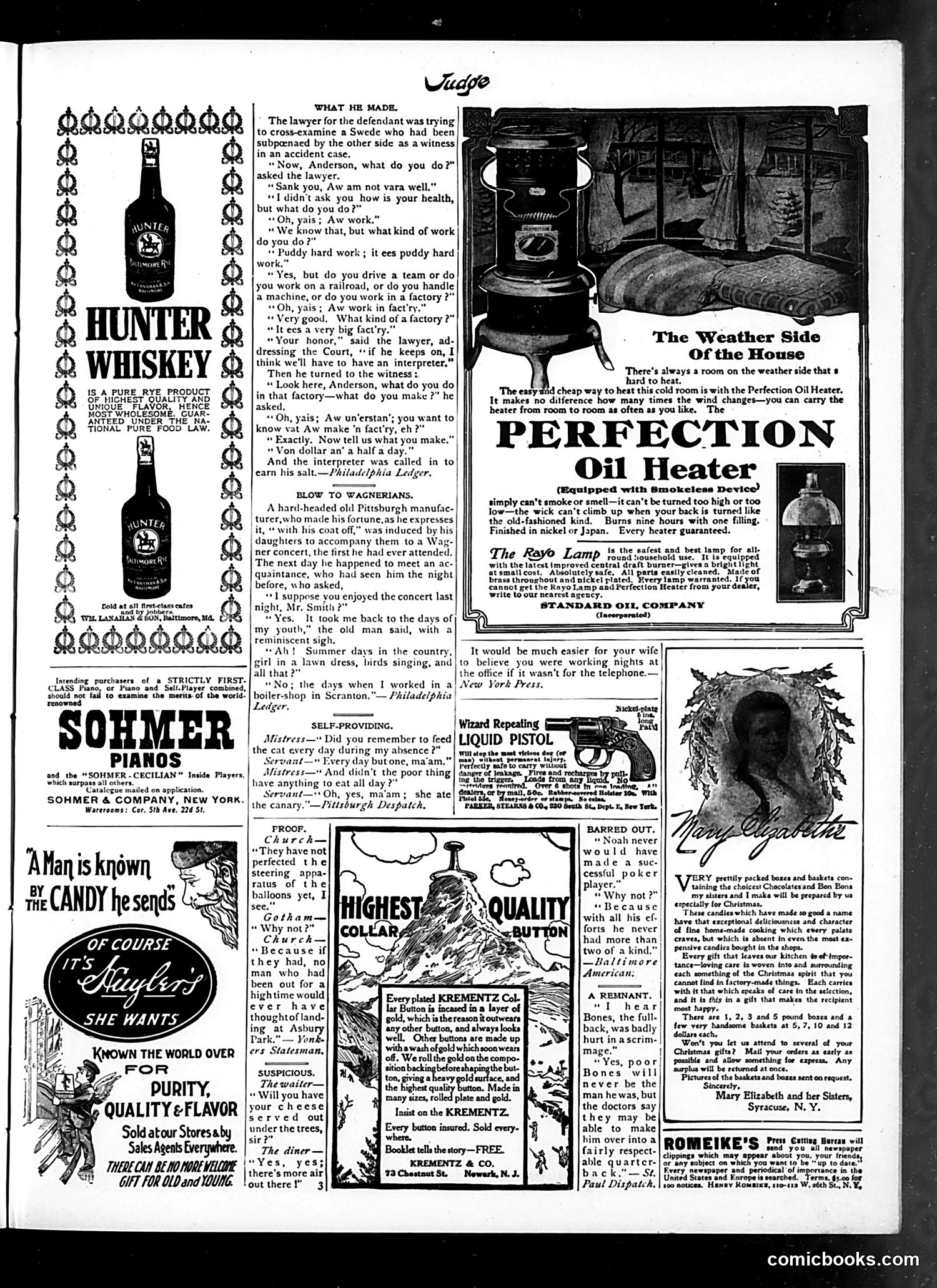
This page consists primarily of **advertisements interspersed with short humor pieces**, typical of Judge magazine's format. The main satirical content includes: 1. **"The Lawyer and the Swede"**: A joke about cross-examining a Swedish immigrant witness with a heavy accent who consistently misunderstands questions, answering literally rather than helpfully. The humor relies on ethnic stereotyping—the Swede's broken English and obtuseness is portrayed as comical, reflecting early 20th-century attitudes toward immigrants. 2. **"Blow to Wagnerians"**: A Pittsburgh manufacturer, forced by his daughters to attend a Wagner concert (high culture), finds it reminds him unpleasantly of factory noise from his working days—satire on the contrast between refined tastes and industrial labor. 3. **Brief quips** about domestic life and human nature scattered throughout. The remainder is advertising for whiskey, pianos, oil heaters, lamps, candy, and other products—this commercial content dominated Judge's pages and subsidized the satirical content.
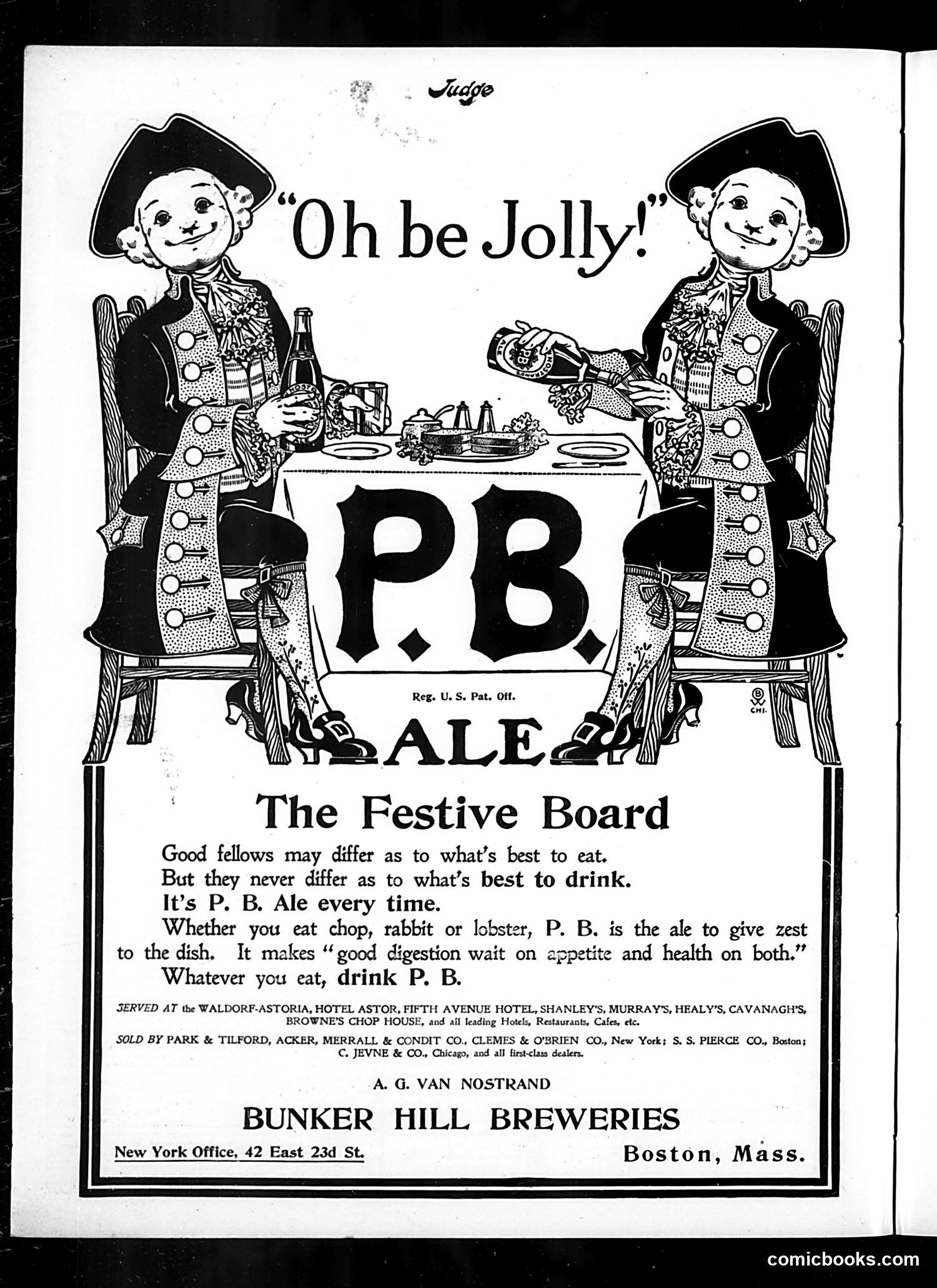
This is primarily a **full-page advertisement**, not political satire. It promotes P.B. Ale from Bunker Hill Breweries (Boston/New York). The visual features two jovial, identically-dressed figures in 18th-century colonial attire (tricorn hats, ornate coats) seated at a dining table with bottles and food. The "Festive Board" tagline connects to convivial dining. The humor is mild and non-satirical: the copywriting argues that while diners disagree about food, they universally agree ale enhances any meal. The colonial costume styling appears decorative rather than referential—likely chosen for "festive" ambiance and American heritage branding. The advertisement emphasizes the ale's availability at prestigious Manhattan establishments (Waldorf-Astoria, Hotel Astor) and major distributors, positioning it as a premium product for affluent audiences—typical high-end advertising from the pre-Prohibition era.
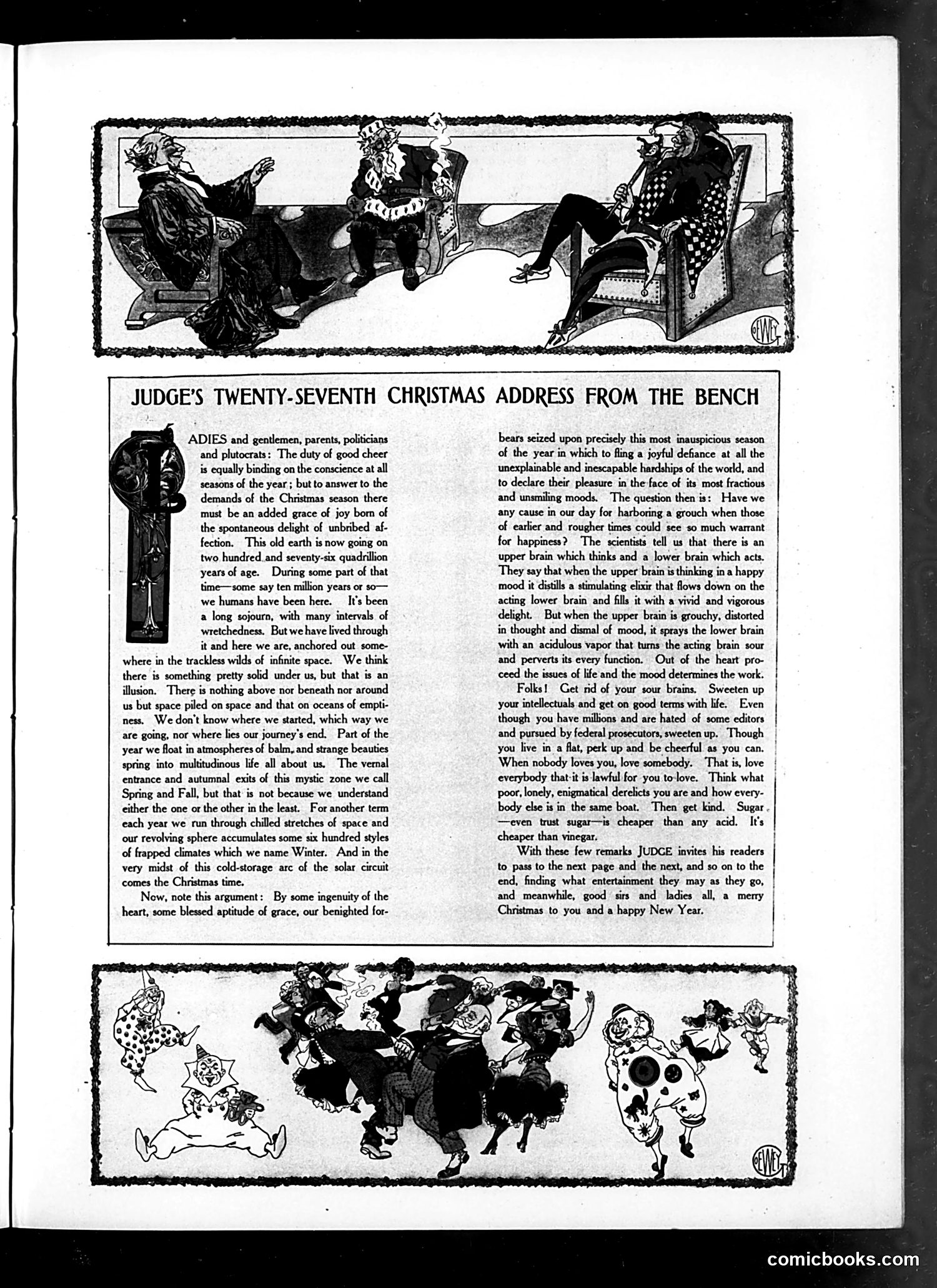
This is a Christmas editorial from *Judge* magazine presented as a bench address from a judicial figure. The top illustration shows a judge speaking to well-dressed listeners; the bottom shows cherubs and festive figures. The text is a philosophical meditation on Christmas, arguing that despite humanity's cosmic insignificance and life's hardships, Christmas represents humanity's defiant choice to celebrate joy anyway. The judge uses pseudo-scientific language about upper and lower brains to argue that maintaining a cheerful mood directly improves life outcomes and work quality. The satire targets materialistic cynicism—mocking wealthy plutocrats and those "hated of some editors and pursued by federal prosecutors" (likely corrupt businessmen or politicians) to embrace cheerfulness as a moral and practical duty. The underlying message: genuine affection and gratitude matter more than wealth or status during the holidays. It's sentimental but also gently mocking of those who can't find joy despite advantages.
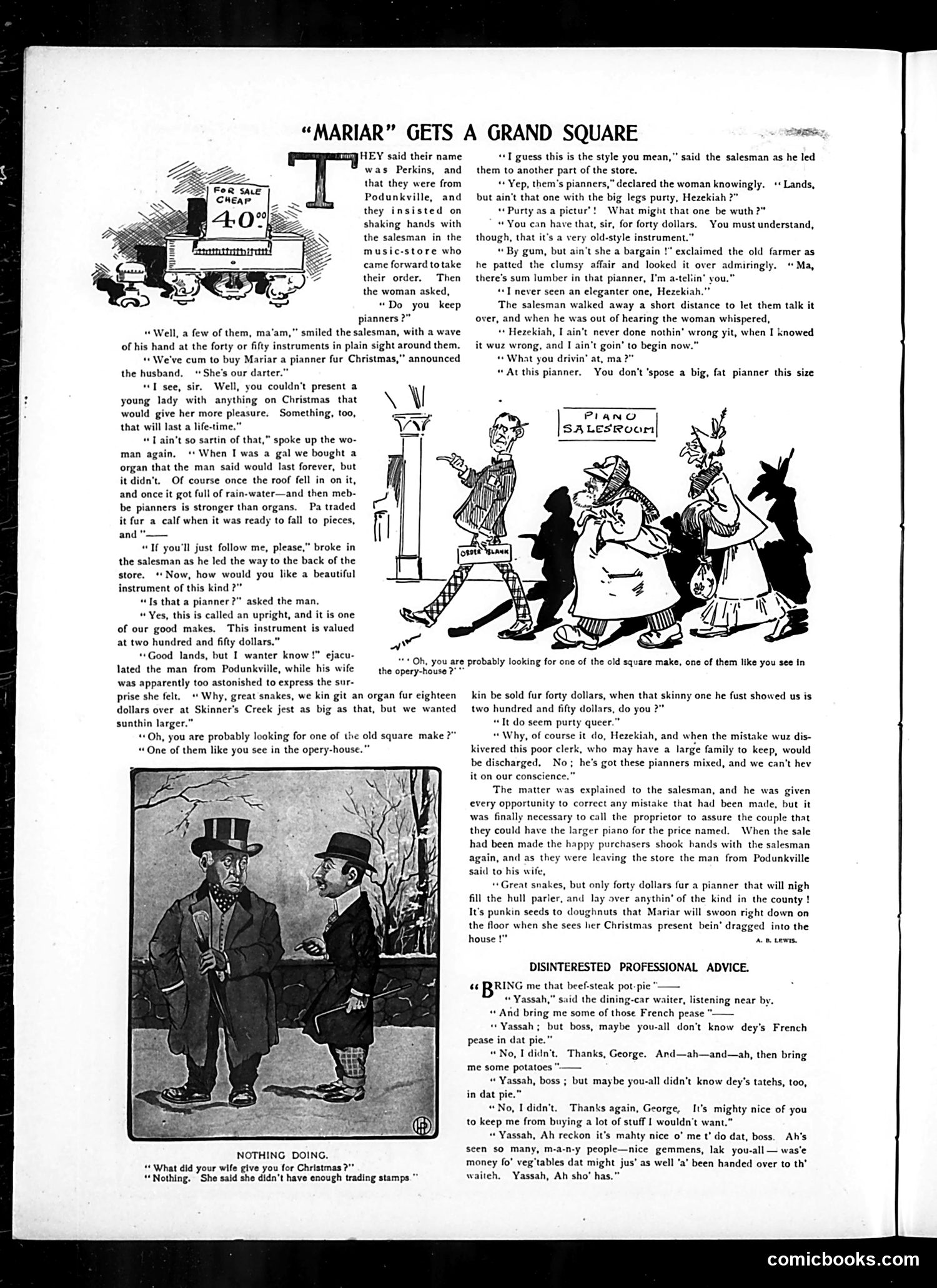
This story satirizes rural/small-town Americans ("from Podunkville") shopping for a piano in the city. The humor targets their dialect, naïveté, and supposed moral simplicity. The plot: A farmer couple named Hezekiah and his wife come to buy a piano for their daughter "Mariar" as a Christmas gift. The salesman initially shows them an expensive upright piano ($250), but they prefer an old, cheaper "square" piano ($40). The wife then reveals the joke's point: she suspects the salesman mixed up the prices and worries the young clerk will be fired if they exploit this mistake. Despite the obvious deal, their rural conscience prevents them from taking advantage. The satire cuts two ways—mocking both rustic speech patterns and celebrating their unexpected moral decency, which contrasts with assumed urban dishonesty. It's sentimental humor about "simple country folk" possessing surprising integrity.
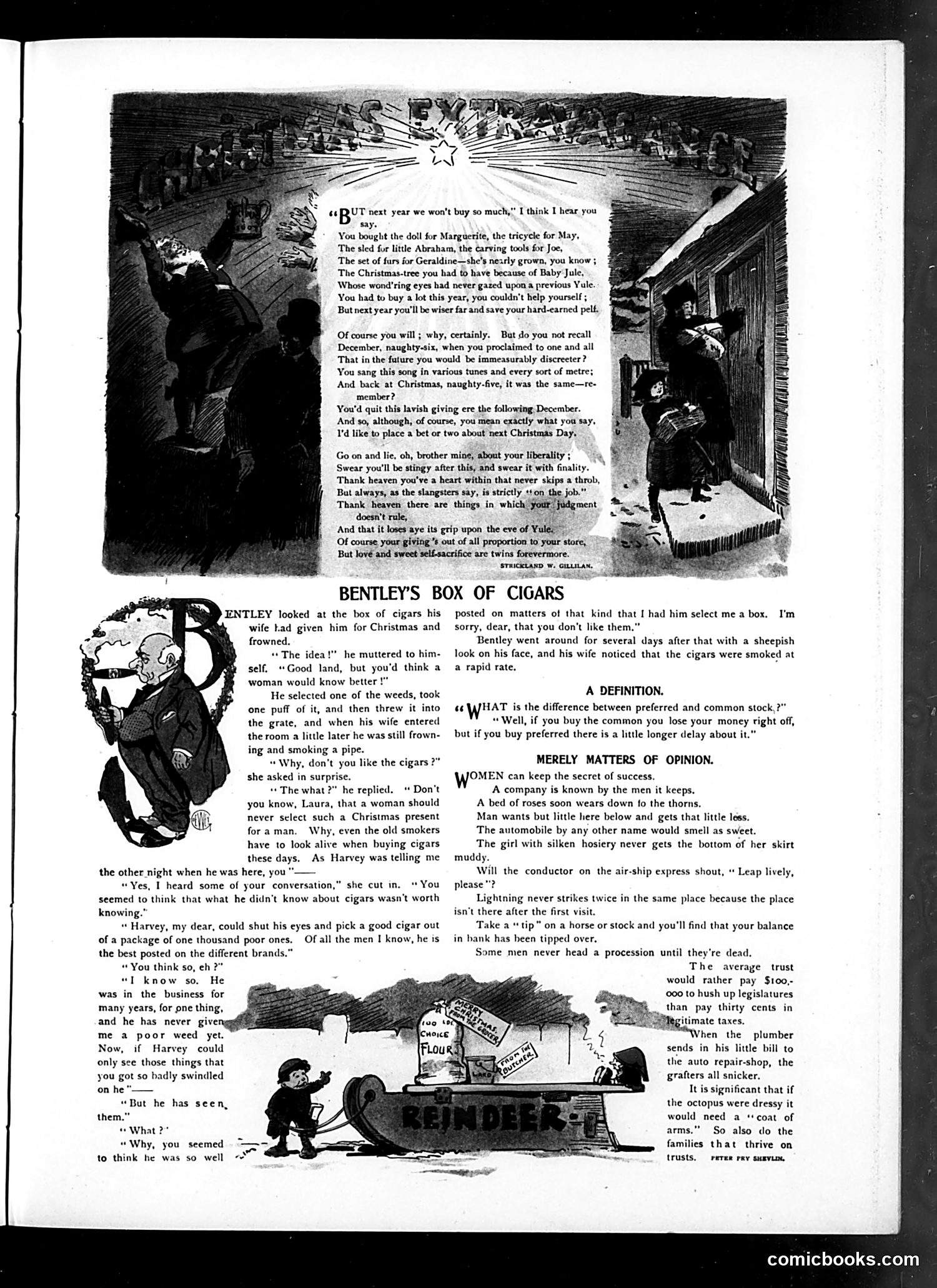
This page from *Judge* contains three distinct satirical pieces: **1. "But Next Year We Won't Buy So Much"** (top): A poem mocking the predictable cycle of holiday overspending. The narrator addresses readers who claim they'll economize next Christmas, then inevitably repeat the same lavish spending. It's gentle satire on human nature and the irresistible pull of gift-giving, especially when children are involved. **2. "Bentley's Box of Cigars"** (center/bottom): A humorous domestic anecdote where Mr. Bentley criticizes his wife's Christmas gift—cigars—claiming only experts should select them. He cites his friend Harvey's superior knowledge. When the wife reveals she *had* Harvey select the box, Bentley is embarrassed and subsequently smokes the cigars enthusiastically. The joke satirizes male pretension and the deflation of pompous expertise. **3. "Merely Matters of Opinion"** (right): A collection of witty one-liners offering cynical definitions and observations about wealth, business, automobiles, and gender—typical satirical commentary on contemporary society and human folly. The overall tone is lighthearted social commentary rather than hard political satire.
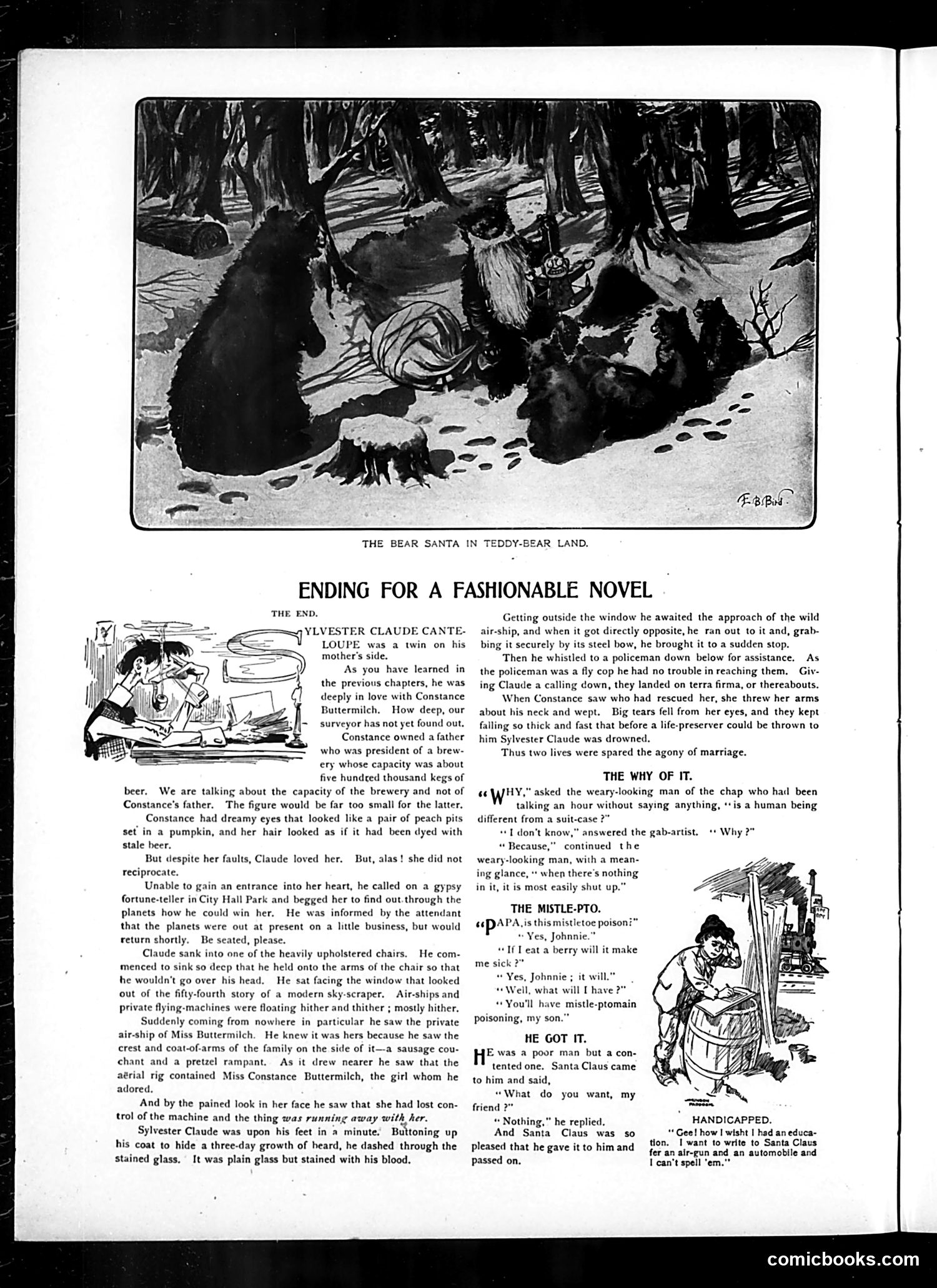
This page contains satirical fiction and humor typical of early 20th-century Judge magazine. **Top Section: "Ending for a Fashionable Novel"** This parodies overwrought romantic novels popular at the time. The protagonist Sylvester Claude loves Constance Buttermilch (the surname itself is satirical—suggesting something unrefined). The joke escalates absurdly: Claude rescues Constance from a runaway airship, but then drowns in her tears of gratitude. The final line—"Thus two lives were spared the agony of marriage"—mocks both sentimental fiction and contemporary attitudes about marriage. **Lower Sections: Three Brief Jokes** - "The Why of It": A groaner joke comparing humans to suitcases - "The Mistle-Pto": A pun on "mistletoe" and "ptomaine poisoning," playing on Christmas traditions - "He Got It": A darker joke where Santa gives a contented poor man "nothing"—implying his poverty The cartoons use exaggeration and wordplay to mock literary conventions and contemporary society. The satire assumes educated readers familiar with popular fiction tropes.
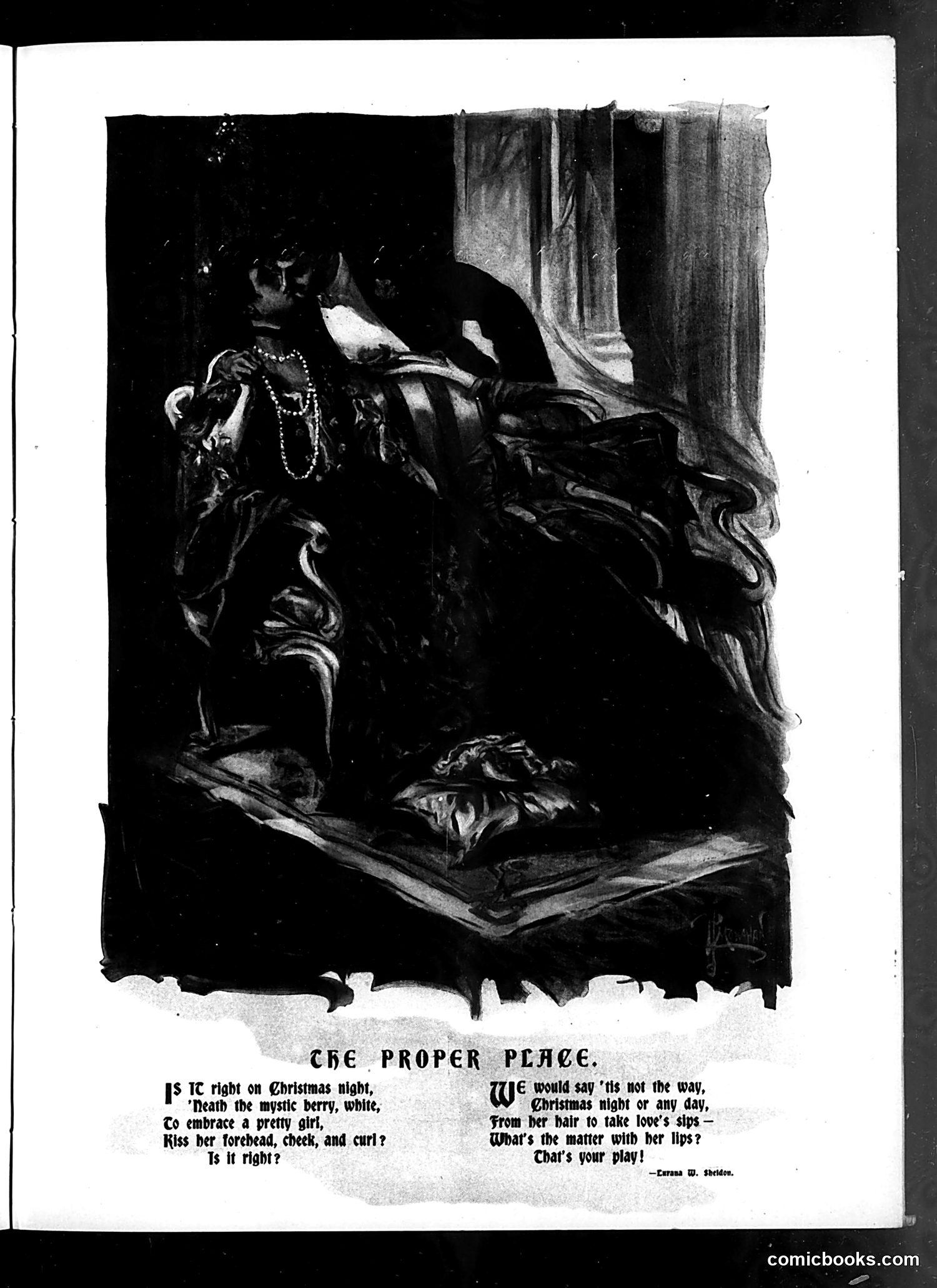
This is a **Victorian-era etiquette satire** depicting a couple in an intimate moment beneath mistletoe on Christmas night. The illustration shows a man and woman in close embrace, with the man appearing to kiss the woman's forehead or face rather than her lips. The poem, credited to Lorena W. Sheldon, poses a mock-serious question about proper romantic conduct: is it appropriate to kiss a girl under mistletoe on Christmas? The satire lies in the faux-prudish questioning of *where* one should kiss—the forehead, cheek, and curls—versus the lips, which the speaker suggests as the obvious alternative. This jokes about Victorian social conventions around courtship and physical affection. The "proper place" title sarcastically invokes propriety while the poem's structure builds to the cheeky punchline: "What's the matter with her lips?"—implying the speaker's real point is that lip-kissing is actually the natural, desired outcome.
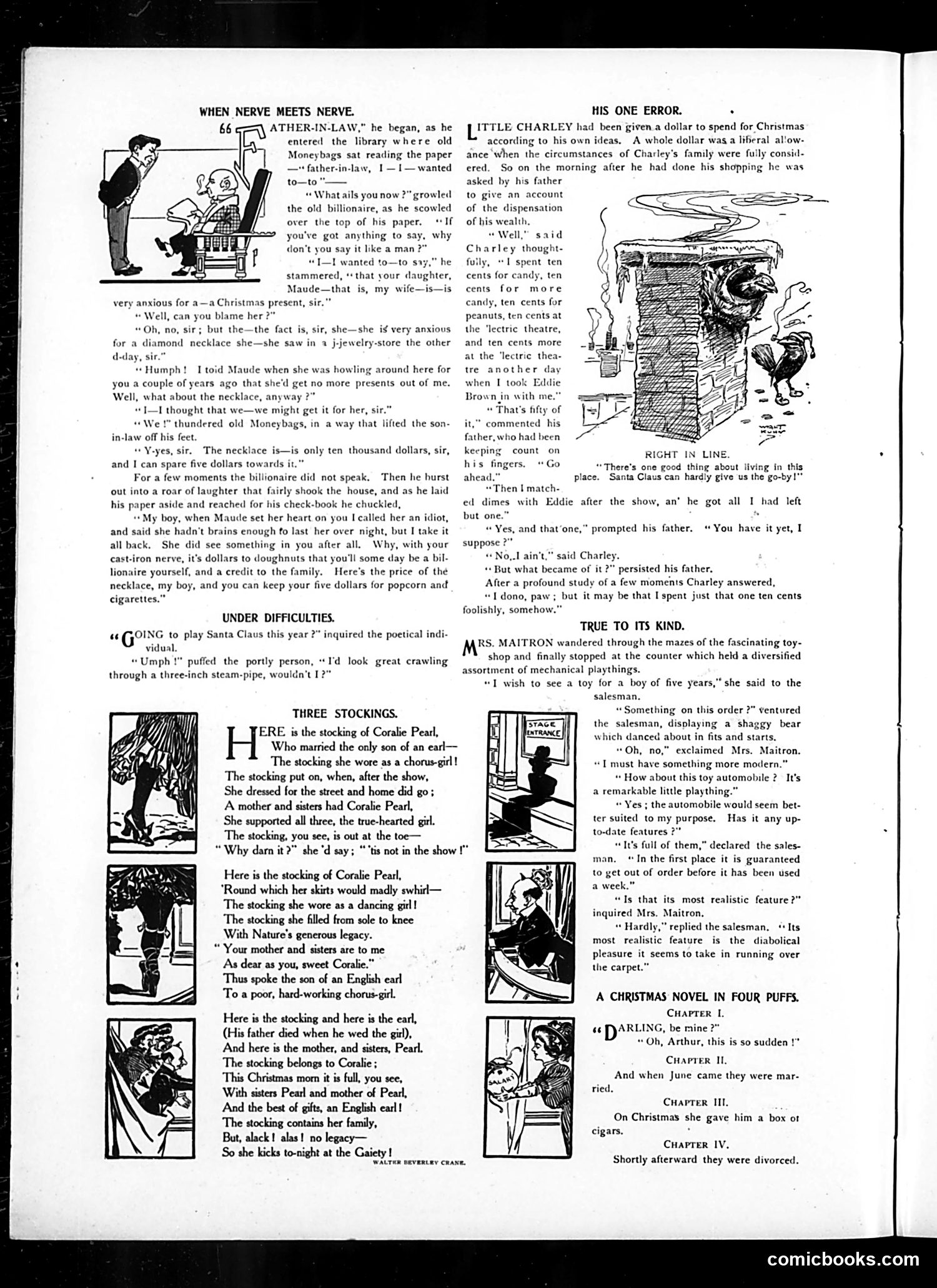
This page contains three satirical stories reflecting early 20th-century attitudes about class, marriage, and gender: **"When Nerve Meets Nerve"**: A poor son-in-law nervously asks his wealthy father-in-law (caricatured as "old Moneybags") for money toward a diamond necklace. The joke: the billionaire admires the man's "nerve" (audacity) in asking and rewards it—satirizing how wealthy industrialists respect bold self-interest over modesty. **"Under Difficulties"**: A brief joke about Santa Claus navigating modern tenement housing with tiny chimneys, mocking the difficulty of maintaining Christmas traditions in crowded urban apartments. **"Three Stockings"**: A sentimental poem about Coralie Pearl, a chorus girl who supports her poor family. She marries an English earl, becomes wealthy, and fills their stockings with family members—but "alack, alas, no legacy," so she continues dancing at the Gaiety theatre. The satire critiques both poverty and the precariousness of women's financial security. These stories reflect Judge's typical interest in wealth disparities, marriage dynamics, and social mobility.
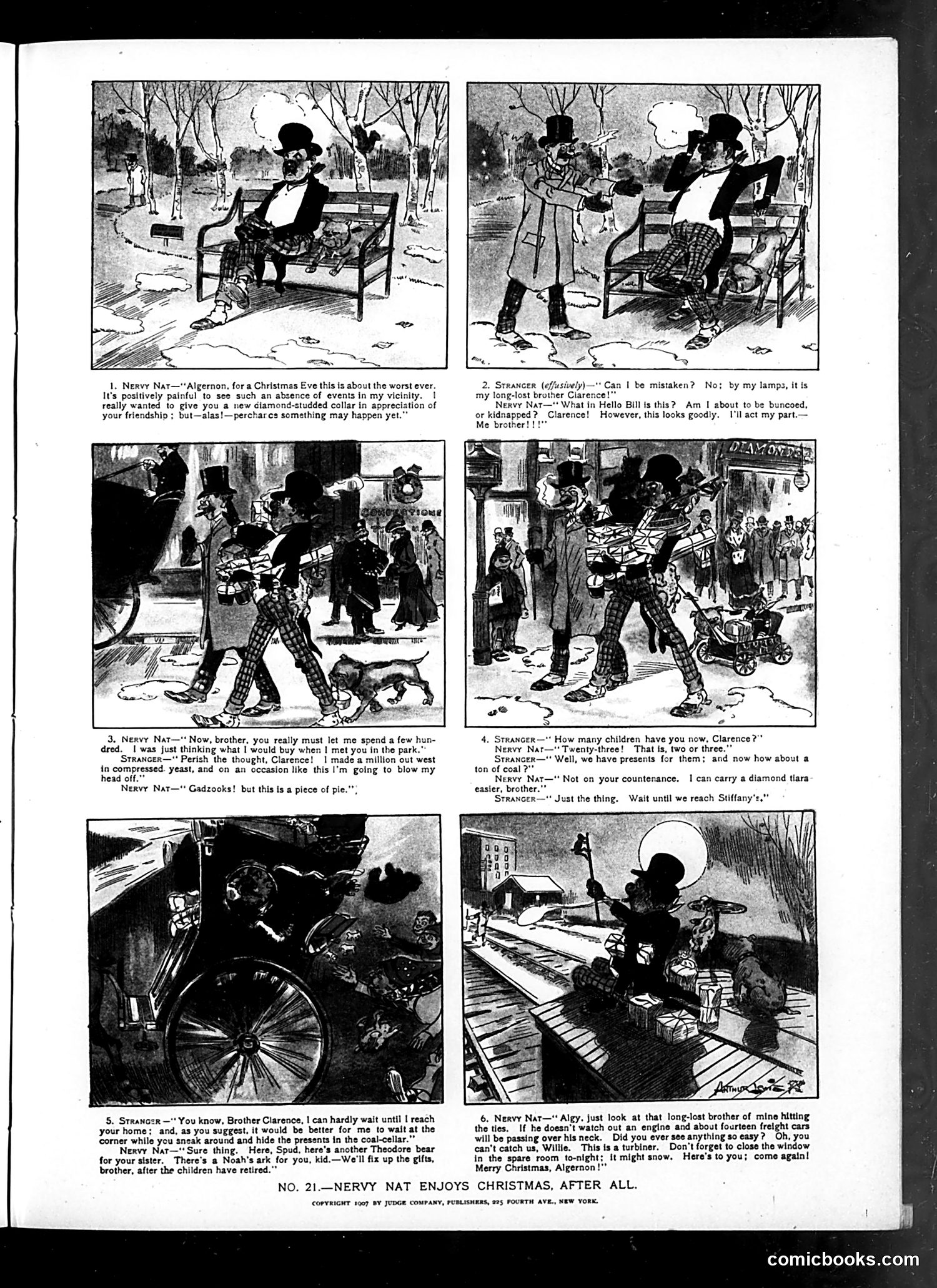
This six-panel comic strip follows "Nervy Nat," a confidence man, as he encounters a wealthy stranger claiming to be his long-lost brother "Clarence." The satire centers on Nat's transparent con artistry: he pretends to recognize the stranger, accepts increasingly generous "gifts" (presents, coal, diamonds), and conspires with him to hide valuables while planning to rob him. The humor lies in Nat's obvious scheming—he's clearly attempting to swindle this gullible mark—yet the final panel suggests the tables have turned: the "brother" escapes after the robbery attempt, leaving Nat duped instead. The strip mocks both petty con men and their easily-fooled victims, reflecting turn-of-the-century urban criminal culture. The title's irony suggests Nat's Christmas "success" is actually his comeuppance.
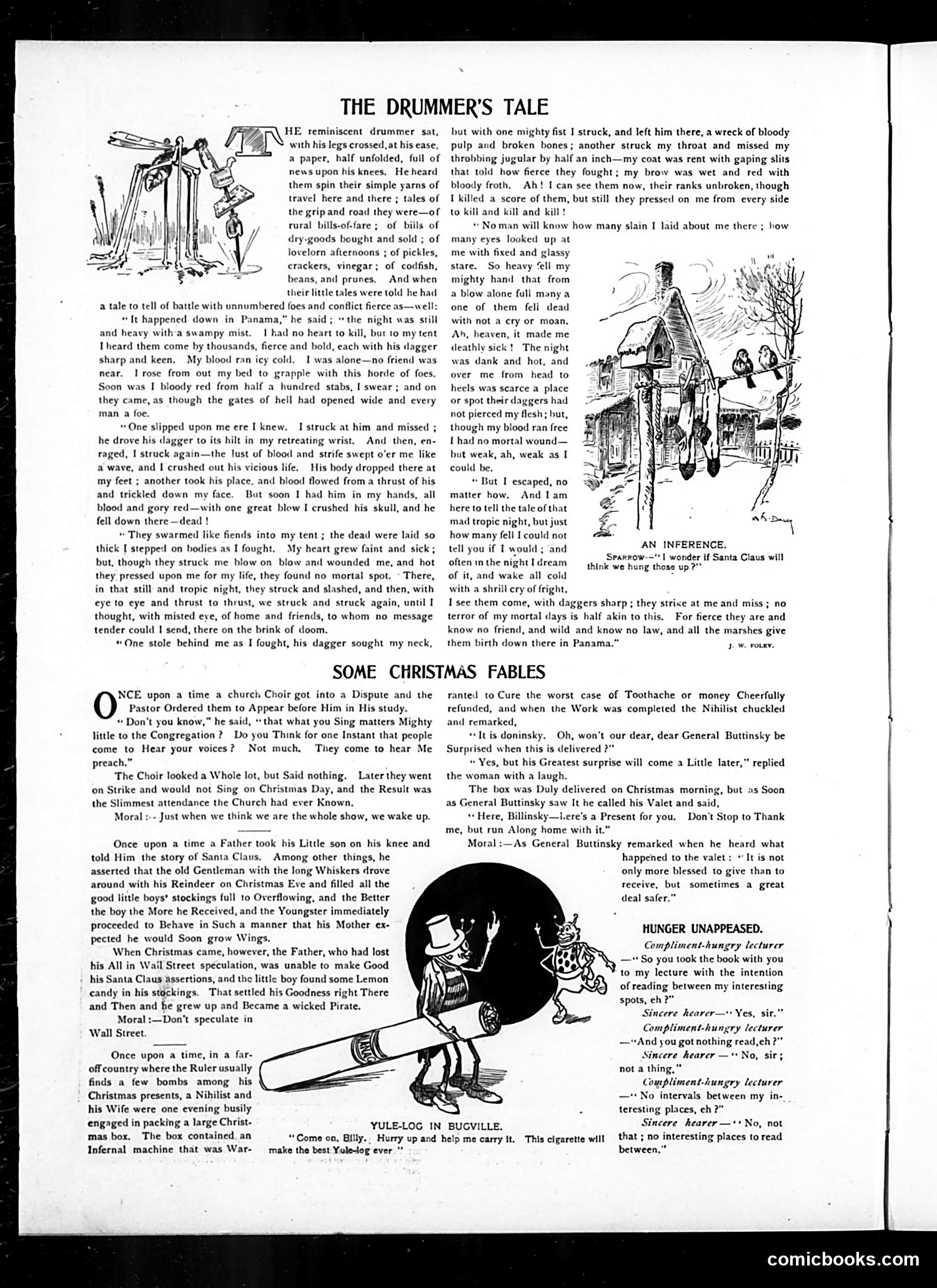
This page features two distinct pieces of satire: **"The Drummer's Tale"** is a tall tale mocking traveling salesmen ("drummers"). The narrator recounts an absurdly exaggerated battle in Panama against thousands of attackers, filled with graphic violence and melodramatic survival. The humor lies in the obvious fabrication—a solo man fighting countless armed opponents yet escaping with merely "weak" injuries. This satirizes the boastful storytelling culture of traveling salesmen, who competed to tell ever-more-outlandish tales to impress colleagues. **"Some Christmas Fables"** below parodies moral tales and sentimental Christmas stories. The vignettes mock both pious sentimentality (a pastor ordering choir singers to appear humble) and cynical materialism (a Nihilist wife receiving gifts). The "Yule-Log in Bugville" cartoon shows elves struggling with an enormous log, continuing the mocking tone. The satire targets American commercial culture, religious hypocrisy, and the gap between Christmas ideals and actual behavior. The page exemplifies Judge's characteristic irreverent humor toward American institutions and pretensions.
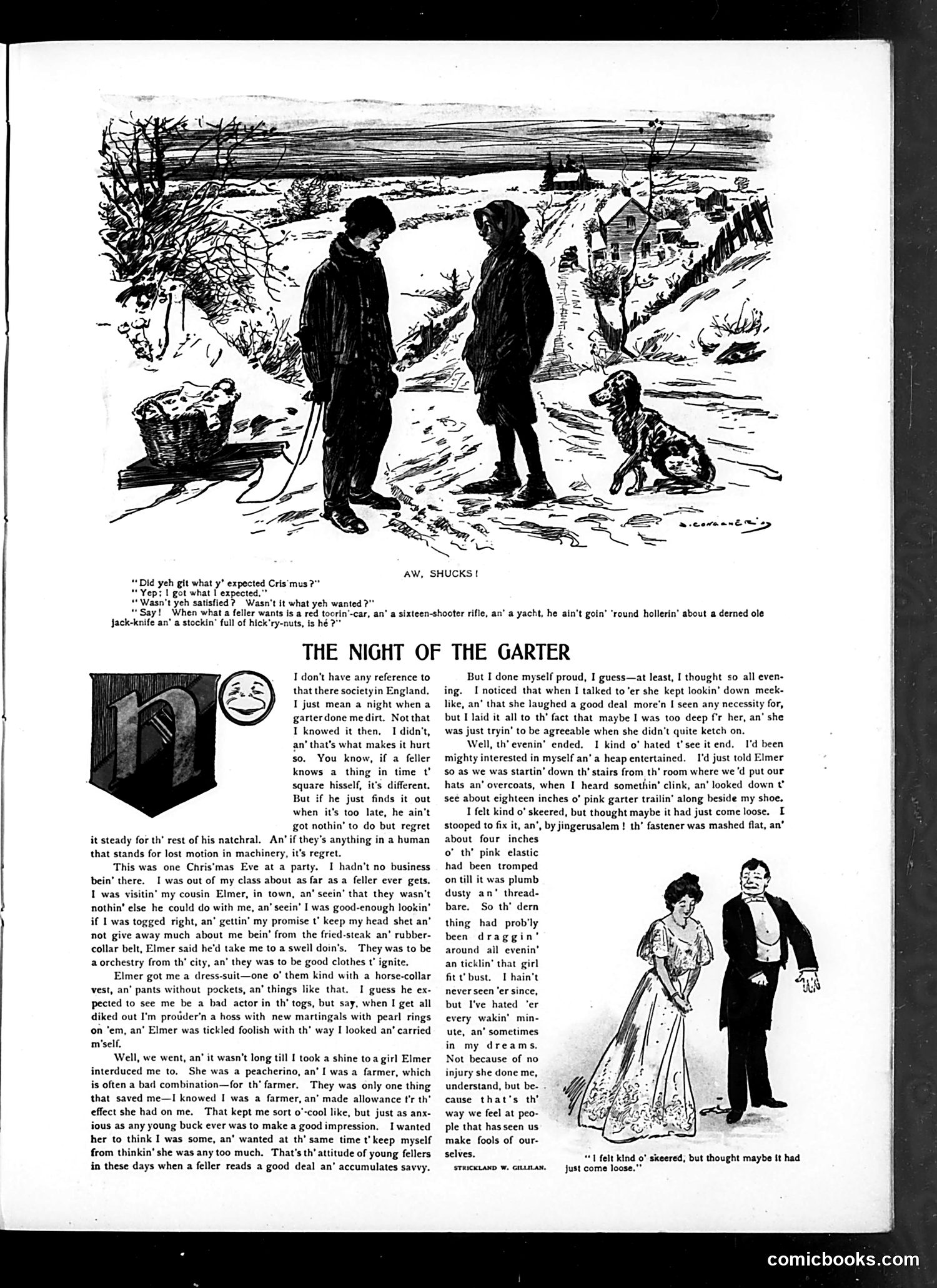
This page contains two separate pieces satirizing rural/working-class characters encountering urban sophistication. **Top cartoon**: A country boy complains that his Christmas gift—a jackknife and hickory nuts—is inadequate when he'd hoped for a luxury car, rifle, and yacht. The satire mocks rural poverty and unrealistic consumer desires. **Main story**: A farmer visits his city cousin and attends a fancy Christmas Eve party in borrowed formal wear. He impresses a young woman until discovering, upon leaving, that her pink garter has been trailing behind him all evening, trampled and dusty. The narrator realizes his apparent sophistication was false—he'd been the object of ridicule the entire time. The satire targets rural characters' aspirations to appear cultured and wealthy despite lacking genuine breeding or knowledge of urban society. The garter serves as a symbol exposing the farmer's pretense and the woman's silent mockery of his outsider status.
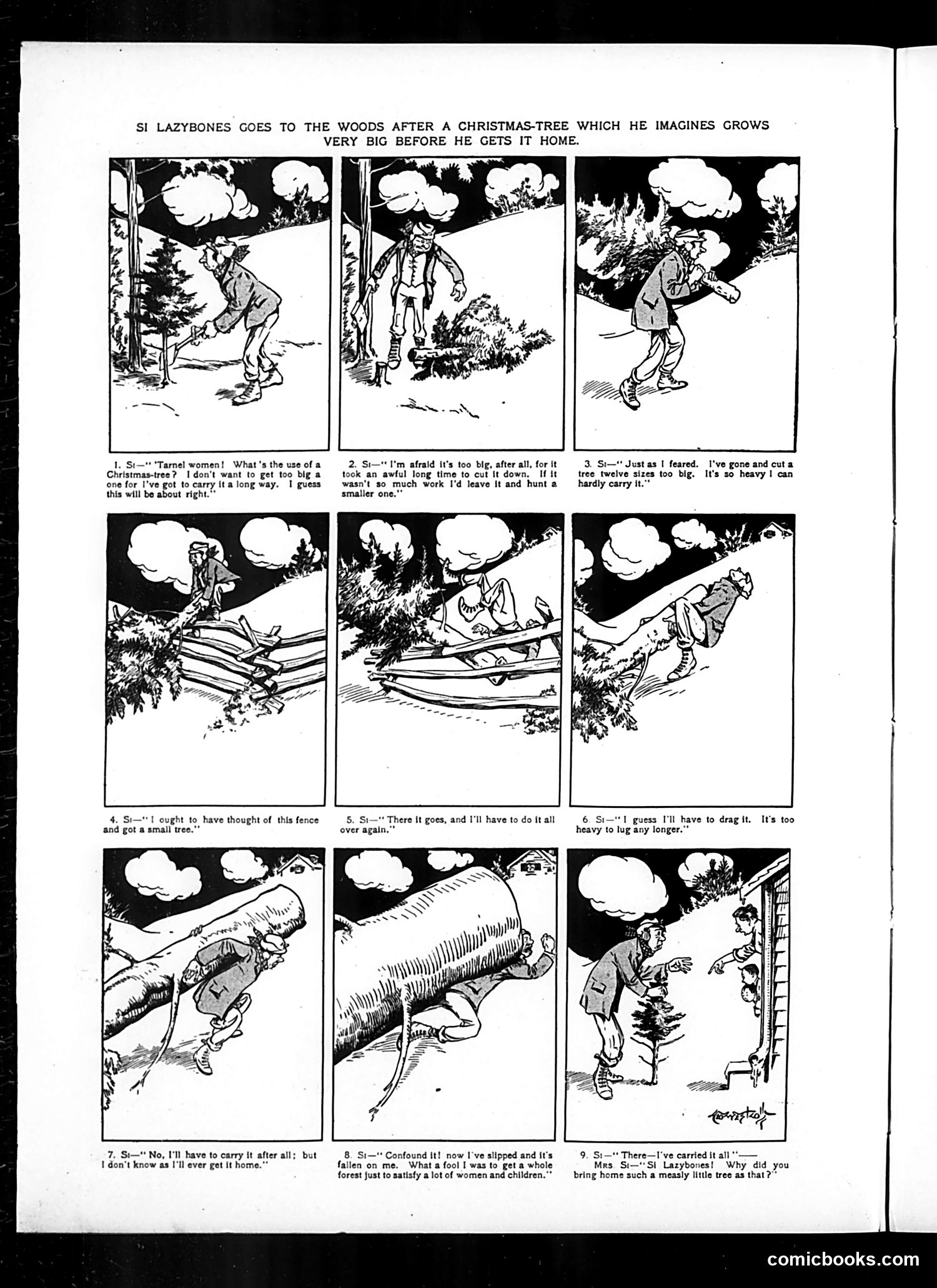
This is a nine-panel comic strip satirizing male incompetence and the impossible expectations of domestic life. "Si Lazybones" is the protagonist, a hapless character who ventures into the woods to cut a Christmas tree. The humor follows a predictable arc: Si repeatedly misjudges the tree's size, complaining it's either too large or too small, struggling mightily to transport it home through various mishaps—dragging it over fences, slipping, falling. He curses "women and children" for demanding such effort. The punchline is classic domestic satire: after all his exertion and complaints, his wife dismisses his efforts, calling the tree "measly" and too small—the opposite of his earlier concerns. The joke reflects early 20th-century gender dynamics: a man's incompetence contrasted with women's unreasonable demands, played for laughs.
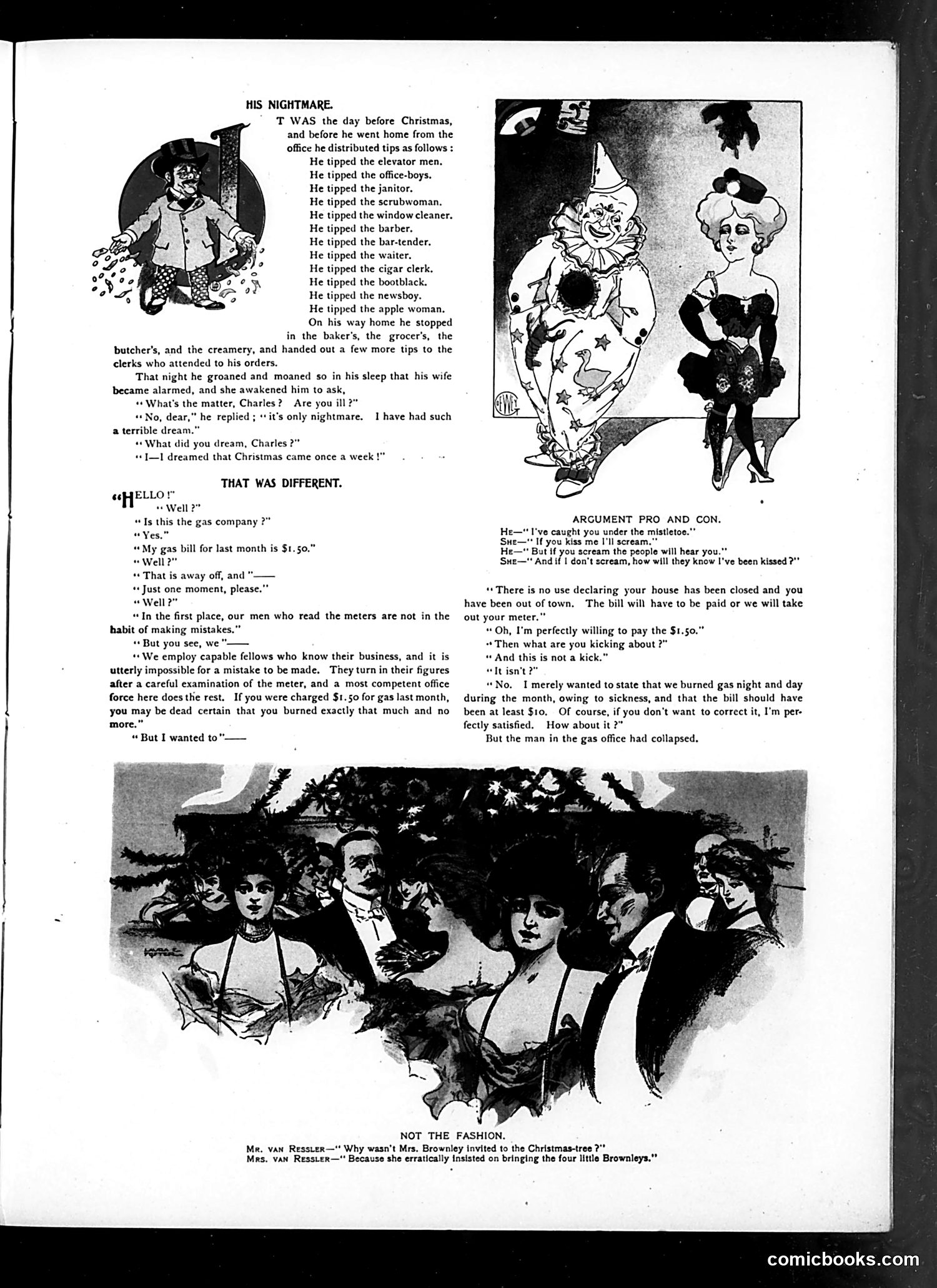
This page contains three satirical pieces mocking early 20th-century American social customs and business practices: **"His Nightmare"** ridicules the Christmas tipping culture—a man tips everyone from elevator operators to apple vendors, then nightmares that Christmas comes weekly. The satire targets the financial burden and absurdity of obligatory seasonal tipping. **"That Was Different"** mocks a gas company's arrogant customer service. A customer disputes a $1.50 bill, but the company representative refuses to acknowledge any possibility of error, insisting their employees are infallible. The joke concludes when the customer reveals he *should* have been charged $10—the company man "collapses," humbled. **"Not the Fashion"** jokes about social exclusion: Mrs. Brownley wasn't invited to a Christmas party because she insisted on bringing her four children, violating proper etiquette for adult social gatherings. All three pieces satirize contemporary social anxieties: financial obligations, corporate arrogance, and rigid class-consciousness in holiday entertaining.
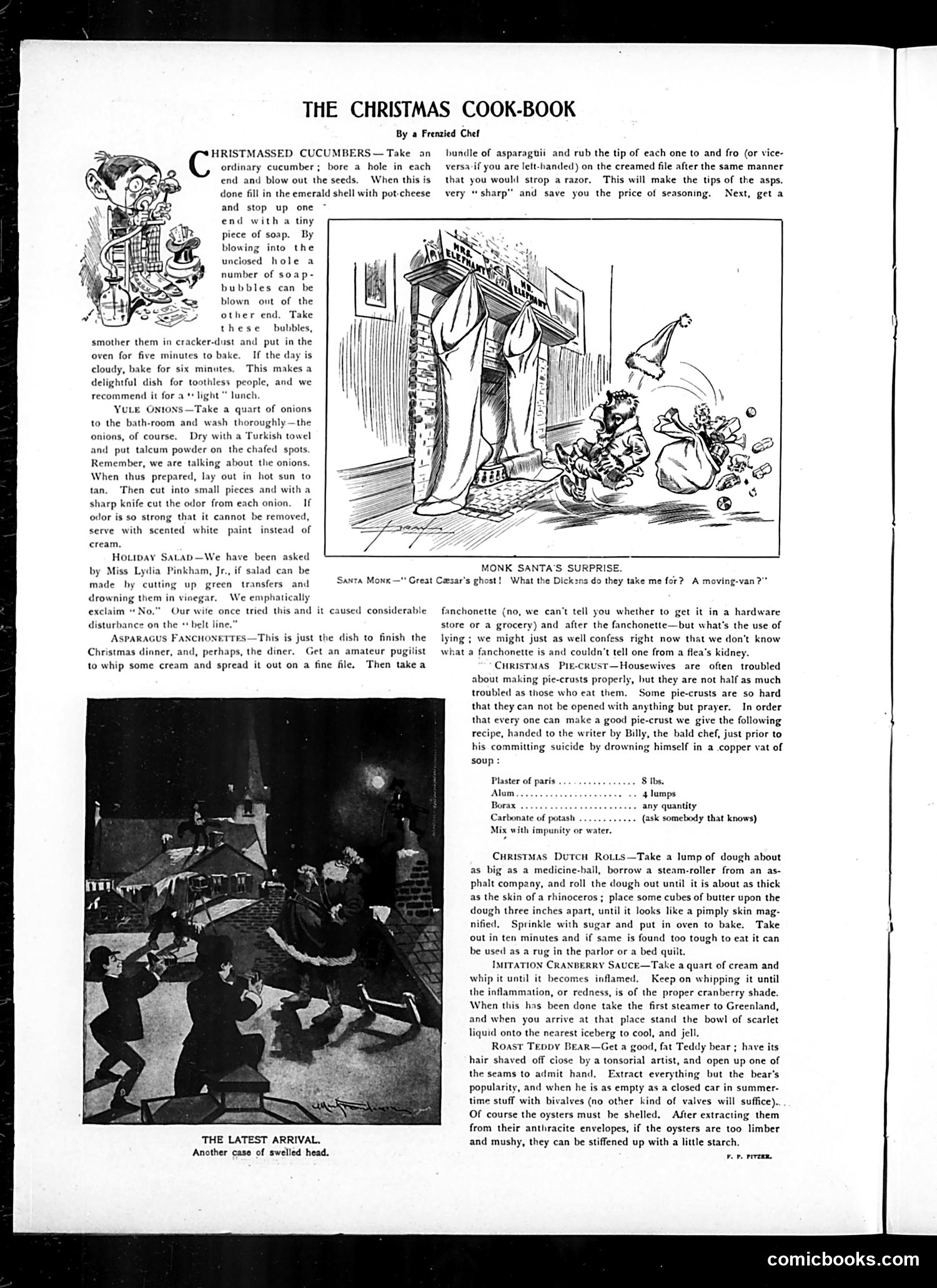
This is a humorous cookbook parody from *Judge* magazine titled "The Christmas Cook-Book By a Frenzied Chef." Rather than offering genuine recipes, it presents absurd, deliberately nonsensical cooking instructions as satire. The jokes mock both elaborate Victorian-era cooking pretensions and the magazine's own readers. Examples include: "Christmassed Cucumbers" (cucumbers filled with cheese and soap bubbles), "Yule Onions" (onions you tan and apply talcum powder to), and "Asparagus Fanchonettes" (using a made-up ingredient the author admits not knowing). The humor escalates with recipes containing inedible ingredients like plaster of paris and borax for pie crust. A sidebar cartoon shows "Monk Santa's Surprise"—a monk character complaining about being mistaken for a moving van, apparently delivering large gifts. The overall satire ridicules pretentious holiday cooking and wealthy households' overcomplicated cuisine, while maintaining a lighthearted, absurdist tone typical of early 20th-century satirical magazines.
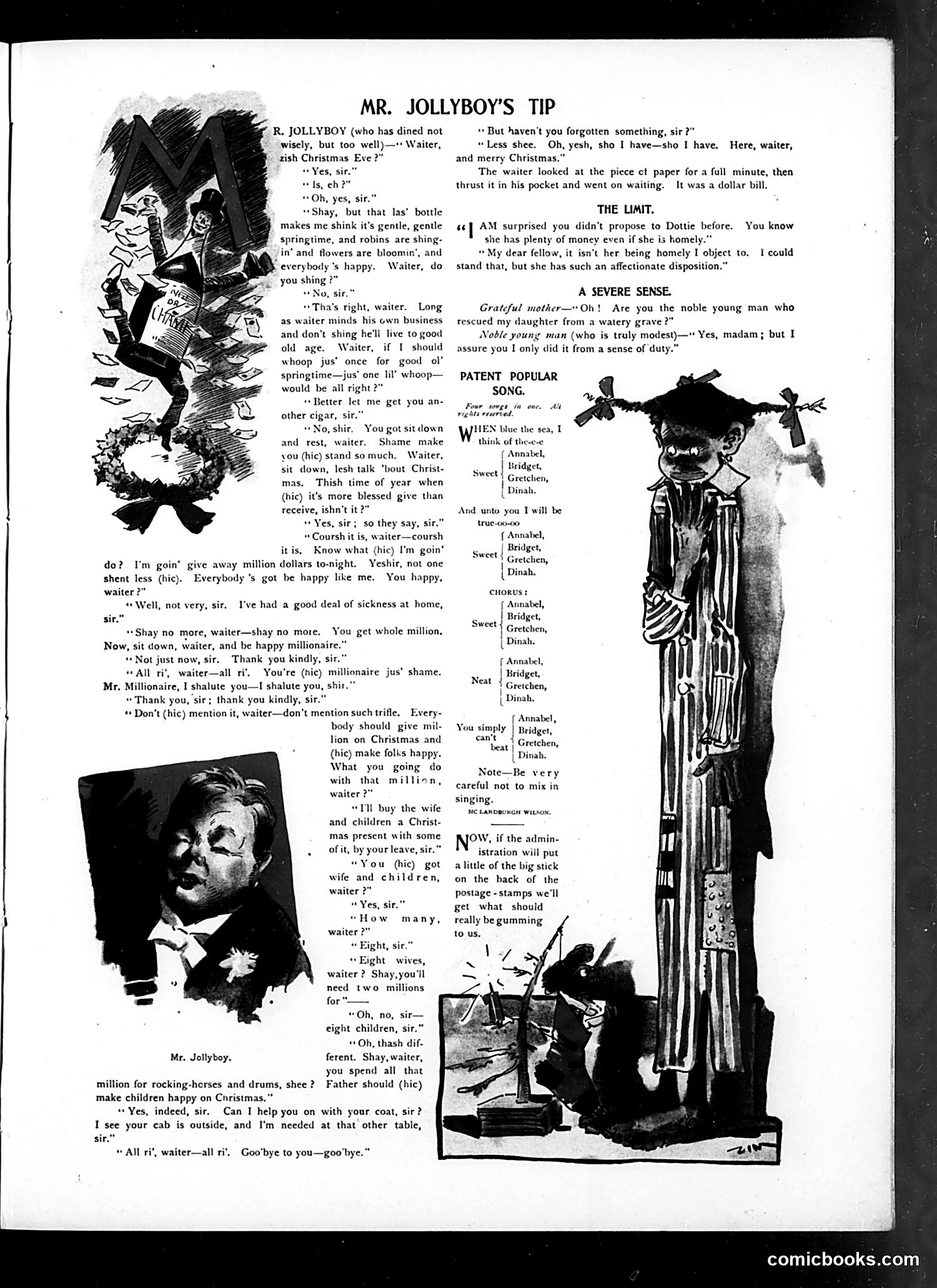
This page satirizes wealthy drunkenness and empty charity. "Mr. Jollyboy," an inebriated wealthy man, grandiosely announces he'll give away millions on Christmas Eve, promising the waiter a million dollars. The waiter politely listens while Jollyboy pontificates about spreading happiness. The punchline: after all this drunken generosity, Jollyboy's actual "tip" is a single dollar bill. The satire targets the performative philanthropy of the wealthy—how they use charitable declarations to appear magnanimous while actually being miserly. The waiter's understated reaction (reading the dollar bill silently before pocketing it) highlights the gap between Jollyboy's boozy promises and his actual generosity. The accompanying sketches mock other social absurdities: a woman accepting a suitor only for money despite his admitted indifference to her, and a "patent popular song" listing interchangeable female names, suggesting mass-produced, interchangeable entertainment.
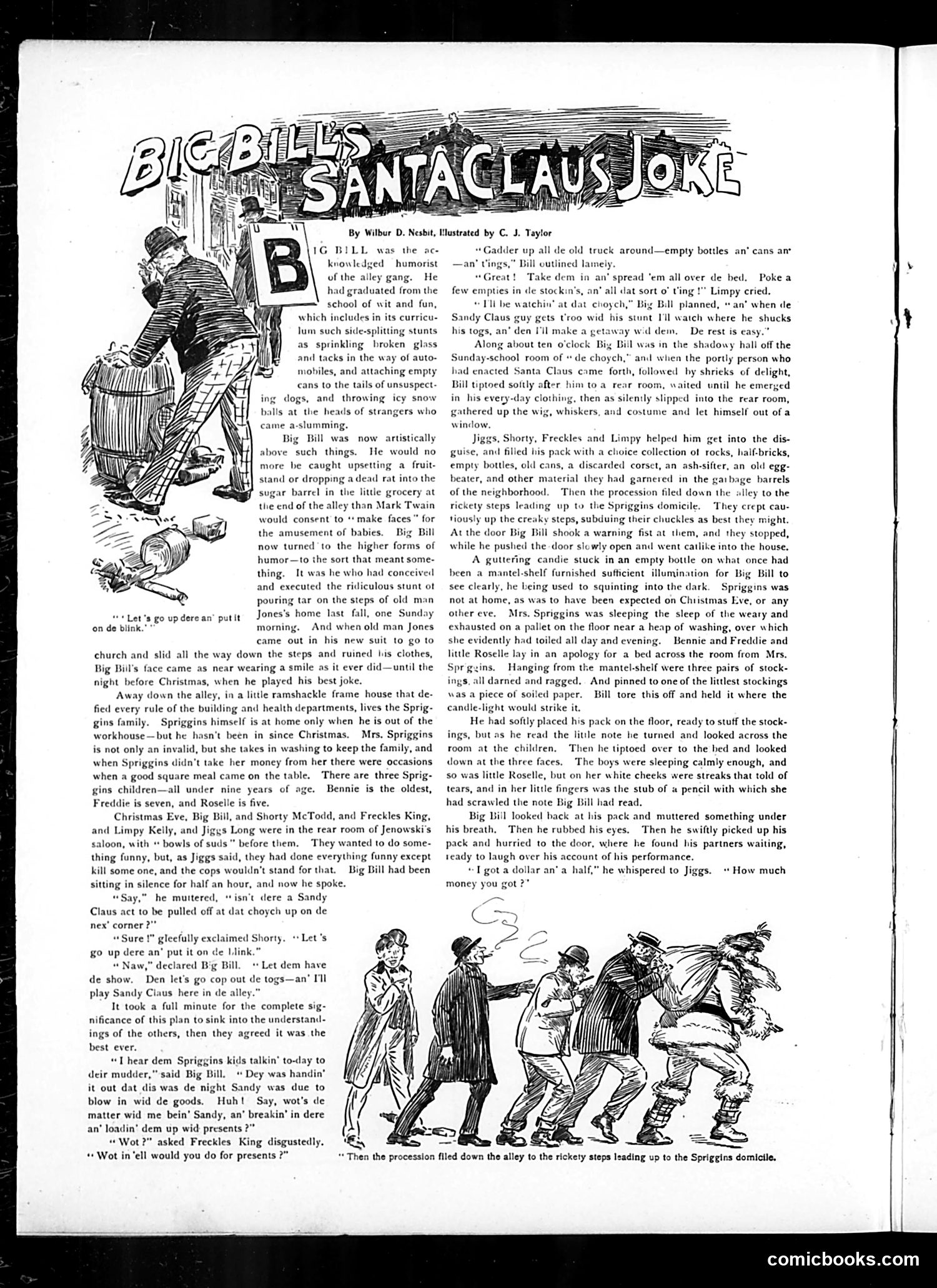
This is a humorous short story (not a political cartoon) by Wilbur D. Nesbit, illustrated by C.J. Taylor. It depicts street gang members in a poor urban alley planning a Christmas prank. **The Setup:** Big Bill, a neighborhood troublemaker known for crude pranks, devises an elaborate scheme with friends Shorty, Freckles, Limpy, and Jiggs. They plan to impersonate Santa Claus at the local church Christmas pageant, then steal the costume and use it to deliver "presents" to the impoverished Spriggins family—filling stockings with garbage (empty bottles, cans, broken glass) instead of real gifts. **The Point:** This satirizes street-gang "humor" while simultaneously presenting what might be a genuine act of charity disguised as mockery. The story plays with readers' expectations about whether this prank is cruel or surprisingly kind-hearted. The humor relies on early-20th-century urban dialect and lower-class stereotypes common to *Judge* magazine. The illustration shows the gang proceeding to execute their plan at the tenement building.
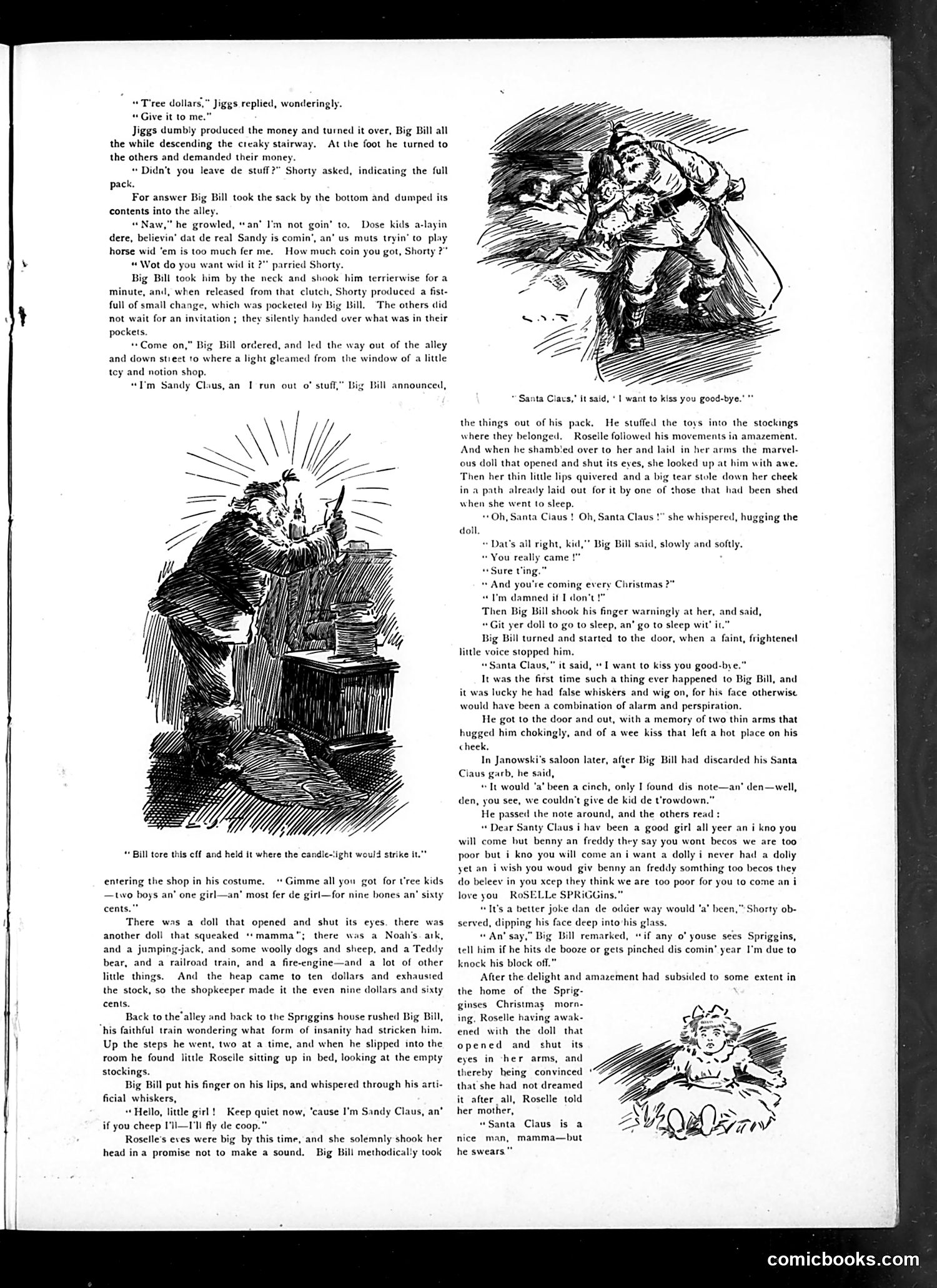
This is a sentimental Christmas story featuring "Big Bill," a hardened criminal character (likely from the popular "Jiggs" comic strip referenced in the text). The narrative presents a classic redemption tale: Big Bill and his gang rob a toy shop, initially planning to keep the profits. However, Big Bill has a change of heart upon learning that poor children in the neighborhood are sleeping, believing Santa will visit. He redistributes the stolen toys to fill empty stockings, disguising himself as Santa Claus. The emotional climax occurs when a little girl (Roselle) asks to kiss "Santa" goodbye—a moment that penetrates Big Bill's hardened exterior and reveals his latent humanity. **The satire/social commentary:** This depicts the era's romanticized view of urban poverty and crime redemption through Christmas sentiment. It suggests even criminals possess inherent goodness, particularly when confronted with innocent childhood faith. The story reflects early 20th-century attitudes mixing cynicism about urban "lowlife" with sentimental belief in redemptive mercy.
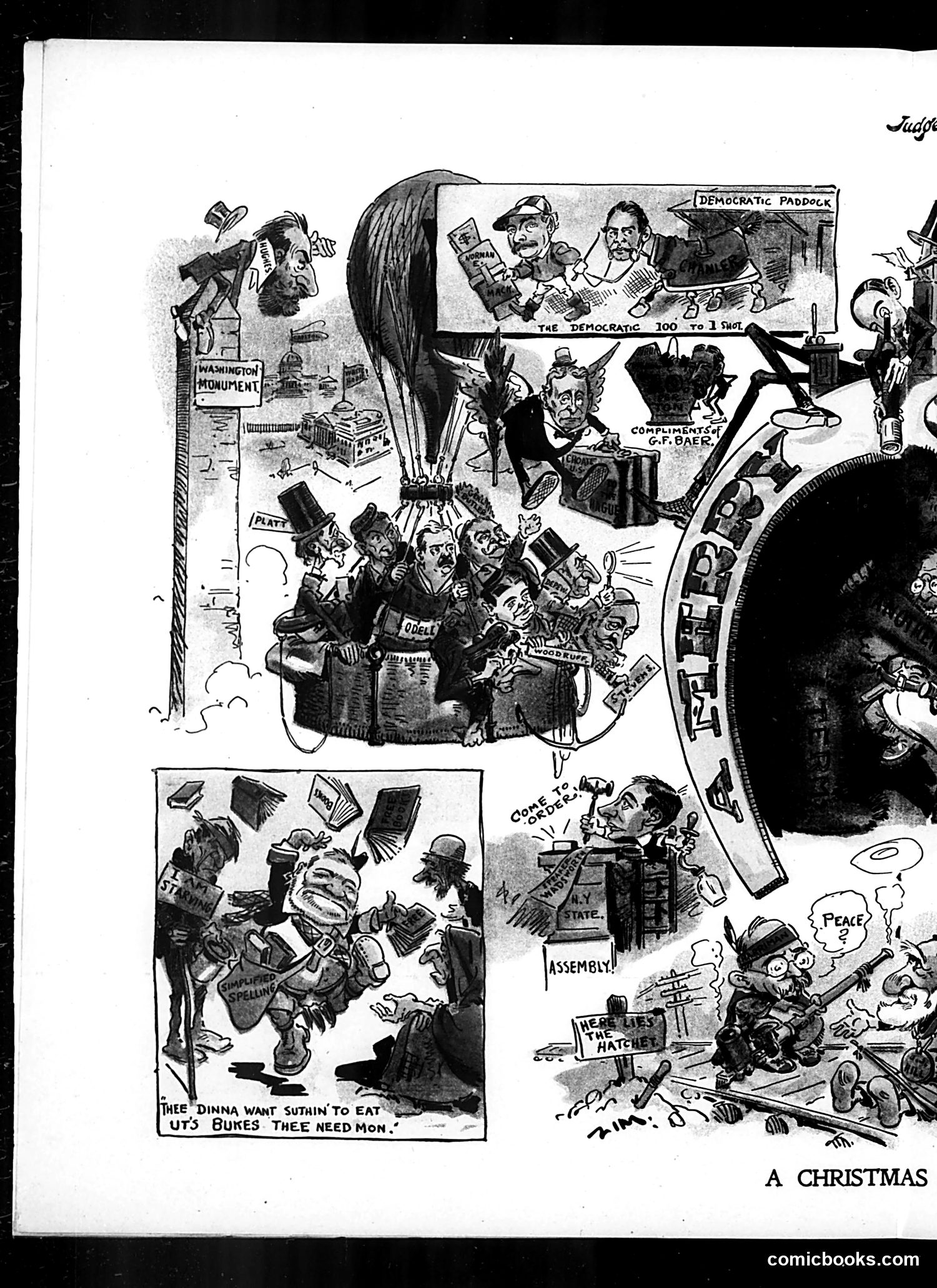
This appears to be a Christmas-themed satirical page from Judge magazine, likely early 20th century. The main cartoon criticizes political and economic inequality during the holiday season. The central image shows wealthy figures ("Democratic Paddock," "Democratic 100 to 1 Shot") contrasted with impoverished masses below. A large figure at left represents the "Washington Monument"—likely commentary on government indifference. The bottom panel, captioned "Thee Dinna Want Suthin' to Eat / Uts Buries Thee Need Mon," uses dialect to depict poor immigrants or working-class families lacking food while politicians feast. Other panels reference "State Assembly" and "Peace"—suggesting satire about legislative bodies failing to address poverty. The overall message: while wealthy elites enjoy Christmas abundance, ordinary citizens struggle to survive, and government remains complicit in this inequality.
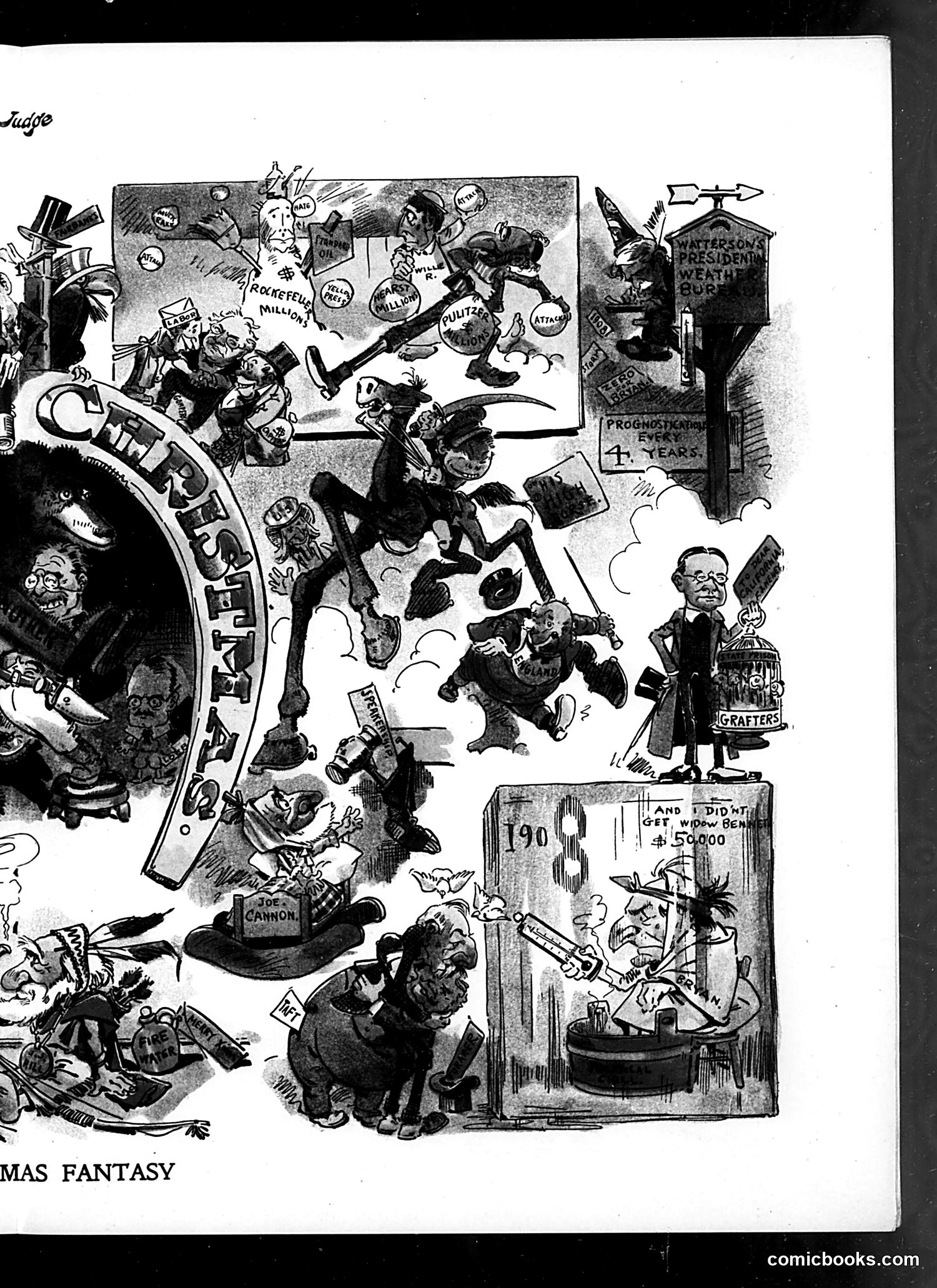
This Judge magazine page presents a chaotic satirical scene titled "Xmas Fantasy" depicting various figures engaged in chaotic activity. The cartoon appears to reference political corruption and graft, as indicated by visible labels including "Grafters" and references to financial figures like "Rockefeller" and "Morgan." The central imagery shows multiple caricatured figures in frantic motion, scattered papers, and money, likely satirizing wealthy industrialists and political corruption of the era. A tower or sign on the right references "Paterson's Presidential Ambitions" with "Prognostications + 5 Years," suggesting commentary on political aspirations. The overall composition suggests Judge's typical critique of Gilded Age excess, corrupt business practices, and the intertwining of wealth and political power—presented as a nightmarish holiday fantasy.
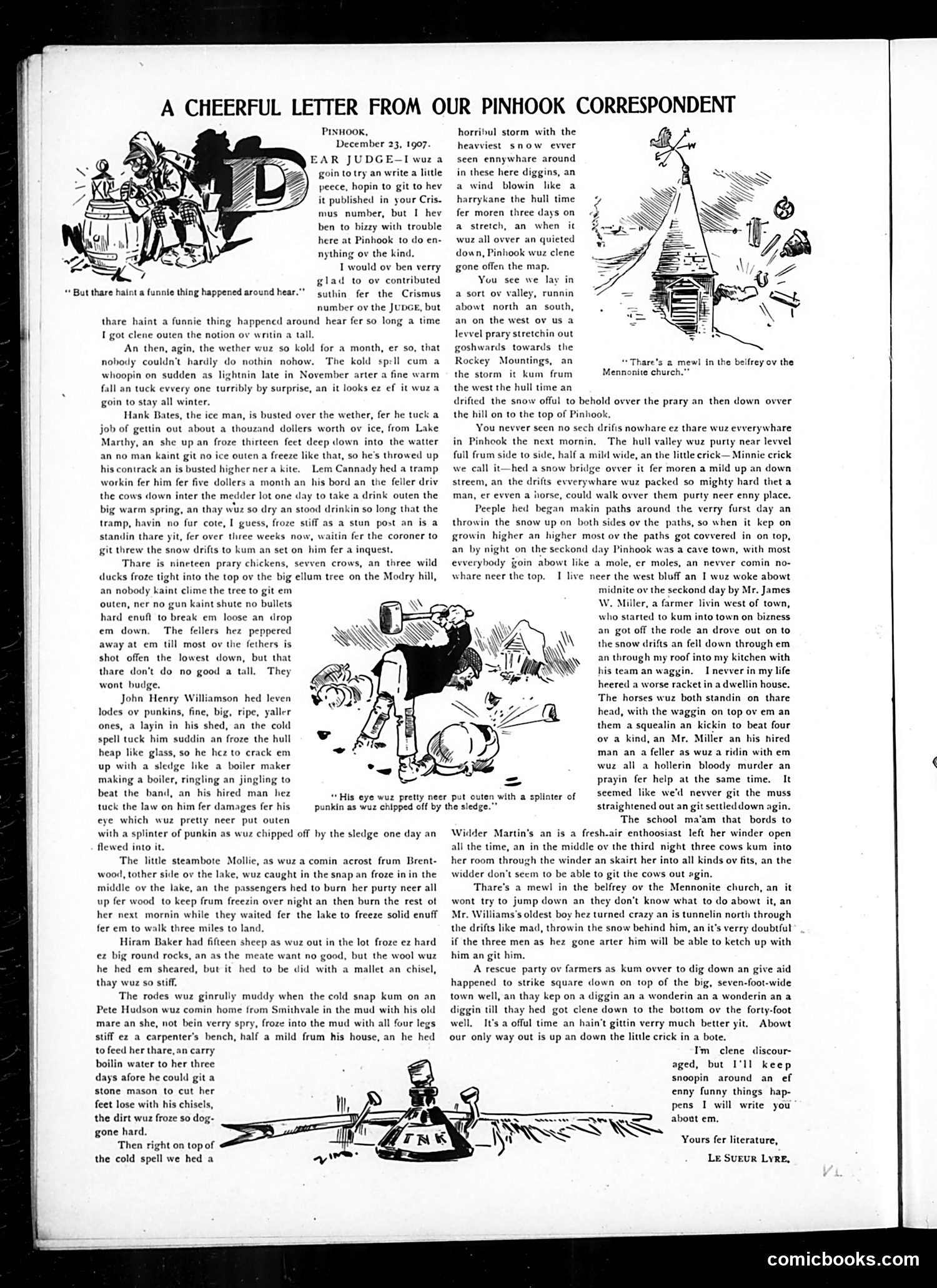
This is a humorous letter from a rural correspondent describing an absurdly severe winter in "Pinhook." The satire lies in the exaggerated, deadpan tone and the escalating absurdity of the disasters—frozen pumpkins that must be chiseled apart, a steamboat trapped in lake ice, chickens frozen mid-perch, and a horse literally frozen into mud. The piece mocks rural dialect and speech patterns through intentional misspellings and grammatical errors ("haint," "wuz," "ov"), which was a common Judge magazine trope for representing unsophisticated rural America. The humor targets both the hardship of rural winter life and the perceived simplicity of country folk describing these calamities in matter-of-fact fashion. The accompanying illustrations show people struggling comically with snow and ice. This represents early 20th-century urban-centered satire poking fun at rural American life and vernacular culture.
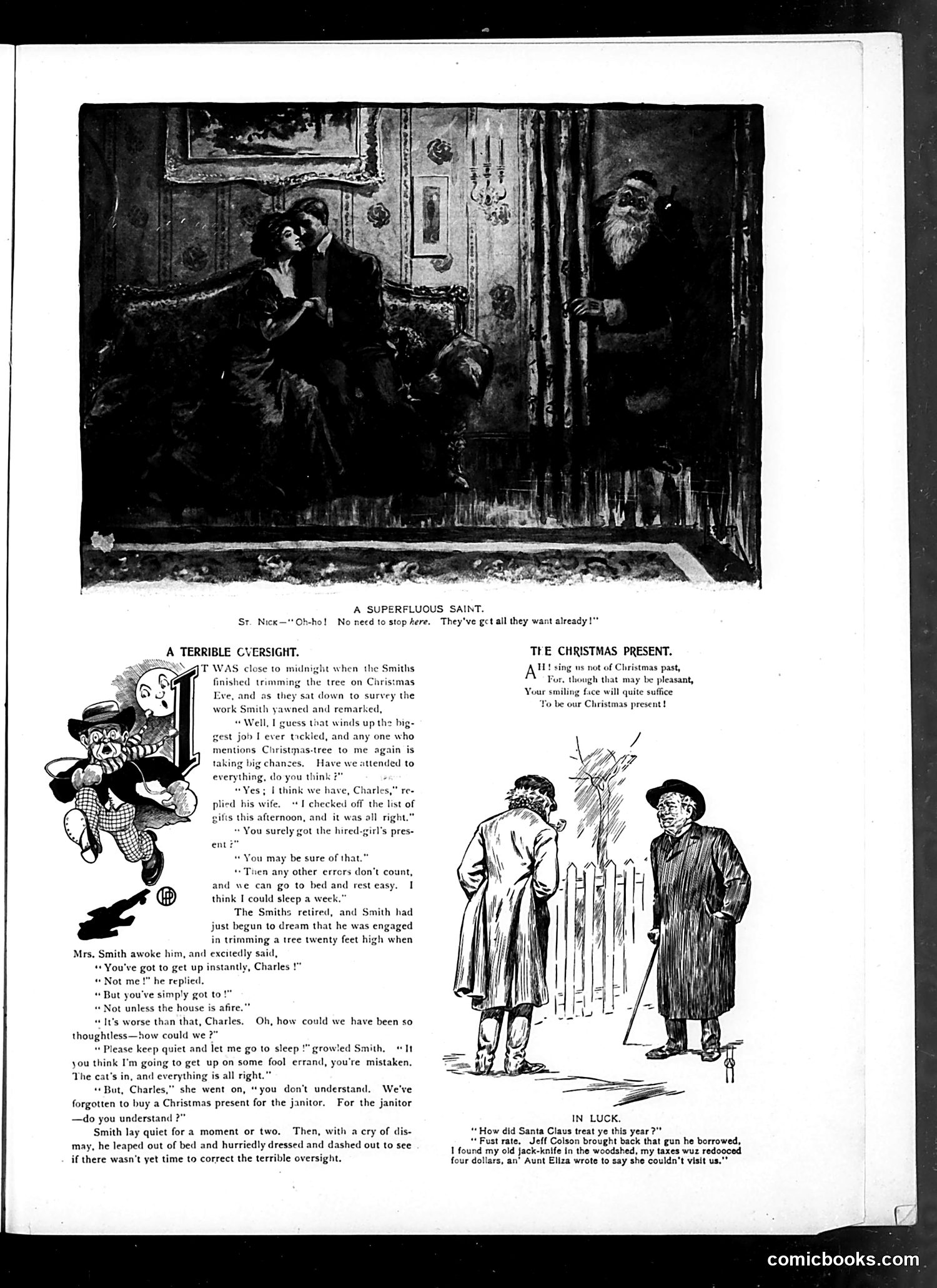
This page contains three Christmas-themed satirical pieces: **"A Superfluous Saint"** (top): Santa Claus tells a couple he needn't stop—they've "got all they want already." This mocks overconsumption and materialism among the wealthy during Christmas. **"A Terrible Oversight"** (left): Mr. Smith frantically awakens to realize he forgot to buy a Christmas present for *the janitor*—his household's working-class employee. The satire targets upper-class anxiety about maintaining proper social appearances and gift-giving obligations to service workers, treating this minor oversight as catastrophic. **"The Christmas Present"** (right): A poor man celebrates when a borrowed gun is returned, his lost knife is found, his taxes are reduced, and an aunt won't visit. The joke inverts typical Christmas gift expectations—his "presents" are modest practical matters and avoided obligations, highlighting class disparity in holiday experiences. Together, these pieces satirize Christmas materialism, class consciousness, and the gap between wealthy and working-class holiday experiences.
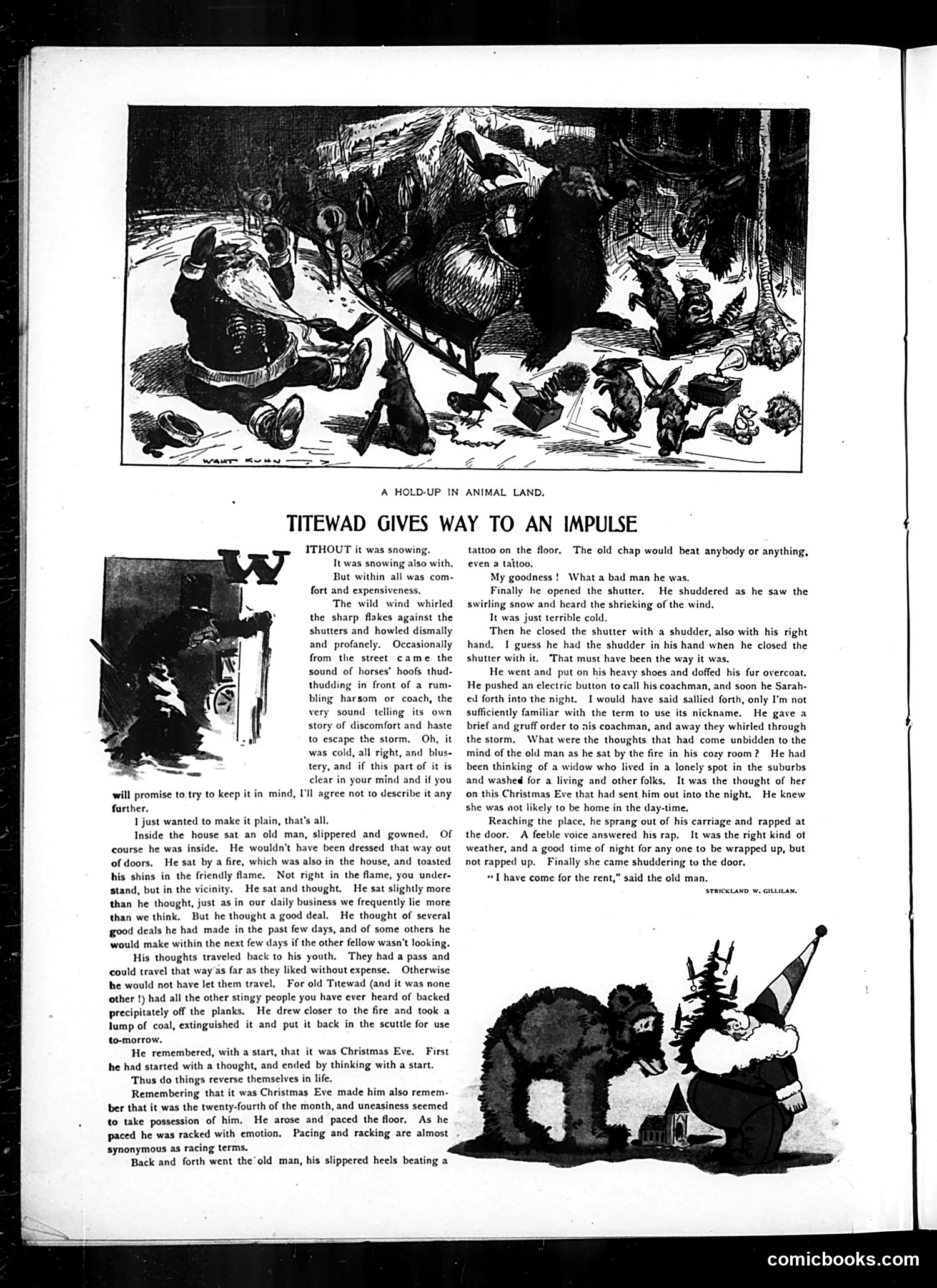
This is a satirical story about a miserly character named Titewad (the name itself is the joke—"tightfisted"). The narrative mocks extreme stinginess: he extinguishes a lump of coal to reuse it, calculates obsessively, and lies in business dealings. The twist: on Christmas Eve, Titewad impulsively visits a poor widow in the suburbs who does laundry for a living. The satire suggests he's either about to exploit her further or—more likely—perform a rare act of charity, which would be so shocking it requires explanation to readers. The top cartoon titled "A Hold-Up in Animal Land" appears to depict animals robbing each other, possibly satirizing human greed or crime. The piece satirizes both miserliness and the redemptive Christmas narrative—Titewad's character flaw is so pronounced that his small kindness becomes noteworthy.
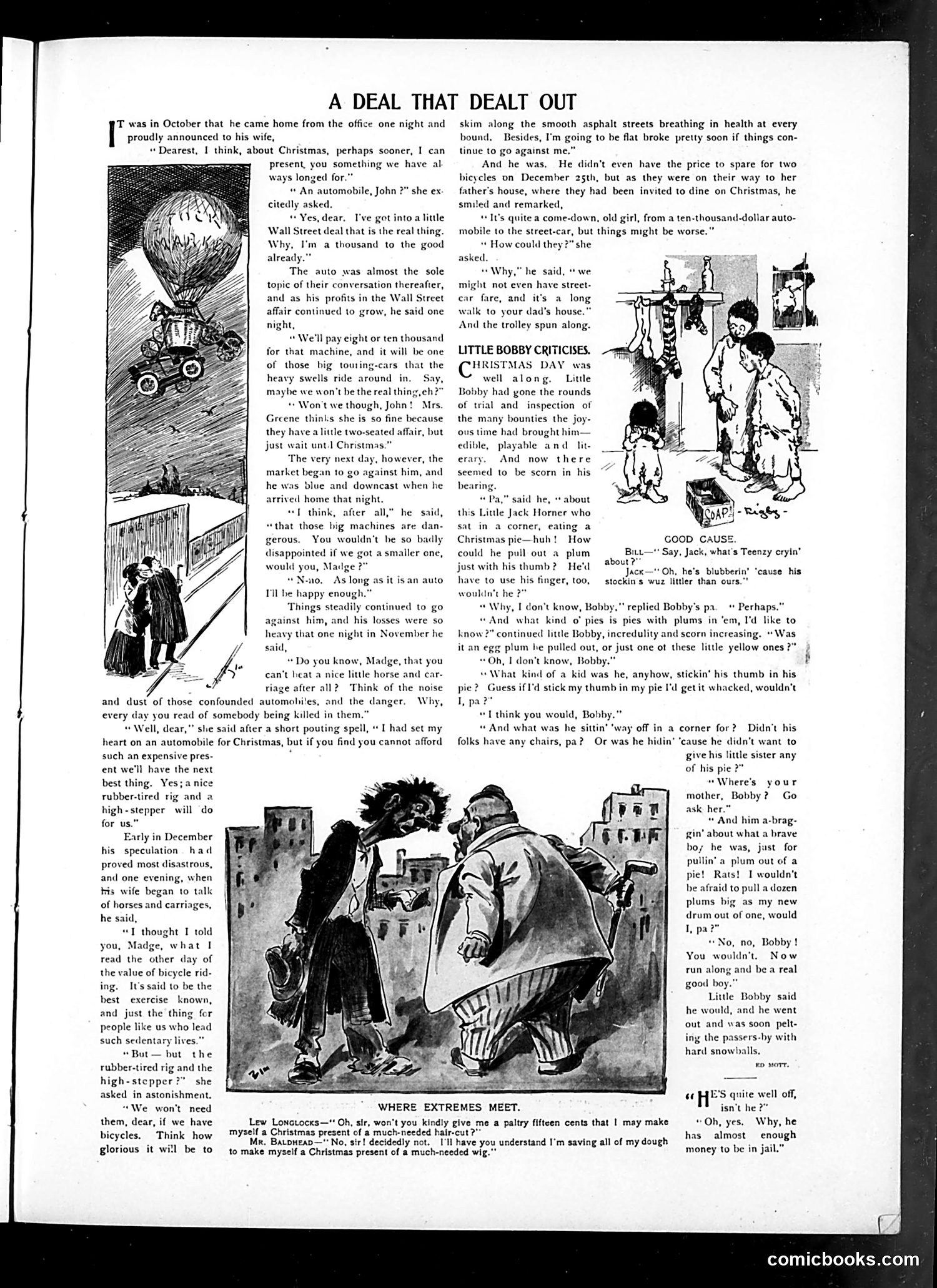
This page satirizes the boom-and-bust cycle of early 20th-century stock market speculation. A man brags to his wife about profits from a "Wall Street deal," promising an expensive touring automobile for Christmas. As the market turns against him, his promises progressively shrink: from a fancy car, to a horse and carriage, to finally just a bicycle—the cheapest option. The joke targets the false confidence of amateur speculators who make grand promises based on paper gains, only to face humiliating losses. His wife's willingness to accept each downgrade reflects the period's economic instability. The secondary comic strip "Little Bobby Criticises" shows a child pointing out logical absurdities in the nursery rhyme "Jack Horner," offering satirical commentary on adults' acceptance of nonsense.
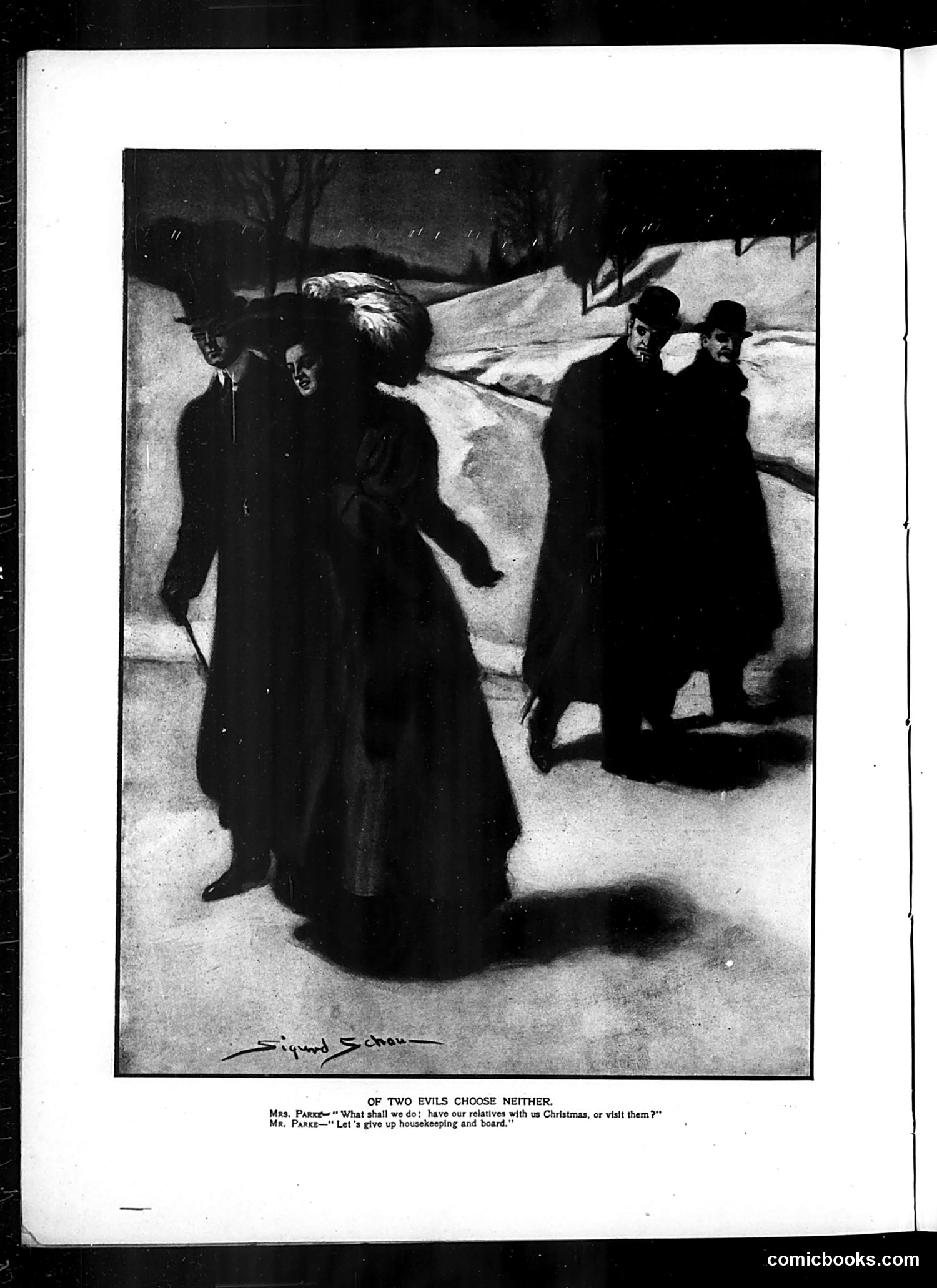
This domestic humor cartoon depicts a married couple (the Parkes) facing a Christmas dilemma: hosting relatives at home or traveling to visit them. Both options were considered burdensome—hosting meant housekeeping labor and expense, while visiting meant travel inconvenience. Mr. Parke's solution—giving up housekeeping entirely and boarding elsewhere—satirizes the couple's desire to escape family obligations altogether. The humor lies in the absurdity of abandoning one's home as a practical solution to holiday stress. This reflects early 20th-century middle-class anxieties about Christmas hospitality expectations and domestic duties, particularly for women managing households. The cartoon mocks the desperation couples felt when facing unavoidable holiday family entanglements, suggesting that even radical life changes seemed preferable.
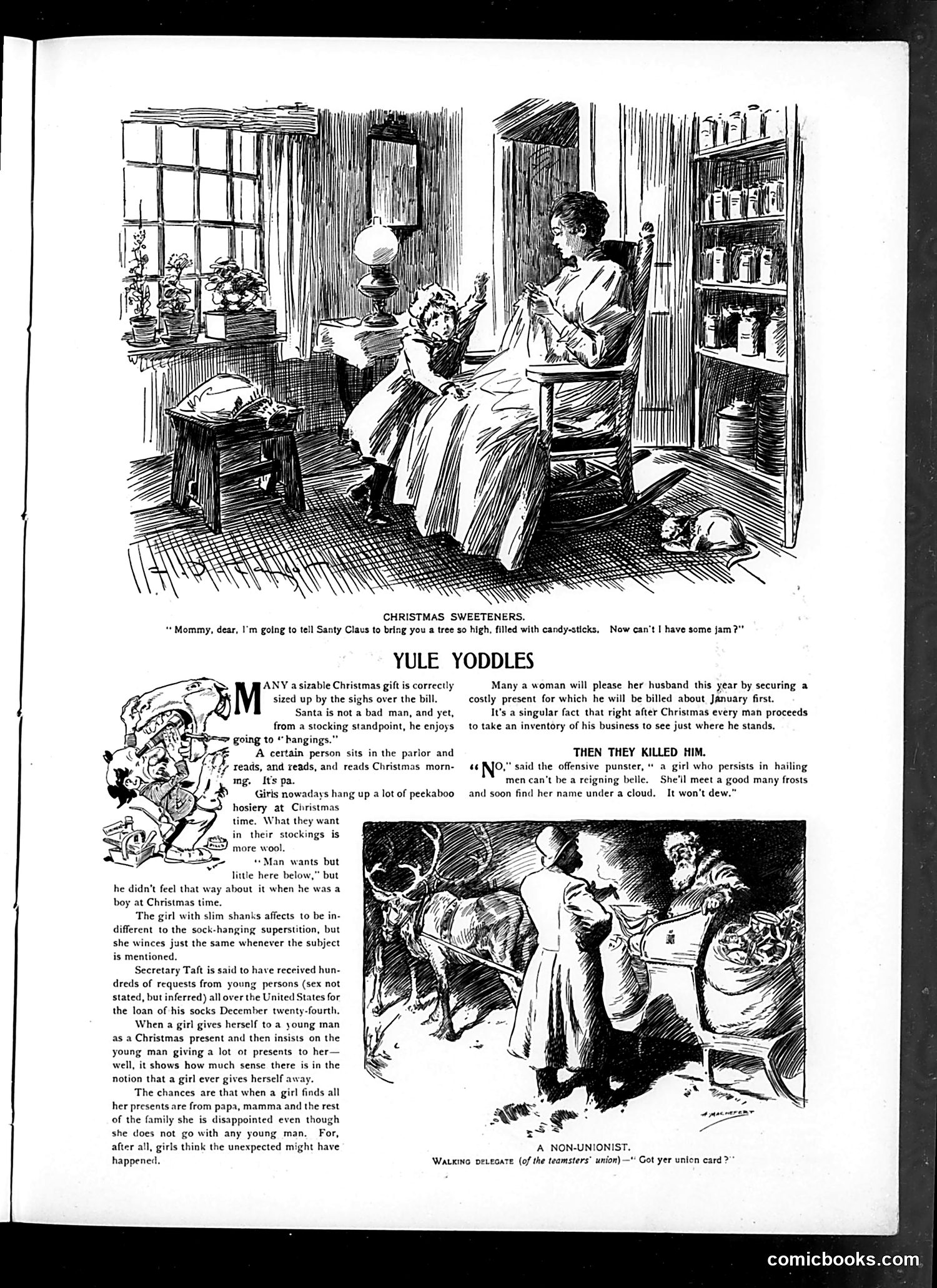
This page contains satirical commentary on Christmas customs and labor issues circa early 1900s. **"Christmas Sweeteners"** depicts a child negotiating with her mother—she'll ask Santa for an extravagant gift (a tall tree with candy) if she gets jam now. The humor mocks childhood manipulation and parental indulgence. **"Yule Yoddles"** offers social commentary through short quips: it critiques gift-giving excess (noting "sighs over the bill"), women's interest in practical wool stockings over appearance, and the hypocrisy of women claiming indifference to stocking-hanging superstitions. A jab at Secretary Taft suggests he received numerous requests to *borrow* his socks—implying they were notably large or valuable. The piece also satirizes women receiving only family gifts and expecting romantic presents. **"A Non-Unionist"** depicts a union teamster demanding a card from a non-member, addressing labor organization conflicts of the era. The cartoons collectively mock consumerism, gender relations, labor disputes, and Christmas excess with typical early-century satirical wit.
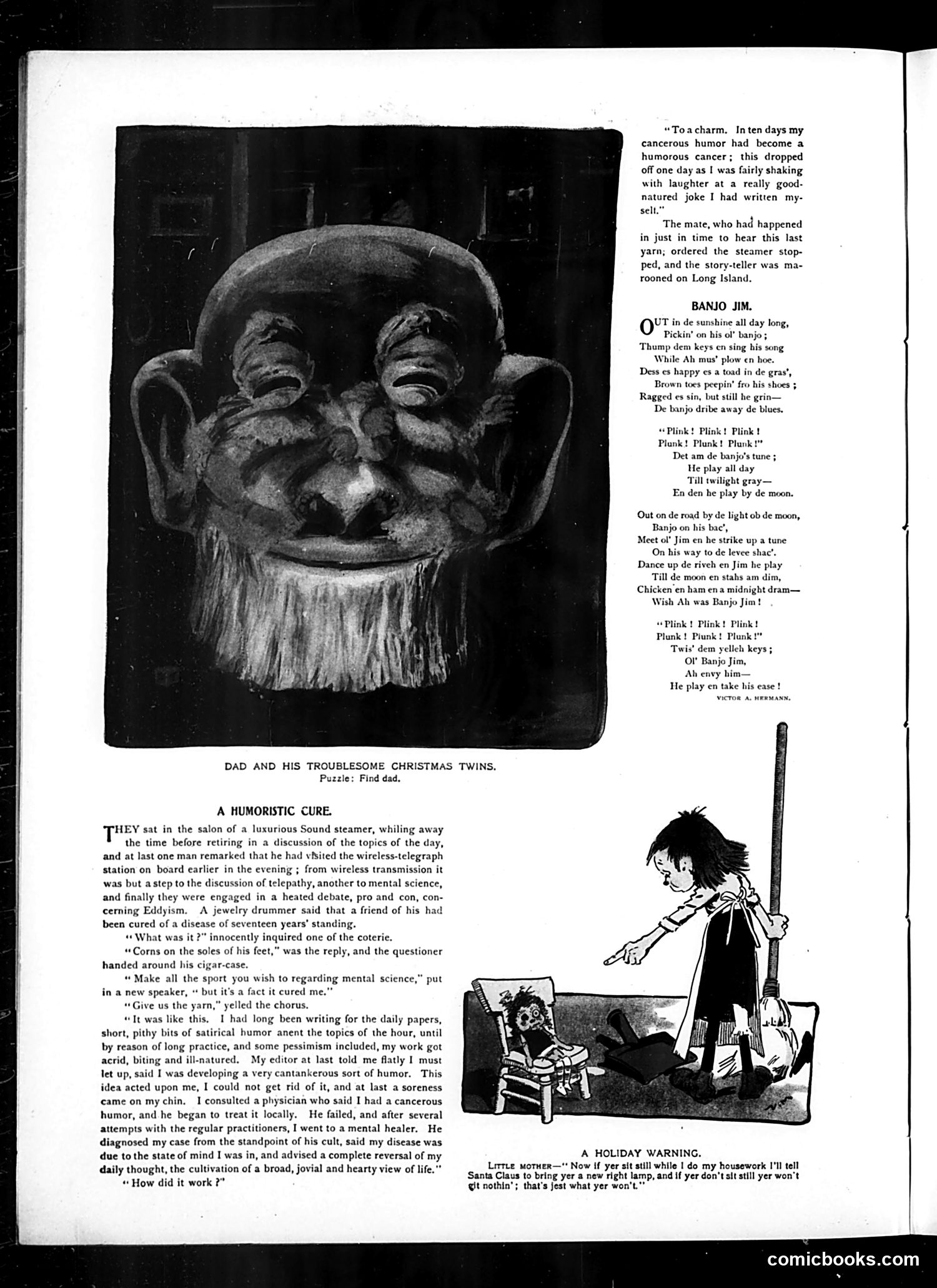
This page contains three separate pieces of humor content: **"Dad and His Troublesome Christmas Twins"** — A visual puzzle (solution not visible) depicting what appears to be a grotesque face, likely playing on the popular "find the hidden figure" puzzles of the era. **"Banjo Jim"** — A dialect poem celebrating an African American character who plays banjo and finds joy despite poverty. The piece uses stereotypical dialect and portrays Jim as carefree and content with simple pleasures, reflecting early 20th-century racial stereotypes common in popular entertainment. **"A Humoristic Cure"** — A longer narrative joke about a writer suffering from a physical ailment ("cancerous humor") caused by writing too much acrid, cynical newspaper satire. A mental healer cures him by prescribing a complete psychological reversal toward "jovial and hearty" thinking. The story mocks both mental science fads and suggests that one's mental state directly causes physical disease—reflecting contemporary interest in mind-body medicine. **"A Holiday Warning"** — A brief caption joke about a mother bribing a child to behave with threats about Santa Claus, typical period domestic humor.
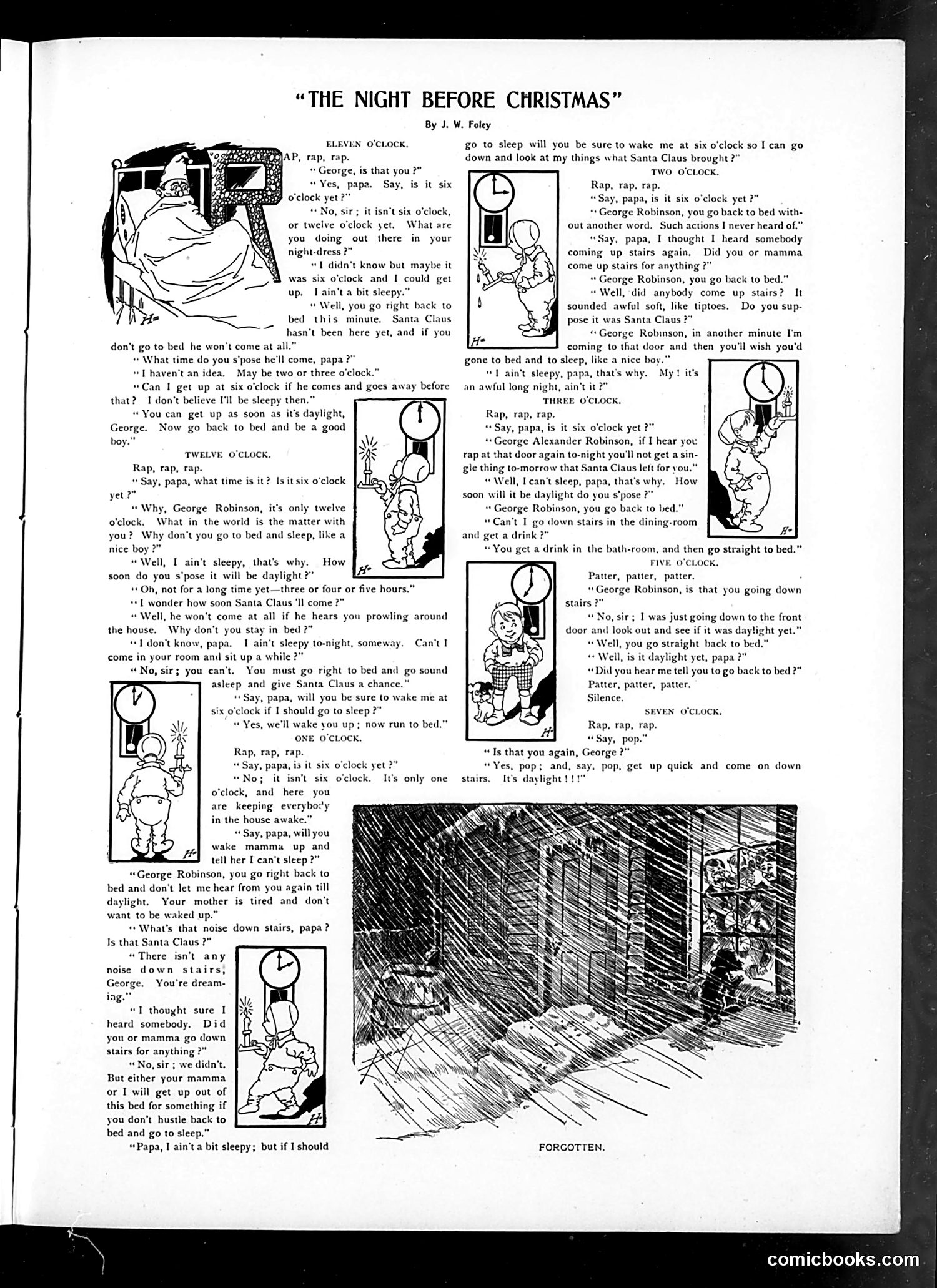
This is a humorous domestic story, not political satire. It parodies the famous Clement Clarke Moore poem by depicting a child named George Robinson repeatedly interrupting his exasperated father throughout Christmas Eve night, asking "Is it six o'clock yet?" at increasingly absurd hours (midnight, one, two, three o'clock, etc.). The joke is the contrast between the idealized Christmas Eve anticipation in the original poem and the realistic chaos of an overtired, hyperexcited child who cannot sleep. The father's patience progressively deteriorates from gentle redirection to threats of withholding Santa's gifts entirely. The small illustrations show the boy in his nightclothes persistently knocking on his parents' bedroom door. The humor derives from relatable parental frustration—a timeless theme rather than commentary on contemporary 1900s society.
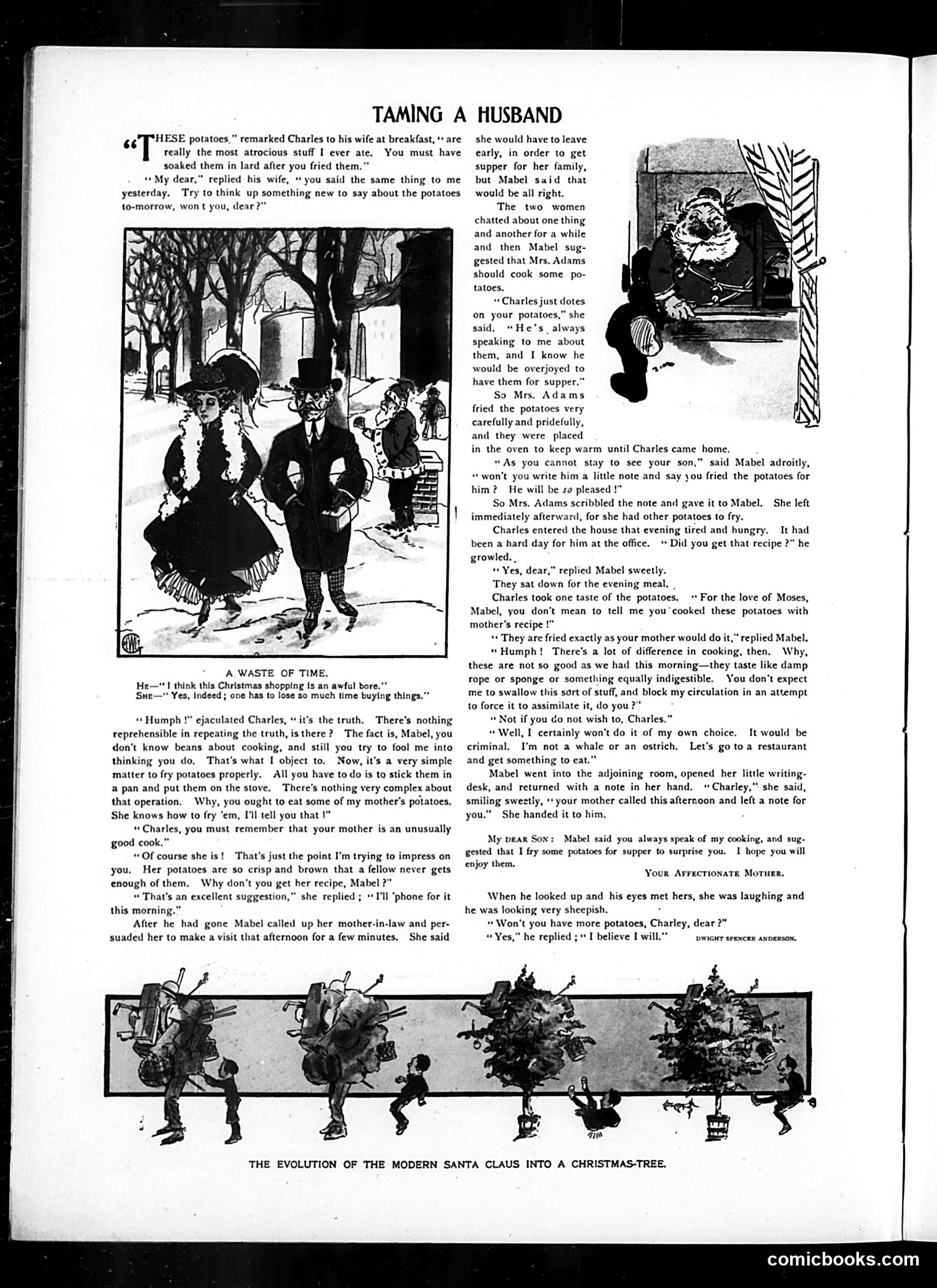
This page presents a humorous story about marital manipulation dressed as domestic advice. Charles constantly complains about his wife Mabel's cooking—particularly her fried potatoes—using identical criticisms daily. When he suggests she copy his mother's recipe, Mabel cleverly invites her mother-in-law to cook the potatoes instead, then has her write a note claiming credit. When Charles praises these identical potatoes as superior, Mabel reveals the note, exposing his hypocrisy: he was criticizing *her* cooking, not the actual food. The satire targets husbands who use nitpicking as marital dominance while being oblivious to their own contradictions. The title "Taming a Husband" suggests Mabel as the clever strategist who uses her husband's own vanity against him—a common theme in early-20th-century domestic humor that positioned wives as shrewd operators within the home sphere. The bottom cartoon about Santa Claus becoming a Christmas tree appears unrelated to the main story.
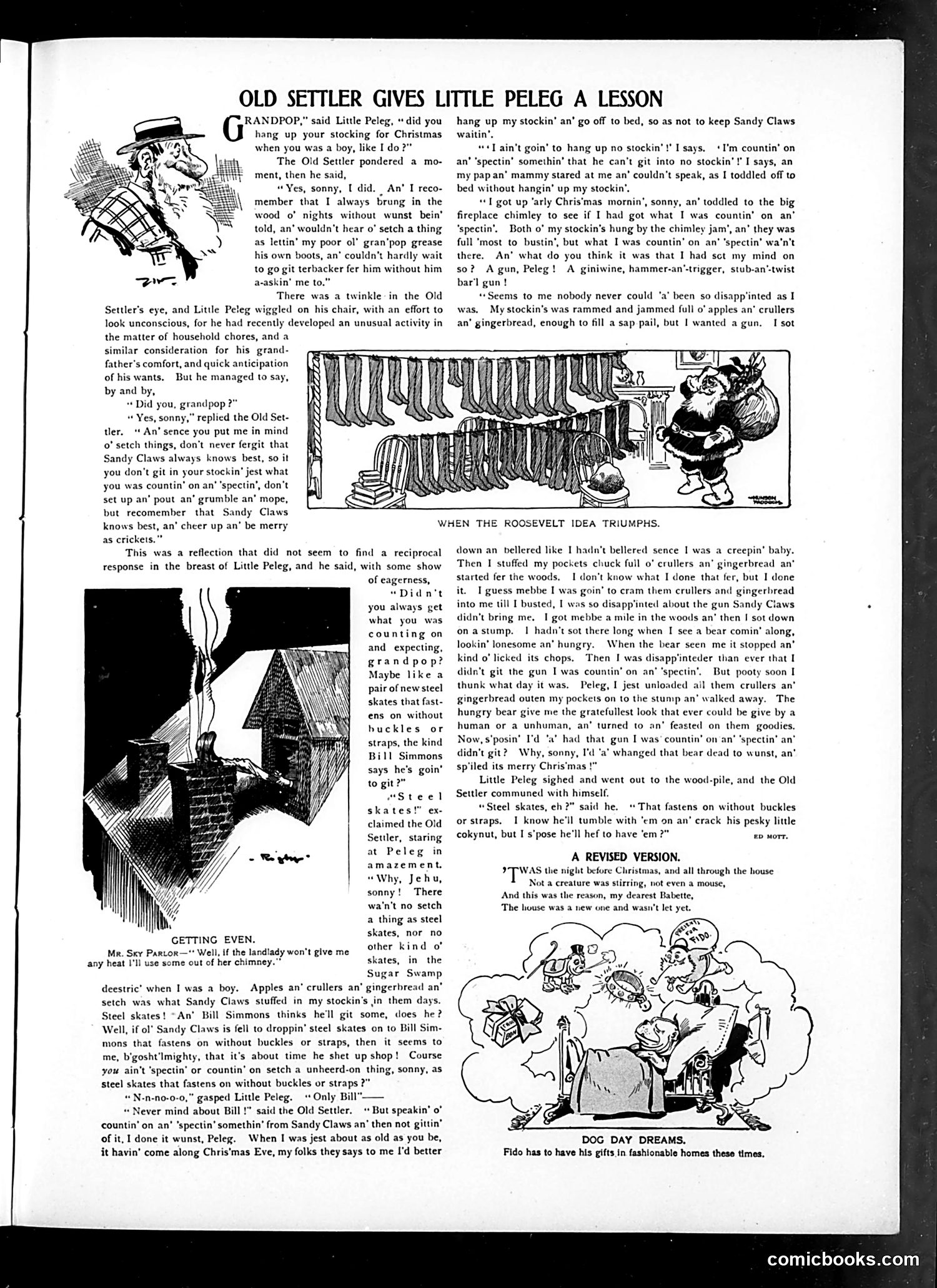
This is a moral tale in dialect, presented as advice from an older generation to a younger one. The "Old Settler" uses his own childhood disappointment—expecting a gun for Christmas but receiving only fruit and pastries—to teach Little Peleg not to be greedy or sullen when expectations aren't met. The satire targets modern materialism and entitlement. References to "steel skates" (fashionable new technology) and Bill Simmons expecting luxury goods mock contemporary children's acquisitiveness. The Old Settler's rural, humble past ("Sugar Swamp deestric'") contrasts with present-day consumer expectations. The lesson: patience, gratitude, and acceptance—values the writer associates with an older, supposedly more virtuous America. The heavy dialect reinforces the nostalgic, moralistic tone, positioning rural simplicity as morally superior to urban commercial excess.
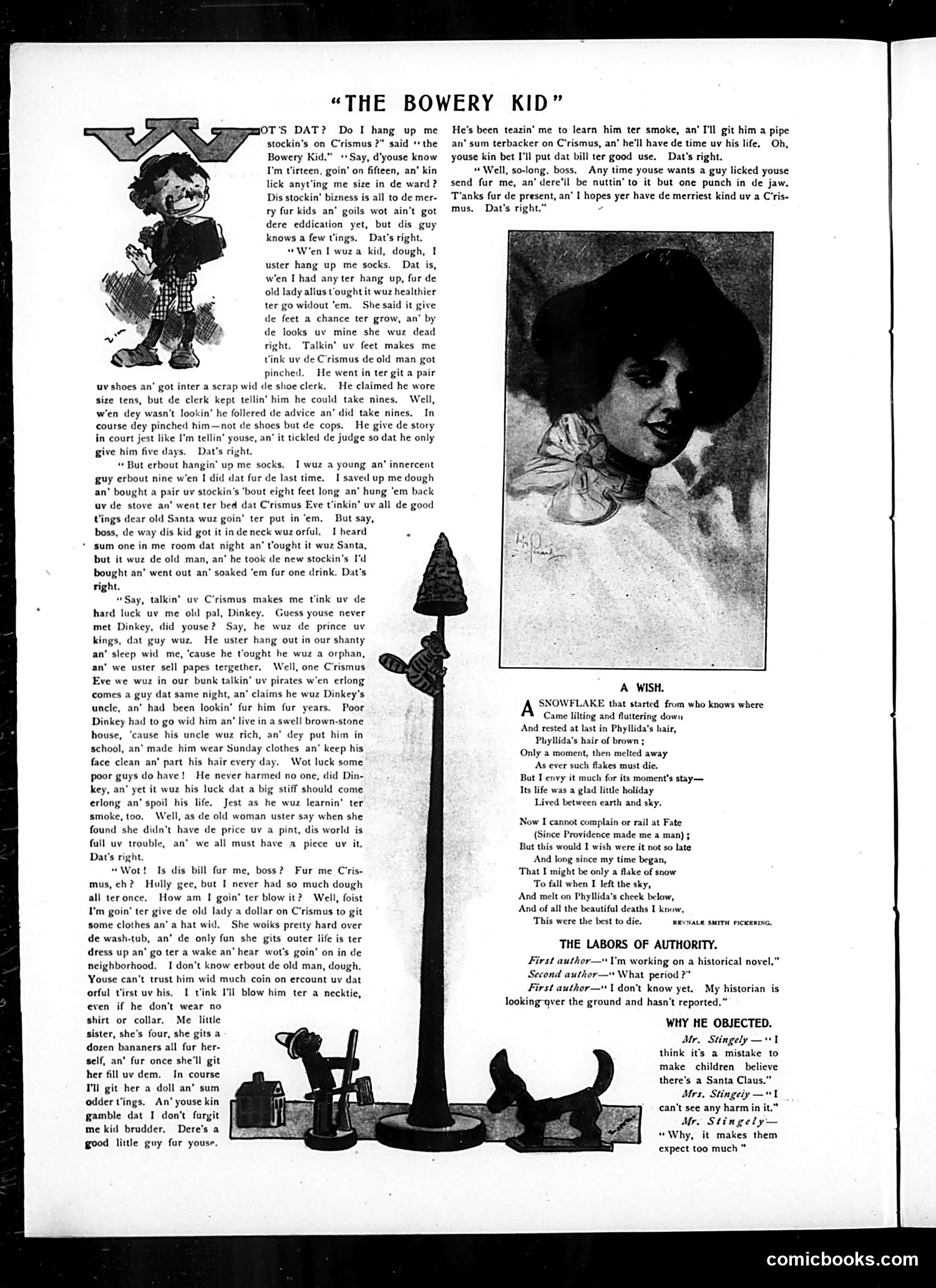
This is a monologue-style cartoon featuring a stereotypical working-class New York street youth of the early 1900s, rendered in exaggerated dialect ("C'rismus" for Christmas, "dough" for money). The satire works on multiple levels: The kid presents himself as tough and cynical—claiming he's outgrown childish Christmas traditions—yet his stories reveal genuine sentiment beneath the hardened exterior. He recalls his father pawning new stockings for drink, his orphaned friend Dinkey being "rescued" into an oppressively respectable life, and how he'll spend his meager earnings on family members he pretends not to care about. The humor comes from this contrast: the rough Bowery dialect and street swagger mask a tender heart. The accompanying illustrations of street life (shoe repair, children playing) reinforce the social commentary about urban poverty and childhood. Judge magazine used such pieces to humanize and sentimentalize working-class characters while simultaneously mocking their speech patterns—typical of early 20th-century American humor.
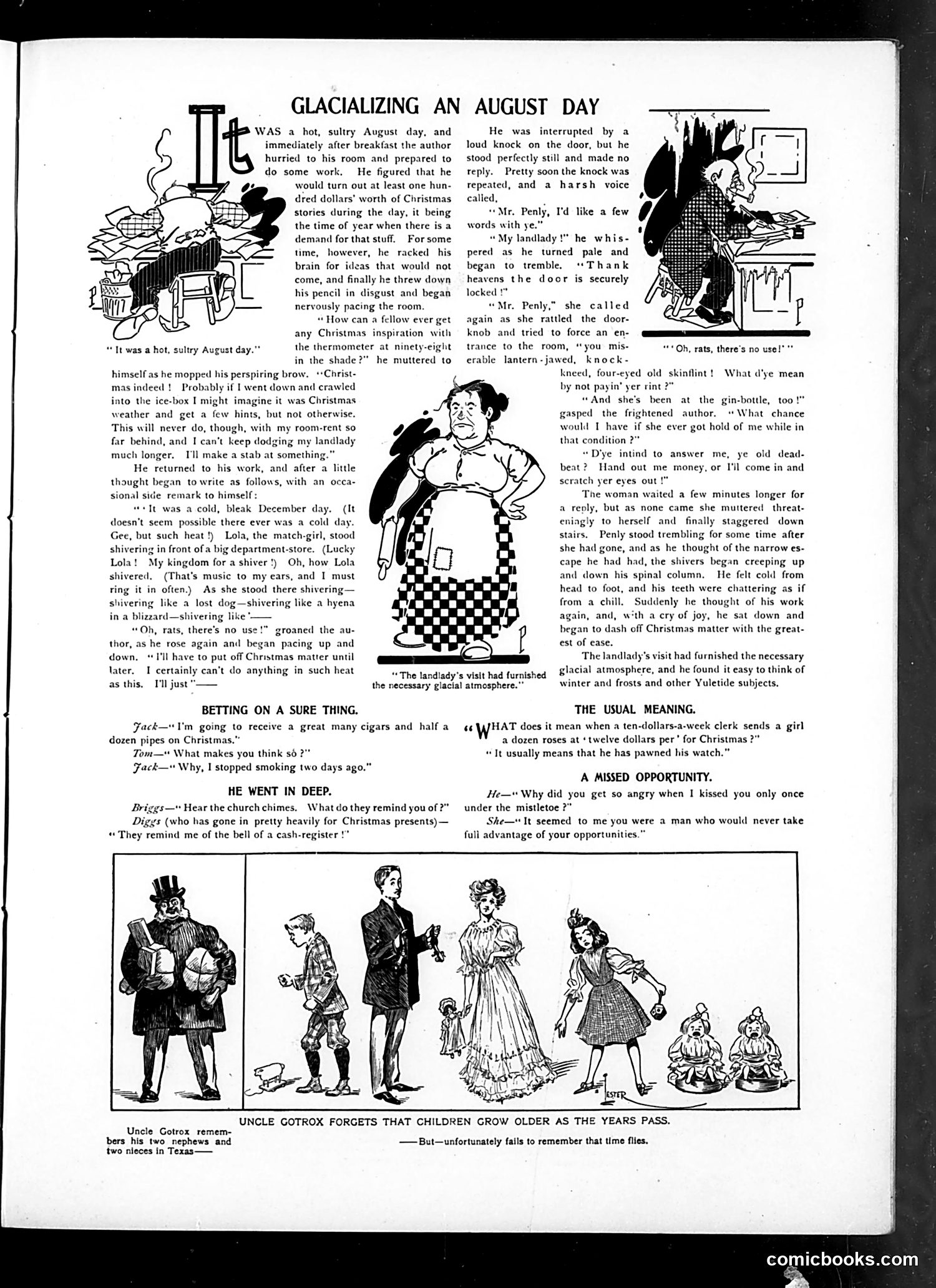
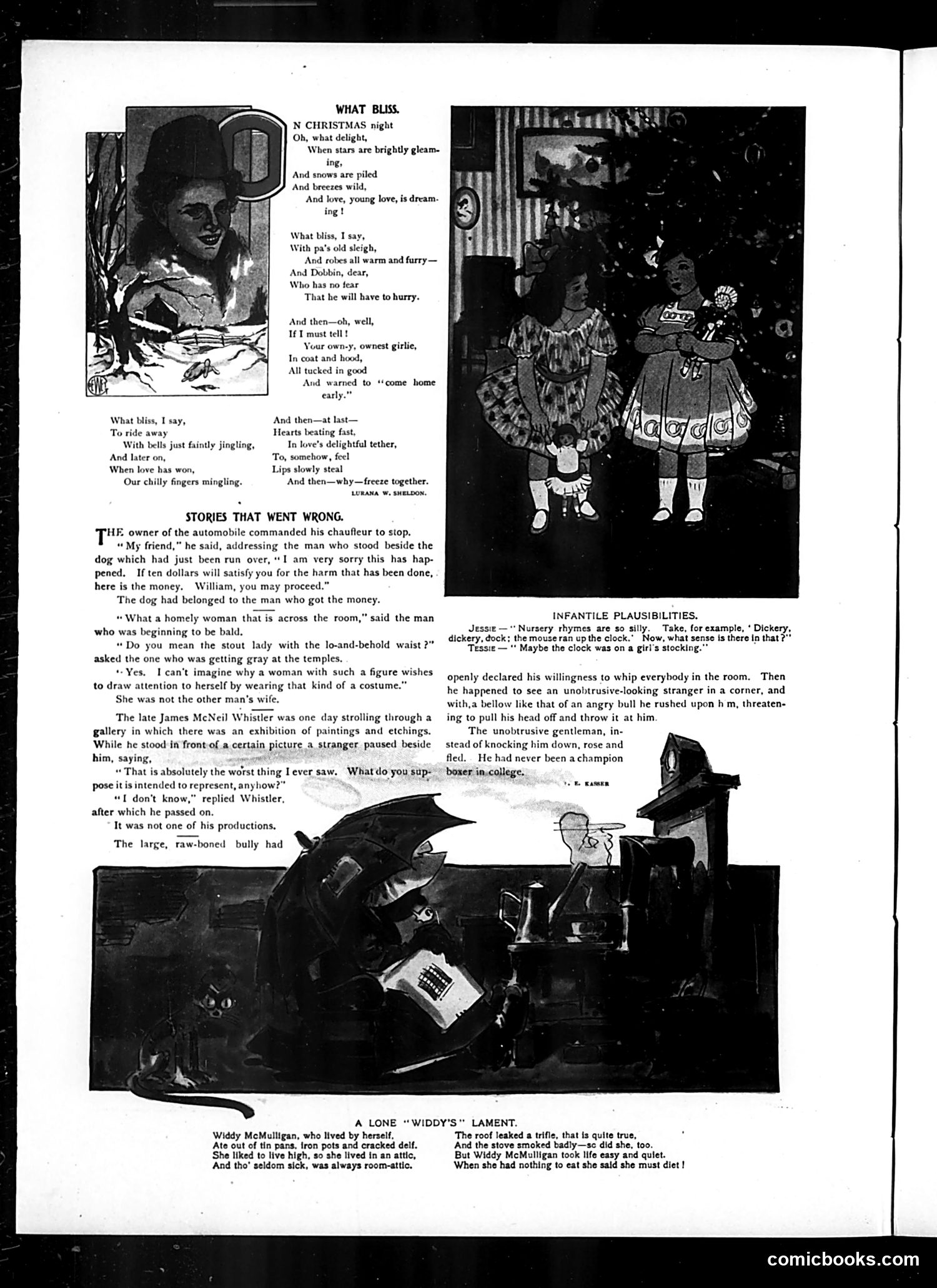
This page contains **poetry, humorous anecdotes, and satirical commentary** typical of early 20th-century American humor magazines. **"What Bliss"** is a sentimental Christmas poem celebrating young romance during sleigh rides—gentle satire of romantic clichés. **"Stories That Went Wrong"** presents three brief comedic anecdotes: 1. A wealthy automobile owner dismisses killing a poor man's dog with $10 compensation 2. A conversation mocking nonsensical nursery rhymes 3. A James McNeill Whistler anecdote (the famous artist) where he deflates a critic's pretension by claiming he doesn't know whose painting it is **"Infantile Plausibilities"** and **"A Lone Widdy's Lament"** are humorous character sketches—the latter depicting an impoverished Irish widow ("Widdy McMulligan") making light of her desperate circumstances. The overall tone satirizes **class pretension, romantic sentimentality, and human folly**. The magazine targets educated readers familiar with art world gossip and literary references.
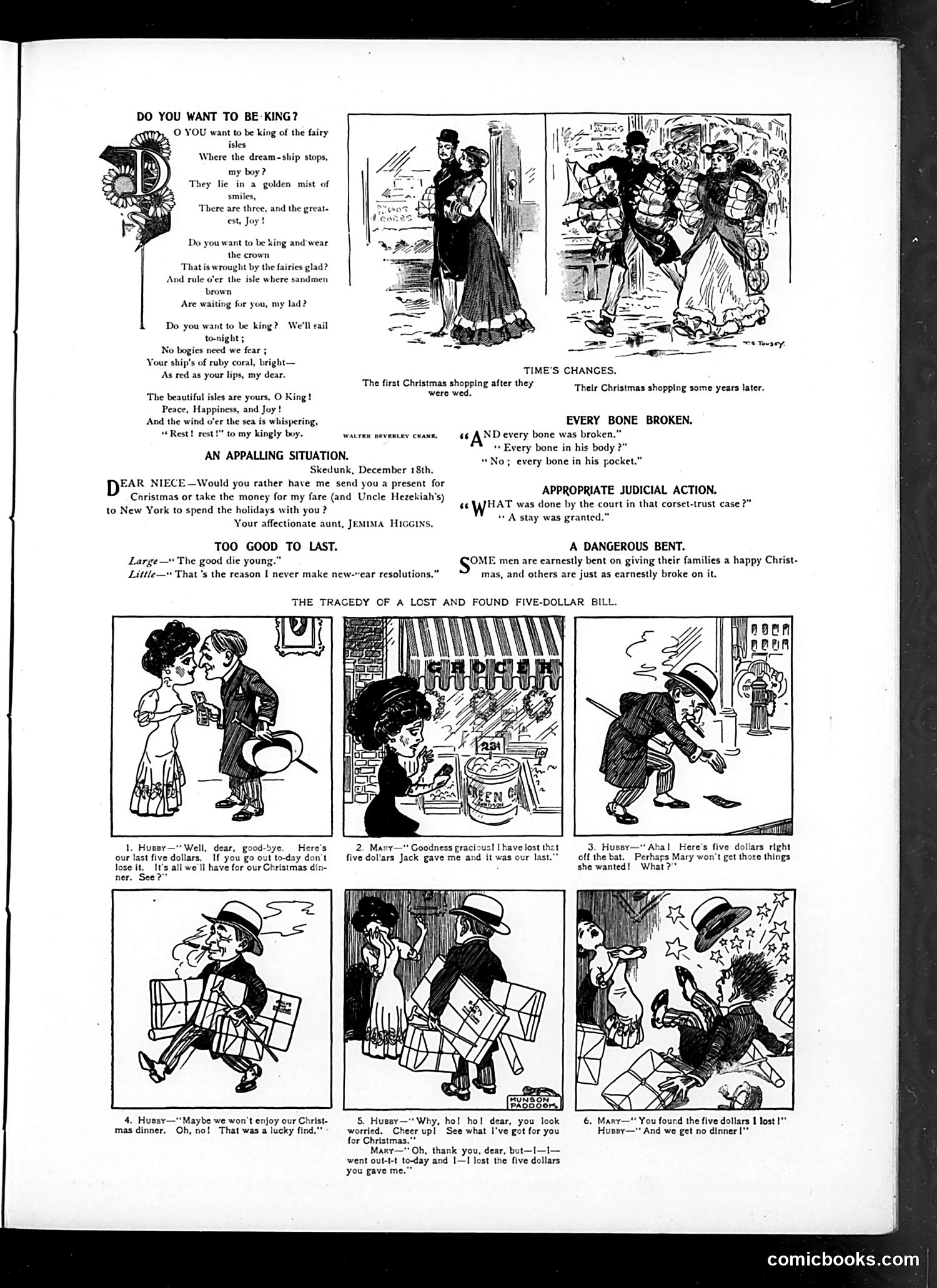
This page contains several discrete satirical pieces typical of early 20th-century American humor magazine content. **"Do You Want to Be King?"** is a whimsical poem addressing childhood dreams and imagination, contrasting fairy-tale fantasies with reality. **"Time's Changes"** depicts a couple's Christmas shopping habits before and after marriage—a common social satire about how matrimony changes behavior and priorities. **"Every Bone Broken"** and **"Appropriate Judicial Action"** are brief wordplay jokes: the first plays on a phrase about injuries; the second mocks legal language and trust-busting actions (likely referencing contemporary antitrust cases). **"The Tragedy of a Lost and Found Five-Dollar Bill"** is a six-panel comic strip following a couple's lost money. A husband finds his wife's lost five dollars, but rather than replacing their dinner funds, they spend it celebrating the "lucky find," leaving them still without Christmas dinner—satirizing working-class financial struggle and poor decision-making during the holiday season. The overall theme emphasizes how economic hardship and life circumstances constrain ordinary people's Christmas celebrations.
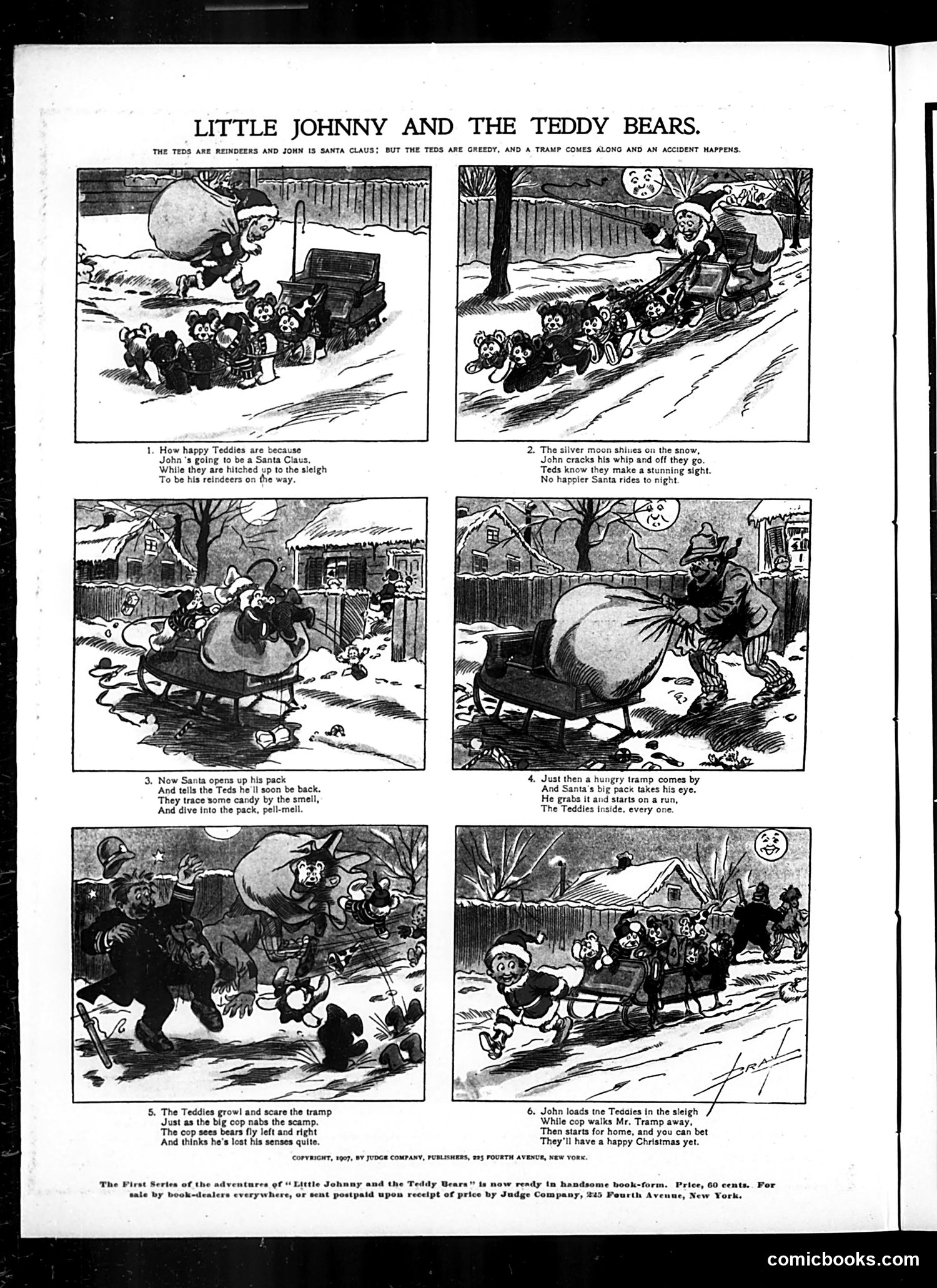
This is a lighthearted children's comic strip, not political satire. "Little Johnny" plays Santa Claus with toy bears (called "Teddies"—likely referencing the popular teddy bear toy craze of the early 1900s) harnessed as reindeer to pull a sleigh. The plot: Johnny opens his gift pack, the greedy bears smell candy and dive in. A hungry tramp steals the pack and runs away with it—and the bears inside. When a policeman catches the tramp, the bears emerge and frighten both him and the criminal, creating comic chaos. Johnny recovers his toys and has a happy Christmas. The humor relies on slapstick: greedy bears, a bungling tramp, a confused cop, and the surprise of toy bears attacking. It's wholesome holiday entertainment for Judge magazine's readers, promoting the teddy bear toy and depicting an idealized Christmas resolution.
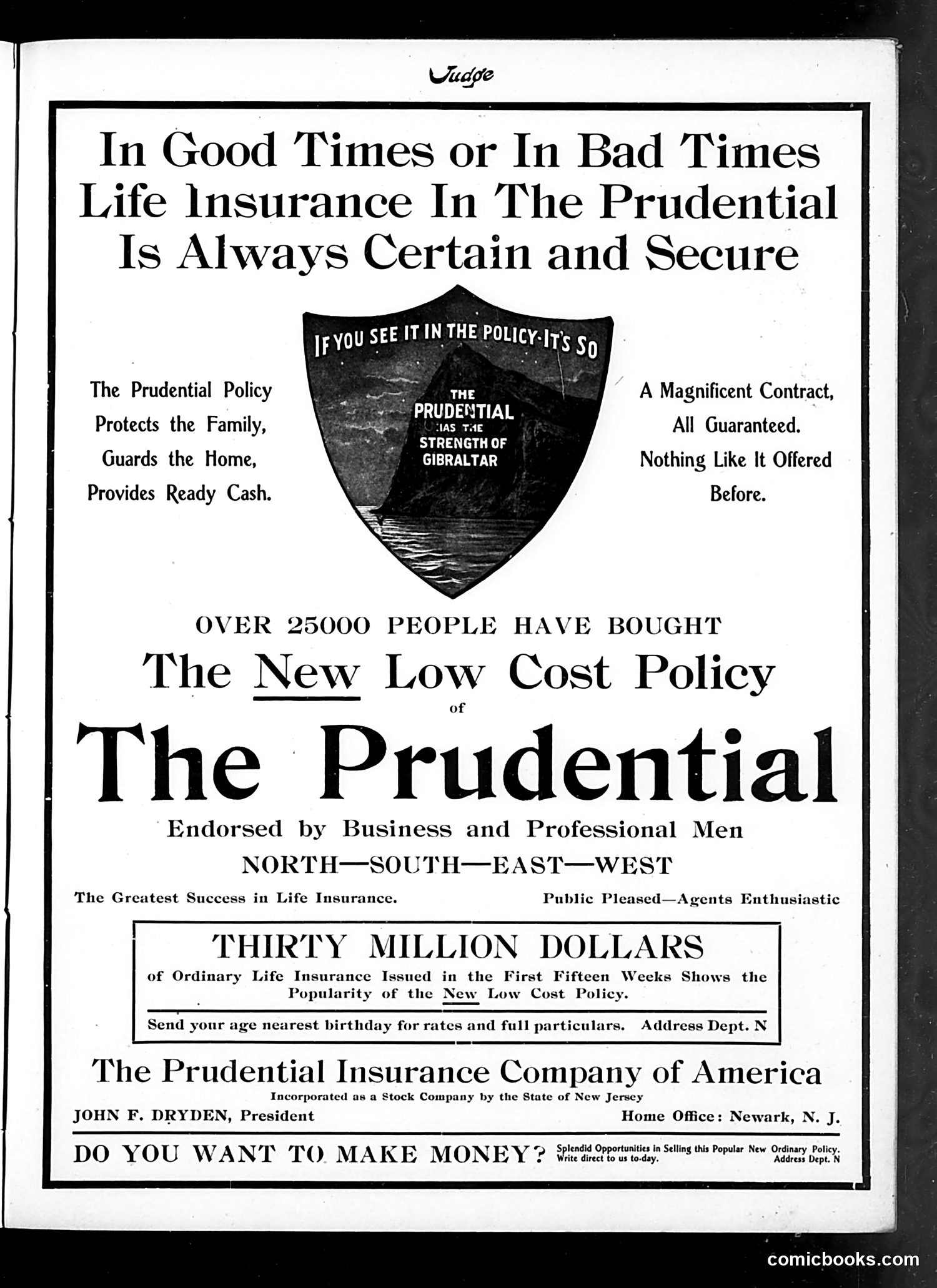
This is primarily **advertising, not satire**—a full-page promotional ad for The Prudential Insurance Company that appeared in *Judge* magazine. The page markets Prudential's "New Low Cost Policy" by emphasizing reliability and popularity. The shield emblem bearing "The Prudential Has the Strength of Gibraltar" uses a famous metaphor for unshakeable stability. The three key selling points listed ("Protects the Family, Guards the Home, Provides Ready Cash") appeal to middle-class anxieties about financial security. The statistics cited—25,000 policies sold in fifteen weeks, $30 million issued—are presented as proof of success and public confidence. The endorsement "by Business and Professional Men, North—South—East—West" suggests broad, nationwide appeal across social classes. The closing lines ("DO YOU WANT TO MAKE MONEY?") recruit insurance agents, offering commission opportunities. Rather than satirizing insurance or the company, *Judge* simply sold advertising space to a major corporation. This reflects the magazine's commercial dependence on paid advertisements alongside its actual satirical content.
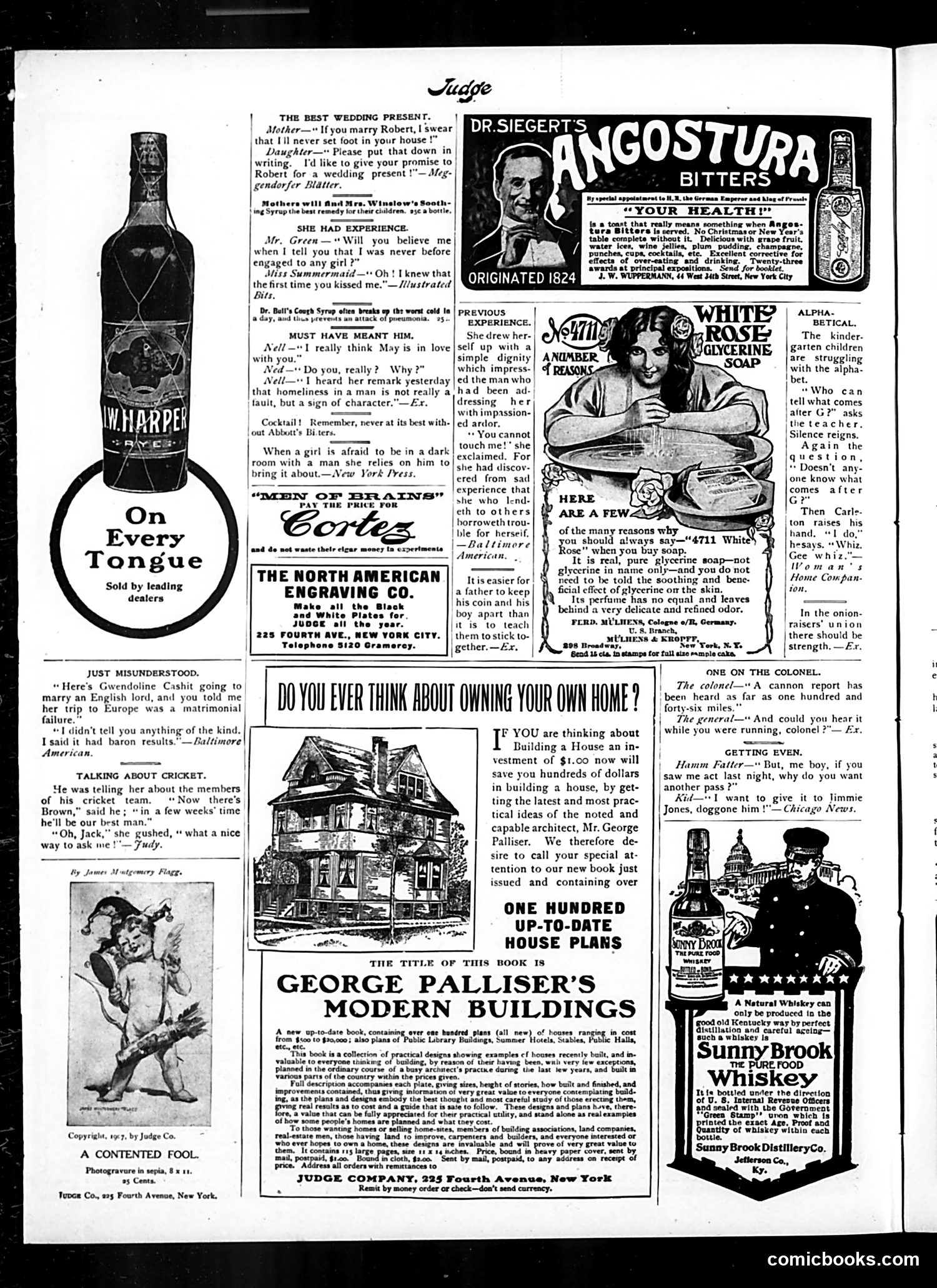
This page from Judge (appears to be early 1900s) is primarily **advertising and miscellaneous content** rather than political cartoons. The layout contains: **Advertisements:** - W. Harper whiskey ("On Every Tongue") - Dr. Siegert's Angostura Bitters - White Rose Glycerine Soap - George Palliser's Modern Buildings book - Sunny Brook Whiskey **Comic Vignettes:** Brief, disconnected jokes about relationships and social situations—typical Judge humor: - A daughter requests her mother's written promise to stay away as a wedding gift - Jokes about engagements, courtship, and marriage - Military humor (colonel and cannon report) **No clear political satire** is evident. The page reflects Belle Époque-era attitudes toward courtship, alcohol, and domesticity, with humor aimed at upper-middle-class readers. The content is lighthearted social commentary rather than political critique.
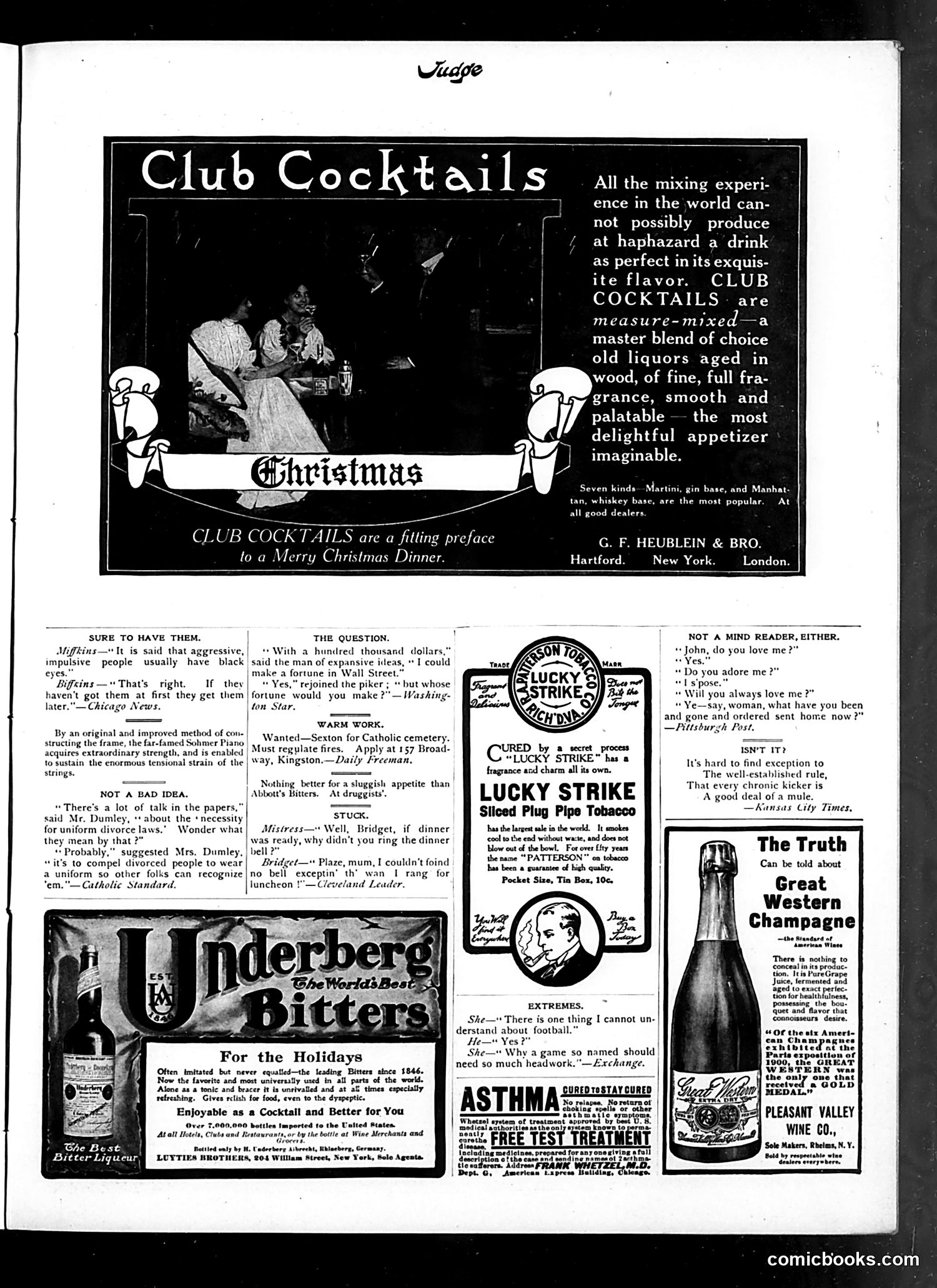
This page is primarily **advertising**, not political satire. It features multiple product advertisements interspersed with short humor columns typical of Judge magazine's format. The main content includes: **Club Cocktails advertisement** (top): A Christmas-themed ad for pre-mixed cocktails by Heublein & Bros., emphasizing quality ingredients and convenience—appealing to holiday entertaining. **Underberg Bitters ad** (left): Promotes this German digestive bitters as a holiday tonic, noting its long popularity since 1846. **Smaller humor items** scattered throughout joke about divorce uniformity, Catholic cemetery workers, and marital dynamics—light, domestic satire typical of the era. **Lucky Strike tobacco, asthma treatment, and Great Western Champagne ads** fill remaining space. No significant political figures or events are referenced. This page reflects early 20th-century consumer culture and domestic humor rather than political commentary.
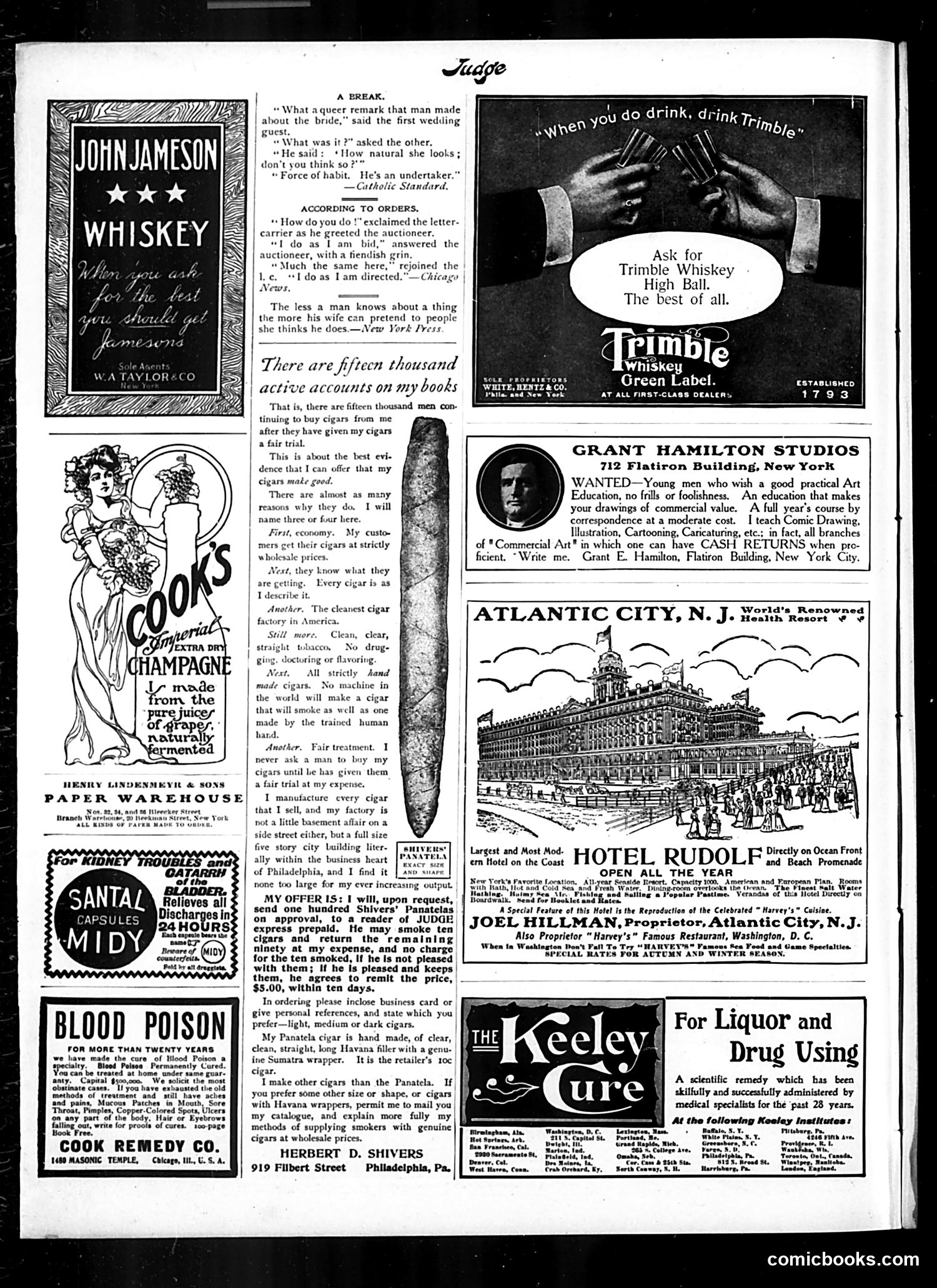
This is primarily an **advertising page** from Judge magazine, featuring multiple classified and display ads rather than satirical cartoons. The **single joke** on the page ("A Break") plays on dark humor: A wedding guest remarks the bride looks "natural," which the other guest finds odd until learning the first speaker is an undertaker—implying he's accustomed to making corpses look lifelike. The humor relies on morbid irony common to early 20th-century joke collections. The rest consists of commercial advertisements: whiskey (Trimble, John Jameson), cigars (Cook's Champagne, Shivers' Panatelas), art instruction (Grant Hamilton Studios), hotels (Atlantic City's Hotel Rudolf), medical treatments ("Blood Poison" cure, Keeley Institute for substance abuse), and business services. The ads reveal period concerns: patent medicines, mail-order education, and cigar quality. No political satire is present—this is a revenue-generating page of classifieds rather than editorial content.

I cannot reliably analyze this page. The image is almost entirely black with only a white vertical stripe on the left edge and the "comicbooks.com" watermark visible. No cartoon figures, text, illustrations, or other content details are discernible enough to identify specific political figures, historical references, or satirical points. To provide accurate analysis per your rules, I would need a clearer image where the actual cartoon(s), caricatures, and OCR'd text are legible. If this is a page from *Judge* magazine, the content likely exists—but it's not visible in this reproduction.

I can see this is a largely blank or extremely dark page from *Judge* magazine with only a white margin visible on the right edge and the "comicbooks.com" watermark at the bottom. The image quality and darkness make it impossible to discern any cartoon illustrations, text content, political figures, or satirical elements that would normally appear on a *Judge* magazine page. To provide accurate analysis of the cartoon's meaning, political references, and historical context as requested, I would need a clearer, more legible version of this page where the actual content is visible.
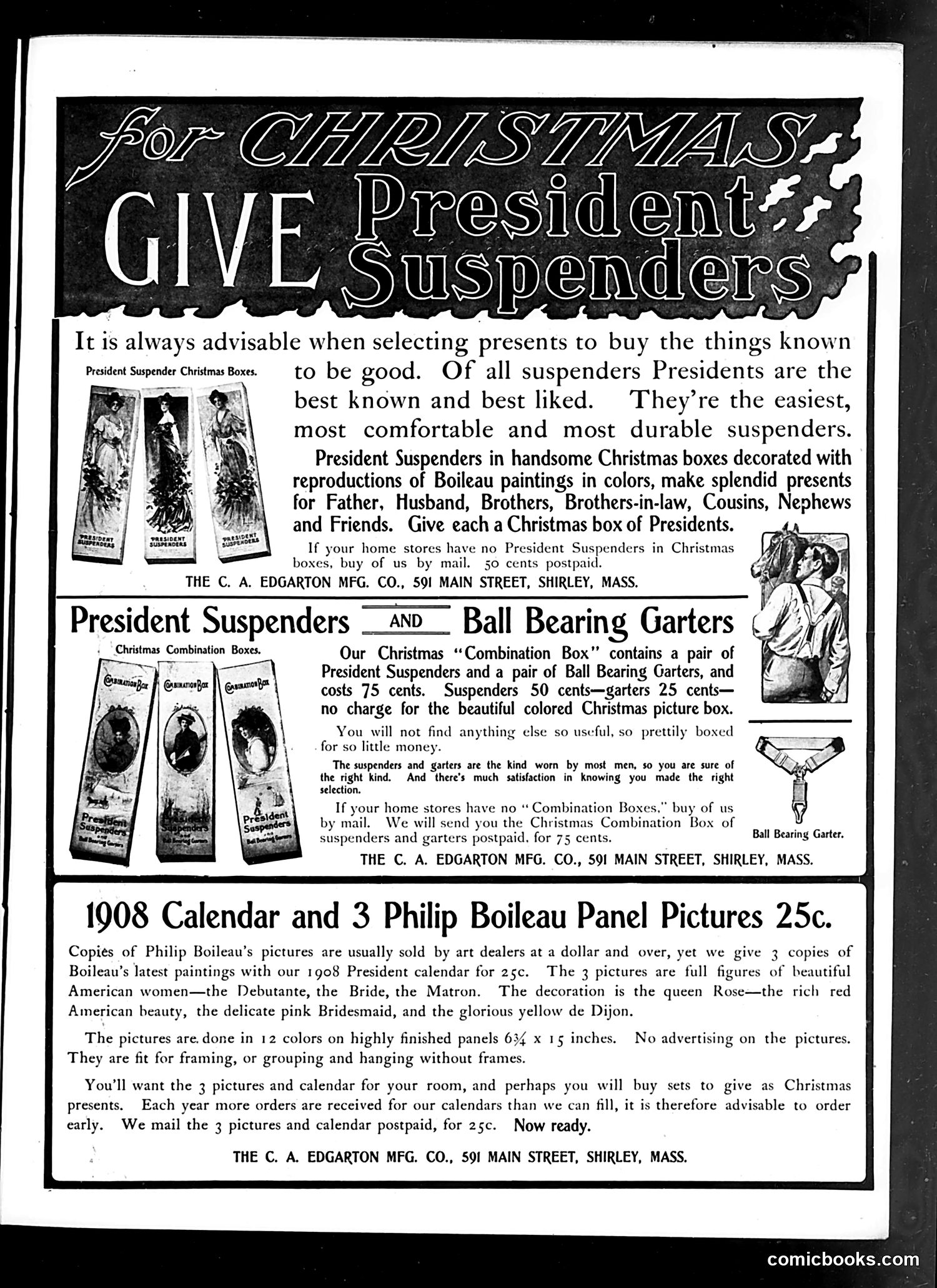
This is **not a cartoon or satire**—it's a full-page advertisement from the C.A. Edgarton Manufacturing Company promoting "President Suspenders" and related products. The company capitalized on the word "President" as a brand name, likely referencing the sitting U.S. President (1908 suggests Theodore Roosevelt's administration). The ads feature product images and copy selling suspenders, garters, and calendars decorated with Philip Boileau paintings of idealized women. The humor is mild—wordplay on "President" as a luxury brand name. There's no political satire here; it's straightforward mail-order advertising using patriotic imagery and beautiful women to sell menswear accessories to gift-buyers during the Christmas season.
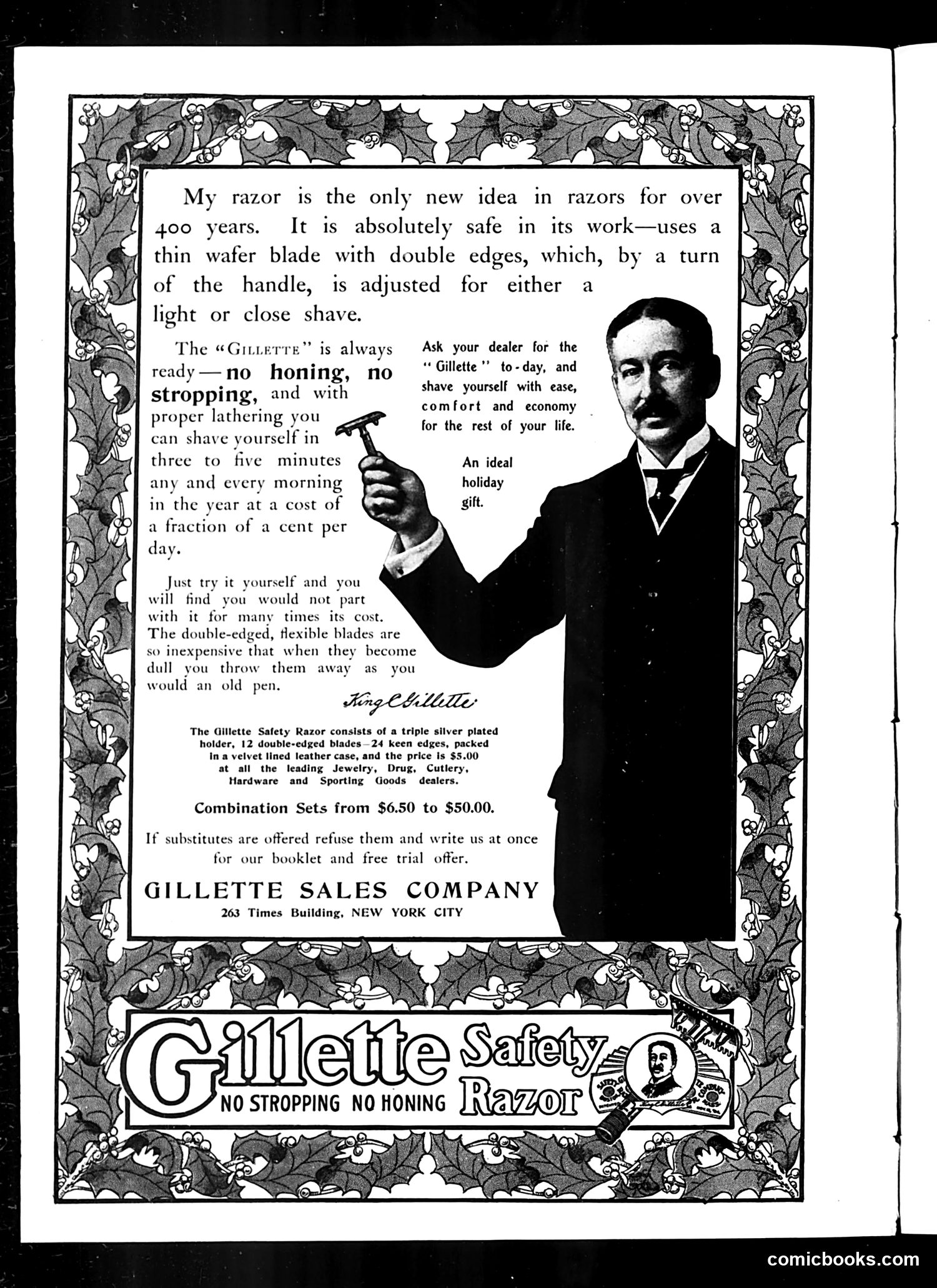
This is a **product advertisement**, not political satire. It promotes the Gillette Safety Razor, claiming revolutionary innovation in shaving technology. The ad features a well-dressed man holding the razor, presenting it as a major breakthrough—"the only new idea in razors for over 400 years." The pitch emphasizes convenience: no stropping or honing required, quick three-to-five-minute shaves, and disposable blades (revolutionary at the time). The marketing targets middle and upper-class men concerned with daily grooming efficiency and cost-effectiveness. The ornate decorative border and prestigious placement in *Judge* magazine suggest this was a luxury product positioned for wealthy consumers, despite claims of economy. This represents early 20th-century consumer advertising strategy: presenting modern manufacturing convenience as a lifestyle necessity and status marker for gentlemen.