
Judge, 1907-12-07 · page 36 of 48
Judge — December 7, 1907 — page 36: what you’re looking at
What you’re looking at
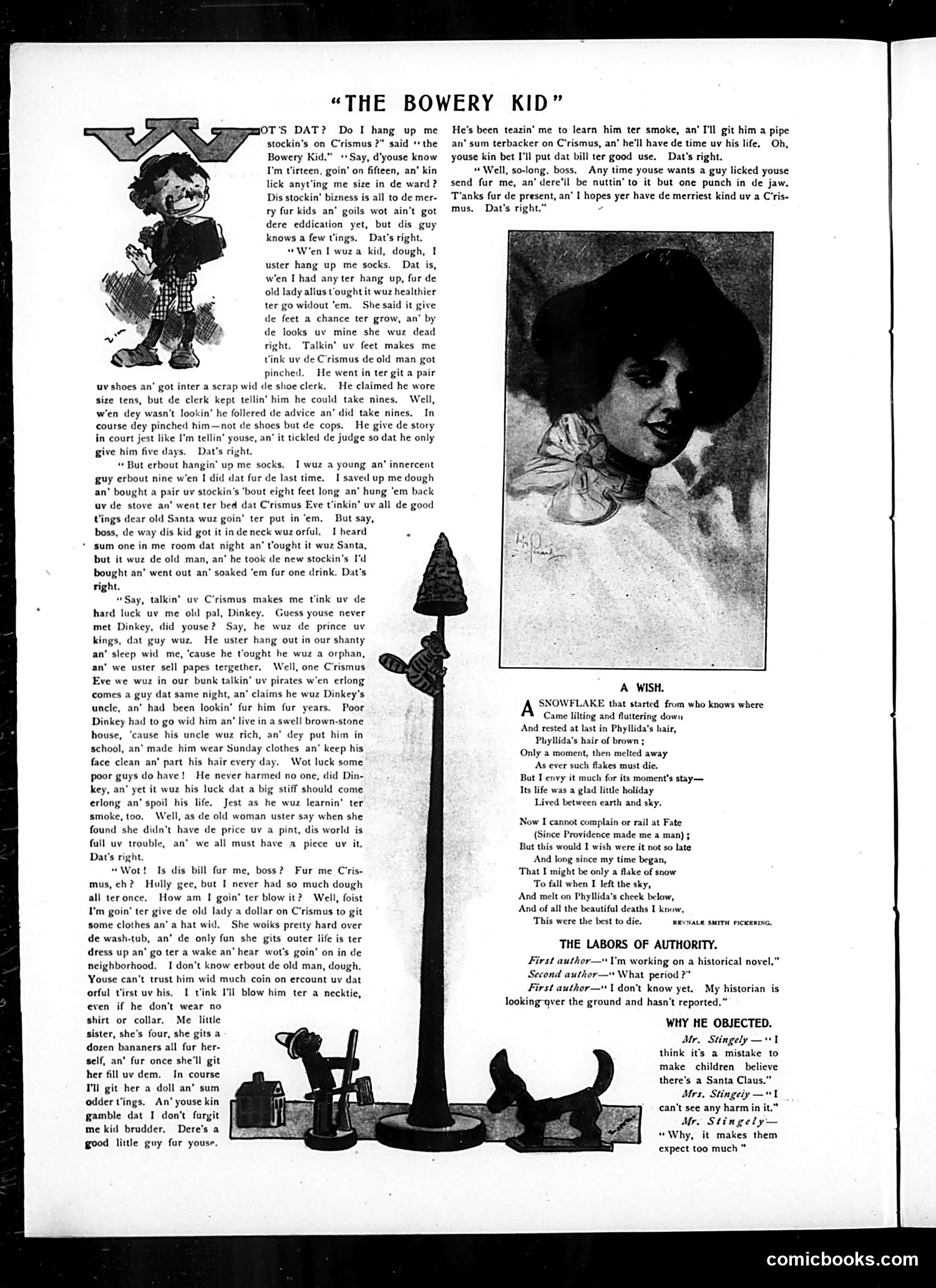
This is a monologue-style cartoon featuring a stereotypical working-class New York street youth of the early 1900s, rendered in exaggerated dialect ("C'rismus" for Christmas, "dough" for money). The satire works on multiple levels: The kid presents himself as tough and cynical—claiming he's outgrown childish Christmas traditions—yet his stories reveal genuine sentiment beneath the hardened exterior. He recalls his father pawning new stockings for drink, his orphaned friend Dinkey being "rescued" into an oppressively respectable life, and how he'll spend his meager earnings on family members he pretends not to care about. The humor comes from this contrast: the rough Bowery dialect and street swagger mask a tender heart. The accompanying illustrations of street life (shoe repair, children playing) reinforce the social commentary about urban poverty and childhood. Judge magazine used such pieces to humanize and sentimentalize working-class characters while simultaneously mocking their speech patterns—typical of early 20th-century American humor.
📄 Transcribed text from this page (OCR, searchable)
Machine-transcribed from the original scan — historical spelling and the odd misread are preserved.
“THE BOWERY KID” OT'S DAT? Do I hang up me stockin’s on C’rismus 2” said “the Bowery Kid.” «Say, d'youse know I'm tirteen, goin’ on fifteen, an’ kin lick anyt'ing me size in de ward? Dis stockin’ bizness is all to de mer- ry fur kids an’ goils wot ain't got dere eddication yet, but dis guy knows a few tings. Dat’s right. “Wren I wuza kid, dough, I uster hang up me socks. Dat is, w'en [had any ter hang up, fur de old lady allus Vought it wuz healthier ter go widout ‘em, She said it give de feet a chance ter grow, an’ by de looks uv mine she wuz dead right. Talkin’ uv feet makes me vink uv de Crismus de old man got He went in ter git a pair uy shoes an’ got inter a scrap wid de shoe clerk. He claimed he wore size tens, but de clerk kept tellin’ him he could take nines, Well, w'en dey wasn't lookin’ he follered de advice an’ did take nines, In course dey pinched him—not de shoes but de cops. He give de story in court jest like I'm tellin’ youse, an’ it tickled de judge so dat he only give him five days. Dat’s right. “+ But erbout hangin’ up me socks. guy erbout nine w'en I did dat fur de last time. an’ bought a pair uv stockin’s ‘bout eight feet long an’ hung ‘em back uy de stove an’ went ter bed dat C’rismus Eve t'inkin’ uv all de good t'ings dear old Santa wuz goin’ ter put in ‘em, But say, boss, de way dis kid got it inde neck wuz orful. I heard sum one in me room dat night an’ tought it wuz Santa, but it wuz de old man, an’ he took de new stockin's I'd bought an’ went out an’ soaked ‘em fur one drink. Dat’s pinched. I wuz a young an’ innercent I saved up me dough right. “Say, talkin’ uv C’rismus makes me tink uv de hard luck uv me old pal, Dinkey. Guess youse never met Dinkey, did youse? Say, he wuz de prince uv kings, dat guy wuz. He uster hang out in our shanty an’ sleep wid me, ‘cause he tought he wuz a orphan, an’ we uster sell papes tergether, Well, one C’rismus Eve we wuz in our bunk talkin’ uv pirates w'en erlong comes a guy dat same night, an’ claims he wuz Dinkey’s uncle, an’ had been lookin’ fur him fur years. Poor Dinkey had to go wid him an’ live in a swell brown-stone house, ‘cause his uncle wuz rich, an’ dey put him in school, an’ made him wear Sunday clothes an’ keep his face clean an’ part his hair every day. Wot luck some poor guys do have! He never harmed no one, did Din- key, an’ yet it wuz his luck dat a big stiff should come erlong an’ spoil his life. Jest as he wuz learnin’ ter smoke, too, Well, as de old woman uster say when she found she didn’t have de price uv a pint, dis world is full uv trouble, an’ we all must have a piece uv it. Dat's right. “Wot! Is dis bill fur me, boss? Fur me C'ris- mus, ch? Hully gee, but I never had so much dough all teronce. How am I goin’ ter blow it? Well, foist I'm goin’ ter give de old lady a dollar on C’rismus to git some clothes an’ a hat wid. She woiks pretty hard over de wash-tub, an’ de only fun she gits outer life is ter dress up an’ go ter a wake an’ hear wot's goin’ on in de neighborhood. I don’t know erbout de old man, dough. Youse can’t trust him wid much coin on ercount uv dat orful virst uv his. I tink I'll blow him ter a necktie, even if he don’t wear no shirt or collar, Me little sister, she’s four, she gits a dozen bananers all fur her- self, an’ fur once she'll git her fill uv dem. In course T'll git her a doll an’ sum odder t'ings. An’ youse kin gamble dat I don’t furgit me kid brudder. Dere’s a good little guy fur youse. "me to learn him ter smoke, an‘ I'll git him a pipe Oh, He's been teaz an’ sum terbacker on C’rismus, an’ he'll have de time uv his life. youse kin bet I'll put dat bill ter good use. Dat’s right. “Well, so-long, boss. Any time youse wants a guy licked youse send fur me, an’ dere'll be nuttin’ to it but one punch in de jaw. T’anks fur de present, an’ I hopes yer have de merriest kind uv a C'ris- mus. Dat's right.” A WISH. NOWFLAKE that started from who knows where Came lilting and fluttering down And rested at last in Phyllida’s hair, Phyllida’s hair of brown ; Only a moment, then melted away As ever such flakes must die. But I envy it much for its moment's stay— Its life was a glad little holiday Lived between earth and sky. Now I cannot complain or rail at Fate (Since Providence made me a man) ; But this would I wish were it not so late And long since my time began, That I might be only a flake of snow To fall when I left the sky, And melt on Phyllida’s cheek below, And of all the beautiful deaths I know, This were the best to die. THE LABORS OF AUTHORITY. First author—«\'m working on a historical novel.” Second author—* What period ?” First author—“ 1 don’t know yet. My historian is looking-gver the ground and hasn't reported.” WHY HE OBJECTED. Mr. Stingely —"1 think it's a mistake to make children believe there's a Santa Claus.” Mrs, Stingely —"1 can’t see any harm in it.” Mr. Stingely— “Why, it makes them expect too much ” ALE SMITH PICKERING, comicbooks.com