A complete issue · 148 pages · 1934
Western Story Magazine, May 12, 1934
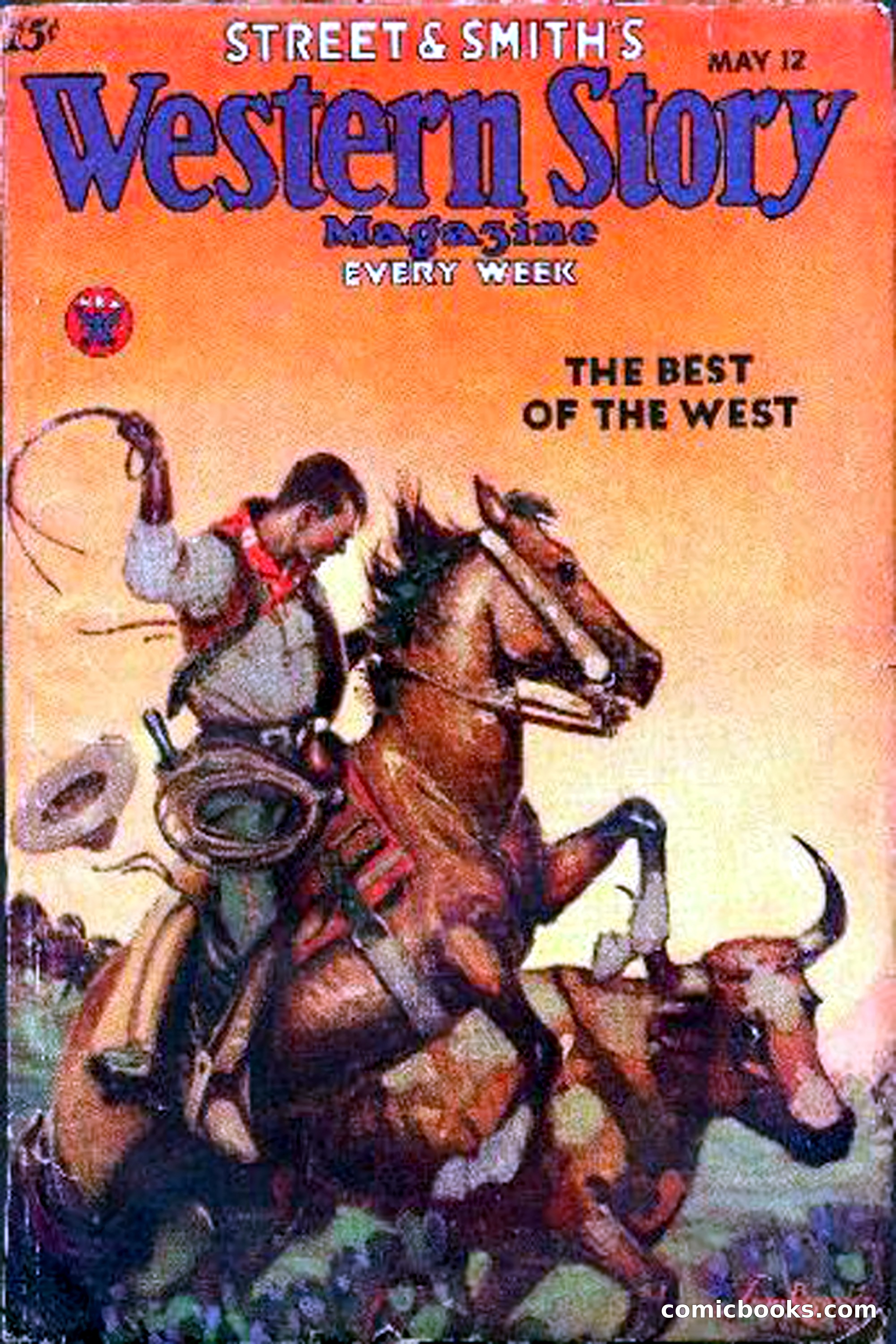
This is the cover of *Street & Smith's Western Story Magazine* from May 12, priced at 5 cents. The cover features an illustration of a cowboy on horseback swinging a lasso, with another figure visible beside him and what appears to be cattle in the lower portion. The tagline reads "The Best of the West," positioning the magazine as a collection of Western fiction stories. The cover art is rendered in warm tones of orange, brown, and tan, typical of pulp magazine cover design from the early 20th century. The OCR text is largely illegible, containing only scattered characters.
This page is a placeholder notice indicating that the inside front cover of this pulp magazine is missing from the digitized archive. The text is a call for help from readers: if anyone owns a physical copy of this magazine, they are invited to photograph and email the missing inside front cover image (in JPEG format at 300 dpi) to the pulp magazine archive at [email protected]. The notice appears to be from a modern digitization project rather than original magazine content.
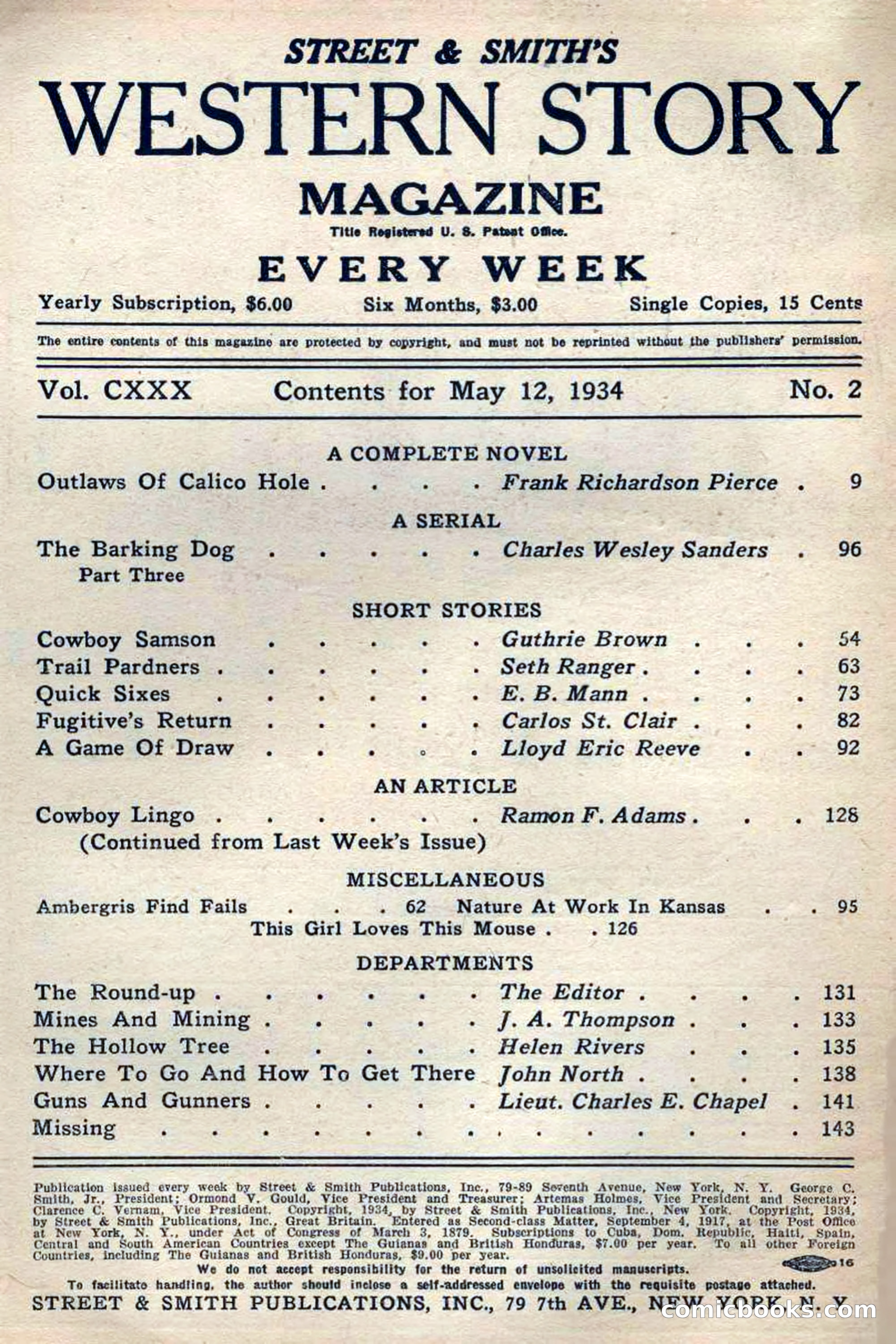
# Contents Page from Western Story Magazine This is a **table of contents page** from Street & Smith's *Western Story Magazine*, dated May 12, 1934. The page lists the issue's contents, including a complete novel ("Outlaws of Calico Hole" by Frank Richardson Pierce), the third part of a serial called "The Barking Dog" by Charles Wesley Sanders, six short stories with western themes, an article on cowboy lingo, and various regular departments covering topics like mining, travel, and firearms. The magazine cost 15 cents per copy and was published weekly.
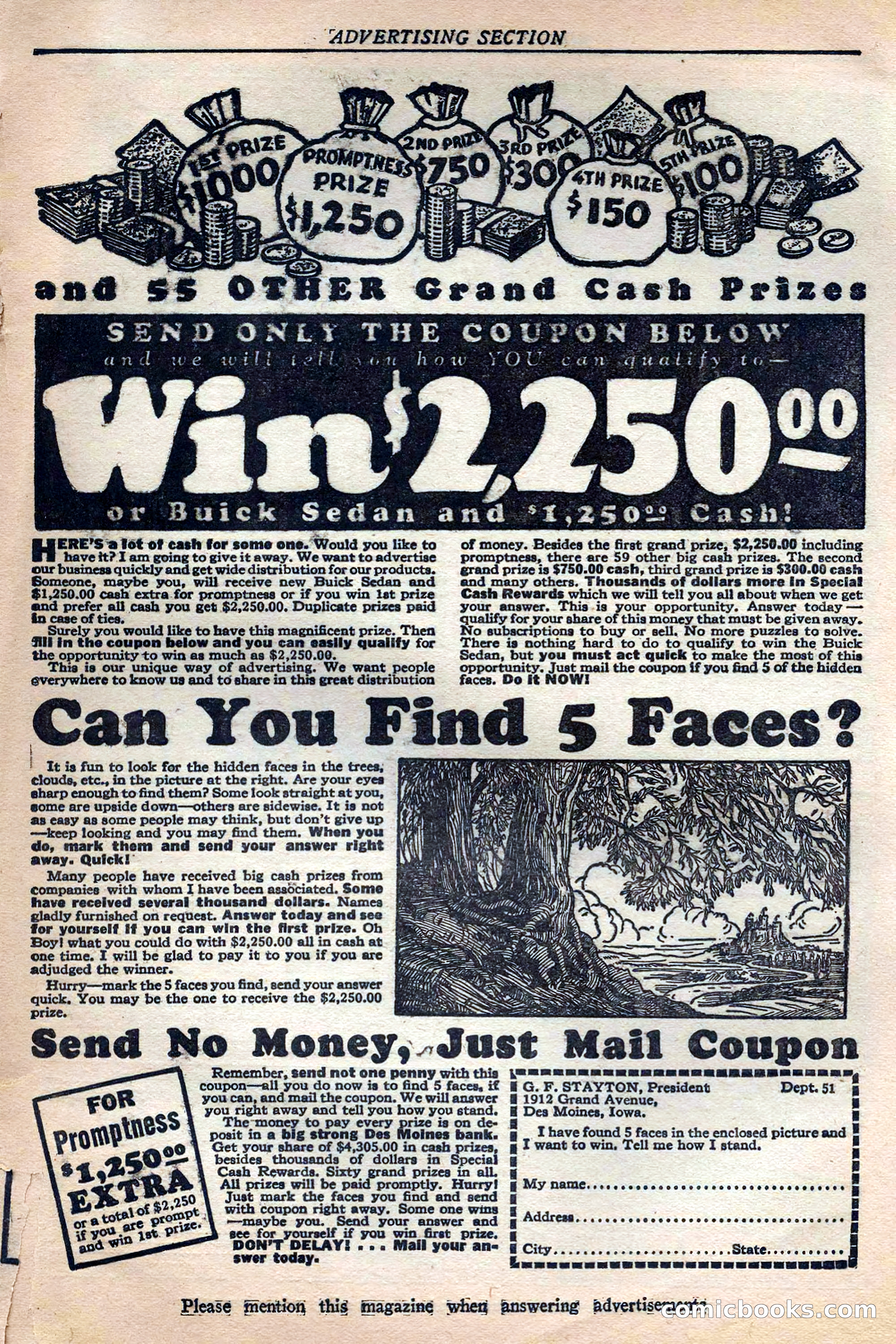
# Advertisement: Cash Prize Contest This is an **advertising section** from a pulp magazine featuring a contest promotion. The page advertises a drawing where readers can win up to $2,250 in cash or a Buick Sedan by finding five hidden faces in an illustrated forest scene and mailing in a coupon. The promoter, G.F. Stayton of Des Moines, Iowa, claims numerous past winners and promises prompt payment of all prizes. No purchase or subscription is required—participants need only mail the coupon with their answer.
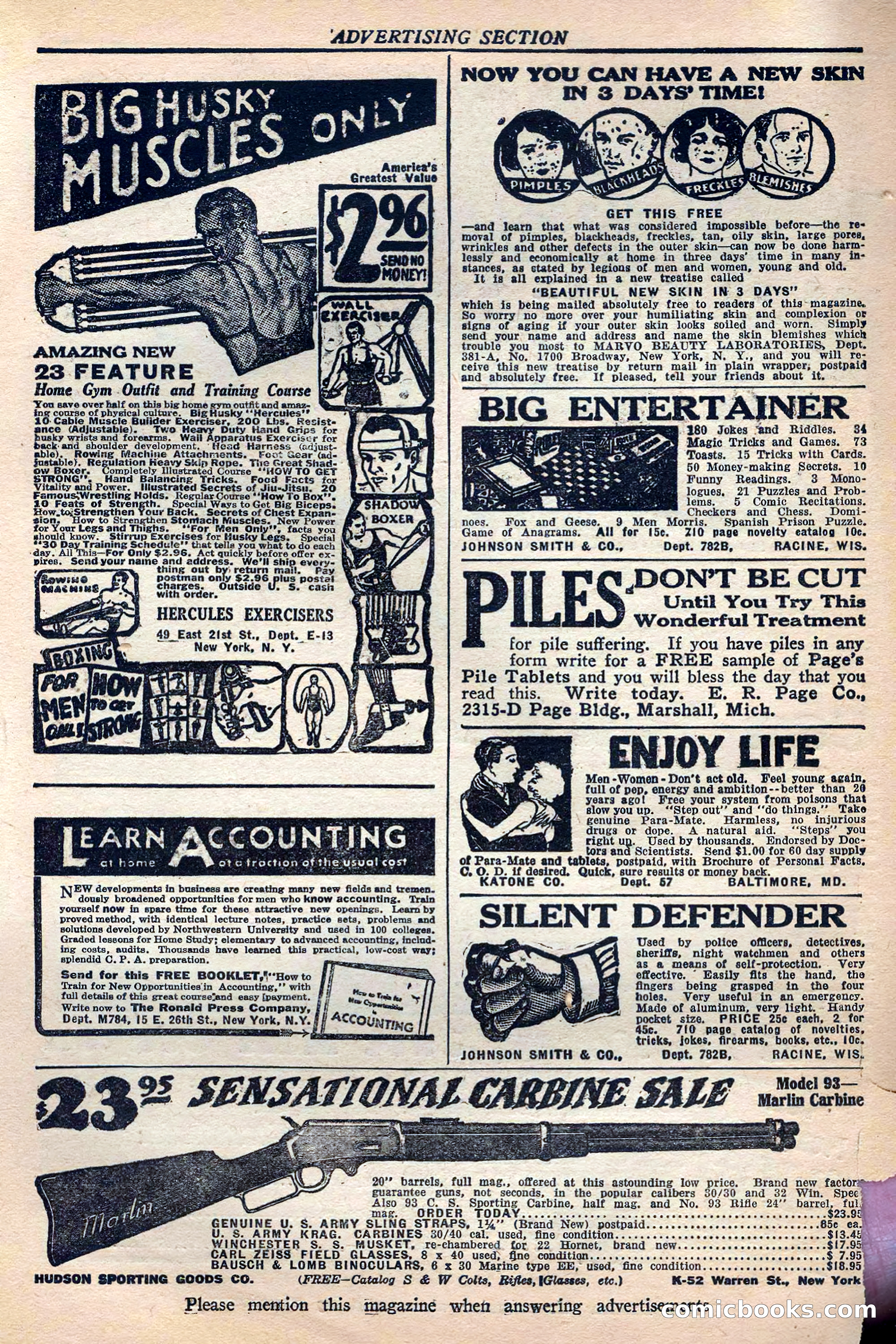
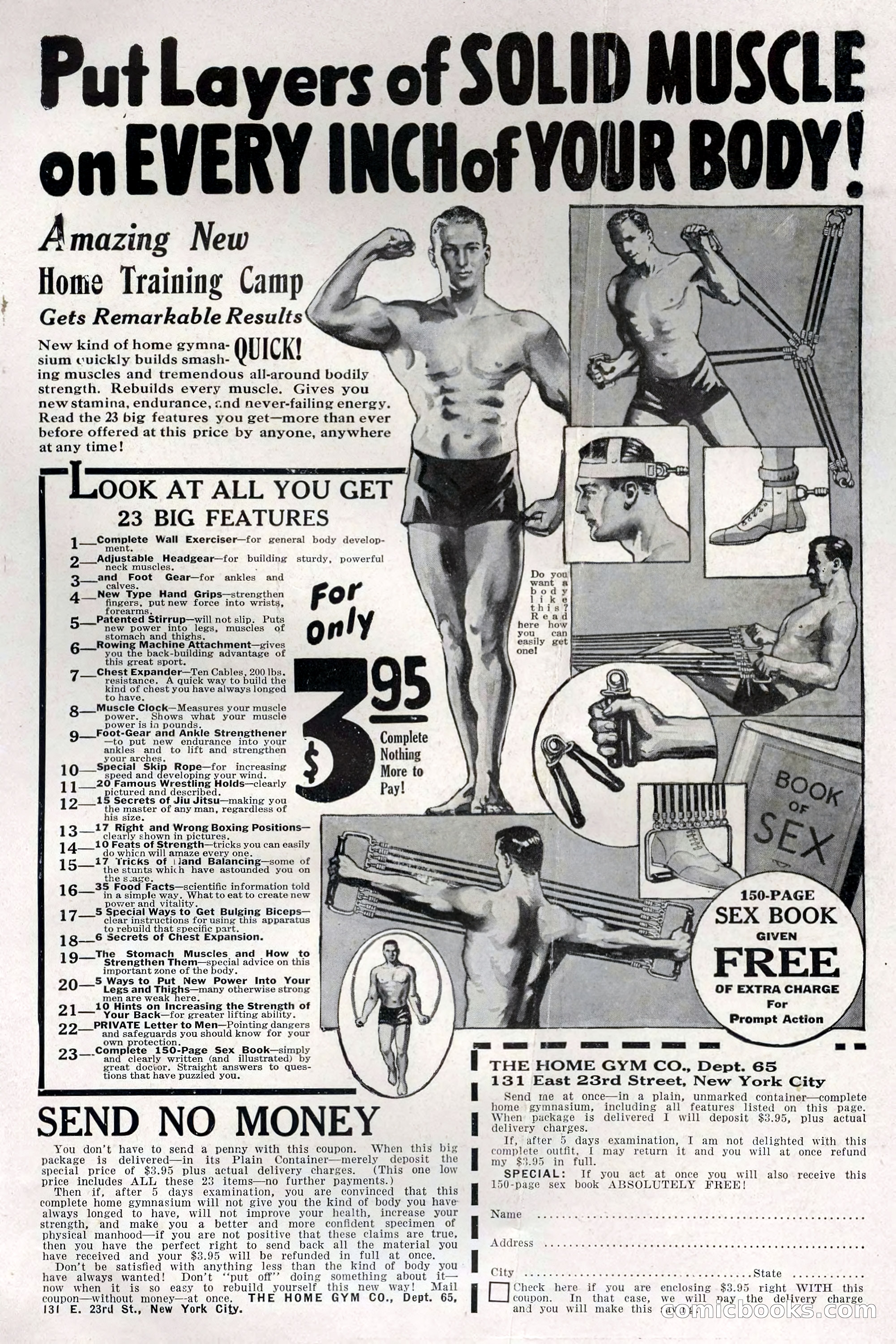
This is an advertising section page from a pulp magazine. The page displays numerous mail-order advertisements typical of early-20th-century publications, including offers for skin treatments promising results in three days, a home gymnasium outfit with training course, accounting correspondence courses, various novelty items and games, medical treatments for piles and general vitality, and a carbine rifle sale. Each advertisement includes ordering information and pricing, reflecting the era's direct-mail marketing practices.
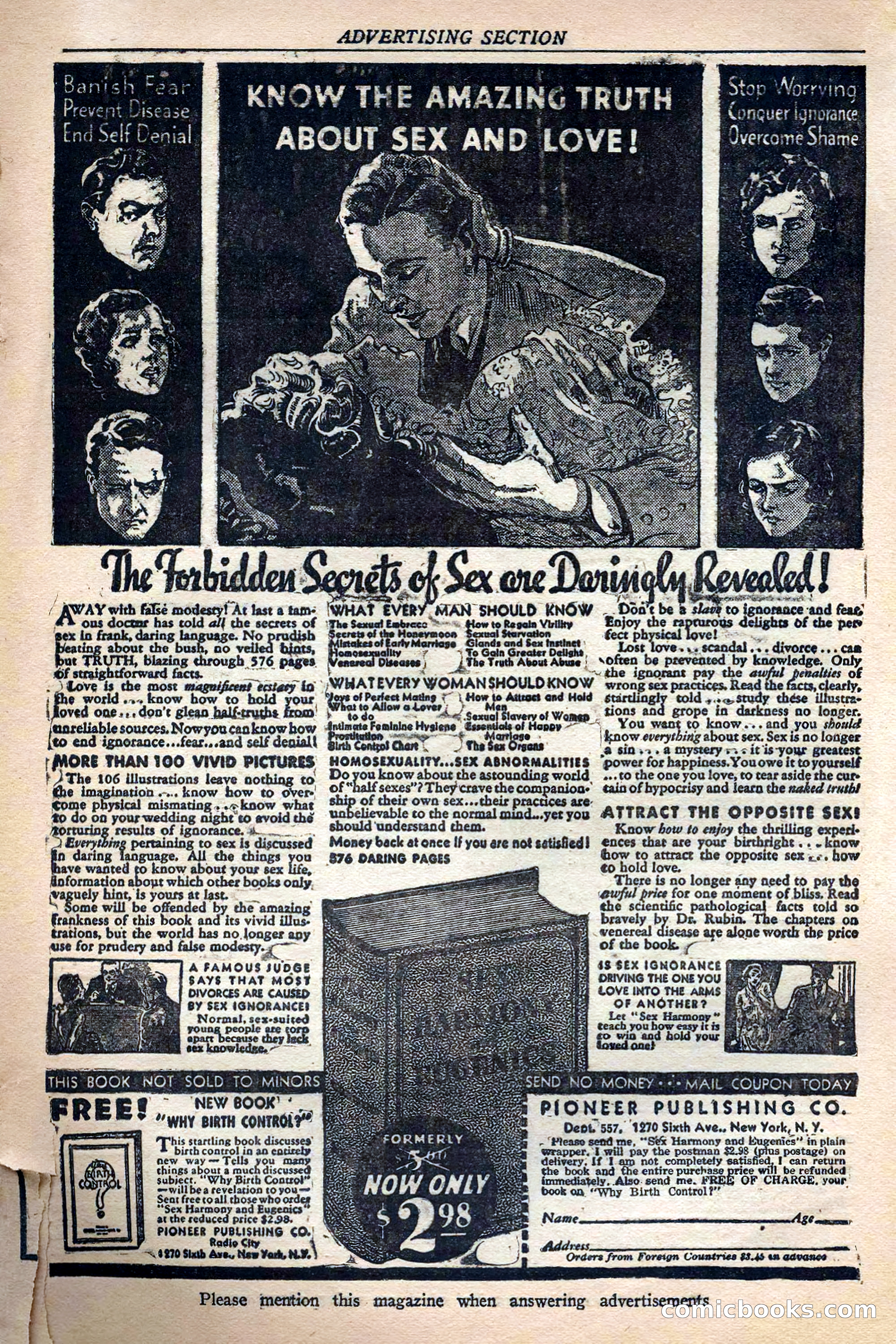
This is an advertising page from an early-20th-century pulp magazine. It promotes a book titled "The Forbidden Secrets of Sex and Love Divinely Revealed" by Pioneer Publishing Co., priced at $2.98. The advertisement uses sensational language and imagery—including portraits of distressed faces and dramatic illustrations—to market the book as containing "100 vivid pictures" and frank discussions of sex, marriage, birth control, and related topics. A coupon at the bottom allows readers to mail-order the book, with a money-back guarantee offered.
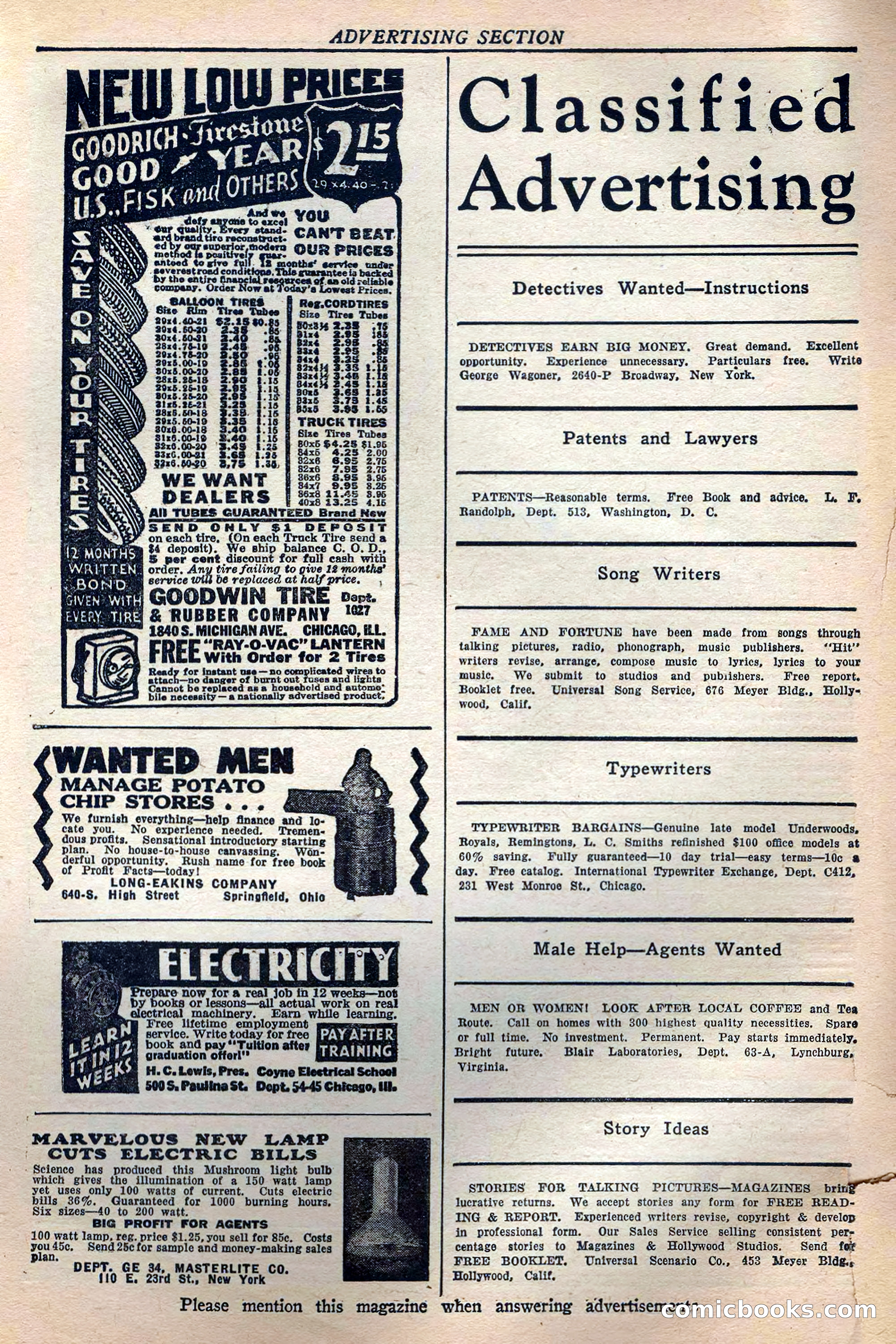
# What This Page Shows This is an advertising section from a pulp magazine, containing classified advertisements and display ads from the early 20th century. The page promotes various business opportunities and products including tire sales (Goodrich and Goodwin brands), detective training, patent services, songwriting assistance, typewriter sales, electrical training courses, and job recruitment schemes. The ads target readers seeking employment or looking to start businesses, offering opportunities in potato chip store management, coffee route sales, and story writing for motion pictures, alongside consumer products like lamps and tires.
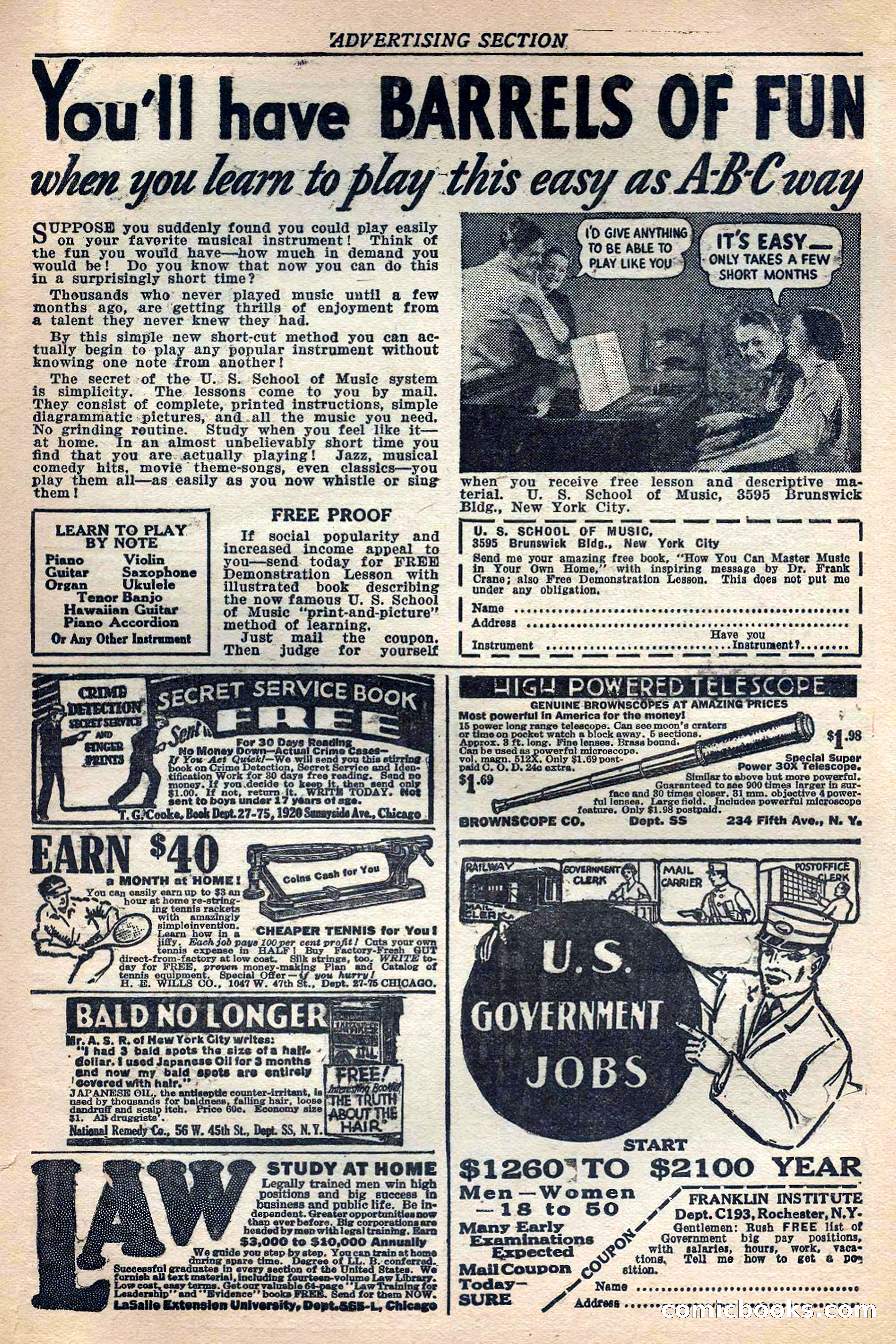
# Advertising Section from Pulp Magazine This is an **advertising page** from an early-20th-century American pulp magazine. The page contains multiple mail-order advertisements typical of the era, prominently featuring the U.S. School of Music's promise to teach readers any musical instrument "as easy as ABC" in surprisingly short months. Additional ads promote government jobs ($1,260–$2,100 yearly), a "Secret Service Book" on crime detection, tennis racket re-stringing for home income, a baldness cure using Japanese Oil, and legal training by correspondence. The page exemplifies the period's direct-mail marketing aimed at readers seeking self-improvement, income opportunities, and remedies.
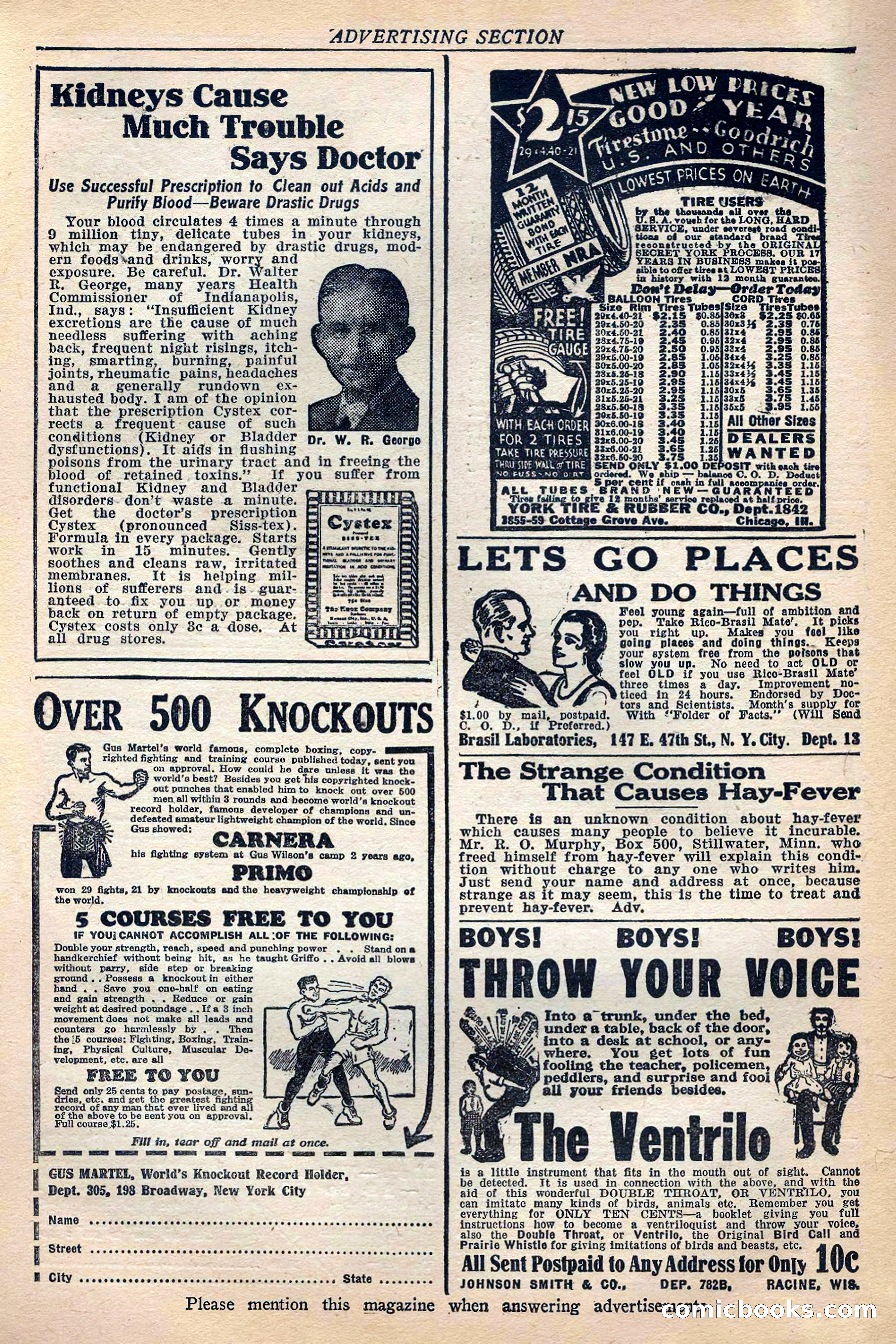
# This Page: Advertising Section This is an advertising page from an early-20th-century pulp magazine. It contains multiple product advertisements, primarily promoting patent medicines and correspondence courses. The main ads include: Cystex, a kidney and bladder remedy; Gus Martel's boxing and fighting course; Firestone tires at reduced prices; Rico-Brasil Malt tonic; a hay-fever treatment; and "The Ventrilo," a device described as producing ventriloquism effects. The advertisements use typical period marketing language emphasizing health benefits, money-back guarantees, and mail-order convenience, with most products costing under one dollar.
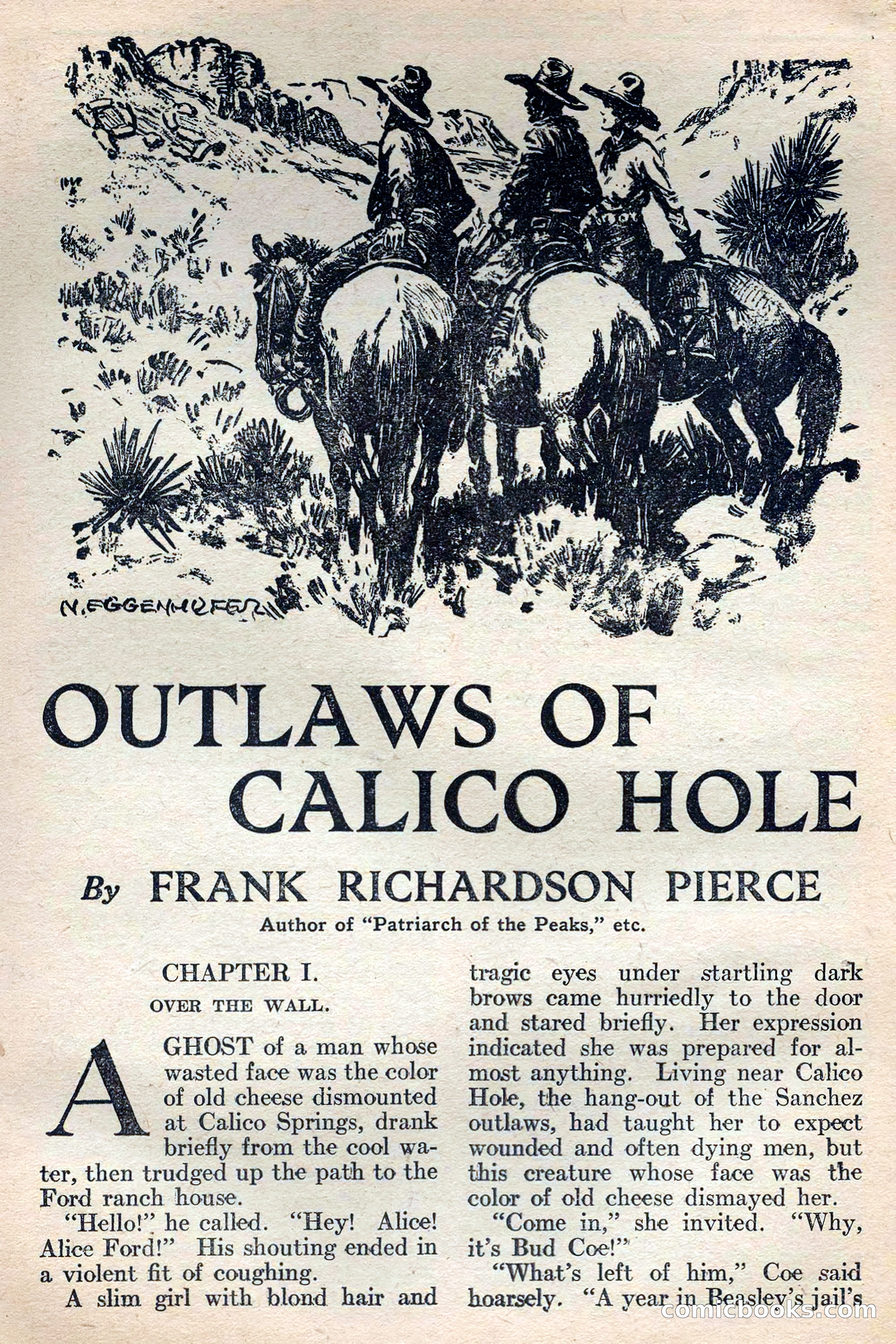
# Page Content Analysis This is the opening page of a serialized Western story titled "Outlaws of Calico Hole" by Frank Richardson Pierce. The page features a dramatic illustration at the top showing two mounted cowboys in a desert landscape with cacti, signed by the artist. Below is Chapter I ("Over the Wall"), which introduces a gaunt, sickly man arriving at a ranch house near Calico Hole—a notorious outlaw hideout. The man, revealed to be Bud Coe, has apparently just been released from jail and seeks shelter with a young woman named Alice Ford, who lives in the lawless region and is accustomed to harboring wounded fugitives.
# Page Analysis This is **story prose** from Street & Smith's Western Story Magazine (page 10). The text depicts a conversation between Alice Ford and a man named "Bud" Coe regarding a proposed jail break. Coe delivers an unsigned note requesting Alice's assistance—she must provide horses, a buckboard, and another girl to help free prisoners from Beasley's jail on Friday night. The passage reveals that Alice's brother Al is imprisoned there, alongside Dan Stuart, who apparently plans the escape. Alice learns that Stuart attempted to rob a bank at Wagon Gap, and that Coe himself faces false cattle-rustling charges that he's fleeing by leaving the country.
# Page Analysis: "Outlaws Of Calico Hole" This page contains story prose from a Western pulp fiction narrative titled "Outlaws Of Calico Hole" (page 11). The text depicts a conversation between Alice and a man named Coe about rescuing Alice's twin brother Al from jail, followed by Alice's visit to recruit her friend Sally Geary to help with the escape plan. The plot involves obtaining horses and supplies while navigating suspicion and family complications, with a mysterious figure named Dan Stuart apparently offering assistance for unclear motives.
# Page Analysis This page contains story prose from Street & Smith's *Western Story Magazine*. The text depicts two women, Alice and Sally, planning a jail break for a man named Al who is imprisoned on a jail farm. The passage shows them arriving at night near the facility, discussing the armed guards and the corrupt political protection of the jail's administrator (Beasley). Alice expresses contempt for a famous Texas Ranger named Jud Tremper, claiming he abandoned his duties after suggesting an arrest of someone named Sanchez—the same man who apparently killed Tremper's brother. The page ends as a locomotive whistle sounds.
# Page Analysis: "Outlaws Of Calico Hole" This is **story prose** from page 13 of a pulp fiction magazine titled "Outlaws Of Calico Hole." The passage depicts an escape sequence: two women, Alice and Sally, assist in orchestrating the getaway of men (apparently Dan Stuart and Al) from a jail. After gunfire erupts and a siren signals escape, the characters execute a detailed plan involving a buckboard, false shoe tracks, and a passing freight train—designed to deceive a pursuing posse into believing the fugitives fled by rail. The narrative emphasizes careful planning and misdirection to evade capture.
# Page Analysis This is **story prose** from Chapter II of a Western pulp fiction narrative. The page depicts Alice and Sally's arrival at Calico Springs ranch, where they're hiding from a posse after Al (Alice's twin brother) became involved in cattle rustling with someone named Sanchez. When Al finally arrives at the ranch via buckboard, the girls discover he's severely emaciated and weakened, apparently from mistreatment. The chapter focuses on their emotional reunion and Al's cryptic statement that his predicament stems from someone wanting "the country."
# Page Analysis: "Outlaws Of Calico Hole" This is a text-only story page from a pulp fiction magazine, likely Western or crime genre. The narrative follows Alice Ford and her brother Al, who appear to be fugitives hiding in Calico Hole with an associate named Dan Stuart. The page shows dialogue and exposition as Alice questions the men's plans—Al refuses to abandon their ranch despite legal trouble, while Dan Stuart proposes joining a man named Pedro Sanchez for a quick ten thousand dollars to develop his own ranch. Subplot tension emerges around Sanchez's romantic interest in Alice.
# Page Analysis This is **story prose** from Street & Smith's Western Story Magazine (page 16). The page contains dialogue-heavy narrative about characters named Al, Stuart, Dan, Alice, and Sally discussing a dangerous criminal named Sanchez who operates from a place called Calico Hole. The text reveals that Sanchez's initials are formed from graves of lawmen he's killed, and explores tensions around Stuart's apparent plan to infiltrate Sanchez's gang, while Alice attempts to dissuade her brother Al from joining him through emotional appeals and the suggestion of a photograph.
# Page Analysis: "Outlaws of Calico Hole" This is story prose (page 17) from a Western pulp fiction magazine. The text depicts a tense escape scene where Dan Stuart and his companion Al flee a pursuing posse toward a hidden refuge called Calico Hole. After receiving fresh horses and ammunition from Alice at the Ford ranch, Dan evades gunfire and follows Al through a narrow canyon to a secluded camp. There they discuss the barbed-wire barrier protecting their hideout, which apparently discourages the posse from pursuing further. The passage emphasizes action, danger, and frontier survival.
# Page 18: Story Prose from Street & Smith's Western Story Magazine This page contains prose fiction from Chapter III, titled "Bury Him Alive." The narrative follows Dan Stuart and Al Ford as they navigate entry into Calico Hole, a hideout surrounded by barbed wire and guarded by outlaws. The text describes graves arranged to form initials, apparently belonging to sheriffs and Rangers. The scene culminates with the unexpected arrival of Al's sister Alice, who has ridden into the Hole despite warnings that entry means never leaving. The passage explores themes of danger, family concern, and apparent romantic complications involving Pedro Sanchez.
# Page Analysis This page contains **story prose** from a Western pulp fiction tale titled "Outlaws Of Calico Hole." The narrative follows characters Dan Stuart and Alice as they approach an outlaw hideout in Calico Hole. The text describes their arrival at the compound—featuring grazing horses, cultivated land, and adobe/log cabin buildings—and their meeting with the outlaw leader Sanchez, who greets them with apparent friendliness but underlying suspicion. The scene involves discussion of a man named Jud Tremper and an apparent challenge or threat involving the dangerous outlaw gang.
# Street & Smith's Western Story Magazine, Page 20 This page contains story prose from a Western pulp fiction narrative. The text depicts an encounter between desperate outlaws in the Southwest, focusing on the arrival of a silent, menacing character named El Mudo and his unsettling interaction with a young woman named Alice Ford. The passage establishes El Mudo as a dangerous, knife-wielding criminal with a disturbing physical appearance, and describes his wordless communication through lip-reading with the outlaw leader Sanchez, who ultimately grants Alice permission to remain with their group to care for an injured man named Al.
# Page Analysis This page contains story prose from a pulp Western titled "Outlaws Of Calico Hole." The narrative depicts a tense confrontation between Dan Stuart (posing as an outlaw named Jud Tremper) and Sanchez, the half-Apache outlaw leader, while El Mudo, a deaf character who reads lips, watches suspiciously. Al Ford attempts to remove his frightened sister Alice from the dangerous situation as Dan tries to convince Sanchez to let him join the gang, while El Mudo signals his belief that Dan is actually a Texas Ranger.
# Page Description This is story prose from *Street & Smith's Western Story Magazine* (page 22). The text depicts a tense scene where Dan Stuart, suspected of being outlaw Jud Tremper, is being marched to his execution by Sanchez's gang. As they walk toward the cemetery, Dan struggles to maintain composure while facing imminent death, though a visible moment of fear betrays him to his captors, who interpret it as confirmation of his guilt and cowardice.
# Page Analysis This is a **text-only story page** from a pulp fiction magazine, numbered 23, continuing "Outlaws Of Calico Hole." The passage depicts a tense execution scene in the Old West. Sanchez, an outlaw leader, orders a man named Dan (or possibly Jud Tremper) into a grave he has dug. After Dan emerges and makes a defiant statement about his criminal past, Sanchez nearly shoots him with a revolver but hesitates, uncertain of Dan's true identity. When Dan manipulates Sanchez's doubt, the outlaw kicks him back into the grave and orders his men to bury him alive instead—a darker fate than gunfire.
# Page Content Description This is story prose from *Street & Smith's Western Story Magazine* (page 24). Chapter IV, titled "A Pact," depicts a tense confrontation between two men—Dan and an outlaw named Pedro Sanchez—following what appears to be a grave-digging scene. Sanchez, coughing from dust, attempts to recruit Dan into his outlaw band by offering a cut of stolen money from Wagon Gap, while threatening to kill someone named Al Ford if Dan refuses. Dan, seemingly recognizing an opportunity, eventually accepts Sanchez's proposition, though the exchange reveals complex motivations on both sides regarding survival and personal codes.
# Page 25 of "Outlaws of Calico Hole" This is a page of story prose from what appears to be a Western pulp fiction magazine. The narrative involves outlaws planning a bank robbery at Wagon Gap Bank, with tensions rising between characters named Al, Dan Stuart, and Alice Ford. The plot centers on disagreements about loyalty and a hostage situation. A key moment shows Alice confronting Dan about his decision to stick with the outlaw Al despite the personal cost to their ranch and family. The passage emphasizes themes of honor among thieves and conflicting loyalties, with dramatic dialogue and internal character reflection typical of early pulp Western fiction.
# Page Analysis **Page Type:** Story prose (text only, no illustrations) **Content Summary:** This page from Street & Smith's Western Story Magazine contains dialogue and narrative from what appears to be a Western adventure story. Dan Stuart and a woman (Alice Ford) discuss courage and danger while examining graves in "Calico Hole," apparently near an outlaw hideout run by someone named Sanchez. Alice expresses suspicion about Dan's true motives, believing he's driven by some hidden purpose. The passage reveals that Sanchez killed a man named Slim Tremper, a Texas Ranger, whose family has since abandoned seeking vengeance. Dan and Alice ultimately decide to leave the graveyard and examine horses in a nearby pasture.
# Page Analysis **Page Type:** Story prose from a pulp fiction magazine **Content:** This page from "Outlaws Of Calico Hole" depicts a dramatic shift in a character's intentions. A man and woman tour a remote, fortified location that could serve as an ideal ranch—he becomes momentarily captivated by the prospect of building rather than destroying. However, the outlaw leader Sanchez arrives and demands the man reveal his plan to rob the Wagon Gap Bank, interrupting this brief respite. The narrative emphasizes the danger of trusting Sanchez, a man capable of smiling while wielding a knife.
# Page Analysis This page contains **story prose** from Street & Smith's Western Story Magazine (page 28). It presents Chapter V, titled "Gold Nuggets," continuing a narrative about a character named Dan who has outlined an escape plan involving robbing a bank and acquiring gold nuggets. The chapter depicts Dan at a ranch examining horses, where he strikes a black mare to conceal his recognition of it from watching outlaws Sanchez and El Mudo. Alice Ford, apparently the sister of someone Dan helped escape, witnesses this and confronts him, expressing her determination to protect her brother from further danger while acknowledging Dan's past assistance. The two reach an uneasy agreement to remain cautious allies.
# "Outlaws of Calico Hole" - Page 29 This page contains story prose from a pulp Western fiction tale. The narrative follows Dan, Alice, and Al as they settle into an outlaw camp run by a man named Sanchez. The passage describes their first full day together—meals, interactions with gang members, and growing tensions. It culminates in an exciting development: a black mare with a white star has gone missing, and suspicion immediately falls on Dan Stuart, though he protests his innocence and claims witnesses can verify he remained in bed all night. The story appears concerned with outlaw gang dynamics and emerging conflict.
# Page Analysis This page contains **story prose** from Street & Smith's Western Story Magazine (page 30). The text depicts a conversation between characters named Dan, Alice, and Sanchez regarding an apparent plan to rob the Wagon Gap Bank. Dan is growing a beard for unspecified "important reasons," while Alice attempts to extract information about his intentions. The passage shifts to a scene where Dan visits a sick man named Al (apparently Alice's brother), offering him false encouragement about recovery while Alice recognizes Dan's deception through his facial expressions. The narrative explores themes of loyalty, sacrifice, and concealed plans within what appears to be an outlaw or criminal context.
# Page Analysis This is story prose from page 31 of "Outlaws Of Calico Hole," a pulp Western fiction tale. The passage depicts the recovery of an outlaw named Al and reveals details about Sanchez's bandit operations—including how he conducts surprise raids and maintains control through fear and loyalty. The narrative follows Dan Stuart's integration into the outlaw camp and concludes with the return of Sanchez's raiding party, including a wounded member, suggesting action and danger ahead in the plot.
This is page 32 of Street & Smith's Western Story Magazine, containing story prose. The text depicts outlaws resting at a hideout after a robbery, with members of the Sanchez gang recounting violent incidents from their crime. A character named Alice withdraws disapprovingly from their boastful conversation, and Al follows her. The passage concludes with the gang planning their next target: the Wagon Gap Bank, which Dan will attempt to rob in two months.
# Page 33 of "Outlaws of Calico Hole" This page contains prose fiction text from a Western pulp story. The narrative depicts a criminal scheme where character Dan Stuart plans to rob a bank at Wagon Gap with outlaw leader Sanchez's cooperation. Sanchez secretly instructs Miguel to betray Stuart to another contact in town. The page concludes with a new chapter beginning, showing Stuart preparing to leave at dawn when Alice Ford approaches him wanting private conversation. The text reveals themes of double-crossing, criminal plotting, and romantic tension typical of early pulp Western fiction.
# Page Analysis This is **story prose** from page 34 of Street & Smith's Western Story Magazine. The text depicts a dramatic romantic and moral confrontation between two characters: Dan (apparently nicknamed "Dan Stuart"), who appears determined to pursue a dangerous criminal path, and Alice, a woman who loves him but fears he will sacrifice both himself and her brother to his ambitions. Alice begs Dan to abandon his plans and stay with her in Calico Hole, ultimately declaring she will follow him regardless of the consequences. The passage explores themes of love, loyalty, sacrifice, and moral compromise in what appears to be a Western pulp fiction narrative.
# Page Analysis: "Outlaws Of Calico Hole" This is **story prose** from page 35 of a pulp Western fiction magazine titled "Outlaws Of Calico Hole." The text depicts a protagonist named Dan executing an escape plan after a confrontation with El Mudo over a girl. Dan rides toward Wagon Gap, discovers that the Twin F Ranch has been foreclosed and purchased by someone named Beasley, and arrives in Wagon Gap at dusk where he disguises himself with wood ashes. He is unexpectedly joined in an abandoned cabin by Al Ford, who warns him that Beasley is heading toward town—apparently on serious business rather than casual travel. The passage emphasizes suspense and mounting danger.
# Analysis of Page 36 from Street & Smith's Western Story Magazine This page contains **story prose** from a Western pulp fiction narrative. The text depicts a gunfight scene where the protagonist Dan shoots and kills a man named Beasley in a darkened alley. Dan then manipulates his accomplice Al Ford into taking the blame by handing him the gun, while Dan escapes toward a cabin to rob a bank. A crowd gathers around the confused Al, who is accused of being part of Sanchez's gang; they threaten to lynch him until an old man called Hi Manning arrives and a deputy sheriff appears, apparently offering intervention.
# Page Analysis This is **story prose** from page 37 of a pulp fiction Western titled "Outlaws of Calico Hole." The page depicts two connected scenes: first, a deputy arresting a character named Al Ford and discussing his case with a prosecutor who vows to execute him within thirty days; second, a character named Dan Stuart visiting a general store where he trades gold nuggets for supplies while deflecting questions about their origin. The narrative appears to involve mining strikes, legal persecution, and frontier intrigue typical of early-20th-century Western pulp fiction.
# Page Analysis This is **story prose** from Street & Smith's Western Story Magazine (page 38), a pulp western fiction publication. The visible text depicts a bank robbery in progress. A character named Dan, who has disguised himself with dark clothing and a handkerchief mask, enters a bank with a drawn gun, forces the teller and bank president at gunpoint into a back room, and prepares to rob the vault. The narrative describes his nervous state and the conveniently emptied town, which Dan had cleverly manipulated into a stampede toward Sundown Creek by drunkenly mentioning gold there the previous night.
# Page Content Analysis This page contains story prose from a Western pulp fiction narrative titled "Outlaws Of Calico Hole" (page 39). The text depicts a bank robbery and its aftermath: a man named Dan successfully steals currency from a bank vault while townsfolk organize a posse, then escapes on horseback toward Calico Hole. The narrative follows Dan as he transfers the stolen money to saddlebags, rides unchallenged into what appears to be an outlaw hideout, and encounters a girl named Alice who anxiously asks about someone named Al Ford, whom Dan says is "in a jam." The story appears to be hardboiled Western crime fiction.
# Page 40 of Street & Smith's Western Story Magazine This page contains story prose with no illustrations. The text depicts a Western crime narrative in which a character named Dan has returned from a scheme involving bank robbery and murder. Dan presents money—apparently from robbing the bank at El Rio—to an outlaw leader named El Mudo (or Sanchez), who calculates the haul at roughly thirty thousand dollars. Dan reveals that he killed a man named Beasley in a gunfight and suggests they can use bribery to prevent his execution. The passage also includes dialogue about a horse named Jerry that Dan acquired, and Alice's emotional response to Dan's dangerous activities.
# Page Analysis This is story prose from a pulp-fiction magazine titled *Outlaws of Calico Hole* (page 41). The page contains Chapter VIII, titled "A Bargain," depicting an outlaw leader named Sanchez negotiating with a woman named Alice regarding the fate of a man named Al who has been jailed. The narrative involves stolen bank money, criminal enterprise, and Sanchez's proposition to Alice, whom he has held captive for two months. The text appears to be from an early-20th-century Western crime or adventure pulp magazine, with no illustrations visible on this page.
# Page Analysis This is **story prose** from Street & Smith's Western Story Magazine (page 42). The text depicts a dramatic dialogue between characters named Dan, Alice, and Sanchez in what appears to be an Old West setting. Alice confronts Dan about potentially marrying the outlaw Sanchez in exchange for her brother Al's freedom, while Dan struggles between his love for Alice and his commitment to an unspecified criminal plan involving a bank robbery. The scene captures mounting tension as Alice threatens to accept Sanchez's proposal if Dan won't help her find an alternative solution.
# Page Analysis This page contains story prose from a pulp fiction narrative titled "Outlaws Of Calico Hole." The text depicts a dramatic scene where a woman named Alice accepts a marriage proposal from a man named Sanchez in exchange for money to help her brother Al escape justice. After receiving a stolen diamond ring, Alice departs for Wagon Gap with five thousand dollars. The scene then shifts to her meeting with a deputy sheriff, where she explains she's been caring for her jailed brother and intends to hire Judge Ritchie as his attorney. The deputy appears sympathetic to Al's situation, suggesting he received unfair treatment from a man named Beasley who controlled local politics.
# Page 44 of Street & Smith's Western Story Magazine This page contains story prose (no illustrations or advertising visible). The narrative follows Alice, a woman involved in defending an outlaw named Al who is jailed for allegedly killing an officer named Beasley. The text shows Alice listening to townspeople debate whether to storm the jail, then receiving news that Judge Ritchie will arrive to help Al's case. Subsequently, Sally Geary and her father Chris visit Alice to offer financial support for Al's defense, having learned that Beasley may have framed Al. The page concludes with the group visiting Al in jail, where the new jailer grants them access.
# Page Analysis: Story Prose This page contains continuous story prose from "Outlaws Of Calico Hole," a hardboiled crime pulp fiction narrative. The text depicts a courtroom drama where Judge Ritchie examines physical evidence in a murder case. A crucial revelation occurs when Alice Ford recognizes that the gun allegedly used by the defendant Al is not his weapon—it's a gun that Dan Stuart obtained from Sanchez, suggesting Stuart, not Al, may be the actual killer. The judge, characterized as keen and observant, immediately grasps the significance and moves to interrogate Al in jail.
# Page 46 of Street & Smith's Western Story Magazine This page contains story prose from what appears to be a Western pulp fiction narrative. The text depicts a conversation between Judge Ritchie and Alice regarding her brother Al's upcoming trial for killing someone named Beasley. Alice reveals that her other brother Dan robbed a bank, and Al is protecting him by claiming self-defense rather than revealing Dan's involvement. The passage explores the judge's attempts to persuade Al to abandon his loyalty to Dan before trial, but Al refuses to betray his brother despite facing a potential life sentence.
# Page Analysis: "Outlaws of Calico Hole" This page contains story prose from page 47 of a Western pulp fiction magazine titled "Outlaws of Calico Hole." The narrative depicts the verdict and sentencing phase of a murder trial for a character named Albert Ford. Sally and Alice, who appear connected to Ford, await the jury's decision overnight, then return to the courtroom where the foreman announces Ford has been found guilty of first-degree murder. The passage follows the emotional reactions of the women and Ford's stoic acceptance, culminating in the judge asking if Ford has anything to say before sentencing, with various characters urging him to speak.
# Page Analysis This page contains story prose from *Street & Smith's Western Story Magazine* (page 48). The text depicts a courtroom drama followed by a jail-break plot. A judge sentences a character named Al to hang on the thirtieth; afterward, Alice writes secret letters to outlaw leader Pedro Sanchez and Dan Stuart. Sanchez receives Alice's message and devises a rescue plan, composing multiple deceptive notes—one to Alice, one to the deputy sheriff at Wagon Gap jail (falsely claiming he'll attack on the twentieth), and one to Dan Stuart. Sanchez uses an Indian boy as his messenger and deliberately mixes up the letters to create confusion.
# Page 49: Story Prose from "Outlaws Of Calico Hole" This page contains story prose from a Western pulp fiction tale. The narrative follows a character named Dan as he prepares for a bank raid on El Rio with an outlaw gang led by Sanchez. Dan receives a letter from someone named Alice Ford, then grapples with his conflicting loyalties while the gang mobilizes. The passage culminates with Sanchez briefing Dan and El Mudo on their imminent attack plan, scheduled for eleven o'clock, emphasizing the ruthlessness required. The prose emphasizes tension, moral conflict, and violent action typical of early-20th-century pulp Westerns.
This page contains story prose from Street & Smith's Western Story Magazine (page 50). The text depicts a bank robbery in preparation, with criminal characters Sanchez, El Mudo, and Dan coordinating an attack on a bank in the town of El Rio. The passage shows Dan positioning himself outside while Sanchez and El Mudo enter the bank to execute their plan, with the robbery apparently commencing at the eleven o'clock hour. Local townspeople are mentioned discussing Texas Rangers being stationed elsewhere, unaware of the imminent crime.
# Page 51: Story Prose from "Outlaws Of Calico Hole" This page contains prose narrative from a Western pulp fiction story. The text depicts an intense gunfight in the town of El Rio, where characters named Dan, Sanchez, and El Mudo are engaged in a shootout with Texas Rangers led by someone called "Tex" Crawford. The action follows Dan and Sanchez as they attempt to escape after El Mudo is shot down. The passage culminates with Sanchez's horse being killed and him diving into brush to evade capture, while Rangers close in on the town. The narrative emphasizes gunplay, quick action, and dramatic dialogue typical of early Western pulp fiction.
# Page Analysis This is **story prose** from Street & Smith's *Western Story Magazine* (page 52). The text depicts the aftermath of a gunfight between Dan Stuart, a Texas Ranger, and the outlaw Sanchez. After being shot, Dan regains consciousness in a doctor's care, where he confesses to killing Beasley (a member of Sanchez's gang) to protect someone named Al Ford from execution. A woman named Alice visits him, revealing that Dan deliberately participated in a raid against Sanchez's gang to keep Al imprisoned and safe from the gunfight that killed the other gang members. The passage suggests Dan's sacrifice has now saved Al's life twice.
# Page 53: Story Prose from "Outlaws of Calico Hole" This page contains story prose from a Western pulp fiction narrative. The text depicts a conversation where characters discuss a man named Dan who orchestrated a fake bank robbery to infiltrate a criminal gang, planning to eventually quit and develop a ranch with reward money. The revelation concludes with Dan's true identity as Ranger Jud Tremper, who is now marrying a woman named Alice. The page ends with a preview advertisement for the next week's complete novel, "Man Trap" by Glenn H. Wichman.
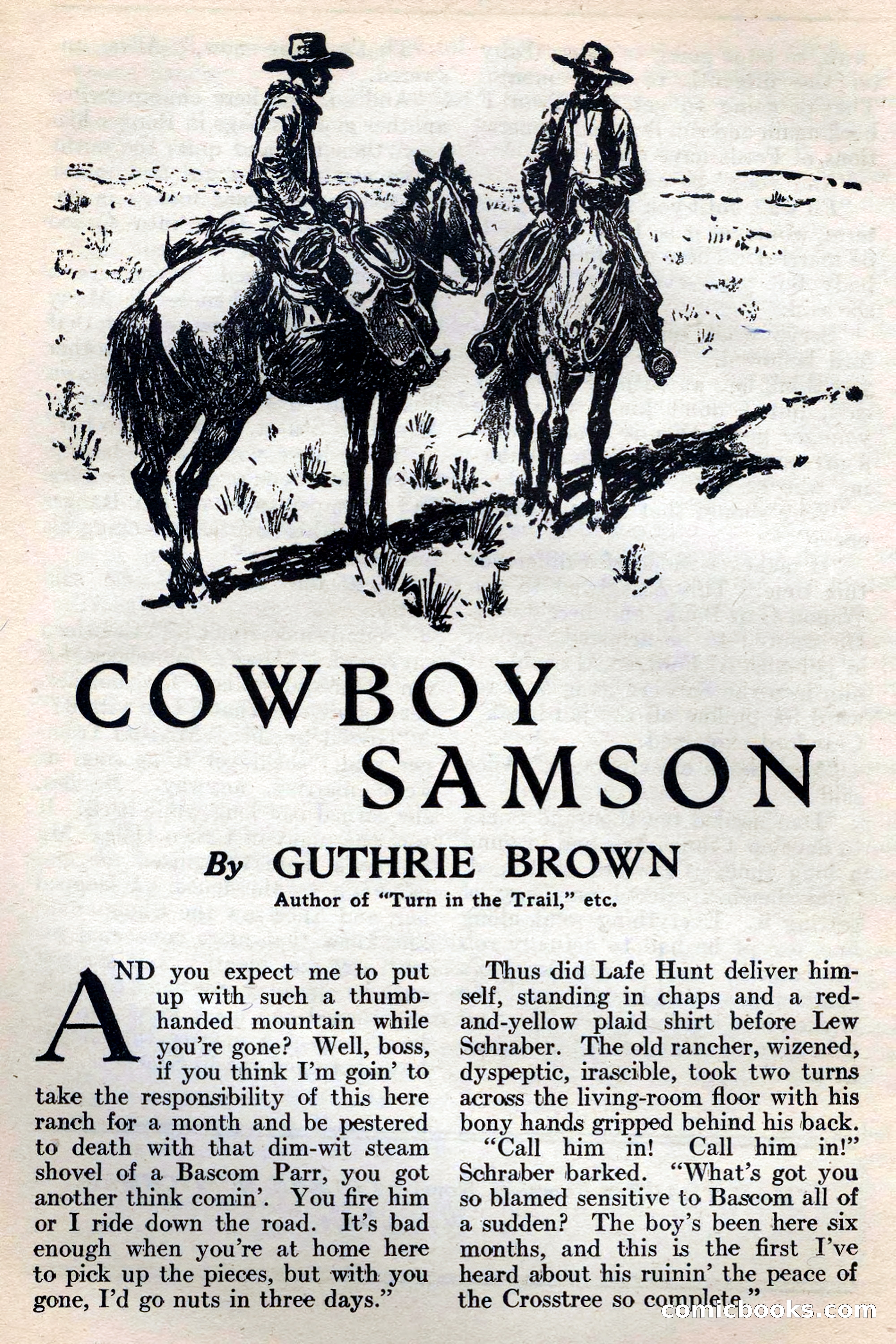
# Cowboy Samson - Story Opening Page This is the opening page of a western pulp fiction story titled "Cowboy Samson" by Guthrie Brown. The page features a illustration at the top showing two cowboys on horseback in a desert landscape, followed by the story's title and author attribution. Below that begins the prose narrative, introducing characters Lafe Hunt and Lew Schraber in what appears to be a ranch dispute over an employee named Bascom Parr. The text establishes a conflict where Hunt demands Schraber fire Parr or he will quit, while Schraber responds by calling Parr in to address the complaint.
# Page Analysis: "Cowboy Samson," Page 55 This page contains story prose from what appears to be a Western pulp fiction tale titled "Cowboy Samson." The text depicts a conversation between ranch foreman Lafe Hunt and ranch owner Old Schraber, in which Hunt accuses a new worker, Bascom Parr, of stealing livestock and damaging ranch property. When Schraber summons Parr, a large, gentle-faced man arrives. The scene captures tension as Schraber questions Parr about breaking the bunk house, while the narrative suggests Schraber finds it difficult to believe the fair-looking young man could be a thief.
# Page Content Analysis This page contains story prose from *Street & Smith's Western Story Magazine* (page 56). It depicts a ranch worker named Bascom Parr being fired by his employer, rancher Lew Schraber, due to financial difficulties. Despite the harsh dismissal, Bascom idolizes Schraber as a legendary figure from frontier history—a man who once heroically defended settlers along Shawnee Creek during an Indian attack. The narrative contrasts Schraber's current worried, irritable demeanor with his storied past, suggesting Bascom's loyalty to the ranch and its owner runs deeper than mere employment.
# Page 57: Story Prose from "Cowboy Samson" This page contains prose fiction from a Western story titled "Cowboy Samson." The narrative follows a young cowboy named Bascom, who has just been fired from his job with the legendary Lew Schraber. As Bascom rides dejected across alkali flats, he encounters a tough, fearless rider named Duke Jones, who inquires why Bascom looks defeated. Bascom explains he was fired by Schraber, attributing it to his own physical clumsiness—his superhuman strength causes him to handle ropes, spurs, and cattle roughly, and he fears injuring ranch hands during roughhousing. The text establishes Bascom's admiration for heroic figures and his frustration with his own uncontrollable power.
# Page Content Analysis This page contains story prose from Street & Smith's Western Story Magazine (page 58). The text depicts a conversation between two characters, Duke Jones and Bascom, in which Duke reveals he is transporting a large sum of money (gold and paper worth roughly four thousand dollars) from Charley Elden to Lew Schraber. Duke expresses concern that someone has been following him and tracking the money, while Bascom reassures him about the safety of leaving the funds at the ranch. The passage ends with Duke departing on horseback and Bascom continuing his journey across the plains toward a spring where he plans to camp.
# Page Content Description This is story prose from page 59 of a pulp magazine titled "Cowboy Samson." The text presents a Western narrative in which a cowboy named Bascom discovers a torn red-and-yellow bandanna at a spring and begins suspecting that a ranch hand named Lafe Hunt may be involved in some unspecified theft or crime. Bascom deliberates whether to return to the ranch to protect money and keep watch, wrestling internally with his natural aversion to conflict. The page ends mid-scene as Bascom, lying in hiding near the bunkhouse at night, suddenly hears a creaking door.
# Page 60: Street & Smith's Western Story Magazine This page contains story prose from a Western pulp fiction narrative. The text depicts an action sequence in which a character named Bascom observes masked intruders forcing an elderly rancher named Schraber to open a safe. When the intruders become impatient and physically assault Schraber, Bascom intervenes, rushing into the living room and engaging the criminals in combat. The passage emphasizes suspense and physical action typical of early-20th-century Western pulp fiction.
# Page Analysis: "Cowboy Samson" Story Prose This page contains story prose from a pulp Western titled "Cowboy Samson" (page 61). The narrative depicts an action sequence where protagonist Bascom physically subdues multiple masked robbers during a confrontation, unmasking them to reveal their identities. The text reveals that Lafe Hunt, whom Bascom was fired by earlier that day, orchestrated a cattle rustling scheme intended to frame the cowboy. Duke Jones arrives with another captured robber, and the rancher Schraber realizes his misjudgment in firing Bascom. The passage emphasizes physical combat, suspense, and the resolution of a criminal plot through violent confrontation.
# What's on This Page This page from *Street & Smith's Western Story Magazine* contains story prose from what appears to be a Western fiction narrative. The visible text depicts a scene where a character named Bascom demonstrates his newfound fighting ability to impress his boss by performing controlled feats of strength—punching near someone's face and lifting a man overhead without injuring him. The page also includes a brief notice advertising an upcoming serial called "Stone Stirrups" by Kenneth Perkins, and a short factual piece titled "Ambergris Find Fails," describing how treasure hunters in California were deceived about supposed valuable ambergris that turned out to be industrial sewage chemical.
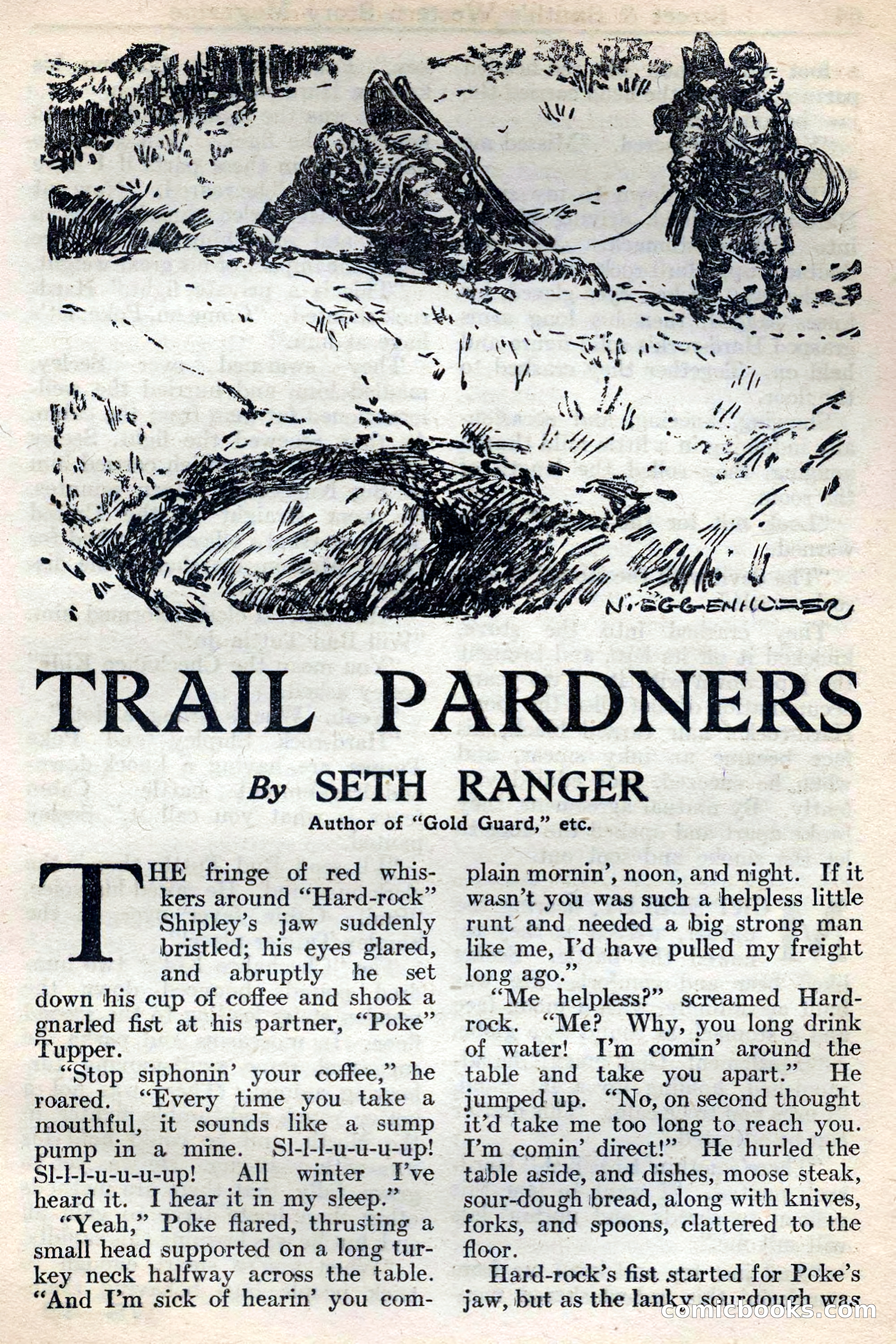
# Analysis of Page This is a **story prose page** from a pulp fiction magazine featuring the opening of "Trail Pardners" by Seth Ranger. The page includes a small illustration at the top depicting two rough-looking men in what appears to be a frontier setting, with one figure lying down and another standing nearby. The visible text shows the beginning of a humorous Western tale about two quarreling partners—"Hard-rock" Shipley and "Poke" Tupper—who bicker over annoying habits (coffee-slurping) and threaten to fight. The scene depicts frontier cabin life with domestic details (moose steak, sour-dough bread) amid escalating comic conflict between the two men.
# Page Analysis: Street & Smith's Western Story Magazine This is a page of **story prose** from a Western pulp fiction magazine (page 64). The text depicts a violent brawl between two prospectors, Hard-rock Shipley and Poke Tupper, that escalates when a peacemaker named Mort Seeley attempts to intervene. After being ejected from their cabin, Seeley seeks help from the marshal's office in Big Nugget, resulting in the dispatch of "Bud Tuttle," known as the "Chechahco Kid," a rough deputy described as an excellent fighter. The narrative focuses on frontier conflict and law-enforcement response to disorder.
# Page Analysis This is **story prose** from a pulp fiction magazine titled "Trail Pardners" (page 65). The text depicts a confrontation between two prospecting partners, Hard-rock Shipley and Poke Tupper, who are fighting and threatening to dissolve their partnership. A deputy marshal named Bud intervenes, breaks up their fight, and attempts to convince them they need each other to explore the Iron Mountain country for gold. Despite his efforts at reconciliation, the two men remain stubborn and determined to split up their partnership and divide their possessions, forcing Bud to take charge of the division himself.
# Page Analysis This is story prose from Street & Smith's *Western Story Magazine*. The text depicts two fur trappers, Hard-rock and Poke, dissolving their partnership after a successful season. Their dispute escalates from dividing household items (a table, a mule) to literally sawing their cabin in half down the middle—with Hard-rock working from the roof and Poke from inside to complete the cut. The passage shows their growing animosity and competitive boasting, particularly Poke's insistence he can work alone despite their apparent need for each other.
# Page Analysis: "Trail Pardners" (Page 67) This page contains story prose from a Western pulp fiction narrative titled "Trail Pardners." The text depicts a conflict between two prospectors, Hard-rock and Poke, who have apparently each claimed ownership of different halves of a mule. After Hard-rock is kicked into the snow by the animal, the two men threaten legal action against each other. Bud Tuttle attempts mediation but fails. The scene then shifts to Bud meeting with Dad Morton and mining camp workers at the marshal's office, where they pressure Bud to reconcile the feuding men and establish a safe trail before the spring break-up and the arrival of newcomers.
# Page 68: Street & Smith's Western Story Magazine This page contains story prose from a Western pulp fiction narrative. The text depicts a deputy named Bud negotiating Jim Listman's bail from jail in exchange for information about silver fox trapping, with marshal Dad Morton's approval. The scene then shifts to the following morning when Bud is summoned to break up a fight between two partners, Hard-rock and Poke, who are accusing each other of stealing fur. The narrative focuses on frontier justice, fur trapping disputes, and character conflicts in what appears to be a gold-rush or frontier settlement.
# Page Analysis: Story Prose from "Trail Pardners" This page contains story prose (text only, no illustrations) from page 69 of a pulp fiction story titled "Trail Pardners." The narrative follows two frontier partners, Hard-rock and Poke, pursuing a fur thief who has stolen their silver fox pelts. After discovering the stolen goods are gone and suspecting a recently released prisoner named Listman, they begin tracking him northward toward Iron Mountain. The passage describes their pursuit across a dangerous glacier, where they encounter a massive crevasse and test its depth by dropping a fifty-pound rock into it—finding the chasm alarmingly deep with no sound of the rock striking bottom.
# Page Content Description This page contains story prose from Street & Smith's Western Story Magazine (page 70). The text depicts a dramatic survival scene in which two prospectors named Hard-rock and Poke attempt to cross a dangerously thin snow bridge spanning a crevasse. As Poke crosses, the bridge begins collapsing; he falls but is saved by the rope his partner maintains. After Poke is rescued, Hard-rock retrieves him, though Poke loses his pack. The passage ends with the two men spotting a fire in distant trees, suggesting they are pursuing someone ("our man"). The narrative emphasizes danger, physical endurance, and partnership between the characters.
# Page Analysis This is story prose from a pulp fiction magazine titled "Trail Pardners" (page 71). The text depicts two frontier partners—Hard-rock and Poke—who catch a man named Listman at their camp, believing he has stolen their furs. After a violent fight, they capture and bind him. The passage then shows them discussing plans to open a trail to Iron Mountain country and dividing responsibilities: Poke will take the prisoner to Big Nugget to sell the recovered furs, while Hard-rock remains behind to relay supplies over difficult terrain. The narrative focuses on frontier adventure and partnership dynamics.
This page contains the conclusion of a Western story and an advertisement for the next installment. The prose describes Poke Tupper delivering a fur thief named Listman to Dad Morton's office, where deputy Bud Tuttle reveals Listman was actually working undercover as a special deputy to catch stampede robbers. Tuttle releases him, pays him one hundred dollars, and clears him of a separate theft charge, allowing Listman to join a gold stampede. At the bottom, the page advertises an upcoming Western story titled "The Vendetta Kid" by Stanley Hofflund.
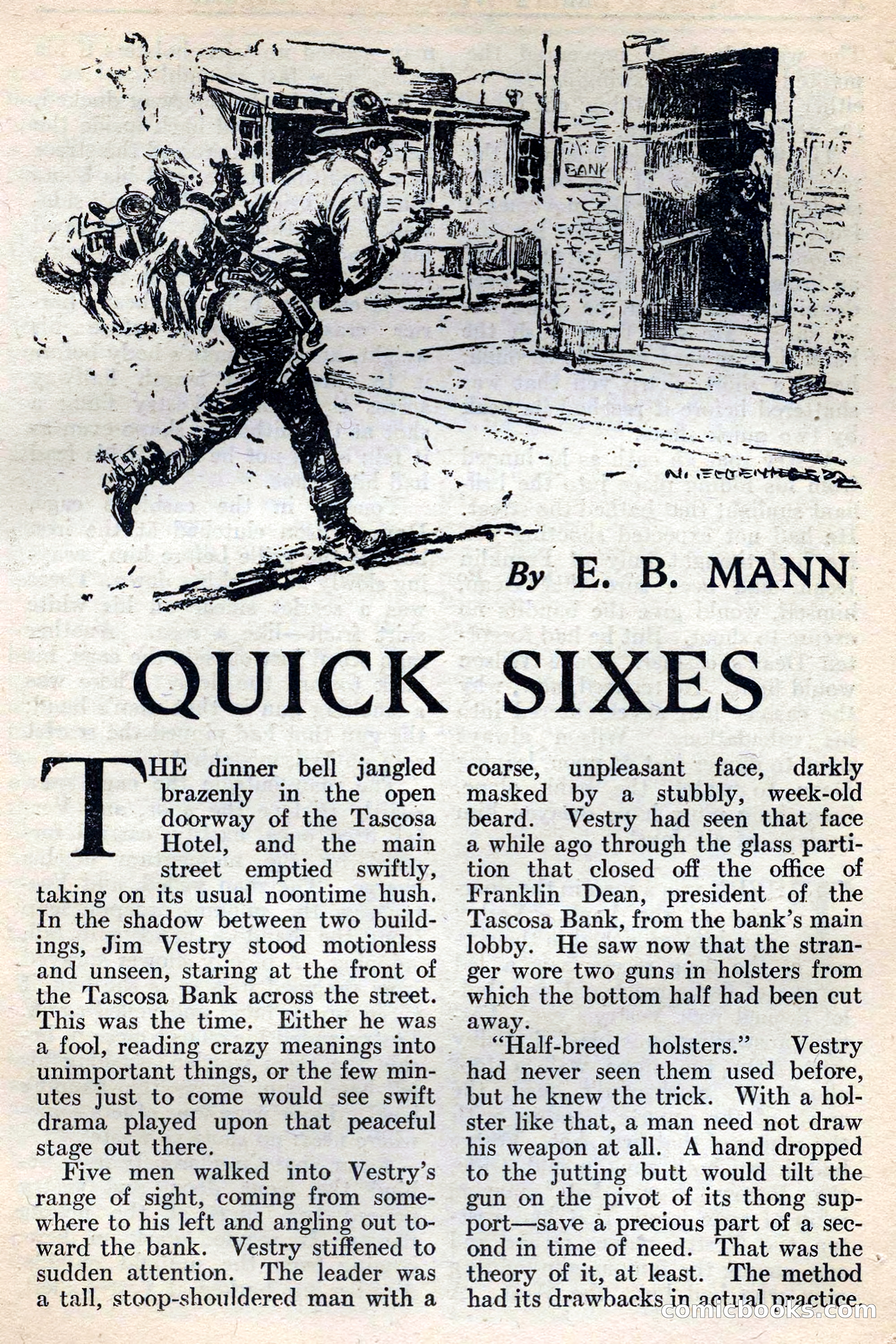
# Page Analysis This is **story prose with an accompanying illustration** from a pulp fiction magazine. The illustration at the top depicts a man in action, appearing to run or move urgently through a street scene. The story, titled "Quick Sixes" by E. B. Mann, is a Western crime narrative set in the town of Tascosa. The text describes Jim Vestry, who observes five armed men approaching the Tascosa Bank during the noon hour. The protagonist notices the leader wears distinctive "half-breed holsters"—modified gun holsters with the bottom cut away, designed to allow faster weapon deployment. The passage establishes tension as Vestry watches what appears to be an imminent bank robbery unfold.
# Page 74: Story Prose from Street & Smith's Western Story Magazine This page contains prose fiction from a Western pulp magazine. The narrative depicts a gunfight inside a bank, following a character named Vestry as he pursues armed bandits. Vestry draws both guns in his signature "Vestry draw" (described as famously fast), exchanges fire with a bandit in the doorway, then charges into the bank. Inside, he discovers that cashier Dave Wilson has been shot by one of the robbers and engages in a chaotic firefight with multiple assailants, wounding one bandit's hand and exchanging gunfire with others. The action is vivid and fast-paced, emphasizing Vestry's gunfighting prowess.
# Page Analysis This page contains **story prose** from a pulp-fiction Western tale titled "Quick Sixes." The narrative follows a character named Vestry through a gunfight and chase sequence. Vestry is shot at inside what appears to be a bank or vault, escapes on horseback in pursuit of armed robbers, and engages in a running gun battle across the prairie. His horse is shot and falls, leaving Vestry stranded and surrounded by approaching lawmen led by "Long Tom" Travis, a sheriff. The passage emphasizes action, gunplay, and Western frontier conflict typical of pulp crime or adventure fiction.
# Page Analysis This is story prose from Street & Smith's Western Story Magazine (page 76). The text depicts a Western crime drama in which Sheriff Travis arrests a man named Jim Vestry on suspicion of bank robbery and threatening Franklin Dean, the bank president. The narrative follows Vestry's arrest and his subsequent arrival at the jail, where he denies the charges. The scene introduces several characters—Travis, Dean, two deputies, and a mysterious stranger in a business suit—as Vestry prepares to tell his side of the story to the sheriff.
# Page Analysis: "Quick Sixes" Pulp Fiction Story This page contains story prose from a hardboiled crime pulp fiction story titled "Quick Sixes" (page 77). The narrative depicts an interrogation scene where Sheriff Travis questions a man named Vestry about his alleged involvement in a bank robbery. Vestry claims he witnessed a suspicious man (apparently the criminal "Blacky Weston") meeting with banker Franklin Dean shortly before the holdup occurred. Dean denies the connection and accuses Vestry of fabricating the story. The scene builds tension as Vestry describes seeing the robbers enter the bank and hearing gunshots, while a bank examiner present begins questioning Vestry's account of what made him suspicious.
# Page Analysis This is **story prose** from Street & Smith's Western Story Magazine (page 78). The text depicts an interrogation scene where Travis questions Jim Vestry about a bank robbery. Vestry describes being knocked unconscious during the robbery and chased afterward, while Travis skeptically challenges his account—noting that Vestry, supposedly an expert gunfighter, fired multiple shots without hitting anyone, which Travis finds unnatural. The conversation ends with Vestry admitting defeat and returning to his cell, accompanied by a deputy.
# Page Analysis This is **story prose** from a hardboiled crime pulp fiction magazine, page 79 of a story titled "Quick Sixes." The text depicts a dramatic jail cell confrontation between Sheriff Travis and prisoner Vestry. Vestry claims that Dean, an official, staged a robbery to cover financial losses. When Travis dismisses this story as unconvincing, Vestry attacks him, knocks him unconscious, takes his guns, and forces him to ride out of town at gunpoint. The scene shifts from dialogue to action as the two men escape into darkness on horseback, heading north.
# Page Content This is story prose from Street & Smith's Western Story Magazine (page 80). The text depicts an action sequence at a remote cabin on Bay Horse Mountain, where a character named Vestry confronts Franklin Dean, president of the Tascosa Bank, over a discrepancy in stolen money. The confrontation erupts into gunfire, with Vestry and an accomplice named Long Tom Travis shooting it out against Dean and others inside the cabin, leaving multiple bodies and significant destruction.
# Page 81: Story Text from "Quick Sixes" This page contains prose fiction from a hardboiled crime story. The narrative depicts a confrontation between characters named Dean, Vestry, and Long Tom Travis, where Vestry reveals he read Dean's lips through a glass partition to overhear a secret meeting arrangement. The dialogue suggests Dean is implicated in a robbery and may be embezzling funds. The scene ends with Travis praising Vestry's detective work and offering him rewards for information on the fugitive Weston. Below the story text is an advertisement for Street & Smith's Detective Story Magazine, promoting their handwriting analysis feature.
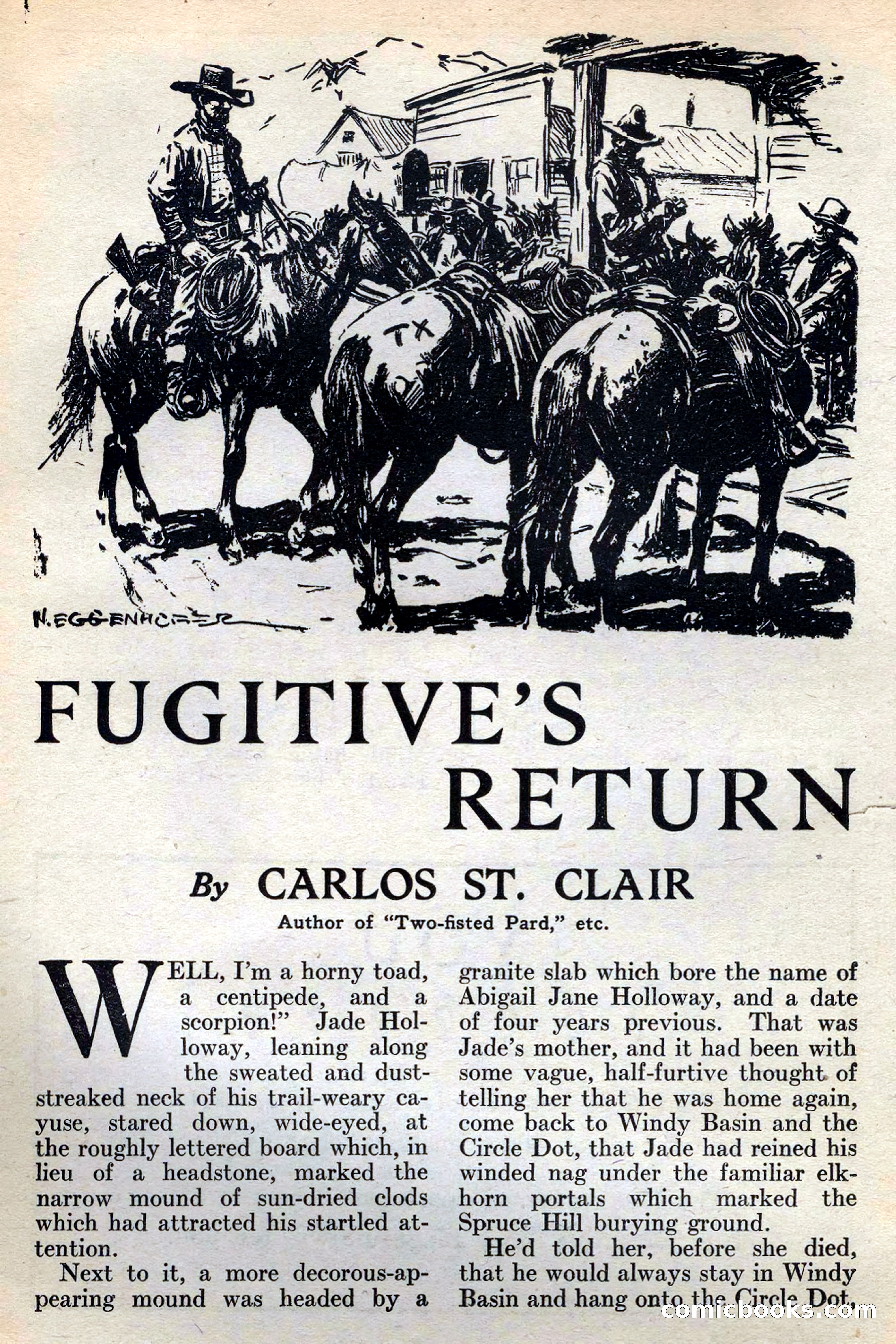
This is a story prose page from a Western pulp fiction magazine. It presents the opening of "Fugitive's Return" by Carlos St. Clair, depicting protagonist Jade Holloway returning to Windy Basin after four years away. He discovers his mother's grave at Spruce Hill and reflects on a promise he made to her before her death to remain in the area and keep the Circle Dot ranch. The page includes an illustration above showing cowboys on horseback near ranch buildings.
# Page Analysis This is story prose from page 83 of a pulp fiction narrative titled "Fugitive's Return." The text follows a fugitive named Jade Holloway who has returned to his hometown of Windy Basin after three years on the run following a bank robbery. The page describes Jade's shock upon discovering his own grave marker—dated August 6th, 1930, the night he committed the crime. Jade theorizes that someone else, possibly an associate named Lonnie Davis, was mistakenly identified as him and buried. This fortunate development delights Jade, as it effectively erases his identity and protects him from legal pursuit.
# Page Analysis This is **story prose** from page 84 of Street & Smith's Western Story Magazine. The text depicts a scene in which a character named Jade, disguised as "Jim Freed," enters a town mercantile and learns about the previous owners of a ranch he has purchased. An old man named Remis recounts how the Holloway family—the original owners—suffered hardship: the father died twenty years ago, the mother worked herself to death four years later, and their son "young Jade" was shot and killed on the Knife Edge Trail about a year after that, his body found months later in a canyon. The passage suggests Jade is somehow connected to this tragic history, which he appears to know about already.
# Page Analysis **Format:** Story prose (text only, no illustrations or cover elements) **Content:** This page continues a hardboiled crime narrative titled "Fugitive's Return." The protagonist, Jade Holloway—who has assumed a new identity as Jim Freed—encounters the sheriff Mel Wiggins, who shot him three years earlier during a bank robbery. Jade reflects anxiously on whether Wiggins will recognize him, recalls that he killed Wiggins's deputy Olmstead, and enters the sheriff's office to test whether his disguise will hold. The page explores Jade's internal tension as he confronts potential discovery.
# Page Analysis This page contains **story prose** from a Western pulp fiction narrative (page 86 of Street & Smith's Western Story Magazine). The text depicts a tense scene where a scarred stranger named Jade meets Sheriff Mel Wiggins in Windy Basin. Jade, who appears to be hiding his true identity, nervously tells a false story about bear injuries to explain his scars. The sheriff seems to recognize him but then calls him "Freed," suggesting Jade has successfully passed a test. The passage ends with Jade learning that someone named Ab Ferris—apparently a man he was supposed to meet—is imprisoned for allegedly shooting someone called Jade Holloway.
# Page Analysis: "Fugitive's Return" This page contains story prose from what appears to be a Western pulp fiction tale titled "Fugitive's Return" (page 87). The narrative follows a character named Jade, who has just learned that Ab Ferris—a man Jade believed he killed—is alive and jailed for an unrelated murder. Jade experiences conflicted emotions: relief at his own safety, bitter satisfaction at Ab's predicament, and unexpected loneliness that draws him toward Ellen, daughter of a local squatter named Seams. The text explores Jade's internal conflict and his decision to visit Ellen's home as evening falls.
# Page 88 of Street & Smith's Western Story Magazine This page contains story prose from a Western pulp fiction narrative. The text depicts an action sequence in which a character named Jade rides urgently to a cabin after hearing a woman's screams, discovers a man attacking a girl named Miss Ellen, and engages in a violent hand-to-hand fight with the assailant. The passage emphasizes Jade's heroic intervention and the brutal struggle that ensues, including gunfire and physical combat as the two men roll across the cabin floor.
# Page 89: Story Prose from "Fugitive's Return" This page contains prose fiction from a pulp story titled "Fugitive's Return." The text depicts an intense physical struggle between a character named Jade and an antagonist over a gun. After Jade defeats the man through strangulation, a young woman named Ellen appears and tends to his wounds. Their conversation reveals she is being pressured to marry two men (Alf and Sam Hugis) against her will. Jade, who appears to be using an assumed name, mysteriously claims he has "come back" to help her, though the full context remains unclear from this excerpt alone.
# Page 90 of Street & Smith's Western Story Magazine This page contains story prose—narrative fiction with dialogue. The text depicts a dramatic moment where a character named Jade encounters a woman who is the wife of Ab Ferris, a man facing execution for allegedly killing someone. The woman has been harassed by other men, and Jade, learning of her plight, decides to capture one of her tormentors and turn him loose elsewhere rather than pursue his own plans to return home. The passage explores Jade's internal conflict between his personal desires and his commitment to help the woman.
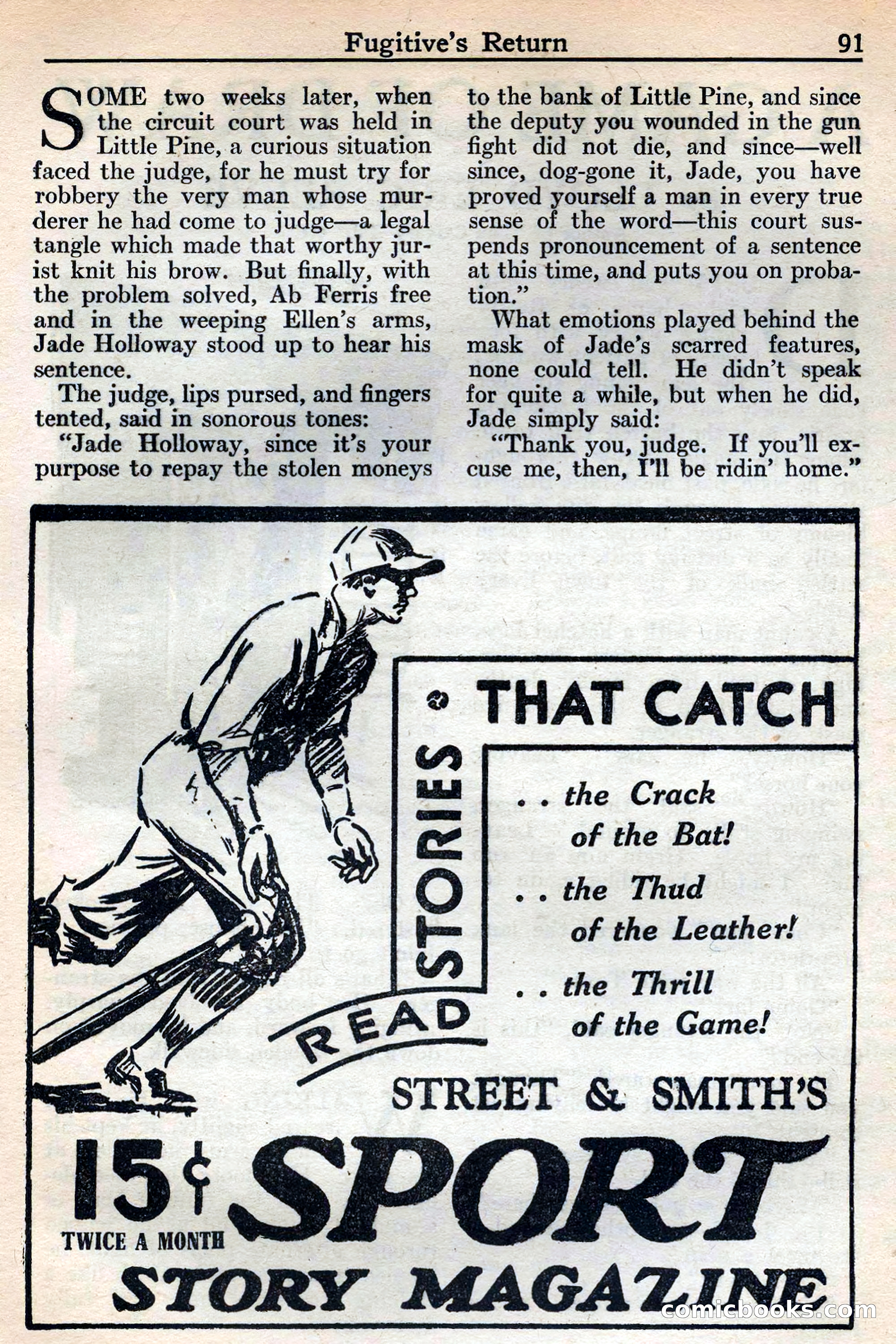
# Page Content Analysis This page contains story prose from a crime/western pulp fiction narrative titled "Fugitive's Return" (page 91). The text describes a courtroom scene where Judge sentences a character named Jade Holloway for robbery. Despite Jade's wounds and apparent redemption, the judge suspends sentencing and places him on probation, allowing him to leave. The passage concludes with Jade's brief, stoic response thanking the judge. Below the story text appears a full-page advertisement for Street & Smith's *Sport Story Magazine*, featuring an illustration of a baseball player in fielding position and promotional text emphasizing baseball's appeal ("the Crack of the Bat! the Thud of the Leather!"). The magazine cost 15¢ and was published twice monthly.
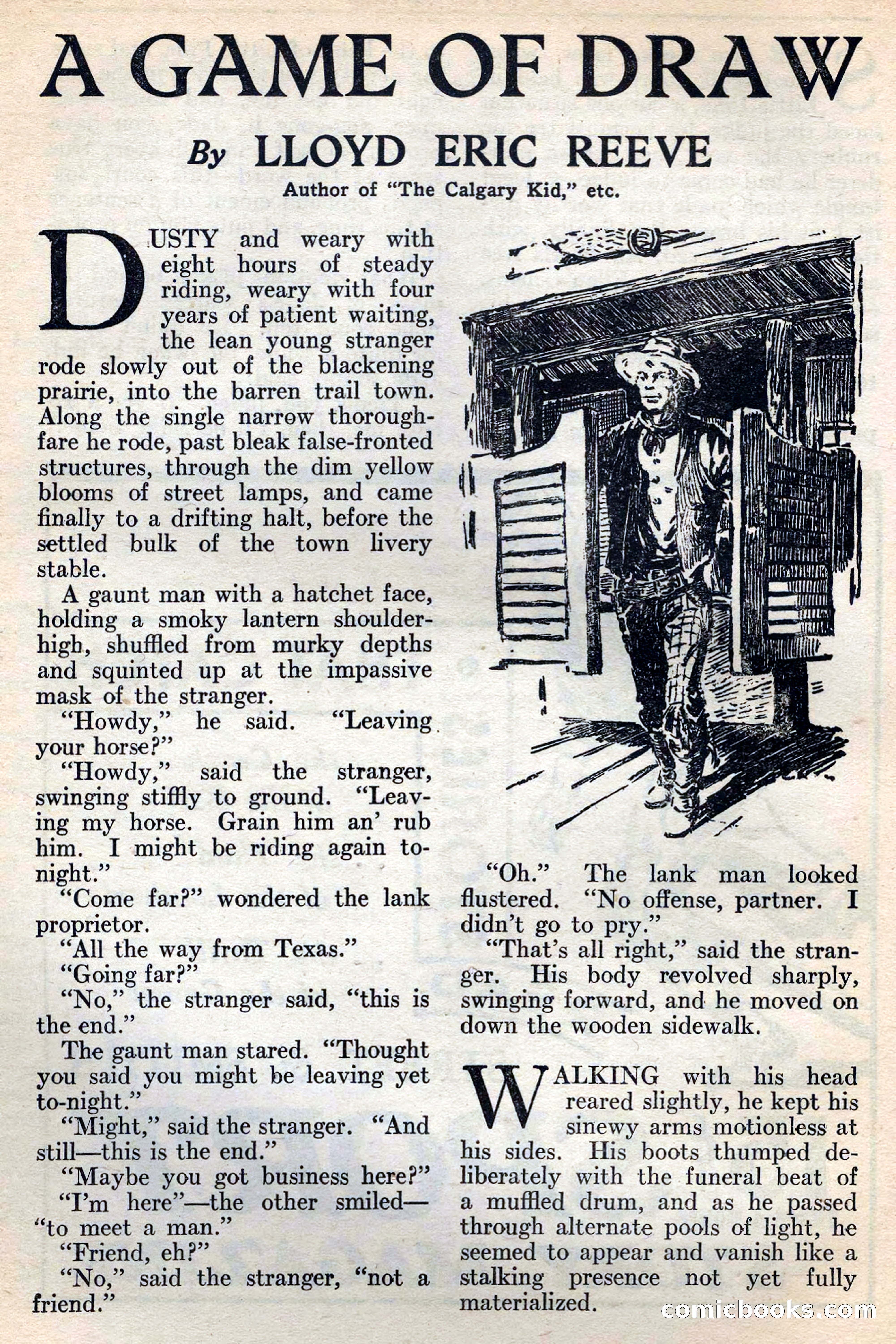
# A Game of Draw This is a story prose page from a pulp magazine, featuring the opening of "A Game of Draw" by Lloyd Eric Reeve. The narrative introduces a weary stranger arriving in a small town after eight hours of riding and four years of waiting. He checks his horse at the livery stable, where a gaunt proprietor questions him. The stranger cryptically states he's come from Texas to "meet a man"—explicitly "not a friend." An illustration on the right shows the stranger speaking with the livery owner in a doorway. The prose concludes with atmospheric description of the stranger walking through town with an ominous, ghost-like presence.
# Page Analysis **Type:** Story prose (no illustrations visible) **Content:** This page presents the opening and development of a Western pulp fiction story titled "A Game of Draw." It describes a mysterious stranger entering the Longhorn Saloon and spotting a large, powerful man named Roaring Bill Hyde playing poker. The stranger joins the game, and after playing cautiously for half an hour, a high-stakes hand develops between the two men, with the stranger betting five hundred dollars. The page ends as they begin drawing cards for what appears to be a climactic confrontation.
# Page Analysis This is **story prose** from Street & Smith's Western Story Magazine (page 94). The text depicts a confrontation in a saloon between a tall young stranger and "Roaring Bill" over a poker game. After the stranger apparently cheats, displaying seven aces from one deck, Bill accuses him and offers a handshake to call it even. Bill then crushes the stranger's hand deliberately, breaking it, and demands he draw his gun anyway. The stranger reveals his name is Johnny Dartin, which causes Bill sudden panic and fear—the stranger cryptically warns that Bill "has killed yourself." The passage emphasizes tension, violence, and an apparent revelation that carries grave significance.
# Page 95: "A Game of Draw" This page contains story prose from a Western pulp fiction narrative. The upper section depicts a gunfight in a saloon between a young stranger and a man called Roaring Bill, ending with Bill's death. A bearded rancher then questions the stranger—revealed to be Johnny Dartin—about his remarkably fast left-handed draw, leading to a revelation that Dartin killed the rancher's father in a previous incident in Texas. The lower section, titled "Nature at Work in Kansas," shifts to non-fiction, describing two unusual geological phenomena: a bottomless hole near Hutchinson and an expanding earth fissure in Haskell County, possibly caused by natural gas pressure.
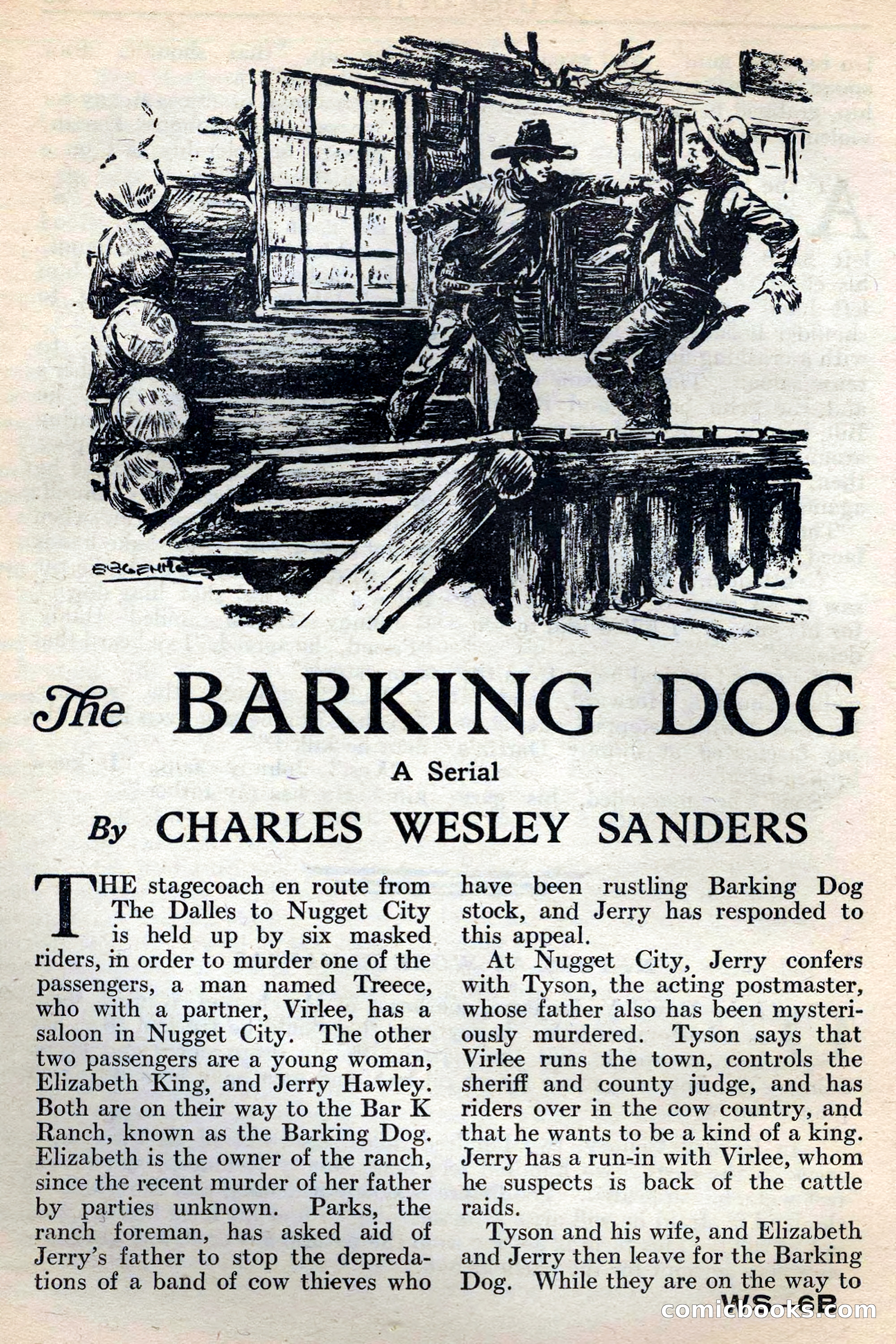
# Analysis This page shows the **opening of a serialized Western crime story** in a pulp magazine. The top features an illustration depicting two men in cowboy attire outside a log cabin with a window, apparently in confrontation. Below is the title "The Barking Dog: A Serial" by Charles Wesley Sanders, followed by plot synopsis text. The synopsis describes a stagecoach holdup near Nugget City, the murder threat against a passenger named Treece, and introduces Elizabeth King and Jerry Hawley traveling to the Bar K Ranch (the "Barking Dog") to investigate cattle rustling and mysterious murders in the region.
# Page 97 from "The Barking Dog" — Story Prose This page contains story prose from Chapter VIII ("Trickery") of what appears to be a Western pulp fiction tale. The narrative describes a gunfight arrangement between Jerry and Dick Bloom, a rustler who killed Jerry's friend Shorty Flynn. Parks, an older man, serves as witness and attempts to intimidate Bloom before the duel by praising Jerry's gun skills and establishing harsh rules—the winner rides free, but anyone firing before the signal will be hanged. Jerry accepts the challenge to avenge his friend's death.
# Page Analysis This page contains story prose from *Street & Smith's Western Story Magazine*, page 98. The text depicts a tense confrontation between two men, Jerry and Bloom, on horseback. Jerry, who appears to be seeking revenge for the death of someone named Shorty Flynn, has forced Bloom to retrieve his dropped gun. As they ride, Bloom suddenly draws his weapon and fires at Jerry, who has him covered. The passage captures the moment of gunfire and the immediate aftermath, emphasizing the action's speed and the psychological intensity of the duel. No illustrations are present on this page.
# Page Analysis: Story Prose from *The Barking Dog* This page contains story prose—the narrative text of a Western pulp fiction story titled "The Barking Dog" (page 99). The visible text depicts a gunfight's aftermath: Jerry shoots and kills a man named Bloom in what Jerry frames as self-defense, then insists on burying Bloom's body despite the callousness of Parks and the other punchers. The scene concludes with the group returning to a ranch at midnight, where a woman named Elizabeth sees Jerry carrying Bloom's corpse and learns that Bloom had killed someone named Shorty Flynn. Elizabeth expresses relief that Jerry survived the confrontation.
This page contains story prose from *Street & Smith's Western Story Magazine* (page 100). The narrative follows Jerry and Elizabeth as they bury a man named Bloom on the prairie, then return to a house where Parks, apparently a ranch authority figure, discusses the fate of fifteen captured cattle thieves with them. Elizabeth questions whether Parks intends to hang the prisoners, while Parks justifies executing them as necessary to stop ongoing cattle theft, despite understanding the violent repercussions this may bring. The scene explores tension between justice, revenge, and pragmatic frontier governance.
# Page Description This is story prose from page 101 of "The Barking Dog," a pulp-fiction narrative. The text shows a dialogue-heavy scene set in what appears to be a Western setting, where characters Parks, Jerry, and Elizabeth discuss matters including cattle theft (punishable by death according to Parks), Elizabeth's marriage prospects, and suspicions about criminals named "Black Redman" and "Virlee" who may be involved in a killing. The conversation reveals tension between the characters over Elizabeth's independence and Parks's intentions regarding her future.
# Page Content Analysis This page contains **story prose** from Street & Smith's Western Story Magazine (page 102). The text depicts a tense conversation between two characters, Jerry and an older man named Parks, discussing a confrontation with a dangerous outlaw named Red Blackman and someone called Virlee. Parks plans to write a provocative letter to draw Virlee into the open, and the two men wait together, eventually falling asleep. The passage ends with Parks secretly meeting with a woman named Elizabeth in the living room, hinting at hidden plans or complications beyond what Jerry knows.
# Analysis of Page 103 from "The Barking Dog" This page contains **story prose** from Chapter IX, titled "Act of Mercy." The narrative follows Jerry awakening at a ranch after sleeping thirty hours. He discovers that Parks, the ranch foreman, has cared for a gravely ill young man by isolating him in a shed, fearing contagion. When Jerry and Parks visit the sick man, they find him in severe distress—exhausted, lying on a cot with bloodstains on the floor. Parks's grim expression suggests the man is dying, likely from internal injuries. The passage emphasizes Parks's compassionate but pragmatic response to the stranger's illness, balancing humanity against practical ranch concerns.
# Page Analysis This is **story prose** from Street & Smith's Western Story Magazine (page 104). The text depicts a dramatic deathbed confession scene in which a dying man with consumption reveals to a character named Jerry that he murdered the local postmaster in town—and crucially, that he acted alone. Jerry realizes this man is the killer of Tyson's father, and he rushes to inform Tyson of this discovery. The dying man's pride in his solitary criminal act, contrasted with his failing health, drives the emotional tension of the passage.
# Page Analysis: "The Barking Dog" This page contains story prose from what appears to be a Western pulp fiction narrative titled "The Barking Dog" (page 105). The text depicts a tense dramatic scene in which Jerry convinces Tyson not to use his gun against a dying man—revealed to be Tyson's father's murderer who is now gravely ill in a shed. Jerry argues the man is too sick to shoot, and ultimately leads Tyson, Elizabeth, and Mrs. Tyson to confront the dying stranger. The passage emphasizes moral conflict and restraint in a revenge scenario.
# Page Analysis This page contains **story prose** from Street & Smith's Western Story Magazine (page 106). The text depicts a dramatic confrontation between Jerry Tyson and a dying man who reveals details about a criminal conspiracy. The dying man confesses to involvement in a post-office robbery orchestrated by associates named Virlee, Red Horner (also called "Blackman"), and others. He explains how he was hired to retrieve a letter from the post office, and suggests that Virlee may have murdered his partner King over business disputes. The passage ends with the man experiencing a sudden surge of strength as he prepares to reveal more information to Jerry.
# Page Analysis This page contains **story prose** from a pulp fiction narrative titled "The Barking Dog" (page 107). The text depicts a Western or crime story in which characters discuss a "trailer" — a man hired to deliberately lose a posse's trail to protect an outlaw named Virlee. A sick man provides physical descriptions of this trailer to Jerry, then suffers a severe coughing fit. Tyson and Elizabeth tend to the dying man with compassion as he appears to be slipping away, suggesting this scene depicts the final moments of a dying informant or associate.
# Page 108: Story Prose from Street & Smith's Western Story Magazine This page contains story prose from a Western pulp fiction narrative. The text depicts a scene where a dying man is brought to a house; after his death, the protagonist Jerry decides to travel to town to find another "trailer" (unclear what this means—possibly a fugitive or suspect). Jerry prepares to leave on horseback, instructing Parks to keep his departure secret from Elizabeth, though Parks convinces him to tell her. The passage ends with a ranch hand reporting that he delivered a letter to someone named Virlee. The tone is hardboiled Western fiction focused on pursuit and conflict.
# Page Analysis This page contains **story prose** from a Western pulp fiction narrative titled "The Barking Dog" (page 109). The text depicts Chapter X, "In Town," following a character named Jerry as he arrives in Nugget City at nightfall seeking someone named Tyson and visiting a man named Virlee's establishment—a combined saloon, gambling hall, and dance hall. Jerry moves through the crowded venue observing patrons, then exits to wait outside, where he notices a young, lean man emerge from the saloon and position himself nearby, exchanging meaningful glances with Jerry before the page cuts off mid-sentence.
# Page Analysis **Type:** Story prose (interior fiction page) **Content:** This page from Street & Smith's *Western Story Magazine* continues a Western fiction narrative about a character named Jerry. The text depicts Jerry's violent confrontation with a man he believes is connected to murders—Jerry punches the man off a platform into the street, then encounters three cowboys to whom he hastily enlists help restraining and gagging his unconscious opponent in a stable, claiming he's in "a jam" and cannot leave his post guarding a door. The passage emphasizes Jerry's impulsive anger and his attempt to manage an escalating situation.
# Page Analysis: "The Barking Dog" This page contains story prose from what appears to be a hardboiled Western pulp fiction tale titled "The Barking Dog" (page 111). The narrative follows a character named Jerry as he observes a tense confrontation in a barroom. A man named Tyson arrives searching for someone called Virlee, draws a gun on the bartender demanding information, and creates a standoff involving multiple "punchers" (cowboys/ranch workers). The scene builds toward apparent violence as tensions escalate among the gathered men. The text is presented in two columns of justified typography typical of early pulp magazine formatting.
# Page Description This is story prose from Street & Smith's *Western Story Magazine* (page 112). The text depicts a dramatic saloon confrontation in which Jerry backs up a man named Tyson against armed adversaries. When gunfire erupts, Jerry's allies—a group of punchers—intervene, shooting down Tyson's attacker. The scene escalates as the punchers draw weapons and force a retreat toward the door, eventually leading Jerry and Tyson to escape on horseback with their supporters riding away down the street.
# Page Analysis This is **story prose** from a pulp Western or crime fiction magazine titled "The Barking Dog" (page 113). The text depicts a tense scene where Tyson and a group of armed men force their way into a house searching for someone named Virlee. Mrs. Virlee, the homeowner, confronts them at the door and refuses to let them search, but Tyson proceeds anyway despite her protests. The narrative suggests Tyson is motivated by rage over Virlee's involvement in a killing and personal conflicts regarding Tyson's own wife.
# Page 114 of Street & Smith's Western Story Magazine This page contains story prose from a Western pulp fiction narrative. The text depicts a tense scene where Tyson and Jerry search a woman's house for someone named Virlee, who has apparently left town. A tall, thin man appears at a locked bedroom door and allows them to search, explaining that his sister (the agitated woman) is disturbed by Virlee's sudden departure. Jerry observes the man is capable of fawning and learns he is a "trailer" (tracker). The chapter concludes with Mrs. Virlee running through the hall while the trailer pursues her to calm her down. The scene emphasizes conflict, suspicion, and emotional distress among the characters.
# Page Analysis This page contains **story prose** from a pulp fiction narrative titled "The Barking Dog" (page 115). The text depicts a tense scene where a character named Jerry and his companions forcibly take a man (referred to as "the trailer") from his home on horseback, against the protests of the man's sister, Mrs. Virlee. As they prepare to ride away, Jerry spots a large group of riders approaching—including men in red shirts whom he identifies as miners. The passage ends with Jerry calling out "Ride!" as this threat bears down on the group, creating a cliffhanger moment that suggests impending conflict or danger.
# Page Analysis This page contains **story prose** from Street & Smith's Western Story Magazine (page 116). The narrative follows a character named Jerry pursuing someone called "the trailer" after a gunfight at Lone Butte. Jerry interrogates the trailer about a murder of a man named King and pressures him to reveal what he knows about events in the area. The trailer, who was brought to the region by a banker and appears to be connected to Virlee, initially denies knowledge but becomes visibly startled when Jerry suggests he could trail for a mile but deliberately lose the trail—implying Jerry suspects the trailer's complicity in covering up crimes.
# Page 117 of "The Barking Dog" This is story prose from a pulp Western fiction magazine. The page continues a confrontation scene where Jerry and a man named Parks interrogate a trailer (a hired tracker) about the murder of someone named Treece. The trailer confesses that a man named Virlee killed Treece during a stagecoach holdup, motivated by profit and personal hatred. Jerry and Parks then take the trailer to a mountain clearing where bodies of fourteen men killed in an earlier battle were disposed of, apparently to intimidate or threaten him into revealing more information.
# Page Analysis This is **story prose** from Street & Smith's Western Story Magazine (page 118). The passage depicts a tense confrontation in a canyon where Parks, an old gunman, intimidates a captured trailer by revealing a horrifying sight—decorated corpses of fourteen men who rode into the opposing canyon slope under Virlee's command. The trailer, terrified, agrees to reveal details about a murder: that Virlee hired gunman Jim Smylie to kill someone named Treece. Parks uses psychological manipulation, refusing to leave the canyon despite the trailer's desperate pleas to escape.
# Page Analysis This page contains story prose from a Western pulp fiction narrative titled "The Barking Dog" (page 119). The text depicts a confrontation between characters named Jerry and Parks interrogating a trailer about the whereabouts of a man named Virlee. When the interrogation concludes, Jerry spots a mysterious red-haired man across a canyon—apparently someone of significance to their cattle-theft investigation. Jerry deliberately turns his horse to prevent Parks and the other men from seeing and potentially shooting this mysterious figure, suggesting the red-haired man holds important information or status in the unfolding conflict.
# Page Analysis This is **story prose** from *Street & Smith's Western Story Magazine*, a pulp western fiction publication. The page shows the continuation of an action sequence and the beginning of Chapter XII ("Corralled"). Jerry and Parks pursue a red-haired man who escaped their initial confrontation, then observe a dozen other riders heading toward what appears to be a hideout. Jerry decides to trail these men, warning his associate that the trailing must be accurate or he'll face deadly consequences. The chapter ends with Jerry studying a valley and several draws where the pursued riders may have disappeared.
# Page Analysis This is **story prose** from page 121 of a pulp fiction novel titled "The Barking Dog." The text depicts a Western action scene in which Jerry and a trailer scout a rocky descent to track fleeing riders. They discover fresh evidence—a recently broken green branch—suggesting the riders passed through a grove of trees heading downward. The passage emphasizes tension and danger as the characters pursue what appears to be outlaws or adversaries, with Jerry maintaining control and vigilance throughout their reconnaissance.
# Page Content This is **story prose** from Street & Smith's Western Story Magazine (page 122). The text depicts a tense scene in which Jerry, apparently pursuing suspects, instructs a skilled tracker to follow hoofprints into a narrow draw while Jerry himself prepares to advance cautiously. The passage emphasizes stealth and danger—Jerry removes his boots for silence and considers the tactical advantage of his position as he prepares to enter the draw, seemingly aware that guards may be waiting beyond a bend.
# "The Barking Dog" — Story Prose, Page 123 This page contains story prose from a Western adventure narrative titled "The Barking Dog." The text follows a character named Jerry as he scouts a hidden canyon or "draw" where he discovers a group of armed men camped in a concealed space shaped like a "frying pan." Jerry observes they are eating cautiously without a fire and notes that a red-headed man he's apparently tracking is not among them. The passage concludes with Jerry planning a tactical advantage by reaching a mountain shelf overlooking the men's position.
# Page 124: Story Prose from *Street & Smith's Western Story Magazine* This page contains story prose—the main narrative text of a Western fiction story. The passage depicts a tense tactical scene where a character named Jerry positions six men on a high shelf overlooking a canyon or ravine to ambush a larger group of armed men below. Jerry signals his men to remain still and quiet as they observe the unsuspecting party eating and resting without posted guards. When Jerry gives the command, they open fire, forcing the men below to surrender. The scene emphasizes careful planning and Jerry's leadership during this confrontation.
This page contains story prose from a Western pulp fiction narrative titled "The Barking Dog" (page 125). The text depicts a violent confrontation where Parks's men disarm a group of outlaws, with one man fighting back desperately before being knocked unconscious. Upon reviving, the man is interrogated about the whereabouts of a figure named Red Blackman and stolen cattle, but claims ignorance about their location and his boss's hideout. The passage emphasizes the brutality and tension of the confrontation through vivid action and period dialogue.
# Page 126 of Street & Smith's Western Story Magazine This page contains prose fiction from an ongoing Western serial story. The narrative depicts a tense confrontation between a character named Jerry and various cowboys/punchers regarding a mysterious figure called "the trailer." A violent altercation erupts when one puncher attempts to force information from the trailer at gunpoint. The scene culminates in gunfire and death. The story concludes with a note promising continuation in the next week's issue. Below the story excerpt appears an unrelated brief human-interest feature titled "This Girl Loves This Mouse," describing how a pet mouse saved a Colorado Springs girl's family from a house fire.
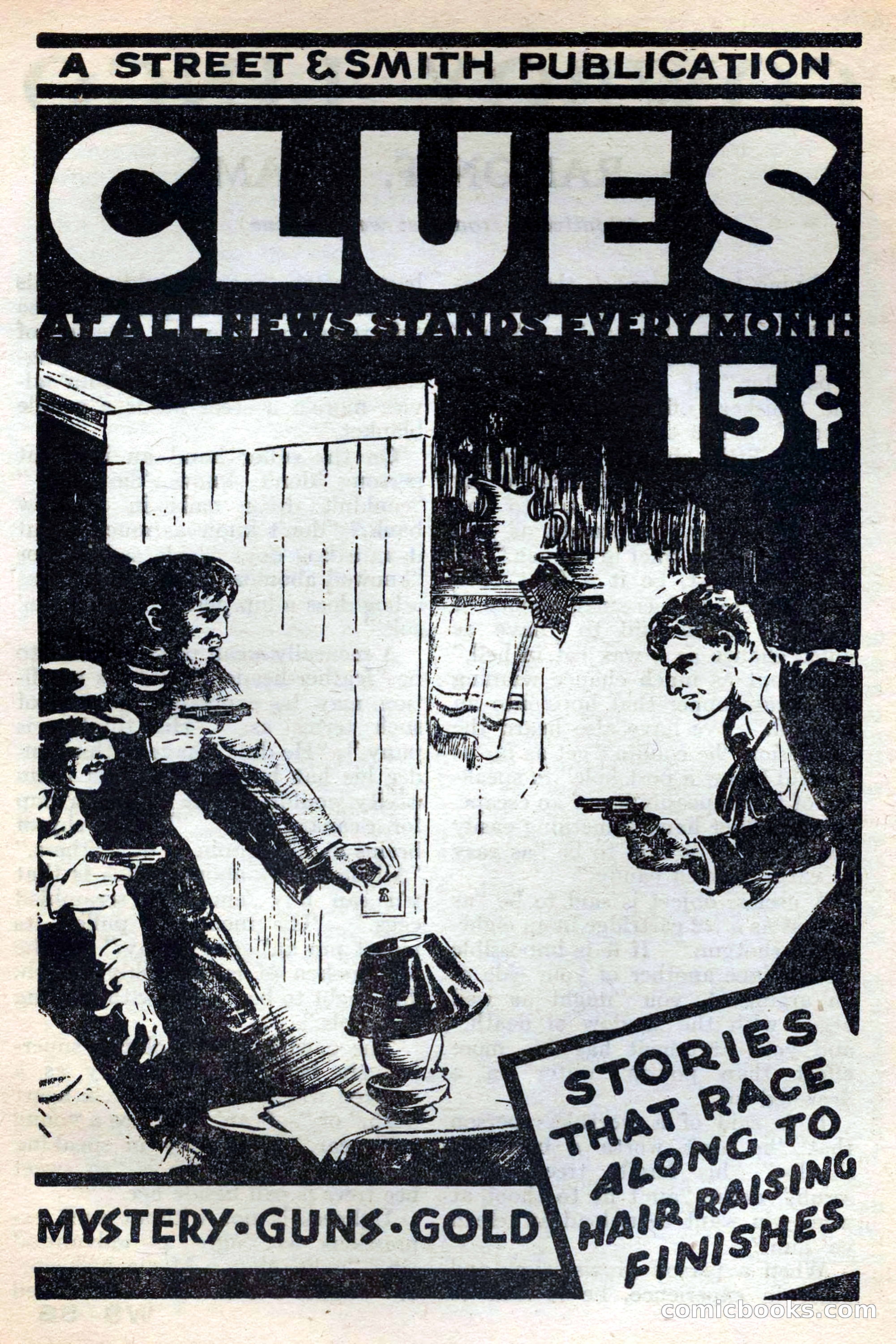
This is a cover for *Clues*, a Street & Smith pulp magazine priced at 15 cents, advertised as containing "Stories That Race Along to Hair Raising Finishes." The illustration depicts a dramatic scene featuring multiple figures in what appears to be an indoor setting, with at least one person holding a revolver. The cover emphasizes the magazine's focus on mystery, crime, and action ("Mystery, Guns, Gold"), suggesting hardboiled detective or crime fiction. The artwork is rendered in black ink with strong contrasts typical of pulp magazine cover design from the early twentieth century.
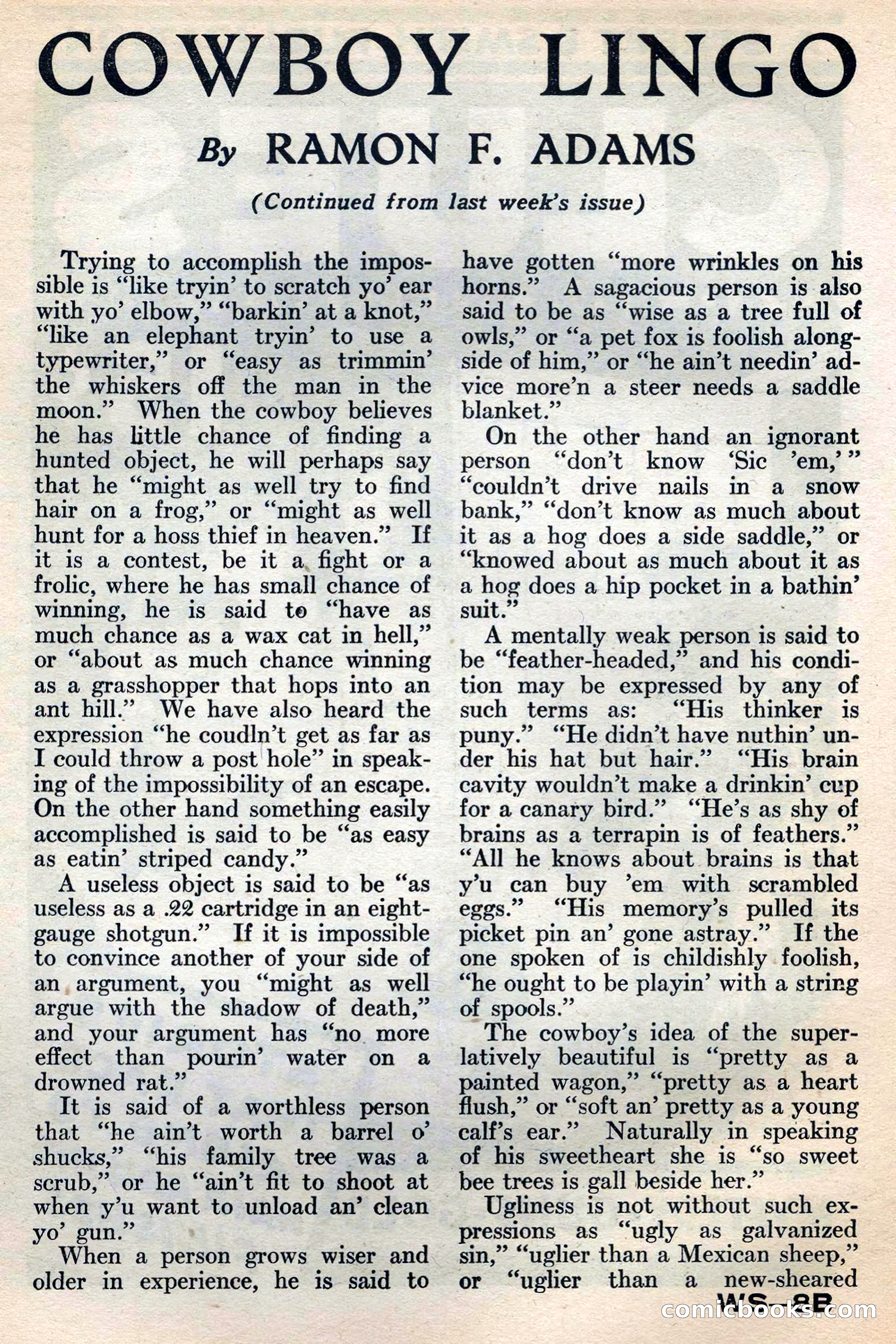
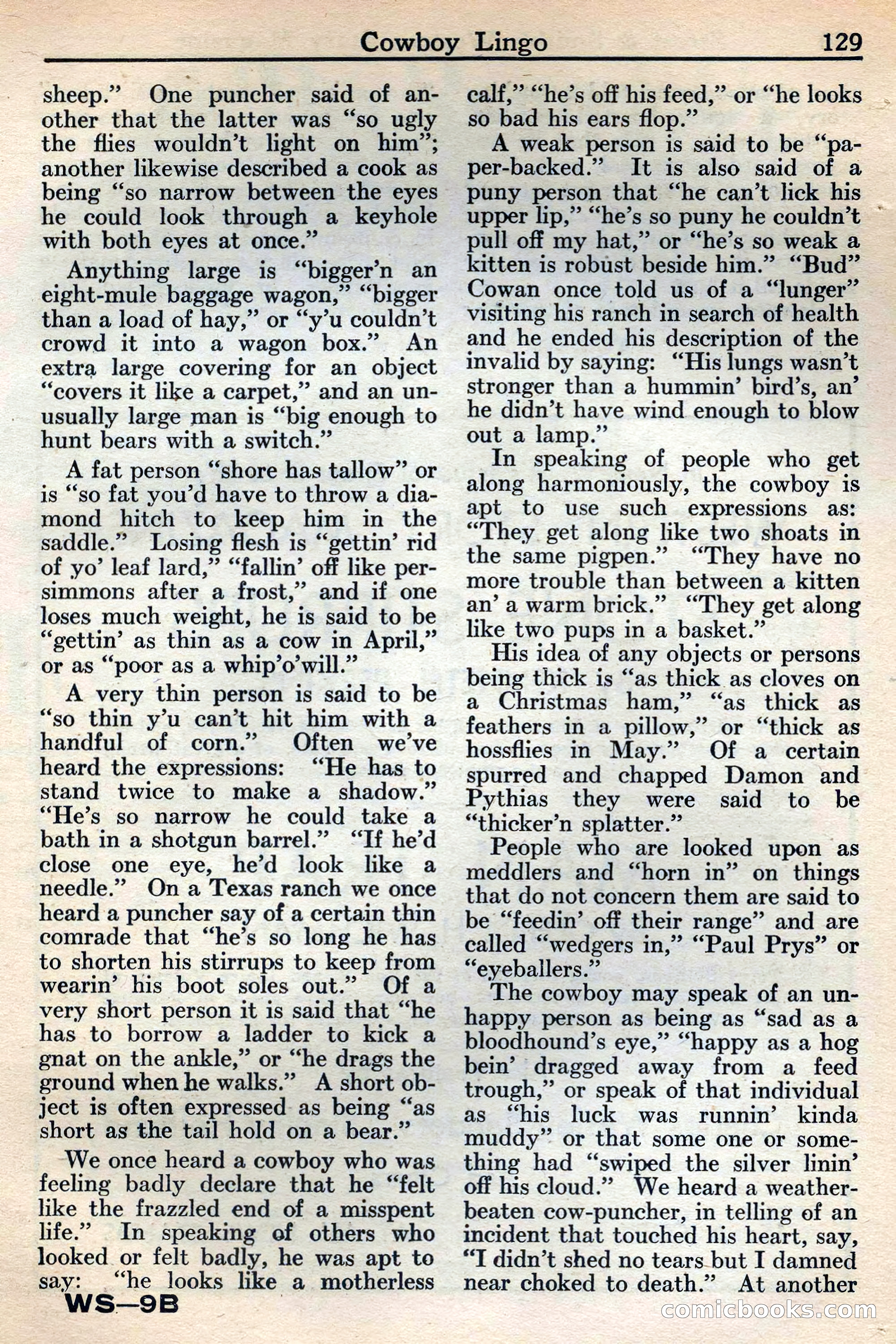
# Page Content Description This is story prose from a pulp magazine article titled "Cowboy Lingo" by Ramon F. Adams, continuing from a previous week's issue. The article is a linguistic study of colorful cowboy expressions and slang, organized by topic—describing impossible tasks, worthless people, mental weakness, and physical appearance. Adams catalogs vivid similes and metaphors used in cowboy vernacular, such as comparisons to frogs, wax cats, and terrapin birds. The text demonstrates the creative, humorous nature of frontier American dialect and speech patterns.
This page is prose text from an article titled "Cowboy Lingo." It presents a collection of colorful metaphorical expressions and descriptive phrases used by American cowboys and ranch workers in the early twentieth century, organized by category—covering physical descriptions of people (ugly, large, fat, thin, weak) and comparisons for harmony, thickness, meddling, and emotional states. The text consists entirely of quotations and examples of cowboy vernacular without narrative or plot.
# Page 130 of Street & Smith's Western Story Magazine This is an interior page containing the conclusion of an article about cowboy dialect and slang, followed by a full-page advertisement. The text above the advertisement discusses how slowness is expressed in Western vernacular—through phrases like "slow as a snail climbin' a slick log" and "lazy enough to make a good fiddler." Below is a promotional box advertising next week's issue, which will feature stories including "Stone Stirrups" by Kenneth Perkins (about Jim Bucknell and his daughter Maverick Jen) and "Man Trap" by Glenn H. Wichman (about sweethearts Terry Sullivan and Janice Volmer). The magazine cost 15¢.
This page from a pulp magazine features "The Round-Up," a readers' letters section. The visible content includes two reader submissions discussing Scout Dick Deering and his potential involvement with General Custer at the Battle of the Little Big Horn. The letters debate whether Deering served as a scout with the Seventh Cavalry and clarify historical details about the Custer Massacre, noting that Crow Indians served as scouts and that there were no survivors of the actual battle itself—only survivors from related expeditions under other commanders.
# Street & Smith's Western Story Magazine, Page 132 This page contains editorial prose from a pulp Western magazine. The editor responds to reader inquiries about General Custer's Last Stand, discussing what firearms Custer's troops carried (antique single-shot carbines versus the Indians' superior Winchester and Remington rifles), recommending books about the battle, and previewing upcoming serialized fiction. The editor also advertises the next issue's complete novel "Man Trap" by Glenn H. Wichman, along with several short stories and an article on Western slang terminology.
# What This Page Shows This is an advice column titled "Mines and Mining" by J. A. Thompson, appearing in Street & Smith's Western Story Magazine. The page presents a reader's inquiry from Walter J. Burden of Binghamton, New York, asking for information about gold prospecting near Elizabethtown in northern New Mexico, followed by Thompson's detailed response providing travel directions via Raton Pass and historical background on the area's gold discovery in 1866. The column solicits questions from readers interested in mining and prospecting.
# Page Description This is a prose page from *Street & Smith's Western Story Magazine* (page 134) featuring an informational article about gold placer mining in a specific region. The text discusses mining techniques, water availability, and gold-bearing creek locations, then pivots to answer reader questions about mining terminology and minerals—specifically explaining what cinnabar is and defining the term "shaft collar." The page includes a boxed notice directing readers interested in Maxwell Land Grant information to contact the magazine's Mines and Mining Department.
# The Hollow Tree — A Pen Pal Column This page shows the masthead and introductory text for "The Hollow Tree," a correspondence column conducted by Helen Rivers. The column facilitates letter exchanges between readers seeking friends and correspondents in different regions. Below the column guidelines appears the first reader letter, from a self-described "Cassiar Sourdough" with fifteen years of Alaskan experience, seeking four men aged forty-five to fifty-five to join him in prospecting for gold in the Cassiar and Stikine River country of British Columbia. The letter emphasizes the region's abundant wildlife and mineral resources.
# Page 136: Reader Correspondence Section This page is prose—specifically, a reader correspondence column titled "The Hollow Tree" from *Street & Smith's Western Story Magazine*. The section features letters from readers seeking companionship for various frontier pursuits: a prospector seeking partners for a two-year mining expedition in the Cassiar region; a rodeo enthusiast looking to connect with friends across America; a California woman sharing her childhood ranch experiences; a Scottish-Irish man seeking a homesteading partner in Washington or Oregon; and a Montana ranch woman seeking similar-minded correspondents. The magazine offers membership badges available for twenty-five cents.
# Page Analysis: "The Hollow Tree" — Personal Advertisements Section This is a text-only page from a pulp magazine's reader correspondence section titled "The Hollow Tree." The page contains personal letters to "Miss Rivers," a column editor, wherein readers seek pen pals, business partners, and photograph exchanges across America. The letters reveal early-20th-century pursuits: a tuberculosis patient seeking adventure work, a camera enthusiast wanting to trade travel photographs, a letter carrier seeking ranch partnership, and various individuals from western and southwestern states advertising for correspondence and companionship. The tone reflects genuine human connection-seeking typical of pre-digital era pulp magazines.
# Description This is an editorial advice column page from *Street & Smith's Western Story Magazine*. The page features a header illustration depicting two cowboys on horseback in a desert landscape, followed by the column title "WHERE TO GO and How to GET THERE" by John North. The text introduces the department's purpose: providing practical information about Western geography, ranches, mines, and travel directions. The visible article responds to a reader's inquiry about Washington's "Horse Heaven" country, explaining that this former grazing region has been developed into productive wheat-farming land with irrigation potential similar to the Yakima Valley.
# Page Analysis This is prose text from a "Where To Go and How To Get There" column (page 139) offering travel and settlement information to early-20th-century readers. The page discusses farming opportunities in the Pacific Northwest, particularly the Willamette Valley of Oregon and ranching regions of Montana. It includes a reader's letter from someone in Missouri inquiring about the Willamette Valley for back-to-farm settlement, and an editor's response describing the valley's climate, crops (fruits and vegetables), and agricultural potential. A "Special Notice" box advertises Montana ranches available through Street & Smith's *Western Story Magazine*.
# Page Analysis: Street & Smith's Western Story Magazine This page contains editorial prose and reader correspondence from a pulp magazine's advice column. The text discusses Oregon farm opportunities and responds to reader inquiries about visiting the Metolius River region in Oregon's Deschutes National Forest. The editor, John North, provides geographical details about the area's lakes, rivers, fishing opportunities, and camping facilities, while offering to send recipes for campfire dishes (beans-in-the-hole, sourdough bread, barbecue) and maps to interested readers. The page includes two boxed notices—one inviting readers to request farm-site recommendations and another advertising available recipes and regional information.
# "Guns and Gunners" Article Page This is an informational article page from a pulp magazine, authored by Lieutenant Charles E. Chapel of the U.S. Marine Corps. The visible text discusses European gun-manufacturing centers, focusing on Austrian firearms production in cities like Innsbruck, Ferlach, Steyr, and Vienna, and names notable gunmakers including Johann Springer. The page also includes a reader Q&A section addressing shotgun compensators. An illustration at the top shows three armed figures in Western attire. The page functions as an educational feature with reader correspondence, typical of early-20th-century pulp magazine departments.
# Page 142: Street & Smith's Western Story Magazine This page contains **prose text and reference material** — specifically, reader letters about firearms and ammunition, interspersed with anecdotes and advertisements. The visible content includes: technical discussion of shotgun design and .45 cartridge reloading; a brief crime statistic about Chicago police; an account of a Chattanooga tea room owner who shot an armed robber; advertisements for rifle sales and manufacturer booklets; and an "Arms Alphabet" providing definitions of firearms terminology (Hand Gun, Ignition, Jacket, Keyholing, etc.). The page is primarily instructional and promotional content aimed at gun enthusiasts and readers.
# What This Page Shows This page is a "Missing" department from Street & Smith's Western Story Magazine—a public-service column helping readers locate lost relatives and friends. The top section explains the department's purpose and submission guidelines, warning readers not to send money to unknown correspondents claiming to need travel funds. The bulk of the page consists of short notices describing missing persons, including their last known locations, physical descriptions, and contact information for those seeking them. The entries span from historical disappearances (like David Whipple, missing since 1864) to more recent cases from the 1930s, reflecting the magazine's role as a community resource for locating missing family members across America.
# Page Analysis This page from a pulp magazine's "Missing Department" (page 144) consists entirely of personal notices and advertisements seeking to locate missing or lost relatives and friends. The text contains dozens of short classified-style entries, each describing a missing person—typically including their name, last known location, physical description, and how to contact the person seeking them. These appear to be genuine public notices placed by readers rather than fictional content, representing early-20th-century attempts to reunite separated family members, likely due to migration, war, or estrangement. The notices span various American locations and reference dates ranging from the 1880s through 1930s.
This is a full-page advertisement from an early-to-mid twentieth century pulp magazine. The ad promotes "The Home Gym Co.'s" mail-order home exercise equipment system priced at $3.95, promising to build muscle throughout the body. It lists 23 purported features including various exercise apparatus parts, instructional guides on bodybuilding techniques, and notably a "150-Page Sex Book" offered free. The page includes photographs of muscular men demonstrating the equipment and flexing, along with an illustration of the apparatus itself. The copy emphasizes a no-money-down ordering scheme with a five-day examination period.
This is a **cigarette advertisement**, not a pulp fiction page. It features a stylized photograph of a woman smoking a "Lucky Strike" cigarette against a burgundy background. The visible text promotes "The Height of Good Taste," explaining that only the center leaves of tobacco plants are used—described as "the Mildest Leaves" and "The Cream of the Crop"—while top and bottom leaves are rejected for quality reasons. The ad employs marketing language typical of early-20th-century tobacco advertising, emphasizing product superiority through selective sourcing.