
Pulp Fiction, 1934 · page 58 of 147
Western Story Magazine, May 12, 1934 — page 58: what you’re looking at
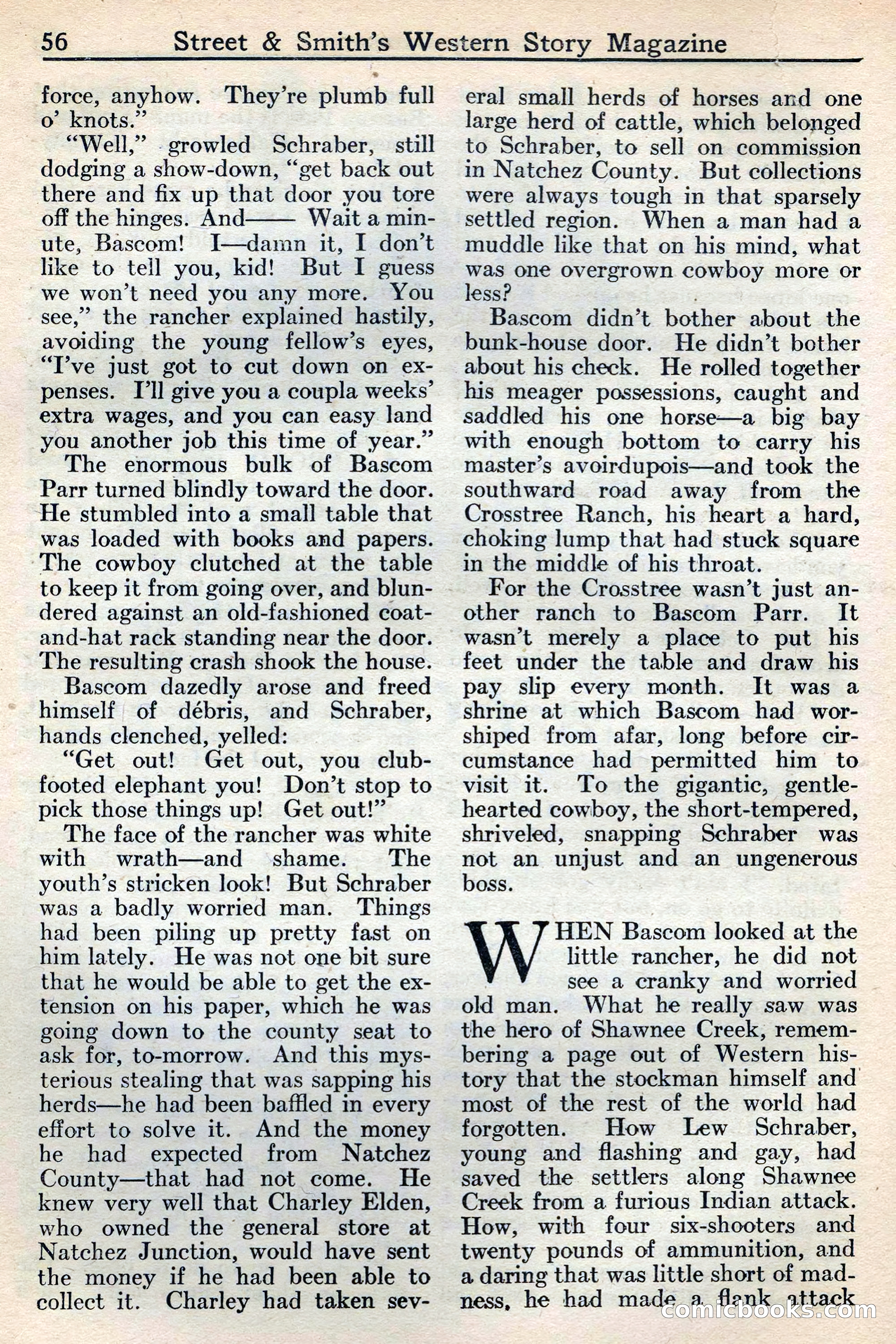
A restored page from Pulp Fiction, 1934. Page through the whole issue in the reader above.
📄 Transcribed text from this page (OCR, searchable)
Machine-transcribed from the original scan — historical spelling and the odd misread are preserved.
56 : Street & Smith’s force, anyhow. They’re plumb full o knots.” “Well,” -growled Schraber, still dodging a show-down, “get back out there and fix up that door you tore off the hinges. And Wait a min- ute, Bascom! JI—damn it, I don’t like to tell you, kid! But I guess we won’t need you any more. You see,” the rancher explained hastily, avoiding the young fellow’s eyes, “Pve just got to cut down on ex- penses. I'll give you a coupla weeks’ extra wages, and you can easy land you another job this time of year.” The enormous bulk of Bascom Parr turned blindly toward the door. He stumbled into a small table that was loaded with books and papers. ‘The cowboy clutched at the table to keep it from going over, and blun- dered against an old-fashioned coat- and-hat rack standing near the door. The resulting crash shook the house. Bascom dazedly arose and freed himself of débris, and Schraber, hands clenched, yelled: “Get out! Get out, you club- footed elephant you! Don’t stop to pick those things up! Get out!” The face of the rancher was white with wrath—and shame. The youth’s stricken look! But Schraber was a badly worried man. Things had been piling up pretty fast on him lately. He was not one bit sure that he would be able to get the ex- tension on his paper, which he was going down to the county seat to ask for, to-morrow. And this mys- terious stealing that was sapping his herds—he had been baffled in every effort to solve it. And the money he had expected from Natchez County—that had not come. He knew very well that Charley Elden, who owned the general store at Natchez Junction, would have sent the money if he had been able to collect it. Charley had taken sev- Western Story Magazine eral small herds of horses and one large herd of cattle, which belonged to Schraber, to sell on commission in Natchez County. But collections were always tough in that sparsely settled region. When a man had a muddle fies that on his mind, what was one overgrown cowboy more or less? Bascom didn’t bother about the bunk-house door. He didn’t bother about his check. He rolled together his meager possessions, caught and saddled his one horse—a big bay with enough bottom to carry his master’s avoirdupois—and took the southward road away from _ the Crosstree Ranch, his heart a hard, choking lump that had stuck square in the middle of his throat. For the Crosstree wasn’t just an- other ranch to Bascom Parr. It wasn't merely a place to put his feet under the table and draw his pay slip every month. It was a shrine at which Bascom had wor- shiped from afar, long before cir- cumstance had permitted him to visit it. To the gigantic, gentle- hearted cowboy, the short-tempered, shriveled, snapping Schraber was not an unjust and an ungenerous boss. HEN Bascom looked at the little rancher, he did not see a cranky and worried old man. What he really saw was the hero of Shawnee Creek, remem- bering a page out of Western his- tory that the stockman himself and most of the rest of the world had forgotten. How Lew _ Schraber, young and flashing and gay, had saved the settlers along Shawnee Creek from a furious Indian attack. How, with four six-shooters and twenty pounds of ammunition, and a daring that was little short of mad- ness, he had made A. JOOK ack. ~