
Pulp Fiction, 1934 · page 121 of 147
Western Story Magazine, May 12, 1934 — page 121: what you’re looking at
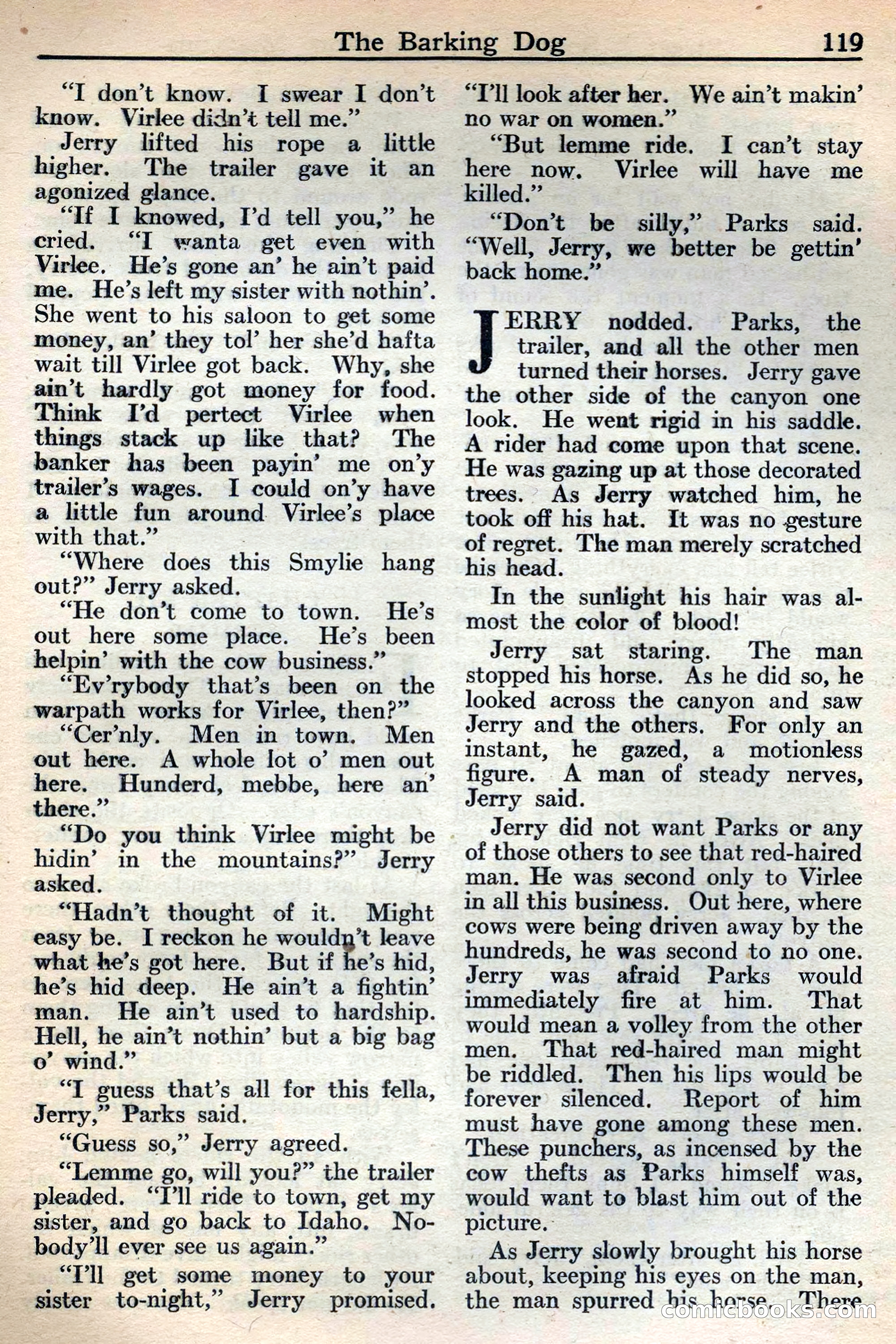
A restored page from Pulp Fiction, 1934. Page through the whole issue in the reader above.
📄 Transcribed text from this page (OCR, searchable)
Machine-transcribed from the original scan — historical spelling and the odd misread are preserved.
The Barking Dog “T don’t know. I swear I don’t know. Virlee didn’t tell me.” Jerry lifted his rope a little higher. The trailer gave it an agonized glance. “If I knowed, Id tell you,” he cried. “I wanta get even with Virlee. He’s gone an’ he ain’t paid me. He’s left my sister with nothin’. She went to his saloon to get some money, an’ they tol’ her she’d hafta wait till Virlee got back. Why, she ain’t hardly got money for food. Think I’d_ pertect Virlee when things stack up like that? The banker has been payin’ me on’y trailer’s wages. I could on’y have a little fun around. Virlee’s place with that.” 7 “Where does this Smylie hang out?” Jerry asked. “He don’t come to town. He’s out here some place. He’s been helpin’ with the cow business.” “Ev rybody that’s been on the warpath works for Virlee, then?” “Cernly. Men in town. Men out here. A whole lot o’ men out here. Hunderd, mebbe, here an’ there.” “Do you think Virlee might be | hidin’ in the mountains?” Jerry asked. *“Hadn’t thought of it. Might easy be. I reckon he wouldn’t leave what he’s got here. But if he’s hid, he’s hid deep. He ain’t a fightin’ man. He ain’t used to hardship. Hell, he ain’t nothin’ but a big bag o’ wind.” “1 guess that’s all for this fella, Jerry,’ Parks said. “Guess so,” Jerry agreed. “Lemme go, will you?” the trailer pleaded. “T’ll ride to town, get my sister, and go back to Idaho. No- body’ll ever see us again.” “Tl get some money to your sister to-night,’ Jerry promised. 119 “Tl look after her. no war on women.” “But lemme ride. here now. We ain’t makin’ I can’t stay Virlee will have me killed.” “Don’t be silly,’ Parks said. “Well, Jerry, we better be gettin’ back home.” ERRY nodded. Parks, the trailer, and all the other men turned their horses. Jerry gave the other side of the canyon one look. He went rigid in his saddle. A rider had come upon that scene. — He was gazing up at those decorated trees. As Jerry watched him, he took off his hat. It was no gesture of regret. The man merely scratched his head. In the sunlight his hair was al- most the color of blood! Jerry sat staring. The man stopped his horse. As he did so, he looked across the canyon and saw Jerry and the others. For only an instant, he gazed, a motionless figure. A man of steady nerves, Jerry said. Jerry did not want Parks or any of those others to see that red-haired man. He was second only to Virlee in all this business. Out here, where cows were being driven away by the hundreds, he was second to no one. Jerry was afraid Parks would immediately fire at him. That would mean a volley from the other men. That red-haired man might be riddled. Then his lips would be forever silenced. Report of him must have gone among these men. These punchers, as incensed by the cow thefts as Parks himself was, would want to blast him out of the picture. As Jerry slowly brought his horse about, keeping his eyes on the man, the man spurred big hearse... Phere.