
Pulp Fiction, 1934 · page 113 of 147
Western Story Magazine, May 12, 1934 — page 113: what you’re looking at
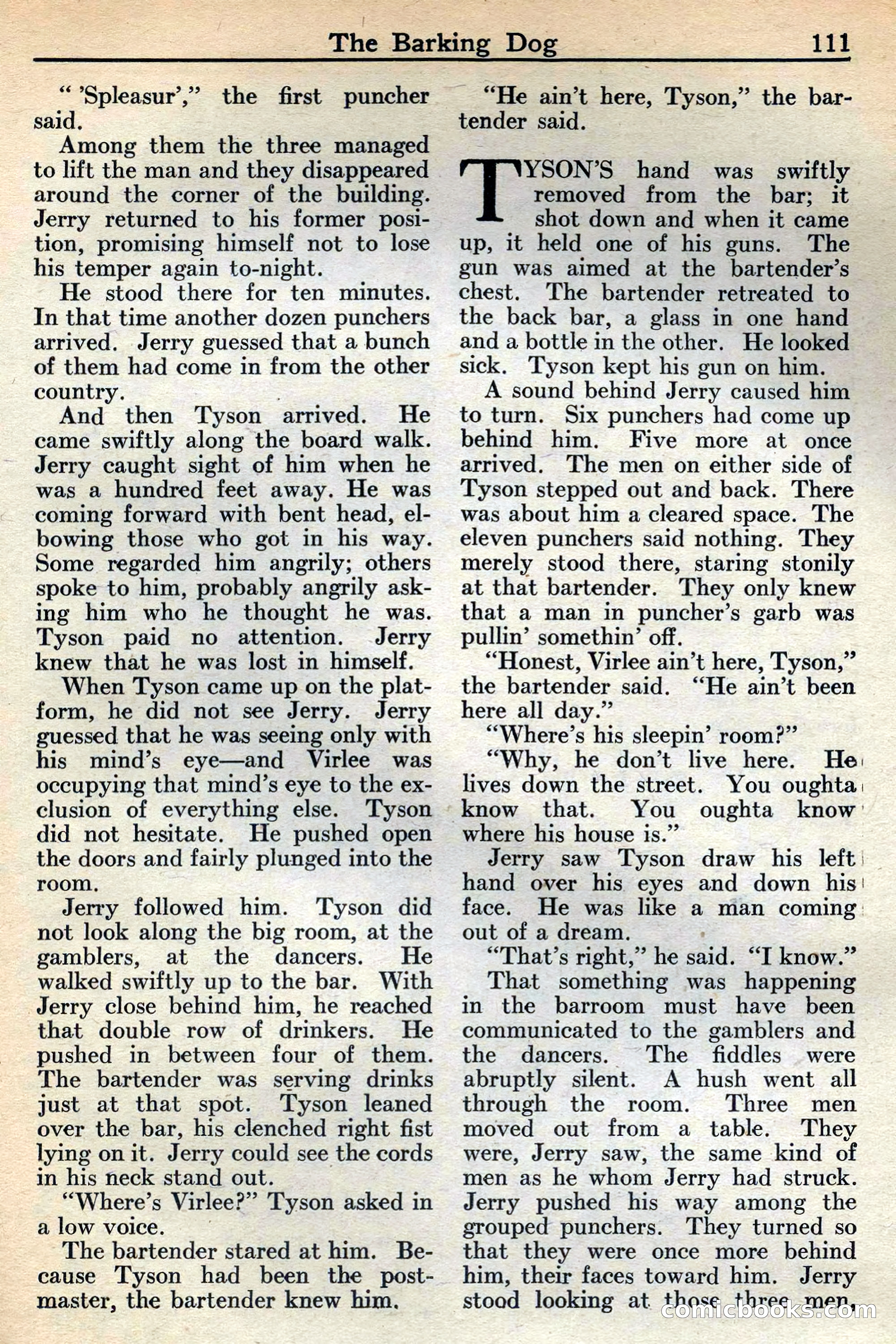
A restored page from Pulp Fiction, 1934. Page through the whole issue in the reader above.
📄 Transcribed text from this page (OCR, searchable)
Machine-transcribed from the original scan — historical spelling and the odd misread are preserved.
The Barking Dog — 111 “’Spleasur’,” the first puncher said. Among them the three managed to lift the man and they disappeared around the corner of the building. Jerry returned to his former posi- tion, promising himself not to lose his temper again to-night. He stood there for ten minutes. In that time another dozen punchers arrived. Jerry guessed that a bunch of them had come in from the other country. And then Tyson arrived. He came swiftly along the board walk. Jerry caught sight of him when he was a hundred feet away. He was coming forward with bent head, el- bowing those who got in his way. Some regarded him angrily; others spoke to him, probably angrily ask- ing him who he thought he was. Tyson paid no attention. Jerry knew that he was lost in himself. When Tyson came up on the plat- form, he did not see Jerry. Jerry guessed that he was seeing only with his mind’s eye—and Virlee was occupying that mind’s eye to the ex- clusion of everything else. Tyson did not hesitate. He pushed open the doors and fairly plunged into the room, Jerry followed him. Tyson did not look along the big room, at the gamblers, at the dancers. He walked swiftly up to the bar. With Jerry close behind him, he reached that double row of drinkers. He pushed in between four of them. The bartender was serving drinks just at that spot. Tyson leaned over the bar, his clenched right fist lying on it. Jerry could see the cords in his neck stand out. “Where’s Virlee?” Tyson asked in alow voice. — The bartender stared at him. Be- cause Tyson had been the post- master, the bartender knew him. _ “He ain’t here, Tyson,” the bar- tender said. YSON’S hand was _ swiftly removed from the bar; it shot down and when it came up, it held one of his guns. The gun was aimed at the bartender’s chest. The bartender retreated to the back bar, a glass in one hand and a bottle in the other. He looked sick. Tyson kept his gun on him. A sound behind Jerry caused him to turn. Six punchers had come up behind him. Five more at once arrived. The men on either side of Tyson stepped out and back. There was about him a cleared space. The eleven punchers said nothing. They merely stood there, staring stonily at that bartender. They only knew that a man in puncher’s garb was pullin’ somethin’ off. “Honest, Virlee ain’t here, Tyson,” the bartender said. “He ain’t been here all day.” ““Where’s his sleepin’ room?” “Why, he don’t live here. lives down the street. You oughta. know that. You oughta es where his house is.’ Jerry saw Tyson draw his left, hand over his eyes and down his: face. He was like a man coming: out of a dream. “That’s right,” he Sid: “T know.” That something was happening in the barroom must have been communicated to the gamblers and the dancers. The fiddles were abruptly silent. A hush went all through the room. Three men moved out from a table. They were, Jerry saw, the same kind of men as he whom Jerry had struck. Jerry pushed his way among the grouped punchers. They turned so that they were once more behind him, their faces toward him. Jerry stood looking at those three men, He: