
Pulp Fiction, 1934 · page 140 of 147
Western Story Magazine, May 12, 1934 — page 140: what you’re looking at
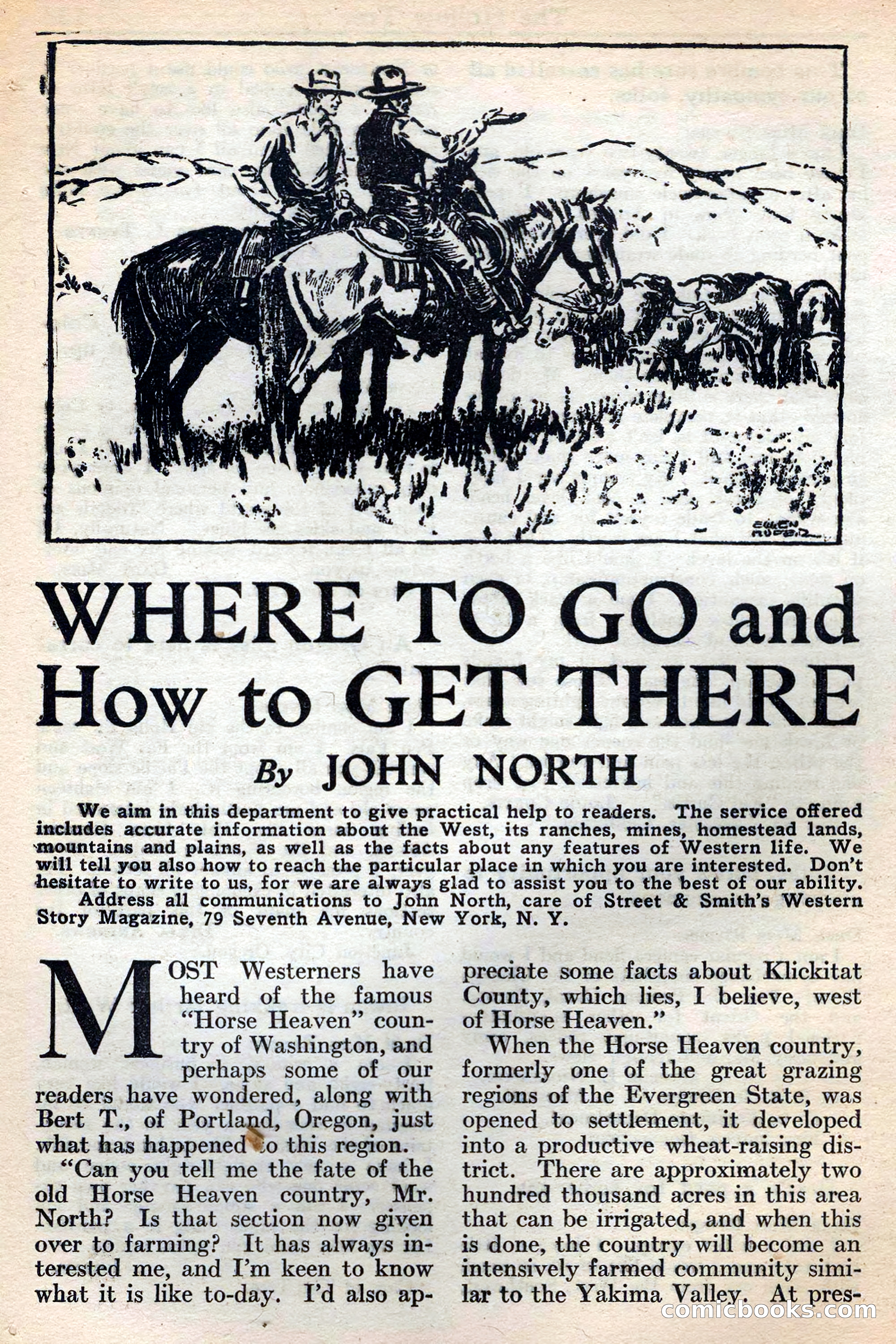
A restored page from Pulp Fiction, 1934. Page through the whole issue in the reader above.
📄 Transcribed text from this page (OCR, searchable)
Machine-transcribed from the original scan — historical spelling and the odd misread are preserved.
WHERE TO GO and How to GET THERE By JOHN NORTH We aim in this department to give practical help to readers. The service offered includes accurate information about the West, its ranches, mines, homestead lands, ‘mountains and plains, as well as the facts about any features of Western life. We will tell you also how to reach the particular place in which you are interested. Don’t hesitate to write to us, for we are always glad to assist you to the best of our ability. Address all communications to John North, care of Street & Smith’s Western Story Magazine, 79 Seventh Avenue, New York, N. Y. OST Westerners have heard of the famous “Horse Heaven” coun- try of Washington, and perhaps some of our readers have wondered, along with Bert T., of Portland, Oregon, just what has bippeasals this region. “Can you tell me the fate of the old Horse Heaven country, Mr. North? Is that section now given over to farming? It has always in- terested me, and I’m keen to know what it is like to-day. Id also ap- ? preciate some facts about Klickitat County, which lies, I believe, west of Horse Heaven.” When the Horse Heaven country, formerly one of the great grazing regions of the Evergreen State, was . opened to settlement, it developed into a productive wheat-raising dis- trict. There are approximately two hundred thousand acres in this area that can be irrigated, and when this is done, the country will become an intensively farmed community simi- ki ley. es- lar to the Ya ma Valle + At pre ae