
Pulp Fiction, 1934 · page 130 of 147
Western Story Magazine, May 12, 1934 — page 130: what you’re looking at
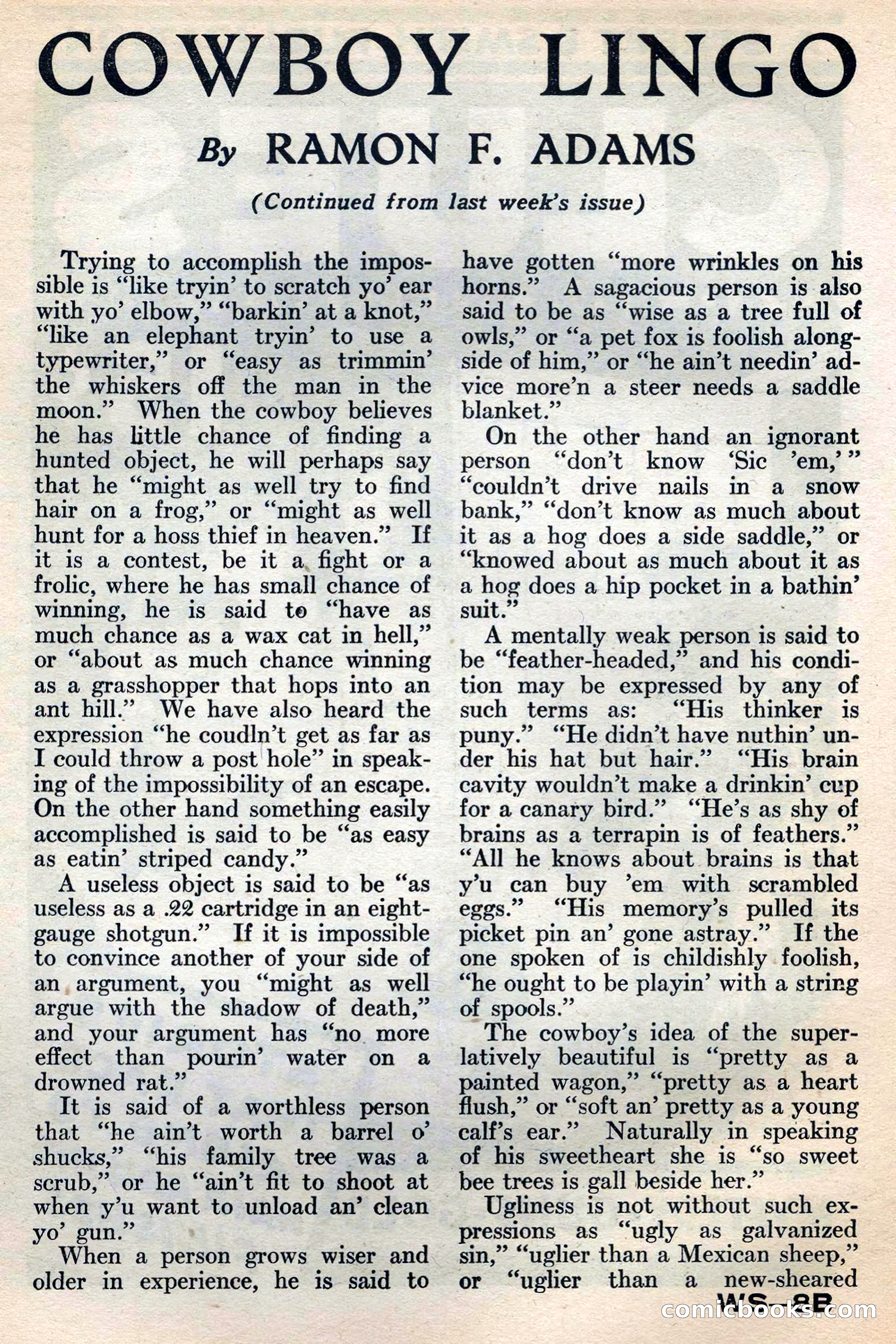
A restored page from Pulp Fiction, 1934. Page through the whole issue in the reader above.
📄 Transcribed text from this page (OCR, searchable)
Machine-transcribed from the original scan — historical spelling and the odd misread are preserved.
COWBOY LINGO By RAMON F. ADAMS (Continued from last week’s issue ) Trying to accomplish the impos- sible is “like tryin’ to scratch yo’ ear with yo’ elbow,” “barkin’ at a knot,” “like an elephant tryin’ to use a typewriter,” or “easy as trimmin’ the whiskers off the man in the moon.” When the cowboy believes he has little chance of finding a hunted object, he will perhaps say that he “might as well try to find hair on a frog,” or “might as well hunt for a hoss thief in heaven.” If it is a contest, be it a, fight or a frolic, where he has small chance of winning, he is said te “have as much chance as a wax cat in hell,” or “about as much chance winning as a grasshopper that hops into an ant hill.” We have also heard the expression “he coudln’t get as far as I could throw a post hole” in speak- ing of the impossibility of an escape. On the other hand something easily accomplished is said to be “‘as easy as eatin’ striped candy.” A useless object is said to be “as useless as a .22 cartridge in an eight- gauge shotgun.” If it is impossible to convince another of your side of an. argument, you “might as well argue with the shadow of death,” and your argument has “no more effect than pourin’ water on a drowned rat.” It is said of a worthless person that “he ain’t worth a barrel o shucks,” “his family tree was a scrub,” or he “ain’t fit to shoot at when y’u want to unload an’ clean — yo gun.” When a person grows wiser and older in experience, he is said to have gotten “more wrinkles on his horns.” A sagacious person is also said to be as “wise as a tree full of owls,” or “‘a pet fox is foolish along- side of him,” or “he ain’t needin’ ad- vice more’n a steer needs a saddle blanket.” On the other hand person “don’t know ‘Sic ’em, ” “couldn’t drive nails in a snow bank,” “don’t know as much about it as a hog does a side saddle,” or “knowed about as much about it as a hog does a hip pocket in a bathin’ suit.” A mentally weak person is said to be “feather-headed,” and his condi- tion may be expressed by any of - such terms as: “His thinker is puny.” “He didn’t have nuthin’ un- der his hat but hair.” “His brain cavity wouldn’t make a drinkin’ cup for a canary bird.” ‘“He’s as shy of brains as a terrapin is of feathers.” “All he knows about brains is that yu can buy ’em with scrambled eggs.” “His memory’s pulled its picket pin an’ gone astray.” If the one spoken of is childishly foolish, “he ought to be playin’ with a string of spools.” The cowboy’s idea of the super- latively beautiful is “pretty as a painted wagon,” “pretty as a heart flush,” or “soft an’ pretty as a young ealf’s ear.” Naturally in speaking an ignorant of his sweetheart she is “so sweet bee trees is gall beside her.” Ugliness is not without such ex- pressions as “ugly as galvanized sin,” “uglier than a Mexican sheep,” or “uglier than a new-sheared Comicbooks..com