
Pulp Fiction, 1934 · page 127 of 147
Western Story Magazine, May 12, 1934 — page 127: what you’re looking at
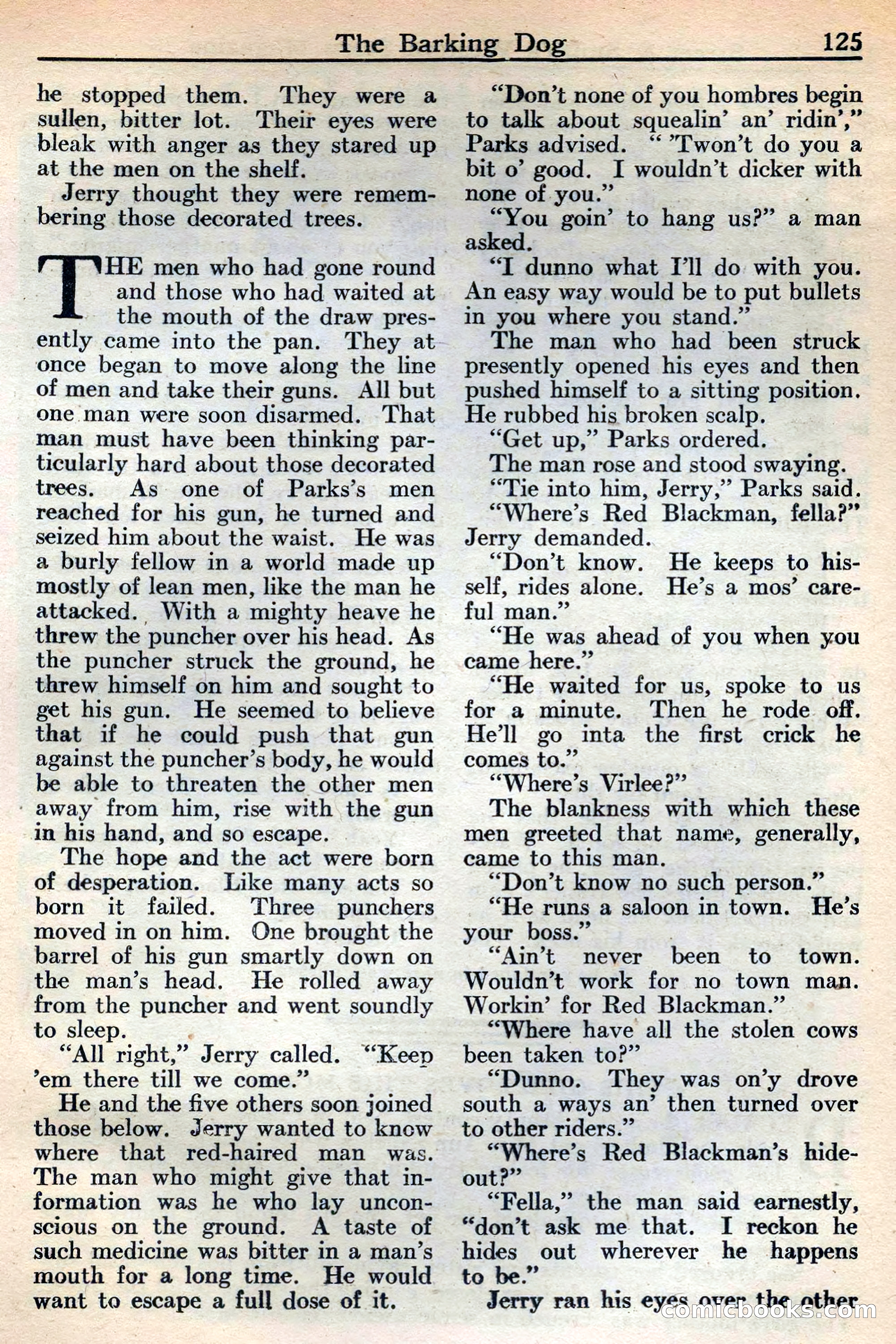
A restored page from Pulp Fiction, 1934. Page through the whole issue in the reader above.
📄 Transcribed text from this page (OCR, searchable)
Machine-transcribed from the original scan — historical spelling and the odd misread are preserved.
The inne Dog he stopped them. They were a sullen, bitter lot. Their eyes were bleak with anger as they stared up at the men on the shelf. Jerry thought they were remem- : bering. those decorated trees. HE men who had gone round and those who had waited at the mouth of the draw pres- ently came into the pan. They at once began to move along the line of men and take their guns. All but one man were soon disarmed. That man must have been thinking par- ticularly hard about those decorated trees. As. one of Parks’s men reached for his gun, he turned and seized him about the waist. He was a burly fellow in a world made up mostly of lean men, like the man he attacked. With a mighty heave he threw the puncher over his head. As the puncher struck the ground, he threw himself on him and sought to get his gun. He seemed to believe that if he could push that gun against the puncher’s body, he would he able to threaten the other men ‘away from him, rise with the gun in his hand, and so escape. The hope and the act were born of desperation. Like many acts so born it failed. Three punchers moved in on him. One brought the barrel of his gun smartly down on the man’s head. He rolled away from the puncher and went soundly to sleep. “All right, 2 Jerry called. em paore till we come.’ He and the five others soon joined those below. Jerry wanted to know where that red-haired man was. _ The man who might give that in- formation was he who lay uncon- scious on the ground. A taste of such medicine was bitter in a man’s mouth for a long time. He would want to escape a full dose of it. “Keep 125 “Don’t none of you hombres begin to talk about squealin’ an’ ridin’,” Parks advised. “ ”I['won’t do you a bit o’ good. J wouldn’t dicker with none of you.’ “You goin’ to hang us?” a man “T dunno what I'll do with you. An easy way would be to put bullets in you where you stand.” The man who had been struck presently opened his eyes and then pushed himself to a sitting position. He rubbed his broken scalp. “Get up,” Parks ordered. The man rose and stood swaying. “Tie into him, Jerry,” Parks said. “Where’s Red Blackman, fella?” Jerry demanded. “Don’t know. He keeps to his- self, rides alone. He’s a mos’ care- ful man.” “He was ahead of you when you came here.” “He waited for us, spoke to us for a minute. Then he rode. off. He'll go inta the first crick he comes to.” ““Where’s Virlee?” The blankness with which these men greeted that name, generally, came to this man. “Don’t know no such person.” “He runs a saloon in town. He’s your boss.” : 3 “Ain’t never been to town. Wouldn’t work for no town man. Workin’ for Red Blackman.” “‘Where have all the stolen cows been taken to?” “Dunno. They was on’y drove south a ways an’ then turned over to other riders.” “Where’s Red Blackman’s hide- out?” : “Fella,” the man said earnestly, “don’t ask me that. I reckon he hides out wherever he happens to be.” Jerry ran his eyes over, the ather..