
Pulp Fiction, 1934 · page 136 of 147
Western Story Magazine, May 12, 1934 — page 136: what you’re looking at
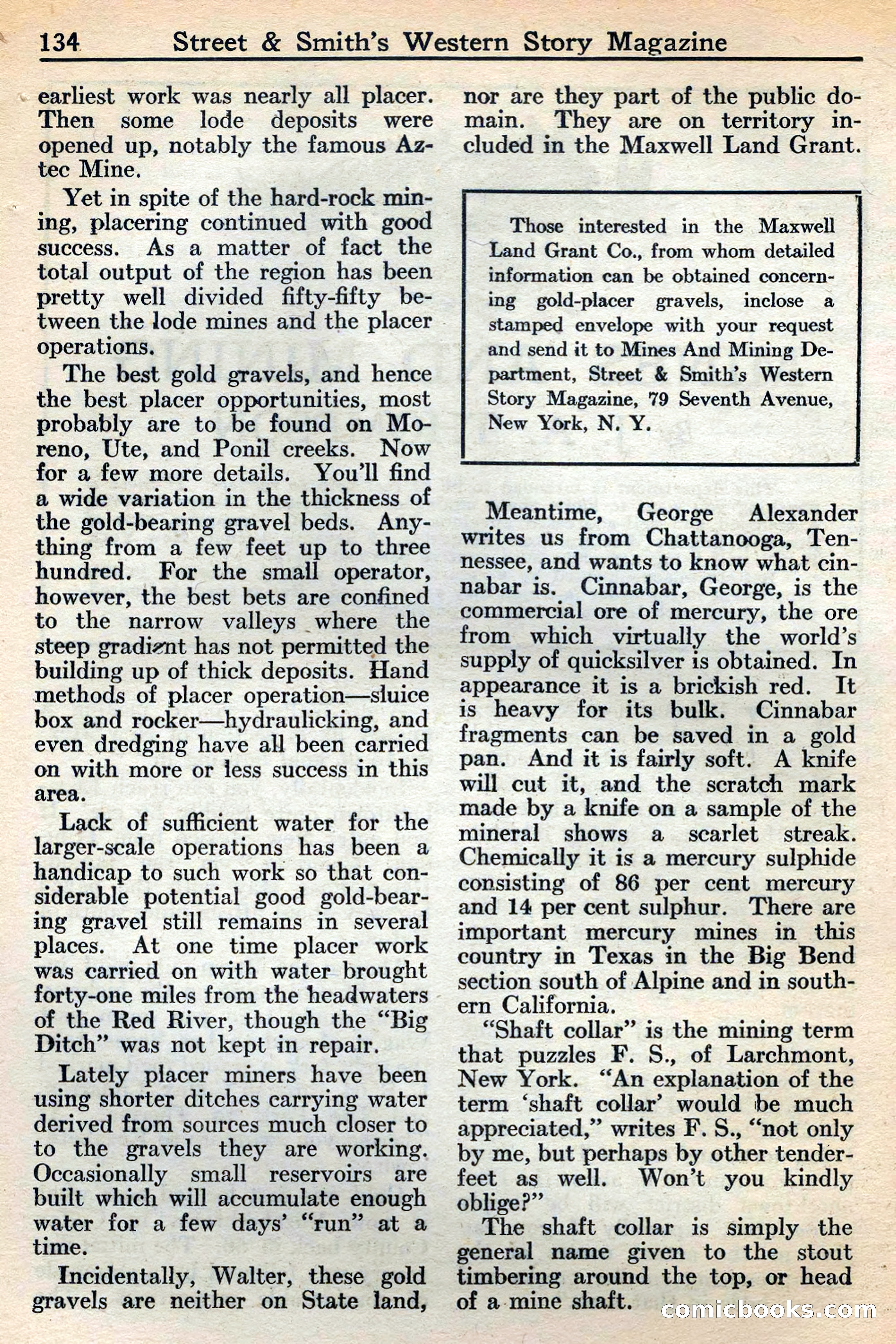
A restored page from Pulp Fiction, 1934. Page through the whole issue in the reader above.
📄 Transcribed text from this page (OCR, searchable)
Machine-transcribed from the original scan — historical spelling and the odd misread are preserved.
134 Street & Smith’s . earliest work was nearly all placer. Then some lode deposits were opened up, notably the famous Az- tec Mine. Yet in spite of the hard-rock min- ing, placering continued with good success. As a matter of fact the total output of the region has been pretty well divided fifty-fifty be- tween the lode mines and the placer . operations. The best gold gravels, and hence the best placer opportunities, most probably are to be found on Mo- reno, Ute, and Ponil creeks. Now for a few more details. You'll find a wide variation in the thickness of the gold-bearing gravel beds. Any- thing from a few feet up to three hundred. For the small operator, however, the best bets are confined to the narrow valleys where the steep gradiznt has not permitted the building up of thick deposits. Hand methods of placer operation—sluice box and rocker—hydraulicking, and even dredging have all been carried on with more or less success in this area. Lack of sufficient water for the larger-scale operations has been a handicap to such work so that con- siderable potential good gold-bear- ing gravel still remains in several places. At one time placer work was carried on with water brought forty-one miles from the headwaters of the Red River, though the “Big Ditch” was not kept in repair. Lately placer miners have been using shorter ditches carrying water derived from sources much closer to to the gravels they are working. Occasionally small reservoirs are built which will accumulate enough water for a few days’ “run” at a time. Incidentally, Walter, these gold gravels are neither on State land, Western Story Magazine nor are they part of the public do- main. They are on territory in- cluded in the Maxwell Land Grant. Those interested in the Maxwell Land Grant Co., from whom detailed information can be obtained concern- ing gold-placer gravels, inclose a stamped envelope with your request and send it to Mines And Mining De- partment, Street & Smith’s Western Story Magazine, 79 Seventh Avenue, New York, N. Y. Meantime, George Alexander writes us from Chattanooga, Ten- nessee, and wants to know what cin- nabar is. Cinnabar, George, is the commercial ore of mercury, the ore from which virtually the world’s supply of quicksilver is obtained. In appearance it is a brickish red. It is heavy for its bulk. Cinnabar fragments can be saved in a gold pan. And it is fairly soft. A knife will cut it, and the scratch mark made by a knife on a sample of the mineral shows a scarlet streak. Chemically it is a mercury sulphide consisting of 86 per cent mercury and 14 per cent sulphur. There are important mercury mines in this country in Texas in the Big Bend section south of Alpine and in south- ern California. “Shaft collar” is the mining term that puzzles F. S., of Larchmont, New York. “An explanation of the term ‘shaft collar’ would be much appreciated,” writes F. S., “not only by me, but perhaps by other tender- feet as well. Won’t you kindly oblige?” The shaft collar is simply the general name given to the stout timbering around the top, or head of a-mine shaft. comicboolciconit