
Pulp Fiction, 1934 · page 101 of 147
Western Story Magazine, May 12, 1934 — page 101: what you’re looking at
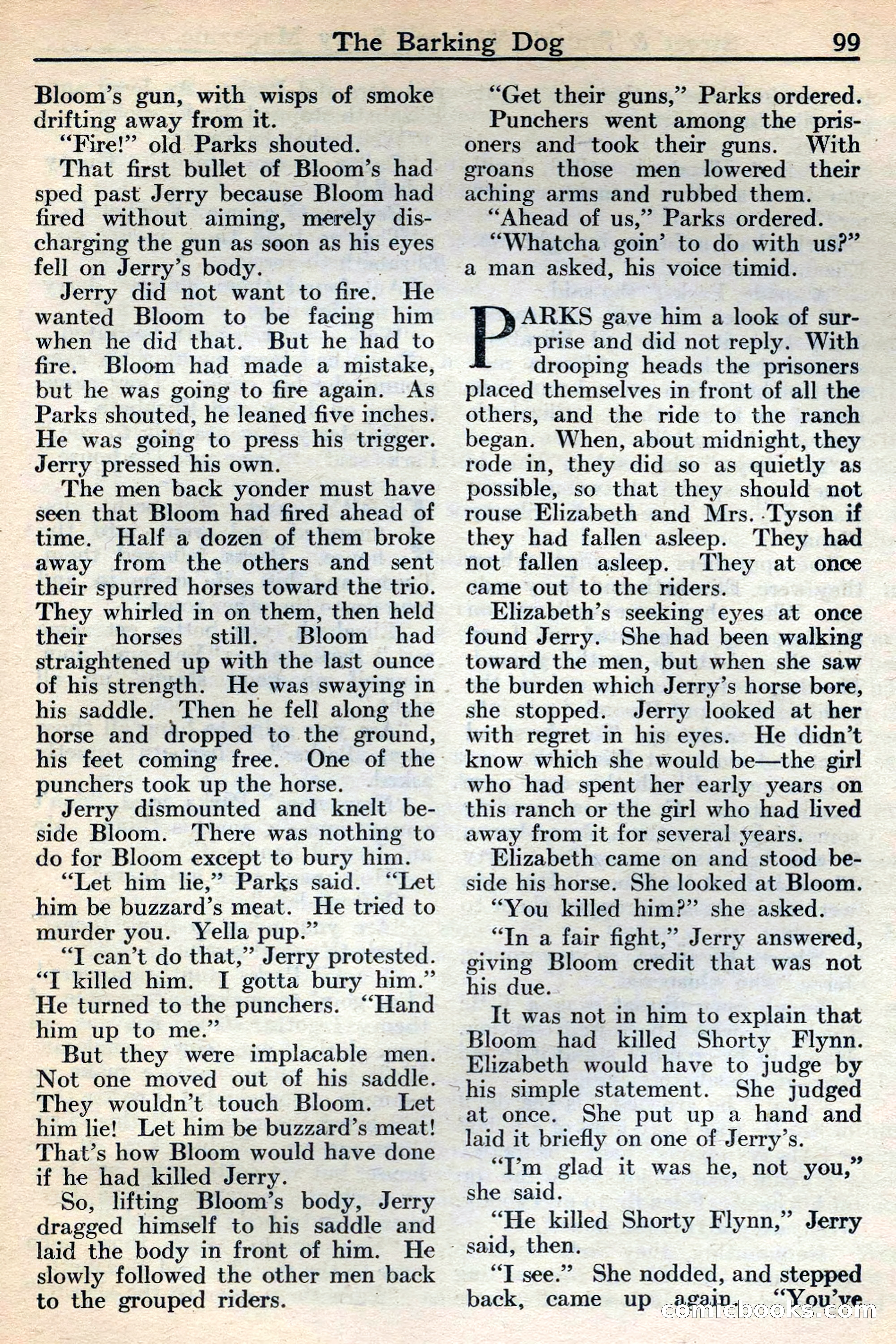
A restored page from Pulp Fiction, 1934. Page through the whole issue in the reader above.
📄 Transcribed text from this page (OCR, searchable)
Machine-transcribed from the original scan — historical spelling and the odd misread are preserved.
The Barking Dog 99 Bloom’s gun, with wisps of smoke drifting away from it. “Fire!” old Parks shouted. That first bullet of Bloom’s had sped past Jerry because Bloom had fired without aiming, merely dis- charging the gun as soon as his eyes fell on Jerry’s body. Jerry did not want to fire. He wanted Bloom to be facing him when he did that. But he had to fire. Bloom had made a mistake, but he was going to fire again. As Parks shouted, he leaned five inches. He was going to press his trigger. Jerry pressed his own. The men back yonder must have seen that Bloom had fired ahead of time. Half a dozen of them broke away from the others and sent their spurred horses toward the trio. _ They whirled in on them, then held their horses still. Bloom had straightened up with the last ounce of his strength. He was swaying in his saddle. Then he fell along the horse and dropped to the ground, his feet coming free. One of the punchers took up the horse. Jerry dismounted and knelt be- side Bloom. ‘There was nothing to do for Bloom except to bury him. “Let him lhe,” Parks said. “Let him be buzzard’s meat. He tried to murder you. Yella pup.” “T can’t do that,” Jerry protested. “T killed him. I gotta bury him.” He turned to the punchers. “‘Hand him up to me.” But they were implacable men. Not one moved out of his saddle. They wouldn’t touch Bloom. Let him lie! Let him be buzzard’s meat! That’s how Bloom would have done if he had killed Jerry. So, lifting Bloom’s body, Jerry dragged himself to his saddle and laid the body in front of him. He slowly followed the other men back to the grouped riders. “Get their guns,” Parks ordered. Punchers went among the pris- oners and took their guns. With — groans those men lowered their aching arms and rubbed them. “Ahead of us,” Parks ordered. “Whatcha goin’ to do with us?” a man asked, his voice timid. ARKS gave him a look of sur- prise and did not reply. With drooping heads the prisoners placed themselves in front of all the others, and the ride to the ranch began. When, about midnight, they rode in, they did so as quietly as possible, so that they should not rouse Elizabeth and Mrs. -Tyson if they had fallen asleep. They had not fallen asleep. They at once came out to the riders. Elizabeth’s seeking eyes at once found Jerry. She had been walking toward the men, but when she saw the burden which Jerry’s horse bore, she stopped. Jerry looked at her with regret in his eyes. He didn’t know which she would be—the girl who had spent her early years on this ranch or the girl who had lived away from it for several years. Elizabeth came on and stood be- side his horse. She looked at Bloom. “You killed him?” she asked. “In a fair fight,” Jerry answered, giving Bloom credit that was not his due. It was not in him to explain that Bloom had killed Shorty Flynn. Elizabeth would have to judge by his simple statement. She judged at once. She put up a hand and laid it briefly on one of Jerry’s. “I’m glad it was he, not you,” she said. “He killed Shorty Flynn, ” Jerry - said, then. “T see.” She nodded, and Stepped back, “cane UP AfieDooersenn